Sabbatical, Day 77: Of Sausages And Crosses

Today, I’d like to apologise to the entire German nation. Every single one of you. By common consent, you make the finest sausages in the known universe. And I’m sure you agree.

But my kids don’t. They think I’m a liar when I tell them that German sausages are the best, and that nothing beats a bratwurst.

Why? Because today, we visited Cressing Temple for its annual St George’s Joust event. It is a wonderful celebration of all things medieval, including crafts, early musical instruments, falconry displays, York versus Lancaster battle re-enactments, and the famous joust with witty script and terrific stuntmen riding the horses. (Oh, and that other medieval theme, the Napoleonic Wars.) 

Having paid our entrance fee, we walked through the gift shop, out into the grounds and there we were greeted first of all by a series of catering concessions. I noted the existence of The German Sausage Company. I pointed it out to the children, and Debbie realised I had set my heart on a snack from there, even though we had brought a picnic. We made it our last call before leaving a highly enjoyable day.

Well, if I’m feeling charitable I have to say we might have caught them on a bad day. I also have to admit that we didn’t complain. But bratwurst doesn’t usually have the texture of half-cooked rubber. I have never seen Mark give up on a sausage so quickly. He could live on a diet of them, if we let him.

And if you ask to have bacon well done, you don’t expect it to pale pink. Because Debbie likes everything well done. She’d have ice cream toasted, if she could. The first time she met my family was for a meal in a French restaurant. She ordered a steak. When the waitress asked how she would like it cooked, she replied in one word my family has never forgotten: “Cremated.”

To add insult, Debbie recognised the brand of orange juice I had been given. “How much did you pay?” was her question.

“A pound,” I said.

“You can get six of those for 99p in Lidl,”she withered. Profit margin is one thing, but that’s – what shall we say? Optimistic? (A little research suggests it might actually be five for £1.29, but it’s still a steep mark-up.)

Now I have to say that – being British, not German (but so were they) – I of course didn’t complain at the time. Perhaps I should have done, but since all the sausages came out of the same container, I don’t think anyone else got a better brattie than we did. So, dear German friends, I am sorry my children now have the wrong impression of your great delicacy. 

It was a disappointing end to a fun day. Rebekah and Mark talked to a woman demonstrating weaving on a medieval loom. We found a company selling dried meat, mushroom and fruit snacks. Their website doesn’t mention the fruit, but we can recommend the dried strawberry and the dried blackberry and apple. 

 

Fighting between Yorkists and Lancastrians in battle re-enactment

Furthermore, the afore-mentioned battle re-enactment was not only lively and fun, it was presented with an educational slant. Along the way, we learned all sorts of things about the nature of medieval warfare that were possibly surprising to many hearers.


Lancastrian archers in the re-enactment by the Medieval Siege Society


To our surprise, Rebekah and Mark had their attention kept all through the half-hour presentation. We had to reasure Mark that the soldiers lying on the ground weren’t really dead – we’ve had a lot of death talk from him since Good Friday. But apart from that – and there’s nothing the re-enactors could have done about that – it was superb.


Sir Odious the Black Knight and his Swedish counterpart in the joust


As for the joust itself, that was pure entertainment. Some might not like the fact that the baddie was dubbed the Black Knight, but it seemed not to be about race and more about a pun on ‘black night’. Or it could have been to do with the Black Country, since his punishment when he finally lost was to be sent to Birmingham. Nothing worse, surely.
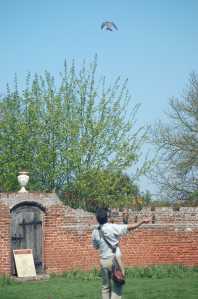


A small falcon flies high above the falconer in the falconry display


Seeing a falconry display gave me an opportunity to educate the children as to the origins of our surname, which was originally something like Falconer. We were the plebs who looked after the falcons on the Laird’s estate in Aberdeenshire. The name is first found in that county around the 1200s. Medieval times, indeed.

My father has long been convinced (through a story his grandfather told him) that we came from Scotland in recent generations. To that end, Dad supports the Scotland rugby and football teams. Trouble is, we come from a part of the Auld Country called … Lincolnshire. All the way back to the early eighteenth century, there is no sign of the tartan, still less of ‘our’ clan, the Keiths.


Mark dressed for his photo in front of a painted backdrop of a castle

If I can be serious about one final thing, though, it was the tragic reminder of seeing the Cross everywhere as a symbol not of suffering love but of violence and oppression. Mark and Rebekah posed in borrowed costumes for pictures in a photographer’s tent (and very good they were, too, for the price). Here, you can see Mark in knight’s garments, with his cross. I thought about the wickedness of the Crusades, their perpetration of Christendom by cruelty, and what they did to peoples who should have been shown the love of God in Christ. 

Then I thought there were hundreds, if not thousands of people at the show, and only few of them would have had that thought. Of the few who did, a good number of them would have seen it as further evidence to prove the wickedness of Christianity.

Most of the rest, though, who would have given no thought to the symbol of the cross at all. Like someone who works for our local Schools and Youth Ministries charity said at a meeting last year, most young people haven’t rejected religion. It just isn’t on their radar in the first place.

And that may be the biggest challenge facing the British church today.

Sabbatical, Day 47: How Could I Forget My Daughter?

Pressed for time in blog writing last night, I made an unwise choice. Yes, I enjoyed writing about the bozos in the High Street, but how could I overlook the achievements of our wonderful daughter?

Yesterday was a terrific day for her. We saw her take the lead when her class led school assembly, sharing on a trip they’d had to Braintree Museum to explore Victorian life a couple of weeks ago. All the class said something, but Rebekah had to kick it off. Clear voice, good projection, nicely paced. Could  make a preacher of her yet.

Later in the assembly, the Deputy Head presented her with a certificate to mark the Maths test she passed last week. She looked so proud, in the right way. At the autumn term parents’ evening, her teacher had told us that Maths was her weakness. No longer, it seems. Not only did she pass this test, we had the spring term parents’ evening on Tuesday night, and she is attaining standards in numeracy ahead of her age now. So there has been a real turnaround. She has worked hard, and the teacher has done well with her.

Meanwhiles, Mark, according to his teacher, ‘can do everything’, and she’s having to hold him back on his reading because he’s so far ahead of the others. On its own, this would have worried us, but she discussed strategies with us for making a bit more of the books they’re expecting him to read that they know are below his capabilities. The real concern is his lack of socialising with children of his own age. 

Collecting the children from school yesterday, we were greeted with a very red Mark. Not only his hair, but blotches on his skin. We kept him off his swimming lesson. This morning, he was much better and we sent him in. However, by morning break the school had phoned me and I went in armed with Piriton. That did little, and at the beginning of lunchtime came the second phone call. We brought him home, and with the school anxious that he might be infectious with something like slapped cheek, Debbie took him to the doctor, where they had to wait alone in a side room before seeing a GP who wasn’t sure what it was, but said just to keep him off school tomorrow. Poor lad, ever since going full time at school in January, he’s struggled to do a full week any week.

Meanwhile, back at yesterday afternoon, Rebekah was fit for her swimming lesson. Once a term, the swim school tests the children. Yesterday, she passed her 20 metres badge, so great elation and more reason to eat chocolate!

Today, she is happy too, because another milk tooth fell out, thanks to a cherry cake that was served for dessert at school dinners. It has been irritating her for days. Tonight, it was not difficult to persuade her to sleep, because she is anticipating a nocturnal appointment with the Tooth Fairy. And in the tradition of a children’s book we once read about the dental sprite, she is sincerely hoping this tooth was clean and sparkling enough to find a home in The Hall Of Perfect Teeth. Our next door neighbour told her there would be an extra reward for such teeth.

Fat chance. The standard £1 coin is in the envelope with the TF’s letter. We’re not getting stung again.

Meanwhile on the sabbatical front, I still haven’t ordered any more books, but having a Myers Briggs personality type that likes to keep my options open, it was fatal today to receive a catalogue for church leaders from Wesley Owen. As I flicked through, hoping not to be tempted and take it on an early trip to the paper recycling sack, I was accosted by a few titles that could have something to do with my research. Not the ministry and personality type stuff, but the dialogue between traditional understandings of ordination and our contemporary missional context. 

So step forward Ministry By The Book by Derek Tidball. Prepare for Exile: A New Spirituality and Mission for the Church by Patrick Whitworth sounded interesting. And Evaluating Fresh Expressions:explorations in emerging church: Emerging Theological and Practical Models edited by Martyn Percy and Louise Nelstrop sounded like it might be useful as a critical voice from outside my tradition to ask hard questions about new forms of church. If anyone reading this has read any of these books, please let me know what you think in the comments below.

Sabbatical, Day 43: Worshipping, Not Drowning

This morning I headed off to church on my own. Debbie and the children went swimming. There were a few reasons behind this parting of the ways. Firstly, when I’m not sabbaticalling, the Sunday School at Broomfield is only alternate Sundays. Debbie doesn’t feel she can make the children sit through an adult service regularly, so she began taking them for fun swims to boost their skills. Yesterday, they said they wanted to go to the pool again.

A second reason would be that I’m still uneasy about missing worship for anything other than illness. I attribute that to my upbringing in a church family. There is something positive about keeping the Sabbath that is important to me. I’m going to find it hard next Sunday: not only is it Mothering Sunday, it is also Rebekah’s birthday, and I know there will be pressure for us to miss church and go out somewhere.

But there is a third reason. I can’t swim.

I had some lessons at school, but at primary school they were scuppered by a traumatic experience. I saw my best friend held under the water. That did things inside a seven-year-old’s mind, and I never recovered. Going onto secondary school at eleven, the games teacher was the macho sort who was aggressively unsympathetic to any boy who couldn’t swim. All he did was haul me across the width of the pool by a rope.

I’ve never seriously revisited the issue. When Debbie and I were on honeymoon, we spent a few days at an hôtel with a pool and she offered to help me learn. Since it was her, I didn’t mind. But I just couldn’t grasp it.

Every now and again, she asks me to take adult lessons. I feel there are so many fear barriers I would have to cross. One is whether I would be humiliated again by a teacher. Another is how I would cope without my glasses on. (I’m not a suitable case for contact lenses – long story.) And some other things. Yet I am one who stands in a pulpit and tells people that Jesus can help them through the painful memories of their past. One day, I’ll have to find a way of dealing with this. Right now, I’m not sure how. I only know it will have to be gentle.

As for the worship, one or two parts really struck me, not least the Collect for the Third Sunday in Lent:

Almighty God, 
whose most dear Son went not up to joy
but first he suffered pain,
and entered not into glory before he was crucified,
mercifully grant that we, walking in the way of the cross,
may find it none other than the way of life and peace;
through Jesus Christ our Lord. Amen.

How many times have I heard those words? How often have I read the biblical passages on which they are based, not least Paul’s words in Philippians, where he wants to know Christ and the power of the resurrection, but only through ‘fellowship in his sufferings’? Today, however, they were a living word for me, making sense of the down times and the dry spells since coming to Chelmsford. Perhaps these will prove to be ‘the way of the cross’ and that hope is coming.

It certainly tied in with what Paul, the vicar, preached about. He changed the Lectionary Epistle reading and preached about how we can face darkness as Christians. He should know. As he said publicly on this occasions, and has said before, he has battled depression for thirty years. It was an honest and hopeful word.

One lovely thing today, and one sadness. The former came this afternoon, when we took the children out to a playground in a local park. There, Rebekah saw someone from school. He is permanently in a wheelchair, but had been at the swimming pool this morning. He had thought Rebekah must be in Year 3 (she’s in Year 1). She asked if we could go and speak with him and his grandparents. We made a new friend, someone we can now speak to when we see him at the school. All because Rebekah made the overture of friendship. She’s learning missional before she’s six.

The sadness was to learn that another couple we know are separating. That is three couples is less than a year. Two of the couples are Christian families. Our hearts now go out to this couple, and to their children. Our prayers go up for their pain.

Sabbatical, Day 35: Missional Party-Going

If there’s one thing I struggle with Missional Jesus over, it’s parties. He loved them. I hate them.

OK, ‘hate’ is the wrong word, but they have too many connotations of embarrassment from the past. And tonight, Debbie and I were at a party for missional reasons.

M has become a friend of ours through pre-school and school. She has children of a similar age to ours. Major aspects of her life have been horrendous in recent times – I’m not going to detail them in a public medium here – and we have stood with her through some difficult and painful decisions. Most of the time, it has simply meant inviting her for coffee or lunch. We gave her a few spare possessions when she needed to move her accommodation. Occasionally, there have been overtly spiritual conversations.

But today was her thirtieth birthday. She could not afford a party, but good friends hired a hall and a DJ. They decorated it and provided food. We were among eighty or so guests who were invited, and we felt it right to accept the invitation, even though we knew it would be the kind of event where I in particular would feel uncomfortable.

It’s that raging introvert issue again. Discos are not my thing. The style of music isn’t my taste, and you’re not likely to see me dance any time before the Second Coming. King David may have danced before the Lord, but this David doesn’t. Thankfully, nobody tonight applied any of the heavy social pressure to which I have been subjected on other occasions: this bunch of largely non-Christians was a lot more relaxed about people making their own decisions than many Christian-dominated parties I’ve attended in the past.

But I can’t escape the fact that in the Gospels, Jesus seemed so comfortable at parties. I know there is no verse which says, “And it came to pass that Jesus got up and danced to ‘You’re The One That I Want’,” but to my mind he seems chilled and at home at parties. If we’re going to share in people’s lives on their territory, not ours, it is going to involve actions that are uncomfortable for us. Not in the sense of ethics and moral decisions, but in terms of personal preferences and tastes. It may not be party-going for you, but if it isn’t that, it will be something else. 

So yes, the incarnational theology stuff is important. We need to be ‘in the world’ and also ‘not of the world’ without giving the appearance that we have landed from another planet. But the practice of such theological theory requires a dose of chilled-out Jesus.

Yet what exactly was that? Was he happy at parties because he was an extravert? If I take the Myers Briggs definition of extraversion as someone who derives energy from being with other people, then he certainly did enjoy the company of gatherings large and small. Yet at the same time he displayed introvert tendencies in his ability to go off on his own for extended times of prayer. So I don’t think this is a matter of personality type, however much I am thinking about that subject at present.

I think it’s a matter of security in his own identity. He knew he was the Father’s belovèd Son, and that the Father was well pleased with him. God reminded him of that twice in his life. The first time was at his baptism, just before his public ministry started. The second time was at the Transfiguration, just before he made his deliberate journey towards his Passion at Jerusalem.

And isn’t it that same knowledge in us – in our case a blessing of grace – of knowing that we are loved beyond measure by the Father – that is our security and foundation? Is this not the rock where our feet stand firm, and where it doesn’t matter how other people treat us or what social pressures they exert? Isn’t this vital for the whole spiritual life, mission and worship? May this knowledge, and an the experience of it, grow in each of us, not simply that we are blessed out of our socks, but that we are chilled-out little Jesuses who bless others.

Sabbatical, Day 31: Links, Lent, Movies And Books

Before today’s news, here are some links. Let’s kick off with a survey. What kind of technology user are you? The Pew Internet and American Life Project has a quiz. I am an ‘ominvore‘. (Via the Comodo Monthly Insider email.)

The Evangelical Alliance has a resource launching on 5th March entitled ‘Square Mile‘. To quote their email:

Mercy: demonstrating God’s compassion to the poor
Influence: being salt and light in the public life of the community
Life Discipleship: equipping Christians for missional living as workers & neighbours
Evangelism: faithful and relevant communication of the gospel
Square Mile is an exciting initiative, designed to catalyse and equip the UK Church to take a truly integrated approach to mission in partnership with the Alliance and Community Mission.
Square Mile resources include a new DVD-based course designed for small groups, which explores these four areas of mission. Featuring insights from: Shane Claiborne, Mark Greene, J John, Tim Keller, Elaine Storkey, Jim Wallis and N.T. Wright, as well as examples of grassroots projects around the UK. A journal is also availabe containing daily readings, reflections and activities covering four weeks – ideally used alongside the DVD course.

Ruth Haley Barton has an article for the first week of Lent: Practising Repentance.

…………

If it isn’t one, then it’s the other. Mark went back to school today, and Rebekah was off sick. She had diarrhoea in the night and this morning. I’ll spare you further grisly details. 

Thus today I have been a teacher and an entertainer. Not that far removed from ministry, is it? I helped her with her reading, her spelling homework and her Maths game.

As a reward, we allowed her to paint a mug. Not one of our existing mugs, one that came in a box with paints and brushes. She has decorated a couple before, but I put the last one in the dishwasher and the paint began to peel. If everything King Midas touched turned to gold, most things I touch shatter into several pieces.

Either side of lunchtime, Debbie, Rebekah and I watched ‘Chitty Chitty Bang Bang‘ on DVD. It came out in 1968, and I saw it at the cinema first time around. If I didn’t feel old enough already, what with the fact that tomorrow I enter the final year of my forties, I felt even more decrepit remembering that fact.

As I watched it, I mused on this thought. Today, we are used to discussing serious themes in films. Organisations like Damaris Trust and others produce first class material to help in that matter. Usually, the movies chosen are not children’s titles. Yet Chitty Chitty Bang Bang has some simple ideas that would bear some exploration. Here are just a few. 

Career-wise, do you follow your dreams, imagination and creative talent, even into penury that affects you and your family, in the hope it will work out in the end, or do you just take a routine mundane job? (Caractacus Potts)

How do you deal with the fact that evil is sometimes blatant and other times disguised? (The Child Catcher)

How do you hang on in the face of evil while injustice reigns? (The villagers keep their children underground, not seeing the sun, while the Baron and his forces seek to eliminate children.)

Can you have successful marriages and relationships across wide socio-economic barriers? (Caractacus Potts doesn’t propose marriage to Truly Scrumptious until he realises his invention of Toot Sweets is going to make him wealthy, just as she is.)

…………

And finally, just a little tiny bit of sabbatical work today. Some of that was reading the terms and conditions for signing up to Survey Monkey. I’m glad I read these. I have to be very careful how I word emails in which I invite people to complete my survey, and include various items to avoid Survey Monkey deleting my account. Clearly they are protecting themselves against use by spammers. I have to include an ‘unsubscribe’ link and my snail-mail address. The problem with ‘ubsubscribe’ will be that I may not be using a mailing list full of individuals, so I’ll need to think of a way around that.

The other thing that has happened is this. You may recall my recent series of posts on The Starfish And The Spider. There was another similar book I also wanted to read. Well, at last, after several weeks on order and being number one in the queue to read it next, ‘Here Comes Everybody‘ by Clay Shirky found its way to North Melbourne Library today, and it is sitting on my desk at last. I had taken to reading something that is not sabbatical related, but which is thought-provoking on a general theme: ‘The God I Don’t Understand‘ by Chris Wright. I may need to return to that later now.

Sabbatical, Day 18

Thank you to everyone who has offered prayers and advice regarding Mark’s illness. He has now been clear of vomiting for two days, but the problem has moved to the other end. He remains reluctant to eat, which brings back all the fears of the two years (only recently ended) during which he barely picked at food. However, it could just be the bug. He also remains pretty tired.

Today, I drove to Kent and picked up Rebekah from her sleepover. She had been rather subdued, but was much closer to her usual more-bouncy-than-Tigger self today. Pat, her old childminder, has come to stay with us for two days.

On the way back, we were coming over the new bridge-like slip road from the A2 to the M25 when we hit one of those first-gear-if-you’re lucky traffic jams. It did not surprise us remotely when it cleared the moment we got through the tolls at the Dartford Crossing. Tolls were introduced here with the south-to-north tunnels and the north-to-south Queen Elizabeth II bridge. Once the bridge was paid for, they were due to be abolished.

But governments are good at lying. Or at least of playing along with a previous administration’s policy, and then changing when it suits them. So, as is well known, once the crossing was paid for, the tolls were kept in place. Now it is supposedly a congestion charge. So let’s just call that the lie that it is. When the tolls cause traffic to stack up in the way they do, fuel consumption worsens badly. Therefore they do not save environmental damage, they cause more pollution. It can hardly be argued that the tolls work by deterring people from taking that route and that if they were abolished more people would use it for two reasons. Firstly, those on the route often have little practical alternative. Secondly, the few who might change would be on the roads anyway. No, the Dartford tolls only increase greenhouse gas emissions and human tempers. So let’s just call the government a big fat teller of porkies. I know people will find it hard to believe in a dishonest government, but there you go.

So little has happened on sabbatical topics today. However, I have just noticed this report on the BBC News site: the Vatican says that the two sexes ‘sin in different ways’. Never mind personality differences, there are sex differences in terms of preferences for the classic seven deadly sins. For women, the popularity of sins comes in the following order:

1. Pride
2. Envy
3. Anger 
4. Lust
5. Gluttony
6. Avarice
7. Sloth.

For men, it is 

1. Lust
2. Gluttony
3. Sloth
4. Anger
5. Pride
6. Envy
7. Greed.

So now you know. The top three in the men’s list sounds very much like the profile for certain seedy men’s magazines, such as Zoo and Nuts (which I’m not going to dignify with links).

The Vatican is reacting to a decline in the practice of personal confession. One third of Catholics no longer consider confession to a priest necessary, and one in ten consider it an obstacle to their relationship with God. All this, despite the fact that the Catholic Catechism still states that 

“immediately after death the souls of those who die in a state of mortal sin descend into Hell”.

The objections to confession sound vaguely similar to traditional Protestant objections to the rôle of a mediator between humans and God other than Jesus Christ. All this at a time when some streams and traditions emanating from Protestantism are rediscovering the importance of accountability groups, which may not have the formalised place for the priest, but which can respect the injunction in the Letter of James that we should confess our faults to one another. I don’t suppose we’re going to wave to each other as we pass one another going in the opposite directions, but isn’t this one of those cases where it would be good to listen carefully to one another and pick out strengths and weaknesses from the various traditions? 

Finally tonight, something that should have drawn a comment from me yesterday. I visit an osteopath every couple of months, as I have previously written. Yesterday, I saw Tom again. In addition to treatment for my usual neck and back issues, I mentioned that a practice nurse at our doctor’s surgery had recently diagnosed some pain in my heel as plantar fasciitis.

Tom being Tom, he not only proceeded to treat it and give me some exercises to do, he launched into an explanation of the condition and the physiology. He told me how the plantar fascia is like a mesh that changes shape, tensing and relaxing, in relation to the movement of the foot and pressure on it, and said something about energy storage that I confess I don’t now understand. He explained how the fascia is linked to the calf muscle. When the latter is tight all the time, it puts strain on the plantar fascia. Therefore, he prescribed some gentle stretching exercises for the calf muscle that would release it and therefore relieve the plantar fascia. He said that unless we started to work quickly, the condition would set in for months and months. 

In the midst of the explanation about how things should work in this part of the body, Tom suddenly said, “He thought of everything, didn’t he?” Now Tom knows my profession and has dropped hints before about believing in God. It was he and not my previous, Christian, osteopath, who told me that the discipline was founded by a Christian, Andrew Taylor Still. However, one thing Tom has never suggested to me that he is a Christian or a disciple of any other faith.

I imagine he might be one of the many who hold to a belief in God without ‘formalising’ it, but my concern here is less with theorising about his convictions. My point is that I wasn’t ready, even within a friendly, warm relationship to make an appropriate response. Sometimes I am so into building a good relationship with someone and avoiding the preachiness of my Christian youth that when an opportunity for spiritual conversation comes up, I blow it. Someone must know how to keep a good balance!

The Starfish And The Spider, Part 8: There Are New Rules To The Game

Here is the final part of the series. You will see a number of recurring themes here, in what virtually amounts to the book’s own summary of itself.

1. Diseconomies of Scale – small outfits with minimal overheads can bring revolutions. How the church needs to hear that, in place of megachurches, buildings, stipends and so on. I seem to be doing myself out of a job!

2. The Network Effect – adding one more person to the network costs little but adds value to them and the existing network. Assumes greater sharing by new network members – this won’t work if we treat people as pew fodder.

3. The Power of Chaos – standardisation squelches creativity. In a starfish, anyone can have a go. Churches think of newcomers as those who can be fitted into the currently vacant jobs. We don’t start with people and see what they can do and then shape church around that.

4. Knowledge at the Edge – not just from on high but the margins too. (Typically postmodern!) Body of Christ metaphor. God works from the fringes, too.

5. Everyone Wants to Contribute – people join a starfish for this reason. This requires reconceiving received models of church if we are to operate as starfish. Many wouldn’t join us for this reason.

6. Beware the Hydra Response – attacking a starfish organisation conventionally generates a many-headed response. Again, I think of persecution in the early church. As they were attacked in one town, they fled to another and more churches began.

7. Catalysts Rule – they inspire people to action rather than running the show, and they know when to let go. However, if one becomes a CEO, the starfish is in jeopardy. This is a radically different vision for leadership. How easy it is to default to CEO.

8. The Values Are the Organisation – ideology is the fuel of the starfish. In the church we have too easily defaulted to ‘institution’ as the definition of organisation, whether it’s seeing episcopacy as the esse of the church (as in Anglo-Catholic theology), or in seeing recruitment of new members as a matter of maintaining the institution rather than sharing the Gospel.

9. Measure, Monitor and Manage – measurement still happens despite ambiguity, but in different ways. It looks at the activity of the circles, how distributed the network is, the health of a circle, continued participation of members, etc. They are more dynamic measurements than static numbers and harder to quantify. Puts a new light on the October Count for Methodists. How would we go about assessing the spiritual health of our groups? How would we handle the inevitable subjectivity? It would also require sensitive handling when the assessment is negative.

10. Flatten or Be Flattened – the power of decentralisation is causing more companies to flatten or at least become hybrids. Decentralisation looks chaotic, even like entropy, but it is powerful. This sounds like an argument of the ‘You must move with the times’ variety. The real question is whether decentralisation is consistent with Scripture. In many ways it is. We have to be wary of where particular applications contradict Christian theology, whether it is eBay‘s ‘people are basically good’ creed (which they couldn’t completely live with, hence the hybrid with PayPal) or the use of the theory in support of violence (al Qaeda, Animal Liberation Front). 

Sabbatical, Day 11

First of all, a bit of techie stuff: late last night I finally succeeded in installing Ubuntu Linux in a separate partition on the hard drive of my laptop. Previously, I’ve managed to install it within Windows using ‘wubi’ on our desktop, but that PC always protested regarding a separate installation. Anyway, I saw a suitable hand-holding article in Computeractive magazine in a newsagent last week. I bought it and it came in handy yesterday evening. So now I can have some fun.

Or so I thought. Ubuntu doesn’t recognise the wireless receiver in the laptop, so I can’t connect to the Internet through it while I’m here. Windows Vista only for that task. I’ll be able to use it when connected via an Ethernet cable to our router at home. Not exactly the flexibility you hope for with a laptop, but at least there is an operating system that will to some extent substitute should Windows ever fall over or crawl in RAM.

Anyway, to change the words of Olivia Newton-John, let’s get spiritual. The lectures have been extraordinary today, right from the get-go. Phil Meadows could hardly read a quote from Samuel Chadwick at the beginning of our first session this morning without weeping. A lecture that began in prayer ended in prayer, with some overcome by the power of the Spirit. A constant theme today has been pain at people in church not receiving Gospel basics. It hasn’t been the judgmentalism of such people that can be found in some evangelical circles: it has more been an agony. And the recurring response has been that we are just as free to proclaim the Gospel as we always have been, but with it we are free to be persecuted. There is a constant historical thread that people who have initiated reform or renewal in the church have done so from the margins (how postmodern is that? If you’ve followed my Starfish and the Spider posts, you’ll have seen it recurring there) and have suffered for doing so.

After lunch we had the coffee and cakes I mentioned yesterday. I ended up sitting again with Stephen Skuce, talking about all sorts of things from family to church life to – yes, the question of a PhD again. I shared a particular misgiving I have about the idea. Not the money: we’ll pray about that if it’s right. But I’ve been deeply concerned about motivation. I don’t want to explore this if it’s just an ego trip to get more alphabet soup after my name. Stephen encouraged me that there might be a number of worthy reasons for pursuing one. I really wasn’t ready for these conversations. Suddenly these ideas are accelerating and I’m thinking ‘Oo-er’. Clearly, I shouldn’t have opened my big mouth on Monday!

Well, I’m going to draw this to a close in a moment. I’m typing this whilst taking part in a chat with three other students about children’s openness to God and other aspects of the Holy Spirit’s ministry. Also, someone wants to find the Lego Gospel on the web and have a look. There are a few possible sites she might mean: The Brick Testament, this YouTube clip

or maybe this site.

See you tomorrow.

The Starfish And The Spider, Part 7: The Hybrid Organisation

Part seven below – a bit shorter today.

Not everything about centralisation is bad. It is sometimes possible to hybridise spider and starfish philosophies in an organisation. There are two main types of hybrid:

1. A Centralised Company that Decentralises the Customer Experience – eBay is built on mutual trust between buyers and sellers – ‘people are basically good’ – but  PayPal operates on ‘no trust’. Amazon is centralised, but user reviews are read avidly. Some Christians are understandably nervous about the eBay creed that ‘people are basically good’, and rightly so, but a church will not function without trust. It also needs accountability.

2. A Centralised Company that Decentralises Internal Parts of the Business – e.g., make each section of the company independent and accountable on a profit-and-loss basis or use ‘appreciative inquiry’ to pair people from different parts of the company who share their ideas non-hierarchically. Methodist churches are not independent in this way, except for the schedules. Non-hierarchical sharing is probably something many would like, though, but may generally be resisted by some ministers.

The decentralised sweet spot is the point along the centralised-decentralised continuum that yields the best competitive position. It may change over time. This is a problem of agility for the church, an especially tricky issue for older churches.

Sabbatical, Day 10

Two miracles in the last twenty-four hours: first of all, I slept well last night. Moving the bed away from the wall helped. I still can’t understand why the college thinks it’s a twin room, though. Not unless Snow White was moonlighting as an architect for friends. Thankfully, I’m alone in the room.

Second miracle: a meal tonight in the refectory that actually came with vegetables. After three consecutive meals accompanied by salad, this was a cause for thanksgiving. Not that the salads were bad at all – they were fresh and edible – but it’s good to have some balance in the diet. Besides, excess salad while snow is still around seems a tad strange.

Lectures have been good today. Two this morning from John Finney, the retired Bishop of Pontefract on the subject of personal and church renewal. Wisdom from an experienced church leader.

Two later from Stephen Skuce, the postgraduate tutor here. Controversial and provocative. He thinks the British church is done for, rather like the North African and Turkish churches of past centuries. We need to learn survival strategies, he says, in the way that the Chinese and Russian churches did under communism. He sees the emerging church movement as a group of lifeboats getting as far away from the sinking Titanic of the mainstream church as fast as possible. However, he thinks there are only twenty emerging church congregations in the UK. He should be in a position of authority on this, as Cliff College is the only place in Europe to offer an MA in Emerging Church studies. He doesn’t rate the idea of the ‘mixed economy’ church advocated by Rowan Williams as part of the Fresh Expressions movement. Fresh Expressions don’t generally count as emerging churches – I think I’m inclined to agree with him on that point.

Tonight he taught for an hour on William J Abraham‘s book ‘The Logic of Renewal‘. As much as anything, though, his purpose was to show the MA students how to research an author and a book. He happened to use a book that is on the theme of the week. It was interesting to see the students being taught these methods.

This evenng, I’ve been indulging my pleasure of offering technical support to someone with her laptop. I managed to get her wirelessly connected when the computer was hiding from doing that. I’ve also been listening to nervous students who’ve had tutorials today where they’ve had to present ideas for their next assignments. I made a suggestion to one woman about a possible book, but the tutor ripped the proposal to shreds.

Tomorrow, two of the students who will soon be celebrating ‘significant’ birthdays will be treating the rest of us on the course to coffee and cakes at the village tea rooms.

Plenty of other students tonight are watching Star Trek Deep Space Nine on DVD on a large screen via a digital projector. Me, I’m typing this instead. Sad? Maybe. Now, then, everyone together: “There’s Klingons on the starboard bow …”

Create a website or blog at WordPress.com

Up ↑