However, the good news is that I now have author copies of my book so you can buy signed copies directly from me.
All is revealed in this video:
Dave Faulkner. Musings of an evangelical Methodist minister.
However, the good news is that I now have author copies of my book so you can buy signed copies directly from me.
All is revealed in this video:
Yes, really, it’s out there in the wild now! It’s available for £9.99 in paperback or £5.99 in Kindle from Amazon.
I don’t yet have my author copies, but when I do I’ll advertise signed copies and the odd launch event. I’m also arranging a blog tour for around three weeks’ time.
But in the meantime, here’s a rather excited me (or about as excited as this introvert ever gets) in the back garden this morning:
The publication of my first book ‘Odd One Out: Good news for those who don’t belong’ is now very close. Would you like to see the front cover?
I’m just taking a break from my sabbatical to share with you the video trailer I have made for my forthcoming (and first-ever) book: ‘Odd One Out: Good news for those who don’t belong.’
I don’t have an exact publication date yet but I don’t expect it to be that long. Watch this space – and/or my Facebook, Twitter, or Instagram feeds where I shall also be posting news.
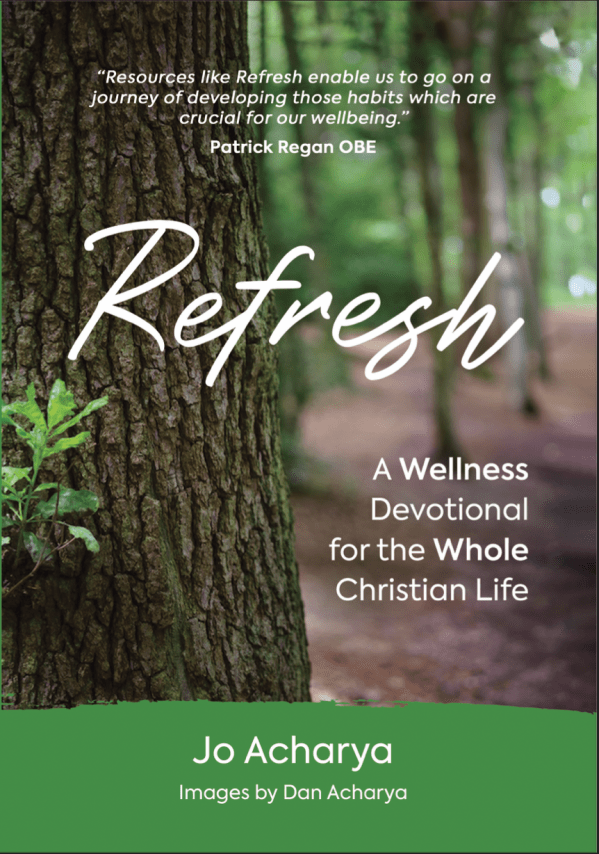
In recent times I have of course mainly just posted my Sunday sermons here on the blog. But a year or so ago, I interviewed Christian author Liz Carter about her book Treasure in Dark Places. The reaction to that interview was so positive, not least from church members asking me where they could buy Liz’s books, that when the opportunity came along to interview Jo Acharya about her new book Refresh: A Wellness Devotional for the Whole Christian Life, I couldn’t pass it up.
Hi Jo, welcome. Would you like to introduce yourself to the readers of this blog, please?
Thank you so much for having me on your blog David! I’m Jo, and I’m a writer and music therapist. I live in Sussex with my husband Dan and we also help to lead a small group at our church for adults with learning needs. I write a regular blog and also write ‘easy read’ Bible study and faith resources for Christians with learning needs, both on my website.
You’ve written a devotional book that’s just been published entitled ‘Refresh: A Wellness Devotional For The Christian Life’, and it has a different approach from many typical books of personal devotions. Do you think the Christian devotional book has become a stale format that needs re-inventing?

I don’t think the traditional devotional format is stale, but I do think there’s room for creative variations on the theme. One of the reasons I wrote ‘Refresh’ was to offer gentle encouragement to people who are struggling with their health, life circumstances or even their faith itself. I have cystic fibrosis and know how hard it can be to keep up with a daily devotional, so I decided to give ‘Refresh’ just one devotional each week, which makes it flexible enough to work through at the reader’s own pace. The other advantage of that is that it allows the reader to stay with a topic for longer rather than rushing onto a new reflection each day, which I think gives it a chance to sink in and have a deeper impact.
I note from a recent piece in Christian Writer magazine that you’re a big believer in ‘simple writing’. Have you written this book in a way that is accessible to all sorts of people, or does it have a specific narrow focus?
You’re right that one of my passions is making the Bible easy to understand, particularly for people with learning needs. ‘Refresh’ is for a general audience, but I have tried to use relatively simple language to make it accessible for people who aren’t confident readers as well as some with very mild learning needs. My next project is to adapt ‘Refresh’ into an ‘easy read’ edition which will use very simple language and be suitable for people with mild to moderate learning needs. Hopefully that should be out later this year, so I’m excited about that!
And the specific theme of ‘wellness’: did this come from all the concerns about mental health we’ve seen during the COVID-19 pandemic?
I actually began writing the book before the pandemic, when the importance of mental health and wellness was already gaining attention. But these last two years have only intensified the need to address those issues, and even many of us who haven’t struggled in those areas before have had to cope with increased stress, anxiety, illness or bereavement, as well as losing access to some of the things we usually do to look after our wellbeing. I know for myself personally the experience of lockdown and shielding has exposed all the things I was putting my hope and joy in that weren’t God! And it’s pushed me to try and realign my heart to focus on him more and hold the things of this world more loosely. ‘Refresh’ explores a lot of basic aspects of life including the practical, emotional and spiritual, and I do believe it has a lot to say to those who have suffered during this pandemic.
I see that Patrick Regan, the founder of the Kintsugi Hope mental health resources, has endorsed the book. Has his work been a particular encouragement to you?
Yes, I found Patrick Regan’s book ‘When Faith Gets Shaken‘, which tells his own story of trusting God through suffering, really helpful to me personally. One of the big bees in my bonnet is about encouraging people to open up to God and be real about all the emotions they are feeling, and not hide from him. That’s something Patrick really emphasises in his work as well, and I’m so grateful for his kindness in endorsing my book.
With the rise in mental health issues being reported to doctors, we are seeing increased use of therapies such as Cognitive Behavioural Therapy. Do you think that your wellness devotional has something to offer in helping people reframe their circumstances and get out of their downward spirals?
I hope so. It’s certainly not a replacement for individual support like therapy, pastoral care or medication, but one area where I think ‘Refresh’ can be useful is in helping readers to identify areas where they might need that extra support. The questions each week probe a little bit into how the topic might relate to them personally and in the introduction I suggest that if particular questions are hard or painful to think about that might give clues as to areas that might be worth exploring further with someone they trust. Of course many readers won’t need further support, and for them I think ‘Refresh’ can be helpful for self-reflection, and an opportunity to discover in prayer areas where God wants to bring change or healing.
As an amateur photographer myself, I’m intrigued and pleased to see that you’ve involved your husband Dan in creating images for the book. How did that come about, and what do the images contribute to the book?
I think the aesthetic side of a devotional journal like this is really important. I wanted it to be a beautiful product that it makes you want to engage with it. So I needed some visual elements, and since I happen to be married to a talented photographer using his images seemed like the obvious choice! Dan’s photos represent each topic (usually in a somewhat abstract way) and they’re all quite different in style which I love. Images often communicate quicker than words and on a more emotional level so I think they give the book it’s feel. The book is also printed in full colour throughout which just makes it lovely to use and work through.
Is there a particular theme in the book that you think is especially relevant to our lives today as we continue to navigate the uncertainties and restrictions of the pandemic?
I guess the major theme weaving through the book is that God really wants to be involved in our whole lives, whatever they look like. For some of us our lives may have looked very different during this period, and we might have felt a bit lost in our faith too without the regular routine of in-person Sunday worship. Things may be beginning to return to normal for a lot of us now, but we still have that opportunity to keep inviting God into our lives outside of church. He really cares about our mundane everyday activities, our joys and our pain, and he wants to join us in all the messiness of life. So I hope ‘Refresh’ will be an encouragement to do that.
Thanks for taking part in this interview, Jo. Can you finally tell the readers the publication details of the book, please?

‘Refresh’ is published by Malcolm Down Publishing and it’s available now in all good bookshops. You can also get signed copies from my website, ValleyOfSprings.com/store.
…
Jo Acharya is a writer and music therapist. Her first book, ‘Refresh: a wellness devotional for the whole Christian life’ is available from all good bookshops. You can read more of Jo’s writing and buy signed copies of ‘Refresh’ at valleyofsprings.com, and you can follow her on social media at facebook.com/valleyofsprings and instagram.com/valleyofsprings.

Two years ago, I read Liz Carter‘s stunning and challenging book ‘Catching Contentment: How to be Holy Satisfied‘. Her insights into finding peace and joy in God with no help from life circumstances made it my book of the year. It found an instant place in a collection of books I dub my ‘Pastoral First Aid Kit.’
Now Liz is back with a new title, ‘Treasure in Dark Places: Stories and Poems of Hope in the Hurting‘. Written mainly during lockdown and enforced shielding, and my copy arrived on publication day, last Saturday.
I’ve had the pleasure of interviewing Liz by email about her life situation and her writing. Enjoy.
Tell us a bit about yourself.
I live in Shropshire with my husband Tim, a vicar, and my two young adult children. I’ve been writing for most of my life – from a young age I knew it was what I wanted to do.
How long and in what ways has chronic illness affected your life?
I’ve been ill since infancy with a rare lung disease. I was the sickly child, the one always missing school. The disease is degenerative, so over years has taken more room in my life than I would wish. As a youngster I often felt different; a weakling, an object of scorn when I struggled once again in a PE lesson, someone who simply wasn’t trying hard enough, according to some of my reports. As an adult my illness arrested a teaching career after only five years, leaving me unable to work outside the home at a fairly young age. I was left feeling as if I had nothing to give, as if I was a failure, at life and at faith – surely, I thought (and some people said), I should have been healed, by now? I’d had enough prayer for healing through my lifetime – but it hadn’t happened. I’d only got sicker. Nowadays, I am often hospitalised with pneumonia, and struggle with multiple infections a year, leaving me in a constant state of fatigue and often breathlessness and pain.

Self-isolation during the COVID-19 lockdown must have been distressing. What was it like for you, and what got you through it?
When I received the shielding letter in March I was shocked and fearful. The words haunted me: I had been identified as someone at risk of severe illness if I caught the virus. I had to go into extreme shielding, away from my family, cut off in my room. I did not hug another human being for almost five months, and it was tough. I thought at first I would be okay with it, being used to some periods of isolation due to the infections I catch. But I wasn’t really okay at all, I found. Days were long and nights were sleepless, I was sad and I was scared. I’d been writing a book I thought I would finish, but the words stopped coming. I knew I needed to stop, to allow myself to admit this experience was painful, to sit within it a while. As I did so I found other words beginning to flow; words of honest poetry and re-imaginings of encounters with Jesus, words that took me closer into the depths of God when my own depths seemed fathomless. As I wrote, I found that God’s depths were even deeper still, and more than that, God was abiding there in those depths with me, holding me, in a way no other could.
Your first book, ‘Catching Contentment’, was about being content in Christ regardless of whether someone’s life circumstances were favourable. How did you first learn that for yourself?
To be honest, I’m still learning it – definitely a work-in-progress! It’s been a long journey over years, but the last few years in particular has led me to a greater peace in who I am and my situation, as I’ve delved deeper into what the Bible says about contentment – and how it doesn’t promise a pain-free life for those who follow Jesus. I loved reading more deeply around the words of St Paul, who said he’d found the secret to contentment, and wrote so profoundly of the truths he had discovered, of dying to self and rejoicing in all circumstances, of setting his mind on Jesus and living in the glorious hope we have been given. The more I read of scripture the more I can catch hold of the contentment not found in my wholeness, but in God’s holiness.
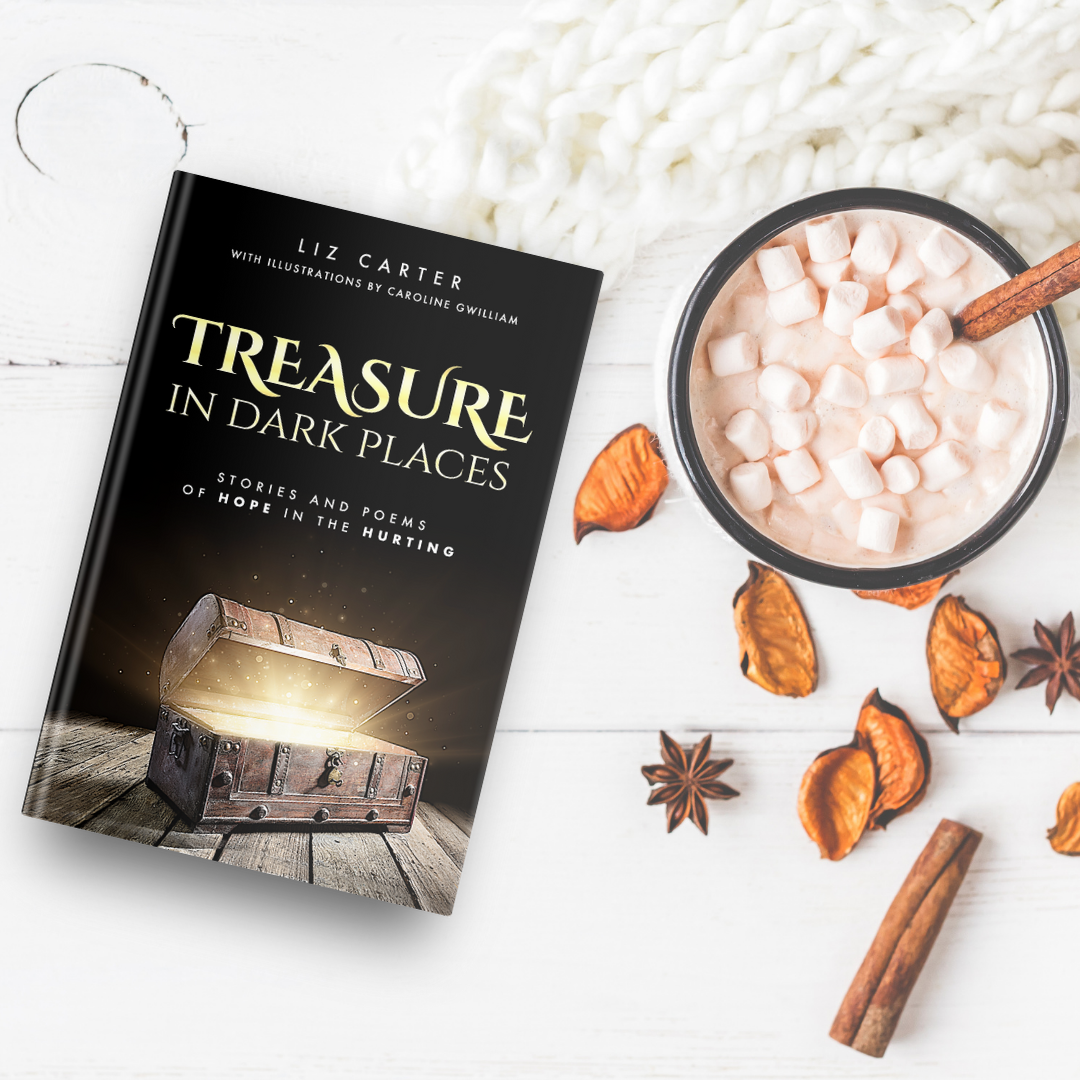
In your new book, ‘Treasure In Dark Places’, you are also tackling the question of suffering, but using other modes of creativity, such as poetry. How did you decide to approach this important theme from such a different angle?
I think that sometimes it’s difficult to capture something of the depths of pain and the breadth of hope in prose alone. The book of Psalms is my favourite book of the Bible because it expresses in such beautiful poetry something of the truth of who God is and how God loves, and I think that we need such forms today, as well. Often words of poetry will resonate and comfort deeper places where other words might not reach.
Can you share a short piece from ‘Treasure In Dark Places’ with us, please?
Yes, of course!
I wrote this one early on in the pandemic, when there was much talk of how the vulnerable and shielded would be placed at the bottom of the list for treatment when healthcare became overwhelmed. It was a response born of emotion but also of lament for all those who are suffering through illness or disability, and have been made to feel lesser in these times:
#SHIELDED
So what am I worth
in this scourge of the earth
it seems I am cursed
as my body is worse
than the young and the fit
I’m a number, an it
I know I’d be missed
but I’m on The List
condemned in a letter
until the earth’s better
I’m measured as less
in infirmity’s mess
But my value’s in more
than my CFS score
worth beyond age
or words on a page
more than a look
at lines in a book
a flawed reflection
of holy perfection
a new creation
of glory’s narration
loved beyond measure
in deep sacred treasure.
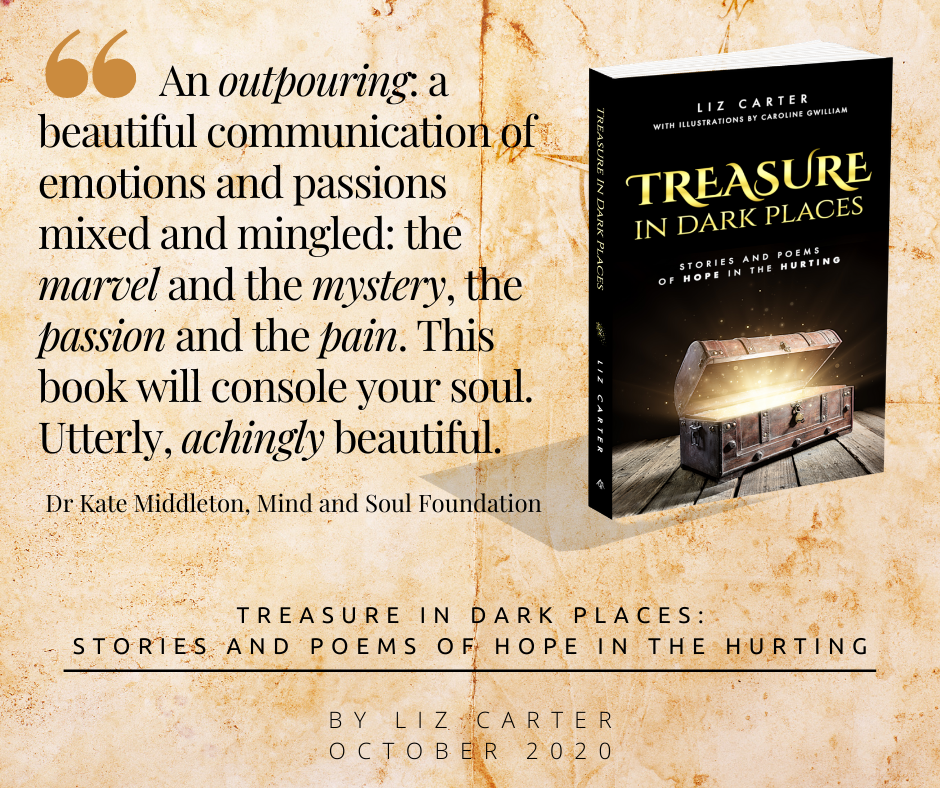
You’ve written these books despite the tremendous difficulties of your personal circumstances. Are people with chronic illness undervalued by the church, and if so what can we do to put that right?
Sometimes, yes, I’m afraid so. The undervaluing is expressed in 3 different ways, in general:
1. Sick people who have not been healed do not show enough faith, and therefore we should invest more in those who do.
2. People with chronic illnesses often cannot come to church, or to meetings, or can be ‘flaky’ and drop out far too often, therefore can be difficult to involve fully in the life of the church.
3. People who are long-term ill can be incredibly inspirational and brave, but we shouldn’t ask them to do anything because they probably don’t have enough energy.
All of these make assumptions: unless we are asked, we do not have the choice to say yes or no. Unless we are invited, we cannot grow into the calling God has upon us – for ministry, or hospitality, or anything else. Unless reasonable adjustments are made for our mobility needs and also for the fact that we do ‘flake out’ a lot, we are left on the edges, looking in to where it’s all happening without us.
I think that the pandemic has exposed something of this and many churches have responded so well, offering more and more content online to those who are housebound, and involving these people in leadership more. Churches will do well to keep up online worship when everyone else goes back to normal and sick people are left back in their isolation – I’m so glad my own church is being very pro-active about doing this.
With regards to those churches who assume lack of faith, that’s a simple case of re-examining some of the theology and bringing more compassion and understanding to the table. I’d love to see more of that!
Do you have any particular words of hope or encouragement for others who, like you, are enduring chronic illness or a life-limiting condition?
I find such great hope and glimpses of light when I reflect upon Jesus’ own life, suffering, death and resurrection. The more I think upon it, the more I am amazed at his outrageous and astonishing love for me, and the more this hope shines through the darkness. I would also want to add that it’s okay to release yourself from the bonds of feeling as though you have let God – or others – down, by continuing to be ill, whether physically or mentally. We must find space to be honest before God and others, to share our lament and our sorrow, and it’s in that place of honesty God so often does his redemptive work in our lives.
What is the main message of ‘Treasure in Dark Places’ and who should buy it?
Treasure in Dark Places is a collection of poetry and short stories that point towards hope, especially when it hurts. Its message is a reminder of God’s grace, love and supernatural peace, and a call towards the heart of God, to encounter more of God in our own depths and to lay out our own pain in candour and relief, as God meets us within our own dark places. It’s for everyone who sometimes finds life tough going – not only for those who live with illness, but for people who struggle in any way – I think that’s all of us, really.
Thank you so much, Liz.
I warmly encourage you to buy Liz’s books, Treasure in Dark Places and Catching Contentment.
You can also follow her blog and her YouTube channel.
Finally, here’s another poem from Treasure in Dark Places:
I know I’m largely only posting video devotions every Sunday morning at present, but I have in the pipeline an interview with Liz Carter about her new book ‘Treasure in Dark Places‘.
Two years ago, IVP published Liz’s book ‘Catching Contentment‘, a biblical look at how to be content when no life circumstances can provide that contentment.
Liz knows what she’s talking about, as she has had a serious chronic degenerative lung condition since her youth. ‘Catching Contentment’ was my book of the year two years ago.
Here’s a flavour of what’s coming. The interview is planned to appear on 21st October.
This is just to let you know that I have applied today to rejoin the Amazon Associates programme, which pays small commission fees to me if you click on a link to one of their products from here and then buy it. That will not apply retrospectively to old blog posts – I don’t have the time to go through them all and alter them to the special addresses they need for Amazon to track that a purchase has come via this site.
I have to make a statutory declaration about this, and have done so on my ‘About‘ page.


Back in July, I wrote about the controversy attending the discovery of substantial fictional elements in Tony Anthony’s book ‘Taming the Tiger’. I noted the evangelical obsession with celebrity, and the lust for dramatic conversion stories as drivers in promoting such books, with an attendant risk of pastoral damage for Christians who do not have a spectacular story to tell. I began the piece with reproducing a cartoon from Ship Of Fools when it was a print magazine, not a website. ‘Born Again Testimonies’ asked, ‘You may be, but has your TESTIMONY been born again?’
Now I’ve found an antidote in Ashley Cleveland‘s memoir, ‘Little Black Sheep‘. i have loved her music for a good twenty years. Many say she sounds like Melissa Etheridge: I say she makes Janis Joplin sound like Janet Jackson. A blues-rock singer with notes of soul, she sings with passion and honesty about faith and life. In the book, she writes with the same passion and honesty about faith and life.
Superficially, her story has elements that Christian publishers and readers love. Blaming herself as a young child for the divorce of her gay father and vain mother, she slides into multiple addictions – food, alcohol and drugs. She seeks love in all the wrong places and believes that God only wants to punish her. She has no concept of a personal, loving God – although eventually she is – if I may borrow Brennan Manning‘s word – ‘ambushed’ by God.
But hers is no quick fix fairytale of the ‘When I met Jesus, everything was happy ever after’ variety. She slides back, still fighting alcoholism while winning Grammy awards for her music. She struggles to establish a healthy marriage. The Christian community is locally welcoming, in the non-judgemental members of her church, but the wider Christian constituency is offended when she dares to sing about sex – even as a married woman. But hers is the tale of the God who lifts her up by love every time she falls.
There is much more that I could say about the book, but what I essentially want to say in this post is that all sorts of people would profit from reading this book:
* Music fans should read it;
* Pastors should read it;
* Most of all, broken people should read it.
I’d better end this with some music:
The song which provides the title for the book:
Queen Of Soul – her take on being a woman of God:
An exhortation to others, based on her own experience:
Covering the Rolling Stones:

Back in the days when the now-famous Ship Of Fools website was a print magazine thirty-odd years ago (aagh!), it printed in Issue 3 (June 1979) this cartoon strip. I reproduce it below with permission from the editor, Simon Jenkins, and Ship Of Fools.

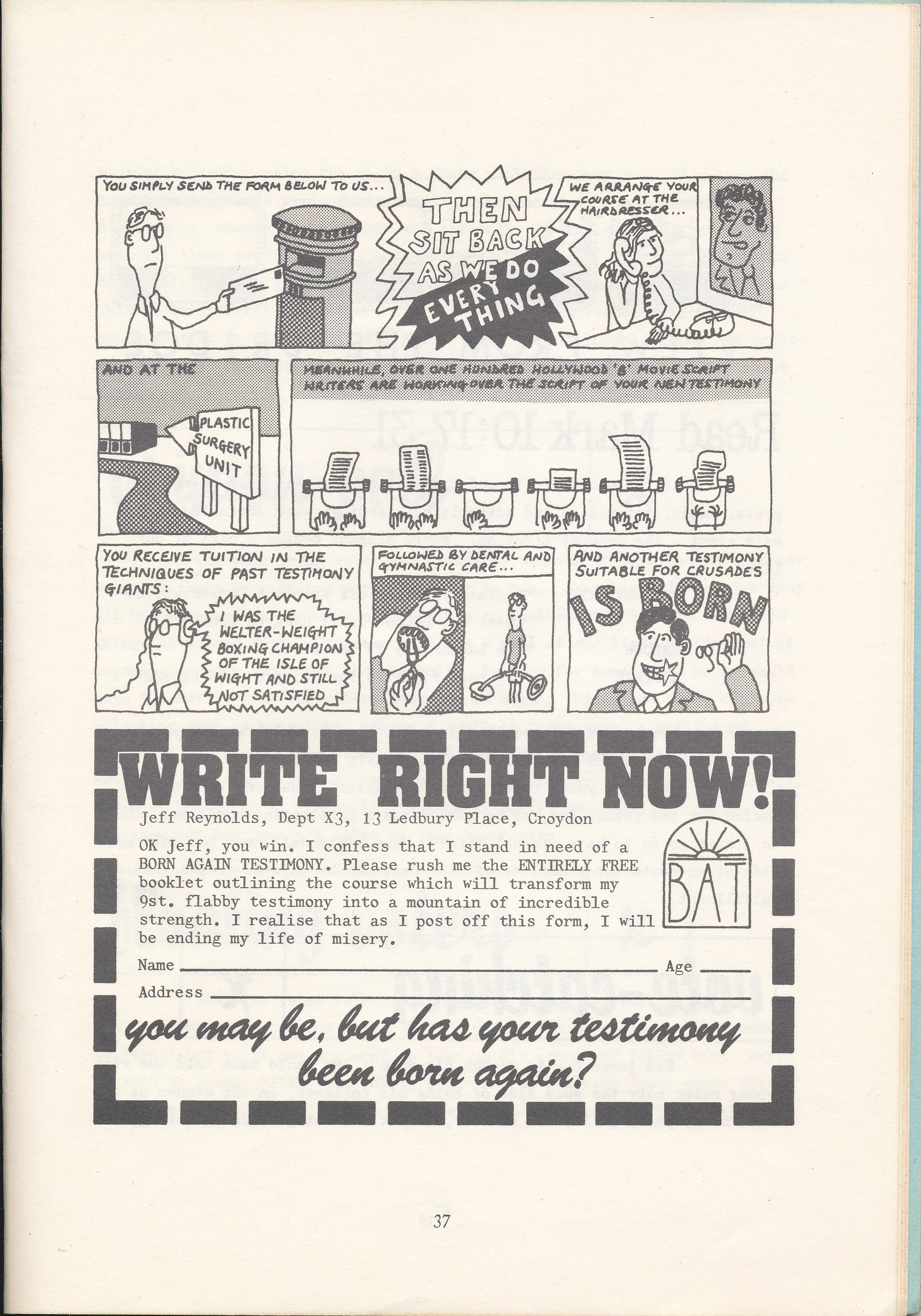
How apposite this seems in the light of the Tony Anthony story. For those who have not heard, Anthony, an evangelist, had a book called ‘Taming the Tiger’ ghost-written by a journalist called Angela Little. Ever since its publication in 2004, some have been sceptical about claims Anthony makes in there about significant details of his life. Now, following the resignation of one of Anthony’s trustees, Mike Hancock, an investigation has indeed shown that large parts of the book are untrue. Journalist Gavin Drake has many of the details. The Evangelical Alliance and Avanti Ministries issued this statement. Ghost writer Angela Little revealed some possibly surprising approaches and attitudes to research and verification in a conversation with someone on a martial arts discussion board. The publisher, Authentic Media, have issued a statement, but it is hard to detect any sense of them taking any responsibility for the debacle in their words.
But my purpose here is not to analyse this specific case. It isn’t hard to find those on the Internet who are doing so. The reason for posting this is to ask what kind of culture promotes the lust for spectacular testimony books, such as Anthony’s.
I suggest there are at least two reasons. The first, briefly, is that evangelical Christianity is too obsessed with celebrity. And if we haven’t got any celebrities, we’ll make some. In this respect, we mindlessly accept the values of the world. I have no wish to decry those who genuinely have become disciples of Jesus Christ through a dramatic route. God bless them. But celebrities are not more valuable than the unknown. Indeed, we believe – surely? – in a Jesus who was and is on the side of the marginalised.
But secondly, we have a huge issue over privileging dramatic conversions, and this troubles me pastorally. So often I hear Christians feeling inferior because they have not had a ‘Damascus Road experience’. It may even make them doubt whether they are Christians at all. I tend to say, “Do you have to remember when you were born to know you are alive? No! You just need to notice the signs of life. And it is the same in spiritual matters.”
In the early 1990s, Churches Together in England commissioned some work on conversion. It was published in 1992 by the British and Foreign Bible Society under the title ‘Finding Faith Today‘, and was authored by John Finney. 54% of the 601 Christians interviewed said they knew of a time when they were not Christians,46% had ‘always been Christians’. Of the former category, 38% spoke of a sudden conversion, and 62% gradual. Of the latter category, 80% had a gradual commitment, 20% sudden. Among evangelicals, it was as I reported: 37% sudden, 63% gradual. Among non-evangelicals, it was 80% gradual, 20% sudden. On average across all Christians, 31% had a datable conversion and 69% did not.
So if datable conversions are a minority experience among Christians, then dramatic datable ones must be an even smaller percentage. And I therefore have to ask how helpful they are, when ordinary Christians feel demeaned by them. I think publishers are partly responsible, and need to rethink their policies. I also think the wider Christian culture is possible, because whatever we say about these contributing to evangelism, in reality they are often treated as Christian entertainment with a spiritual veneer.
As Phil Groom asked on the Association of Christian Writers’ Facebook page today,
Why do we need super conversion stories to proclaim the gospel? Isn’t the gospel dramatic enough??
So – does an addiction to dramatic celebrity testimony indicate that we don’t really believe in the Gospel?
 Big Circumstance