
It has been said that neither Protestants nor Catholics really believe in Father, Son, and Holy Spirit. Catholics believe in Father, Son, and Holy Mother, and Protestants in Father, Son, and Holy Bible.
In other words, all sorts of Christians become embarrassed about believing in the Holy Spirit.
And both the strangeness in the biblical account of Pentecost plus the apparently wild behaviour (at least to traditional Christians) in Pentecostal churches only exacerbates that disconnect from the Holy Spirit.
Therefore, what I want to do today is demystify Pentecost and the Holy Spirit. For however unfamiliar some of the account in Acts 2 is to many churchgoers in the older denominations, there is important truth for us to receive in this narrative.
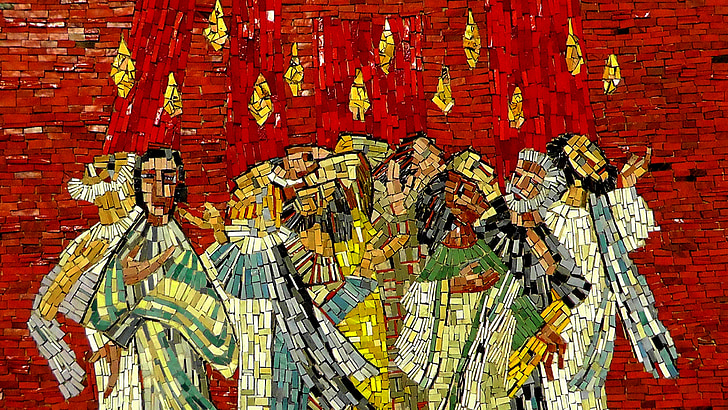
And if some of it is strange – don’t be discouraged. Luke had trouble describing it. He refers to ‘a sound like the blowing of a violent wind’ (verse 2) and ‘what seemed to be tongues of fire’ (verse 3). This is awe-inspiring, and a moment of wonder.
Firstly, Pentecost is about restoration:
Pentecost celebrated the first fruits of the harvest. The full harvest festival would come later, at the Feast of Tabernacles. But in late Spring, Israel would rejoice that the first fruits of the harvest were appearing.
This is an image that Paul uses about the Resurrection. He says that the Resurrection of Jesus is the first fruits, and he looks forward to the full harvest when all will be raised from the dead. And not only that, God will make all things new, including heaven and earth.
Pentecost puts us in that period between the first fruits and the final harvest – between God beginning to make all things new when he raised Jesus from the dead, and the great day when everything will be renewed and healed.
There is a biblical name for this period. It’s called the ‘last days.’ We are probably used to hearing ‘the last days’ from preachers who are predicting the imminent Second Coming of Jesus, but in the New Testament the last days is this entire period when the coming kingdom of God overlaps with the existing kingdom of death and sin, a time when God begins to make all things new. You will notice that Peter made reference to it in his Pentecost sermon. All that talk about ‘the sun being turned to darkness and the moon to blood’ was not a reference to today’s weather forecast from the Met Office.
Pentecost puts us in this season of restoration, even though much continues to happen that is anything but that. All those things we long for, and which we know God will ultimately bring in a full and perfect way – health, peace, justice, full provision of every need, the healing of relationships, you name it – are ministries of the Holy Spirit now.
So where is God calling you to make a difference for good in the world? Where is he calling you to rebuild and be an agent of restoration? The key to your response is to call on the Holy Spirit, who will work these things that we cannot do of ourselves.
Secondly, Pentecost is about holiness:
Pentecost was one of three Jewish festivals where pilgrims came to Jerusalem. As well as marking the first fruits of the harvest, it commemorated God’s giving of his Law to Israel at Mount Sinai during the Exodus.
Pentecost marks the New Testament response to that. For people tried and failed to keep God’s Law. Moreover, others used it as the mark of who was in or who was out of God’s People, and perhaps still others said that keeping the Law was your way of being in favour with God. Which was a problem if everyone failed.
Now, just as Ezekiel 36 prophesied the day when God would give his people a new heart and a new spirit, so the Spirit of God is poured out on all God’s people so they may have power to do the will of God. It is why Paul told the Galatians to ‘keep in step with the Spirit.’
We want to please God, don’t we? We want to do it, not to earn salvation but to show our gratitude that he has saved us from sin through Jesus Christ, his cross and resurrection. To live that life of pleasing God, he helps us by sending the Holy Spirit.
Pentecost is a day to rejoice that our struggles to obey God can be addressed. It is a day when we can go from ‘Can’t do’ to ‘Can do’ in the kingdom of God. If we want to be a ‘can do’ Christian, then we welcome the gift of the Holy Spirit.
Thirdly, Pentecost is about power:
We see this in the way the Spirit comes ‘like the blowing of a violent wind.’ Wind or breath is the same as ‘Spirit’, in both Old and New Testaments. This is therefore the fulfilment of Jesus’ words where he told the disciples to stay in the city until they were clothed with power from on high.
A couple of years ago, I had a serious problem with my car, thanks to Peugeot failing to include monitoring of the cam belt in my service plan. Fortunately, a call to my dealer and their diagnosis caught the issue just in time before my engine was trashed. The dealer then fought Peugeot to get them to pay for the repair.
As a result, I started looking into the current car market, and it is so different from when we last bought one. Now, as you will know, it is as easy to buy an electric or hybrid vehicle as it is a conventional petrol-engined model.
But whatever car you go for, you need power, be that electric, petrol, or a mixture. Your wagon will not move without it.
Yet we forget this when we come to the Christian life. We think we can get on with things in our own strength or using the right techniques. What fools we are.
Pentecost is the reminder we badly need that we are utterly dependent upon the power of God to live for Jesus Christ. Today is the day we need to bring us back to that need for divine power, the Holy Spirit.
And what’s distinctive about the Spirit’s power is that it is related to the Cross – something certain Christians seeking to exercise power in the USA at present seem to have forgotten.
Fourthly, Pentecost is about presence:
‘What seemed to be tongues of fire’: time and again in the Bible, fire signifies the presence of God. Whether it was the burning bush, or the pillar of cloud by day and pillar of cloud by night that God used to lead Israel in the wilderness, or the God who answered by fire when Elijah confronted the prophets of Baal at Mount Carmel, fire is a symbol of the divine presence.
But that presence only came upon a few select individuals before Pentecost. Moses longed for the day when the Spirit of God would come upon all of God’s people, and they would prophesy. Pentecost is the occasion when Moses’ prayer is answered.
The presence of God comes upon all the disciples. Not just those who had been selected as apostles; there were a hundred and twenty gathered when the Spirit fell. Thus it is that Peter in his sermon goes on to quote the prophet Joel, who foresaw the day when the Spirit would come upon both sons and daughters, the young and the old, and female and male servants.
If you are a follower of Jesus, the Holy Spirit descends upon you and resides within you. No exceptions. The Spirit is not the deluxe gift for the especially enthusiastic, but the birthright of all Christians.
As a result, not only do we have the awe-inspiring comfort of knowing that God is always with us, but we also become carriers of his presence into the world. Part of our mission is for people to meet the presence of God through us. Therefore, we need to tend the gift of the Holy Spirit. To go back to my illustration of the car, we need either to fill up with petrol or charge it with electricity. So too do we need to ensure we are full of the Spirit.
The evangelist D L Moody was once speaking at a meeting about the text in Ephesians, ‘Be filled with the Spirit.’ He pointed out (correctly) that the Greek means, ‘Continue to be filled with the Spirit.’ Afterwards, a vicar objected to this teaching. ‘Why do I need to continue to be filled with the Spirit when I have already received him?’
Moody replied: ‘I need to continue to be filled with the Spirit, because I leak.’
Fifthly and finally, Pentecost is about reconciliation:
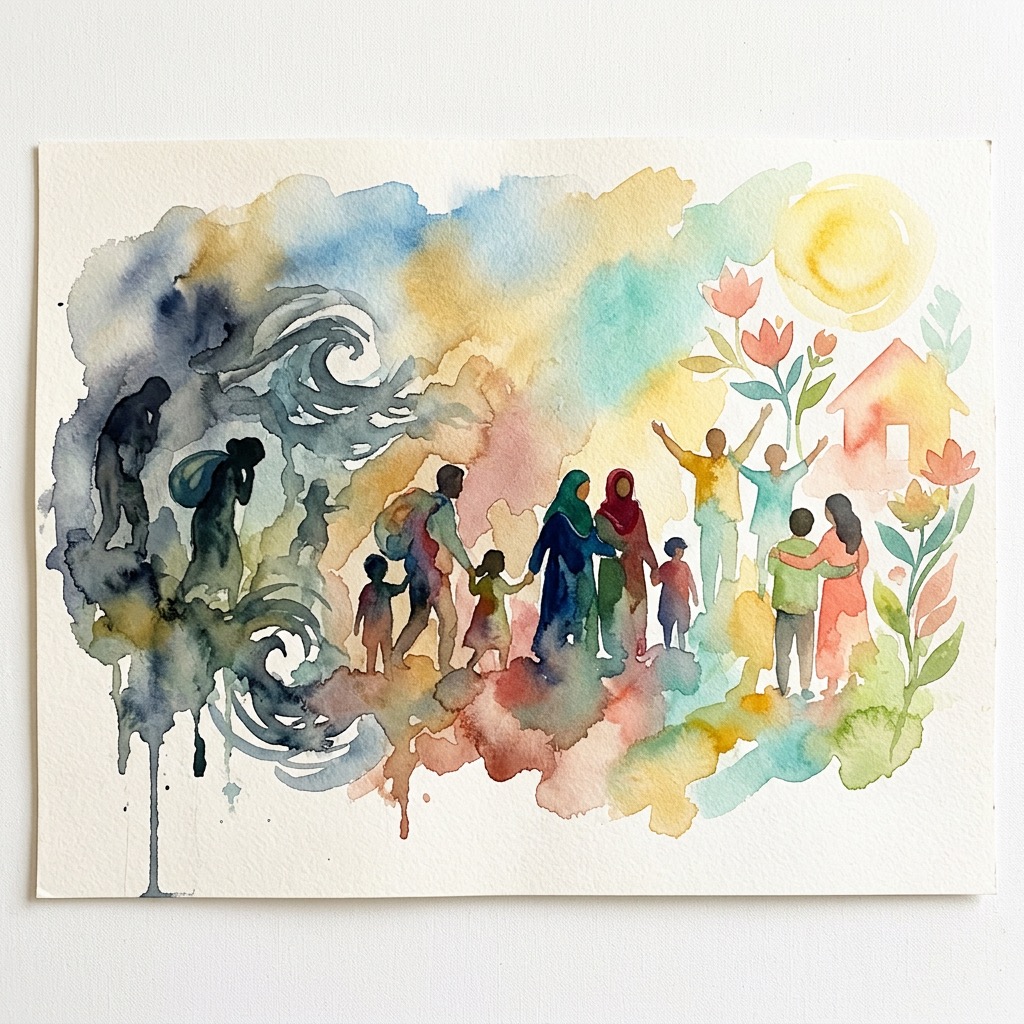
At Pentecost, we sometimes make a contrast with the story in Genesis about the Tower of Babel, where God acted against human pride by confusing people through making them speak different languages. Here, we have God crossing the language barrier through the gift of tongues. It isn’t that people are restored so that everyone speaks one language, but the Holy Spirit crosses over the barriers of human language and culture.
This is a sign of two forms of reconciliation: one is that God’s mission is to reconcile all people of all races and backgrounds to himself through Jesus Christ. The other is that the Holy Spirit enables reconciliation between people of different cultures and nationalities.
It’s not that there are different ways to God in different parts of the world, and that all religions lead to God. The way to reconciliation with him is through Jesus, for that is who the Spirit reveals. There is a strong mission and evangelism impulse in the outpouring of the Holy Spirit. The Spirit doesn’t simply come to give Christians a good time; the Spirit comes to send us into the world with the Good News of Jesus.
Then, in a world riven with fear and hatred between people of different races, the Holy Spirit comes to take down the barriers and build bridges of reconciliation. As someone who grew up in what became an increasingly multi-racial church, I have seen this.
And in a world where asylum seekers are demonised, the work of the Spirit is very much not about claiming white privilege. The early church, once it broke out of its initial Jewish context, quickly became a mixture of cultures. And they were known how? By their love. A love that transcended masters and slaves, male and female, Jew and Gentile. What would it say to our world if it saw the church modelling something similar today?
Conclusion
We began by saying that Pentecost is about God’s mission of restoration. It calls us to holiness, depending on the power of the Holy Spirit, carrying the presence of God into the world, and proclaiming reconciliation both with God and one another.
It’s time to stop being sheepish about the Holy Spirit. Instead, we urgently need to welcome the Spirit.


What Do You Think?