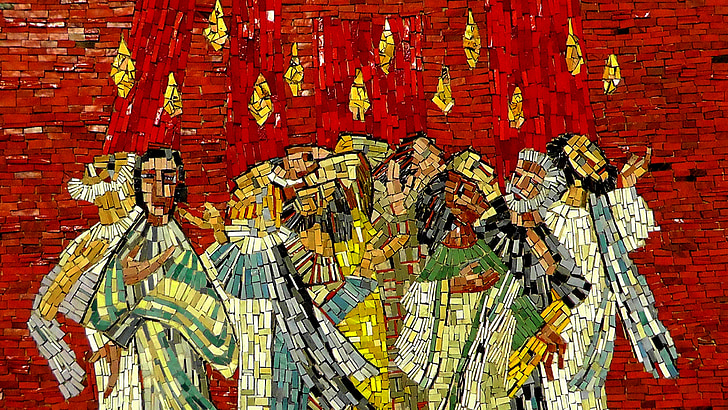
Demystifying Pentecost, Acts 2:1-21

Acts 2:1-21

Religious brick wall painting at PickPik. Public Domain.

It has been said that neither Protestants nor Catholics really believe in Father, Son, and Holy Spirit. Catholics believe in Father, Son, and Holy Mother, and Protestants in Father, Son, and Holy Bible.

In other words, all sorts of Christians become embarrassed about believing in the Holy Spirit.

And both the strangeness in the biblical account of Pentecost plus the apparently wild behaviour (at least to traditional Christians) in Pentecostal churches only exacerbates that disconnect from the Holy Spirit.

Therefore, what I want to do today is demystify Pentecost and the Holy Spirit. For however unfamiliar some of the account in Acts 2 is to many churchgoers in the older denominations, there is important truth for us to receive in this narrative.

And if some of it is strange – don’t be discouraged. Luke had trouble describing it. He refers to ‘a sound like the blowing of a violent wind’ (verse 2) and ‘what seemed to be tongues of fire’ (verse 3). This is awe-inspiring, and a moment of wonder.

Firstly, Pentecost is about restoration:

Restoration Techniques → Area → Sustainability at sustainable-directory.com. CC 4.0.

Pentecost celebrated the first fruits of the harvest.  The full harvest festival would come later, at the Feast of Tabernacles. But in late Spring, Israel would rejoice that the first fruits of the harvest were appearing.

This is an image that Paul uses about the Resurrection. He says that the Resurrection of Jesus is the first fruits, and he looks forward to the full harvest when all will be raised from the dead. And not only that, God will make all things new, including heaven and earth.

Pentecost puts us in that period between the first fruits and the final harvest – between God beginning to make all things new when he raised Jesus from the dead, and the great day when everything will be renewed and healed.

There is a biblical name for this period. It’s called the ‘last days.’ We are probably used to hearing ‘the last days’ from preachers who are predicting the imminent Second Coming of Jesus, but in the New Testament the last days is this entire period when the coming kingdom of God overlaps with the existing kingdom of death and sin, a time when God begins to make all things new. You will notice that Peter made reference to it in his Pentecost sermon. All that talk about ‘the sun being turned to darkness and the moon to blood’ was not a reference to today’s weather forecast from the Met Office.

Pentecost puts us in this season of restoration, even though much continues to happen that is anything but that. All those things we long for, and which we know God will ultimately bring in a full and perfect way – health, peace, justice, full provision of every need, the healing of relationships, you name it – are ministries of the Holy Spirit now.

So where is God calling you to make a difference for good in the world? Where is he calling you to rebuild and be an agent of restoration? The key to your response is to call on the Holy Spirit, who will work these things that we cannot do of ourselves.

Secondly, Pentecost is about holiness:
Your Pastor Is Not A Therapist by David Gate at rawpixel.com. Public Domain.

Pentecost was one of three Jewish festivals where pilgrims came to Jerusalem. As well as marking the first fruits of the harvest, it commemorated God’s giving of his Law to Israel at Mount Sinai during the Exodus.

Pentecost marks the New Testament response to that. For people tried and failed to keep God’s Law. Moreover, others used it as the mark of who was in or who was out of God’s People, and perhaps still others said that keeping the Law was your way of being in favour with God. Which was a problem if everyone failed.

Now, just as Ezekiel 36 prophesied the day when God would give his people a new heart and a new spirit, so the Spirit of God is poured out on all God’s people so they may have power to do the will of God. It is why Paul told the Galatians to ‘keep in step with the Spirit.’

We want to please God, don’t we? We want to do it, not to earn salvation but to show our gratitude that he has saved us from sin through Jesus Christ, his cross and resurrection. To live that life of pleasing God, he helps us by sending the Holy Spirit.

Pentecost is a day to rejoice that our struggles to obey God can be addressed. It is a day when we can go from ‘Can’t do’ to ‘Can do’ in the kingdom of God. If we want to be a ‘can do’ Christian, then we welcome the gift of the Holy Spirit.

Thirdly, Pentecost is about power:
Background Wallpaper Energy at needpix.com. Public Domain.

We see this in the way the Spirit comes ‘like the blowing of a violent wind.’ Wind or breath is the same as ‘Spirit’, in both Old and New Testaments. This is therefore the fulfilment of Jesus’ words where he told the disciples to stay in the city until they were clothed with power from on high.

A couple of years ago, I had a serious problem with my car, thanks to Peugeot failing to include monitoring of the cam belt in my service plan. Fortunately, a call to my dealer and their diagnosis caught the issue just in time before my engine was trashed. The dealer then fought Peugeot to get them to pay for the repair.

As a result, I started looking into the current car market, and it is so different from when we last bought one. Now, as you will know, it is as easy to buy an electric or hybrid vehicle as it is a conventional petrol-engined model.

But whatever car you go for, you need power, be that electric, petrol, or a mixture. Your wagon will not move without it.

Yet we forget this when we come to the Christian life. We think we can get on with things in our own strength or using the right techniques. What fools we are.

Pentecost is the reminder we badly need that we are utterly dependent upon the power of God to live for Jesus Christ. Today is the day we need to bring us back to that need for divine power, the Holy Spirit.

And what’s distinctive about the Spirit’s power is that it is related to the Cross – something certain Christians seeking to exercise power in the USA at present seem to have forgotten.

Fourthly, Pentecost is about presence:

Free bold abstract painting background at rawpixel.com. Public Domain.

‘What seemed to be tongues of fire’: time and again in the Bible, fire signifies the presence of God. Whether it was the burning bush, or the pillar of cloud by day and pillar of cloud by night that God used to lead Israel in the wilderness, or the God who answered by fire when Elijah confronted the prophets of Baal at Mount Carmel, fire is a symbol of the divine presence.

But that presence only came upon a few select individuals before Pentecost. Moses longed for the day when the Spirit of God would come upon all of God’s people, and they would prophesy. Pentecost is the occasion when Moses’ prayer is answered.

The presence of God comes upon all the disciples. Not just those who had been selected as apostles; there were a hundred and twenty gathered when the Spirit fell. Thus it is that Peter in his sermon goes on to quote the prophet Joel, who foresaw the day when the Spirit would come upon both sons and daughters, the young and the old, and female and male servants.

If you are a follower of Jesus, the Holy Spirit descends upon you and resides within you. No exceptions. The Spirit is not the deluxe gift for the especially enthusiastic, but the birthright of all Christians.

As a result, not only do we have the awe-inspiring comfort of knowing that God is always with us, but we also become carriers of his presence into the world. Part of our mission is for people to meet the presence of God through us. Therefore, we need to tend the gift of the Holy Spirit. To go back to my illustration of the car, we need either to fill up with petrol or charge it with electricity. So too do we need to ensure we are full of the Spirit.

The evangelist D L Moody was once speaking at a meeting about the text in Ephesians, ‘Be filled with the Spirit.’ He pointed out (correctly) that the Greek means, ‘Continue to be filled with the Spirit.’ Afterwards, a vicar objected to this teaching. ‘Why do I need to continue to be filled with the Spirit when I have already received him?’

Moody replied: ‘I need to continue to be filled with the Spirit, because I leak.’

Fifthly and finally, Pentecost is about reconciliation:
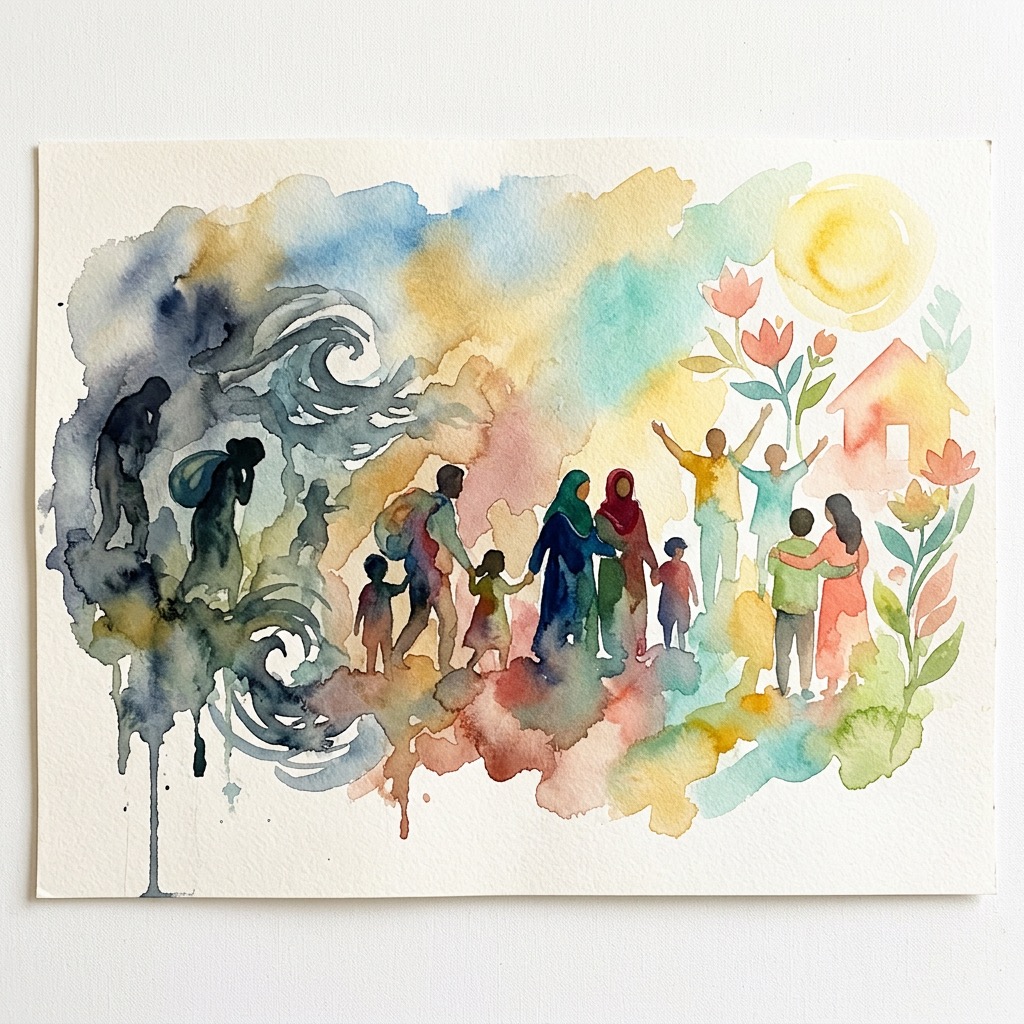
Refugee Resettlement Watercolor Painting | AI Art Generator | Easy-Peasy.AI. CC 4.0.

At Pentecost, we sometimes make a contrast with the story in Genesis about the Tower of Babel, where God acted against human pride by confusing people through making them speak different languages. Here, we have God crossing the language barrier through the gift of tongues. It isn’t that people are restored so that everyone speaks one language, but the Holy Spirit crosses over the barriers of human language and culture.

This is a sign of two forms of reconciliation: one is that God’s mission is to reconcile all people of all races and backgrounds to himself through Jesus Christ. The other is that the Holy Spirit enables reconciliation between people of different cultures and nationalities.

It’s not that there are different ways to God in different parts of the world, and that all religions lead to God. The way to reconciliation with him is through Jesus, for that is who the Spirit reveals. There is a strong mission and evangelism impulse in the outpouring of the Holy Spirit. The Spirit doesn’t simply come to give Christians a good time; the Spirit comes to send us into the world with the Good News of Jesus.

Then, in a world riven with fear and hatred between people of different races, the Holy Spirit comes to take down the barriers and build bridges of reconciliation. As someone who grew up in what became an increasingly multi-racial church, I have seen this.

And in a world where asylum seekers are demonised, the work of the Spirit is very much not about claiming white privilege. The early church, once it broke out of its initial Jewish context, quickly became a mixture of cultures. And they were known how? By their love. A love that transcended masters and slaves, male and female, Jew and Gentile. What would it say to our world if it saw the church modelling something similar today?

Conclusion

We began by saying that Pentecost is about God’s mission of restoration. It calls us to holiness, depending on the power of the Holy Spirit, carrying the presence of God into the world, and proclaiming reconciliation both with God and one another.

It’s time to stop being sheepish about the Holy Spirit. Instead, we urgently need to welcome the Spirit.

New Beginnings 3: Occupy The Land (Joshua 1:1-9)

Joshua 1:1-9

Moses my servant is dead. (Verse 2a)

It’s not quite what we experience in Methodism when one minister leaves and a new one arrives. Or, as is the case here, one minister in the circuit changes responsibilities and a new one arrives. But it is that time when we break with the past and set out on a new adventure. 

Now then, you and all these people, get ready to cross the River Jordan into the land I am about to give to them – to the Israelites. (Verse 2b)

I know our call is not literally to occupy geographical land, as was Israel’s. Nor is it military conquest. For Christians, crossing the Jordan and occupying the land is metaphorical. It is about breaking out of our holy huddles and bringing the Good News of God’s victory in Jesus Christ into the world. 

But even so, there are some parallels between the commands God gives Joshua and what he requires of us as we begin moving forward. These are commitments we can renew at our Covenant Service. Here are three. 

Firstly, be strong and courageous.

6 Be strong and courageous, because you will lead these people to inherit the land I swore to their ancestors to give them.

7 ‘Be strong and very courageous.

I think Joshua gets the memo! Be strong and courageous; be strong and very courageous. 

There is no doubt that we need strength and courage to announce the Good News of God’s victory in Jesus Christ to the world. We know that we risk being mocked, ignored, or maybe at best patronised. We know that we live in a society that understands life in a very different way from the historic Gospel. On occasions, the difference can be so much that we are assumed to be a threat to the well-being of our society, and we are treated as enemies. The number of people with a residual sympathy for Christianity is declining fast.

When our world is like that, it’s little wonder that we can feel nervous about speaking up for Christ. No wonder we get worried. Unlike Israel, we do not face military enemies who can take our lives, but we do face people who may be cruel with words and other actions. 

We too need to hear the injunction to be strong and courageous. We need strength that will overcome our paralysing fears so that we act in word and deed for the Gospel. 

We need strength and courage to overcome the excuses we make for keeping silent about Jesus. I’ve heard some Christians engage in worthy social action programmes but keep quiet about their faith, while claiming that their social action was their evangelism. No, it wasn’t. It was a demonstration of the Gospel, but the Good News still needs to be proclaimed and explained. That requires our words. 

We don’t all need to be confident evangelists with slick presentations, we just need to be people who are willing to speak of what Jesus has done for us and what he means to us. We are witnesses: we speak of what we have seen and heard. 

Neither do we all need to be people with clever answers to the questions and objections people raise against our faith. We can say with all honesty, I don’t know an answer to what you are saying, but I will come back to you. In the meantime, we can bring their questions to the Christian community for reflection, and where people who are more specialised in their knowledge can offer some thoughts. We can and should do our own thinking, too – O for more Christians to do serious reading about their faith in between Sundays. 

At heart, we simply need to be people who will speak of the difference Jesus has made in our lives. A friend of mine is an Anglican priest, and he is serving in parishes in the Church in Wales. Every week, he puts a video on Facebook of an ordinary church member speaking about the difference Jesus has made them. 

Can we do that? If Jesus went to the Cross for us, surely we can do that? The Cross gives us the strength and courage we need. 

Secondly, be scriptural.

Be careful to obey all the law my servant Moses gave you; do not turn from it to the right or to the left, that you may be successful wherever you go. 8 Keep this Book of the Law always on your lips; meditate on it day and night, so that you may be careful to do everything written in it. Then you will be prosperous and successful.

Joshua doesn’t have the whole Bible at hand – obviously! He just has the Law that God has given Moses. But he is to follow the revelation he has been given. 

We, on the other hand, do have the entire Bible. It is the collection of books which the Church recognised had the particular signs of the Holy Spirit’s work as the apostles, prophets, and others recorded in their own styles what God had revealed to them. 

And in handling the Bible, we hold no ordinary book, or library of books. We hold a collection that in classical Christian terms is sufficient rule for our faith and practice. Its origins with the Spirit’s guidance of divinely commissioned messengers makes it the written Word of God. Its job is to point us to the living Word of God, Jesus himself. 

As Christians, we therefore have no liberty to depart from and contradict the teaching of Holy Scripture in all that it affirms about our faith and practice. We cannot soften our message when the world doesn’t like it. We cannot adapt our meaning to make it more congenial, for if we do so we are more concerned to please people than please God. And in any case, if we think that making ourselves more like the world will bring more people into the church, we are seriously deluded. If they don’t have to change, there is no need for them to join us! 

In my ministry among you, it will be my task to expound the teaching of the Bible as our primary guidance in their faith. I know there are difficult parts. Some are difficult, because we don’t understand them. Other passages are difficult, because we do understand them and don’t like them. But I will grapple with the difficulties and seek to provide a lead through such exposition. 

And I therefore call every Christian to a regular and sustained encounter with the Bible, so that we may engage seriously with the written Word and let it reveal to us the will of the living Word, Jesus himself. 

Can we renew that commitment at this our Covenant Service?

Thirdly and finally, the promise of God’s presence.

Have I not commanded you? Be strong and courageous. Do not be afraid; do not be discouraged, for the Lord your God will be with you wherever you go.’

There it is a third time: ‘Be strong and courageous.’ Only this time it isn’t simply a command. It’s accompanied by a promise. In the Lord’s desire for us not to lapse into fear or discouragement, he makes Joshua and his people a promise: ‘the Lord your God will be with you wherever you go.’

There is something similar here to the promise of Jesus to be with us always, even to the end of the age in Matthew 28. In both cases, the promise of the divine presence with his people is given in a specific context. And that context is of God’s people being sent out into the world as witnesses to him. Israel and her army will witness to the presence of God as they occupy a land where tribes who practise detestable things such as child sacrifice are. Christians will go into the world with the Good News of God’s victory over death and sin in Jesus Christ. 

It’s not just a general promise for God to be with his people. It’s a promise that God will be with his people at the very time they may need strength and courage. 

It is as if God said, I didn’t make up all this going into places where people will be hostile just for a bit of fun as I watch you suffer. Oh no. I will be with you. 

Christians may not have the sort of visible signs of God’s presence that Israel had in the wilderness, such as the pillar of cloud by day and the pillar of fire by night. In any case, that didn’t always stop Israel from disobeying. 

But the sign of God’s presence with us is the gift of the Holy Spirit. The work of the Spirit is to bear witness to Jesus, and he will do that in many ways in our lives. He will help us see Jesus in our everyday. He will fill us with the peace of Christ, and not only individually, the peace of Christ will dwell in our midst. The Spirit will be there to help us speak when we are opposed. He will be our Advocate when we are under accusation. 

We may be a long time past Pentecost in the church calendar, but this is as good an occasion as any in the Christian Year to cry, ‘Come, Holy Spirit. Come with the presence of God. Come to make us strong and courageous as we witness to Jesus. Come and enliven the Scriptures as we read them so that we may know the will of God.’

Yes indeed: come, Holy Spirit.

Transfigured Jesus, Transfigured Lives (Mark 9:2-9): Worship for the Last Sunday Before Lent (Transfiguration SundaY)

This is the last of our Epiphany/Ordinary Time themes before Lent kicks off on Wednesday. I shall then be following the series ‘Worship in the Wilderness‘ from Engage Worship throughout Lent. If you want to follow that devotionally, you can buy a book to go along with it.

Mark 9:2-9

Our set reading from Mark’s Gospel takes quite a leap this week from last week. For the last few weeks we’ve been in the beginning of the first half of Mark, looking at the early ministry of Jesus.

But this week we jump to the beginning of the second half of Mark’s Gospel. Just before this reading, the first half has come to a climax with Simon Peter confessing that Jesus is the Christ. However, his understanding of that proves to be deficient, when he reacts adversely to Jesus’ first prophecy of his forthcoming suffering and death.

Peter has the right words, the right creed if you like, but not the right understanding. He appears not to be alone, because Jesus teaches the whole crowd about his suffering and also the suffering that his followers will face.

Then he prophesies that some of those present will not taste death until they have seen the kingdom of God come with power (verse 1).

I go into this detail, because Mark clearly links today’s story with that episode in his opening words: ‘After six days’ (verse 2). If Peter and any other disciples cannot understand the link between who Jesus is and how his mission will be carried out through words and arguments, then the experience of a dramatic divine encounter may do the trick.

As a scholar named James Edwards writes,

In Peter’s confession Mark teaches how disciples should think about Jesus (8:33), and in the subsequent transfiguration narrative he allows them to behold his true nature.[i]

If theological argument won’t work, then perhaps experience will.

Firstly, the Transfiguration is a story of divine revelation. Mountains were often places in the Bible where God said or did something special, and all the more if – like this one – it was described as a ‘high mountain’ (verse 2). Specifically, this account is reminiscent of Moses going up Mount Sinai to meet with God and receive the Law. Even the six-day gap between this story and the previous one may echo the six days Moses spent at Mount Sinai with God.

All this, then, should prepare Peter, James, and John for a word of revelation from God. Frightened as we know later on they are (verse 6) – and no surprise at that – the clues are there for them as devout Jews to recognise that they should prepare for a revelation from heaven itself.

Sometimes I wonder how prepared we are to hear from God. Is it because we bumble along from the day to day without tuning ourselves in that we rarely hear from him? Is it that so often God has to interrupt our daily routines in an attempt to catch our ears? Might it be that we could tune ourselves in, ready for when he wants to reveal something to us?

This is why I bang on from time to time about our use of the spiritual disciplines, such as personal Bible reading and prayer. These practices get us used to the voice of God. That voice will not always speak something big and dramatic as in today’s story, but as a baby learns soon to recognise its parents’ voices, so we need to do the same with God. The more we practise the spiritual disciplines, and the more we look and listen for the signs of his presence in our routine duties.

Secondly, the Transfiguration is an account of divine glory.

2b There he was transfigured before them. 3 His clothes became dazzling white, whiter than anyone in the world could bleach them.

Think back to Christmas for a moment. Maybe not this last Christmas specifically, but the Christmas season generally.

Specifically, think back to singing ‘Hark! The herald-angels sing’ and that line, ‘Veiled in flesh the Godhead see.’ God coming in human flesh meant that we were shielded from the dazzling brilliance of God’s glory. It is almost too much to bear, rather like the way we warn children not to gaze directly at the Sun.

But here at the Mount of Transfiguration, all the layers that protect sinful humanity from encountering the divine glory are stripped away.

Despite the faltering description, v. 3 succeeds in conveying that the transfiguration is so complete that Jesus’ clothing as well as his person is transformed. …

The diaphanous garments and brilliant face of Jesus signify total transformation and suffusion with the divine presence.[ii]

Jesus reflects the presence of God every bit as much as Moses did on Mount Sinai, if not more so. God hasn’t spoken his revelation yet, but he is showing up.

So again, Peter, James, and John are being called to attention. What they find themselves in counts. It’s important.

Not every Christian has dramatic experiences of God, but most of us would talk about times in our lives when God has seemed especially close. Sometimes those seasons of closeness and almost tangible presence are there to comfort or reassure us through a hard time, but on many other occasions, like the Transfiguration, God is not simply wanting to give us a spiritual thrill, he is wanting to transform us more into people who reflect his glory.

I simply want to ask whether we are open to that.

Thirdly, the Transfiguration is a narrative of divine supremacy, and specifically of Jesus’ supremacy.

4 And there appeared before them Elijah and Moses, who were talking with Jesus.

Why Elijah and Moses? There have been various theories, but the important thing is this: the way this is worded originally gives an indication that they are not equals with Jesus: ‘they hold an audience with Jesus as a superior.’[iii] They appear and they disappear. There is no command to listen to them. They are ‘representatives of the prophetic tradition that, according to the belief of the early church, would anticipate Jesus.’[iv]

Jesus is superior to both of them. Their lives and ministries pointed ultimately to the fulfilment of God’s plans in Jesus. And Jesus is not merely a prophet, as religions like Islam would have you believe.

Jesus is more than our Friend and our Brother. He is more than the celestial lover that some hymns and worship songs portray. He is more even than Saviour. He is Lord.

Peter, James, and John here are learning that Jesus isn’t just a wonderful rabbi. He’s even more than Israel’s promised deliverer. They owe him their allegiance.

And so do we.

Fourthly, the Transfiguration speaks to us of divine presence.

5 Peter said to Jesus, ‘Rabbi, it is good for us to be here. Let us put up three shelters – one for you, one for Moses and one for Elijah.’ 6 (He did not know what to say, they were so frightened.)

Poor Peter. He and his friends are scared out of their wits. What comes out of his mouth is something that would be worthy of a typical pious Jew. He wants to build shelters, or tabernacles, and the Jews looked forward to a time when God would build a new tabernacle or dwelling for his presence on earth to replace the old one that Israel had had in the wilderness.[v]

But what he doesn’t yet grasp is that the new tabernacle is here already. Jesus is the new tabernacle. He is the presence of God on earth.

So Jesus is more than one who is ranked higher in God’s ranks than Elijah and Moses. He is the presence of God on earth. That is enough to blow the fuses in the mind of a devout Jew. It is why many learned Jews rejected Jesus.

But when you meet Jesus, you meet God. Later Christians would look at all the biblical data and formulate the doctrine of the Trinity, but here is one major sign of how Jesus expanded and exploded traditional Jewish beliefs about one God, the chosen people, and the messianic hope.[vi]

Jesus, being God who came in human flesh to earth, is the climax of God’s plans. And as such, we see everything through the light of him. We interpret our hopes and dreams in the light of Jesus. We interpret the Scriptures in the light of Jesus. We frame our very lives in the light of Jesus.

When we realise that God has been present on earth through Jesus and that he is still present through his Spirit, how does that change the way we live?

Because it should.

Fifthly and finally, the Transfiguration speaks to us of divine vindication.

7 Then a cloud appeared and covered them, and a voice came from the cloud: ‘This is my Son, whom I love. Listen to him!’

8 Suddenly, when they looked around, they no longer saw anyone with them except Jesus.

You may recall that a voice from heaven spoke to Jesus in similar terms at his baptism: ‘You are my beloved Son, I am well pleased with you.’ Here, the words are similar, but they are not addressed to Jesus. Instead, God the Father speaks to Peter, James, and John: ‘This is my Son, whom I love. Listen to him!’

They were to listen to all that Jesus had told them. Doubtless – and most importantly – that referred to his prophecies of his coming suffering and resurrection, which had offended Peter so much.

No: the voice from heaven tells the disciples that what Jesus has said is right and true. You must take it on board, even if you don’t understand it.

When we make Jesus out to sound so much like us, with similar views to us, similar ethical standpoints, similar political views, and so on, then we no longer have Jesus, we have an idol. Jesus will always say and so things that go against the things we cherish. But because of his divine nature, we are the ones who need to change.

And here, that’s just what the Father expects of Peter, James, and John. Put aside your objections to the Cross. Put aside your assumptions that you know better.

And that’s a very fitting place for us to end this week’s reflection, especially as we prepare to enter Lent on Wednesday. The Transfiguration calls us to a life where we increasingly conform our will and our ways the will and the ways of Jesus, who has the right to do this, as God who came to Earth. And whose journey to Earth led to the Cross.

We start that journey again now, and as we go into Lent.


[i] James R Edwards, The Gospel According To Mark, p261.

[ii] Edwards, p263, p264.

[iii] Edwards, p265.

[iv] Edwards, p265.

[v] Edwards, p266.

[vi] ‘Monotheism, election, and eschatology’ in NT Wright’s words.

Video Sermon: You Have Never Been This Way Before – How To Face New Challenges

I wrote and recorded this week’s video a week ago, so it was before last night’s announcement by the Prime Minister that England is being placed in another lockdown from Thursday coming.

Joshua 3 has been significant for me for a long time as a guide to how we face new challenges in life. And we certainly need that help right now.

I hope this helps you, too. If it does, please share this on your socials.

Video Sermon: How Do We Understand The Presence Of God?

Continuing with the story of Moses and the Israelites, this week we arrive at Exodus 33:12-23.

However, rather than explore this story, I’m taking up one important theme in it – the presence of God – and giving a sketch of that subject as it appears through Scripture.

I hope you find these thoughts helpful in your own life.

Create a website or blog at WordPress.com

Up ↑