
I’ve spent Holy Week this year offering reflections on some of the characters in the Gospel stories of Jesus’ passion and crucifixion. On Monday in the first of our three daily meditations, I explored Mary of Bethany with you. On Tuesday, we wrestled with the stories around Judas Iscariot, before thinking on Wednesday about Peter.
At the Maundy Thursday meal, we focussed on the Beloved Disciple, and I carried this over on Good Friday to my services where we looked at Simon of Cyrene.
For all of these, my inspiration was a book from 1999 called At The Cross by my own postgrad supervisor Richard Bauckham and Trevor Hart.
Today, I want to continue with some characters in the story, but Bauckham and Hart’s book doesn’t extend to the Resurrection, so with a little help from Craig Keener’s commentary on Matthew, I offer you the challenge of the Good News as seen in the characters around the empty tomb. We’re going to consider the women, the angel, and the soldiers.
Firstly, the women:
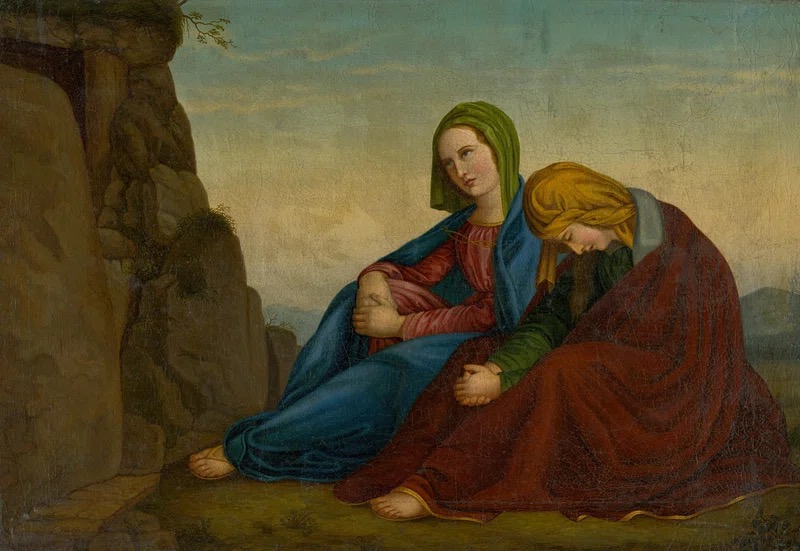
The women are about the customary business of women after a death. It was usual to bring spices to a tomb, but men could only tend to the bodies of dead men, whereas women could care for both dead women and dead men. When Mary Magdalene and the other Mary visit the tomb, this is nothing out of the ordinary.
But their routine is exploded by what they find. They were not expecting to find the tombstone rolled away. More likely, they were preparing to ask permission of the soldiers to attend to Jesus’ body. They certainly weren’t anticipating a conversation with an angel.
Angels have a habit of interrupting the normal and transforming it. Ask Mary, the mother of Jesus. Ask a certain group of shepherds. Ask Abraham, and numerous others.
How are the women transformed? They become the first witnesses to the Resurrection. Not only do they see the evidence of the empty tomb, but they also meet the risen Jesus.
And moreover, they receive a commission to take the news to the disciples. Yes, those male disciples that Jesus had taught and trained over the three years, but who had failed him at the end. The women hadn’t, and the angel calls them to do something that later Paul would say was a qualification for apostleship: see the risen Jesus and be a witness to his Resurrection.
Who would expect that in a culture where women could not give evidence? It’s just one of those details you would never include if you were making up the story. People considered insignificant and of lesser value in their society – women – were given an apostolic call. That’s a long way from the traditional and expected habits that had brought them to the tomb that morning. They didn’t have this on their agenda that day.
Therefore, I want to ask you whether you are open to the risen Lord bursting in on the normal routines of your life and transforming them. Does Jesus have a call for you? Never mind the conventions of our society. Don’t sit there thinking I’m dyslexic, I’m neurodiverse, I’m too young, I’m too old, I’m the wrong skin colour, I don’t have the right education, I lack confidence, I’ve got secret shame, I’m disabled, or anything else you care to add. The things that are barriers for the world are not barriers for the risen Lord. If God by his Spirit can raise Jesus from the dead, then it is no trouble at all for him to jump over the hurdles our world puts in the way of people doing something significant.
It was in the Easter season in 1985 when God interrupted me, through a sermon by a Local Preacher on Low Sunday where in John 21 Jesus says to Peter, ‘Feed my sheep,’ that my journey to ministry began. It took me a long time to unravel what that interruption that morning meant, but it was a resurrection moment for me. I thought I was just doing my usual duties as a church steward that morning, but the risen Lord had other ideas.
What about you this Easter?
Secondly, the angel:
While I was training for the ministry at Manchester, one of the northern students was very keen on wrestling. He organised outings to watch wrestling bouts. I never could understand it, because to me, having been a child when my grandmother, who lived with us, stayed glued to World of Sport on a Saturday afternoon to see Mick McManus, Jackie Pallo, Giant Haystacks and others, the appeal of wrestling was for old ladies. Why my friend Peter should persist in inviting me to something so camp, I could not understand. I never felt it belonged in the arena of sport, it was more like pantomime.
And of course, despite my aversion to it, I cannot erase from my memory the notion of ‘two submissions or a knockout’ to win, and how, when one wrestler had gained a submission from his opponent, he would often sit on him in triumph.
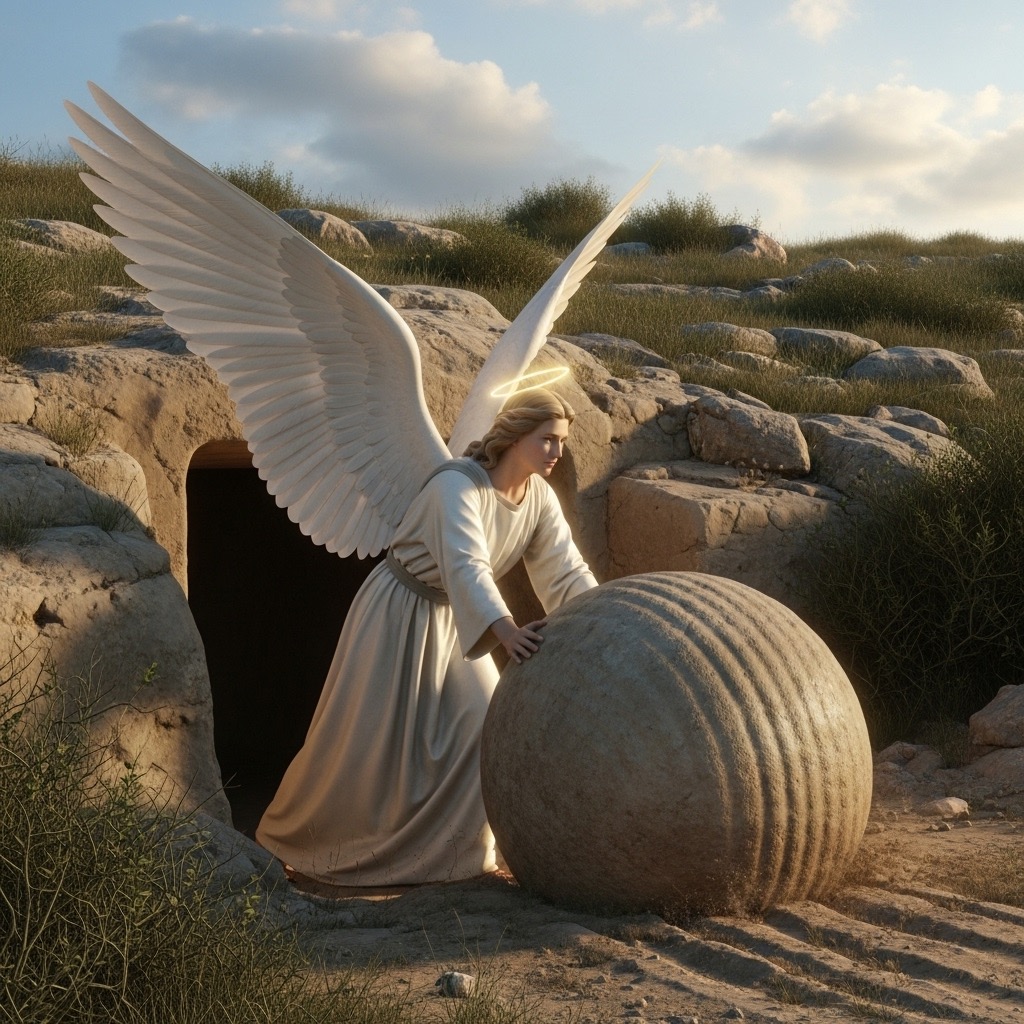
Well, here, on Easter morning, an angel sits not on the guards who have been so shaken by his arrival but on the stone he has rolled back. It’s not the soldiers who have been conquered so much as death itself. Not two submissions, just a knockout.
Easter Day is the supreme day of triumph. As the angel sits on the tombstone, we know that everything the New Testament claims for Christ’s work on the Cross is true and is vindicated. So –
- Jesus has died in our place and our sins are forgiven;
- Jesus has conquered what the Bible calls ‘the principalities and powers’ and all the forces of evil;
- Jesus has fulfilled all that Adam and then Israel failed to do, by turning sinful human flesh back into obedience to the Father, right through to death;
- Jesus has shown that the route to eternal life is not by violence, but by the way of the Cross.
Next time an inner voice condemns you for your sins, go and look at the angel sitting on the tombstone. Next time evil does its worst, cast your eyes at the angel on the tombstone and know that time has been served on evil. Next time you fail, look at that angel sitting in triumph know that Jesus has united you with him, and that’s who the Father sees when he looks at you. Next time you are troubled by world leaders who think they can bomb their way to freedom or cut down thousands of their own population to hold onto power, observe once more the angel who put his feet up on top of the tombstone and know that those ways will not last into eternity.
It was Friday, but Sunday has come.
Thirdly, the soldiers:
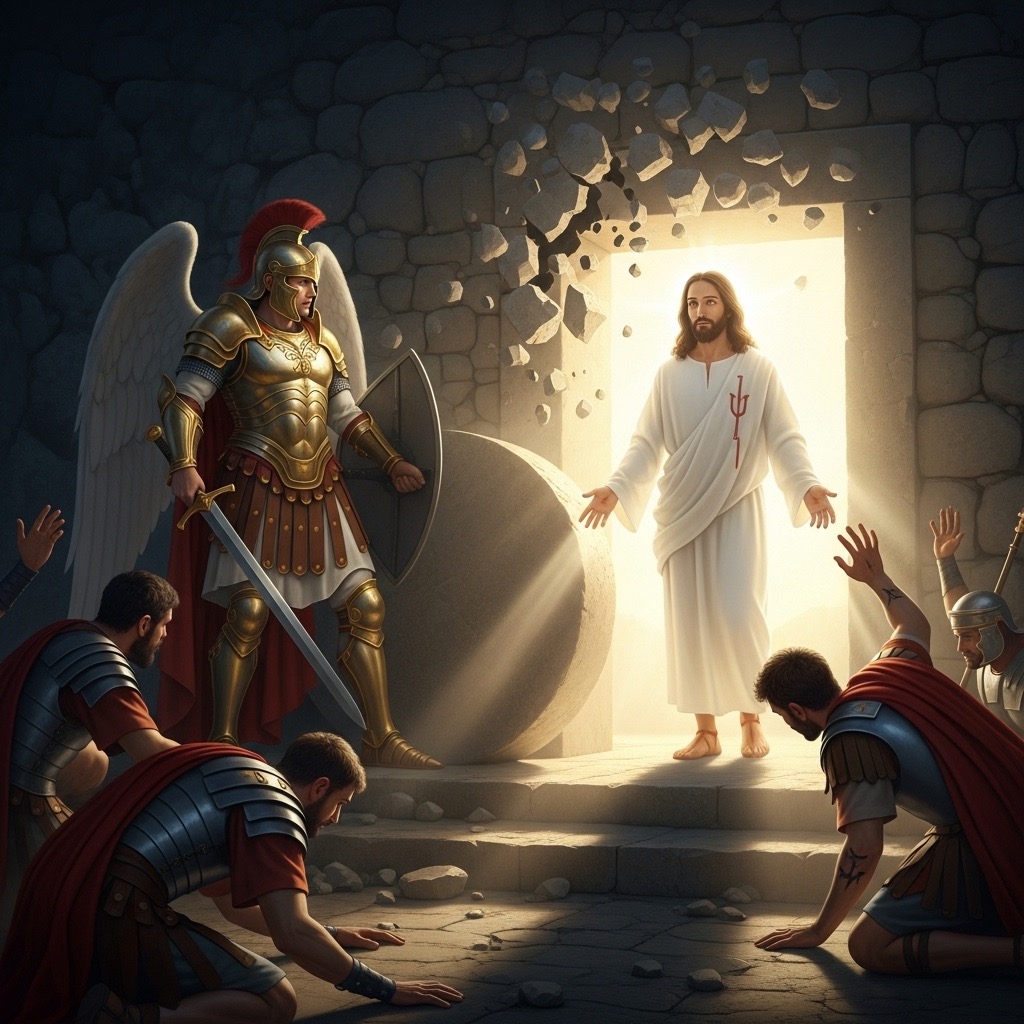
The soldiers are the first to witness the awesome divine power of the Resurrection, as they encounter the angel, but as they shake and become like dead men their hearts are exposed. They are not on the side of life, but the side of death. Their job has been to promote and protect death. Now, they cannot hear the words of grace that the angel has for the women. Fancy witnessing the power of God and staying with the forces of death.
If you have any doubts about what I am saying and think I am just being fanciful, remember what happens after this. In verses 11 to 15, which we didn’t read, the soldiers are perfectly happy to collude with the authorities in the lie that the body of Jesus has been stolen. They are not on the side of life or truth, but of death and falsehood.
What a warning this is to us all. The saving power of God has come up close. The Good News has been enacted in front of them. But still, they choose death. Still, they choose to embrace a lie. Moreover, they allow themselves to be bribed with a large sum of money in order to go along with the fiction that the chief priests want.
This is surely a sobering reminder to us not to miss the grace of God when it comes calling. Now is the day of salvation. Now, life in all its fulness opens up before us. Now, the door of true freedom has been unlocked before our eyes. Why would we prefer the realms of untruth, monetary greed, and the decay of death?
But some people do. They are more entranced by the shrunken, shrivelled republic of sin than by the beautiful kingdom of love, joy, and peace. For it means putting aside a lifestyle where ‘me, me, me’ is at the centre, and where we can justify staying as we are on the grounds of what others have done to us, despite the fact that the death and resurrection of the king offers the prospect of those old wounds being healed through forgiving love.
The biggest mistake any of us could make on Easter Day is to be like the soldiers. The life-giving power of God in the Resurrection has come close. Through it, God bids us to walk with Jesus in newness of life, exchanging the dirty rags of our weaselly self-centredness for the clean robes of a disciple who puts Jesus first.
But the more we ignore that call, the more we put it off, the more we delay saying ‘yes’ to Jesus, the more is the risk that one day that life-transforming power will stop calling. For God will realise we are not serious about him. He will confirm us in our own decision to harden our hearts. He will leave us in our selfishness and greed, shaking like dead men.
Easter Day is a day to witness that angel sitting triumphantly on the tombstone, to respond like the women who, though afraid, allowed the angel’s interruption to give their lives new direction, and ran away with joy to tell the good news, and to let dead soldiers bury their own dead.
 Big Circumstance
What Do You Think?