The Centre of Gravity of the Christian Faith, Matthew 16:13-20 (Trinity 12 Ordinary 21 Year A)

(I’m aware I preached on this passage as recently as May, but on that occasion it was a Church Anniversary at a different church. This time, it has come up in the Lectionary. There will be some crossover between the two sermons, but this is a newly-written message.)

Matthew 16:13-20

Our dog loves us to take him to a park with a stream running through it. We will collect sticks and throw them into the stream for him to retrieve. He jumps into the water, swims after the stick, and brings it back to shore.

But for all his intelligence, there is one thing he has not grasped about this game. Instead of carrying the stick in the centre, he holds the stick in his mouth at its end. Although it amuses us that it can look like he has a cigar, his failure to discover the centre of gravity can have awkward consequences. He may crash the other end of the stick into the ground and break it, for example. He clearly missed the lessons about balance at doggy school.

Finding the centre is important. A briefer version of this reading forms the centre of Mark’s Gospel. But here in Matthew, the content of this passage is central to the message of this Gospel. Moreover, the reading itself balances nicely into two halves. Hence, we’re going to think today firstly about Peter’s Confession (The Christ), and secondly Peter’s Commission (The Church).

Firstly, Peter’s Confession (The Christ)

Verses 13 to 16 are about who the disciples believe Jesus to be. He starts by asking who others say he is, but then focusses the question of them: ‘But who do you say that I am?’ (verse 15)

This is the question at the centre of Christian faith and at therefore at the centre of church membership. Who do you say Jesus is?

In the Methodist Church, people are not confirmed and brought into church membership just on my say-so as the minister. If people attend a confirmation class and I am satisfied they have confessed Jesus Christ as Lord and Saviour, then I have to bring their names to the Church Council so that the church can say whether we see that these people are Jesus-followers.

And that’s important. The question is not, are they nice people? If I want nice people, I can find them in all sorts of places outside the church. There are lots of nice people in the camera club where I am a member. But only a few have Christian faith.

Nor do we simply make a decision to avoid upsetting people. Jesus himself tells his disciples here that who they confess him to be is the most important question in all of life.

Let none of us rely on being ‘good’ or ‘nice’, because that won’t cut it with God. It is Muslims, not Christians, who rely on the hope that our good deeds will outweigh our bad deeds to be admitted to Paradise. The Gospel speaks in contrast about the grace of God in Jesus, through his death and resurrection. In response, we turn from sin to him and confess him as the Christ, the Son of the living God.

And it’s a confession to be made in the midst of life and all its pressures. Note that Jesus doesn’t ask the disciples to make their confession on home territory, or in somewhere safe and familiar like a synagogue. He does this when they come ‘into the district of Caesarea Philippi’ (verse 13). Why is that significant?

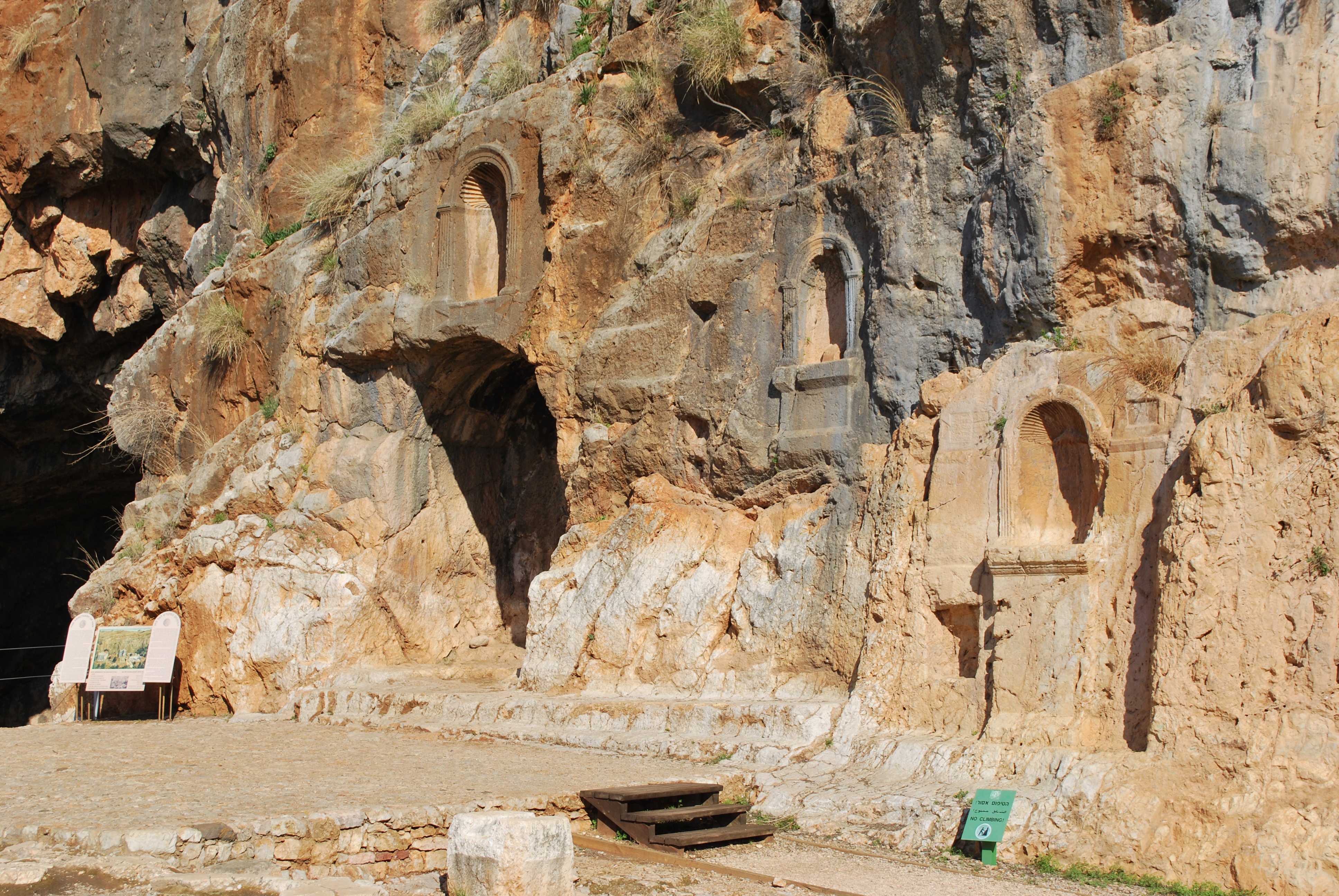
The recently renamed Caesarea Philippi was as pagan a territory as one could find: famous for its grotto where people worshipped the Greek god Pan[1]

At this centre of paganism, where other gods were worshipped, Jesus wants the allegiance of his disciples.

And he wants the same from us today. He calls us to confess him as our Lord in the midst of a society that offers plenty of competing false gods. Some of these are familiar to us. Look at the worship of money and possessions. Consider the way some people are devoted to celebrities, sportspeople, and entertainers. Ponder how others put their trust in extremist politicians. Still others expect romantic relationships to fulfil them, hence the phenomenon of relationship addiction and sex addiction.

In each of these cases, good servants have been elevated to the status of bad masters. And they will not fulfil all the desires their worshippers seek from them. Welcome to Pan’s Grotto, twenty-first century style.

But there is another way by which people are tempted to Pan’s Grotto, and it has been around a long time. It is the desire or expectation to short-circuit the process of hearing from God. In the Christian tradition, we often have to ‘wait upon the Lord’ to discern what he may be saying, but some want to hear instantly. And so, they turn to horoscopes or other occult methods, where it’s not God who is speaking to them.

There is a new variation on this desire to get an instant answer. I am hearing increasing stories of people who, rather than turning to the Scriptures and prayer to seek God’s voice, are instead relying upon … AI. A recent survey showed that 48% of Christians say they would trust AI with their spiritual growth. One in three American adults believe that spiritual advice from artificial intelligence is just as trustworthy as the advice a minister would give.

Older Christians will perhaps poo-poo those figures. But sometimes it’s those older Christians who are reading their horoscopes instead of their Bible. The problem goes right across the generations.

So I make the challenge today that we all confess Jesus as Lord of our lives, and that we place all the good things of life that we enjoy or aspire to under that Lordship. And further, that in confessing Jesus as Lord before the paganism of today, we accept the discipline of listening patiently for the voice of God, instead of taking short-cuts that lead us into spiritual danger.

Secondly, Peter’s Commission (The Church)

Verses 17 to 20 build on Peter’s confession as Jesus commissions him to be the first leader of his messianic community. The Greek word used for ‘church’ in these verses, ekklésia, is used in Greek translations of the Old Testament for the People of God. And surely it’s no surprise that Jesus as the Messiah of Israel will form a community of his people.

And it is, as I have already hinted, faith in Jesus alone that is the basis for Christianity, and therefore for membership of the church. Not niceness, not sincerity, not a religious club that is the centre and circumference of our social lives, but a community of people who have put their lives in the hands of Jesus.

Now this is not humanly achievable. It only comes, because God reveals it to people and we respond, as Jesus tells Peter. When we are seeking to spread the good news, one thing we must never lose sight of is that it is not us who convert people, but the Holy Spirit. All our evangelistic witness to build the church (verse 18a) depends not upon our techniques or clever words or good answers, but on the prior work of the Holy Spirit to reveal Jesus to people. Our prayers for mission begin with praying for the Spirit of God to go ahead of us and be at work before we get there. We then ask for the grace to join in with what the Spirit does first.

Isn’t it great that it doesn’t depend on us?

And isn’t it great, too, that the church is an indestructible community? What do I mean by that? Jesus says that ‘the gates of Hades will not prevail against it’ (verse 18b). I have been fond of saying for many years now that we have misunderstood these words. For too long Christians have understood this as meaning that no demonic schemes can prevail against us, even when we are trapped in a corner. But since when did gates go around attacking people? Gates are a defensive measure! If the gates of Hades cannot prevail, then given that Hades is the place of the dead in the New Testament, this means that it is the church that is on the offensive, and even death cannot stand in our way!

So be of good courage when you hear the stories of church decline. Yes, individual churches may decline and close, and we are no exception to that if we default to making our church experience about our personal preferences rather than seeking to glorify God. But overall, the church cannot fail. We are resurrection people. We plunder death to bring life in the Name of Jesus.

Within all this, Peter has a particular commission, and it’s to leadership and authority in this community of the Messiah. That’s what the language about being given the keys of the kingdom, and binding and loosing on earth on behalf of heaven (verse 19) are about. While I certainly think my Catholic friends have taken this too far in pointing to the papacy, I nevertheless agree with them that at this point Jesus commissions Peter as the first leader of the church.

A church cannot be anarchy. It cannot be a bundle of people where everybody just does what he or she wants. For example, I have lost count of the number of times I have encountered arguments in churches about styles of worship, where mostly they come down to personal taste rather than seeking to please God. So, there are those whose responsibility it is to say, this is what the teaching of Jesus and the Gospel is. There are those whose responsibility is to show the spacious place that is the Gospel, but also the boundaries of the faith.

Now that’s dangerous talk, in the eyes of some. There are those who are not willing to be corrected. But also, as we know time and time again, there are leaders in the church who have exercised their ministry in harmful ways, hurting others to bolster their own power. This must not be tolerated: those who are called to lead are to keep to the Gospel teaching themselves as a matter of example, and that includes fidelity to a Gospel lifestyle.

Peter will discover what that means in the next verses beyond today’s reading: the way of the Messiah is the way of the Cross, and he will be shocked. No wonder Jesus tells the disciples here not to tell anyone he is the Messiah (verse 20), because right now that is too outrageous and revolutionary to be contemplated, even by his own closest followers.

But this is how the community of Jesus will live, and it will be what its leaders exemplify. Tradition tells us Peter himself, despite his initial objections, will give himself to this way, too.

It is as far from the pagan Grotto of Pan as you can realistically go.


[1] Craig Keener, The Gospel of Matthew: A Socio-Rhetorical Commentary, p424.

The Extraordinary Faith of the Canaanite Woman, Matthew 15:21-28 (Trinity 11 Ordinary 20 Year A)

Matthew 15:21-28

Photo by it’s me neosiam on StockSnap

If you’ve ever had a baby screaming constantly in pain that has no words to tell you what’s wrong, or if you’ve ever cared for a child with a serious long-term health condition, then you might sympathise with the Canaanite woman with the demonised daughter. Jesus’ disciples are cruel and unsympathetic to the mother:

‘Send her away, for she keeps crying out after us.’ (Verse 23)

And then, before we make any progress in understanding this story, we must look at those troubling words Jesus says to this poor, distressed mother:

‘It is not right to take the children’s bread and toss it to the dogs.’ (verse 26)

There are some pretty unthinking progressive Christians who look at these words and confidently tell us that Jesus, by being a Jew of his day, was a racist, and he had to learn God’s truth from this Canaanite woman.

I know the words sound shocking, but this is nonsense. It shows they have not thought about the rest of Matthew’s Gospel. In the nativity stories, it is the Gentile Magi whose faith is commended, not the Jewish leaders. Jesus praises the faith of a Roman centurion in contrast to that of others. At the end of the Gospel, Jesus’ mission – which, yes, began with Israel – is extended to the ends of the earth.

There has to be a different explanation. We’ll come to that later, but I’m flagging up here at the beginning of the sermon that we shouldn’t accept simplistic, silly answers that don’t read the story in its wider context.

Firstly, she is persistent:

The Place of Persistence by Sheila Sund from Salem, United States, CC BY 2.0. Found at Wikimedia Commons.

Notice what the disciples say about the woman: ‘she keeps crying out after us’. It’s not a one-off. It’s continuous. The need she has for her daughter is such that she will not shut up. She will not take ‘go away’ for an answer. She will not give this up as a lost cause when she seems to be getting nowhere. She keeps crying out.

You see it in other ways, when she gets into conversation with Jesus. She doesn’t take what Jesus says lying down. She comes back at him. You could say she argues with him. Audacious doesn’t quite describe it. It’s faintly shocking that she doesn’t retreat the moment Jesus pushes back.

Like many a loving parent, she will do anything for the sake of her child. And this story effectively tells us that it’s fine to display a similar attitude towards God when we pray about deep needs, be they ours or of others.

Often, the problem is that we have been brought up to be reverent towards God, and that’s good and proper. God is holy. Reverence is a right response to him. But we take it so far that we end up being unable to speak with passion to God when things really matter, when they desperately matter.

But this woman was not the only character in Holy Scripture to speak audaciously to God about a significant need. Abraham prayed and prayed for the people of Sodom, that they be saved from divine judgment. He beat God down time and time again about the number of righteous people in the city.

Read the works of the psalmists and notice just how many of the biblical psalms are ones that lament injustice and pain. God’s people cry out to him about all that is wrong in the world and in their lives. Do they stop? No. Do they get all their theological ducks neatly in a row? No. They cry out again and again in pain to Almighty God.

Then there is the parable of Jesus recorded in Luke’s Gospel about the persistent widow and the unjust judge. Time and again, she came before that judge in the most forthright of manner, until she got the justice she needed.

Let us be in no doubt that passionate, persistent prayer is fine with Jesus. In fact, it’s more than fine. Sometimes, it is the only appropriate thing to do.  

I have heard it put this way. Think of a baby who is in distress but naturally cannot articulate its pain to a parent. So, it beats its fists against the parent’s chest, as the parent holds it. Our persistent and passionate prayer can be like that. It is perfectly fine for us to beat our fists against the chest of God. That doesn’t change the fact that he still holds us in his arms, for he is our loving Father.

Secondly, she is perceptive:

Allen’s Hummingbird by Becky Matsubara on Flickr. CC 4.0.

The Canaanite woman hears beyond those troubling words of Jesus about not taking the children’s food and giving it to the dogs (verse 26). She recognises what Jesus has already told his disciples, that his mission is to the lost sheep of Israel (verse 24). This would have been commonplace knowledge: that the Jewish Messiah was for the Jews. And who is she?

She is a descendant of the ancient Canaanites, the bitter biblical enemies of Israel whose paganism had often led Israel into idolatry.[1]

So you would think she knows her place. Israel’s Messiah is only here to bless Israel.

But she seems to know more. Perhaps it’s the close proximity and the mixing of Jews with people they didn’t want to meet, but she knows that isn’t the last word about the Messiah of Israel. Yes, he will come to the Jews. But what is the vocation of Israel? Why did God choose these people?

It wasn’t so they could simply have their own private bless-up. It was so they could bless the world. It goes all the way back to God’s call of Abram in Genesis 12. God chooses a people for himself, but the Chosen People’s calling is to bless the world.

So, yes, Jesus as Messiah comes to the lost sheep of Israel. But it can’t stop there. Why should she and her daughter also not be blessed by the God of Israel?

And as I said in the introduction, signs of this are spread all through Matthew’s Gospel, from the Magi to the faithful centurion to the Great Commission.

The blessings we receive as the Church are not for our sole benefit. We are blessed so that we may become a blessing to others. I often pray that way when I close a meeting, that we will be sent with God’s blessing so that we may bless others.

This should challenge the ungodly notion we sometimes adopt where we think that some people deserve God’s blessings and others don’t. We have certain people down as ‘Canaanites’ today, but could they be people whom God wants to bless? Does God want to bless benefits scroungers? Yes! Does God want to bless people who come to this country on small boats? Yes! Does God want to bless the politicians I despise? Yes!

Blessing is never about who deserves it. None of us deserves blessing. We are all sinners in need of grace – even the most godly or the most respected people in the church. Blessing is always about grace, ‘outrageous grace’ even, as the singer Godfrey Birtill calls it.

Which ‘undeserving’ people are we going to pray for this week, that God will bless them?

Or perhaps it’s the other way round, and we ourselves feel unworthy. We have a pervading sense of shame, whether we have done anything shameful or not. Then for us this is Good News: God delights in the thought of blessing people like us.

Thirdly and finally, she is faithful:

Free Public Domain image at PxHere.

Look at the way Jesus commends her in the final verse of the reading:

Then Jesus said to her, ‘Woman, you have great faith! Your request is granted.’ And her daughter was healed at that moment. (Verse 28)

She is a woman of faith in the qualities we have already noted: her persistence and her perceptiveness. Towards the end here, she doesn’t even reject Jesus’ challenging riddle about the children’s food and the dogs: she takes the riddle and extends it:

‘Even the dogs eat the crumbs that fall from their master’s table.’ (Verse 27)

She certainly belongs with the other Gentile heroes of faith in Matthew’s Gospel that I have already mentioned. The Magi may have arrived at the house where the young Jesus was by the dubious method of astrology, but when they left, they followed the clear directions of God in a dream. That was faith in action. The Roman centurion with the paralysed servant learned faith from his experience of being a man under authority, and Jesus said he had never met anyone in Israel with such great faith.

Which of us wouldn’t want Jesus to say to us, ‘you have great faith’? Which of us wouldn’t want to hear Jesus say, ‘Your request is granted’? Surely that’s exactly what we long to hear from him.  It’s like wanting to hear him say to us at the Last Judgment, ‘Well done, good and faithful servant.’

The Canaanite woman’s faith had been learned in adversity, desperate as she was for her daughter to be healed. How often faith grows in such circumstances. Look at those churches that have grown despite persecution. We might prefer the thought that our faith grow while we are sitting comfortably. But comfort rarely requires great faith. (And that might be one reason for the decline of faith in the West, where we ask more questions about God and suffering than those who live with daily adversity.)

Her faith had also been formed, ironically, in exclusion – as one who was not part of the Chosen People. She was an outsider. She didn’t belong. Yet God used that to form the ‘great faith’ which Jesus commended.

I wonder sometimes whether those of us who wish we had more faith and who even ask for more faith really know what we’re asking for. What are we letting ourselves in for? Because the testing ground for great faith includes the terrains of hardship, difficulty, danger, and misfortune. You can see it in the Scriptures. You can see it in the lives of the saints down the centuries.

We may sense God leading us down a particular path for our lives, one that initially excites us. But then we discover it requires of us greater fortitude to endure than we ever anticipated. It asks of us greater forgiveness of others, including those who are in the company of the faithful, yet have a particular propensity for cruelty. But faith walks the way of the Cross.

Which of us will walk this road? Which of us will be commended by Jesus for having ‘great faith’ in him?


[1] Craig S Keener, The Gospel of Matthew: A Socio-Rhetorical Commentary, p414.

Parables of the Kingdom, Matthew 13:31-33, 44-52 (Trinity 8 Ordinary 17 Year A)

Matthew 13:31-33, 44-52

Airbnb: 10 Downing Street: Perfect for short stays by Dunk on Flickr. CC 2.0.

When I see pictures of Number 10 Downing Street, my only surprise is that it isn’t a revolving door. This is the week in which our nation has had its seventh new Prime Minister in ten years.

And one of the early criticisms of Andy Burnham, as he announced his first policy decisions, was that many thought he was a people-pleaser. To be a people-pleaser is a weakness. You cannot please all of the people all of the time.

21/07/2026. Bath, United Kingdom. Prime Minister Andy Burnham visits First Bus’s Bath Depot. Picture by Lauren Hurley / No 10 Downing Street at Flickr. CC 4.0.

Yet what is one of the most frequent comments I get when people discover I am a minister? They say, “Oh, it must be so hard trying to please everyone” – as if pleasing everyone is what I should do, despite the fact that we recognise elsewhere such behaviour is a weakness.

It is not my job to try to please all of you. It is my job to please God. Whether I do or not is another matter. But that is why I am paid a stipend, not a salary. A stipend is a living allowance so that I can pray and seek what God wants me to do.

All that said, I nevertheless want the content of my preaching to reach as many people as possible. And most weeks, I know that’s a forlorn hope. The theme will be relevant to some people, but not to others.

However, this week is unusual. We heard a variety of short parables from the teaching of Jesus. They come from a block of Jesus’ teaching in Matthew 13 about the kingdom of heaven. So, while I am not setting out explicitly to please any of you, I do hope this week that there may be brief relevant elements in the sermon for most people.

We have five parables in our reading, and I will offer a brief point from each.

Firstly, the mustard seed:

Mustard seeds by Jessica Spengler on Flickr. CC 2.0.

We live in a world where people think they need to get known in order to have influence for good. You have to climb the greasy pole of politics, but to do so you need to be known. You may want to publish a book to get your message across, but publishers will ask what kind of a platform you already have: how many people follow you on social media, how many are signed up to receive your email newsletter, and so on. And we have the whole realm of the ‘social media influencer’, who has thousands of followers on YouTube or maybe Instagram. There they pronounce their views and review products that have been sent them free of charge by the manufacturers.

Before we scoff too loudly at current trends, let’s reflect on how many of us said when we were children that we wanted to be famous. How many of us encouraged our own children to follow their dreams, because anybody could see their dreams come true. It’s all cut from the same cloth.

But in the Parable of the Mustard Seed, Jesus reverses this. What we do in our present obscurity leads to future greatness in the kingdom.[1] Jesus himself lived out this example. Craig Keener says that Jesus came as a meek servant, wandering around Galilee healing the sick with his group of obscure disciples. The Romans took no notice of him until he offended Jewish aristocrats over the temple system.

In a world with governments in turmoil and full of wandering teachers and magicians, Jesus’ initial arrival as a meek and politically inconspicuous servant rendered his mission as opaque as his parables, except to disciples bearing the insight of faith.[2]

Jesus was content with obscurity. Yes, Jesus, the Son of God! But he knew that even there, without being famous, without being a public face, God could and would do his kingdom work through him.

Are we content to do kingdom of God things quietly, and leave the growth to God?

Secondly, the yeast:

Yeast by Chris Campbell on Flickr. CC 2.0.

This parable says something similar but takes it a step further. It says something like this: if you are willing to accept the call to serve the kingdom of heaven in obscurity and trust the outcomes to God, will you also be open to just how much God can accomplish this way?

Let’s listen again to Craig Keener:

Although Roman cities had bakeries, Galilean women baked their own families’ bread … The amount of flour involved here … represents roughly fifty pounds, providing enough bread for over one hundred people. A housewife would not normally fix so much meal and could not knead more than this; the unnatural magnitude of the illustration probably suggests that the kingdom far exceeds daily examples to which it may be compared.[3]

Do you want to see God do big things in the world? Then learn that your part in that purpose is not to hype things up but to continue working in obscurity and praying that God will spread the influence far and wide. It’s not something we hack for ourselves.

In pointing out that the word ‘yeast’ is better translated ‘leaven’, Maggi Dawn puts it this way:

If you joined (or observed) the great trend for making sourdough bread during the COVID pandemic, you will understand this: while yeast is something you add to flour to make it expand, leaven is more like sourdough: you add the flour to it, and the new flour is absorbed into the whole. The Kingdom of God is less about making small things bigger, and more about transforming the nature of everything it touches.

Are we ready for God to do something bigger than we can conceive? Do we want him to do that? I’m sure we do. If that is the case, then our task is not to fire up the hype machine, but to continue doing kingdom work in obscurity while praying that he will transform the nature of everything he touches through us.

Thirdly, the buried treasure:

Buried treasure by Carol VanHook on Flickr. CC 2.0.

I bought my current camera three years ago. It’s far and away the most complex camera I’ve ever owned. It’s also easily the best camera I’ve ever had.

But that also means it is by some distance the most expensive camera I’ve ever bought. How did I afford it, especially on a minister’s income? I traded in every piece of existing camera equipment I owned but could do without. I sold other possessions over a significant period of time.

And I’m glad I did it. For me, it was worth it, even though the new beast took a lot of getting used to, and indeed I am still learning more about its capabilities and features.

Jesus tells us in the parable of the buried treasure that the kingdom of heaven is worth so much that it will cost us everything we have. It is not that the owner of the field now uses the treasure to lead an extravagant lifestyle; instead,

The man not only recognised that its value outweighed all he had, but he acted accordingly.[4]

You can see the question this poses of us. Christianity is no hobby or leisure pursuit. It isn’t a preference, or a taste. It will take all we have. It will reorder our priorities. We do not just add it as a layer on top of everything else: rather, we start again from scratch with our lives when we enter the kingdom that Jesus announced.

For while the gift of salvation is free, discipleship is costly. As the great German Christian Dietrich Bonhoeffer pointed out, there is no such thing as ‘cheap grace’ in God’s kingdom. How can there be when it cost Jesus everything?

Fourthly, the merchant and the jewels:

The Austrian Imperial Crown Jewels, Imperial Treasury Museum, Hofburg Palace, Vienna by Alex-David Baldi on Flickr. CC 4.0.

Just as the parables of the mustard seed and the yeast are quite similar, so are the parables of the buried treasure and this one. Both have something to say about the cost of discipleship in God’s kingdom.

But look how willing the merchant is to sell everything he has in order to buy a fine pearl. Yes, taking up the challenge to follow Jesus is a costly affair. But it is not all misery. When we throw our lot in with Jesus wholeheartedly, we shall discover that it is all worth it. We shall find the joy of the kingdom.

In that sense,

the kingdom is like the merchant, not like the jewel: it’s less about some product or result you are promised, and more about what happens to you.

The kingdom changes us. We become different people. Our values change. What was once significant to us is no longer, for the kingdom has made us see everything in all creation differently. Disposable people are now precious to God. The things that the world chases after are no longer satisfying to us. A switch has flicked inside us. Now life is illuminated in a different way. It can’t be any other way:

One who was unwilling to sacrifice everything else for the kingdom, who did not believe its reality sufficiently to stake all one’s future on it, was unworthy of it.[5]

But if we are sold out to Jesus, then everything is new.

Fifthly and finally, the net:

Setting a large haul seine by FWC Fish and Wildlife Research Institute on Flickr. CC 2.0.

This final parable, which picks up on the common sight around the Lake of Galilee of fishermen separating the edible and kosher fish from the inedible[6], makes the most serious point of all.

This is the end game. This is where it is all leading. A final judgement, where God will vindicate the righteous and send the wicked to eternal loss, puts paid to the idea that God’s love means he will save everybody, whether they like it or not. Again, Maggi Dawn puts it well:

the Kingdom of God may be the best thing ever, a matter of immense rejoicing, freely offered to anyone who wants to join it — but it’s not fluffy. It’s free, but it’s not cheap. It demands something of us, and its consequences are serious.

Jesus doesn’t tell us here who are the wicked and who are the righteous, but I think it’s safe to assume that the righteous are those who have responded positively to the kingdom message. They have embraced God’s free gift of salvation in Christ by repentance and faith and have taken on board the blessings and demands of the kingdom. They are the ones who have sold everything to gain treasure and rejoiced in their pearl of great price. They are the ones who are willing to work in obscurity like the mustard seed or the yeast, not building their own reputation but that of Jesus, as they seek to transform everything they touch.

Whichever of these parables speaks to us today, they all speak to us about our life in the kingdom.

And whichever it most relevant to us in our current situation, Jesus asks us, as he did the disciples at the time, ‘Have you understood all these things?’ (verse 51)

Have we understood the response we need to make to God’s kingdom?


[1] Craig Keener, The Gospel of Matthew: A Socio-Rhetorical Commentary, p388.

[2] Keener, p387.

[3] Keener, p388f.

[4] Keener, p392; italics his.

[5] Keener, p392.

[6] Keener, p392.

Church Anniversary Sermon: The Jesus-Shaped Faith of the Church (Matthew 16:13-20)

Matthew 16:13-20

As a young person growing up, I became very frustrated by the Church. I used to describe it, in typical teenage black and white terms, as a God club where God had been voted off the committee.

It became a passion for me that the Church become more like she was meant to be. One time, as a young Local Preacher, I was in my bedroom one evening preparing a service for the following Sunday, when my sister came in.

‘What are you preaching about this Sunday?” she asked.

‘The Church,” I replied.

“You’re always preaching about the Church,” she said. She was probably right.

Even when I undertook my postgraduate research in Theology while I was training for the ministry, the focus of my thesis was ‘ecclesiology’ – that is, the doctrine that describes what we believe about the nature of the church.

So when you ask me to take a church anniversary, it feels to me like eating one of Penny’s cheese scones straight from the oven, closely followed by her lemon drizzle cake!

The way I want to speak about this subject today from this passage is to talk about ‘The Faith of the Church’.

Firstly, the Location of the Church’s faith:

Caesarea Philippi. Wikimedia Commons. CC 2.0.

Verse 13:

When Jesus came to the region of Caesarea Philippi, he asked his disciples, ‘Who do people say the Son of Man is?’

‘When Jesus came to Caesarea Philippi’ is not mere decorative detail. Caesarea Philippi[1] was twenty-five miles north from the Lake of Galilee by the source of the River Jordan and close to the ancient city of Dan, that had marked the northern end of the Promised Land.

But this boundary place no longer reflected the ancient faith of Israel. You can tell from the name ‘Caesarea Philippi’ that it had succumbed to Roman influence. It was famous by then for its grottos and caves dedicated to the worship of the Greek god Pan. He was the god of nature, flocks, shepherds, and wild mountain areas. Sacrifices of cows, rams, lambs, milk, and honey were offered to him in the hope he would bring them luck. He was approached noisily: quiet and silence were considered inappropriate.

Against this pagan context, Jesus invites his disciples to elucidate their faith. Not in the relative safety of the synagogue, but as part of God’s people throughout the world, surrounded by paganism and Roman military might. Here – in the midst of the world, where not everyone would agree – the faith was to be lived out.

It’s the same for us today. We live out our faith, not in the cosy warmth of church fellowship but in a world where it is one of many competing ideas. Today, Jesus calls us to live for him not only in a society full of other faiths but also in a context of different cultural persuasions. At one end we have a political protest that wants to reverse all the social change since the 1960s; at the other, we have so-called ‘progressive’ or ‘woke’ values. Not only that, we have a spectrum that runs from those who believe true satisfaction can be found in money and possessions to those who are beginning to realise that their parents’ rejection of God and religion has left a vacuum at the heart of life.

To live as a family that follows Jesus in such a society is neither easy nor simple. But this is the context in which our Lord calls us to be faithful community today. We cannot wistfully hope for a return to the way things were when we were younger. This is the generation in which Jesus calls his church to live as one for him.

Secondly, the Confession of the Church’s faith:

CS Lewis. Leman Ramishvili on Flickr. Public Domain.

Here, we go from ‘Who do people say the Son of Man is?’ in verse 13 to ‘Who do you say I am?’ in verse 15.

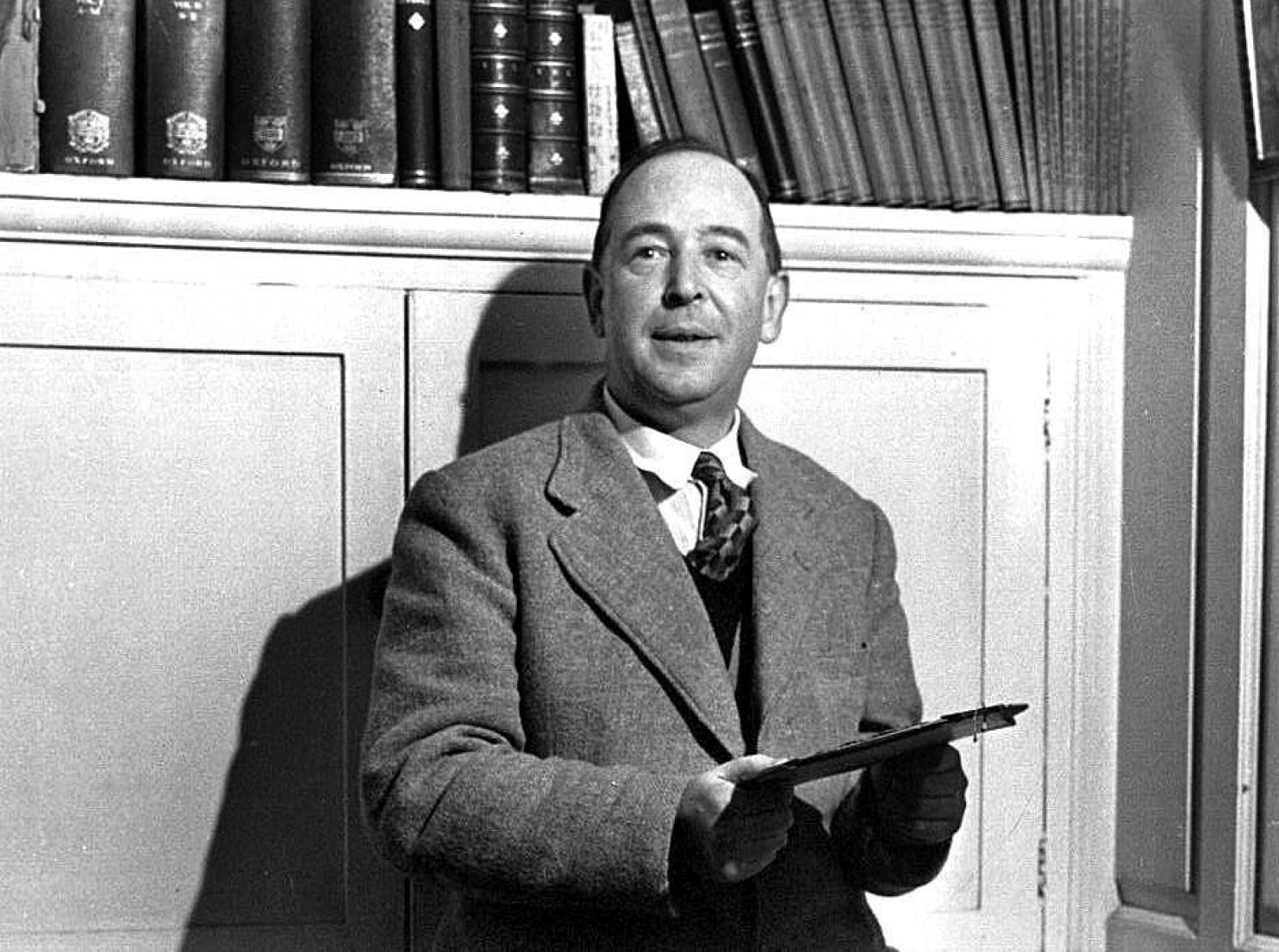
To be part of the faithful Church it’s not enough to say Jesus is a good guy, a prophet. Our Muslim friends revere Jesus, and that’s why it’s untrue to claim they want to ban Christmas, but this is as far as they go. They are vulnerable to CS Lewis’ famous criticism that it won’t do to say Jesus was a good man. It doesn’t fit with the remarkable claims he made about himself. Lewis said that the only realistic options in the light of those claims is to say that he is (or was) either Lord, liar, or lunatic. There is no evidence of him being a liar and he doesn’t behave like a lunatic. The best explanation that fits the evidence is that he is Lord.

And that’s where the Church’s confession of faith lands. The earliest Christian confession was the words, ‘Jesus is Lord.’

Naturally, the words of our confession need to be accompanied by deeds. To acknowledge him as Lord, as Son of the Living God, is something to be demonstrated. It calls us to be a community that lives according to his teaching.

Not only that, this complex, plural society that is the context for our faith expects us to live differently, and that is a fair expectation. Moreover, it may be one of the best ways we witness to Jesus. As the saying goes, ‘You may be the only Bible someone reads.’ People do not know the Christian faith anymore. It has been said that we have moved as a society from being one that framed itself inside the Christian story as its defining narrative to one that instead frames itself against the story of Hitler and the Nazis. You hear more reference to them negatively today than you do to Jesus positively. We have a calling here, to confess Jesus as Lord and to live in harmony with that confession.

Thirdly, the Foundation of the Church’s faith:

Sylvester Stallone. Wikimedia Commons. CC 2.0.

Have you ever wondered where Sylvester Stallone appears in the Bible? It’s here. Jesus pronounces a blessing on Simon for his answer that was given to him by heaven and then renames him Rocky. For that’s what Peter means. Those Hollywood movies would never have sounded so attractive had they been called ‘Peter I, II, III, and IV’, but in this text you get a sense of the wordplay if you read it as ‘You are Rocky, and on this rock I will build my church’ (verse 18).

Foundations were often made from rock. Remember Jesus’ teaching in the Sermon on the Mount about the wise man who built his house on a rock, whereas the foolish man built his on sand.

The Church, then, is built on the rock of Peter’s confession of faith in Jesus. How much of that is connected to the person of Peter as our Catholic friends believe is a debate I will not enter here, but the crucial point for us is that we are only the Church insofar as we build on the foundation of faith in Jesus, the Messiah, the Son of the Living God, our Lord. We cannot jettison any of what the apostles handed on to us whilst remaining the Church, even if it is true that we must always interpret the application of the ancient faith in our day.

So whatever we are doing in the Church, let us always bring it back to Jesus – and not our imaginings of him, but his life, teaching, and example as set out in the Gospels. That way, we attend to our foundations, and our house is not swept away in the storm.

Fourthly, the Resilience of the Church’s faith:

Salvation Army building. Wikimedia Commons. CC 2.0.

Jesus promises that the gates of Hades will not overcome the church in verse 18. Sometimes we imagine these words as depicting the church cowering under attack, but since when was anybody attacked by a set of gates?

No! Gates are defensive objects. They are there to keep people out. And these are the gates of Hades – not of Hell, as in older translations. Hades was the place of death. Here, Jesus promises that death cannot kill the church, and what is more, the church is on the offensive against death.

Therefore, all our worries about church decline and aging need to put into this context. Yes, it is true that certain individual churches (and denominations) will disappear, but overall, the Church of Jesus Christ is indestructible. He has made it so. In history, various denominations have declined and become moribund, but God has raised up a new expression of his church to continue his mission.

Methodism is one example. God raised up the Methodist movement when the eighteenth-century Church of England was not so much full of living waters as of spiritual ditchwater.

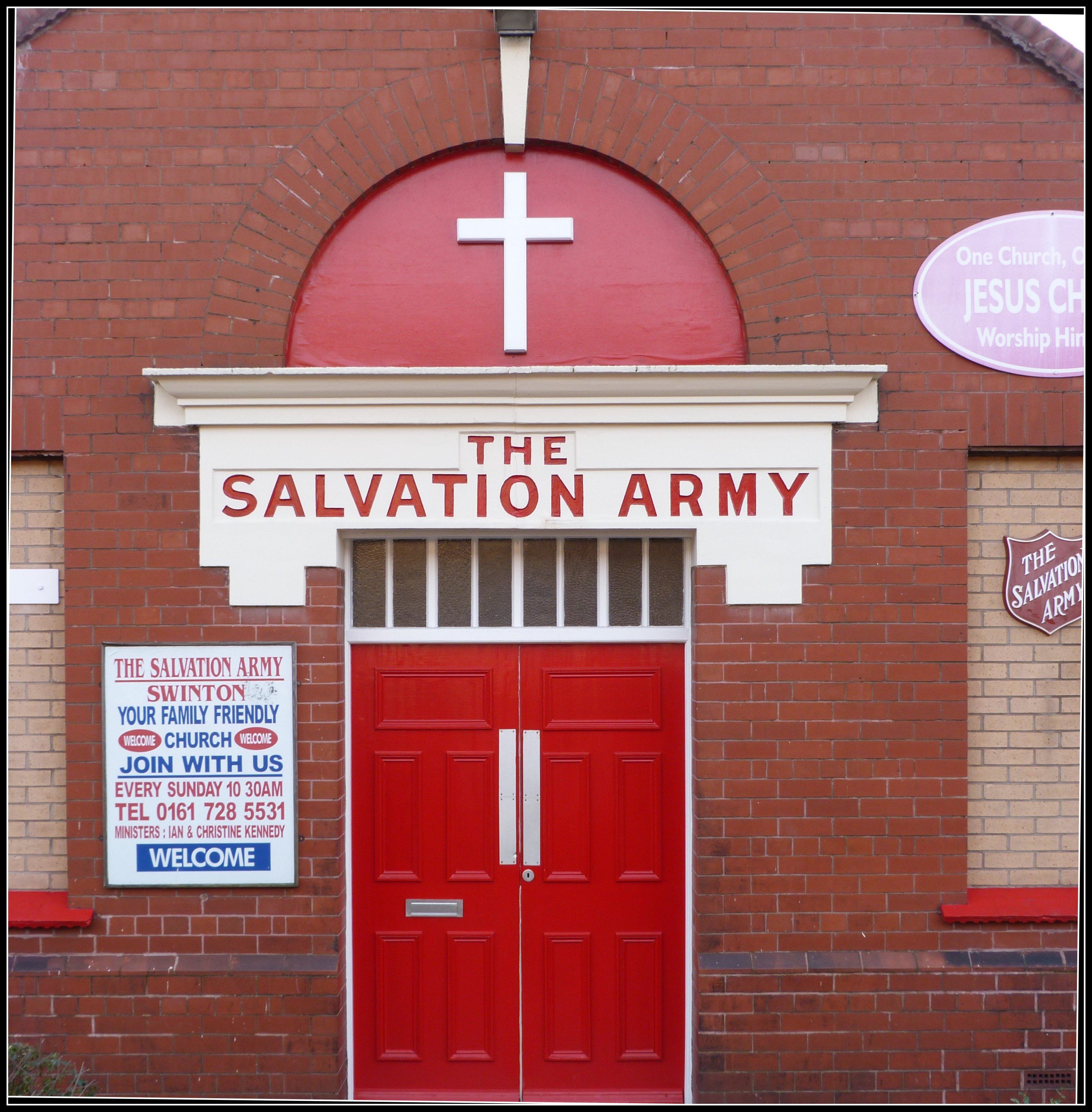
Then Methodism became rather too comfortable and middle-class cozy towards the end of the nineteenth century, so God raised up the Salvation Army to restore the importance of bringing good news to the poor.

When Methodism also declined in holiness and spiritual power at the beginning of the twentieth century, God acted again. He raised up the Pentecostal movement partly, at least, out of Wesleyan holiness churches.

Our version of Christianity may possibly wither and die, but still God will do something new with his people.

And whatever form it takes, God’s people will be on the offensive against death and all its friends – sickness, poverty, injustice. The gates of Hades don’t stand a chance against the Church of Jesus Christ.

Fifthly and finally, the Authority of the Church’s faith:

A metal keyring and three keys on a dark surface. Free Images Live. CC 3.0.

Here we’re thinking about all the ‘keys of the kingdom’ and ‘binding and loosing’ language Jesus applies to Peter (or should I say, Rocky?) in verse 19.

These words clearly involve Jesus giving Peter some power and authority. The keys to the kingdom make him some kind of ‘Prime Minister’ or ‘Chief Rabbi’[2] in God’s kingdom, giving ruling decisions and interpretations of God’s will. That comes down to us in the teaching of Peter and the other apostles that is authoritative for us in the New Testament canon.

The binding and loosing on earth as it is in heaven should probably be translated, ‘Whatever you bind on earth will have been bound in heaven, and whatever you loose on earth will have been loosed in heaven.’ Therefore, this is about ratifying the decisions of heaven[3]. It means that church leaders must only allow into the church community those who have confessed Jesus Christ as Lord.

I know an incident in a past circuit where I think I failed in this regard. A couple started coming to the church and eventually asked to see me about church membership. They wanted to know if they were ‘good enough’ for membership of the church. I recommended them.

But those words ‘good enough’ should have been a red flag for me. Their religion was all about rules – that is, so-called legalism. They brought a harshness into the church that was hard to remove. We even had to shut down one home group because the husband of this couple turned all the discussions into occasions of taking every preacher in the circuit to pieces.

Pray that those entrusted with authority in Christ’s Church use it in ways that reflect the life and teaching of Jesus. To vary from it is disastrous.

Conclusion

We’ve looked at the location of the Church’s faith in a varied and mixed-up world. We’ve looked at our confession of Jesus as Lord, and how Jesus alone is the foundation of that faith. We have taken encouragement from the resilience of the Church’s faith, based on the unchanging purposes of God in Christ, and we have looked at the solemn responsibility of leaders to base their authority on Christ alone.

In other words, everything always comes back to Jesus in the Church. Let’s make sure we do.


[1] On what follows, see Craig S Keener, The Gospel of Matthew: A Socio-Rhetorical Commentary, p424.

[2] Keener, p429.

[3] Keener, p430.

Easter Day: A Choice To Make At The Empty Tomb

Matthew 28:1-10

Image from Abundant Life Church. CC 4.0.

I’ve spent Holy Week this year offering reflections on some of the characters in the Gospel stories of Jesus’ passion and crucifixion. On Monday in the first of our three daily meditations, I explored Mary of Bethany with you. On Tuesday, we wrestled with the stories around Judas Iscariot, before thinking on Wednesday about Peter.

At the Maundy Thursday meal, we focussed on the Beloved Disciple, and I carried this over on Good Friday to my services where we looked at Simon of Cyrene.

For all of these, my inspiration was a book from 1999 called At The Cross by my own postgrad supervisor Richard Bauckham and Trevor Hart.

Today, I want to continue with some characters in the story, but Bauckham and Hart’s book doesn’t extend to the Resurrection, so with a little help from Craig Keener’s commentary on Matthew, I offer you the challenge of the Good News as seen in the characters around the empty tomb. We’re going to consider the women, the angel, and the soldiers.

Firstly, the women:

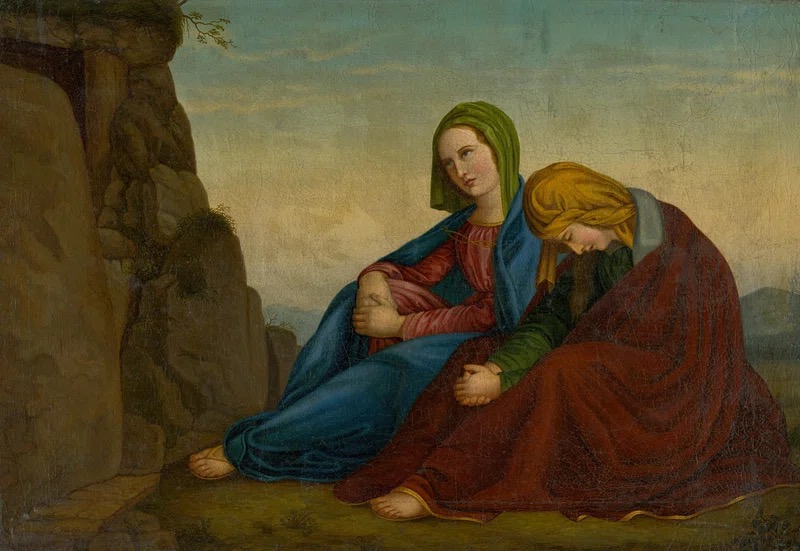
Two Marys at Christ’s tomb by Vincent Vörös. From RawPixel. Public Domain. Original public domain image from Web umenia.

The women are about the customary business of women after a death. It was usual to bring spices to a tomb, but men could only tend to the bodies of dead men, whereas women could care for both dead women and dead men. When Mary Magdalene and the other Mary visit the tomb, this is nothing out of the ordinary.

But their routine is exploded by what they find. They were not expecting to find the tombstone rolled away. More likely, they were preparing to ask permission of the soldiers to attend to Jesus’ body. They certainly weren’t anticipating a conversation with an angel.

Angels have a habit of interrupting the normal and transforming it. Ask Mary, the mother of Jesus. Ask a certain group of shepherds. Ask Abraham, and numerous others.

How are the women transformed? They become the first witnesses to the Resurrection. Not only do they see the evidence of the empty tomb, but they also meet the risen Jesus.

And moreover, they receive a commission to take the news to the disciples. Yes, those male disciples that Jesus had taught and trained over the three years, but who had failed him at the end. The women hadn’t, and the angel calls them to do something that later Paul would say was a qualification for apostleship: see the risen Jesus and be a witness to his Resurrection.

Who would expect that in a culture where women could not give evidence? It’s just one of those details you would never include if you were making up the story. People considered insignificant and of lesser value in their society – women – were given an apostolic call. That’s a long way from the traditional and expected habits that had brought them to the tomb that morning. They didn’t have this on their agenda that day.

Therefore, I want to ask you whether you are open to the risen Lord bursting in on the normal routines of your life and transforming them. Does Jesus have a call for you? Never mind the conventions of our society. Don’t sit there thinking I’m dyslexic, I’m neurodiverse, I’m too young, I’m too old, I’m the wrong skin colour, I don’t have the right education, I lack confidence, I’ve got secret shame, I’m disabled, or anything else you care to add. The things that are barriers for the world are not barriers for the risen Lord. If God by his Spirit can raise Jesus from the dead, then it is no trouble at all for him to jump over the hurdles our world puts in the way of people doing something significant.

It was in the Easter season in 1985 when God interrupted me, through a sermon by a Local Preacher on Low Sunday where in John 21 Jesus says to Peter, ‘Feed my sheep,’ that my journey to ministry began. It took me a long time to unravel what that interruption that morning meant, but it was a resurrection moment for me. I thought I was just doing my usual duties as a church steward that morning, but the risen Lord had other ideas.

What about you this Easter?

Secondly, the angel:

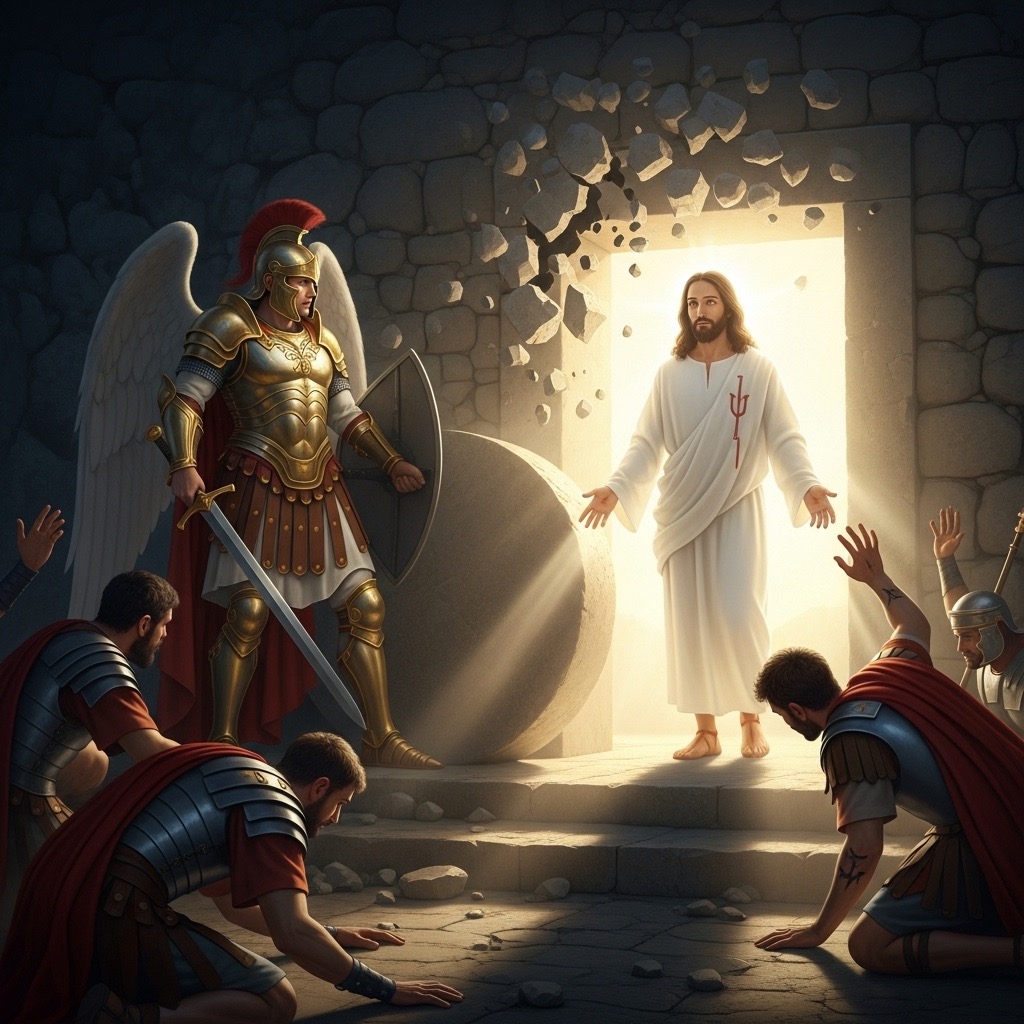
Angel turning stone at Christ’s tomb. Found at Easy-Peasy AI. CC 4.0.

While I was training for the ministry at Manchester, one of the northern students was very keen on wrestling. He organised outings to watch wrestling bouts. I never could understand it, because to me, having been a child when my grandmother, who lived with us, stayed glued to World of Sport on a Saturday afternoon to see Mick McManus, Jackie Pallo, Giant Haystacks and others, the appeal of wrestling was for old ladies. Why my friend Peter should persist in inviting me to something so camp, I could not understand. I never felt it belonged in the arena of sport, it was more like pantomime.

And of course, despite my aversion to it, I cannot erase from my memory the notion of ‘two submissions or a knockout’ to win, and how, when one wrestler had gained a submission from his opponent, he would often sit on him in triumph.

Well, here, on Easter morning, an angel sits not on the guards who have been so shaken by his arrival but on the stone he has rolled back. It’s not the soldiers who have been conquered so much as death itself. Not two submissions, just a knockout.

Easter Day is the supreme day of triumph. As the angel sits on the tombstone, we know that everything the New Testament claims for Christ’s work on the Cross is true and is vindicated. So –

  • Jesus has died in our place and our sins are forgiven;
  • Jesus has conquered what the Bible calls ‘the principalities and powers’ and all the forces of evil;
  • Jesus has fulfilled all that Adam and then Israel failed to do, by turning sinful human flesh back into obedience to the Father, right through to death;
  • Jesus has shown that the route to eternal life is not by violence, but by the way of the Cross.

Next time an inner voice condemns you for your sins, go and look at the angel sitting on the tombstone. Next time evil does its worst, cast your eyes at the angel on the tombstone and know that time has been served on evil. Next time you fail, look at that angel sitting in triumph know that Jesus has united you with him, and that’s who the Father sees when he looks at you. Next time you are troubled by world leaders who think they can bomb their way to freedom or cut down thousands of their own population to hold onto power, observe once more the angel who put his feet up on top of the tombstone and know that those ways will not last into eternity.

It was Friday, but Sunday has come.

Thirdly, the soldiers:

Easy-Peasy AI. CC 4.0.

The soldiers are the first to witness the awesome divine power of the Resurrection, as they encounter the angel, but as they shake and become like dead men their hearts are exposed. They are not on the side of life, but the side of death. Their job has been to promote and protect death. Now, they cannot hear the words of grace that the angel has for the women. Fancy witnessing the power of God and staying with the forces of death.

If you have any doubts about what I am saying and think I am just being fanciful, remember what happens after this. In verses 11 to 15, which we didn’t read, the soldiers are perfectly happy to collude with the authorities in the lie that the body of Jesus has been stolen. They are not on the side of life or truth, but of death and falsehood.

What a warning this is to us all. The saving power of God has come up close. The Good News has been enacted in front of them. But still, they choose death. Still, they choose to embrace a lie. Moreover, they allow themselves to be bribed with a large sum of money in order to go along with the fiction that the chief priests want.

This is surely a sobering reminder to us not to miss the grace of God when it comes calling. Now is the day of salvation. Now, life in all its fulness opens up before us. Now, the door of true freedom has been unlocked before our eyes. Why would we prefer the realms of untruth, monetary greed, and the decay of death?

But some people do. They are more entranced by the shrunken, shrivelled republic of sin than by the beautiful kingdom of love, joy, and peace. For it means putting aside a lifestyle where ‘me, me, me’ is at the centre, and where we can justify staying as we are on the grounds of what others have done to us, despite the fact that the death and resurrection of the king offers the prospect of those old wounds being healed through forgiving love.

The biggest mistake any of us could make on Easter Day is to be like the soldiers. The life-giving power of God in the Resurrection has come close. Through it, God bids us to walk with Jesus in newness of life, exchanging the dirty rags of our weaselly self-centredness for the clean robes of a disciple who puts Jesus first.

But the more we ignore that call, the more we put it off, the more we delay saying ‘yes’ to Jesus, the more is the risk that one day that life-transforming power will stop calling. For God will realise we are not serious about him. He will confirm us in our own decision to harden our hearts. He will leave us in our selfishness and greed, shaking like dead men.

Easter Day is a day to witness that angel sitting triumphantly on the tombstone, to respond like the women who, though afraid, allowed the angel’s interruption to give their lives new direction, and ran away with joy to tell the good news, and to let dead soldiers bury their own dead.

A Beautiful View of Jesus, Matthew 17:1-9 (Sunday Before Lent, The Transfiguration, Year A)

Matthew 17:1-9

A year into marriage – and it will be our silver wedding anniversary this year – my wife Debbie and I decided we fancied a walking holiday in the Snowdonia region of Wales. We booked a room in a B & B near the village of Beddgelert, and looked forward to joining the hordes walking up Mount Snowdon.

View from the Summit: Mount Snowdon by James E Petts on Flickr. CC 2.0.

It didn’t work out like that. Not long before going, we discovered Debbie was expecting our first child. Our vigorous walking holiday became a sedate one. We never got up Mount Snowdon.

Jesus, however, went up mountains quite regularly during his ministry. And every time Matthew’s Gospel records him doing so, something significant – revelatory, even – happens. In the last couple of weeks, you may have had readings from the Sermon on the Mount – his great description of what repentant living in the kingdom of God looks like. At the very end of Matthew after the Resurrection, Jesus sends his disciples up a mountain in Galilee, where he gives the Great Commission to disciple the whole world.

And here he is in today’s reading, going up a mountain again. We traditionally refer to the ‘Mount of Transfiguration.’ We expect a significant revelation of Jesus. And boy, do we get that. What is revealed about Jesus at the Mount of Transfiguration?

Here are four things the Transfiguration shows us about Jesus[1]:

Firstly, the glory of Jesus:

Jesus meets Moses and Elijah. Both of them had history of profound spiritual experiences on mountains. Moses received the Ten Commandments and his face glowed with the glory of God. Elijah saw God give him a mighty victory over the pagan prophets of Baal on Mount Carmel.

But here, only Jesus is transfigured. Moses isn’t. Nor is Elijah. However great they were in Israel’s history, they are not equal with Jesus. Only he shows the dazzling glory of God on his face and his clothes.

The message is clear. Jesus is supreme to all other religious leaders and heroes. He is not just another teacher. Nor is he merely a prophet, as Islam would say. He is so much more. He is Lord.

The natural consequence of this is that Jesus is as worthy of worship as the Father. He manifests the very glory of God.

Peter gets it all wrong. Perhaps he is tongue-tied in the presence of surpassing greatness, a bit like any of us would be when we meet someone famous and all our plans to ask intelligent questions disappear as our legs go to jelly and so do our brains. He says the daftest thing when he wants to build three shelters, one for Moses, one for Elijah, and one for Jesus. Yet again, he has missed the point.

It’s not enough to like Jesus or even admire him. The Transfiguration tells us that he is worthy of our worship – not merely an hour of our time on a Sunday, but the allegiance of our lives.

This morning, we take Holy Communion together. In our tradition, we call that a ‘sacrament.’ Now ‘sacrament’ is an interesting word. It is not a word from Scripture. Rather, it derives from a Latin word ‘sacramentum’, which was the oath of allegiance that a Roman soldier made to the Emperor. May our initial response to the glory of Jesus this morning be in renewing our sacramentum, our oath of allegiance to him, at the Lord’s Table.

Secondly, the words of Jesus:

Just to underline what Peter should have learned from only Jesus being transfigured, the divine voice from the bright cloud says,

‘This is my Son, whom I love; with him I am well pleased. Listen to him!’ (Verse 5)

As good Jews, Peter, James, and John had it imprinted on their memory that when Moses went up Mount Sinai he received the Law of God. Now, as they are up this other mountain, they learn that Jesus is not simply the recipient of God’s words, he is the giver of them. Jesus is, and he gives, the Word of God.

This is the logical consequence of the first point. If the glory of Jesus tells us about his supremacy and we offer our worship and allegiance, then that involves heeding what he says. It is not for us to treat the teaching of Jesus as merely interesting or optional: what he says, goes. It is the Word of God.

Some of us like to sit in judgment on what we read in the Scriptures – like when Field Marshal Montgomery read the Old Testament lesson at Matins one morning and began, ‘And the Lord said unto Moses – and in my opinion quite rightly’! Others of us like to analyse the words and enjoy coming up with clever theories or explanations, but then do nothing. That won’t do either.

Of course, we will struggle with some of the difficult sayings of Jesus. We may need to understand certain nuances, or their historical background to make sense of them. But in the end, what we need to embrace as Christians is that Jesus and the Scriptures are for life, not just Sundays. One of the things coming in our forthcoming circuit-wide Lent preaching series will be a challenge to study and meditate on the Scriptures more. This would be a good time to embrace that discipline.

Thirdly, the compassion of Jesus:

It would be easy after what we have just been thinking about to assume that everything Jesus says and requires of us is challenging and maybe severe. But following on immediately from the words, ‘Listen to him,’ Jesus does in fact speak to Peter, James, and John. Hear verses 6 to 8 again:

6 When the disciples heard this, they fell face down to the ground, terrified. 7 But Jesus came and touched them. ‘Get up,’ he said. ‘Don’t be afraid.’ 8 When they looked up, they saw no one except Jesus.

Get up. Don’t be afraid. Even after the overwhelming glory that comes upon Jesus. Even after the summons to listen to him. Who is this Jesus whose glory tells of his supremacy, and whose Father tells us he is and he speaks the Word of God? Is he some severe authoritarian?

No. The Jesus who is Lord is full of love, mercy, and compassion. He reaches out in kindness to his people. He is the giver of dignity to those who are bowed down. Like the Psalmist says of the Lord in Psalm 3:3,

You are the One who lifts my head high.

This is how Jesus reigns. He was God’s agent in creation, where we were made in God’s image. However much we have marred that image by our sin, he is now remaking us in the divine image. He is making us more like him. And he does that with love and care for each of us.

If we are worried about giving our allegiance to Jesus and following his Word, here is what we need to remember about him. His yoke is easy and his burden is light[2] and we find our rest in him.

This is who we are called to follow. This is who is speaking to us. Whatever has laid us low, be they fears about God or the wounds of life, he invites us to get up and leave our fears with him. We are safe in his divine presence.

Fourthly and finally, the suffering of Jesus:

9 As they were coming down the mountain, Jesus instructed them, ‘Don’t tell anyone what you have seen, until the Son of Man has been raised from the dead.’

For all the glory of Jesus, for all his authority as the Word of God, and for all his love, his next destination is Jerusalem and the Cross.

Suddenly, it feels like everything has changed. We have gone from the retina-searing brilliance of the Transfiguration to three hours of darkness on a hill.

But maybe nothing has changed. Maybe the Cross will reveal the same truths about Jesus, just in startlingly different ways. For though the world may think the Cross will be his shame, it will be his glory. The world may think he is condemned at the Cross and in one sense he is, but it will also be his enthronement.

And in the silence of God at Calvary, Jesus himself will speak his word. Seven last words from the Cross. Still, the Word of God will go out into the world, even from One suffering a cruel death. He will say, ‘Father, forgive them, for they do not know what they are doing,’ and that word will be fulfilled as forgiveness pours out with his blood.

And do we see there the Jesus who in love lifts people up? Why, yes we do. For one thing, the forgiveness we have just spoken about does that. For another, he will lift up the penitent thief next to him by assuring him, ‘I tell you today, you will be with me in Paradise.’ Moreover, he lifts up both his mother and the Belovèd Disciple as he addresses them from the Cross: ‘Mother, here is your son. Son, here is your mother.’

Nowhere more do we see Jesus lifting people up and showing love than at Golgotha. As the Welsh Revival hymn puts it,

Here is love, vast as the ocean,
lovingkindness as the flood,
when the Prince of life, our ransom,
shed for us his precious blood.
Who his love will not remember?
Who can cease to sing his praise?
He can never be forgotten
throughout heaven’s eternal days.
[3]

Conclusion

We began by talking about mountains. Sometimes, when you go up a mountain you get to see the most magnificent view. I recall seeing the powerful sight of the snow and the ski slopes when I went up the Jungfrau in Switzerland.

Here, as we have ascended the Mount of Transfiguration, I hope we gained the beautiful view of Jesus. We have taken in his majestic glory, his identity as the Word of God, and his compassionate love. Then we have seen that all of these will be recapitulated at the Cross.

I’ll finish not with the words of an old hymn but of a modern worship song, because they seem to capture these thoughts:

You are beautiful beyond description
Too marvelous for words
Too wonderful for comprehension
Like nothing ever seen or heard
Who can grasp Your infinite wisdom?
Who can fathom the depth of Your love?
You are beautiful beyond description
Majesty, enthroned above
[4]


[1] These are influenced by Craig Keener, The Gospel of Matthew: A Socio-Rhetorical Commentary, pp 436-41.

[2] Matthew 11:30

[3] William Rees (1802-83); translated by William Edwards (1848-1929).

[4] ‘I Stand In Awe’, Music and words by Mark Altrogge. © 1986 Sovereign Grace Praise/BMI (adm. by Integrity Music). Sovereign Grace Music, a division of Sovereign Grace Churches. All rights reserved. CCLI: #23914.

How to Understand the Sermon on the Mount and the Beatitudes, Matthew 5:1-12 (Epiphany 4 Year A)

Matthew 5:1-12

There once was a church member who claimed that Jesus said we should disregard the Old Testament. This seemed rather strange to others, not least because Jesus spoke of fulfilling it, and so they asked him why he made this claim.

“Well, that’s easy,” he replied. “Jesus once said, ‘Hang all the Law and the Prophets.’”

Now Jesus did say, ‘Hang all the Law and the Prophets.’ The problem is, that isn’t the whole quotation. It came when he was asked about the greatest commandment. He replied that there were two: firstly, love the Lord your God will all your heart, soul, mind, and strength. Secondly, love your neighbour as yourself.

And his punchline? “On these two commandments hang all the Law and the Prophets.”

Quite different! Context is everything. As has been well said, a text without a context is a pretext.

Hermeneutical Basics by Brett Jordan on Flickr. CC 2.0.

Bear this in mind as we look at the opening of the Sermon on the Mount with the Beatitudes today. There are so many theories about the purpose of the Sermon and the meaning of the Beatitudes. There may be up to thirty-six main theories about the Sermon on the Mount[1]! Don’t worry, I’m not going to describe them all to you!

Context, then, is our first tool for discovering what these famous words mean for us.

We begin with the fact that context tells us who the teacher is. Well, you say, it’s Jesus. Of course it is. But context is making some big claims about him. You cannot read the context and just come away with the idea that he was a great religious teacher. He was claiming more.

How so? There are a couple of indications. One is that this is the first of five major blocks of Jesus’ teaching in Matthew’s Gospel. It is a parallel to the so-called ‘Five Books of Moses’, namely Genesis to Deuteronomy. Moses had prophesied that God would one day send one who was greater than him to his people. The Sermon on the Mount is one of the first indications Matthew gives us that Jesus is the One who fulfils that prophecy. He is not just a teacher. He is greater. How great? Keep reading.

The other indication about who the teacher is comes in the fact that Jesus goes up on a mountainside. It’s another echo of Moses, who went up Mount Sinai to receive the commandments from God. But Jesus doesn’t receive commandments, he gives them. And every time he goes up a mountain in Matthew, something important and revelatory happens. Here, it’s the Sermon the Mount. Later, it will be events like the Transfiguration and the Great Commission. Jesus is the New Moses, the One greater than Moses. If you thought it was important to listen to the Ten Commandments, then it is every bit as important, if not more so, to listen to Jesus in the five blocks of teaching and when he goes up a mountain (of which this is the first example of both).

Context also tells us who is being addressed. Hear verses 1 and 2 again:

1 Now when Jesus saw the crowds, he went up on a mountainside and sat down. His disciples came to him, 2 and he began to teach them.

Jesus addresses his disciples, but the crowds are present, too. Right through the Sermon, this is teaching for disciples. But others are watching and listening. It’s still true at the end of the sermon. These are the last two verses of Matthew’s account at the end of chapter 7:

28 When Jesus had finished saying these things, the crowds were amazed at his teaching, 29 because he taught as one who had authority, and not as their teachers of the law.

It’s consistent. The Sermon on the Mount is addressed to disciples, but they are not alone. The crowds are watching.

The influential American Christian thinker Francis Schaeffer once wrote a book called The Church Before The Watching World. You might say that title encapsulates what we’re about here. Jesus is teaching his followers how to be the church before the watching world. Do you want to know what constitutes a good witness in the world, according to Jesus? Then read, mark, learn, and inwardly digest the Sermon on the Mount.

Dr. Francis Schaeffer. Wikimedia Commons, Public Domain.

And so that means we’re beginning to answer another question that context helps us with: what is the theme of the teaching? This is one of the areas where those thirty-six different theories argue with one another. For example, are these political policies we should demand in our national life? No, the primary focus here is on how the disciples of Jesus live.

In fact, the recent context just before this passage might also help us with this. It comes not long after Jesus has begun his public ministry with the call to repent, for the kingdom of heaven is near. If the Sermon on the Mount is for disciples, then it is for those who have responded to the call to repentance. It is a description of what the repentant life looks like. Do I want to know if I am doing what Jesus loves, and have turned from the ways of the world? Again, our answer is to read the Sermon on the Mount. This is a plumbline Jesus holds up for us to examine ourselves as Christians and see how we are getting on with the life of the Spirit rather than the life of the flesh.

To sum up so far: context tells us that Jesus, the teacher of the Sermon on the Mount, is the Great One prophesied for centuries, and that he should be listened to with all the seriousness we give to the Ten Commandments, if not more so. He is addressing his disciples, teaching them what the repentant life looks like, and what it means to live a Christian witness before the watching world.

With all that in mind – which I hope will help you with any part of the Sermon on the Mount that you read – let’s spend the second half looking specifically at the Beatitudes. And here our tool will not be context but structure.

Structure image, Highway Signs 3. Pix4Free.org. CC 3.0.

In the Beatitudes, there is a reasonably consistent structure of each saying. They more or less follow a formula. It’s only the last one, which Jesus expands on, but even there it displays some similarities. It goes roughly like this:

  • Who is blessed?
  • What blessing will they receive?

But let’s just define that word ‘Blessèd’ first. It means, ‘It will go well with the one’ who is named[2].

Then let’s observe that broadly there is a contrast in time between the people who are blessed and when they receive their blessing. The blessèd ones are doing what Jesus commends now, in the present tense. However, the promised blessings generally come in the future[3]. This is not a guide to having an enjoyable life now. Jesus is not promising that if you live your best life now you will receive health, wealth, and prosperity in this life. This is not some manual for successful living.

See it this way. Jesus is saying that here are some of the marks of living the repentant life. These are examples of how he calls us to live before the watching world. Because of that, God is pleased with us. He will bless our obedience. However, that blessing may well only come in the future – perhaps even only in the life of the age to come.

For at present, we live in a time when two different ages are overlapping and clashing with each other. The age of sin is continuing. But Jesus has inaugurated the age of God’s kingdom, which has come but is not yet here in all its fulness. The age of sin and the age of God’s kingdom are incompatible, so they clash. That is why not all the blessings of the age to come are here yet. It is why not everybody we pray for is healed, for example. God’s kingdom has won the decisive battle at Easter – yes! – but the war is not yet finished.

What does this mean for us? Jesus calls us to live the repentant life before the world as a witness. We are not forcing ourselves on the world but showing by our lives what the ways of Jesus are like, knowing that God delights in what we are doing, and that he will show us his favour for responding to him like this. However, we may have to wait patiently to receive the fruits of that approval.

Jesus is calling us to live not as those who choose violence, even in the face of oppression, but who live humbly, seeking peace and reconciliation (which is not the same as caving in). He calls us to be the ones who trust in him, even when we think we don’t have many resources – after all, he doesn’t need a big budget to achieve great things, he just needs surrendered lives. He calls us to be the ones who witness to mercy and compassion; to be the ones who yearn for him above all things, rather than having our imaginations captured by the desires that our society elevates. To become such people, we may well mourn – not only in the general sense of those who are bereaved but mourning for our sin and the sin of the world, which surely leads us to passionate prayer for transformation for ourselves and others. We are the ones to show kindness to others, even if it means we need to carry the burden of unjust suffering.

Such a calling probably sounds unbearable. But a day is coming, he promises us, when God will vindicate us for following these costly choices. We will hear the words, ‘Well done, good and faithful servant.’ We will be blessed.

And in that respect, we shall be following Jesus himself. For surely the Beatitudes describe the kind of life he lived on earth. And he too was blessed in the vindication of the Resurrection.

But isn’t this all impractical and irrelevant? What of when we see the powerful in our world living differently and crushing others, shooting the innocent on the streets of Minneapolis and Tehran? Do we respond in kind? When Donald Trump’s adviser Stephen Miller tells the CNN TV channel,

“We live in the real world, Jake, that is governed by strength, that is governed by force, that is governed by power. These are the iron laws of the world since the beginning of time”

should we not respond with similar use of force? No. We continue to live the Beatitudes. These are the ways of God’s coming kingdom. These show God’s great future. As such, they pronounce God’s judgment in a subversive way on the wickedness of our day. In their peaceable nature they reveal God’s truth and promise the downfall of violence. God will pass sentence on the wicked, but we let him do it in his way.

Let us heed the call of Jesus, to live the repentant lifestyle of peace before the watching world. We must take this seriously, because of the One who tells us that this is his way. The rest we leave to his Father who, as the Psalmist tells us, places the wicked on slippery ground that they might be cast down to ruin[4].


[1] Craig S Keener, The Gospel of Matthew: A Socio-Rhetorical Commentary, p160.

[2] Keener, p165.

[3] As Paul Beasley-Murray says, they are a ‘divine passive’. See also Keener, p167.

[4] Psalm 73:18

The Building-Blocks of Jesus’ Mission, Matthew 4:12-23 (Epiphany 3, Year A)

Matthew 4:12-23

A few years ago, Debbie and I went to the cinema to see the ‘biopic’ Bohemian Rhapsody, about the rock band Queen and their lead singer Freddie Mercury. I expected the movie to end with Freddie’s death from AIDS in 1991, but it didn’t. It climaxed with the band’s triumphant performance at Live Aid in 1985. I guess it was the point that they exploded from being massively popular in the UK and a few other places to being superstars on the world stage.

If you made a biopic about the early years of Jesus, I think this is where it might end. After the amazing birth stories, the escape from Herod, his baptism, and then his trials in the wilderness, here is where it all explodes and the public ministry is launched, as he moves from Nazareth to Capernaum.

And therefore it’s natural that what we see in this story is some of the building-blocks of Jesus’ message. Tonight, we’re going to explore three building-blocks that we find in this passage and what they mean for us.

Firstly, fulfilment:

Verses 12 to 16 tell us that Jesus moved from Nazareth to Capernaum to fulfil a prophecy of Isaiah’s that the Messiah would live in ‘Galilee of the Gentiles’ and bring light into darkness.

This is a continuation of something Matthew has been stressing from the beginning in his Gospel: that Jesus the Messiah fulfils Old Testament prophecies. How does the fulfilment work here? In a couple of ways.

One is that he is now based in ‘Galilee of the Gentiles.’ Although Galilee was filled with devout Jews who were faithful to the religious Law and to the Jerusalem Temple, there were Gentile settlements nearby[1]. This becomes a foreshadowing of the later mission to the Gentiles that Jesus announced after his Resurrection at the end of the Gospel[2].

And hence, there is a hint here of what is to come: to be part of the Jesus Movement will entail not just staying comfortably with people like us but reaching out beyond social and cultural boundaries to share Jesus there. It is no good thinking we can stay with our own kind. It is no good making the church the centre and the circumference of our social lives. There is a mission beyond us, and Jesus was clear about it from the start.

The other element of fulfilment is in bringing light into the darkness. That includes light for people who are struggling in the darkness of despair. Jesus is Good News for them, because he brings a hope in him that not even death can destroy. Whatever the most dreadful of our thoughts are when we are down, Jesus still brings hope. He is the light-bringer.

Let There Be Light!! by Premnath Thirumalaisamy on Flickr, CC Licence 2.0.

But light shines into darkness in other ways, too. Most notably, Jesus shines his light onto the darkness of our sins. When we meet Jesus, we begin a lifelong process of transformation, as bit by bit he casts his light into those areas of darkness that we don’t want anyone else to see. Stage by stage, Jesus calls us to confess our dark deeds and bring them into his light. There he forgives us and begins his work of equipping us to change.

Is it any wonder that the first thing we hear Jesus saying in the passage is these words?

Repent, for the kingdom of heaven has come near.’ (Verse 17)

When Jesus shines his light onto our lives, we will begin to have a list of things from which we need to repent. We need to turn our lives around.

Perhaps like me you often resist this. But it is an essential part of God’s project to make us more like Jesus. So may he grant us the grace to go along with the surgery the light of Jesus performs on us.

Secondly, following:

Red Follow Me beacon at PickPik (Public Domain)

In verses 18 to 22, Jesus calls Simon, Andrew, James, and John to follow him. They leave their fishing nets immediately.

There is something really quite radical here. Rabbis didn’t generally call people to follow them. Instead, young men (and I’m afraid it was only men in those days) would choose a rabbi for themselves. For Jesus to go to these men, who either had not looked for a rabbi or had been rejected when they had applied, turns everything upside-down.[3] What we see here is that Jesus calls some young men to follow him who would not have been accepted by any other rabbi. But Jesus wants them. They will be among his core followers.

The early church followed through with this principle. We are pretty sure that some of the early bishops were slaves. No way would a Roman religion do that! But Jesus calls everyone, including the unexpected and the rejected.

It’s worth us remembering that Jesus still issues the call to follow him to people that we wouldn’t expect. Who would that be in our circles? Who are the people we have dismissed as potential Jesus-followers? Maybe we’ve even dismissed ourselves. Don’t do it. Jesus is calling.

But let’s also be aware that this call comes with a potential cost. Simon, Andrew, James, and John had to quit their family businesses to follow Jesus. They left their nets. They left the boat.

This was probably an act of what we would call ‘downward mobility.’ The fishermen might not have been wealthy, but neither were they peasants.[4] These young men walk out on a steady income generated from a vital profession for a life with a much more uncertain income. What did their families think?

It still happens in our generations. Someone who grew up in the same church youth group and young adults’ group as me trained to a high standard as secretary and PA and landed a job as the PA to one of the directors of one of our most famous upmarket High Street stores. But then God called her into church leadership with a new, fledgling independent congregation. Her parents were not best pleased, after all the money they had poured into her professional training. But she heeded the call.

One of my fellow ministerial students had previously been a solicitor. One day, somebody asked him, how much of a pay cut does entering the ministry mean for you?

‘I’ve knocked a nought off the end of my salary,’ he replied.

I wonder whether there is anyone here who is sensing the call of Jesus to follow him, perhaps in a new way, but that the implications are that it will be costly. You are risking financial loss, or family disapproval. Let us as a church family gather round in support of you so that you can set out on where Jesus is calling you.

Thirdly and finally, fishing:

In verse 19, Jesus says to Simon and Andrew,

‘Come, follow me,’ …, ‘and I will send you out to fish for people.’

Perhaps this reminds you of the old Sunday School chorus, ‘I will make you fishers of men,’ and maybe you now have an earworm!

The traditional way in which we have interpreted this is to think of this as a call to share the Gospel with people so that they, too, become followers of Jesus. I don’t think that was far from the minds of the early church, because one of the earliest visual images of the church was that of a boat. They saw there was a task to do of bringing more people into God’s boat.

We urgently need to release people into the ministry of evangelism, because there are so many more who need to hear the Gospel and respond. If anyone here is sensing that call, then let’s have a conversation about what we can do to train, facilitate, and support your call.

And let’s do it in a way that keeps a strong link between the evangelist and the church. The call is to fish for people, so they are brought into the boat. Too often in the past, evangelists have become disconnected from the local church. The fault has been on both sides, and we cannot allow it to continue. Evangelism is a ministry of the church.

But I want to take ‘fishing for people’ further. As I said, if you look forward from New Testament times to the early church, you end up with this application of these words to evangelism. But if you look back to the Old Testament, you see another dimension of mission, and it’s about the prophetic announcement of judgment. Here is one example from Jeremiah 16:16:

‘But now I will send for many fishermen,’ declares the Lord, ‘and they will catch them. After that I will send for many hunters, and they will hunt them down on every mountain and hill and from the crevices of the rocks.

What’s that about? The context is about God bringing judgment on his people who have forsaken his ways for worthless idols. This fishing for people is about the bad news, not the good news. It is the warning of what God will do with those who wilfully reject his truth. When Israel left Egypt, the Egyptian army tried to catch them and failed. But now, God’s messengers – his fishermen and hunters – will catch them.

Fishing for people, then, involves not only the winsome call to follow Jesus but also the warning to those both outside and inside the boat of the church to reject idolatry.

What would that mean for us today? I’ll confine myself to one example. There is only one sin that is described as idolatry in the New Testament. Greed. Colossians 3:5:

Put to death, therefore, whatever belongs to your earthly nature: sexual immorality, impurity, lust, evil desires and greed, which is idolatry.

Fishing for people, then, is not only a call to evangelism. It is also a call to a prophetic ministry. This is why it is right the Church condemns so much of what is going on in international politics at present.

But we have a long way to go in much of the church to put to death the idolatry of greed, which is so widely practised in our society. What else would we expect when we follow One who shines his light into the darkness?

Conclusion

Let’s summarise these three building-blocks:

Fulfilment – this happens when we take the Gospel beyond the People of God to others, and when the light of Christ shines into darkness.

Following – let’s be open to surprises in who God calls but be ready for the fact that when he does, there is usually a cost involved.

Fishing – for people – this is both the evangelistic call to join the boat of the church and putting the fishhooks of God’s judgment into those who wilfully reject his ways.

How far are we reflecting the fundamental elements of Jesus’ mission?


[1] Craig S Keener, The Gospel of Matthew: A Socio-Rhetorical Commentary, p146f.

[2] Matthew 28:16-20

[3] Keener, p150.

[4] Keener, p151.

Shame and Honour in the Baptism of Jesus, Matthew 3:13-17 (Ordinary 1 Year A)

Baptism of Christ. Wikimedia Commons, CC Licence 3.0.

Matthew 3:13-17

When David Cameron was Prime Minister, there was a big public debate about ‘British Values.’ Some very conservative Muslims had been accused of undue influence in Birmingham schools to promote militant Islam. Mr Cameron said that anyone living in the UK should abide by ‘British Values’, by which he meant things like democracy, the rule of law, personal and social responsibility, freedom, and tolerance of other beliefs. He cited things like the Magna Carta – although that was a little awkward, as the Magna Carta was an English, not a British document.

Whatever you think of that debate, it shows the reasonable assumption that a nation, a society, or a culture has certain shared values. We may argue about what they are, but the basic idea is sound.

That means, when we come to the Bible, that it is helpful to know about the values of the culture in which a story is placed. Doing that this week with the story of Jesus’ baptism has helped me see it in a new light. The culture into which Jesus was born was

A traditional Mediterranean culture where society stressed honour and shame[1].

Middle Eastern societies have reflected those values of honour and shame right up to modern times. My late father spent a couple of years in Arab countries when he was in the RAF, and I remember him telling me that no matter how much one might disagree with someone from that region, one should never shame them: that was a terrible insult. You should always treat them with dignity and never shame them.

Today, I want us to read about the baptism of Jesus through the lens of honour and shame. It is something we can do throughout the Bible with great profit[2], but today we shall just think about Jesus’ baptism in this way.

Firstly, we’re going to consider shame:

Shame. Wikimedia Commons. CC Licence 2.0.

13 Then Jesus came from Galilee to the Jordan to be baptised by John. 14 But John tried to deter him, saying, ‘I need to be baptised by you, and do you come to me?’

15 Jesus replied, ‘Let it be so now; it is proper for us to do this to fulfil all righteousness.’ Then John consented.

John knows that Jesus is superior to him. Immediately before this, he has been prophesying the coming of Jesus, saying that Jesus is more powerful than him, and that he is not fit to untie Jesus’ sandals (verses 11-12). Whether he fully understands Jesus’ divine status at this point we don’t know, and whether he knows Jesus is sinless we also don’t know, but he does recognise that he is outranked by Jesus. Therefore, he says, he should honour Jesus, not the other way round.

But Jesus does not pull that rank. He takes a place below John by submitting to his baptism. He takes the place of humility, but more than that, he takes the place of humiliation, of shame. Baptism was for those who were ashamed of their sins, and Jesus identifies with the shamed.

Of course, this is a foreshadowing of the Cross, the deepest example of Jesus identifying with the shamed, when he suffered one of the cruellest forms of execution ever devised. But for now, notice that Jesus puts himself alongside the shamed. He could pull rank, but he doesn’t. No wonder the tax collectors and ‘sinners’ loved him.

Shame takes many forms. In part, it is the shame we experience for our sins, if we have any moral compass. Here, by identifying with those who are ashamed of their sins, we see the Jesus who will pronounce divine forgiveness to some of the most outrageous of sinners, those who commit some of the most socially unacceptable sins.

It’s been my privilege on occasion to assure people who have secretly carried the guilt of awful sins that they were too ashamed to admit publicly that God in Christ forgives them. I have seen a burden disappear from someone’s face. And it is all made possible by the Jesus who identifies at his baptism and later at the Cross with those shamed by sin, and who in between those two episodes spends time befriending such people.

But there is more to shame than this. Some people have shamed foisted onto them. These people are not so much those who have sinned, but those who have been sinned against. Somebody else has done something dreadful to them, and they have been told they must keep it secret, or there will be terrible consequences for them. Sometimes, the perpetrator engages in what we call today ‘gaslighting’, where they manipulate their victim to the point of them doubting reality. This is incredibly damaging to someone’s self-esteem. I’m sure I don’t need to elaborate too much.

When Jesus identifies with the shamed, I believe he identifies with these people, too. Jesus is for those who have been sinned against. He has love, compassion, acceptance, and healing for people who have endured such trauma.

The Christian Church is called by Jesus also to identify with the shamed, whether that shame is caused by sin, being sinned against, or some other cause. It is our calling today to bring the love and healing of Jesus to those carrying shame.

It includes prayer as well as action. In Daniel chapter 9 verses 1 to 19, Daniel confesses the sins of his people that led to the Exile in Babylon, even though he personally was not responsible. He identifies with the shamed.

One of the problems Jesus had with many of the Pharisees was that they did not do this. Instead, they made it very clear that they distinguished themselves from the shamed. In Luke 18:9-14 Jesus tells the famous Parable of the Pharisee and the Tax Collector, where the Pharisee begins his prayer with the ominous words, ‘God, I thank you that I am not like other people’ (verse 11). It is so easy for us to fall into that trap, too. We don’t want to be tarred with the same brush as others whose actions are wrong. But Jesus tells us to resist that. Let us come alongside the shamed with the love of God in Christ, rather than setting ourselves up as being above them.

Secondly, we move from shame to honour:

OBE – George 6th. Wikimedia Commons. CC Licence 4.0.

16 As soon as Jesus was baptised, he went up out of the water. At that moment heaven was opened, and he saw the Spirit of God descending like a dove and alighting on him. 17 And a voice from heaven said, ‘This is my Son, whom I love; with him I am well pleased.’

Well, can you get a better way of being affirmed or honoured than that? Already, John the Baptist – a prophet – has honoured Jesus. Now heaven speaks, and quotes Scripture in doing so. A prophet, Scripture, and the direct voice of God. Top that if you can.

But why is Jesus being honoured like this at this time? There is more than one way of looking at this.

One is to say that God is honouring Jesus for what he has just done in humbling himself to identify with the shamed at his baptism. God is pleased that Jesus has given a preview of his mission. God honours the way Jesus humbles himself, or ‘made himself nothing’, as Paul was to describe it in Philippians 2. This is God setting his seal of approval on the way in which Jesus will conduct his ministry. When Muslims deny the suffering of Jesus because that would supposedly be beneath the dignity of a prophet, let alone God, we say no: this is the glory of God, that there is no depth too low that Jesus will not stoop to bring salvation.

Another way of looking at the Father honouring Jesus here is to say that this happens just before Jesus’ ministry begins. He will go from here into the wilderness and then he will start his mission. On this reading, God is unconditionally affirming Jesus. If we take this approach, then Jesus goes into the difficult conflict in the wilderness and then into all the challenges of his mission having heard the ringing endorsement of the Father, who had underlined his status (‘This is my Son’) and that he loves him. This could be important too, because if you are going to face difficulty as Jesus was, then what could be better for helping your resilience and perseverance than remembering that you are God’s Son and you are loved?

Is that not something we need, too? Yes, Jesus was the Son of God in a unique way, but we are also children of God in a different way – we are adopted[3] – but nevertheless we have incredible privilege as a result. And we are loved. We are not earning God’s love. It is already there for us to accept and receive.

If we put these two approaches together, we get an application for us. We remember that – as in the words of John – ‘We loved because he first loved us.’ Anything and everything we do as Christians is a response to God’s love for us in Jesus. He loved us first. We only go into our discipleship as those who are already loved, already affirmed, already honoured with that love. We are honoured too by the fact that God has adopted us as children into his family, bearing his name – Christians, little Christs. This is our foundation. We bear the honour of God.

Yet that calling we have, and which we take up bearing the honour of God, is to bear the shame of the world. It is to live humbly among the shamed, witnessing to God’s great love for them, too. We have the strength to do this, not only because God gives us the Holy Spirit but also because he has honoured us with his love and adoption of us.

And further, following this calling to live the love of God among the shame, will rarely earn us the adulation of the world. It will more likely earn us the reproach – and yes, the shaming – of the world, for bringing dignity, belonging, love – and yes, honour – to those who are despised by the world.

Conclusion

We began by talking about the values that different societies have. We have seen that the ways of Jesus challenged the values of his culture. Our society is not the same: it might be that we have more sympathy for those who have been shamed, at least when it has been inflicted upon them.

But even so, if we live out the baptised life of Jesus, identifying with the shamed and sharing God’s love with them because we have been honoured with receiving the love of God ourselves, that will still be a challenge to our world. Some will like it, others will not.

However, as adopted members of Jesus’ family, it is incumbent upon us to follow this calling, when it finds favour with others and when it doesn’t.

May God give us such a deep experience of his love through the Holy Spirit within us that we have the fortitude to do so.


[1] Craig S Keener, The Gospel of Matthew: A Socio-Rhetorical Commentary, p131.

[2] See Judith Rossall, Forbidden Fruit and Fig Leaves: Reading the Bible with the shamed.

[3] See Rossall, pp 127-135.

Where is the Hope in the Slaughter of the Innocents? (Matthew 2:13-23, Christmas 1 Year A)

Matthew 2:13-23

Peter Paul Rubens, The Massacre of the Innocents; Wikimedia Commons, CC Licence 4.0

Sometimes, Christians tell stories of miraculous answers to prayer where they are saved from a disaster. Around the time of 9/11, I heard one about a Christian who should have been on one of the planes that crashed into the Twin Towers, but whose circumstances changed unexpectedly and they missed the flight.

Here is one I read recently, from a respected pastor:

I remember once almost booking a trip to Prague. I’d planned it perfectly—a romantic getaway for Vicky and me. My finger hovered over the “Book Now” button, but something in my spirit said no. It didn’t feel right. I hesitated and didn’t book it. Weeks later, there was a massive explosion in the very square where we would have been staying.

Admittedly, that pastor is making a different point, about how God sometimes says ‘no’ because he is preparing something better for us. But I still read the account and wondered about who might have been present at the site of the explosion.

And something like this is one of the concerns we bring to the disturbing account of Herod the Great’s order to kill babies and toddlers in Bethlehem, whereas Jesus, Mary, and Joseph miraculously escape.

How are we going to tackle this troubling story? It naturally falls into three acts: the escape, the slaughter, and the return. These will be our guide to the flow of the story and what Matthew is saying.

Firstly, the escape:

Just as he did when Mary fell pregnant by the Holy Spirit, Joseph hears an angel of the Lord in a dream, and they escape to Egypt. That would have been financially easy for well-off Jews of their day, but it was certainly not a preferred option[1]. And while it is debatable whether Jesus’ family was poor, they were certainly not wealthy, so this was not an easy decision.

And yes, that makes Jesus, Mary, and Joseph refugees, something we might remember in today’s fevered politics of immigration. The fact they returned later does not negate that, as some have tried to claim.

Right from the beginning, then, pain and suffering cast their shadow over the life of Jesus. It will also be so for his followers.

In doing so, Jesus is like Moses, who was also rescued from certain death as a baby at the hands of Pharaoh. It is one sign that Jesus will be the One greater than Moses, who was prophesied.

That gets further underlined when Matthew, as he does so often and especially in the birth stories, quotes Scripture as being fulfilled. In verse 15 he cites Hosea 11:1,

Out of Egypt I have called my son.

In other words, he makes a parallel to the Exodus, which again was led by Moses. And just as in Old Testament texts such as this one Israel was called God’s son, so now Jesus is supremely God’s Son – not only because of the virginal conception by the Holy Spirit, but also because Jesus will fulfil all that Israel was meant to be, but failed to be, due to sin.

Even – and perhaps especially because – suffering and injustice are at work, what we see here is that Jesus’ ministry of salvation is being foreshadowed, maybe even beginning, in his infancy. The One greater than Moses, the True Israel, will lead his people through and from suffering to salvation. In the midst of the darkness, the light of Christ is shining.

Is that not reason to praise God? Even in this darkest of stories, God is working his purpose out.

And if God has preserved us through trials, are we listening to know what our place in those purposes is?

Secondly, the massacre:

There is a lot to say here. There are those who think the story didn’t happen, and that Matthew made up this story to fit with the fulfilment of a Scripture. However, if that’s what he did, then that makes Matthew a pretty awful person, and I don’t think that’s sustainable on the tone of the rest of his Gospel.

The big objection is that there is no historical record of the ‘slaughter of the innocents.’ All sides agree that it is consistent with Herod’s vile character. We know he had family members whom he regarded as political rivals killed. We know he even arranged for a number of nobles to be executed on the day of his own death, so that there would be grieving in the land. He obviously knew that few would grieve his own death.

But the reality is, horrible as it sounds, that the killing of male babies and toddlers in Bethlehem was probably political small fry in comparison to all his other atrocities. The violent acts that get reported by ancient sources like Josephus tend to be ones of national importance. This would not have been so, especially given that working from our best estimates of Bethlehem’s population at the time, probably around twenty youngsters in an insignificant town were slain[2].

That is still twenty too many, and it is still unbearably wicked. And I am working from the assumption that Matthew has given us an entirely plausible account.

Building on that, this is not the only place in Scripture where we see a juxtaposition of deliverance for some but suffering for others. To give one other example, when persecution breaks out against the early church in the Acts of the Apostles, many are imprisoned, Simon Peter is freed from his cell by an angel, but others are executed.

Many years ago, I heard a story about a massacre of some missionaries, who lived together in a compound. Many were killed, but others escaped. The survivors returned to their homeland, where a memorial service was held. As you can imagine, people struggled there with the fact that some were murdered but others were not. A speaker at the memorial service said, “God delivered all the missionaries. He delivered some of them from suffering, but he delivered others through suffering.”

The slaughter of the innocents is the most graphic telling of why Jesus needed to come. This is the level of wickedness in our world. Human sin and depravity is such that we will even not spare the most vulnerable and the most innocent for the sake of our own comfort, status, or financial gain. It is just as true today. While some abortions do happen because of serious medical complications and other distressing reasons, there are others that happen because of couples who are unwilling to make the financial sacrifices necessary to raise a child. If the Assisted Dying Bill gets successfully through Parliament, there will be elderly people in this country put under emotional pressure to end their lives so that greedy relatives can get their hands on their inheritance sooner.

Make no mistake, the slaughter of the innocents is not just something terrifying that happened two thousand years ago. Parallels are still happening today. And they will continue until people bow the knee to Jesus.

For Jesus is God’s remedy for all the violence and hatred in the world. Jesus, who escaped suffering here, would one day go to the Cross where he would absorb the sin of the world for all of us.

God had planned this from the beginning. God had created this world out of love, but love is something that takes risks, including the risk of rejection. God knew from the outset that it could and would go wrong, and that a rescue plan was needed. That is why Revelation speaks of Jesus as ‘the Lamb who was slain from the creation of the world.

Even here, there is hope. For when Matthew looks for an appropriate Old Testament text, he finds one in Jeremiah 31 that imagines the matriarch Rachel weeping in her grave as the exiles are marched off to Babylon. That sounds relentlessly bad, doesn’t it? But in that chapter, the disaster of the Exile leads to God’s rescue plan. For it climaxes in the promise of the New Covenant. And for Christians, that means Jesus.

Even in the darkness, God’s light in Christ is still shining. May we remember that.

Thirdly, the return:

Once again, Joseph has an angelic visitation during a dream. What a man Joseph was, for being open to God speaking to him. We laud Mary for her example of discipleship in agreeing to carry the Messiah in her womb, but Joseph deserves praise, too. He is an example of true faith to us as well.

When the family returns, Joseph also shows he is astute. Not Bethlehem, because although Herod is now dead, his son Archelaus is in charge of that area. He was every bit as bad, if not worse, than his father[3].

Joseph opts for Nazareth, where according to Luke he and Mary came from. It was politically insignificant, a small settlement of about five hundred people[4]. There is no way the sophisticated urban elites from Jerusalem would have ever had Nazareth on their shortlist for the upbringing of the Messiah.

But if the town was inconsequential to them, it certainly wasn’t to God. In his eyes, Nazareth was spiritually significant – something Matthew makes clear with a quotation that is a wordplay[5]. That quotation, ‘He will be called a Nazarene’, in verse 23, does not appear anywhere in the Old Testament. However, it was a common practice to make Hebrew puns by what was called ‘revocalising’ a word, which basically meant putting in a different selection of vowels. The best theory is that Matthew has revocalised the Hebrew word ‘nezer’ to make ‘Nazarene.’

If he has done that – and I think he has – then ‘nezer’ is the word for ‘branch’ in the prophecies that the Messiah will come from the ‘nezer’ or ‘branch’ of David’s line. The Messiah growing up in obscure Nazareth? Oh yes. What is insignificant in the world’s eyes is significant to God.

Now if that is true, what about those of us who do not live in our great metropolis or indeed in another major city today? Who cares about these places? God does. Let others write off the places we live in. God doesn’t. He cares about them and has plans for them.

For our part, let us be open to God’s leading in the places where he has called us to serve him. Let us be modern-day Josephs, attentive to the voice of God in our lives, especially in the Scriptures.

People who know their Methodist history should get this. We make a lot of the fact that John and Charles Wesley grew up in Epworth in Lincolnshire. For many years, we even had a publishing house named after Epworth. But who would have heard of Epworth were it not for the Wesleys? God had other ideas, just as he did for Nazareth.

What does God want to do here, and who does he want to raise up as his servants in this place, who might even go on to have a wider influence for Christ?

Let us be on the lookout.


[1] Craig S Keener, The Gospel of Matthew: A Socio-Rhetorical Commentary, p109.

[2] Keener, p111.

[3] Keener, p113.

[4] Ibid.

[5] Keener, pp113f for this and what follows.

Create a website or blog at WordPress.com

Up ↑