The Upside-Down Baptism Of Jesus, Matthew 3:13-17 (Ordinary 1 Epiphany 1 Year A)

Matthew 3:13-17

One thing I look back on with affection from childhood is the puddings my Mum used to make. She was great at making classic puddings with leftovers. Nobody for me has quite equalled her bread pudding – not least because she didn’t add so many fancy spices that a lot of cooks do.

Ditto her bread and butter pudding – a great way to use stale bread, and I always loved sultanas as a child. Only a holiday once in Shropshire, featuring a visit to Ironbridge, where a café offered various different flavours of bread and butter pudding, ever came close.

But one pudding she always made differently – and in my opinion, better than anybody else – was pineapple upside-down cake. Everybody else made it with slices of pineapple rings and added glacé cherries. Well, I hated cherries, and Mum used not pineapple rings but crushed pineapple, which made the flavour soak right through the cake.

Are you feeling hungry now?

Upside-down cake could be a metaphor for the ministry of Jesus. I’m not the first preacher to tell you that Jesus turned everything upside-down from our expectations. Any attempt to fit Jesus into our expectations, be they social, political, or anything else, is doomed to failure or to distorting him badly.

Today, I want to show you the way his baptism turns everything upside-down.

Firstly, Honour and Shame:

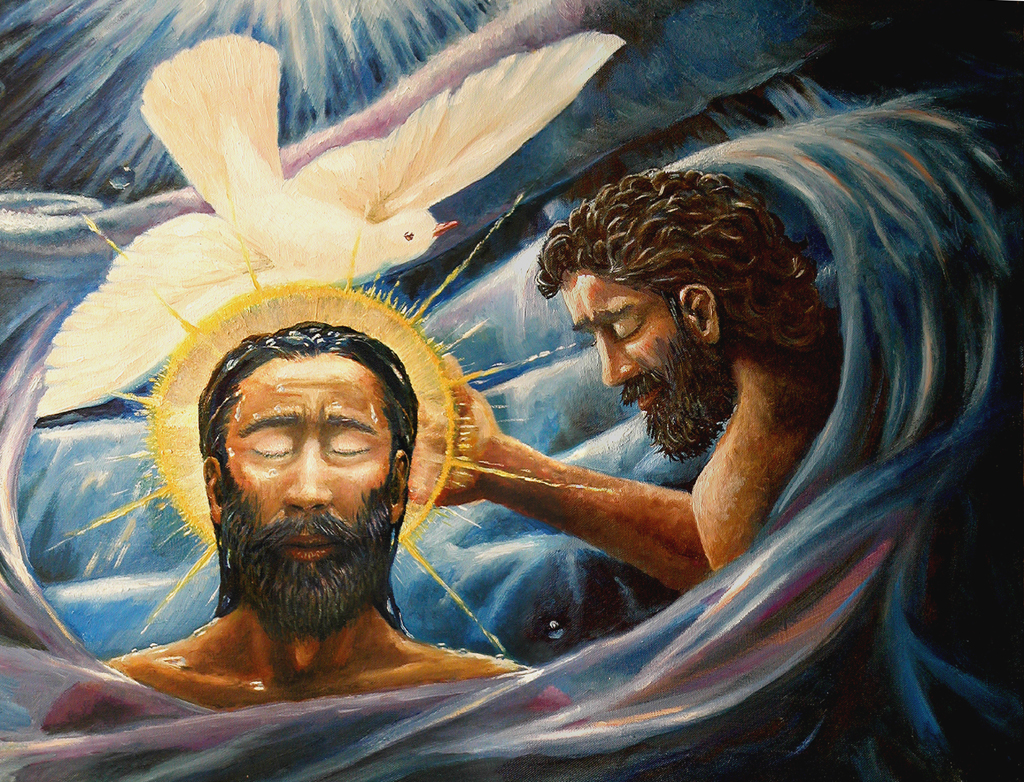
13 Then Jesus came from Galilee to the Jordan to be baptised by John. 14 But John tried to deter him, saying, ‘I need to be baptised by you, and do you come to me?’

John has just done the big introduction to Jesus, like the compère building up to the headline act. He has told the crowds that although he baptises people in water, someone is coming who will baptise with fire! The curtains part, the spotlight picks out this man as he walks onto the stage of history … and he wants to be baptised by John.

Whoa! Hang on, says John. You’re the big shot, not me. But Jesus says, I do things differently. You’re not going to get the prima donna act from me.

Now we acclaim celebrities and stars (even if later we like to shoot them down), but in Middle Eastern culture honour has always been important. People should be honoured. There is nothing worse than shame. That’s why, as I’ve told you before, Islam cannot get its head around the idea of a crucified Messiah.

But in submitting to baptism, Jesus shows his willingness to embrace the same shame as those who had already come to the Jordan to confess their sins. He has come to identify with their shame and to embrace it.

I believe this could be a powerful way of sharing the Good News of Jesus today. We struggle to convince people they are sinners (although strictly that’s the Holy Spirit’s job, not ours) because they think of ‘sinners’ as especially bad people, rather than all of us with our failings, which we tend to excuse.

But many people know feelings of shame. They know things in their lives that they just can’t talk about openly. Jesus has come as one who understands shame and who bears it all the way from the manger to the Cross.

In fact, an old friend of mine called Judith Rossall wrote a book that reclaims the importance of shame in the Bible. It’s called ‘Forbidden Fruit and Fig Leaves[1] and she argues that this all comes to a climax at the Cross, which was such a shameful mode of execution that Romans didn’t talk about it in polite society. Jesus was shamed by the Jewish and Roman authorities at the Cross, but honoured by God at the Resurrection[2].

So if you have something that you find so shameful you can’t bear to talk about it openly, I want you to know that Jesus’ willingness to be baptised is an early sign that he above all will embrace you in your sense of shame to make you whole. Whether it was something awful you did or something terrible that was done to you, I believe Jesus wants to raise you up and give you hope, honour, and dignity.

Secondly, Humility and Salvation:

15 Jesus replied, ‘Let it be so now; it is proper for us to do this to fulfil all righteousness.’ Then John consented.

Now when we hear the word ‘righteousness’ we might think this is about moral or ethical behaviour. But it’s more than that here, because it’s paired with the word ‘fulfil’, and Matthew has a big thing about the fulfilment of Scripture. Go back to the birth stories we’ve been reading at Christmas and you’ll see that a lot there. Fulfilling all righteousness means not only doing what Scripture requires, but that Jesus is fulfilling God’s whole plan revealed in the Scriptures. He fulfils Israel’s history and destiny by identifying with them here in baptism, and he takes that all the way to identifying with their sin at the Cross[3]. In submitting to John’s baptism of repentance even though he had not sinned, he showed where he was going: to the Cross, where he would identify not only with sinful Israel but the whole sinful human race. He would experience abandonment by God, but be vindicated in the embrace of the Resurrection.

Again, there is something relevant for people today. Who feels abandoned by God? Who thinks that God has left them, because of their sin? Jesus came to heal that. In undergoing a baptism of repentance he showed that he would stand in for us whose sins separate us from God.

And not only that, by doing so he would show us that the God who cannot look on our sin is nevertheless on our case, calling us back to him. The way back is the Cross.

If you have a sense of being abandoned by God and you know you have done things which have separated you from him, then hear the Good News here as Jesus fulfils all righteousness in his baptism of repentance and ultimately in his death at the Cross. God’s plan all along was to make a way back to him when we are far away due to our own fault.

If that is you, then you can start the journey back today through what Jesus did for you at the Cross.

Thirdly and finally, Hero and Servant:

16As soon as Jesus was baptised, he went up out of the water. At that moment heaven was opened, and he saw the Spirit of God descending like a dove and alighting on him. 17 And a voice from heaven said, ‘This is my Son, whom I love; with him I am well pleased.’

What a guy to do all this! And the Holy Spirit comes down on him in the form of a dove, just as

the dove appears as the harbinger of a new world after the flood, which other early Christian literature employs as a prototype of the coming age[4].

The new world is coming! This is what Jesus is bringing! Wow! And the voice from heaven commends him, and says how pleased he is with his Son. What a hero!

But wait. The language of affirmation from heaven is modelled on Isaiah 42, the first of the so-called ‘Servant Songs’ in that book. Godly heroics are not achieved by a superstar, by a celebrity, by someone in peak physical condition, or by a warrior. They are achieved by a servant.

I talked once before about how sad it is that when many children are asked today what they want to be when they grow up, the most common answer now is, ‘I want to be famous.’ But the example of Jesus shows how shallow this is. The Son of God himself rejects this way of life!

And that is good news for all of us. Because if you don’t have to be a famous celebrity or some kind of hero in society in order to change things for the good in line with God’s kingdom, then this way of life is open to everyone! Very few people will become nationally-known heroes that it’s really not worth aiming for. If it comes along, it comes along – but there are dangers.

However, everyone can find other people to serve. There are no limits. The upside-down way of Jesus opens up the way for everyone to make a difference for good in the world.

Conclusion

Jesus at his baptism gives some of the earliest signs that the ways of the world are disordered and that his upside-down approach will restore this world to a healthy and life-giving order.

So let us not seek honour for ourselves. If we live among the shamed, let us embrace it, for God will honour us and will transformed the shamed by his love.

Let us take the road of humility, knowing that it is the pathway to salvation, rather than pride and self-exaltation.

And let us not worry for a moment about whether people will regard us as heroes. Instead, let us give ourselves over to a life of service, knowing that this is how God brings in his kingdom.


[1] Judith Rossall, Forbidden Fruit and Fig Leaves: Reading the Bible with the Shamed; London, SCM, 2020.

[2] See Judith Rossall, Whose Honour? Whose Shame? Some Reflections on the Bible; Anvil volume 37 issue 2 at https://churchmissionsociety.org/anvil/whose-honour-whose-shame-some-reflections-on-the-bible-judith-rossall-anvil-vol-37-issue-2/

[3] Craig S Keener, The Gospel of Matthew: A Socio-Rhetorical Commentary, p132.

[4] Keener, p133.

John The Baptist: The Marmite Minister Matthew 11:1-19 (Advent 3 Year A)

Matthew 11:1-19

I once succeeded a previous minister in an appointment who was described to me as a Marmite minister. In other words, he divided opinion and everyone had an opinion about him. You couldn’t sit on the fence. You were for or against. He had that effect on everyone.

And in a similar way, John the Baptist was a Marmite minister. You had to take sides over what he preached. Some of that will come out as we think about this week’s reading.

But to our surprise, this story shows us another side of him. The vulnerable, struggling side of his personality.

This means we’re going to divide up four things I want to say about this passage into two halves. In the first half we’re going to think about John’s response to Jesus, and here we’re going to see signs of the weaknesses with which he wrestled.

In the second half we’re going to examine two ways people respond to John, and there we’ll see the Marmite minister in all his glory.

Firstly, then, two ways in which John responded to Jesus.

The first response John makes to Jesus in our reading is doubt.

When John, who was in prison, heard about the deeds of the Messiah, he sent his disciples to ask him, ‘Are you the one who is to come, or should we expect someone else?’

Doesn’t that seem astonishing? John has been preaching that the Messiah is coming and that people should prepare. We know from earlier in Matthew that he recognised his cousin Jesus as that Messiah by the way he saw himself as unworthy to baptise him (3:11-15). So why does he even need to send his disciples with this question?

I think the clue is found in the opening words of verse 2: ‘When John, who was in prison ….’ Things have gone wrong for John. This is not how he planned it. His fearsome preaching has got him in deep trouble with the political authorities. And of course, we know how it will end.

In such strained and stressed circumstances John begins to doubt. Does my imprisonment mean I got it wrong all along?

I have been in situations like that. Have you? Not in prison and likely to lose my life, but times when I thought I knew God’s will and then everything seemed to go wrong. I began to doubt.

One such occasion for me was before going to theological college. I have told you before some of the amazing stories of how God provided the money for me to go when I was denied a grant from my local authority and when I lost my appeal against the refusal of that grant.

Looking back, it is a wonderful story of God’s provision. But when I was at the in-between stage, with no grant and far from enough savings of my own, I too began to doubt.

It’s not that doubt is a good thing, but it is understandable. I follow the Christian thinker Os Guinness in saying that doubt is not the same as unbelief, because doubt is where our faith is in two minds and unbelief has no faith.

What a gift it is, then, to read Jesus’ response to the question:

 Jesus replied, ‘Go back and report to John what you hear and see: the blind receive sight, the lame walk, those who have leprosy are cleansed, the deaf hear, the dead are raised, and the good news is proclaimed to the poor. Blessed is anyone who does not stumble on account of me.’

If you are struggling with doubt in your faith at present, bring your questions to Jesus. Ask him to resolve them. He loves to do so.

John’s second response to Jesus is very similar to doubt: it is disappointment. There is a note in his questioning of ‘This is not how it was meant to be. Israel was meant to turn back to her God when the Forerunner and then the Messiah came. Yes, some have certainly turned back, but there is still opposition. That’s why I’m in prison. How does that fit in the divine plan?’

Many people lose their faith when they feel God has disappointed them. They believe he has let them down at a crucial time in their lives. Someone they loved fell ill and died young. Their marriage broke up, or maybe they lost all hope of ever marrying in the first place. There can be many other things, too.

Jesus sends back that message detailing the great things he is doing, and also describes John to the crowd as a prophet and more than a prophet. But prophets are people who at least in part live with unfulfilled hopes as they proclaim what God wants to do. It is the tension of being a prophet that you declare that God will perform certain actions but you don’t always get to see them yourself.

So John must live with disappointment in the short term. It isn’t that the mission has failed, but it is that before the end of all things it is incomplete.

Jesus will disappoint us, too. We need that prophetic perspective that disappointments now are not the end of the story. They may be terrible things. But the story of God does not end in darkness. It ends in his victory.

Then we have two ways in which people responded to John.

The first of these is something I am going to call determination. I’ll pick out one verse to summarise this:

12 From the days of John the Baptist until now, the kingdom of heaven has been subjected to violence, and violent people have been raiding it.

What do you make of a verse like that? If it’s any comfort to you, I remember this verse being singled out in New Testament Greek classes at college as being one of the very hardest to translate in the whole New Testament!

But let’s cut to the chase and say I believe this is about people who are very determined in their positive response to the message of John and then of Jesus.

One scholar puts it like this:

Jesus regularly borrowed images from his society and applied them in shocking ways, and thus may speak favourably here of spiritual warriors who were storming their way into God’s kingdom now. One second-century Jewish tradition praises those who passionately pursue the law by saying that God counts it as if they had ascended to heaven and taken the law forcibly, which the tradition regards as greater than having taken it peaceably. These were the people actively following Jesus, not simply waiting for the kingdom to come their way.[1]

So I simply want to ask: how are we showing determination and passion in our response to the kingdom of God? Has God given us a great zeal for some aspect of his kingdom work, and if so, are we pursuing it?

It could be that you want to see people find faith in Christ – so are you sharing your faith actively? It could be that you care passionately about the eradication of injustice in the world – so are you getting your hands dirty with that one? It could be that you long to see relationships healed and people reconciled – so are you putting in the quiet, patient, and resilient work behind the scenes which that needs?

Maybe it’s something else. But what is important is that we find how God wants us to respond to the Gospel in a determined and passionate way.

The second way in which people responded to John was by a decision.

Honestly, says Jesus, some of you can’t be pleased. You won’t dance to the music of the pipe and nor will you grieve when a dirge is sung. You don’t like John’s austere lifestyle and yet you condemn me when I enjoy a good party (verses 16-19). There is no pleasing some people.

And there is no pleasing such people because they want to make every excuse possible to avoid making a decision about the message first John and then later Jesus proclaim.

Ultimately, no-one can sit on the fence when it comes to John and to the One he preached about, Jesus himself. In fact, to sit on the fence is to choose against God’s kingdom.

John would say to us, if we’ve been putting off that decision about following the Messiah, it’s time to stop doing that now. It’s urgent and crucial, he says, that we make up our minds about Jesus.

Some of us cover up our refusal to get off the fence by manufacturing respectable churchgoing lives. We look for all the world like a dedicated follower of Jesus, but we are in fact using religious behaviour as a cover for our failure to declare for Christ.

And therefore I cannot finish my words today without putting out that challenge. Is anyone listening to this avoiding making that commitment to Jesus Christ that John urges us to do?

Remember, this is a Marmite matter: you have to decide one way or the other.


[1] Craig S Keener, The Gospel of Matthew, p340.

The Prophetic Question: Who Are You? Matthew 3:1-12 (Advent 2 Year A 2022)

Matthew 3:1-12

I had always thought that the parent I most resembled was my father. Temperament, build, hair colour, interests – not identical, but pretty similar.

It was therefore a surprise when I went into a room in the office where I began my working life to find there a woman called Olive say, “You must be Joan Faulkner’s son! You look so like her.” It turned out Olive had worked with my mum many years previously.

Who are you like? Sometimes I approach a Bible passage like that. Which of the characters are we like, and what does that tell us about our faith?

And I want to take that line with today’s passage. Who am I like in the reading? Who are you like?

Are we like John the Baptist?

I don’t know how many times I’ve read this story during my life, but what I do know is that when I came to it this week my first reaction was, ‘Yes, I identify with John the Baptist!’

Why?  Because I like locusts and honey? No. Because I want to wear something made from camel’s hair? No: I just ordered a new winter coat from Mountain Warehouse in a Black Friday deal.

It was the line about being ‘one calling in the wilderness’ (verse 3). And the word ‘wilderness’ grabbed me. I thought, that’s what my ministry is like. Much of the time I haven’t seen the things I’d have hoped for, and much of the Methodist Church feels as parched as the wilderness. Woe is me!

But then I dug deeper instead of feeling sorry for myself. I thought of what the wilderness symbolises in the Scriptures. One thing it symbolises is ‘testing’, just as God tested the faithfulness of Israel in the wilderness between Egypt and the Promised Land.

And so I wondered whether a prolonged period of spiritual drought was one where my faithfulness to God was being tested. Furthermore, I wondered about the drought the Christian church finds itself in, as evidenced by the substantial fall in the numbers of people calling themselves Christians, as we have learned this week the 2021 Census data shows.

But then perhaps we are being tested by God to see whether we will be faithful to him in disappointing circumstances. The temptation at a time of decline is to start adjusting our message to fit what people popularly believe, but that is a serious mistake. For one thing, it means we won’t be faithful to Christ even when it means we are unpopular. For another it’s a tactical mistake, because if we make ourselves just like the rest of the society then there is no longer any point in conversion.

The Anglican evangelist J John put it like this in response to the census figures:

In my view, and I claim the Bible on my side, what is needed is not a stripped-down creed tuned to the prevailing mood of the culture.

That won’t work: no one goes to church to hear exactly what they get from the media and from their friends and colleagues. What will bring them in and see them committed to the church is the full- blooded, confident preaching of Christ in the power of the Holy Spirit.

Paradoxically the way to change the census figures is to ignore them and instead focus on producing changed lives through Jesus Christ.

But the wilderness is also the place of renewal. God promises to bring his people back from exile in Babylon through the wilderness to their land. So it’s fitting that John locates his campaign for the renewal of Israel in the wilderness. So as we witness more and more decline and death in the British church, we also pray, Lord, turn this wilderness into a place of renewal and growth.

Meanwhile, what do we do? We trust in God. This is what the locusts and honey are about. They are not a description of a bush tucker trial from I’m A Celebrity, Get Me Out Of Here, they were the basic foods available to him if living simply in the desert. Honey was a regular sweetener for the poor and for others in his culture; other wilderness-dwellers often fed on locusts[1]. Just don’t go looking for them among the more unusual foodstuffs at Waitrose. John was saying, I am willing to live simply and live on what God provides here.

How willing are we like him to trust God like that?

Or are we like the crowds?

It isn’t difficult for the people to go and hear John. His location is just twenty miles from Jerusalem. The Jewish historian Josephus tells us that the crowds were so large that Herod Antipas, the local ruler on behalf of the Romans, feared an uprising[2].

But if it was easy for them to get there, it wasn’t so easy for them to fulfil what John was calling them to do. He preached that they needed to repent (verse 2), and here ‘repentance’ doesn’t merely mean ‘change your mind’, it means ‘turn your whole life around’. We see them doing this because Matthew tells us that they were baptised by John when they confessed their sins (verse 6).

Let us pause and consider what a humbling thing this was for the average Jew to do. John was not asking them to follow through simply with a liturgical, ritual act. He was expecting a complete change of lifestyle.

But he is expecting this from devout Jews! These are people who are already committed to faith in God! John is saying to them, you might just as well be a pagan Gentile, such is the level of turnaround you need in your lives. They were being treated as if they had never demonstrated any serious commitment to God at all before, despite having followed the Jewish way of life and taken part in its rituals for years!

I gained a small insight into what that must feel like many years ago. As a good number of you know, when I was exploring God’s call to the ministry, I ended up studying Theology as an independent student at an Anglican theological college. When the calling became clear, I had a quandary. Did I stay with my native Methodism or did I go over to the Church of England, because I was seeing a great advert for it there?

It was that thought that I would have to be confirmed just like I had never been a Christian before that ultimately put me off the C of E. To me, it denied the previous work oof the Holy Spirit.

Now what if I or some other preacher told you that all your Methodist heritage was in vain in terms of getting into God’s Kingdom? Just because you were a church steward for many years didn’t count. Just because you knew Wesley’s hymns inside out meant nothing. Just because you had taught Sunday School or been a Local Preacher – well, so what?

Rip it all up and start again. That’s what John expected of the crowds. What if we need to do that? What if all that we do, much as we cherish it, has declined into empty ritual and dead religion? Do any of us need to hear John’s call for a radical turning back to Christ and a complete reset of our spiritual lives? Does anyone hearing this today need to do that?

Or finally, are we like the Pharisees and Sadducees?

Well, if you thought John was hard on the ordinary crowds, just wait until you hear him tear into the religious leaders. A ‘brood of vipers’ (verse 7): That is an ancient insult! There was a belief that had been around for a few centuries going back to the Greek historian Herodotus five centuries earlier that vipers were mother killers – that the children, the brood, killed their mothers in revenge for the fact that the females killed the males during procreation. ‘Mother-killer’ becomes, then, a way of saying that these leaders were utterly depraved morally[3].

Therefore being ‘children of Abraham’ (verse 9) counted for nothing. Some of you have heard me say that my sister once worked out when doing some work on the family genealogy that she and I had grown up as the fifth generation of Methodist in the same congregation. But that would have meant nothing spiritually if we both had not taken the decision to respond to the grace of God and follow Jesus Christ ourselves.

And that’s why I get disappointed when I go to a church and am greeted by someone who tells me with pride that they are a life-long Methodist. It counts for nothing unless the person has embraced Wesley’s call to repentance and faith in Jesus Christ, leading to a life of discipleship.

But John the Baptist exposes these religious leaders as people who rested on their spiritual heritage while using that as a cover for shamelessly immoral lives. I’d like to tell you that doesn’t exist in the church today, but I’d be lying. From time to time I encounter it. I don’t mean those who are genuinely struggling to conquer sin but not always succeeding, I mean those who are happy to use religious respectability as a cover for a totally different lifestyle. You know – the sort of stories that make salacious headlines occasionally, and bring the church into disrepute.

Now I sincerely hope this third and final point is the one that makes least connection with anybody here today. Perhaps it is more made to be preached at Synod or Conference!

But were any of us to be living a double life, outwardly proclaiming our faithfulness to the truth while using that to hide a shameful life, then Advent is  the time to hear Jesus’ warning that he won’t play games with us. He can make new faithful people out of stones, he says (verse 9). We shouldn’t rely on some sense of being indispensable to him.

Conclusion

All these three sets of people we’ve considered point us to the fact that Advent is a season of preparation, but it is preparation that happens by repentance. Not for nothing have some Christian traditions called Advent ‘The Lesser Lent.’

We prepare for Christ’s coming by inviting the Holy Spirit to examine our hearts. He prepares the way of the Lord in us and makes straight paths for him in our lives (verse 3).


[1] Craig S Keener, The Gospel of Matthew: A Socio-Rhetorical Commentary, p118f.

[2] Ian Paul, https://www.psephizo.com/biblical-studies/john-the-baptist-jesus-and-judgement-in-matthew-3/

[3] Keener, p122f.

Fifth Sunday in Easter: I Am the Vine

I made one very tired mistake in the video below: I forgot to set my camera to eye autofocus, and so at points I go out of focus during the video. Of course, you may prefer me that way!

John 15:1-8

Last week we thought about one of the seven ‘I am’ sayings of Jesus in John’s Gospel, namely, ‘I am the Good Shepherd.’ This week we think about another one: ‘I am the Vine.’

We need to carry over two things from last week. The first is to remember that this very emphatic way of saying ‘I am’ indicates a claim by Jesus to divinity, reminiscent of God calling himself ‘I am who I am’ to Moses at the burning bush.

The second thing we need to carry over is to look to the Old Testament for some background to the title. So just as we looked at the title of ‘Shepherd’ last week, we must now look at ‘Vine’, and the obvious place to go is Isaiah 5:1-7, where the prophet describes Israel as like a vineyard. However, it’s a bad vineyard, and is symbolic of God’s people being persistently and seriously disobedient to God through their disregard for justice. God promises to withdraw the vineyard’s protective hedge and leave it to decay and destruction.

A new vineyard is needed. That’s what Jesus claims to be here in today’s passage. This is yet another New Testament passage where Jesus claims to be the True Israel, fulfilling everything that Israel should have done but didn’t.

And with Jesus’ disciples being the branches, Jesus says that the vineyard is now constituted differently, not on the basis of observing Torah, but on the basis of union with him.

Now we often say that all metaphors are limited, and one of the limitations here is that Jesus doesn’t describe how we become branches of the vine. There’s nothing obvious here about salvation by grace through faith, for example. We conclude that’s not the purpose of Jesus choosing this image.

Instead, Jesus seems to talk about what it takes to remain one of the branches. His Father is the gardener (verse 1). In the Apocrypha, the literature between the Old and New Testaments that our Catholic friends recognise as Scripture but we don’t,  

The state of a tree’s fruit … was said to attest how well the farmer … had cared for it (Sir 27:6), reinforcing the importance of a gardener’s care for it.[i]

So, if you like, God’s reputation is at stake here! But he trusts that reputation to our behaviour – a very chancy thing, you may well think. It’s something that came home in a distressingly powerful way to me this last week when reports began to appear online that alleged the long-deceased headmaster of my old secondary school was a paedophile. You see, it was a Church of England school, and one of the alleged victims said that this behaviour pushed him towards atheism.

God’s reputation is at stake according to the conduct of his people.

So we need to give careful attention to our relationship with Christ.

A couple of things strike me about that in the reading.

The first is that we have a choice between being pruned and being cut off. Both sound painful. There is no choice that involves the avoidance of pain. It’s rather as I heard Adrian Plass put it some years ago:

Life is a choice between doing what you don’t want to do and doing what you really don’t want to do.

What’s the difference between being pruned and being cut off? Pruning took place in late Spring: the tendrils of the vine were clipped back to allow the fruit to grow. The idea was to get the vine to put all its energy into producing fruit.[ii]

Being cut off was much worse. This was when branches that would no longer produce fruit were removed to leave space for new ones that would.

I’m sure you can see some spiritual parallels here. God the Father is determined that the church of his Son Jesus be spiritually fruitful in what it does. If we share that concern (and if not, why not?) then we shall be wiling to submit to his pruning, removing those things from our lives individually and together that get in the way of fruit growing.

What might God prune from our lives if we are willing to let him work in us so that we are fruitful? I suspect it would include all those frivolous and shallow things on which we spend our time. How many of us are just not getting down to serious prayer and spiritual reading because we are filling our time with trashy magazines, Internet gossip, and maybe worse things? Or maybe he’s calling us to put aside something good in favour of what is better?

Are we aware of God wanting to prune us of the things that stop us going deeper with him?

And then what about the cutting off? How many of us have not only become unfruitful, we have also managed to get ourselves in the way of those promising branches that could become fruitful?

How might that happen? Do we dominate church life at the expense of those who want to move forward spiritually? Have we belittled the passion of those who want to press on with Christ?

Look at how few of us take our devotional life seriously, to the point that some surveys show many Christians only interact with the Bible on a Sunday morning, and when we talk about what we believe, it’s utterly infused with the values of the world rather than the Gospel.

In these cases, God has every right to look at his church and say, the situation is so serious that I shall have to get some people out of the way if the church is to have any hope.

Pray God that we shall not give him reason to consider us. Pray God instead that we accept his pruning.

The second strand of Jesus’ thought I wanted to pick up on is connected with this and is all the language about remaining – us remaining in Christ and Christ remaining in us.

The late Eugene Peterson’s translation of the Bible, The Message, paraphrases this language as a call to make our home in Jesus just as he does in us, or to be joined to him in an intimate and organic relationship.

I wonder what it means to be at home with Jesus? Surely it sounds like the sort of relationship where we are comfortable with him – as a Person, and in what he says and what he does. It’s not just a distant admiration for a great man: it’s such a desire for him that we want to draw close to him and even imitate him.

So yes, this begins with all the sorts of things I regularly bang on about: the importance of personal Bible reading and prayer, and all the other spiritual disciplines.

But that’s only where it begins. If it stops there it won’t be enough for us to remain in Christ. I have known avid Bible readers who have also been avid back stabbers.

It was the twentieth century American saint A W Tozer who captured the spirit of what I’m trying to say here in these words of his:

The driver on the highway is safe not when he reads the signs, but when he obeys them.[iii]

When we not only listen to Jesus but put into practice what he says, then what do we think the result will be? Answer: spiritual fruitfulness.

Alternatively, when we hear the words of Jesus (and most of us have heard them regularly for years) but do nothing about them, what is the logical conclusion? The answer, surely, is the predominantly fruitless church that we have today. God is determined to have a fruitful vine,, not one he has to leave to rack and ruin again. Will we draw close to him in listening and in obedience so that he makes us fruitful for him? Or will we be so casual in our faith that in the end he says, these people are getting in the way, I must remove them so that I can use newer and younger branches?


[i] Craig S Keener, The Gospel of John: A Commentary, Volume 2, p994.

[ii] https://www.psephizo.com/biblical-studies/jesus-the-true-vine-in-john-15/

[iii] https://www.pinterest.com/CandidChristian/aw-tozer-quotes/

Create a website or blog at WordPress.com

Up ↑