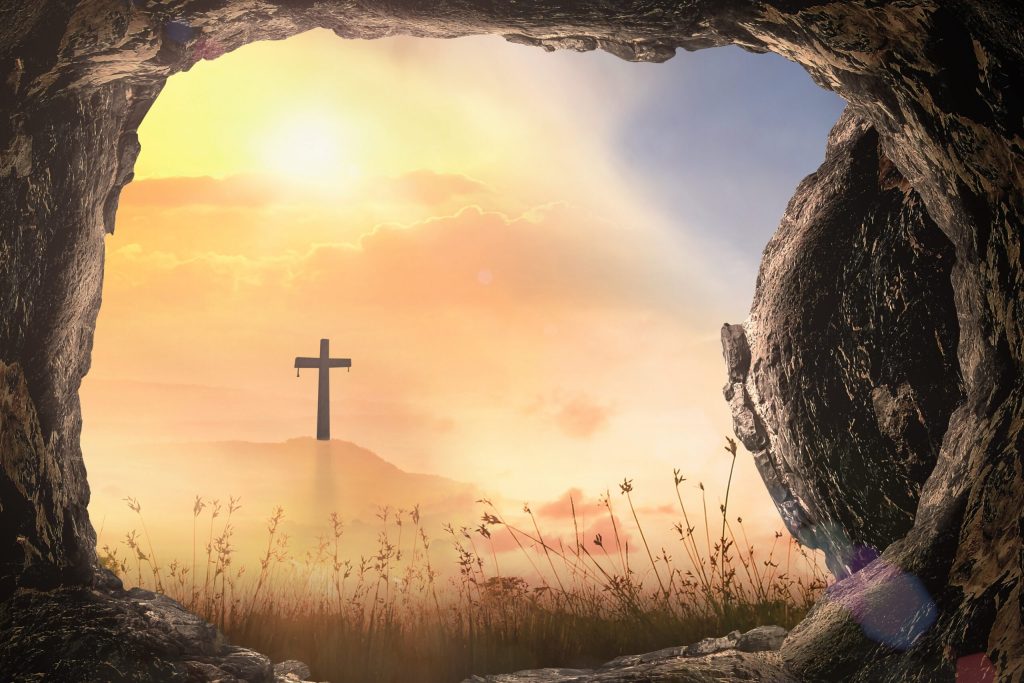
Easter Day: A Choice To Make At The Empty Tomb

Matthew 28:1-10

Image from Abundant Life Church. CC 4.0.

I’ve spent Holy Week this year offering reflections on some of the characters in the Gospel stories of Jesus’ passion and crucifixion. On Monday in the first of our three daily meditations, I explored Mary of Bethany with you. On Tuesday, we wrestled with the stories around Judas Iscariot, before thinking on Wednesday about Peter.

At the Maundy Thursday meal, we focussed on the Beloved Disciple, and I carried this over on Good Friday to my services where we looked at Simon of Cyrene.

For all of these, my inspiration was a book from 1999 called At The Cross by my own postgrad supervisor Richard Bauckham and Trevor Hart.

Today, I want to continue with some characters in the story, but Bauckham and Hart’s book doesn’t extend to the Resurrection, so with a little help from Craig Keener’s commentary on Matthew, I offer you the challenge of the Good News as seen in the characters around the empty tomb. We’re going to consider the women, the angel, and the soldiers.

Firstly, the women:

Two Marys at Christ’s tomb by Vincent Vörös. From RawPixel. Public Domain. Original public domain image from Web umenia.

The women are about the customary business of women after a death. It was usual to bring spices to a tomb, but men could only tend to the bodies of dead men, whereas women could care for both dead women and dead men. When Mary Magdalene and the other Mary visit the tomb, this is nothing out of the ordinary.

But their routine is exploded by what they find. They were not expecting to find the tombstone rolled away. More likely, they were preparing to ask permission of the soldiers to attend to Jesus’ body. They certainly weren’t anticipating a conversation with an angel.

Angels have a habit of interrupting the normal and transforming it. Ask Mary, the mother of Jesus. Ask a certain group of shepherds. Ask Abraham, and numerous others.

How are the women transformed? They become the first witnesses to the Resurrection. Not only do they see the evidence of the empty tomb, but they also meet the risen Jesus.

And moreover, they receive a commission to take the news to the disciples. Yes, those male disciples that Jesus had taught and trained over the three years, but who had failed him at the end. The women hadn’t, and the angel calls them to do something that later Paul would say was a qualification for apostleship: see the risen Jesus and be a witness to his Resurrection.

Who would expect that in a culture where women could not give evidence? It’s just one of those details you would never include if you were making up the story. People considered insignificant and of lesser value in their society – women – were given an apostolic call. That’s a long way from the traditional and expected habits that had brought them to the tomb that morning. They didn’t have this on their agenda that day.

Therefore, I want to ask you whether you are open to the risen Lord bursting in on the normal routines of your life and transforming them. Does Jesus have a call for you? Never mind the conventions of our society. Don’t sit there thinking I’m dyslexic, I’m neurodiverse, I’m too young, I’m too old, I’m the wrong skin colour, I don’t have the right education, I lack confidence, I’ve got secret shame, I’m disabled, or anything else you care to add. The things that are barriers for the world are not barriers for the risen Lord. If God by his Spirit can raise Jesus from the dead, then it is no trouble at all for him to jump over the hurdles our world puts in the way of people doing something significant.

It was in the Easter season in 1985 when God interrupted me, through a sermon by a Local Preacher on Low Sunday where in John 21 Jesus says to Peter, ‘Feed my sheep,’ that my journey to ministry began. It took me a long time to unravel what that interruption that morning meant, but it was a resurrection moment for me. I thought I was just doing my usual duties as a church steward that morning, but the risen Lord had other ideas.

What about you this Easter?

Secondly, the angel:

Angel turning stone at Christ’s tomb. Found at Easy-Peasy AI. CC 4.0.

While I was training for the ministry at Manchester, one of the northern students was very keen on wrestling. He organised outings to watch wrestling bouts. I never could understand it, because to me, having been a child when my grandmother, who lived with us, stayed glued to World of Sport on a Saturday afternoon to see Mick McManus, Jackie Pallo, Giant Haystacks and others, the appeal of wrestling was for old ladies. Why my friend Peter should persist in inviting me to something so camp, I could not understand. I never felt it belonged in the arena of sport, it was more like pantomime.

And of course, despite my aversion to it, I cannot erase from my memory the notion of ‘two submissions or a knockout’ to win, and how, when one wrestler had gained a submission from his opponent, he would often sit on him in triumph.

Well, here, on Easter morning, an angel sits not on the guards who have been so shaken by his arrival but on the stone he has rolled back. It’s not the soldiers who have been conquered so much as death itself. Not two submissions, just a knockout.

Easter Day is the supreme day of triumph. As the angel sits on the tombstone, we know that everything the New Testament claims for Christ’s work on the Cross is true and is vindicated. So –

  • Jesus has died in our place and our sins are forgiven;
  • Jesus has conquered what the Bible calls ‘the principalities and powers’ and all the forces of evil;
  • Jesus has fulfilled all that Adam and then Israel failed to do, by turning sinful human flesh back into obedience to the Father, right through to death;
  • Jesus has shown that the route to eternal life is not by violence, but by the way of the Cross.

Next time an inner voice condemns you for your sins, go and look at the angel sitting on the tombstone. Next time evil does its worst, cast your eyes at the angel on the tombstone and know that time has been served on evil. Next time you fail, look at that angel sitting in triumph know that Jesus has united you with him, and that’s who the Father sees when he looks at you. Next time you are troubled by world leaders who think they can bomb their way to freedom or cut down thousands of their own population to hold onto power, observe once more the angel who put his feet up on top of the tombstone and know that those ways will not last into eternity.

It was Friday, but Sunday has come.

Thirdly, the soldiers:
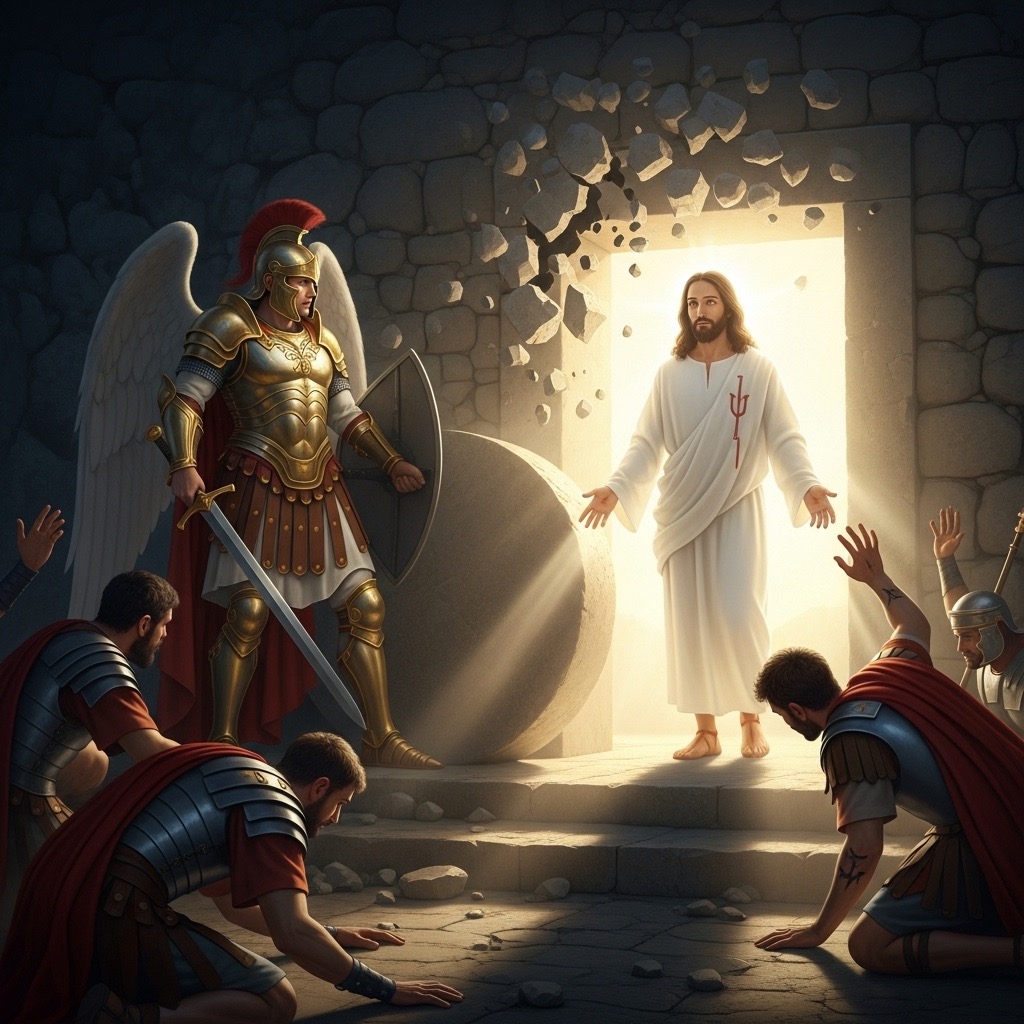
Easy-Peasy AI. CC 4.0.

The soldiers are the first to witness the awesome divine power of the Resurrection, as they encounter the angel, but as they shake and become like dead men their hearts are exposed. They are not on the side of life, but the side of death. Their job has been to promote and protect death. Now, they cannot hear the words of grace that the angel has for the women. Fancy witnessing the power of God and staying with the forces of death.

If you have any doubts about what I am saying and think I am just being fanciful, remember what happens after this. In verses 11 to 15, which we didn’t read, the soldiers are perfectly happy to collude with the authorities in the lie that the body of Jesus has been stolen. They are not on the side of life or truth, but of death and falsehood.

What a warning this is to us all. The saving power of God has come up close. The Good News has been enacted in front of them. But still, they choose death. Still, they choose to embrace a lie. Moreover, they allow themselves to be bribed with a large sum of money in order to go along with the fiction that the chief priests want.

This is surely a sobering reminder to us not to miss the grace of God when it comes calling. Now is the day of salvation. Now, life in all its fulness opens up before us. Now, the door of true freedom has been unlocked before our eyes. Why would we prefer the realms of untruth, monetary greed, and the decay of death?

But some people do. They are more entranced by the shrunken, shrivelled republic of sin than by the beautiful kingdom of love, joy, and peace. For it means putting aside a lifestyle where ‘me, me, me’ is at the centre, and where we can justify staying as we are on the grounds of what others have done to us, despite the fact that the death and resurrection of the king offers the prospect of those old wounds being healed through forgiving love.

The biggest mistake any of us could make on Easter Day is to be like the soldiers. The life-giving power of God in the Resurrection has come close. Through it, God bids us to walk with Jesus in newness of life, exchanging the dirty rags of our weaselly self-centredness for the clean robes of a disciple who puts Jesus first.

But the more we ignore that call, the more we put it off, the more we delay saying ‘yes’ to Jesus, the more is the risk that one day that life-transforming power will stop calling. For God will realise we are not serious about him. He will confirm us in our own decision to harden our hearts. He will leave us in our selfishness and greed, shaking like dead men.

Easter Day is a day to witness that angel sitting triumphantly on the tombstone, to respond like the women who, though afraid, allowed the angel’s interruption to give their lives new direction, and ran away with joy to tell the good news, and to let dead soldiers bury their own dead.

I Can See Clearly Now: Easter Day 2025 (Luke 24:1-12)

Luke 24:1-12

When I conduct a wedding, I like to bring along some of my camera gear and took some photos. Not in the middle of the ceremony while I am marrying the couple, you understand, but before and after the service, and at the reception.

When I came to check the photos on the computer after one wedding, I was happy with some and unhappy with others. Nothing unusual in that, you might think.

But then I noticed that all the photos I thought were substandard had been taken with the same lens. They just weren’t sharp. And that was crazy, because it was one of my sharpest lenses.

Then I realised. That lens had needed cleaning, and I hadn’t done that before the ceremony. All the other lenses I used that day were clean.

So I cleaned the lens, and all the photos I have made with it since have been every bit as clear and sharp as I would expect.

Johnny Nash sang ‘I Can See Clearly Now’, and I believe the Resurrection, being the most stunning work of God since creation, is a time when we can see God more clearly now. Our lenses are cleaned, the rain is gone, and God comes into vision ever more vividly. That’s even true in Luke 24:1-12, where the disciples are still tentative and haven’t yet come to a full Easter faith.

So in what ways do we see God more clearly at the Resurrection? Here are three.

Firstly, we see God’s Work more clearly.

The women arrive at the tomb early in the morning and the miracle has already happened. This fits with an Old Testament theme ‘in which the action of God comes to light following the hours of darkness’[1]. When the Israelites are trapped at the Red Sea and the Egyptian army is pursuing them, we read that

During the last watch of the night the Lord looked down from the pillar of fire and cloud at the Egyptian army and threw it into confusion. (Exodus 14:24)

On an occasion when Israel was under siege from Assyria, we read this:

That night the angel of the Lord went out and put to death a hundred and eighty-five thousand in the Assyrian camp. When the people got up the next morning – there were all the dead bodies! (2 Kings 19:35)

God does his work of deliverance in the darkest and coldest times, and it comes to light at dawn. The same happens at the Resurrection.

I wonder whether that makes any connections for you? In these last few days of Holy Week, we’ve had the darkness of Judas Iscariot scuttling off from the Last Supper to earn his thirty pieces of silver. We’ve had the darkness of Gethsemane, in Jesus’ anguished prayer and then that betrayal by Judas. We’ve had the Cross itself, where for three hours the land is covered in darkness in the middle of the day. And we might think that only evil is at work. We might even think that evil has triumphed. But that isn’t true. God is at work. Redemption is coming.

I wonder whether we are prone to thinking that when all seems dark, God is not at work. When everything is going wrong, we are tempted to think that God is absent. When life is not going as it should, has God abdicated from the throne of the universe?

Not a bit of it! The Resurrection declares to us that God is at work to bring salvation and freedom even in the darkness, and even though we may only see the signs of his work when the light comes again. God is still continuing with his quiet revolution, rolling stones away and raising bodies under cover of darkness.

There will be some of us here today who are going through dark times. We shall be tempted to think that God is not on the case. But I tell you that he is. Invisible to our sight in the darkness, God is preparing to turn our worlds upside-down. He calls us to wait for the dawn, when we shall finally see what conspiracies of hope he has been plotting and executing.

So let the Resurrection give us increased insight into the work of God, even in the darkness.

Secondly, we see God’s Words more clearly.

The two men (whom I take to be angels) say to the women,

‘Why do you look for the living among the dead? He is not here; he has risen! Remember how he told you, while he was still with you in Galilee: “The Son of Man must be delivered over to the hands of sinners, be crucified and on the third day be raised again.”’ Then they remembered his words.

So Jesus had promised his resurrection on at least three occasions to his disciples, but it just hadn’t sunk in. They couldn’t grasp it. Such a prophecy didn’t fit in with their existing understanding of faith and life, and so either they dismissed it or it just didn’t register. They believed that the resurrection of the dead would only happen at the end of time (as it will for everyone except Jesus) and so the words of Jesus just didn’t get through. As a result, they denied themselves the hope they would have had even when Jesus was crucified.

The Resurrection, then, is the greatest case of ‘Told you so!’ in history!

And what is it like when a human being says, ‘Told you so!’ to us? They usually tell us with some vigour that we should have listened to them in the first time. If we are humble, we may reflect on that, regret not listening to them, and wonder what it might have been like had we accepted their word. None of this seems to apply, however, if the person concerned is our spouse.

The ‘Told you so!’ of the Resurrection, though it is said with far greater grace than we mere mortals say it, makes the case for us going back on all the teaching and the promises of Jesus. How many of them just don’t seem to fit into our preconceived ideas or the popular values of our culture? Love your enemies? Well, OK, just so long as they don’t take the opposite view on Donald Trump from me. Forgive seventy times seven? But shouldn’t people get what they deserve? Yet if we are called to forgive seventy times seven, how much more does God forgive us? Give to the poor? They should get a job!

Yes, the words of Jesus certainly rub our culture up the wrong way. It’s tempting not to hear them, or to explain them away. But the Resurrection shows that it’s the words of Jesus that will come true. It’s his teaching that is eternal. It’s his promises that will stand for all time, not the promises of the advertisers or the politicians.

This Easter, then, let’s return to the words of Jesus with renewed confidence and renewed commitment. Truly, he has the words of eternal life.

Thirdly and finally, we see God’s Witnesses more clearly.

I’m referring here to the women, the first witnesses to the Resurrection. It’s a common point to make that if you were going to invent the story of the Resurrection, you wouldn’t have made your first and most important witnesses women. Generally speaking, women were not accepted as witnesses in Jewish courts of law two thousand years ago. You can sense the disparaging attitude that the male disciples had with Luke’s comment in verse 11:

11 But they did not believe the women, because their words seemed to them like nonsense.

Yet the gospel writers all tell us that women were the first to find the tomb empty. This becomes testimony to the veracity and honesty of the gospel accounts.

Now that’s all well and good, but I’d like to take that familiar point further forward. Here’s my point: if God can choose unlikely people to be the first witnesses to the Resurrection of his Son, does this not show that he can continue to pick people who are unlikely candidates to be his witnesses? I think he can.

There are many ways in which Christians like us think we are disqualified to be witnesses to the risen Jesus. We may say that we are not a trained religious professional, with all the appropriate academic knowledge. But Jesus didn’t seem too bothered when he called fishermen who had not been chosen by other rabbis to be his disciples.

We may say that we have disqualified ourselves by sin, but how many of Jesus’ original disciples stayed at the Cross? Simon Peter disowned Jesus three times publicly, and doubtless many of the others effectively did the same. Yet Jesus chooses these people to carry the message of his kingdom into the ancient world after his Resurrection and Ascension.

We may say that we lack the necessary confidence, but God chose Moses, who didn’t know how to speak in public, and Gideon, who wanted to hide. They were unlikely witnesses, too.

So who, then, do count as God’s witnesses? There’s a telling story early in the book of Acts, chapter 4. Peter and John have been hauled before the religious bigwigs for having preached the resurrection following the healing of the man at the Beautiful Gate of the temple. After Peter speaks defiantly to these leaders, Luke notes this:

13 When they saw the courage of Peter and John and realised that they were unschooled, ordinary men, they were astonished and they took note that these men had been with Jesus. (Acts 4:13)

‘Unschooled, ordinary men’ – or, if translated a little over-literally, ‘ungrammatical idiots’. But the difference was not their education, it was ‘that these men had been with Jesus’.

That’s the qualification. Not alphabet soup after your surname but being with Jesus. Not a charismatic personality but being with Jesus. Not a perfect life but one lived with Jesus.

Sure, some people will not take seriously out witness to the fact that Jesus is alive. If even the male disciples thought the women’s words were nonsense, then we can be sure that some people outside of our faith will certainly think that what we testify to is ridiculous.

But from time to time we will find a Peter. His curiosity was triggered by the witness of the women, and he ran to the tomb, where he found the strips of linen lying in an unexpected way (verse 12). It wouldn’t be long before his curiosity led to full Easter faith.

So in conclusion you may find this morning’s sermon a challenge. But what I really hope is that you find it to be a series of encouragements. Be encouraged that the Resurrection tells us God is still at work in the dark, and when the light comes we’ll see the marvellous things he’s been doing quietly.

Be encouraged that when Jesus speaks his word to us, he will keep his word. The fulfilment of his prophecies in the Resurrection show that he is trustworthy.

And be encouraged that when it comes to being his witnesses, you only need to be someone who lives in the presence of Jesus to have a credible testimony.

This Easter, let us be encouraged by our risen Lord in our faith and in our witness.


[1] John Nolland, Luke 18:35-24:53, p1193.

A Gentle Healing – Worship for Easter Day 2021 With Added Noel Richards!

Happy Easter!

And what better day to sing the praises of God? So the video is a little longer this Sunday, and that’s not because I’ve preached an extra-long message, it’s because I’ve included extra sung worship. Much of it comes courtesy of Noel Richards, who kindly sent videos of him leading some of his own Easter-themed worship songs.

Mark 16:1-8

A couple of years ago in the run-up to Christmas, I couldn’t get any inspiration for what to preach about at the Christmas Eve Midnight Communion service. That’s not a good place for a preacher to be in, and certainly not me. I like to have all my thoughts for a sermon or address prepared and organised. Extempore preaching is just not for me.

But on this occasion I strangely didn’t feel stressed about the prospect. I offered some thoughts around John chapter 1 verse 5:

The light shines in the darkness, and the darkness has not overcome it.

I linked it to my experiences of bereavement, losing my mother in February 2014 and my father in August 2017. I explained how that Advent hope of the light in the darkness had made sense of my experience. I had just enough light in the darkness. This was my hope: just enough light in the darkness.

Those of you who bought the book ‘Merry Christmas Everyone’ to which I contributed a chapter may recall that this is what I wrote about there. It’s important to me.

So why am I beginning an Easter Day message with a reference to Christmas? Because I think there’s something similar going on here.

Just look at Mark’s account. It only has eight verses, far fewer than the other Gospels. Granted, your Bible may offer you other possible endings to Mark, but these are most likely additions from other writers who couldn’t cope with the short and stark way in which Mark ends his account with the women still afraid, despite being told by the young man robed in white not to be alarmed. It does feel like a strange ending. Some scholars assume that we have lost the original ending to the Gospel, and that it would have all been tidied up much more neatly than this.

But what if this really is the end? I think it surprisingly might be quite fitting. Why do I think that? Let me explain.

Mark’s Gospel makes great play on the suffering of Jesus and teaches that his disciples will also suffer. That’s why the first of three prophecies Jesus makes of his betrayal and death leads to him telling those gathered around him that if anyone wants to be his disciple, he or she must deny themselves, take up their cross, and follow him.

And there are strong reasons for thinking that Mark emphasises these elements of Jesus’ life and message because he is writing to Christians in Rome facing persecution under the Emperor Nero in the AD 60s. They need to hear that suffering for your faith is par for the course according to Jesus himself, but they also need to have a glimpse of hope, and eight verses in Mark 16 give them that.

I don’t know about you, but when I am going through a bad patch in life, the sort of people who come along and give me a hearty slap on the back, explaining all my troubles in ways that God hasn’t, and telling me how great things will be soon, are actually people to whom I want to give a hearty slap on the back, but not in the same way. A dose of triumphalism is not what the doctor orders at those times for me.

However, a gentle pointer towards hope is much more likely to act as medicine to my soul, and I think that’s what the young man robed in white gives the women at the tomb:

‘Don’t be alarmed,’ he said. ‘You are looking for Jesus the Nazarene, who was crucified. He has risen! He is not here. See the place where they laid him. But go, tell his disciples and Peter, “He is going ahead of you into Galilee. There you will see him, just as he told you.”’

He just says it the once. He doesn’t labour the point. He doesn’t repeat it. He doesn’t bang a fist. One gentle statement and he leaves it at that, knowing, I think, that the women’s mindset may not change immediately but the miraculous reality will seep in over time.

And what the robed young man – or let’s be straightforward, angel – says in that one gentle statement is something that starts the healing process in every part of the women.

Healing of their emotions begins here:

‘Do not be alarmed.’

What is more natural in the Bible when human beings encounter heavenly beings than a sense of fear? These encounters are often accompanied by human dread of the Almighty.

But the first thing the angel says begins the process of moving the women from fear to peace. We know it isn’t instant, because the last verse of the reading says they were trembling, bewildered, and afraid.

However, the message of the Resurrection is that even in this most powerful and awe-inspiring work of God, there is no need to fear. This is the work of the God who does not want us to be afraid. It is a key way in which he begins to take away fear from us, for this is the conquest of death, that event which provokes a fearfulness of God.

May our terror of God begin to subside this Easter. ‘Do not be alarmed.’

Healing of their minds also begins here.

‘You are looking for Jesus the Nazarene, who was crucified. He has risen! He is not here.’

Were their minds playing tricks on them? Well, it certainly wasn’t a hallucination, as such events are usually solitary experiences (whereas there were three women present here) and involve things that the hallucinating person expects (and the women don’t expect the Resurrection).

So the angel points to where the body of Jesus had been. It isn’t that the empty tomb of itself proves the Resurrection, and opponents of Jesus soon came up with their own theories about why the grave was empty (although their objections were all doomed to failure). But the empty tomb is one part of the jigsaw. Other jigsaw pieces will follow. Before long the women will believe.

This Easter, stop believing the lies that only weak-minded people believe in God and believe the biblical accounts. The evidence shows otherwise. Those who think they are more mature because they don’t believe in God are actually falling for that most basic of human sins, namely pride.

So be reassured in your mind this Easter about the truth of Jesus and the veracity of the Gospel.

Finally, healing of their spirits begins here too.

‘But go, tell his disciples and Peter, “He is going ahead of you into Galilee. There you will see him, just as he told you.’

Why ‘his disciples and Peter’? Wasn’t Peter one of the disciples? Is this a mark of how Peter felt following his three denials that he knew Jesus? Did he perhaps no longer consider himself a disciple? It rather sounds like it.

Here the angel is telling the fearful women to convey a message that human failure doesn’t have the final word: the grace of God does. Jesus has risen for his followers, not to condemn them.

What are those reasons why we think we have put ourselves outside the boundaries of God’s love? Let the Resurrection be the reminder that Jesus is calling us back, not casting us out.

Let Easter Day remind us this year that our shame and sin has got nothing on the grace and mercy of God. Jesus rose to meet and restore his disciples, including us.

Like Mary Magdalene, Mary the mother of James, and Salome, it may also take us time to heal of our brokenness. But today, facing the truth that Jesus is alive, let the healing begin.

Let our fearful emotions give way to joy and peace.

Let our faithless minds give way to confidence in Jesus and his Gospel.

And let our shamed spirits bask in the light of God’s merciful love in Jesus.

Thus may it be a Happy Easter.

Easter: Energy And Exhaustion

I don’t do 5:30 am. Although I had to, today. Easter Day began with a 7 am ‘sunrise service‘ at Bisley Clock Tower, the highest piece of land locally. It’s part of the National Shooting Centre, so what better place to celebrate the resurrection of the Non-Violent One?

We gathered to sing three traditional hymns that we couldn’t include in the later 10 am All Age Communion, all to the accompaniment of a melodica. During the hymn before my talk, I felt prompted to change what I was going to say. Working from Matthew 28:1-10, I spoke about the women, the angel and Jesus. The women are the first apostles – they are the first witnesses to the resurrection. Effectively, they are the apostles to the apostles. You would not have chosen women as witnesses in the first century if you wanted to be believed – this is a hint of the account’s veracity. And God is always choosing unlikely people as his witnesses.

As for the angel, I loved the piece where – after rolling away the stone, he sat on it. The very object that had contained the imperial seal of Rome. For the Resurrection shows God’s conquest of all powers and authorities. Whatever we see today in terms of opposition, the Resurrection guarantees that principalities and powers will be ‘sat on’!

And Jesus – whereas later I was to talk about meeting him, now I emphasised him going ahead. Not only is the risen Lord always with us, he also goes ahead of us. Wherever we have to go in our life’s journey, we can find that Jesus has gone ahead of us to meet us there.
From that service to Addlestone for an 8:30 am communion, singing our hymns to the backing of CDs ripped to a laptop. And then it was back to the church building at Knaphill, where our wonderfully creative all age worship team had devised a service featuring scents and spices, an earthquake sound effect, drama, dance and Noel Richards‘ recent Easter hymn ‘Because He Lives‘. Back in February you could email Noel for a free MP3 of the song – not sure if that offer is still available, but in case it is, the link is here.

By the end of the morning, I was exhausted. No stamina, me. I didn’t go to the united service in the evening. But it struck me that on the original Easter Day, at least two disciples moved from exhaustion to energy – right at the end of the day. I’m thinking of the Emmaus Road story. Cleopas and his companion are downcast, discouraged and without hope. But when they recognise the risen Jesus in the breaking of bread, they hurry back to Jerusalem from Emmaus, late at night – even though they have invited the stranger (Jesus) in, because it’s late and you shouldn’t be travelling. The Good News that Christ is risen gives new energy – may it do so to us, too.

Easter Day Sermon: Behold!

Matthew 28:1-10 NIV NRSV

If you want someone to find an object that’s missing … don’t ask me. Debbie will tell you I am constitutionally incapable of even seeing something that is right in front of my nose. It’s not about the strength of the prescription for my glasses, nor is it my jealousy that Debbie still (just about) doesn’t need specs, I simply don’t seem to notice detail.

And we come to Matthew 28 on Easter Day, with a word that frequently appears in the Greek but doesn’t always make it into modern English translations. That word is, ‘Behold’. Behold: look closely, look carefully, pay attention. The places into which Matthew inserts ‘Behold’ into his text give us a way into appreciating the Easter story. He wanted his original readers to sit up and take notice. And the Holy Spirit wants us to do the same, I’m sure.

The first ‘Behold’ is to behold the earthquake. ‘And behold there was a great/violent earthquake’ (verse 2). An earthquake would certainly make you pay attention. Given the few earthquakes and the relative weakness of them that occur in the UK, it’s something we know very little about. But watch video of people in the middle of a quake or take in news reports, and you’ll know that one thing you can’t do with an earthquake is ignore it. You must pay attention and do something about it.

Now Matthew has a thing about earthquakes. This isn’t the first mention of them in his Gospel. He has recorded an earthquake that happened at the time of the crucifixion, and when Jesus is prophesying the destruction of Jerusalem (and possibly his own Second Coming, too) he speaks of earthquakes as being a sign of ‘the end’.

Put this together and you see the earthquake on Easter morning as God saying, wake up! Listen! I am doing something of world-shattering importance here! It’s not just a by-product of the angel rolling away the stone, it’s God grabbing our attention.

For on Easter morning, we are in the presence of power. God’s power. God at work powerfully in his world. Easter Day is not simply a happy ending after Good Friday: this is about the holy power of God at work. This is God at work in our world, and we stand in awe. The earthquake is there as a marker to say, never forget that God is at work in resurrection power in the world.

I came across a testimony from a man called Gary Habermas. He is a Professor of Philosophy whose lifetime calling is to promote the Christian faith by defending the historical truth of Jesus’ bodily resurrection. However, he lost his first wife, Debbie, to cancer when she was just 43. While she lay dying, he had an argument with God in prayer. He asked the Lord how he could let this happen, when he and Debbie had young children. If she died, how could he both follow his call into ministry and take care of the children?

He felt that God said to him, I’m not asking you to go through something that I myself haven’t. God reminded him that he watched his only begotten Son die on the Cross at a relatively young age. He promised Gary Habermas that he would be with him every inch of the way. And when Professor Habermas complained, saying, what kind of world is this in which you allow a young mother to die?, he felt God say, This is a world in which I raise people from the dead.

Debbie died. But this is a world in which God raised his Son from the dead, and one day he will do the same for us. Behold the earthquake, and the resurrection power of God that makes us stand in awe and live in hope.

On to the second ‘Behold’. It’s in the words of the angel when he says, ‘Come, see the place where he lay’ (verse 6). Or to give it its context, he says to the frightened women:

Do not be afraid; I know that you are looking for Jesus who was crucified. He is not here; for he has been raised, as he said. Come, see the place where he lay. (Verses 5b-6)

Behold the empty tomb is how you could paraphrase it. It is the first sign to encourage faith. The women will begin their journey to faith in the Risen Christ by witnessing the absence of his body from the tomb.

And, ultimately, there are no convincing explanations for the empty tomb other than the Resurrection. If the body had been stolen, someone could have produced it. If the body had been buried elsewhere, all you needed to do was go to that grave and – hey presto – end of the Jesus movement before it started.

It may not be proof, but it is evidence. The empty tomb is a sign that faith in the Risen Christ is not irrational. It has a basis in history. It may not be strictly scientific in one sense, namely that scientific experiments assume that you can repeat what has happened in order to verify the truth or prove it to be false. Here, though, we are dealing with the one and only example of someone being raised from the dead so far, and therefore it is not a scientifically repeatable experiment. But – it does come with circumstantial evidence from history.

So take a good look at the empty tomb. It means that all those ideas that faith means believing something you know not to be true are nonsense. After all, what is faith if not a matter of trust?

Think of it this way. When two people marry, they do not know everything about each other – and they never will! My sister once told me that her decision to marry her husband meant entering into a lifelong process of trying to understand this mysterious male person, whom she knew she would never completely come to terms with! But when people marry, I think it’s reasonable to assume they have come to a point of trust: they have experienced enough of the one they love to know that they can be trusted.

I suggest to you that Christian faith is a little bit like that. God doesn’t give us overwhelming, incontrovertible proofs of his existence, because if he did then there would be no room left in the relationship for trust, and that would diminish any hope of love. But here as we behold the empty tomb, we get that first sign that God says, “I keep my word. Won’t you trust me?”

This Easter Day, then, let your mind be reassured that what we believe is no falsehood, but based in truth. Let the evidence of the empty tomb witness to the possibility of trusting Christ.

However, you can’t stop there. It doesn’t fall into place finally for the women until the third ‘Behold’. In verse 7, the angel instructs the women to tell the disciples that Jesus is risen and that he is going ahead of them to Galilee to meet them there. This instruction ends with the words, ‘This is my message for you’ (NRSV) or ‘Now I have told you’ (TNIV). But what it actually says is, ‘Behold, I have told you.’

So the third ‘behold’ is to take the angel’s words seriously and meet Jesus. And – lo and, er, behold – Jesus meets the women as they run away from the tomb. Beholding the earthquake can make you realise that God is at work. Beholding the empty tomb can put you on the journey of trust. But until you behold Jesus and it becomes personal, it’s not real faith.

You can be convinced that Christianity is true, you can be convinced that Jesus Christ is the Saviour of the world, but unless it becomes personal between you and Jesus it counts for nothing. It has to go from theory to commitment.

I used to work with a lady called Doreen. Her best friend was a Christian, who used to invite her regularly to church. Doreen became inquisitive and spent many Sundays in church. One weekend, she and her friend came to hear me preach. They gave me a lift. In the car on the way back, Doreen spoke wistfully about faith. Her friend said, “I hope one day it will become an affair of the heart.”

Well, one I came back from some sick leave to find that Doreen had been reading a book I had thought of lending to her but never had. What a mistake. Her friend had lent it to her, Doreen had read the story it told of a man who found faith in Christ, and she had made her own decision to follow Christ. Her friend’s prayer had been answered: now it was an affair of the heart. Doreen ‘beheld Jesus’.

And I plug this theme, because quite often in our churches I find people who are devoutly committed to church work, who are deeply religious, and yet who have never met Jesus. They are often ‘pillars of the church’ and we would miss their efforts when they move or die, but actually they are all about doing things and very little about prayer, Bible study and deep fellowship. Why? Because they haven’t discovered that the essence of Christianity is actually about relationship with Christ, and that everything spiritually healthy flows from that relationship.

So what to do? Well, note how in the reading the risen Jesus seems to appear out of nowhere to meet the women. Well, just as he ‘suddenly … met them’ (verse 9), so he is ready to do exactly the same today. We don’t have to go seeking him: because he is risen, he is present.

And so he is here now, greeting us by his Spirit, waiting for each of us to say ‘yes’ to him. Yes to his forgiving love. Yes to enjoying his company. Yes to following him. Yes to living for him in gratitude for his love, rather than out of duty.

We’ve beheld the earthquake and known that God is at work in our world. We’ve beheld the empty tomb to know that God gives us reason to trust him and his word. Will we also behold Jesus, give him our ‘yes’

Create a website or blog at WordPress.com

Up ↑