
Characteristics of the Early Church, Acts 2:42-47 (Easter 4 Year A)

Acts 2:42-47

Patience, frustration, cynicism, sarcasm, disbelief, contemplation…….

All kinda rolled into one. By Paul Howard at Flickr. CC 2.0.

One of my less attractive attributes – and there are many – is that I can be quite cynical. As I pondered why I was like that, I came across the idea that a cynic is a failed idealist.

And I thought, yes: that’s me. The failed idealist.

One of the things I’ve been an idealist about over the years is the church. I’ve been grieved by the difference between the New Testament church, even with all its imperfections, and church as we experience it today.

I had some sympathy with the late Billy Graham when someone criticised him, saying, ‘Mr Graham, you are setting the church back fifty years.’

Graham replied, ‘If I have only set the church back fifty years then I have failed. I wanted to set it back two thousand years.’

Today’s passage from Acts is one of those accounts where we see some of the core values of the early church. This description shows what they focussed on in the immediate aftermath of Pentecost, when three thousand were added to the number of the first disciples when Peter preached.

I think it would be good for us to measure ourselves against this plumbline.

The initial summary statement in verse 42 –

They devoted themselves to the apostles’ teaching and fellowship, to the breaking of bread and the prayers

is filled out in verses 43 to 47.

We’re going to reflect on those four key things to which the earliest church was devoted – the apostles’ teaching and fellowship, the breaking of bread and the prayers – and see how well we reflect them.

The first characteristic of the early church is the apostles’ teaching:
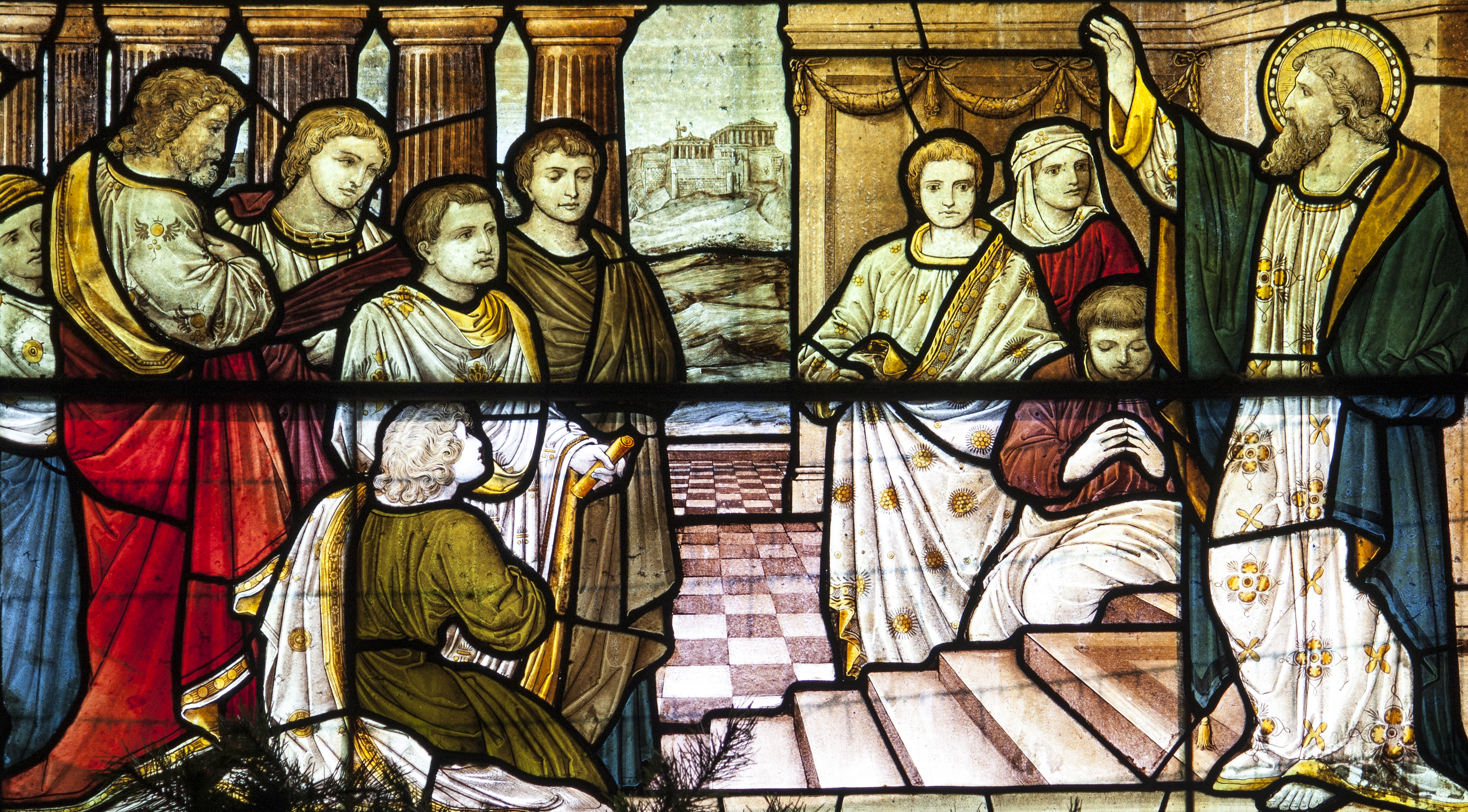
The Apostles preaching the Gospel by Fr Lawrence Lew, OP on Flickr. CC 2.0.

The converts are both listening to the spoken teaching of the apostles and also watching them put it into practice: ‘many wonders and signs were being done by the apostles’, according to verse 43.

There is no true Christian church unless it stands in continuity with the apostles, to whom Jesus entrusted his teaching. How is that guaranteed? Anglicans do it through a succession of laying-on of hands down the centuries, vouchsafed by the continuation of bishops. Catholics do it by a similar method, but especially by seeing the Pope as the successor to the Apostle Peter.

But both methods are suspect. There have been enough bishops who clearly have not believed the historic faith down the centuries. And some Catholic traditions and teachings are also questionable.

We may not be much better. We are right to say that we need a succession in the apostles’ teaching, but we certainly let a lot of people – church leaders included – sit very loose to that (to put it as diplomatically as I think I can).

The New Testament is the collection of writings that are either from the apostles or from their circles of influence, and it is the basis for the content of Christian faith. Our call is to know that teaching and to live it out. That makes us apostolic.

Therefore, let us all ask ourselves: what are we doing to learn more about what the New Testament calls ‘the faith once delivered to the saints’? Do we not only attend to its reading and exposition on Sundays but also read it for ourselves (preferably every day)? Do we discuss it with others? Do we take on its teaching by saying, OK, that’s what it means, now what am I going to do about it?

I love the story of the grandchild who observed Grandma reading her Bible, and saying, ‘Nanny, why are you still reading the Bible? Haven’t you read it over and over again in your life?’

‘Yes,’ said Grandma, ‘I have. But I’m studying for my finals.’

The second characteristic of the early church is fellowship:

Careers at Abundant Life. Found at Abundant Life. CC 4.0.

They are devoted to ‘the fellowship’ and this has its outworking in verses 44 and 45:

44 All who believed were together and had all things in common; 45 they would sell their possessions and goods and distribute the proceeds to all, as any had need.

We have such a shallow understanding of fellowship. We think it’s drinking coffee together while we chat about the weather. Somebody once said that the kind of fellowship we witness in some churches is no more than what he called ‘billiard ball fellowship’: we just bump into one another once a week. The New Testament church shows us up.

For the word translated ‘fellowship’ means ‘in common.’ Who or what do we have in common? They had Jesus in common, and because of that they shared not only him but every aspect of their lives, possessions included.

Let’s not write this off lazily as some have, by saying this was an early experiment in communism that failed. The earliest church shared their experience of Jesus, and because of that they also shared life together at a very deep level.

I have seen some wonderful examples of this over the years. I think of when my grandmother (who lived with us) died. Our West Indian Christian friends from the Bible study group we hosted turned up on the doorstep. Some came in and relieved my mother of the housework. Others arrived, carrying a fully cooked meal for the whole family. They shared and gave so that we as a family had time and space to grieve. I will never forget that.

Or this incident from the first theological college I attended: there was a Singaporean student whose mother died back home while she was at the college. She couldn’t afford a plane ticket to fly home for the funeral and then come back to England for the rest of her course. But the student body, comprised of people with very limited incomes, rallied around. She was given the money for a return ticket.

If we share Jesus in common, what else do we share?

The third characteristic of the early church is the breaking of bread:

From needpix.com. Public Domain.

This too is mentioned in the summary statement in verse 42. It is expanded upon in part of verse 46:

they broke bread at home and ate their food with glad and generous hearts

Now some Christians hear those words ‘the breaking of bread’ and ‘they broke bread’ and think this is some kind of primitive communion service held in people’s homes without the need for formal leadership. It isn’t – any more than when the risen Jesus broke bread with the two who walked to Emmaus at their house was. It was an ordinary meal.

You could say this is an extension of what I have just said about the true meaning of fellowship. It is a marker of how life was shared together. Homes were open. There was no limitation to just the nuclear family of Mum, Dad, and the kids, like there is in our society. Your family was not just biological. Your family was the family of God.

It’s quite a challenge to the concept that an Englishman’s home is his castle, and that we get in, shut the door, pull up the drawbridge, and shut out the rest of the world. The church family, according to the example of the early believers, has more of an ‘open door’ philosophy. Open to the family of God. Open to those in need.

When I was single, I was glad to know others who would open their home to me, so that I didn’t have to spend every mealtime alone. I think too of the Christian couple I know who applied to have an extension on their home. It wasn’t so that they could live in more comfort. They did it, because they wanted to become foster parents. Over the years, I believe they fostered somewhere between thirty and fifty children, many of whom came from traumatic backgrounds. As a result of their caring witness, some even found faith and joined the church.

What might it mean for us to eat our food ‘with glad and generous hearts’?

The fourth characteristic of the early church is the prayers:

Free hands praying in church image, public domain people. Found at Religion Unplugged. CC 1.0.

This is mentioned at the end of verse 42 and is amplified in the rest of verse 46 and the first half of verse 47:

46 Day by day, as they spent much time together in the temple, they broke bread at home and ate their food with glad and generous hearts, 47 praising God and having the goodwill of all the people.

Prayer and praise? Am I just stating the obvious here? Am I about to tell a collection of grandparents how to suck eggs?

I hope not. But here’s the thing. When the Holy Spirit is at work, prayer and praise moves from duty to desire to delight. It is no longer what we have to do, but what we want to do. The work of the Spirit is to reveal Jesus, and as we see more of who Jesus is and what Jesus is like, then our capacity for worship will inevitably increase.

I am not suggesting we should spend so much time in church that we ignore the needs of the world. If I thought that, I wouldn’t have shared the last point about our open homes.

And nor am I saying that duty on its own is necessarily bad. Sometimes we get through a difficult period or a dry spell by attending to the need for duty in coming to worship. We cultivate virtuous habits that help us.

But what does concern me is a lackadaisical attitude to worship that I sometimes see in church members. I’ll come to worship provided there’s no better attraction available to me. I won’t come to worship today, because it’s raining. I’ll come to worship, because I want to get something rather than give something.

A true church is committed to praise and prayer as a priority. I think of the Ugandan Anglican priest I knew at my first college who would walk up to twenty miles, carrying all his vestments and everything he needed. Over the years, he had developed a stoop from the weight of all he had carried, and while you might reasonably ask whether it was sensible in the African climate for clergy to wear the same attire that they do in the UK, that deformity also spoke of one who was committed to leading God’s people in praise and prayer.

I wonder what cost we were glad to pay to come to worship today.

Conclusion

Here’s the whole of verse 47:

praising God and having the goodwill of all the people. And day by day the Lord added to their number those who were being saved.

They wouldn’t always enjoy the goodwill of the people. But they did generally grow in number. We have much to learn from them about continuing in the apostolic faith, holding our lives in common because we have Jesus in common, having open homes, and being committed to worship.

Michael Frost in 2017 at Wikimedia Commons. CC 4.0.

I want to close with a pattern of life suggested by the Australian missiologist Michael Frost. I do not live up to all these ideals, but I think he captures the spirit of the early church in a mnemonic for the Christian life called BELLS:

Bless —I will bless three people this week — at least one of whom is not a member of our church.

Eat — I will eat with three people this week — at least one of whom is not a member of our church.

Listen — I will spend at least one period of the week listening for the Spirit’s voice.

Learn — I will spend at least one period of the week learning Christ.

Sent — I will journal throughout the week all the ways I alerted others to the universal reign of God through Christ.[1]

How about we ring some bells?


[1] See Michael Frost, Surprise the World: The Five Habits of Highly Missional People.

Sermon: Jesus Our Example For Mission

John 4:4-42

Jesus?
Jesus? by Isaac Torrontera on Flickr. Some rights reserved.

I once heard the great Australian mission leader Michael Frost tell a story of how he had once spoken to a gathering of six hundred Christians. He had retold to them one of the Gospel stories about Jesus, and invited them to imagine themselves as one of the characters in the account. Afterwards, he asked them which characters they had taken on.

To his disappointment, only twelve of the six hundred had imagined themselves as Jesus.

Now I can see why many Christians would be reticent to identify themselves with Jesus. We feel unworthy to do so. But Michael Frost’s point was this: aren’t we called as Christians to imitate Jesus? Isn’t Jesus supposed to be our example? That was how he was hoping people would take his invitation.

And that’s what I hope for us this morning, too – that we shall take Jesus as our example from our reading. Specifically with John chapter four, we are going to take Jesus as our example on the question of mission. We hear a lot about the importance of the church to emphasise mission these days – well, where better to take our model than from Jesus himself? One passage won’t give us an exhaustive treatment of how Jesus models mission for us, but it will give us a good start.

Wind
Wind by Shamin Mohamed on Flickr. Some rights reserved.

Firstly, Jesus operates by the wind of the Spirit. I don’t suppose that’s a contentious claim, but let me justify it from the passage. The Lectionary this week starts officially at verse 5, ‘So he came to a Samaritan  city called Sychar’, but I asked for the reading to begin at verse 4, where John writes, ‘But he had to go through Samaria.’

Did Jesus have to go through Samaria? No. If he were a devout Jew, he could have avoided Samaria. Yet he felt a compulsion to go there. I can’t help thinking back to last week’s Lectionary Gospel reading from John chapter three, where Jesus himself tells Nicodemus that ‘The wind blows wherever it wills. So it is with everyone born of the Spirit.’ Jesus has said that his true followers are blown by the wind of the Spirit. The Holy Spirit takes them on all sorts of adventures, detours and strange, unexpected directions.

But Jesus doesn’t just say this about his followers. He lives that way himself. He had to go through Samaria – when really, he didn’t. I suggest to you that Jesus is living out what he had taught Nicodemus – the life of discipleship is one of being led by the Holy Spirit. It is not predictable, it is not conventional; discipleship is not about accepting the norms by which the rest of society lives. It is not about adopting the expectations of wider society in the way we set the course of our lives. It is about being open to the ‘God of surprises’ who may well want to do unexpected things with us. Paul, the great expert on the Jewish Law, becomes an apostle not to the Jews but to the Gentiles. John, nicknamed by Jesus one of the ‘Sons of Thunder’, becomes the apostle of love. And so on.

Could it be, then, that one reason why we have not been effective in Christian mission in today’s church is that we have not allowed ourselves to be blown into places we would never have anticipated by the Holy Spirit? Could it be that we have so swallowed our culture’s norms that that we have not been in the places God intended us to be? Isn’t it so easy to be sucked into the regular expectations of everyday Surrey? I must get the best education. I must get the best paid job. I must live in the nicest neighbourhood. Not that these are always bad things in themselves, but to default to them without being open to the leading of the Holy Spirit is a huge spiritual mistake with potentially massive consequences.

So – is God challenging any of us not just to accept the expectations of our culture but to be ready to go wherever the Holy Spirit leads us?

England World
England World by Doug Wheller on Flickr. Some rights reserved.

Secondly, Jesus conducts mission in the world. The action happens at Jacob’s Well – and I don’t mean the location near Guildford where you might pick up the A3. Jesus is weary and sitting by the original Jacob’s Well (verse 6), and that is where the story unfolds.

How remarkable is that? Remember that Jesus conducted much more of his mission in the world than in the synagogue. And then contrast that with us. We conceive of mission in terms of people coming to us, attending our events at church. We’d rather not get out into the world with our faith, because that makes us nervous. If we really do have to engage in Christian mission, then can we at least please cajole people into coming along to something we’ve arranged ‘at church’, where we feel safe?

Jesus would never have got the woman to a synagogue. She wasn’t a Jew. She was female. She was probably regarded as a ‘sinner’.  There was no hope. Operating by the strategies we adopt where we hope people turn up at church would never have reached this woman with the love of God. And increasingly, as fewer and fewer of our population are used to the church environment, the hope that we might just get people along to the place where we feel safe is more and more a misplaced strategy that has more to do with our fears than it has to do with our desire to overflow with God’s love.

Jesus is again acting out something from earlier in John’s Gospel. Not simply the previous chapter, as with following the wind of the Spirit, but the first chapter, with its great Prologue about the Incarnation, where we read that ‘The Word became flesh and dwelt among us’ (1:14). Jesus is dwelling not in the safe religious space but in the world. And if we are to imitate him, then we must do something similar.

So when a person tells me that they aren’t playing any part in the life of the church because they don’t have a job in the church, I don’t believe them. They are being sent to practise their faith in the world.

I say this as a minister where the expectations of many church members in various churches I have served would cage me inside the church. I have to work at making my connections outside the church. For some while now, that has been in our children’s school community, but that is lessening as the children get older. It is increasing on a Saturday morning as I stand on the touchline watching my son play football, and as I talk with other parents. But as the children’s independence increases, I shall have to be quite intentional about finding my contacts outside the church.

What of us, then? Are we willing to spend time outside the safe environs of the church community for the sake of the Gospel? Some of you have ready-made communities in the work place. Others of you will have to look harder. But please don’t build your whole life around this building.

It's a drag
It’s A Drag by MTSOFan on Flickr. Some rights reserved.

Thirdly, Jesus goes to the weak and the marginalised. Why did the Jews despise the Samaritans? Go back to 2 Kings 17 and you see. Samaria was more or less the northern kingdom that had so betrayed the faith of Israel that it had been conquered by Assyria in the eighth century BC. After that conquest, Assyria had placed members of other races and faiths there. As a result, faith in Samaria became no longer concentrated exclusively on Yahweh but a compromised mixture. They included idol worship in their religious practice. Anyone with a devotion to ‘pure’ Judaism would find these elements distasteful, if not horrifying.

And not only is Jesus talking to a Samaritan, he is talking to a Samaritan woman. Remember that the pious daily prayer of many a devout Jewish man went like this: ‘Blessèd art thou, King of the universe, who hast not made me a slave or a Gentile or a woman.’ Second class just doesn’t seem to cover it.

Furthermore, this particular Samaritan has a reputation. She has had five husbands, and is now living with a man outside marriage (verses 17-18). Now I used to think this meant John was painting for us the picture of a deeply immoral woman – I remember preaching on this passage as a young Local Preacher and saying she was someone who would go for anything in trousers. But later I realised that wasn’t fair on her – not in a culture where only the men could initiate divorce. She is a broken woman. Men have treated her like an object to be tossed away when no longer required. She can have no reasonable expectation that this devout Jewish man will treat her as anything more than dirt. She is socially and religiously unacceptable.

Except this is Jesus we’re talking about. Jesus, who did not live in fear that he would be contaminated by those who did not meet the highest standards of ritual purity. Jesus, who knows that his following the wind of the Spirit and his commitment to mission in the world have on this occasion led him to this woman – this broken, hurting, rejected woman.

And here is the application for us. Isn’t it easy for us to stay with the nice, clean, safe people – the good churchgoers and if not that, then the pillars of the community? Isn’t it simpler to mix with people from Horsell but not those from Sheerwater?

Actually, no. It isn’t a question of it being ‘easier’ to mix with the ‘right’ types. When we do that, we’re not simply taking the easy option, we’re giving in to temptation.

And neither do I want to see us succumb to patronising other people. This is, after all, the week in which the Chancellor of the Exchequer has told us that ‘hard-working people’ (that favourite expression of politicians) like beer and bingo.

What I’m calling for is genuine love for those who are different. I’m saying that Jesus went to the wounded with a message of God’s love for them. To the Samaritan woman at Jacob’s Well he offers ‘living water’. She is dry, and he offers her divine refreshment (verses 10-15). She is interested in worship God aright, and he promises the help of the Holy Spirit (verses 20-24). She longs for the Messiah, and unlike many other people he meets, Jesus is open with her about who he is (verses 25-26).

While we accept the conventions of society rather than allowing ourselves to be blown by the wind of the Spirit, our faith will atrophy, just like muscles in our body that are never used. While we stay safe and warm, huddled up in the church community, rather than venturing into the world that God loves, we shall never encounter the people God has called us to serve in his name. And while we ignore or despise the weak and the troubled, we shall not have the privilege of encountering many people whom God loves so dearly that his Son Jesus Christ was born, died and was raised from the dead for them. In short, without following the example Jesus sets for us in John 4, our faith is dead, and our churches wither.

But when we are open to being led by the Spirit, God will take us to new, surprising and fruitful places for his mission. When we are willing to go into the world and meet people where they feel secure, God has us beginning to act in faith, and he can use that. And when we are willing to share and demonstrate God’s love in Christ with people who don’t meet our standards of respectability, then God may well be taking us to the very people he has prepared to respond to the Gospel.

So – which of us is willing to follow the example of Jesus?

And to do it this week?

Poetry For The Australian Fires

Australian FiresAussie missiologist Michael Frost recently reproduced this cartoon on his Facebook page from a New Zealand newspaper. It rather sums up the extreme and dangerous weather going on in his homeland lately. Death, destruction and devastated lives are everywhere, along with amazing stories of bravery and heroism.

My faithful Australian commenter Pam has written a poem about her experiences of this, and with her permission I am glad to reproduce it below. It is based on what happened on 8th January. Please use it as a stimulus to pray for the people of her nation.

Catastrophic Warning by Pam Connor
Three phones in our house last night
Mobile VOIP landline.
“Have your emergency bushfire plan in place.  Catastrophic conditions for the Shoalhaven, Illawarra,
 Southern Tablelands tomorrow”
droned the non-human, inhumane voice.
Sydney Temperatures 130108Moments later, my friend in Ulladulla,
Her voice too calm,
“We should go and see The Hobbit tomorrow, three hours in an air-conditioned cinema.
 My treat for the choc-top”.
In the boot of my car, my shiny Honda,
Neatly stacked photo albums
my children grinning, black shoes shining,
First day of school.
My father at 21 years of age.
They tell me who I am.
A marriage certificate, my only one, must take that.
 Passports.
Some clothes, clean underwear, no holes.
Full tank of petrol.
My gardenias better survive,
Or there’ll be hell to pay.

Michael Frost: Missional Listening

It sounds counter-intuitive to many Christians, that listening is a key to mission. Isn’t mission about proclamation, about us speaking? Watch this superb video of Mike Frost on adopting a posture of listening:

(Via ChurchLeaders.com)

He contrasts listening with prepackaged, prefabricated approaches to mission. Our culture likes to buy a package off the shelf to solve a problem, and the church is no exception when it comes to solving our problems of mission, of decline, of making worship more interesting …

Yet one of my churches is currently doing one of these very prefabricated mission packages, Alpha. However, we didn’t adopt it, because we were desperate to stimulate church growth. We ended up doing it as a result of listening. We had made a specific attempt to listen to our community at last summer’s village fair. We offered a lucky dip and asked adults who called at our stall to answer one question about what they thought the church should do in the community. We had about thirty responses, almost all of them positive. Our Leadership Team debated the replies, but didn’t come up with anything concrete.

Alpha came up a few months later. We had a moving and powerful memorial service for a much loved church member. It prompted spiritual questions. From some of those people came the request for Alpha, not us. It wasn’t on our agenda.

I love the way the Frost video ends with the appeal to listen to your community, because it is telling you how to evangelise it. How are you doing that?

What Is The Gospel?

Scot McKnight is worried:

He’s not the only one. I’m currently reading Michael Frost‘s book ‘The Road To Missional‘, in which he builds on the work of N T Wright and the late David Bosch to say that mission is alerting the world in announcement and demonstration to the fact that Jesus is King.

What they all seem to be getting at is that we have reduced the gospel to easy-believism. ‘Just accept Christ as Lord and Saviour.’ ‘Repent and believe.’ Well, yes, except the emphases on ‘Lord’ and ‘repent’ often fail to connect with Jesus’ frequent command in the Gospels to follow him. Indeed, these approaches are often embarrassed by the Gospels, drawing purely on a certain reading of Paul and only concentrating on the death of Christ, plus perhaps his birth to prove he was divine. The bits in between seem irrelevant to this approach.

How, then, should we summarise the Gospel? How would you summarise the Gospel? Indeed, can we summarise the Gospel briefly?

Create a website or blog at WordPress.com

Up ↑