Sermon: Offended By Jesus

John 6:56-69

I want to introduce you to a new religion. It will involve cannibalism, vampires and the overthrow of cherished ancient traditions. Are you interested?

Or are you shocked? Because that is what the first followers of Jesus thought he was proposing. ‘Those who eat my flesh and drink my blood abide in me, and I in them,’ he said (verse 56). They were offended, and many on the fringes of belief turned away from him in this reading. They were scandalised by his claims.

He called people to eat his flesh – well, who wants cannibalism? And he said they were to drink his blood. Remember that Jews never drank the blood from a dead animal, because it was thought to contain the life of the creature.

Vampires? OK, actually no. I just wanted to underline the shocking nature of Jesus’ words about drinking his blood. But maybe you get a feeling for how Jesus’ first hearers felt scandalised by his teaching. We may find it hard to appreciate that, because two thousand years of familiarity have changed our perceptions. But in its original context, the person and message of Jesus were offensive.

And today, for all our familiarity with Jesus, it is just as possible to be offended by him, his words and his deeds. If we look at what upset those early disciples, we might get some clues to some issues today. Who knows? We might be the ones who need to change. Let’s see.

Firstly, Jesus himself and his teaching is offensive:

When many of his disciples heard it, they said, ‘This teaching is difficult; who can accept it?’ (Verse 60)

You might think that gentle Jesus, meek and mild would respond with a word of gentle explanation, but no:

But Jesus, being aware that his disciples were complaining about it, said to them, ‘Does this offend you? Then what if you were to see the Son of Man ascending to where he was before?’ (Verses 61-62)

What if you were to see the Son of Man ascending to where he was before? This is not only about the Ascension itself, but also about what leads up to it, for in John’s Gospel, Jesus ascends to the Cross. This is therefore about the Cross, the Resurrection and the Ascension. This is about the deity of Jesus, and what he accomplished in his atoning death and resurrection before he returned to the Father’s right hand.

How is that offensive? Let me recount a story.

In one past church, an elderly couple joined the congregation. They began worshipping with us every week. After a while, I visited them and they raised the question of church membership. In the past, they had been active members of a Baptist church, but must have lapsed for a period of years. Having plied me with tea and cakes, they asked, “Are we good enough to join your church?”

That is a question that can only be asked by people who don’t understand the Cross, or who find the Cross offensive. Like a fool, I paid insufficient attention to it and chose to explain it away. I brought them into church membership, and it was a terrible mistake. The husband in particular spent every week’s home group ripping to shreds the previous Sunday’s preacher. Week after week, until the two leaders of the group could take it no more and resigned. We ended up having to close the group.

All because I didn’t pay attention to a couple who didn’t understand the Cross, and who later showed in their behaviour that they didn’t appreciate grace. I should have let them be offended by the Gospel.

The trouble is, a Jesus ascended on a Cross humbles us. We have to lay aside the pride of our respectable lives, and kneel before him as sinners needing forgiveness.

I’ve seen it not only in the respectable but also in the intellectual. People want to find God by their own cleverness, but God will not have that. I have seen such people harbour all kinds of destructive behaviour, all because they will not kneel at the Cross.

Those who are merely interested in Jesus may well fall away, like the crowds here. Those who are willing to meet him at the Cross are those who will be his true disciples.

Secondly, the work of the Holy Spirit is offensive to some. Jesus goes on to say:

‘It is the spirit that gives life; the flesh is useless. The words that I have spoken to you are spirit and life. But among you there are some who do not believe.’ (Verses 63-64a)

We may only come to know God through the work of the Holy Spirit, who makes the presence of God real to us and the Word of God alive to us. Normal human abilities – ‘the flesh’ – are ‘useless’, says Jesus.

This too is an affront to many people. We have lived through several centuries of scientific discoveries, breakthroughs and advances. Human society has benefitted hugely from many of these things. The idea has arisen that the human mind will ultimately solve all problems. Thus today, leading atheists like Richard Dawkins, Christopher Hitchens, Daniel Dennett, Sam Harris and others mock the thought of anything that cannot be perceived by human reason. If it does not originate from reason, then it is superstition.

But these ideas are false. Yes, society has seen great wonders, not least in medicine. But the same human reason is fallen through sin, and science has given us nuclear weapons and climate change. Ultimately, the thought that reason can solve everything is pure arrogance and idolatry. God is not against the use of the mind at all – in fact it can be properly used to his glory – but he knows how we idolise our reason and so,  in the words of John Arnott, ‘God offends our minds to reveal our hearts.’

And indeed the Gospel is not merely available to intellectuals – thank God! It is revealed by the Holy Spirit, whose work is available to all.

In our tradition of Christianity, we are so used to emphasising human free will (and I’m not saying we should ditch that!), but sometimes we stress it so much that we forget the life of faith is impossible without the prior work of the Holy Spirit. The Holy Spirit draws people to Christ; only then do we make response.

Listen for reference to that work of the Spirit in part of a testimony from a friend of mine:

‘I wasn’t raised in a Christian household, I was saved in a summer camp when I was 14….one night afterwards, I was dialing my radio around and found a Christian radio station. As I listened, I could feel the Spirit inside me awakening, and that station was basically how God “fed me” while I was at home. When I got old enough to drive myself, I was able to go to church myself.’

Once again, we see that it is our pride that gets offended – this time by the need to rely on the Holy Spirit for life in Christ. But also, this has implications for our evangelism. The prime need in our outreach is not the latest techniques, but prayer – prayer that the Holy Spirit will go ahead of us, working in people’s lives before we get there. Let us be released from having to think up new clever (and possibly manipulative) schemes, and instead remember that the Holy Spirit does the spadework. Let us call on the Spirit in prayer to do that in the lives of those who need Christ.

Well, if we’ve talked about the Cross of Christ and the ministry of the Spirit in the first two points, it won’t take a brain surgeon to work out that the third and final area in which people find the teaching of Jesus offensive is in what he says about God the Father.

And he said, ‘For this reason I have told you that no one can come to me unless it is granted by the Father.’ (Verse 65)

Now again, that’s the kind of verse to make those of us in the Wesleyan Arminian tradition, who believe in the importance of human free will, to get rather nervous. It gladdens the hearts of Calvinists, who believe that some people are predestined by God to salvation, while he predestines the rest to damnation. But all it really stresses is another version of what we’ve just said about the Holy Spirit – namely that the first move in salvation is God’s.

It has always been the case. The first missionary in the Bible was God, walking in the Garden of Eden in the cool of the evening, calling, ‘Adam, where are you?’ God called Abraham and the patriarchs as he formed a people for himself. He called Moses, the Judges and the prophets. Finally, he sent his Son.

And how good it is that God has always made the first move. For as Leon Morris has put it, writing on this verse:

‘Left to himself, the sinner prefers his sin. Conversion is always a work of grace.’[1]

It is God’s work to bring us to the possibility of salvation. It does not mean he is capricious: he wants all to be saved. But remembering what we have already learned about the need for humility, that comes into play here again, for if God makes the first move, we must pay attention. John Wesley thus commented on this verse:

Unless it be given – And it is given to those only who will receive it on God’s own terms.’[2]

The Good News is that God sets out to rescue those who, by their own instincts, would always prefer to remain in sin. The Good Challenge is that we must accept God’s remedy. We must come on God’s own terms. Therefore that means not only welcoming Christ as God’s Saviour, but also bowing before him as Lord. If we can only come to Christ because God the Father makes the first move, then we end up coming to God not only for the blessings, but also for the obligations.

We can ask ‘What’s in it for me?’ and the answer will be about salvation from the penalty of sin, the practice of sin and the presence of sin. But to ask that question alone is to indulge in religious consumerism. Because the Father makes the first move there is another question: ‘What’s in it for God?’ And the answer involves him incorporating us into the People of God, because his desire has always been to form a people for himself, a new community that lives under his kingly reign. And therefore we must rise to the challenge and make the Church just such a community, instead of fighting and plotting against one another, and settling for cliques instead of community.

In Conclusion, then, God the Father, Son and Holy Spirit takes the initiative in saving the human race. This brings us to humility at the foot of the Cross and in dependence upon the grace of the Father and the power of the Spirit. We lay aside everything we trumpet about our respectability and intellect. But this news frees us from other tyrannies. No longer need we rack our brains for new methods of evangelism, when instead we begin in prayer for the Holy Spirit to move. And in the converted life, the Father who has graciously reached out to a world of persistent sinners not only saves us but makes us his subjects. Our only proper response is grateful obedience.

May we have the grace not to be offended, but to become God’s loyal servants and friends.


[1] Leon Morris, The Gospel According to John, p387. Exclusive language unchanged from the source.

[2] John Wesley, Explanatory Notes Upon the New Testament, p330.

Sabbatical, Day 77: Of Sausages And Crosses

Today, I’d like to apologise to the entire German nation. Every single one of you. By common consent, you make the finest sausages in the known universe. And I’m sure you agree.

But my kids don’t. They think I’m a liar when I tell them that German sausages are the best, and that nothing beats a bratwurst.

Why? Because today, we visited Cressing Temple for its annual St George’s Joust event. It is a wonderful celebration of all things medieval, including crafts, early musical instruments, falconry displays, York versus Lancaster battle re-enactments, and the famous joust with witty script and terrific stuntmen riding the horses. (Oh, and that other medieval theme, the Napoleonic Wars.) 

Having paid our entrance fee, we walked through the gift shop, out into the grounds and there we were greeted first of all by a series of catering concessions. I noted the existence of The German Sausage Company. I pointed it out to the children, and Debbie realised I had set my heart on a snack from there, even though we had brought a picnic. We made it our last call before leaving a highly enjoyable day.

Well, if I’m feeling charitable I have to say we might have caught them on a bad day. I also have to admit that we didn’t complain. But bratwurst doesn’t usually have the texture of half-cooked rubber. I have never seen Mark give up on a sausage so quickly. He could live on a diet of them, if we let him.

And if you ask to have bacon well done, you don’t expect it to pale pink. Because Debbie likes everything well done. She’d have ice cream toasted, if she could. The first time she met my family was for a meal in a French restaurant. She ordered a steak. When the waitress asked how she would like it cooked, she replied in one word my family has never forgotten: “Cremated.”

To add insult, Debbie recognised the brand of orange juice I had been given. “How much did you pay?” was her question.

“A pound,” I said.

“You can get six of those for 99p in Lidl,”she withered. Profit margin is one thing, but that’s – what shall we say? Optimistic? (A little research suggests it might actually be five for £1.29, but it’s still a steep mark-up.)

Now I have to say that – being British, not German (but so were they) – I of course didn’t complain at the time. Perhaps I should have done, but since all the sausages came out of the same container, I don’t think anyone else got a better brattie than we did. So, dear German friends, I am sorry my children now have the wrong impression of your great delicacy. 

It was a disappointing end to a fun day. Rebekah and Mark talked to a woman demonstrating weaving on a medieval loom. We found a company selling dried meat, mushroom and fruit snacks. Their website doesn’t mention the fruit, but we can recommend the dried strawberry and the dried blackberry and apple. 


Fighting between Yorkists and Lancastrians in battle re-enactment

Furthermore, the afore-mentioned battle re-enactment was not only lively and fun, it was presented with an educational slant. Along the way, we learned all sorts of things about the nature of medieval warfare that were possibly surprising to many hearers.


Lancastrian archers in the re-enactment by the Medieval Siege Society


To our surprise, Rebekah and Mark had their attention kept all through the half-hour presentation. We had to reasure Mark that the soldiers lying on the ground weren’t really dead – we’ve had a lot of death talk from him since Good Friday. But apart from that – and there’s nothing the re-enactors could have done about that – it was superb.


Sir Odious the Black Knight and his Swedish counterpart in the joust


As for the joust itself, that was pure entertainment. Some might not like the fact that the baddie was dubbed the Black Knight, but it seemed not to be about race and more about a pun on ‘black night’. Or it could have been to do with the Black Country, since his punishment when he finally lost was to be sent to Birmingham. Nothing worse, surely.


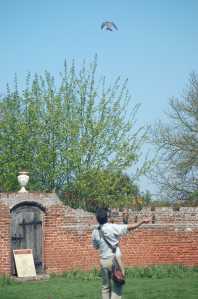
A small falcon flies high above the falconer in the falconry display


Seeing a falconry display gave me an opportunity to educate the children as to the origins of our surname, which was originally something like Falconer. We were the plebs who looked after the falcons on the Laird’s estate in Aberdeenshire. The name is first found in that county around the 1200s. Medieval times, indeed.

My father has long been convinced (through a story his grandfather told him) that we came from Scotland in recent generations. To that end, Dad supports the Scotland rugby and football teams. Trouble is, we come from a part of the Auld Country called … Lincolnshire. All the way back to the early eighteenth century, there is no sign of the tartan, still less of ‘our’ clan, the Keiths.


Mark dressed for his photo in front of a painted backdrop of a castle

If I can be serious about one final thing, though, it was the tragic reminder of seeing the Cross everywhere as a symbol not of suffering love but of violence and oppression. Mark and Rebekah posed in borrowed costumes for pictures in a photographer’s tent (and very good they were, too, for the price). Here, you can see Mark in knight’s garments, with his cross. I thought about the wickedness of the Crusades, their perpetration of Christendom by cruelty, and what they did to peoples who should have been shown the love of God in Christ. 

Then I thought there were hundreds, if not thousands of people at the show, and only few of them would have had that thought. Of the few who did, a good number of them would have seen it as further evidence to prove the wickedness of Christianity.

Most of the rest, though, who would have given no thought to the symbol of the cross at all. Like someone who works for our local Schools and Youth Ministries charity said at a meeting last year, most young people haven’t rejected religion. It just isn’t on their radar in the first place.

And that may be the biggest challenge facing the British church today.

Sabbatical Day 69, Good Friday: Jesus Is Crucified

Vodpod videos no longer available.
more about “Sabbatical Day 69, Good Friday: Jesus…“, posted with vodpod

Here is the Damaris Trust video for Good Friday. Andrew White talks about the importance of Jesus’ death on the cross on our behalf. He discusses what this means for his ministry of reconciliation in Iraq.

We went into town this morning for the annual open-air united service in Chelmsford High Street. A band from the church where we are worshipping led the music, and the choir from our children’s school dazzlingly performed a selection of songs from a musical entitled Resurrection Rock.

A nun from a local community spoke. Hers was a serious address where she spoke of Bad Friday and Good Friday. Today is only Good Friday because it is about redemptive suffering. Anything else would be Bad Friday. Suffering isn’t good for its own sake. She spoke passionately as one who had spent years in the Democratic Republic of Congo, serving women and young girls who had been raped by HIV positive men, young boys who had been brutalised into becoming child soldiers and mothers who had watched children die from diseases we find easily preventable in the West.

And from that, she made a connection between Good Friday and Easter Day. For whenever we, who believe in Christ’s redemptive suffering and conquest of death, minister to those in need or work for justice, we are doing Resurrection work. In that sense, she asked, is the Resurrection happening today?

Later, Rebekah – who had understandably described that part of the service as ‘longer than church’ – posed again the question, “Why do we call it ‘Good Friday’ and not ‘Bad Friday’?” I tried to explain how God took the Bad that was done to Jesus and turned it for Good. She found that hard to grasp.

In the back of my mind I was thinking of Tim Keller‘s The Reason For God, and his chapter on the Cross. He explains how forgiveness and love inevitably involve both substitution and exchange. When we forgive someone, it always comes at a cost. If I forgive you a debt, I take on that debt. He doesn’t get into the question of Pauline language and whether to speak of penal substitution, just that forgiveness must in some sense involve the substituting of the debt, and that this consitutes and exchange. The notion of exchange, he says, is fundamental to love. If I love my children, I will exchange my freedom for their well-being. I will not only give them attention when it is convenient to me, for if I do that they will only grow up physically. Love means I will attend to them when it is inconvenient. I give up my freedom to serve them in love. This, says Keller, is like what Christ does for the world on the Cross.

I shall be interested to plug those thoughts into those from a book that is on its way from Amazon: Justification: God’s Plan and Paul’s Vision by Tom Wright. I’d like to see how this compares and contrasts with Wright’s more cosmic vision of salvation. The Reformation tradition has tended to take Luther’s question of “How can I find a gracious God?” and insert the word ‘personally’ after ‘I’. That is critical, but I know that in this book, Wright is saying that such a question makes the sun orbit around us rather than vice-versa. We’ll see …

Sabbatical, Day 57: Lee Abbey Photography Course, Part 2


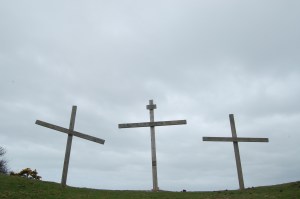
The Three Crosses at Lee Abbey: view from below

Wednesday’s expedition in search of photos saw me consulting a map of the Lee Abbey estate in order to find the location of the famous three crosses the community erected many years ago. They were not difficult to find. Unsurprisingly, several of us on the photography course took pictures of them, although nobody was there at the same time I was. I simply needed to let a group of pilgrims who were following some guided prayers around the land finish ahead of me.

For this first shot, I deliberately took the image from below, in order to include in the foreground the cow pat on the left and the treacherous hole in the ground on the right. Crosses are ugly and dirty, not shiny happy jewellery.


The Three Crosses at Lee Abbey set against a background of sky

For the second photo I have included here, my aim was a little more pragmatic. You will see that again I am below the crosses with a wide-angle lens, but I have included a large amount of featureless cloudy sky. This was one of several pictures I took, thinking they might be useful as backgrounds for PowerPoint or SongPro slides. On the surface, that may not be the most spiritual reason, although I would like to think that if this is used in public worship, it will play a small part in enhancing people’s devotion. However, I castigated myself for moving on all too quickly from the crosses in order to take more images. I think I share the general weakness for moving on as quickly as I can from the foot of the Cross. I certainly did so last week.


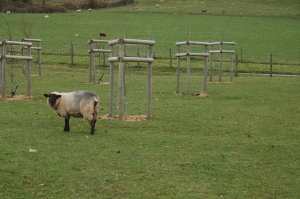
Lost sheep among saplings in putative orchard

This third shot is one I might use as a metaphor sometime. The sheep shown should not be in this field. It has escaped from the rest of the flock, and is roaming in a field planted with saplings that will eventually become an orchard. Next time I want a ‘lost sheep’ image, I may pull this one out.

The week was not all about the photography, though. On Thursday morning, one of the host team, Chris, recognised my name on my badge. I had thought he looked familiar, but he didn’t prove to be who I thought he was. Chris turned out to be the son of two people I had known in an ecumenical church in my last circuit. When I knew him, he was about eleven. Now he was eighteen, and spending a year in community while offering for the Anglican ministry. I must say, he looked a natural up in front of a large group of people from different backgrounds and generations. I gave him my email address before leaving, and asked him to tell me how he gets on.

Sabbatical, Day 36: Getting Old And Wet In Lent

St Andrew’s has become our default church for the sabbatical. The children are happier visiting a church where they know some people, rather than every face being strange or forgotten.

Today, Lee, the curate (our next door neighbour) preached. He took the classic Lenten passage from Mark 8 featuring Jesus’ call to deny ourselves, take up our crosses and follow him. He said that for someone who enjoys preaching about God’s love, such a stern passage seemed difficult, but this was about the love of God, too. For love is a two-way street, and taking up the cross is a way we respond in love to God’s love.

He passed round a cross he keeps at home. He had asked a blacksmith to make it for him before he began training for the ministry. The blacksmith made three nails, and then made the cross from those nails. I couldn’t pass it on quickly when it came to me. I had to examine it and feel it. What a powerful piece of art it was. It reminded me of when I once had nails given out to worshippers at a Good Friday service, and another when I let people know in advance that someone would hammer nails into a cross during the service. Some church members objected. It made me wonder about their faith. I am glad nothing like that happened to Lee today.

He also made a simple, telling point about what it might mean to carry one’s cross. Taking up the cross, he said, can happen when we have to choose between the easy way to do something and the right way. On a day when a pastor has been shot dead in Illinois, I find this poignant. It is of course only too common in many other countries. 

St Andrew’s service begins at 10 am, so even with communion and an after-service coffee it’s possible to arrive home early enough to do something worthwhile as a family for the rest of the day. We headed for the Great Notley Discovery Centre. Sunshine and blue skies beckoned us to take a picnic.

Arriving around 1 pm, we settled straight down for the picnic. It didn’t surprise us to eat in blustery conditions: the adventure park is open and exposed. The children got to swing and climb on all sorts of outdoor activities, not worrying that grey clouds were infiltrating the blue. 

Except that they got cold, and so we headed back to the café, where we ordered hot chocolates and despite the much reduced temperatures, they insisted on ice creams. Finding the last spare table inside, we sat down. And noticed the arrival outside of horizontal rain. We supped slowly before heading back to the car during a break in the meteorological assault. 

I’ll close tonight with some music. In view of various scurrilous comments on Facebook about my age since my birthday last Wednesday, I thought I’d post this clip of the mighty Little Feat performing Old Folks’ Boogie. Sing with me:

Don’t you know
That you’re over the hill
When your mind makes a promise
That your body can’t fill

Removing The Cross In Coronation Street

Last week we discussed the church that removed a graphic crucifix in Horsham. This week, a similar issue has hit British television. The Daily Mail, Times and Daily Telegraph all report the case of a wedding scene in soapland, where the television crew wanted to remove a cross from a church where they were filming said wedding. On learning that the cross was fixed, they obscured it with candles and flowers.

Why did they do it? It certainly wasn’t for realism. Dry ice wafted through the scene – so just like any church service, then. According to church sources, they said they didn’t want to cause offence.

I didn’t see the show. Not only do I see very little TV, I’m allergic to soaps. I’ve been catching up on the issue after two church members told me about it.

In fairness, the television company has since apologised for the error and conducted an investigation. They believe there has been a misunderstanding over their intentions and motives. I wonder how the story would have been reported if the church had protested directly to Granada first and not gone public until after this investigation.

However, my main interest here is this: it’s curious to see the language used by the church leaders in protesting, and what it might imply. I’m particularly interested in the language of ‘offence’. In the Daily Mail report linked above, Stephen Regan of the Diocese of Chester is reported as saying,

The cross is universally accepted as a symbol of Christianity, and should offend no one.

Er, hold on? The first part of his sentence is correct, but from the beginning of faith in Jesus the cross has been an offence. If the cross has been reduced to symbol in the sense of a corporate logo, then I suppose it wouldn’t offend, but that isn’t what we’re about.

Similarly, James Milnes, the rector of the parish, quoted in the Telegraph story linked above, rightly says that Granada Television had 

emptied the church of the very thing that makes it a church

in that the Cross is what makes us the community of God. Absolutely. I once wanted to design a church letterhead as not showing a line drawing of the building, but people around the Cross.

However, what is strange is the extended quotation from his church magazine:

How can people think it offensive to see a cross in a church, in the same way as you would normally see the Koran in a mosque or the Torah in a synagogue? That is the emblem of this faith.

This has a resonance around the country. It plays into who we are as a nation because I do not think we have a clear idea as English people. We do not really know where we are going.

There is constant attrition to our way of life. You can’t say this or you can’t say that for fear of offending. Who can we possibly be offending?

If ’emblem’ has become ‘logo’, then again one can understand the shock at the sense of offence. But the Cross itself is offensive to many who do not know the power of the Gospel. Muslims would see the death of a ‘prophet’ such as Jesus as being demeaning to the dignity of God. To traditional Jews, one thinks of Paul quoting Deuteronomy in Galatians, ‘Cursed is anyone who hangs on a tree.’ To the Greeks of Paul’s day, it was foolishness, and it remains that to many people today.

To Christians, it is the glory of God’s love and grace. And that is what I understand the Revd Milnes and Mr Regan defending. However, they cannot expect it to lack offence. Here’s just a thought: do they take things this way because they have an ‘Established Church’ mentality? I’m just guessing, and may be doing them a disservice. If I am, I will apologise. However, Milnes clearly links the issue to the confused current destiny of being English, so I don’t think I’m too far off the mark, even if I am wrong.

Yet as the Christian Church in the UK seeks a mission rôle as a minority group in society, I can’t help thinking that more helpful models of church are needed. I’ve spoken and written before, as others of a missional theological mindset have, of ‘exile’ as a helpful biblical model. From the perspective of church history, I find myself heading more in Anabaptist directions all the time. I don’t pretend that’s easy, in fact it risks being painful, but I do think the changed and changing society in which we live means we need to look for some different paradigms on which to model our witness.

In typing this, I am mindful of an interview in the February 2009 issue of Christianity Magazine, with Ann Widdecombe MP (the interview will probably not be online for another month). For anyone reading this who doesn’t know British politics, Miss Widdecombe is a Conservative Member of Parliament who famously left the Church of England for the Roman Catholic Church in opposition to women’s ordination. In the interview, she is asked about the current vexed issue of the establishment of the Church of England. She replies:

I would die in a ditch for the establishment of the Church of England. The last people I would expect to find in the ditch beside me are the hierarchy of the Church of England. If we didn’t have an established Church, the last fig leaf in our claim to be a Christian country would have gone.

But there’s the problem. Claiming the UK is a Christian nation is a fig leaf. Widdecombe would doubtless wish to protect establishment (even though she went over to Rome) for political reasons of constitution, and certainly some of the reasons advocated by politicians for disestablishment are weak and unChristian. But right now establishment is not protecting the rights of Christians in the courts when religious freedoms are trumped by other freedoms, so that some Christians cannot exercise their consciences and keep certain jobs. In that atmosphere, it’s hardly realistic to expect that people won’t find the Cross offensive.

In saying all this, I may of course be putting too much weight on the use of the words ‘offend’ and ‘offending’ as used by Stephen Regan and James Milnes. Perhaps what Mr Regan really means is ‘surprised’. However, Revd Milnes uses his language in a context of objecting to ‘political correctness’, and so I am a little more sure that he really does mean to be concerned about the problem of offence. Certainly, the risk of offending people provided it is with the substance of the Gospel rather than just by being aggressive Christians (step forward Stephen Green of Christian Voice, who inevitably responded to requests for a quote) is a risk we must take today. If we do not, we shall not be faithful to the Gospel.

Interestingly, the Telegraph has this week carried the story of an Asian Christian minister in Scotland who claims he was sacked from an Asian community radio station for supporting Christianity and criticising a Muslim’s understanding of the Christian faith. The station disputes his account, and asked for questions to be put in writing. However, the Telegraph received no response to its fourteen points. If the case has been accurately portrayed in the newspaper (and I don’t think the station’s failure to respond looks good), then sadly this is the climate in which more and more British Christians live. Mr Milnes and his parishioners may have had a rude awakening into it, even if it was a misunderstanding and Granada Television meant no offence. This is not to seek persecution or develop some unhelpful persecution complex, which some Christians play on, but it is, I think, to be more realistic.

Over to you.

Worship

John 4:5-26

‘God is spirit, and those who worship him must worship in spirit and truth.’ (verse 24)

That’s an obvious verse to pick for this circuit service on the theme of worship. But sometimes, however much I like to be obscure, obvious is OK!

There are several valid ways you can read this verse. Worshipping in spirit and truth can be about the fact that you can worship God anywhere. That’s true, and in the context, the woman has just raised the question of physical locations for worship.

You can also read the ‘spirit’ aspect as being about the need for the inspiration of the Holy Spirit in order to worship. That has some merit, too, because there is much in John’s Gospel about the ministry of the Spirit.

Worshipping in ‘truth’ can be about the importance of basing our worship on the truth of God, rather than our own preferences or fantasies. That, too, would be valid.

But I want to offer a different – if complementary – approach to Jesus’ teaching that we are to worship in spirit and in truth. I think it also means our worship is to be Christ-centred. Why? The work of the Spirit in John’s Gospel is to point to Christ. And Jesus himself is the way, the truth and the life in John. Spirit and truth both focus on Christ. I’m going to use Christ as our framework for worship.

Incarnation
My sister is an Occupational Therapist. At the end of her college training in 1988, she had to take a final elective placement. With the support of her college Christian Union, she went out with a missionary society to Gahini Hospital in Rwanda.

One of her most interesting cultural experiences (apart from African driving!) was Sunday morning worship in the hospital’s Anglican church. People were not called to worship by the ringing of bells, but by drums. All well and good. 

But when worship began, it was the 1662 Book of Common Prayer. Seventeenth century England, transposed to twentieth century Africa. Crazy.

Why is that crazy? Jesus is the Word made flesh, who dwelt among us. He took on human flesh, and lived in his context as a first century Jew. Might it be that when it comes to worship, our worship has to live in the cultural forms in which we live, and of the people we desire to reach with the Gospel?

Can I bring that insight to the worship wars that often rip apart our churches? We need to drop the nonsense talk that hymns and choral music are somehow morally superior. And those who argue for contemporary music need to quit the notion that others are fuddy-duddies. The issue is this: who has God called us to reach?

The American pastor Rick Warren, who planted Saddleback Church in California, has a useful approach to this. He says that if you are going to plant a church, then the way you decide the musical style of the worship is this: find out what the most popular radio station in the area is, and model the musical aspect of your worship on that style of music. 

So never mind what we like: incarnation demands we live in the culture of the people where God has placed us on mission. And that will shape our worship – from music to other elements, too.

Cross
In my  last appointment, I was part of a team that put on a weekly Wednesday lunch-time prayer and worship event entitled Medway Celebrate. At one team meeting, I remember the founder of the event say he had asked all visiting worship leaders to put a particular emphasis on ‘celebration’ in the tone they set. 

Inwardly, I winced. What about people suffering pain or troubles? How would they cope with relentless joy and happiness? And at first glance, anchoring our worship to the Cross of Christ would support my reaction. In worship, the Cross leads us to confession of sin. It puts us in touch with the pain of the world, and so it also informs our intercession. And the central act of Christian worship, Holy Communion, is directly linked to the Cross: ‘This is my body … this is my blood.’

Not only that, something like one third of Israel’s hymn book, the Psalms, are the so-called ‘Psalms of Lament’, where the psalmists bring their pain and complaints to God in worship. So surely it’s right that worship is not persistently happy-clappy.

There must be room in worship to express pain. But – it’s only half the story. Even when the Cross shows us our need to confess, we don’t stop there: we receive forgiveness. When we intercede about the pain of the world, we do so expecting that God will answer. When by faith we take the tokens of Christ’s body and blood in the sacrament, we are renewed.

I was once at a Good Friday united service at the Baptist Church in my home town. Our own minister was preaching. He had chosen a song that was popular at the time: ‘I get so excited, Lord, every time I realise I’m forgiven‘. As a congregation, we sang it in the most drab way. Michael stopped us and berated us. How could we not be excited that God had forgiven us in Christ?

As we come to the foot of the Cross in worship, yes we bring our pain at the sin that put Christ there. We also bring the pain of the world. But we come for healing and restoration. Making the Cross central to worship is a matter of joy as well as pain.

Resurrection
I referred to Holy Communion a moment ago when talking about the Cross and worship. But it’s the Resurrection that makes sense of the sacrament.

‘What? Isn’t the Lord’s Supper about the death of Christ?’ you may object.

Yes, but it’s OK to stop there if you only believe communion is a symbolic memorial of a past event. If it’s remotely more than that, you need the Resurrection to explain it. How many memorial services have you attended where the deceased was present? How many funeral wakes have you been to where the one you were remembering served you the food? Jesus is alive! And our worship is filled with hope. Whatever discourages or depresses us, Jesus is risen from the dead and there is a new world coming.

So my friend who wanted celebratory worship had a point. Just so long as it wasn’t escapism, celebration is the proper tone for those who know the Christian hope. We experience suffering and we witness suffering, but in the Resurrection we know it won’t have the final word and our worship is an act of defiance based on Christian hope. In the words of Steve Winwood, we’re ‘talking back to the night‘. But we talk back to the night because the dawn is coming.

And when the dawn comes, God will no longer feel distant or remote. God will always be close. Thus if Resurrection characterises worship in spirit and truth, our worship will have a sense of intimacy with God. We cannot use hymns about the majesty of God to make him distant, even if we also avoid songs that make Jesus sound like a boyfriend.

Ascension
If there’s one curse in all the worship wars that occur in church, it’s the way we use sophisticated arguments to hide the fact that what we’re really campaigning for is ‘what we like’. The Ascension of Jesus puts paid to that.

Why? Because the Ascension is the enthronement of Jesus at the right hand of God. It is the confirmation that Jesus is King over all creation, including the Church. When we treat worship as what pleases us, worship becomes idolatry, for we worship ourselves. When we recognise the kingship of the ascended Christ, I cannot ask what pleases me. I can only ask, what pleases you, Lord?

It also means we must stop treating worship as spiritual escapism. When a steward prays in the vestry before the service about us ‘turning aside from the world for an hour’, I cringe. When we sing an old chorus like ‘Turn your eyes upon Jesus‘ with its line about ‘The things of earth will grow strangely dim’, I wonder what some people are thinking when they sing those words.

If worship is in spirit and in truth – if that means it’s Christ-centred – and if that includes the Ascension – then worship cannot be used to escape from the world. It can only be used in preparation to face the world. For the king of the Church is on the throne of creation.

There is a church building in Germany, which has over the exit doors these words: ‘Servants’ Entrance’. Worshipping the ascended Christ thrusts us into the world. It’s why the Roman Catholic Mass is called the Mass – after the Latin ‘Eta misse est’: ‘Get out!’ Our feeble version is, ‘Go in peace to love and serve the Lord’: perhaps that should be ‘Go in boldness to love and serve the Lord’! The test of worship isn’t Hymns And Psalms versus Mission Praise versus Songs Of Fellowship. It’s whether we continue to worship by our lifestyles in the world where Christ reigns.

Conclusion
Archbishop William Temple wrote a classic devotional commentary on John’s Gospel. I can do no better in concluding this sermon than quoting some of his most potent words on this very verse:

For worship is the submission of all our nature to God. It is the quickening of conscience by His holiness; the nourishment of mind with His truth; the purifying of imagination by His beauty; the opening of the heart to His love; the surrender of will to HIs purpose – and all of this gathered up in adoration, the most selfless emotion of which our nature is capable and therefore the chief remedy for that self-centredness which is our original sin and the source of all actual sin. Yes – worship in spirit and truth is the way to the solution of perplexity and to the liberation from sin. [p 65]

May we worship like that.

Create a website or blog at WordPress.com

Up ↑