Dave Faulkner. Musings of an evangelical Methodist minister.
Author: Dave Faulkner
I'm a British Methodist minister, married with two adult children. I blog from a moderate evangelical-missional-charismatic perspective.
My interests include digital photography (currently using a Nikon Z8), contemporary music, and watching football (Tottenham Hotspur) and cricket. For my photography, please visit www.flickr.com/photos/davefaulkner
It all started at the end of our holiday this year. “Dad, why do we just go away on holiday in this country when my school friends go to Turkey twice a year?”
A few weeks later it was, “Dad, why doesn’t the church pay you as much money as other people? A minister’s job is very important! You should be paid lots of money! Then we wouldn’t have to think about whether we can afford an iPad or not.”
At the weekend there were three questions. One went like this: “Dad, why do we have to go to church every Sunday when most of my friends don’t go very much at all?”
The next was, “Dad, why do our teachers ask us all the questions in RE lessons, just because they know you’re a minister?”
And at bath-time I got, “Dad, why don’t as many people go to church these days?” Oh yes: I had to explain theories of secularisation to an eight-year-old.
Our children, at the ages of eight and nine, are now beginning to feel how different it is to be the daughter and son of a manse family. Some of it is exacerbated by currently living in the wealthiest county in the country. But it was going to come at some point. So how do we respond?
I used the first two questions to discuss with them what Jesus teaches about money, and why it isn’t the most important thing in life. I hope I got them thinking about the priorities of love and relationships. However, the issue will keep returning, especially here in Surrey.
The question about church attendance was asked by one of the children and answered by the other: “We have to go every week, because Dad is the minister.” I said, “No, we go every week because that’s what Christians do.” I would have liked more time to explore that. On its own it wasn’t an adequate answer.
I sympathised with them over the way their teachers seem to single them out in RE, expecting them to know a lot. I suggested it was possible their teachers weren’t churchgoers, and were looking for help from them. But that just provoked another question: “If our teachers are meant to show us what is true and good, why don’t they go to church?” And that led into the bath-time discussion of secularisation.
Yet it’s not just a matter of asking the questions. It’s about what we model and how we handle the whole consequences of my distinctive (perhaps the old word ‘peculiar’ is appropriate here) calling.
So I thought I’d throw this out for discussion: what are the best ways to raise preachers’ kids? I especially don’t want church to put them off. They can’t help but realise at times that not everything about church is nicey-nicey. All that alongside peer pressure around here, based presently on financial lifestyle implications.
I’m writing to let you know that I will not attack you personally if you run for office. I will not make disparaging remarks about you or your family. I will not call you names. I will not put bumper stickers on my car that insult you. I will not attack your supporters and label them as one thing or another. And even if you attack an opposing candidate personally because he disagrees with your stance on a particular issue, I will not do the same. Even if you disparage, stereotype, or categorize me because I vote for your opponent, I will not trade you insult for insult. Instead, I will choose to bless and pray for you and your family. I will choose peace, encouragement, and building up instead of war, insult, and tearing down. I will extend grace, love, and mercy. I know that you are someone who matters to God and for whom Christ died on the cross. In this regard, you are just like me. God seeks after your heart just as he does mine. These are just some things I needed you to know.
The late Steve Jobs famously insisted that the same design standards be applied to those parts of an Apple product that no consumer would ever see as were applied to the outer parts, which gained admiration for their style.
Something similar is true of the Christian, and certainly of those of us called to the daunting task of leadership in the church. Gordon Macdonald makes a similar point in a recent book, using a similar analogy:
David McCullough’s book The Great Bridge tells a fascinating story about the building of the Brooklyn Bridge, which arches the East River and joins Manhattan to Brooklyn.
In June 1872, the chief engineer of the project wrote: “To such of the general public as might imagine that no work had been done on the New York tower, because they see no evidence of it above the water, I should simply remark that the amount of the masonry and concrete laid on that foundation during the past winter, under water, is equal in quantity to the entire masonry of the Brooklyn tower visible today above the waterline” (italics mine).
The Brooklyn Bridge remains a major transportation artery in New York City today because 135 years ago the chief engineer and his construction team did their most patient and daring work where no one could see it: on the foundations of the towers below the waterline. It is one more illustration of an ageless principle in leadership: the work done below the waterline (in a leader’s soul) that determines whether he or she will stand the test of time and challenge. This work is called worship, devotion, spiritual discipline. It’s done in quiet, where no one but God sees.
Macdonald’s book is appropriately called, ‘Building Below the Waterline: Shoring Up the Foundations of Leadership‘. The quote above is from the introduction (page 1). By the end of the first chapter he’s making the large claim that almost all Christian leaders agree that they need to carve out one to two hours a day for this work of nurturing the spiritual centre.
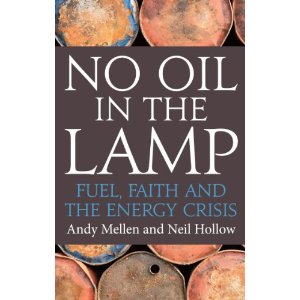
I can’t recall ever hosting a guest post before, but this approach seemed both worthwhile and important. Andy Mellen is the co-author with Neil Hollow of ‘No Oil in the Lamp‘, a Christian response to the Peak Oil crisis. About three years ago, I heard Sam Norton give a theological lecture on Peak Oil in Chelmsford, and his blog Elizaphanian is a useful source of informed comment on the problem. Because I had had my eyes opened by that experience, and because I am not myself a scientific specialist in this area, I was only too willing to host a piece on this subject.
Over to you, Andy:
Our ideas about the future tend to be conditioned by our experience of the past, so if you were born in a developed country sometime in the last sixty years, it’s likely that you have experienced a rising standard of living, with increasing comfort and convenience. Yet we only need to look back a few generations to see how much has changed, and how much we take for granted: We flick a switch, assuming that electricity will be there to light up the bulb. We expect to be able to travel long distances quickly, in comfort and at reasonable cost. We think nothing of sitting down to a meal whose ingredients have been transported across the globe to our table. These things and many more besides have become basic expectations – and as Christians living within a modern, developed country, we share them. Whilst we may bow our heads and give thanks for God’s provision at the start of a meal, in many other ways we take the conveniences of modern life for granted.
We might expect the future to look something like a continuation of the past, but what if that isn’t possible? It takes an enormous amount of energy to make the modern world work. The average household is using more energy today than at any time in the past. Globally, use of oil, coal and gas has at least almost doubled since 1970. The unfortunate thing is, there aren’t unlimited amounts of these commodities to fuel our lifestyles way into the future. In fact the most critical energy source – oil, which provides 90% of all transport, is already beginning to decline. So what does this mean? Well, it’s complicated, but also surprisingly simple: The good news is that nobody is saying we are going to suddenly run out of oil. The bad news is that declining oil production will cause us a host of difficulties in the years ahead. Experts predict a two-stage process: firstly high energy prices (which we are already experiencing) and eventually actual physical shortages. High prices are already giving the global economy a headache, and straining the finances of households. Actual shortages would provide an enormous challenge for society, the economy, food supplies and much more. A smooth transition to green renewable energy is what some people are hoping for – others are looking to science for the answer – new forms of energy, maybe hydrogen? Unfortunately, no technology is in a position to do for us what oil does today.
So what can we do? Is it a case of waiting for the Prime Minister, the UN, or someone else to take action? So far, despite credible voices speaking up, very little attention is being paid to this problem at Government level. However, at the grass-roots, in communities across the UK and increasingly across the world, something very interesting and exciting is happening. It is something called Transition. You may not have heard of it unless it is happening in your area, but the Transition movement is fast becoming the most positive response to the problems of resource constraints and climate change. Although it may sound a bit wacky and alternative, the heart of Transition is a very simple idea: we need to move away from oil dependence and instead build resilience into our households, communities and the local economy. Just how this plays out is different in every community, but the places which have embraced the concept are already starting to reap the benefits in terms of a more vibrant local economy, stronger community and reduced energy use. So far, I know that many Christians are individually involved in these initiatives, though I have not heard of any church becoming directly linked to Transition. Yet many of the qualities of the Transition movement overlap with what we might call “kingdom values” – concerns we see in the Bible. Three spring immediately to mind: Stewardship of the earth (humankind is given responsibility for the earth in Genesis 1), the principle of justice is seen throughout the Bible, (and particularly in the writings of the prophets, from Amos to Zechariah) and the principle of simplicity as espoused by Jesus, (most tellingly in Luke 17: “A man’s life does not consist in the abundance of his possessions.”). The church in the past has shied away from engagement with environmental issues for fear of contamination with “new age” philosophies. But it seems to me that the Transition movement offers an opportunity for Christians and the church to engage with something good, wholesome – and urgent.
Andy Mellen
(For much more detail on this whole area, see my book ‘No Oil in the Lamp‘ published last month, or check out the ‘No oil in the lamp’ page on Facebook)
Finally getting back to posting sermons. My church at Knaphill holds its annual covenant service today, where we renew our promises to God. Here is the sermon.
Henry Gerets was the American padre appointed as a chaplain to those Nazis who were put on trial at Nuremberg after World War Two. It was not a job he wanted. His only son had been killed by the Germans in the war, and so you can imagine his feelings towards these evil people.
But eventually he accepted the post. He went to Nuremberg, and he set about visiting every notorious Nazi held there. Gerets went from cell to cell, sharing the Gospel with men who were about to pay for their crimes by being hanged. Some went to the gallows, proudly defying the God of whom Henry Gerets spoke.
But some got down on their knees, and begged for mercy.
And mercy is a fundamental quality of the Gospel. ‘Therefore, I urge you, brothers and sisters, in view of God’s mercy,’ says Paul in Romans 12:1. It is the mercy of God that has brought us to this Covenant Service. We, too, are the ‘tax collectors and sinners’ beloved of Jesus and brought into his Father’s presence by grace.
In fact, it’s better than ‘mercy’. What Paul really says is, ‘in view of God’s mercies’. How many of us have known God only to be merciful once to us? Is it not our testimony that God is merciful to us over and over? Like the author of Lamentations, we know that his mercies are ‘new every morning’. Mercy upon mercy, grace followed by more grace, love poured out over more love – is that not the God of the Gospel?
And we come to make our promises today ‘in view of God’s mercies’. Paul has given his readers eleven chapters about God’s mercies. We know many years of God’s mercies. In view of all he has done for us in Christ, we offer ourselves.
How are we going to do that? Paul says it’s going to take all we are and all we have. He calls us to make two responses – one with our bodies and one with our minds.
Firstly, then, our bodies:
‘offer your bodies as a living sacrifice, holy and pleasing to God – this is your true and proper worship’ (verse 1)
‘Sacrifice’ – for Paul as a Jew, this is the language of worship. It is appropriate to use our bodies as expressions of our worship. Some Christians do this quite naturally. They may do in set liturgical ways such as kneeling for prayer. I have to say, that I have found that simple bodily act of kneeling for prayer in, say, an Anglican church has been a profound reminder for me of my need to be humble before God. Similarly, I remember asking one Anglican friend why she signed herself with the cross before worship. She told me it was a particular reminder to herself that the Cross was the reason she could be in worship at the first place. It therefore prevented her from approaching worship casually.
Some Christians, especially those of a charismatic of Pentecostal spirituality, use their bodies more spontaneously in worship, perhaps most notably when lifting their hands in praise. It is, of course, an ancient Jewish practice to lift up holy hands to God in the sanctuary. It is mentioned in the Psalms. The Jewish tradition is more to raise hands in intercession, whereas the charismatic-Pentecostal style is more about praise. It’s as if to say, ‘I am already lifting my voice to God in praise. What else can I raise as a sign of how much I want to worship God?’
One thing that strikes me about prayers in worship and before worship is that a common theme is this: ‘Lord, we thank you that we are free to worship you in this country.’ Now that’s a laudable sentiment, and we should not take that freedom lightly. But I wonder whether it morphs for some of us into, ‘Thank you, Lord, that we don’t have to pay a price in order to worship you.’ Because if it does, then we have lost sight of the fact that worship is a sacrifice, and that surely means it will cost us something.
How, then, are we going to offer something costly with our bodies as an act of worship to God? It may not be in terms of persecution, but if worship costs us nothing then it is barely on the level of a hobby or a pastime. They probably cost us more than worshipping our God of mercy does.
That cost may come for some of our more elderly and frail family in the physical effort it takes to be at worship, and to participate. Their faithful commitment to worship is something the rest of us will only understand when we get to their age and condition.
But of course this is not all about Sunday services. This call to use our bodies sacrificially in worship is also about our expression of devotion every day. Think of how the old marriage service contained the promise, ‘With my body I worship thee’ – it says, ‘With my body I honour you’ in the modern service. is that not what we are to do? God created our bodies. They are not empty shells for the ‘real person’. They are part of who we are. Tomorrow morning, you will see there are ways in which you can make a physical effort with your body as a way of honouring God. There will be something you can do that will be ‘holy and pleasing to God’ with your body.
I’m sure you have little problem with the idea that worship is ‘holy’ – that is, it is something we set aside for God’s service. When we do something that is specifically for our Lord – whether it is explicit or implicit – the fact that we have made it for him means it is holy.
But what about the idea that Paul tells us here that this offering of our bodies is ‘pleasing to God’? Will you just take a moment to reflect on the fact that we can give God pleasure with what we offer him? Our images of a solemn, severe old-fashioned Headmaster God need tempering with these words. Right now, I believe God is looking forward to what we can offer him. Why? Because it will be what Paul calls here our ‘true and proper worship’. That is, when we have reasoned how we should respond to the mercies of God, it will become apparent that the offering of our bodies is an appropriate response.
Let us each think this morning, especially as we renew our covenant promises: how are we going to offer our bodies in worship to God?
Secondly, our minds:
Do not conform to the pattern of this world, but be transformed by the renewing of your mind. Then you will be able to test and approve what God’s will is – his good, pleasing and perfect will. (Verse 2)
This may sound like a negative question to get into this point, but bear with me: what do we think the effects of sin are? I would suggest that we have underplayed the effect of sin upon our minds, because our society has for the last three hundred years placed such value upon the powers of human reason. We sometimes overlook the effect of sin upon the mind. So, for example, we rightfully laud the achievements of scientists, whose use of their minds have brought wonderful benefits to our lives. But we miss the way scientific minds have been used to bring terrible harm to our world – nuclear weapons, environmental damage, climate change and so on.
I suggest we are all like that. Our minds are capable of great things, but they are also corrupted. They are as much affected by sin as any other part of us. Earlier in the epistle, Paul spoke about the ‘unfit mind’ (1:28) and that is what we have. So our minds need renewing, because as Christians we are not finally to be part of this sinful age but of the glorious age to come, the kingdom of God.
So if we are grateful for the mercies of God, we shall submit our minds to the renewing power of the Holy Spirit. What does this renewal of our minds look like? We get some idea when we realise that the end product, according to Paul, is that we ‘will be able to test and approve what God’s will is – his good, pleasing and perfect will’. In other words, having renewed minds is not a matter of just reading a list of rules and following them. That is what machines and computer programs do. It is impersonal. No: the renewed mind can ‘test and approve what God’s will is’. That implies personal involvement, a journey of discovery.
And so I suggest to you that the Holy Spirit renews our mind not by filling them with rules but with the mind of Christ. The Spirit shows us more of Christ – his person, work and teaching. This becomes the matrix by which we are guided into evaluating what the will of God is. We are involved in working out what that will is – it isn’t simply dropped into our empty minds.
How, then, do we open ourselves to the Holy Spirit’s renewing work in our minds? Well – if it means getting in touch with the mind of Christ, then yes, this is another time when I need to urge us to engage in those spiritual disciplines that soak us in the Scriptures, particularly the New Testament and especially the Gospels. It may be daily reading of the Bible using Bible reading notes. It may be taking a reading and using our imagination to get inside the story by wondering what our five senses would tell us or how we would feel if we were one of the characters. It may mean taking a passage, looking for the one thing that particularly strikes us and then chewing that over. Whatever methods we use, we need to be as diligent about our Bible reading as we are about nourishing ourselves with food, and we certainly need to respond prayerfully to whatever we have encountered. We shall also do this not only on our own but in conversation and fellowship with our sisters and brothers in Christ. For the mind of Christ will come in exploration with them as well as individually.
And I must also remind you that none of this is a quick fix. In a society that is addicted to instant solutions (so says he whose Internet connection speed is about to double!) the renewal of our minds is a long process. If the old mind is, as I said before, an ‘unfit mind’, then the renewal that makes our minds spiritually fit for the kingdom of God is a long training process, much like the years of training our Olympic and Paralympic heroes of recent weeks have had to follow.
But … it’s worth it. Because this leads us to discern ‘God’s will – his good, pleasing and perfect will.’ Did you notice that? His will is ‘good, pleasing and perfect’. Although our Covenant promise will balance the ideas that some things we are called to will be enjoyable and others will be difficult, it is common among some Christians to assume that the will of God will automatically be hard, if not unpleasant and maybe downright tortuous. Yet Paul says it is ‘good, pleasing and perfect’. Yes, of course sometimes following God’s will can be painful – in talking about our bodies we used the word ‘sacrifice’ – but it can also be a joyous thing. Our faith is resurrection as well as death.
So let us embrace the call to dedicate our bodies and minds to God, in the light of his never-ending mercies. Let us be willing to sacrifice, yes, but let us also relish the thought that discovering his will and walking in it may bring joy not only to our Lord but also to us.
When Neil Armstrong, the first man to set foot on the Moon, died yesterday, I remembered being a nine-year-old boy in a primary school hall. The whole school was assembled to watch a small black-and-white television that had been perched on the stage for us all to watch recorded footage of the momentous event.
After Apollo 11, Armstrong was famously reclusive. Not for him the celebrity circuit. In one of his rarer excursions into public, he sued a barber for selling some of his hair.
“For those who may ask what they can do to honour Neil, we have a simple request. Honour his example of service, accomplishment and modesty, and the next time you walk outside on a clear night and see the moon smiling down at you, think of Neil Armstrong and give him a wink.”
O that others would seek a similar remembrance. ‘Honour his example of service, accomplishment and modesty’ indeed.
Frank Cottrell Boyce, who worked on Friday night’s Opening Ceremony of the Olympics, said this about the volunteers who took part:
The fact that almost 10,000 people kept the secret didn’t surprise Cottrell Boyce. “Those volunteers redefined the nation for me,” he said. “We’re told people need to be paid great sums to get results, but those who are motivated by money cock up. Because they’re crap. People who are motivated by things like love, family, friendship and humanity are the ones who have something to offer.”
Last Sunday evening, I got in after Richard Goldstraw’s farewell service and tea at Addlestone to find that we had a new temporary resident in the manse.
The Queen.
OK, it was a life-size cardboard cut-out of her, and apparently it is doing the rounds of every house in our road that will have her, ever since the Diamond Jubilee street party.
Jokingly, I put up a comment on my Facebook page, saying that this had happened, and asking any of my friends if they had any messages they would like me to relay to her. These included one friend who had recently been to a Buckingham Palace garden party asking me to give her a cheery wave and say ‘thanks’ for the tea. Another thought I could ask her to whip up a sermon for today. Somebody wanted to know if she had changed her mobile number. And another saw the opportunity for a lucrative business opening. I could advertise my services to parents who are regularly nagging their children over their manners by offering a practice Royal Garden Party. They could ‘meet the Queen’ and ‘have tea with the vicar’.
Of course, I wanted to have some fun with this, but our concept of a ruler’s majesty has declined over the years. The Psalmist, on the other hand, has a rich view of God’s majesty. Yet even then, the way in which that majesty is expressed on earth and in the heavens (verse 1) is surprising at times.
Firstly, God shows his glory in weakness.
Recently I had to take our daughter Rebekah on a Brownies’ trip to the dry ski slope at Aldershot, where the girls had an hour of ‘donutting’ – that is, coming down the dry ski slope in a glorified large rubber tyre, while wearing helmets for safety. As we arrived at the car park, Brown Owl suddenly got very excited and shouted to everyone, “Look! A Vulcan!”
I should explain that this was not a reference to Star Trek but to a Vulcan bomber that could be seen in the sky. The Farnborough Air Show was about to start.
And maybe an air show like that is what we expect in terms of rulers showing their power and might. They use displays of military hardware or force. Think back to all those parades of the Soviet Army through Red Square that we used to see on the news.
But God goes explicitly against this in the display of his majesty:
Out of the mouths of babes and infants
you have founded a bulwark because of your foes,
to silence the enemy and the avenger. (Verse 2)
What could contradict military might much more than ‘the mouths of babes and infants’? Those who claim might and majesty by force are those God treats as enemies. He shows his glory instead in a tiny, fragile life.
The Psalmist wasn’t to know this, but several hundred years later God would show this explicitly. His majesty would be seen not in the palaces of Rome or Jerusalem, but in a manger in Bethlehem. Supremely Christians see this in the incarnation of Jesus. There is God’s upside-down majesty. Wonder at his glory in, say, the words of Charles Wesley:
Our God contracted to a span,
Incomprehensibly made man.
For me, this is captured in the words of a contemporary Christian poet and singer, Bruce Cockburn, in two of his songs. One is called ‘Cry of a Tiny Babe’.
The chorus says:
Like a stone on the surface of a still river
Driving the ripples on forever
Redemption rips through the surface of time
In the cry of a tiny babe
Why does ‘redemption [rip] through the surface of time in the cry of a tiny babe’? Because this is how God shows the splendour of his glory – his majesty. He does so in a reversal of the world’s ways and the world’s values. In the scandal of humility, God reveals his glory.
What does that mean for us? Go to another Cockburn song, one called ‘Shipwrecked at the Stable Door’.
The stable door of the song is the stable in Bethlehem. In the lyrics of the final verse, Cockburn connects the frailty of the Incarnation with the revolutionary words of the Beatitudes:
Blessed are the poor in spirit –
Blessed are the meek
For theirs shall be the kingdom
That the power mongers seek
Blessed are the dead for love
And those who cry for peace
And those who love the gift of earth –
May their gene pool increase
Cockburn took inspiration here from a wonderful spiritual writer called Brennan Manning. The final chapter of one of his books, ‘The Lion and the Lamb’, is called ‘The Shipwrecked at the Stable’. Manning makes the case that it is the poor and the weak who find hope in the infant Christ:
The shipwrecked at the stable are the poor in spirit who feel lost in the cosmos, adrift on an open sea, clinging with a life-and-death desperation to the one solitary plank. Finally they are washed ashore and make their way to the stable, stripped of the old spirit of possessiveness in regard to anything. The shipwrecked find it not only tacky utterly absurd to be caught up either in tinsel trees or in religious experiences – “Doesn’t going to church on Christmas make you feel good?” They are not concerned with their own emotional security or any of the trinkets of creation. They have been saved, rescued, delivered from the waters of death, set free for a new shot at life. At the stable in a blinding moment of truth, they make the stunning discovery that Jesus is the plank of salvation they have been clinging to without knowing it!
All the time they are battered by wind and rain, buffeted by raging seas, they are being held even when they didn’t know who was holding them. Their exposure to spiritual, emotional and physical deprivation has weaned them from themselves and made them re-examine all they once thought was important. The shipwrecked come to the stable seeking not to possess but to be possessed, wanting not peace or a religious high, but Jesus Christ.
The God who comes to us in weakness and vulnerability can only be encountered in weakness and humility. Strutting pride and forceful power are not the entry tickets to the kingdom of God. The vulnerable God of Bethlehem meets those who are weak, who admit their need of him, and in doing so reveals his majesty.
Secondly, God shows his glory in insignificance.
I grew up as the son of an amateur astronomer. Even now, my father still belongs to the British Astronomical Association. One Saturday, Dad took me to London for a BAA lecture given by Patrick Moore. I didn’t understand it, but I noticed how he spent as much time afterwards answering the children’s questions as he did the adults’. Conversations at home were punctuated with Sirius, Orion, the Plough, the Pleiades, Aldebaran and the star I as a child called Beetlejuice. Television meant the Apollo missions, Tomorrow’s World and James Burke science shows. To learn that the nearest star outside our solar system was four light years away – that’s 23 trillion miles – was mind-blowing and awe-inspiring. Later, when I came to faith in my mid-teens, although I had not kept up the interest in astronomy, to gaze up at a clear night sky was to engender a spirit of worship:
When I look at your heavens, the work of your fingers,
the moon and the stars that you have established;
what are human beings that you are mindful of them,
mortals that you care for them? (Verses 3-4)
The Psalmist didn’t know what we know about the night sky, but what we know gives these words even greater force: our Sun is but one star among between two and four hundred billion stars in our Milky Way galaxy. There are one hundred and seventy billion known galaxies in the observable universe.
In a world like that, don’t you feel tiny and insignificant? No wonder some people say our own planet Earth is just ‘the third stone from the Sun’.
No wonder others say that humans are just ‘dust in the wind’.
The contemporary atheist movement makes a lot of this. It says that the scale of things are such that it is ludicrous to see human beings as in any way special. We are just an impersonal consequence of the Big Bang and evolution.
What is difficult for these arguments is the evidence for the fine-tuning of the universe. An apologist for the Christian faith called Andrew Wilson lays out some of these in his recent book ‘If God, Then What?’ According to Wilson, there are fifteen different mathematical constant numbers that all have to be right to one part in a million (or even more precisely) for life to exist. If the ratio between the strong nuclear constant and the electromagnetic constant were different by one part in ten million billion, we would have no stars. If the balance between the gravity constant and the electromagnetic constant altered by one part in 1040, the stars would not be able to sustain life. And there are many others. Wilson quotes scientists who say that it is like ‘the universe knew we were coming’ and laid out a ‘cosmic welcome mat’.
But more than this, the Psalmist sees human beings as having a specific status and dignity in creation:
Yet you have made them a little lower than God,
and crowned them with glory and honour. (Verse 5)
And not only that, this special status comes with a particular function on God’s behalf:
You have given them dominion over the works of your hands;
you have put all things under their feet,
all sheep and oxen,
and also the beasts of the field,
the birds of the air, and the fish of the sea,
whatever passes along the paths of the seas.
(Verses 6-8)
Instead of being meaningless, human beings have dignity and responsibility in creation. In the face of feeling insignificant amidst the vastness and power of creation, God grants to the human race the moral management of creation on earth. This is our calling as a race, and it has huge implications.
For one, this is a restatement of Genesis chapter one, where the function of human beings made in God’s image was to look after this planet. That is far from insignificant. It is humans who feel insignificant. That is not how God regards us.
‘Looking after this planet’ implies our daily work. One sadness I encounter in pastoral conversations is with Christians who think that because they are not ordained or do not work for the church, what they do is of little value to God. I think this is a legacy of our past. The Catholic understanding of vocation was indeed something like this. You had vocations into the priesthood, or into a religious order as a nun or a monk. The Protestant Reformation widened this, and so we began praying for people in the healing, caring and education professions.
But there are all sorts of opportunities for Christian vocation if our calling as people made in God’s image is to look after his world. Graham Dow, who was Bishop of Carlisle until three years ago, wrote a booklet on ‘A Christian Understanding of Daily Work’. He argued that there were three purposes of work for Christians:
Creative management of God’s world.
Moral management for the good of all.
A community of good relationships.
While he didn’t go as far as Martin Luther, who once said that if the job of village hangman fell vacant, the conscientious Christian should apply, we can see from these three purposes of work that we have many opportunities to give glory to God in everyday life and work.
Although it would take a whole sermon to explore the three purposes of work, I want you to see that tomorrow morning, you have an opportunity to give glory to our majestic God in your work. Whether you are in paid employment, doing unpaid work, unemployed or retired, God has set us in a world where we may work to his praise and glory, whether what we do is overtly religious or not.
Yes, in weakness and in work, we can live our lives in ways that reflect the words with which the Psalmist both begins and ends here:
O Lord, our Sovereign,
how majestic is your name in all the earth! (Verses 1 and 9)
We extend a special welcome to those who are single, married, divorced, gay, filthy rich, dirt poor, yo no habla Ingles. We extend a special welcome to those who are crying new-borns, skinny as a rail or could afford to lose a few pounds.
We welcome you if you can sing like Andrea Bocelli or like our pastor who can’t carry a note in a bucket. You’re welcome here if you’re “just browsing,” just woke up or just got out of jail. We don’t care if you’re more Catholic than the Pope, or haven’t been in church since little Joey’s Baptism.
We extend a special welcome to those who are over 60 but not grown up yet, and to teenagers who are growing up too fast. We welcome soccer moms, NASCAR dads, starving artists, tree-huggers, latte-sippers, vegetarians, junk-food eaters. We welcome those who are in recovery or still addicted. We welcome you if you’re having problems or you’re down in the dumps or if you don’t like “organized religion,” we’ve been there too.
If you blew all your offering money at the dog track, you’re welcome here. We offer a special welcome to those who think the earth is flat, work too hard, don’t work, can’t spell, or because grandma is in town and wanted to go to church.
We welcome those who are inked, pierced or both. We offer a special welcome to those who could use a prayer right now, had religion shoved down your throat as a kid or got lost in traffic and wound up here by mistake. We welcome tourists, seekers and doubters, bleeding hearts … and you!
That’s how one Catholic community in the States welcomes people, according to Jon Acuff. Being a pastor ‘who can’t carry a note in a bucket’, I like it.
What do you think? Assuming they live up to their words, what might it say to us?



 Big Circumstance