Joy-Bringer, Isaiah 35:1-10 Advent With Isaiah 3 (Advent 3 Year A)

Isaiah 35:1-10

One popular Christmas carol, especially among American Christians, is ‘Angels we have heard on high.’ Its first verse reads,

Angels we have heard on high
Sweetly singing o’er the plains
And the mountains in reply
Echoing their joyous strains
Gloria in excelsis Deo!

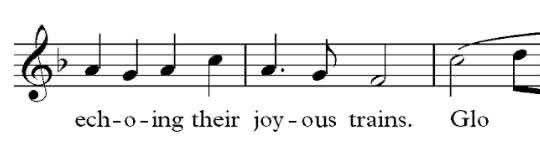
Unfortunately, one source of the music misprinted ‘Echoing their joyous strains’ as ‘Echoing their joyous trains.’

Source unknown. From the Church Service Typos group on Facebook.

I don’t suppose anyone who commutes would readily think of ‘joyous trains.’ I know my wife didn’t on Thursday evening when her train from Waterloo didn’t initially have a driver, when the passengers were told to disembark to find another train, only then to be told to stay on board. They left twenty-seven minutes late. Joyous trains, indeed.

But if the trains were transformed, that truly would be reason for joy.

The theme this week is ‘Joy’ but it is connected with transformation. So maybe a better title might be, ‘Joy in Transformation.’ These verses in Isaiah give five examples of the transformation the coming Messiah will bring, which lead to joy. It was something the southern kingdom of Judah needed to hear, nervous as the nation was due to the military power of Assyria, which had already conquered the northern kingdom of Israel.

But as so often in Isaiah, we shall see that no earthly king could completely fulfil the prophecy. Even with Jesus, the true Messiah, he would begin the transformational work prophesied, but it will only come to complete fruition with his return in glory.

However, in the meantime, in our in-between time, these point to our work for God’s kingdom today. There are five arenas for joy in the reading; I shall deal with each one briefly.

Firstly, joy for the desert:

The desert and the parched land will be glad;
    the wilderness will rejoice and blossom.
Like the crocus, 2 it will burst into bloom;
    it will rejoice greatly and shout for joy.
The glory of Lebanon will be given to it,
    the splendour of Carmel and Sharon;
they will see the glory of the Lord,
    the splendour of our God.

In the Middle East, the people know all about parched deserts in the heat. But God will restore life to the desert as he breaks the drought and beautiful plants bloom and flourish there.

Our droughts today are often caused by our failure as the human race to fulfil the command we were given when God created us: namely to rule over the created order wisely on his behalf. Instead of caring for it, we have exploited it. Now we pay the consequences – but worse, it is the poorer nations who are suffering first and most.

As Christians, we have common cause with those who are concerned for our environment. But we have a unique reason for being involved. It is that we are doing so as stewards of God’s creation, and as a prophetic sign that God will make all things new in his creation. We agree that the world is in a mess, but we engage out of a spirit of hope, not panic.

So let us engage in our creation care as an act of worship and of witness to the Messiah who will renew the earth. And if we listen carefully, we may catch the sound of the world rejoicing, too.

Secondly, joy for the fearful:

3 Strengthen the feeble hands,
    steady the knees that give way;
4 say to those with fearful hearts,
    ‘Be strong, do not fear;
your God will come,
    he will come with vengeance;
with divine retribution
    he will come to save you.’

At the time of the prophecy, Israel could well have been afraid of Assyria. But as we know, fear comes in many flavours. Fear of war. Fear of death. Fear of other people’s expectations. Fear of losing someone. The list of fears is long.

In the specific context, Isaiah promises that those who are afraid of wrongdoers can take heart, because God will judge the wicked who are scaring them.

And yet there is still a universal application. It is often said – and I confess I have not checked the veracity of this – that the words, ‘Do not be afraid’ occur three hundred and sixty-five times in the Bible. One for every day of the year. You can have one day of fear in a leap year!

God does not want us paralysed by fear. He wants us animated by love. And so, he promises to banish the forces and the people that cause us to fear. The life of the messianic age to come will not be characterised by fear. It will be an eternal age of love.

And if God promises that for us, we can ask ourselves, what can we do to help remove fear from the lives of other people? Sometimes we can banish the cause of fear. In other circumstances, we may not be able to do that, but we may be able to show how to live without fear when unwelcome things happen.

I know how easy it is to panic. My body goes into panic mode before my mind catches up with the truth. For me, God’s message of peace and love comes through human beings, not least my wife. There has been more than one occasion when people who didn’t like me in churches have made up false and malicious Safeguarding accusations against me. One time, my Superintendent phoned me and said, ‘Watch your back on Sunday morning.’ Debbie has helped me be anchored in truth when lies have flown about.

Thirdly, joy for the silenced:

5 Then will the eyes of the blind be opened
    and the ears of the deaf unstopped.
6 Then will the lame leap like a deer,
    and the mute tongue shout for joy.

There is more than one way of reading these words. Some take them literally as a promise of healing, and we saw in our Gospel reading from Matthew: Jesus did heal the blind, the deaf, and the lame. I wouldn’t want to deny that, nor the promise of full healing when Jesus comes again and makes all things new. I would encourage us to pray for the sick, just so long as we don’t treat chronically ill or disabled people purely as prayer projects rather than people with dignity. As the title of one book puts it, My Body Is Not A Prayer Request.

But I will say there is a wider meaning to these words. Why did I introduce this point as ‘joy for the silenced’? For this reason. Our English translations say at the end of the quote, ‘the mute tongue [will] shout for joy.’ But the words ‘for joy’ are not there in the Hebrew. The mute will shout. That’s it. People who have been silenced by those who oppress them find their voice in the kingdom of God. The persecuted are vindicated and set free. The people that society does not value are of great worth and significance to Jesus.

The early church did this by the way they gave importance to slaves and women. Jesus calls us too to value those who would not be elevated by our society. He longs for them to find their place in his family and his kingdom purposes. Let’s not evaluate people by worldly standards, but by the fact that they are loved and cherished by God in Jesus.

Fourthly, more joy for the desert:

Water will gush forth in the wilderness
    and streams in the desert.
7 The burning sand will become a pool,
    the thirsty ground bubbling springs.
In the haunts where jackals once lay,
    grass and reeds and papyrus will grow.

We’re back in the wilderness, but to make a different point. This time, we see the conditions coming together so that life can flourish. Water to drink. Papyrus to make documents. Reeds to make household items.

In this context, artisans, craftsmen, and business can flourish. Their raw materials are plentiful again.

And so, I want to suggest to you that one way we can be a sign of the Messiah’s coming kingdom is by supporting human flourishing, including our local businesses.

Is that a Christian thing to do? I think so. Remember how later the people of Judah were taken into exile in Babylon. The prophet Jeremiah wrote a letter to the exiles. You can find it in Jeremiah 29. In that letter, he tells these Jews who have been separated from their own land and temple that were so vital to their understanding of salvation that they were to seek the prosperity of the city to which they had been taken. Yes – even a pagan city. Go and bless the pagans, says Jeremiah: it is a sign of God’s covenant love.

Let’s cultivate our relationships with local shops and businesses. Not only by giving them our custom, but that when we do so we take an interest in them and we build relationships with them. I have known ecumenical groups of churches in a village take boxes of chocolates to every business in that village at Christmas, with a card thanking them for all they do, and offering to pray for them if they would like it.

Which shops, businesses, or community groups do you appreciate here? Can you bless them? I’m sure you can. Maybe it will provoke questions.

Fifthly and finally, joy for the temple:

8 And a highway will be there;
    it will be called the Way of Holiness;
    it will be for those who walk on that Way.
The unclean will not journey on it;
    wicked fools will not go about on it.
9 No lion will be there,
    nor any ravenous beast;
    they will not be found there.
But only the redeemed will walk there,
10     and those the Lord has rescued will return.
They will enter Zion with singing;
    everlasting joy will crown their heads.
Gladness and joy will overtake them,
    and sorrow and sighing will flee away.

The highway of holiness, on which only the redeemed and not the unclean may walk, is surely the road to the temple in Jerusalem.

This reminds us that when Jesus is present among his people, there is joy. Yes, of course we will be reverent: I am not calling for some religious chumminess with God. But for all that, to have the Messiah in our midst will be a cause for joy and it will reflect in the way we are together in worship and in the sharing of our lives together. With Jesus, church is to be a place of joy.

Today, we only have that experience of Jesus by the presence of his Spirit within us and in our midst. But part of the fruit of the Spirit is joy! And one day, we shall all be together in the presence of Jesus and his Father, too.

It’s nice that we look forward to seeing our friends at church. But that doesn’t make us any different from anyone else. Do we have a sense of joy that Jesus will be present with us, and indeed that we are each bringing him with us to our gathering? That is what the messianic community is like.

Conclusion

Joy to the world, we sing at this time of year, the Lord is come. And when the Lord comes, there is joy. Joy for the broken, joy for God’s people and joy for all creation.

And when he comes again, the joy will be magnified and sorrow banished.

Let us, the followers of Jesus, then, also be joy-bringers.

Worship In The Midst Of The World (Isaiah 6)

Isaiah 6:1-13

I expect you’re aware of the custom whereby just before the Sunday service starts, the duty steward prays for the preacher in the vestry. Over the years, I have heard a variety of such prayers, the worst being one Good Friday where in his prayer the steward called the death of Jesus a mistake.

But another common one starts something like this: “Dear Lord, we gather here today to leave the world outside behind and concentrate on you.” Now I guess that could be interpreted more than one way. But is our worship really an escape from the world?

In the year that King Uzziah died, I saw the Lord (verse 1a).

Is that just a date in Isaiah’s diary? I don’t think so. If all he wanted to tell us was the day on which he had a powerful experience of worship and commissioning, he would surely just have named the month and the day of the month. ‘On the twenty-third day of Nisan,’ or something like that.

No. Locating his divine encounter as happening ‘In the year that King Uzziah died,’ Isaiah affirms that worship takes place in the middle of what is happening in the world. The events of history do not drive our worship, for sure, but worship is located in the midst of politics, economics, and every power that competes to shape our lives.

What does this worship look like?

Firstly, glory:

In the year that King Uzziah died, I saw the Lord, high and exalted, seated on a throne; and the train of his robe filled the temple. 2 Above him were seraphim, each with six wings: with two wings they covered their faces, with two they covered their feet, and with two they were flying. 3 And they were calling to one another:

‘Holy, holy, holy is the Lord Almighty;
    the whole earth is full of his glory.’

4 At the sound of their voices the doorposts and thresholds shook and the temple was filled with smoke.

I once arrived at a church as a visiting preacher and was greeted by a member of the congregation who said, “I hope you’re going to entertain us today.” This brought out my Mister Grump side, and I replied, “Well, I hope we’re going to worship.”

We must get rid of this idea that worship is entertainment. It is a prominent heresy across all sorts of Christian traditions and worship styles. Worship is to give glory to the triune God, who is holy, holy, holy. We are here to honour his name and to give thanks for all he has done. Worship is God-centred or it is not worship at all.

Archbishop William Temple gave a famous definition of worship:

Worship is the submission of all of our nature to God. It is the quickening of the conscience by his holiness; the nourishment of mind with his truth; the purifying of imagination by his beauty; the opening of the heart to his love; the surrender of will to his purpose–all this gathered up in adoration, the most selfless emotion of which our nature is capable.[i]

None of this is an escape from the world, for God is the greatest reality there is. Moreover, as the Creator of this world and its Redeemer, God is where our focus needs to be, without having an escapist mentality.

So while it’s not true to say that ‘the world sets the agenda’ – that was one of the heresies from liberals at the World Council of Churches – it is true that we come to focus our energies on God, who created the world we live in through Christ and by the Spirit, and who also redeems the world through Christ and in the power of the Spirit.

Secondly, confession:

5 ‘Woe to me!’ I cried. ‘I am ruined! For I am a man of unclean lips, and I live among a people of unclean lips, and my eyes have seen the King, the Lord Almighty.’

6 Then one of the seraphim flew to me with a live coal in his hand, which he had taken with tongs from the altar. 7 With it he touched my mouth and said, ‘See, this has touched your lips; your guilt is taken away and your sin atoned for.’

If we truly encounter the living God in his glory in worship, then we shall realise quickly that we do not match up. That’s what Isaiah realises, and not only for himself. He admits not only his personal sin, but the sin of the nation. A true encounter with God will blow away once and for all the idea that we’re all good, decent people who merely make the occasional error in life. It will relieve us of the comfortable illusion that we are good enough for eternal life.

Furthermore, here our lives are calibrated not by the popular standards of the world but by God and his holiness alone.

Initially, this leaves Isaiah with a sense of hopelessness. He cannot get beyond ‘Woe is me! I am ruined!’ That’s desperate.

But God can get beyond it. A seraph brings a live coal from the altar, the place of sacrifice. It is God who provides for Isaiah and God’s people to know forgiveness and the removal of their sin.

If you remember the painful story in Genesis where God asks Abraham to sacrifice Isaac, you may recall how Isaac asks his father who will provide the lamb for the sacrifice. Abraham replies that God will provide the lamb. And he does – mercifully not in the way he was expecting.

Ultimately, we believe that is what God supremely did with Jesus at the Cross. The Lamb of God was provided. Now our sins are removed as we confess them. They have already been atoned for at Calvary.

The regularity of our failure is why we confess and receive assurance of forgiveness in every Sunday service. It is God’s free gift. We have not earned it. God has reached out in love to the world at the Cross. Will we look at the worldly horror of the Cross and allow it to cleanse and transform us?

Thirdly, God’s word:

Then I heard the voice of the Lord saying, ‘Whom shall I send? And who will go for us?’

Following confession and forgiveness, the way is clear for us to hear God’s word. That’s why the reading of Scripture and the preaching come next in a typical Sunday service, by the way.

There’s no reading of Scripture in the Temple for Isaiah. It’s questionable what, if anything, they had in written form at this point – not much, for sure. But in any case, God speaks directly on this occasion.

If we are to be worshippers in the midst of the world, we need to hear God’s marching instructions to us. ‘Whom shall I send? And who will go for us?’

Therefore, the reading and proclaiming of the word is to have an honoured and central place in our worship. It is not that with a variety of preachers we get to hear a whole host of different opinions, because the job of the preacher is not to foist their sentiments or even prejudices on the congregation; it is rather to proclaim what the Word of God says.

Therefore, there is another steward’s vestry prayer that both encourages me for its meaning but also humbles me by reminding me of the expectation on my task. It is when the steward prays that the congregation may hear your word through me. That is profoundly sobering!

This is not to say that a congregation should be uncritical of what the preacher says, although I do note the old joke which asks what the favourite Sunday lunch in a Christian household is. The answer is, ‘Roast preacher.’

But it is to say that we should be like the Berean Jews, whom Paul encountered on his missionary travels. In Acts 17:11 we read of them,

Now the Berean Jews were of more noble character than those in Thessalonica, for they received the message with great eagerness and examined the Scriptures every day to see if what Paul said was true.

In some old pulpits, the preacher was confronted by a small plaque. On it were the words of the Greeks who came to meet Jesus before the crucifixion, where they told the disciples, ‘Sir, we would see Jesus.’ Our prayer and aspiration for worship needs to be that we see and hear Jesus, so that we know what he is expecting of us in the world.

Fourthly and finally, response:

And I said, ‘Here am I. Send me!’ (verse 8b)

Isaiah responds to God’s word. He is willing to go into the world on behalf of his God. We learn in the subsequent verses that he can’t necessarily expect people to respond positively to what he has to say, but nevertheless someone must go, and then if there is no redemption there will be no excuse. People will not be able to say they were not warned.

How does this play out in our worship? Within the service, it comes in the intercessions, which are meant to be a response to the word. (I’m not sure they always are, but that is the theory.) If you were used to services where the sermon was the climax of the service before the final hymn and blessing, but then noticed a change, where the intercessions followed the sermon, well, this is why.

And so it’s right that in our intercessions we pray not only for ourselves and the church, but for those in power, authority, or influence. If you read the Bible carefully, you will realise that the divine commands are not limited to God’s people. You will hear prophets speaking to kings and nations and all in authority.

This is a holy task. In the early church, those who had not yet been baptised and professed faith and who were undergoing catechism classes would leave the worship before the intercessions. Why? Because intercession is a priestly task, and they were not yet part of what we later called ‘the priesthood of all believers.’ But for those of us who believe, we are acting as God’s priests when we intercede in response to the word.

But the response doesn’t stop with the end of the prayers or with the blessing at the conclusion of the service. The genuineness of our response to the word is tested by what we do when we leave. At the end of the Latin Mass, Catholics were effectively told in the liturgy, ‘The Mass is over: now go out!’

Isaiah did that. It’s our calling, too. Like him, we may or may not see success in response to our bearing God’s word to the world in word and deed. But Isaiah kept faithfully doing it in response, because to do so in the world was intrinsic to true worship. May we do the same.


[i] William Temple, Readings In St John’s Gospel, on John 4:24.

Journey To Jerusalem 2: How Worship Shapes Us, Psalm 122 (Lent 3)

Psalm 122

If you survey a group of Christians and ask them what the number one priority of the Christian life is, they will almost certainly answer, ‘worship.’ 

I personally would want to refine that answer a little: I would answer in terms of the description the crowd gave of the disciples at Pentecost, ‘We hear them declaring the mighty works of God,’ which to me seems to describe both worship and mission. 

But I get the basic point. Worship is a central activity of Christian faith. 

Worship was also central for ancient Israel. And with only three opportunities a year to travel to Jerusalem for the great feasts, they retained a sense of how special and awe-inspiring it was: 

1 I rejoiced with those who said to me,
  ‘Let us go to the house of the Lord.’

2 Our feet are standing
in your gates, Jerusalem.

What a contrast with our casual approach to worship that treats it as little more than a visit to the supermarket. “I don’t feel like going to church today, it’s raining, I’m tired, my friend isn’t going to be there, I don’t like the preacher, I bet it’s those horrible modern hymns,” and so on. 

So I believe the pilgrims of ancient Israel on their way to the Temple at Jerusalem have a lot to teach us about worship. Granted, our context is different. In New Testament terms, we are not to refer to church buildings as ‘the house of the Lord’ for two reasons. One is that the Gospels show us that Jesus is the new and true Temple, where heaven and earth meet in his divine and human natures. The other is that Paul tells us that we together are ‘the temple of the Holy Spirit,’ something the early church was able to express as they met in people’s homes. 

But for all those qualifications, my point remains: we have a lot to learn from ancient Israel about worship, and especially in this Psalm about how worship shapes us as disciples. 

Firstly, worship gives us a framework:

3 Jerusalem is built like a city
    that is closely compacted together.
That is where the tribes go up –
    the tribes of the Lord –

The tribes went up three times a year to participate in festivals that celebrated the creating, redeeming, and providing works of the Lord. They ‘declared the mighty acts of God,’ to use my earlier expression. And the building of Jerusalem ‘closely compacted together’ was an architectural metaphor for this structure and framework that the worship festivals gave to Israel.[i]

Christian worship is meant to do no less. We declare and celebrate our belief in God as Creator of all things. We rehearse his special creation of the human race in his own image. We recall his acts of salvation in forming a people for himself, and sending patriarchs to lead them and deliver them, judges and prophets to call them back to him. Most of all, we recall how the Father sent his only-begotten Son who took on human flesh, proclaimed the kingdom of God, and went to the Cross to conquer sin. We rejoice in God’s raising of Jesus from the dead to bring new life, Christ’s ascension to the Father’s right hand on high where he reigns until everything is put under his feet, and the sending of the Spirit to empower our lives of discipleship. We anticipate the full coming of God’s kingdom, when all things will be made new. 

This is what we acclaim about our God in worship. Have you ever wondered why we have a big thanksgiving prayer at Holy Communion? This is why. It goes over the mighty deeds of God and puts Christ and his Cross central. 

This gives us a framework for our life of devotion to Christ. You know, atheists have good arguments against the existence of God. Christians and others have good arguments to support the existence of God. But which gives a better framework for life? Is it atheism, with its belief that we are just an accidental collection of atoms and that the process of evolution is entirely random and without purpose? If that is true, then it is meaningless to talk about love. How can you love another accidental collection of atoms? How can you speak of having any purpose in life when everything is random? 

Or is it better and truer to speak of a God with good intentions for his creation, who continues to reach out to humans who have rejected him, who came and lived among us and paid the ultimate price, and whose kingdom project is to make all things new? For all the problems there might be in believing in God, this framework is surely a better one to live by. 

And it is worship that embeds us in that framework. 

Secondly, worship is a command:

4 That is where the tribes go up –
the tribes of the Lord –
to praise the name of the Lord
according to the statute given to Israel.

‘According to the statute given to Israel.’ Ancient Israel was commanded to worship. This was God’s decree for them. 

We may say that we are not under the Jewish Law, we are under grace, but that does not negate the command and duty to worship. The first commandment, according to Jesus, is to love the Lord our God with all our heart, soul, mind, and strength. Jesus wasn’t shy in giving out commandments! He also talked about us worshipping God in spirit and in truth. 

Today, we resist the idea of being commanded by someone else. We think we run our own lives. We want to be in charge. We do not want to be subservient. We are wrong.

This is not about being humiliated, but it is about being humble. It is about recognising our true relationship with God, where he is the Creator and we are his creatures. 

You will have heard preachers say that the English word ‘worship’ is a contraction of ‘worth-ship.’ It is about ascribing true worth, in this case, to God. It is the right thing to do. 

But more than that, the Greek word most often translated as ‘worship’ in the New Testament means ‘to move towards and kiss.’ This is not in the romantic sense. It refers to the kiss of allegiance, such as when a new Prime Minister or a new Anglican bishop is appointed and they have to kiss the sovereign’s hand. 

If this is all true, then our habit of measuring worship by our feelings must go. It is not good worship just because it gives me a warm, fuzzy feeling inside, although it’s nice if that happens. Nor do we decide whether to worship depending on whether we feel like it. God is worthy of our worship, full stop! Maybe at times we shall particularly feel that it is a sacrifice to worship but so be it if we are doing what is right regardless of our feelings by offering our worship. 

Thirdly, worship is about hearing the Word of God:

There stand the thrones for judgment,
    the thrones of the house of David.

Judgment? We don’t like that word. But here’s a definition of this particular biblical word: 

The decisive word by which God straightens things out and puts things right.[ii]

In worship, we are not only coming to get our lives set in a proper framework and to give God the honour due to his Name, we are also coming to hear what God says to us. That is why the reading of the Scriptures and the preaching of them is so important. When I preach, it is not my task to share a soundbite or a religious opinion. It is not that I preach a sermon to make a point. 

I have a much deeper and more solemn task than that. It is to teach and proclaim the Word of God. Nothing less. And given the levels of biblical illiteracy among many experienced Christians, that takes time. I hold to the old adage that ‘Sermonettes by preacherettes make Christianettes.’ 

If we stay at home and engage with the Scriptures, that’s good and necessary. But we also need to engage with God’s Word in worship with others, as together we listen to what he is saying and discern together with guidance that word he has for us now. 

It may be fashionable to knock preachers, and maybe some of us deserve it on occasions, but do not despise the fact that God has ordained to speak to us through his Word. 

Fourthly and finally, worship is about seeking God’s action in the world:

Pray for the peace of Jerusalem:
    ‘May those who love you be secure.
May there be peace within your walls
    and security within your citadels.’
For the sake of my family and friends,
    I will say, ‘Peace be within you.’
For the sake of the house of the Lord our God,
    I will seek your prosperity.

Our encounter with God in worship leads to our desire that he act in the world. And so we ask him to do so. We ask for ‘peace’ and ‘security’. Peace and security are gifts we receive in worship: peace and security with God as he assures us of his faithful love. 

More than that, the Hebrew words for peace and security both play on the name ‘Jerusalem.’ Our worship and our life together as God’s people are to be characterised by these qualities. And we desire that the rest of the world also experience these gifts, not only peace and security in relationship with God but also peace and security in their own societies and nations. 

So, you say, this is the justification for prayers of intercession. Indeed so. If we have received such riches from God we shall want others to share in them, too. So we pray for God’s mission in the world – both for people to know God’s peace and security themselves (evangelism) and for societies to experience peace and security in their relationships and their ordering (social justice). 

But it doesn’t stop there. We don’t get away with just ‘thoughts and prayers’, as if we have done our duty by praying and continuing with our private happy lives. God calls us to partner with him in the answers to these prayers. 

So if worship begins with the journey to Jerusalem, it concludes with our departure into the world. As one church put over the exit doors from its premises, ‘Servants’ Entrance.’


[i] Eugene Peterson, A Long Obedience In The Same Direction, p47f.

[ii] Ibid., p50.

Paul’s Favourite Church 8: A Grateful Receiver (Philippians 4:10-23)

Philippians 4:10-23

Over the years, I have learned as a preacher that there are a few topics you can preach on that can easily make your hearers feel guilty. One is prayer: who can honestly say that they pray enough? Another is evangelism: many of us feel nervous about that and so it’s easy to ladle on the guilt.

And one other is giving: it’s easy to tug on the emotions on that subject. Just look at the highly emotive advertisements many charities produce, if you doubt me. Preachers can do something similar.

Well, today’s passage is about giving. But it’s in reverse. Paul speaks as the recipient, not the giver. And although elsewhere he quotes Jesus as saying, ‘It is more blessèd to give than to receive,’ here he tells his friends in Philippi about the grace of receiving.

It struck me that this would be a helpful approach to adopt. Some of us find it hard to receive. Others of us are rather too keen to receive!

So you’ve heard all those sermons down the years about being a cheerful giver; this is about being a gracious receiver.

I’ve identified three traits of a gracious receiver in these verses.

Firstly, thankfulness:

10 I rejoiced greatly in the Lord that at last you renewed your concern for me. Indeed, you were concerned, but you had no opportunity to show it.

Paul was so grateful that he ‘rejoiced greatly.’

I expect that when you were young you were taught to write thank-you notes to people who had given you birthday or Christmas presents. The age of the handwritten note may be fading away, but our kids still ask us for the mobile phone numbers of the people who have given them presents, so that they can send them text messages. In fact, every Christmas Day at present-opening time I sit there with sheets of paper, recording who gave what to whom, so these lists can be used for the thank-you messages.

How different this is from Trick Or Treat at Halloween, which is like a small-scale demanding of gifts with menaces. At least some things happen now to moderate that and to reduce the fear some elderly people have, by kids only going to houses with pumpkins outside. Whatever would happen to the economy of Rogate otherwise?

Thankfulness is an important discipline that reminds us all of life is a gift. We don’t need to wait for our annual harvest festival to affirm that ‘All good gifts around us are sent from heaven above.’

We may have saved for certain things. We may have earned them with hard work. But they are still gifts, because all that is good comes from the hand of God. We are dependent on the giving nature of our God for life itself and all its accoutrements.

God is a giver. The sun shines and the rain falls on the righteous and the unrighteous alike. In the Parable of the Sower, the farmer distributes the seed everywhere with an almost reckless extravagance.

Therefore thankfulness, especially when practised towards God, is a reminder of God’s grace. Whether he gives directly to us or through someone else, it is pure gift. It is not based on what we deserve, only on what we need and what he delights to give us.

We are thankful to a generous God. But this is something it took me many years to grasp. I came up in a family where the default financial atmosphere was one of struggle. That my parents couldn’t give my sister and me as much as our friends received from their Mums and Dads is something I carried over into my image of God. Yes, God the Father was a giver, but he only just about gave what we needed to scrape by.

I have learned differently since. I still affirm that God is Father, and not an indulgent grandfather. He doesn’t want spoilt brats for his children. But he is good, and he is generous, and these are all reasons for thankfulness.

In the ancient form of Christian prayer called the Examen, each evening we review the day that is about to pass, and we look back for where we can rejoice with thankfulness at what God has done. It’s an encouraging practice. I commend it to you.

Secondly, contentment:

Paul goes on to say,

11 I am not saying this because I am in need, for I have learned to be content whatever the circumstances. 12 I know what it is to be in need, and I know what it is to have plenty. I have learned the secret of being content in any and every situation, whether well fed or hungry, whether living in plenty or in want. 13 I can do all this through him who gives me strength.

Remember, Paul is sending this letter from prison in Rome. In those days, prisoners did not have their basic needs met by the state. If one of your family was imprisoned, you needed to supply them with the basics of life, even including food and drink. This is why Paul depends on gifts like these ones from his friends the Philippians.

What a contrast this is from when he was Saul, the up-and-coming scholar who also ran his tentmaking business. He was probably quite comfortably off then. He has experienced such oscillations in his standard of living.

But in the middle of such tumultuous changes in his lifestyle over the years, he can affirm that ‘I have learned to be content whatever the circumstances.’

I don’t know whether you have been through similar ups and downs. I am sure some of you have. I certainly have. As I said a moment ago, my upbringing was financially challenging. But then when I was working as a single person, things were a lot easier. They were fine when we first got married.

Until we had children and Debbie ceased from paid work. Well do I remember the year when we would not have been able to afford new school uniform for one of our two unless I had received a funeral fee. For at that time, our friends at HMRC had managed to double-count my income and deny us the Child Tax Credits we were entitled to. On more than one occasion we only got the tax credits we were due thanks to the intervention of our MP.

Yet – did God change during that time? I would say ‘No.’ We still had whatever we needed, even if sometimes it was by the skin of our teeth.

God doesn’t change in his faithfulness. He doesn’t guarantee us wealth, but he does commit to looking after us in what he gives us. Perhaps Proverbs 30:8 puts it in a balanced way:

keep falsehood and lies far from me;
    give me neither poverty nor riches,
    but give me only my daily bread.

When we live in such an acquisitive society with its desire for more, more, more, what could be a more countercultural sign of living under God’s kingdom than doing so with contentment, because God is faithful?

Thirdly, reverence:

I’d like you to notice how Paul describes the Philippians’ generous gifts to him in verse 18:

I have received full payment and have more than enough. I am amply supplied, now that I have received from Epaphroditus the gifts you sent. They are a fragrant offering, an acceptable sacrifice, pleasing to God.

This is the language of temple worship: ‘a fragrant offering, an acceptable sacrifice, pleasing to God.’ Paul sees the package Epaphroditus has brought from Philippi as way more than a food parcel. He treats the giving of the Philippians as being an act of worship to God. Therefore, he handles it with reverence. Their gifts are holy.

Now I am sure that in one sense that is exactly how the Philippians regarded their giving. To supply Paul’s needs was something they did as an expression of their faith. Their love for God is a response to God’s love for them in the gift of Jesus Christ.

Therefore, a fitting response of worship is for them to give. And just as the giving of sacrifices in the Old Testament often constituted support for the temple workers such as the priests and Levites who had no land of their own where they could farm animals for their food, so here the Philippians give as an act of worship to support a worker in the new temple, namely their apostle. Paul recognises what they are doing. It’s worship. Their gifts should be handled with holiness.

Some of you have heard me say that when I first wanted to go to theological college, I was denied a student grant. (Remember them?) God provided for me financially in a remarkable way. I cannot tell you the whole story now, but I want to pull out one example of the generous giving. An elderly and very prayerful single lady in the church gave me a cheque for a large sum of money. With it she wrote a letter. In it she said, ‘It seems that God is calling you to trust him to supply your needs. We will trust him to meet our needs, too.’ Those words told me that her giving was a sacrifice. It was an act of worship.

All this is why I’m not so keen to refer to the monetary gifts we bring forward in the service as ‘The collection.’ Collections are OK, if not good, such as when we hold a collection for a good cause. But what we give to the Lord is not a collection because he’s in need: he owns the cattle on a thousand hills, as the Psalmist says.

No: it’s an offering. We dedicate it. We treat it with reverence. We pray for those who will handle it. It’s part of our worship.

Conclusion

You may have seen the news story in the week about the death of the famous actor Timothy West at the age of 90. He had been married to the actress Prunella Scales for 61 years. And you may well know that in their final years together West was caring for his wife through dementia. One of the news reports showed a clip of them a year or so ago when they had reached their diamond wedding. The reporter asked what it was like being married for that long. Prunella struggled for words, but then planted a kiss on her husband’s cheek, and said, ‘Thank you.’ It was a beautiful moment.

There is a beauty in being thankful, being content, and treating gifts with reverence. It offers beauty back to the giver and gives glory to the Great Giver himself.

Sure, it is more blessèd to give than to receive. But this is one way in which that giver is blessed.

So let us never tire of being thankful. We have an eternity of thankfulness ahead of us.

Mission in the Bible 9: Fellowship as Lifestyle Evangelism (Acts 2:42-47)

Acts 2:42-47

In recent years, one criticism older generations have had of the young is the way they devalue the currency of words. ‘Awesome’ is used when they simply mean ‘Good.’ Sometimes our daughter says to me, ‘Dad, can’t you ever get excited about anything?’ and I reply, ‘I’ll call something awesome when it really is. Until that time, this is just good.’

However, if we older generations look down our noses at younger people over this, we should realise that in the church we are also guilty of devaluing the currency of words.

And one word we frequently devalue in the church is ‘fellowship.’ ‘We invite you to stay after the service for a time of fellowship over tea and coffee.’ ‘Working together on the Christmas Bazaar is an experience of fellowship.’

Fellowship is so much more than a warm fuzzy feeling.

We see the biblical word for fellowship, ‘koinonia’, deployed in our reading from Acts chapter 2. It has a cluster of meanings: ‘fellowship’, ‘sharing’, ‘in common.’

It’s used elsewhere in the New Testament of things like the Lord’s Supper, when Paul tells us that the bread we break is a ‘sharing’ in the Body of Christ. We have the Body of Christ in common. We have fellowship in the Body of Christ.

Ultimately, our fellowship is everything we have in common in Christ. And the three thousand converts at Pentecost find that such deep fellowship is the first fruit of their faith in Christ. This is what happens when the Holy Spirit leads them in putting into practice the teaching of Jesus.

Much of our fellowship is little more than a religious game of snooker where we bump into each other, and then bounce off. Not them. The first fruit of mission was a shared life. This really was the church as a sign and foretaste of God’s kingdom.

And the preached evangelism from Peter which led to their conversions (verse 41) led to the lifestyle evangelism at the end of our passage where ‘the Lord added to their number daily those who were being saved’ (verse 47). So this is important! What did this fellowship look like?

Firstly, it was shared worship:

In verse 42, they share in prayer. In verse 46, they meet together every day in the Temple courts.

This continues what was already happening. The one hundred and twenty disciples upon whom the Spirit fell at Pentecost had been gathering together for prayer. And it continues afterwards. So some years later, when the Corinthian Christians are meeting for worship probably in a large house owned by one of the few wealthy members of the church, they are not simply in the same room together, they are using their differing gifts of the Spirit in the service of worship. Or at least that’s what Paul wants them to do.

The best and most true Christian worship is shared worship. Yes, it’s possible to worship alone and we should, but it’s not the sum total of worship. There is no such thing as a solitary Christian, as John Wesley said.

It isn’t always possible to have mass participation in a typical Sunday service and not everybody likes speaking in front of everyone else, although there might still be things we could do to involve more people and their gifts. But often the place for truly shared worship is the small group such as the house group. In these contexts, it’s often easier to have a time of worship where more people can make contributions based on their gifts.

And so that’s another reason why we need to revisit the idea of small groups in many churches. We need to share in our worship, having the opportunity to use our gifts in that cause.

Perhaps we worry that our gifts aren’t all that good. A small group is a good place to try them out among supportive friends. If we play a musical instrument, we don’t have to be Royal Albert Hall performance standard. Our friends will cheer us on and encourage us.

And I have certainly known examples in the past where the first steps a budding preacher made were in a small group where they led a Bible study. Sharing together in worship has great potential for taking nascent gifts and growing them.

Plus, we don’t have to do this from scratch. There are various resources around to help small groups share in worship. I don’t recall whether I still have it after the big reduction in books I had to do to come here, but I used to have a book entitled, ‘50 Worship Ideas For Small Groups.’ It was co-written by the hymn writer Stuart Townend.

So let me encourage people to be brave in our churches, and truly share in worship.

Secondly, it was shared meals:

Again, we find this in verses 42 and 46. In verse 42 ‘They devoted themselves to … the breaking of bread’ and in verse 46 ‘They broke bread in their homes and ate together with glad and sincere hearts.’

‘Breaking bread’ here is not code for an early form of Holy Communion. It is an everyday expression for eating together. Simple meals earlier in the day often were just bread. But more ample meals later on ‘would start with breaking and blessing bread and wine.’[1]

Later, these practices would help form the framework for celebrating the Lord’s Supper, but what we have here is sharing in that most basic way of meeting human need and sustaining life: everyday eating. It might even be that the common meals in the Christian community were ‘sometimes at the expense of those who could afford the food.’[2]

In this, the early church was following the example of Jesus, who conducted much of his ministry over food. Some of his most dramatic teaching was over a meal. He provided for people’s needs in the feedings of the five thousand and the four thousand. I believe Jesus knew that there is something about a meal where, especially if it is not rushed, people begin to open up some of the deepest things in their lives. So what an opportunity it becomes to share together, support each other, and deepen faith.

And this is something the church can build upon. There are churches that run men’s breakfasts with a guest speaker. I can think of a church I know that has a monthly women’s pub meal. The opportunities are there to make this into something significant for the kingdom of God. Yes, of course we can unwind and let our hair down – if we have enough – but we can also take the moment to build our relationships and our trust so that we can support each other and help one another’s faith grow in the face of life’s challenges. There is a chance here to take something good and make even more of it.

Furthermore, we can develop the biblical gift of hospitality. Remember that one definition of hospitality is to make someone feel at home even when you wish they were at home! So yes, it can include a meal, but it can be so much more.

I often appreciated that when I was single – apart from the times when I arrived to find they had also invited a young lady with whom they were trying to set me up! It was well-meaning but misguided.

Let’s see what we can do under the Holy Spirit’s guidance to make the most of sharing food together.

Thirdly and finally, it was shared possessions:

If the worship and the meals are the bread in the sandwich on the outside in verses 42 and 46, then the filling is in the middle in verses 44 and 45:

44 All the believers were together and had everything in common. 45 They sold property and possessions to give to anyone who had need.

So – I guess this one is the biggest challenge of all, especially in a consumerist, materialist society like ours. And even two thousand years ago, what the early church practised was different from other groups. Professional guilds and associations required the payment of entry dues (perhaps not dissimilar from today), and radical religious groups like the Essenes enforced the complete surrender of goods to the community. But what the Christians practised according to Acts was voluntary.[3]

Luke does not describe abolition of private property. Rather, members sold property to help other members as any had need (Acts 2:45). Their resources do not become community property, but are designated for the poor; they were not against property, but valued people altogether more.[4]

I have seen and experienced this for myself. I cannot tell you the whole story now, but when I wanted to go to theological college, I was turned down for a grant (as it was in those days). A number of people gave sacrificially to make it possible for me to go. One was a student who had taken a gap year to earn some money for her own needs, but who gave it to me. Another was an elderly lady at my church, who gave me a large cheque with a letter in which she said, ‘It seems God is calling you to trust him for your provision. We will trust him, too.’ With those words, I read between the lines that this was a significant sacrifice for her.

I saw it at college when a Singaporean student heard that her mother had died back home but she didn’t have the money to pay for a flight to get back for the funeral. The student community, filled with people on limited incomes, rallied round, and raised the money for her to board a plane.

I saw it in the last circuit when due to a technicality a Nepalese church member lost his Nepalese citizenship but could not afford to apply for British citizenship. We set up a fundraising campaign on the website gofundme.com. When we got within an ace of the amount we needed, who gave a donation to carry us across the line? A student.

This is what it means to value people more than property. This again is the church putting into practice the teaching of Jesus about treasures in heaven.

Conclusion

How did the early church devote themselves to the apostles’ teaching (verse 42)? These examples of real fellowship were certainly part of it.

And are we surprised that the apostles performed ‘many wonders and signs’ ( verse 43)? Not really, if the Holy Spirit was already at work so powerfully among the community.

And as I said at the beginning, the evangelistic preaching of the apostles is matched by the evangelistic lifestyle of the church, showing what the kingdom of God is like. No wonder ‘the Lord added to their number daily those who were being saved’ (verse 47).

But it takes more than just being nice. I think I have had enough of Christians just trying to be nice. If I want nice, I can go to my camera club and meet plenty of nice people.

Being the sign and foretaste of God’s kingdom calls for more than niceness. It calls for a deep openness to the power of the Holy Spirit, who will mould us into what one author called ‘The Community of the King.’

Are we up for the challenge? Come, Holy Spirit.


[1] Craig Keener, Acts (New Cambridge Bible Commentary). p171.

[2] Ibid.

[3] Op. cit., p174.

[4] Op. cit.. p175.

Mission in the Bible 5: The River from the Temple (Ezekiel 47:1-12)

I’m back, although not fully recovered yet. So here is a slightly shorter than usual Bible talk. Please excuse the regular water-sipping in the video!

Ezekiel 47:1-12

If you ask most average Christians what the main purpose of the Church is, the most popular answer is, worship.

But in this life that is at best an incomplete answer. It may be true in the life of the world to come, but right now there is more than worship to do as the Church. There is mission as well as worship.

Look in our passage how the living waters, the river of God, ultimately coming to symbolise the Holy Spirit, may start flowing at the Temple in Ezekiel’s dream but they don’t remain there. They flow out to bless the surrounding world.

Let’s look at the flow.

Firstly, in the river beginning at the Temple, mission starts at the place of sacrifice.

Ezekiel’s dream or vision is of a rebuilt Temple after the return of Israel from exile in Babylon. It was the centre of worship and the place of sacrifice. Therefore, this vision says that sacrifice is not just about the benefits for the personal worshipper. It goes out and beyond.

As Christians, we see this most clearly in the Cross of Christ. His death ends all need for sacrifices for sin. It was the ‘one full, perfect, and sufficient oblation’ as the Anglican Book of Common Prayer puts it.

We receive the benefits of the Cross when we come to faith and when we confess our sins every week. It is comforting and healing to know that this is the sign of God’s enduring and faithful love for us, the love that anchors our lives.

But for Ezekiel, the river of life begins at the place of sacrifice. And for Christians, the Cross also means that God will pour out his Spirit, and when he does the benefits of Christ’s sacrifice will be seen as not merely for us but for the whole world. It is what happened at the first Christian Pentecost. The Spirit falls, Peter preaches the Gospel, people of many nations hear, and thousands profess faith.

The first thing to remember, then, is that our blessings are not for us alone. That’s why I can’t stomach attitudes to church that sound like consumerism: what’s in it for me? What do I get out of this, never mind anybody else? Perhaps one of the classic examples is the older person in a declining church who says, ‘All I care about is that this church is here to see me out.’ That is a selfishness that cannot sit in front of the Cross of Christ.

Secondly, also in the river beginning at the Temple, we see that mission is launched in worship.

The river of God, the water of life, the Holy Spirit, does not simply bring joy, refreshment, and power to worship. The river flows from the place of worship to the world.

Again, there’s a challenge to our consumer attitudes to church. Worship is not just a personal bless-up. Yes, there are times when God blesses us graciously out of his sheer love for us. And sure, we often come in great need of blessing ourselves. But worship is not fundamentally a ‘getting’ experience. It is a giving experience. And it takes us beyond Sunday, into Monday and on from there.

What happens on Sunday is part of what equips us for Monday. That’s why an organisation like the London Institute for Contemporary Christianity came up with something called ‘This Time Tomorrow’, where a church member is interviewed in the Sunday service, asked what they will be doing in twenty-four hours’ time, and how people might best pray for what they will be doing then.

Or come with me to an American church that has, over the exit from the building, put the words ‘Servants’ Entrance.’ We go out from worship on mission in the world, showing God’s redeeming love in our words and our deeds.

The Holy Spirit is always thrusting us out into the world with the love of God. In the Gospels, after Jesus has his amazing spiritual experience at his baptism, he next goes into the wilderness. Some English translations rather tamely translate the Greek to say that the Holy Spirit led Jesus into the wilderness, but it’s actually more forceful than that. In at least one of the Gospels, the writer literally says that the Holy Spirit threw Jesus out into the wilderness. The ‘throw’ part is related to where we get our word ‘ball’, and it makes me think of a cricketer in the field on the boundary, positively hurling the ball all the way back to the wicketkeeper with considerable force.

You and I have come to worship today for a purpose. Yes, we may need some blessing or comfort, but what we haven’t come for is, so to speak, just to be tickled by God. We have come to encounter the Holy Spirit, who will energise us for our daily witness in the world.

Thirdly, in the river flowing from the Temple, we see that mission is to transform creation.

The river gets deeper and deeper, even to the point where no-one can swim in it. And for someone like me who can’t swim at all in the first place, that’s scary!

But it’s scary in a good way. What we see here is the awesome power of God transforming creation. Take the reference to life teeming in the Dead Sea, where the extreme saltiness is usually a killer. I visited the Holy Land in 1989, and on the day we went to the Dead Sea, some of my friends got into the water and floated – I’m sure you’ve seen pictures of that there. But for me, the salt was so intense even in the air that my eyes stung and I couldn’t even look in the direction of the water to see my friends, let alone take photos on my camera. And I am a keen photographer.

That’s how salty it gets there. So for Ezekiel to see the salt water become fresh and be filled with fish and other creatures is an image of a miracle.

Then look at the trees on the riverbank, which bear fruit every month rather than every year, whose ‘fruit will serve for food and … leaves for healing’ (verse 12). Reading that from a New Testament perspective makes us think of the way this passage is an inspiration for the Book of Revelation, where trees line not a river but the Holy City, and whose ‘leaves are for the healing of the nations.’

Yes, there are marshes where nothing changes, just as there are many who are resistant to the Gospel of God’s grace in Christ that calls everyone to repentance and faith in Jesus. But overall what we perceive in Ezekiel’s vision is a foretaste of the day when God will make the new heavens and the new earth, where everything that is broken in creation is healed, where relationships with God and one another are reconciled, and where all pain, war, and suffering is abolished.

What does that mean for us? It means that our encounter with the Holy Spirit through the Cross of Christ and through worship throws us out into the world as bearers of God’s love in a multiplicity of ways. The Holy Spirit sends us to call people back to God through Jesus. The Holy Spirit sends us to be people who heal relationships. The Holy Spirit sends us to be people of peace, not violence. The Holy Spirit sends us to bring good news to the poor and the wounded. The Holy Spirit sends us to restore broken creation, not because we are afraid of what will happen to this planet, but because we are full of hope about God’s good intentions for his creation.

When we come to worship each Sunday, the presence of God equips us for these tasks. When we leave gathered worship each Sunday, we go as commissioned officers of God’s kingdom.

Remaking The Church, Luke 15:1-10 (Ordinary 24 Year C 2022)

Luke 15:1-10

At the recent Lambeth Conference of Anglican bishops from around the world, Stephen Cottrell, the Archbishop of York, said,

McDonald’s makes hamburgers
Cadbury’s makes chocolate
Starbuck’s makes coffee
The Simon Bolivar Youth Orchestra of Venezuela make music
Heineken makes beer
Toyota makes cars
Rolex makes watches
The church of Jesus Christ makes disciples. That is our core business.[1]

It seems important to go back to this at a Covenant Service where we renew our commitment to Jesus in the light of his commitment to us. He calls us to make disciples.

But how?

Later in the same address Cottrell describes a conversation he had once on Paddington train station while waiting for a connection to Cardiff. A woman asked him why he became a priest. I won’t quote his whole answer, but essentially he said that it was a combination of God calling him and his own desire to see change for the better in the world.

The woman then said to him

that when she met people of faith, she found they fitted into two categories. It either seems like their faith is like their hobby – either they go to church on Sunday but it doesn’t change their life on Monday, or “they embraced their faith so tightly, it frightens everyone else away.”  I have seen these extremes, and she said to me “is there another way?”

The woman identified two wrong responses to finding Christian faith. What is wrong with them?

The hobbyist who comes on a Sunday but doesn’t let it affect her way of life is someone who has not understood the Gospel. Or she may have understood the Gospel, but has chosen to look the other way.

As we have been seeing in Jesus’ teaching in recent weeks, that just isn’t a valid response to his coming. Yes, God loves us before we ever love him, but just because he meets us as we are doesn’t mean he wants us to stay as we are.

An essential element of Christian faith is embracing God’s agenda of transformation for us. That’s what makes sense of renewing promises at a covenant service. We recognise once more the enormity of what God has done for us in Christ and we respond.

Call it an argument from silence if you will, but in the two parables we read the thought of there being no action in response to the missing sheep or the missing coin is just not countenanced. Finding the love of Jesus puts us on his team. We are co-opted into his mission.

So a good thing to reflect on for all of us this morning is this question: what part am I playing in the mission of God as a response to God’s love for me?

Let me put it bluntly. How are we ever going to do more than just survive as a church unless more people step up to the plate? Right now we have a small group of people doing most of the work in this church. I can tell you, some of them get very tired! I lose count of how many hats some of them are wearing.

Friends, we need to lift burdens if we are to do more than just limp along as a church until we finally close.

But, you say, like so many people here I’ve got older. I don’t have the strength to do something vigorous.

That’s not a problem. Because you can begin with something simple that you can do. Even going on the tea and coffee rota would help. You can do that, can’t you? Don’t you make hot drinks for yourself at home? Then you can do it for your friends at church. And by doing so you can free up some of the people who are working to the bone in this church.

Similarly, you read for pleasure at home, or you may read for grandchildren. In that case, you can go on the rota of Bible readers for Sunday services. We have such a small rota of willing readers, but you could expand it. You do it at home, you can do it here.

And these are just simple jobs in the church. I’m not even asking you to be an evangelist at this point! But know this one thing. A Christian cannot be a hobbyist. We are on duty for the King.

The other group the woman who talked to Archbishop Cottrell identified were those who “embraced their faith so tightly, it frightens everyone else away.” Now these people do appear in our reading! They are there in verse 2:

 But the Pharisees and the teachers of the law muttered, ‘This man welcomes sinners, and eats with them.’

For shorthand, I’m going to call this second group of people of faith the Pharisees.

There’s a big question here that we don’t always see: why on earth would the Pharisees condemn Jesus’ missionary outreach activity? They were a missionary group themselves. In Matthew 23:15 Jesus notes this:

Woe to you, teachers of the law and Pharisees, you hypocrites! You travel over land and sea to win a single convert, and when you have succeeded, you make them twice as much a child of hell as you are.

As I’ve said before, the Pharisee movement had been founded a long time before as a way of renewing the Jewish faith and bringing it back to basics. They were also missionary.

But they didn’t like Jesus’ methods. They had so longed for the renewal of Jewish faith but hadn’t seen it come to fruition. I think they had become frustrated, and with that cynical.

Not only that, because they had lofty aims they then became superior and self-righteous as they blamed others for the failure of their hopes.

And in that superiority, they refused to mix with those who failed to live up to their standards. Why would Jesus do differently from them? And perhaps embarrassingly, how come he attracts people and they don’t?

This toxic combination led to their condemnation of Jesus.

I want us to be passionate Christians, not hobbyists. Christianity is not a leisure activity, it’s a way of life. But there is danger when our passion gets misdirected when disappointment sets in. Then we start hurling insults from our ivory towers and we begin plotting against those who do things differently from us.

No wonder some Christians and some churches take on toxic atmospheres. No wonder some of those Christians and some of those churches end up committing spiritual abuse.

So if my plea to the hobbyists is to embrace the mission of God, my plea to the Pharisees is to keep your hearts tender and full of grace before a merciful God. If you recognise Pharisee tendencies in yourself, please remember that you too are a sinner in need of God’s grace. You too are a beggar seeking bread.

And let that open you up to the loving heart of God that sends us on  his mission.

But finally we come to Jesus, and his attitude is represented by the actions of the owner of the sheep in the first parable and the woman in the second.

For someone to own a hundred sheep in Jesus’ day meant they were very wealthy. The typical family owned ten to fifteen. Perhaps Jesus made the number so large in his story as to make his point all the more strikingly to his listeners.

And when you hear of the woman’s ten coins it is a mistake to think of ordinary loose change. Either these were her savings or they were the dowry money given to her by her husband when they married, which some women wore around their neck.[2] The lost coin is valuable!

The parable of the lost sheep shows how Jesus will not simply be the chaplain to those who remain safely at home. He cares for the lost.

The parable of the coin takes this a little further and shows us just how valuable to him those lost from his love and the family of God are.

All this means that if we are to renew our commitment to working out the teaching of Jesus, then we need to rethink the priorities of the church.

If you ask many Christians what the main purpose of the church is, they will answer, ‘worship.’ I remember that coming out at the top of a survey in my home church, for example.

But is that right? Might we learn from the Westminster Catechism, the document so beloved of Presbyterian Christians? It said that ‘the chief end of man’ (please excuse the exclusive language of a bygone day) was ‘to glorify God and enjoy him for ever.’

I’ll leave aside ‘enjoying God’ for another time. But ‘glorifying God’ is more than Sunday worship. Certainly we glorify God in worship, but we also glorify him when we spread his name in the world and witness to it in our words and deeds. We glorify God when we share Jesus’ heart for those who are lost from him, as we see in these parables.

What if God’s vision for our church were a reordering of our life so that we glorified him every day and everywhere? What if we reordered our church around the glorification of God rather than the gathered worship of God?  

To do that, we need to put away our ‘hobby’ approach to religion and repent in humility of our ‘Pharisee’ tendencies.

Then we need to embrace the heart of love Jesus has for the world.

So what about it? Who fancies remaking the church?


[1] https://www.premierchristianity.com/bishops-should-always-have-the-name-of-jesus-on-their-lips-archbishop-of-yorks-message-to-church-leaders/13569.article

[2] On both the number of sheep and the nature of the coins, see https://www.psephizo.com/biblical-studies/the-short-parables-of-the-lost-in-luke-15/

Seventh Sunday of Easter (Sunday After Ascension): Waiting Well

For the foreseeable future, the videos are only going to be the Bible reading and the talk. My workload at present makes it difficult to find time for sourcing and editing the music and prayers that I have been including. (On top of a full appointment, I am temporarily the Acting Superintendent of my circuit while my boss is on sabbatical.)

Luke 24:44-53

Since this video goes beyond my usual congregations via YouTube, I hope my churches will forgive me if I begin this Ascension reflection with some material they may have heard before.

At this time I always remember the story told by one famous Anglican bishop about how he was invited to perform the reopening of a local Post Office. It happened to be on Ascension Day.

When he arrived, he found a hot air balloon tethered in the field. There was also a brass band. He learned that the Post Office had planned to combine his reopening with Ascension Day. So they expected him to soar up into the sky in the balloon while the band played the hymn ‘Nearer My God To Thee’!

The idea of Jesus ascending into the sky is an intimidating story for us today. I was also intimidated one year when as a theological student the local Methodist minister invited me to fill his pulpit on the Sunday after Ascension. There in the congregation was the local university Professor of New Testament, following the Bible reading in his Greek New Testament. If ever I had to get a difficult reading right it was that morning!

I have found most help from a source not commonly quoted in my own theological tradition, indeed someone who is often reviled among Methodists. And that is John Calvin. He wasn’t all double predestination and executing his enemies, he had some good points!

One of them was his doctrine of ‘accommodation’. He said that in revealing himself and his truth to people, God often had to ‘accommodate’ the way he did that to the limited understanding of human beings.

The Ascension would be a good example of this. Jesus ‘lifting off’ like a rocket from Cape Canaveral seems strange to us, but how else was he going to show his followers that he was returning to heaven? So the Ascension story isn’t designed to tell us that heaven is literally above us, the miracle is there to communicate a theological truth about where Jesus is in terms that would have been understood two thousand years ago. How Jesus would do it today I’m not at all sure, but this is how he needed to communicate it at the time.

Now when Jesus ascends, his disciples are left waiting for Pentecost and the arrival of the Holy Spirit. He expressly tells them to wait in Jerusalem for that event:

49 I am going to send you what my Father has promised; but stay in the city until you have been clothed with power from on high.

Waiting can be an exciting time, as we anticipate something we’re looking forward to. But it can also be a difficult time spiritually. ‘Lord, when are you going to fulfil your promises? When are you going to do what we need you to do?’ Does that sound familiar to you?

I recall a time as a child of primary school age when in the school holidays I went over the park that was opposite our house to play with my schoolfriend Tony. We were set upon by bullies, and Tony ran away. I was terrified.

But a few minutes later I discovered why Tony had run away. He had gone back to our house and returned with my father. The bullies then ran away!

It was awful waiting for those few minutes and not even knowing why Tony had gone, but the wait brought a good outcome.

Unlike those first disciples, we don’t have to wait for the Holy Spirit. But those other times of waiting for the promise of God that I alluded to a moment ago are common to our spiritual experience.

And therefore a question that the Ascension helps us with is this: how do we wait well as Christians?

I see two elements in the story about how we can wait well for what God wants to do.

The first is that the disciples are blessed people.

50 When he had led them out to the vicinity of Bethany, he lifted up his hands and blessed them. 51 While he was blessing them, he left them and was taken up into heaven.

That’s how Jesus leaves them – with a blessing upon them. But what does it mean to be blessed by Almighty God?

Essentially, if God blesses you, then you receive his favour. Perhaps the most dramatic example is when the Archangel Gabriel appears to Mary to announce her pregnancy. He says she is ‘highly favoured’ and that ‘the Lord is with [her]’[1]. That’s a blessing – well, that particular one may be a blessing and a half!

When I as a minister pronounce a blessing at the end of a service, what I am praying for is that everyone in that congregation leaves knowing that they are favoured by God. This is the good news: sinners receive the favour of God.

And it forms our core identity as Christians. It’s the most important thing about us, that through no merit of our own we are blessed, we are favoured by God.

If we don’t make it our core identity, then things go awry. I had an elderly lady in one previous appointment who made the fact that she was a Local Preacher central to her sense of worthy. But the time came when her mind and body began to fail. The most telling occasion was a service where she introduced the Lord’s Prayer three times. We asked her if she would step down gracefully and we would hold an event to celebrate all her years of preaching, but she refused. I know it would have been hard for anyone in her position, but she carried that bitterness with her as her health declined, instead of recognising the unchanging fact that she was a beloved child of God.

But more positively, if we do accept that we are favoured by God as his dearly loved children, then this holds us through the waiting times. On a small scale it happened to me earlier this week when I was preparing this talk. That morning I received an email that caused me some stress. I was rather anxious as I waited some hours for the outcome of it, and in the meantime had to go off and do other things.

But then the very teaching I’m giving you here hit me. What doesn’t change is that I am a beloved child of God. I am blessed by him. Therefore I can trust God to work this thing out. And he did.

So can I encourage you, then, to live out your identity as a son or daughter of the living God? That he has adopted you into his family is a sign of the most monumental blessing you can possibly imagine. Let that truth hold you up in the times of waiting.

The second element is that the disciples are worshipping people.

52 Then they worshipped him and returned to Jerusalem with great joy. 53 And they stayed continually at the temple, praising God.

Why do they worship Jesus? For sure, one reason is the blessing they’ve just received, but there has to be more. As good Jews, they would only worship Jesus if they thought he had divine status. They know now that he is more than a prophet. At the beginning of our reading, he has taken them through the Scriptures and shown how necessary his suffering, death, and resurrection were, and how that good news must now go out to the nations. Instead of the nations coming to Jerusalem, now God’s people will go from Jerusalem to the nations. All these things are wonderful signs that God’s purposes are being fulfilled, and that God has kept his promise to Israel – just not in the way they were expecting.

And when they appreciate all that they are filled with wonder. And that wonder comes out in praise and worship.

It’s interesting to compare this with the description the crowd at Pentecost gives the disciples when they hear them speaking in tongues: they say they hear them ‘declaring the wonders of God’[2], which could be a pretty good description of worship.

Yes, they are full of wonder at what God has done. They were slow to get it during the three years that they followed Jesus around, but now the shekel has dropped and it makes sense.

How does this help us when we are waiting? It would be good for us to be reminded of the amazing ways in which God has fulfilled his purposes over the centuries, supremely in his Son Jesus. It would be good for us to recount the promises God has made to his people and kept.

Sometimes we recount them in broad brushstrokes during the great prayer of thanksgiving at a communion service. We go back to the marvels of creation. We move on to God making a people for himself and continually calling people back when they stray through patriarchs, judges, and prophets. Ultimately, we celebrate the coming of Jesus, with his birth, ministry, death, resurrection, and – yes – ascension. The next time you’re at a communion service, listen for the minister covering those great topics in the thanksgiving prayer.

These things fortify us because they remind us of the great truths relating to our God. Our faith and confidence increase. We sing his praise. And we become more certain that he will see us through the difficulties of the waiting time, because he is a purpose-fulfilling, promise-keeping God. His ascended Son is at his right hand praying for us, and his Holy Spirit is within us and praying through us.

Don’t neglect worship. We engage in it because God is worthy of our praise. But as we worship, it builds up our own faith and trust.

So there you have it – two elements from the period between the Ascension and Pentecost that strengthen us in those periods when we have to wait to see God at work. One is done to us – we are blessed, we are favoured as adopted children of God by grace. The other we ourselves do in response – we worship, because God keeps his promises and fulfils his plans, and he will do the same for us.

I hope and pray that as a result, each of us will be able to bear the waiting times with greater faith.


[1] Luke 1:28

[2] Acts 2:11

Sermon: The Worshipping Community

Colossians 3:12-17

“What does your church offer that’s missing at the YMCA? … When you read your church’s bulletin and determine the invitation you offer, you will know whether your church is a community center or the globalizing, wounded arm of the Savior.”

Worship
Worship (Photo credit: Josa Jr)

So asked the late American pastor Calvin Miller in his ‘Letters to a Young Pastor’. Not that I claim to be young, you understand.

But it seems to be a good question. What is different about the church? Or, what could or should be different about the church?

And it seems good to ask it today, when we have so many visitors here for Emma’s baptism. I know some of you are churchgoers, but I expect a good number of you aren’t. You join us in the middle of a series where we are thinking about what our vision for a worshipping community is, and if you have any constructive feedback for us, please let us know.

It’s easy, of course, to find fault with the church, and often the fault-finding is deserved. While I sometimes recount that the famous celebrity who grew up along the same road as I did was Bruce Forsyth – and I play with ideas of changing the liturgy to begin with, ‘Nice to see you’ – another local lad was the late broadcaster Adrian Love. He attended the same grammar school as my Dad. Love was a churchgoer in his younger days, but gave it up because he couldn’t abide the persistent atmosphere of gossip in the church.

Against that background, it’s easy to have a romantic view of the early church, but the Apostle Paul would not have had to dictate the words of his that we read a few moments ago had everything been perfect then. So for the next few minutes we’ll consider those words on the basis that there is a gap the church needs to straddle, between how things are now and the vision of how things could be. This isn’t going to be an exercise in slating the church, but it is meant to be a time when we might become restless with things as they are, and develop a longing for how they might be.

Here, then, are three characteristics of a Christian worshipping community:

Firstly, love. I don’t think there is any other way to sum up the first three verses of the reading. Let’s hear them again:

Therefore, as God’s chosen people, holy and dearly loved, clothe yourselves with compassion, kindness, humility, gentleness and patience.13 Bear with each other and forgive one another if any of you has a grievance against someone. Forgive as the Lord forgave you. 14 And over all these virtues put on love, which binds them all together in perfect unity. (Verses 12-14)

Love
Love (Photo credit: praram)

Compassion, kindness, humility, gentleness, patience, bearing with each other, forgiving one another – all united by love. These are the qualities of love, of wanting to do whatever it will take for others to flourish. All of them could be taken as qualities of Jesus’ life – he was compassionate, kind, humble, gentle, patient and forgiving. Paul is calling Christians to love after the pattern of Jesus. It’s not real worship unless we love one another. Our relationships need to be whole, healing and authentic. If I say I’m worshipping God while I’ve got it in for my brother or sister Christian, then I am not truly worshipping at all.

But it’s a bit scary to speak about loving after the pattern of Jesus, isn’t it? Who could possibly do that? We know we fall short. The everyday reality is that we are fallible, failing, sinful people. We don’t make the grade. I was once at a conference where a seminar speaker asked us to take Paul’s famous words about love from 1 Corinthians 13 – ‘love is patient, love is kind, love keeps no record of wrongs’, and so on – and remove the word ‘love’, substituting our own names. Then we had to read it aloud. Most of us tripped into embarrassed laughter at the thought that we were patient and kind, keeping no record of wrongs. The speaker then asked us to remove the word ‘love’ and put in the name ‘Jesus’. Reading the words then made complete sense: ‘Jesus is patient, Jesus is kind,’ and the rest.

We are left, then, with this gap between the kind of people we sadly know ourselves to be and the sort of people we would aspire to be. And if we had to love like Jesus from a standing start straight to self-giving and self-sacrifice, we wouldn’t have a chance.

But it’s not like that. Paul starts with these words:

Therefore, as God’s chosen people, holy and dearly loved … (Verse 12a)

He can call us to love, because of who we are in God’s sight. We are chosen, holy (set apart) and – perhaps most important of all, dearly loved. The love we are called to demonstrate is not something that is a cold obligation. Rather, Paul says, love because you are loved. When you know you are loved, does that not change the way you live? The knowledge that someone loves you gives you security, and you risk doing things you wouldn’t otherwise have chanced. When you know you are loved, you don’t walk with stooping shoulders but with your head held high.

It’s all that and more in a relationship with Jesus Christ. We don’t love in order to be loved by God: we love because we are already loved. Loved with an everlasting love, the Bible says. Loved to the point of death, death on a Cross. And when we know we are loved like that, we find through God’s Holy Spirit the beginnings of bridging that gap between our weaknesses now and the vision of loving like Jesus.

Secondly, peace. Now – the love we have just described puts us on the road to peace, especially when we bear with each other and forgive one another. We start demonstrating a measure of reconciliation that is deeply appealing to broken and suffering people.

But Paul speaks of peace in another way in verse 15:

Let the peace of Christ rule in your hearts, since as members of one body you were called to peace.

Cristo Redentor, statue on Corcovado mountain ...
Cristo Redentor, statue on Corcovado mountain in Rio de Janeiro (Photo credit: Wikipedia)

When Paul says, ‘Let the peace of Christ rule in your hearts, the Greek word translated ‘rule’ is one that means an umpire or a referee. Christ’s peace is to blow the whistle in the church. When there are disagreements or even disputes – and we’d be naïve to think we won’t have them – then it is the peace of Christ that stops play or calls a foul. When there is something good – dare I say when we have scored a goal? – it is Christ’s peace that marks the fact and the style of our celebrations.

But if we really stretch the metaphor even further beyond what Paul had in mind, it might be worth asking, what kind of referee or umpire are we dealing with? Unfortunately, we often treat Christ and his peace like a football referee. We think we can argue him out of the decision he has made. We think we can show dissent and get away with it. And I know, of course, that Colin Stone would be deeply disappointed if I didn’t make an allusion to Chelsea players in this respect! How tragic it is that in the church we too often dissent from what the peace of Christ decrees. We don’t get our way, so we throw our toys out of the pram. Some aspect of church life doesn’t suit our tastes, so we break our relationships to go elsewhere. We don’t like what one individual does, so we bad mouth them behind their backs.

But what if we were dealing not with a football referee but a rugby referee, where dissent is punished by moving the kick ten metres nearer your goal? And therefore what if we allowed every aspect of Christ’s peace to rule our lives as a community? Not just peace in the sense of quietness, but the desire to overcome conflict, the desire to see harmony flourish, a commitment to justice in our relationships, strong resolve to work for healing in every area of life? I dare you to believe that spiritually we can hear Christ blowing the whistle on some of our behaviour, and that if only we were to treat him as the rugby referee whose will must be obeyed rather than the football referee who is constantly challenged, then we would take further steps towards being the worshipping community we long to be. We would be one in heart and mind as we come before God.

Thirdly and finally, thankfulness. When Paul finally gets onto the subject of worship in explicit words in the last couple of verses, note how words that suggest thankfulness (or gratitude) keep recurring:

And be thankful16 Let the message of Christ dwell among you richly as you teach and admonish one another with all wisdom through psalms, hymns, and songs from the Spirit, singing to God with gratitude in your hearts. 17 And whatever you do, whether in word or deed, do it all in the name of the Lord Jesus, giving thanks to God the Father through him. (Verses 15b-17, italics mine.)

thankfulness is the soul that joy thrives in !
thankfulness is the soul that joy thrives in ! (Photo credit: Joshua Daniel O.)

Where do we fall short when it comes to thankfulness? This is serious, because thanksgiving is central to our worshipping life. But – when we are ungrateful for all the good things God has given us, something is wrong. When we take our material and spiritual blessings for granted, things are going awry. When we become so detached from our brothers and sisters in Christ that our first instinct is to look for what we can grumble about, then we have departed from God’s vision for us as a worshipping community. Sadly, some people in our churches are known for their expertise in moaning.

What would begin to change us? How would we grow in thankfulness as a Christian community? It isn’t enough to be told to be thankful: there has to be a reason. Paul’s answer is that it’s to do with ‘the message of Christ’. As we dwell on all aspects of Christ’s life and ministry, it leads us to thankfulness. We are grateful for his coming. We give thanks for his life and teaching. We express gratitude for his suffering on our behalf. We offer thanksgiving because he conquered the grave. It is a case of turning our eyes on Jesus. Reflecting on Jesus rather than on our own petty dissatisfactions will begin to transform us.

But how can we do that? Not on our own, according to Paul. It’s something where we need one another. He envisages the wonders of Jesus being embedded in every style of worship the church offers – psalms, hymns and spiritual songs. And he anticipates not our style of worship where it’s all led from the front and one person chooses almost everything, but a group of people who together say to one another, ‘I think this hymn (or psalm, or spiritual song) will encourage you.’

And from there, it starts to fan out to the whole of our lives. Whatever you do, says Paul, do it in thankfulness, is how he ends. Our life as the worshipping community doesn’t end when I pronounce the blessing at the end of the service. That is but the beginning. When we are thankful for all that Christ has done, a light shines on all parts of life.

In fact, there was a church where the exit had a sign over the arch. As the congregation left the building, there were the words, ‘Servants’ Entrance’. Because we go as a worshipping community from this place with love, peace and thankfulness into the world.

Sermon: Worship and the Gifts of the Spirit

Continuing our sermon series on worship:

1 Corinthians 14:26-33

Nancy Duarte is something of a hero to me. She married her husband Mark at eighteen, and they planned to go Bible college and then find a church to pastor. Instead, Mark bought a computer, and set up a business which Nancy now heads. They design visual presentations for major international clients such as Apple. Their most famous work was to design the visuals for Al Gore’s film about the environmental crisis, ‘An Inconvenient Truth’. Nancy is a pastor, though – to her staff.

One of the key themes Nancy Duarte teaches about designing engaging presentations is that they must resonate with the hearers. There must be an empathy, a deep inward ‘Yes!’ to what the speaker is saying.

My problem with today’s passage was that initially I thought it might be difficult to get it to resonate with a good number of you. Some of you will struggle might be troubled by the references to speaking in tongues and prophecy. But it isn’t just that: Paul has a completely different conception of what a typical gathering for worship looks like from traditional twenty-first century Christian worshippers. We are used to most or all things being led from the front, but he assumes that everyone has a contribution. Not for him is the content all down to a trained expert.

So how are we going to appreciate what Paul says here about the common use of spiritual gifts in Christian worship? Well, one thing I need to do immediately is to take you out of the pews. In fact, not just out of the pews, but out of the church building. Because Paul was not writing to a congregation that had its own special religious space like us. The notion of church buildings is so ingrained into us, but it distorts what Paul is saying.

To put it more specifically, I once heard Professor Jimmy Dunn say that when we read that the early church met in homes, we can probably assume that they met in the homes of the wealthier members. Archaeological evidence of large homes in the Roman Empire suggests that we are talking about a space that could accommodate thirty, or at most forty people. It is neither like typical Sunday services as we know them, nor is it like the house groups of our experience.

But it does provide a context that makes sense of so much of what Paul teaches about worship in 1 Corinthians. For example, if you bridle at his command that women should keep silent, remember first of all that they are being allowed to learn in the early church (unlike other religions), but that they are probably saying, “What does that mean?” every now and again to their husbands in a confined space where that will be disruptive. Hence they are to keep their questions until they get home for the sake of good order. It also makes sense of the chaotic scenes at the Lord’s Supper in Corinth, if you read chapter 11.

And I suggest to you as well that a gathering for worship in a large home makes sense of Paul’s teaching here. See if some of what Paul says resonates more with you if I can ask you to imagine thirty or forty people crammed together in a large reception room. They are not all sitting on chairs; many are cross-legged on the floor, and others are reclining. For me, it means recalling a holiday I had with friends many years ago where we hired a villa on the Algarve. Imagine something similar – but definitely delete the pews and the church building from your thoughts this morning.

So – if you can picture this different style of gathering – let us ask three questions of the text to help us understand the place of spiritual gifts in Christian worship. Those three questions are ‘Who?’, ‘What?’ and ‘Why?’

Firstly, we ask ‘Who?’ The answer to this is, ‘Everyone’.

What then shall we say, brothers and sisters? When you come together, each of you has a hymn, or a word of instruction, a revelation, a tongue or an interpretation. Everything must be done so that the church may be built up. (Verse 26, italics mine)

It’s just the way of things in the early church. Paul doesn’t need to command ‘each of [them]’ to bring a contribution to worship: they do, anyway. This statement is indicative of the existing situation, and Paul doesn’t have any problems with it. After all, when he began his teaching about spiritual gifts in chapter 12, he soon used his image of the Body of Christ, where every member plays a part.

You may have heard some preachers say that church is often like going to a football match, where twenty-two thousand people in need of exercise watch twenty-two people in need of a rest. Over the centuries, we have deified forms of worship led by the experts – whether it is the more Catholic insistence on the need for a priest who can lead us into the presence of God, or the more Protestant emphasis on a sermon like this that makes teaching the Word of God more like a lecture. That, of course, comes complete with rows of seating. And as we sit in rows (whether in pews or on chairs), we reduce our sense of community and the congregation becomes passive, listening to the minister.

Now once you get beyond the numbers that were in a typical early church meeting, then the group dynamics change, and they certainly do if you go for a more formalised structure. But that is to beg the question of what to do when you grow – maybe instead of getting bigger a church should divide into two.

Of this I am sure: we have disabled many members of Christ’s Body from being able to contribute in worship. It is not to say that everybody has to lead from the front – Paul doesn’t assume that here – but it is to say that we have squashed people’s gifts. Sometimes we ministers don’t want the contributions of others. Sometimes congregations want to stay passive. Christians judge a church or a preacher by whether they were ‘fed’, but shepherds don’t merely feed the sheep, they also teach the sheep where to feed for themselves.

Hence, I want to announce something this morning that I have been thinking about ever since I came. Just as I have made a modest increase in worship participation at the communion services by involving our Youth Church, so I now want to increase adult participation, and I shall do that in the non-sacramental services. I am introducing a feature that runs in a number of churches, called ‘This Time Tomorrow’. The aim is to make the link between 10 am on Sunday and 10 am on Monday. I would like people who are willing to share (perhaps by being interviewed) what they do in the week away from church, how they approach it as a Christian, and what challenges they face for which they would like prayer. You can be in paid work, you can be retired or unemployed, you can be doing something voluntary in the community. If you would like to do this, please speak with me after the service, but I am on the lookout and will have a sign-up sheet available, too! The key is to connect our worship more clearly with every member, and through every member to the world in mission.

Our second question is ‘What?’ That is, what is every member bringing to worship?

What then shall we say, brothers and sisters? When you come together, each of you has a hymn, or a word of instruction, a revelation, a tongue or an interpretation. Everything must be done so that the church may be built up. (Verse 26, italics mine)

Here is why we can’t allow the rule of experts to disable the ministry of all God’s people. It’s because God has equipped not only the leaders but all of his followers. There is a wide range of gifts here. At one end are gifts that traditional Christians would easily recognise, such as ‘a hymn, or a word of instruction.’ At the other end are the gifts that unnerve some Christians, because they seem so far away from everyday life and conventional behaviour – ‘a revelation, a tongue or an interpretation.’ Yet all good gifts are from God and are to be welcomed in a spirit of trust.

We shouldn’t trivialise this. The thought that someone can bring ‘a hymn’ should not be reduced to some kind of community hymn-singing, or just an opportunity to sing someone’s favourite hymn. It is all about the contribution that can be made to the overall act of worship. I would not be picking a hymn for myself, but for the sake of the gathered body of disciples. ‘A word of instruction’ is not the chance for someone to inflict their hobbyhorse on the congregation, but the prospect of someone who has been close to God in prayer and the Scriptures bringing a word that has the aroma of heaven. Likewise, the more spectacular gifts of ‘a revelation, a tongue or an interpretation’ are not occasions for Christians to show off some supposed spiritual prowess, but an opening to use something precious from God to bless his people.

But here’s where our disparity from the way the early church gathered makes it difficult for us to take this on board. Once you get beyond a certain size, only particular types of people are willing to speak up and ask for their contributions to be included. Sitting in rows doesn’t help, either. It has to be done in more intimate, flexible gatherings we have such as the house groups.

In public worship in our culture it would have to happen in a more controlled way, because we require that someone takes responsibility for ensuring that the content of worship is consistent with the Christian faith as the Methodist Church has received it. That person is the preacher appointed to take the service. But there is no reason why members cannot approach the preacher (in good time, of course!) and say they have something which they think could be of benefit to the congregation. Heaven knows, there are few Local Preachers and ministers who are highly skilled in every aspect of worship. That means the church as a whole is missing out if others do not come forward with their gifts and offerings.  I want to encourage you to break through the barriers that our current practices create, so that we can all be enriched by what God has given you. If that means you having a word with me to tell me you have something that could be a gift for our worship together, then I want to urge you to speak with me.

Our third and final question is ‘Why?’ Come back again to verse 26:

What then shall we say, brothers and sisters? When you come together, each of you has a hymn, or a word of instruction, a revelation, a tongue or an interpretation. Everything must be done so that the church may be built up. (Verse 26, italics mine)

So that the church may be built up. That’s why Paul goes on to give some instructions about how many people should speak, how what is said should be weighed, how some speakers should give way to others, and how generally those who offer their gifts should exercise self-control and demonstrate peace and good order. The gifts of the Spirit in worship are not about manufacturing religious superstars or launching careers in the Church: they are to be used with one motive in mind only, the building up of Christ’s church.

Or let’s see it this way. Never mind those who harbour the vain ambition to be big fish in the small pond of the church, we would probably all agree that the building up of the church is a noble goal for worship. But presently we leave that task of building up largely to one person – the preacher. Paul clearly believed that it took the actions of the whole Body to build itself up. There’s nothing particularly contentious among Christians about a goal to build up the church. But the idea that such a goal requires more than the diligence of the preacher is resisted in places. In one church it was said, “Why buy a dog and then wag your own tail?” Even in churches where there is a lot of participation in various areas of its life, there can still be a disturbing division. The minister is expected to do the ‘spiritual’ work, while the congregation does the ‘practical’ stuff.

Of course, some will ask, “How can I contribute to the edification of the church? I haven’t got anything worthwhile to offer.” To that I would reply in two ways. Firstly, either you already have some latent spiritual gifts you can offer that you haven’t noticed, or you could ask God to give you spiritual gifts that you can use for the benefit of the church. And the second thing I would say is to quote the Apostle Peter:

Draw near to God, and he will draw near to you.

In other words, nurture your spiritual life and you will find that something grows in you that you can share. I talked last week about some of the opportunities we offer in KMC and which we have offered to help you grow in the life of the Spirit. The nub of the matter is that if you share in the view that worship should build us all up, then that implicates you in playing a part that contributes towards that goal.

Where does all this leave us? It gives us a radical view of Christian worship that departs from our traditions in some significant ways. But really it’s our traditions that have departed from the apostolic testimony. When the Holy Spirit is at work, that will happen in an apostolic way, not a traditional way, and if we are not careful we shall find that the new wine of the Spirit is poured into the brittle old wineskins of our traditionalism.

Ironically, that’s why I’ve ended up speaking for a little longer than usual this morning. It has been an attempt to lay out a more thoroughly New Testament vision for worship, one that depends on us all using our spiritual gifts for the maturing of the church.

Friends, we might have to choose between our cherished traditions and the growth of the church.

Create a website or blog at WordPress.com

Up ↑