Following the Risen Jesus in Everyday Life (John 21:1-25)

John 21:1-25

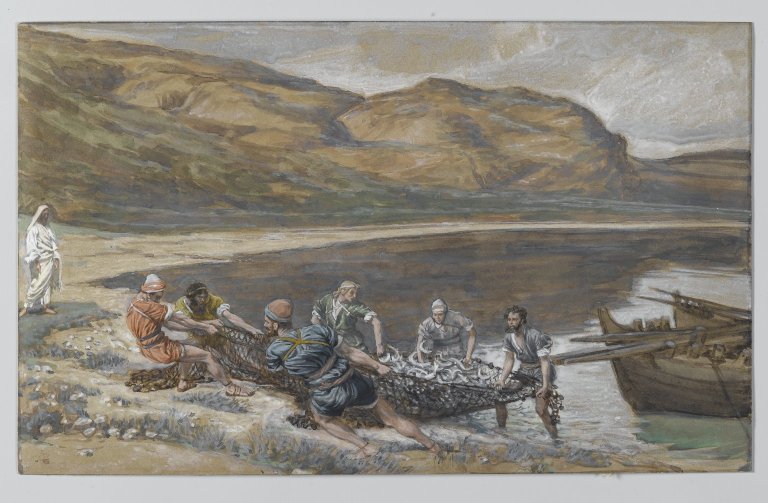
Brooklyn Museum – The Second Miraculous Draught of Fishes – James Tissot. Public Domain.

Last week, I got to preach on one of my favourite Bible passages, the second half of John 20. Today, I have disregarded the Lectionary, which would have taken us to the Emmaus Road story, which was the Bible reading at our wedding, to follow John 20 with – er – John 21, which is also significant for me. It was hearing a Local Preacher speak on this passage in 1985 that began my journey to theological study and eventually ordained ministry.

But today, I don’t want to speak about ordination. I want us to look at how the risen Jesus transforms everyday life.

Firstly, the risen Jesus transforms work:

Aerial view of computer laptop on wooden table photography hobby concept from rawpixel.com at pxhere.com. Public Domain.

The disciples have met the risen Lord. He has promised them the Holy Spirit. But they haven’t been transformed yet. They haven’t begun the mission Jesus has described for them. Simon Peter is hanging around, twiddling his thumbs.

‘I am going fishing,’ he says, and the six friends with him join him. Back to the day job. Back to something familiar. Back to something he knows all about.

But for all the knowledge and experience of fishing among those assembled on the boat, the expedition is a failure. They have gone out to fish at night, which was generally the most fruitful time, but they have caught nothing.

Until a knowing voice from the shore calls out: ‘Children, you have no fish, have you?’ How did he know from that distance?

‘No.’

‘Cast the net to the right side of the boat, and you will find some.’ How could he tell from that distance? He couldn’t see a shoal swimming under the water from there.

But lo and behold. A hundred and fifty-three fish. Many scholars have tried to find symbolic significance in that number, but really it’s just an eyewitness account that testifies to the abundance in contrast to the prior lack. On this occasion, Jesus doesn’t draw a spiritual parallel, such as when he had talked about ‘fishing for people.’ He simply blesses the work of fishermen.

Jesus loves to bless our work. In creation, the human race was made stewards of all God had made. If you look closely, you can see that in so many professions.

It’s not just the obvious work of ministers. Nor is it some of the other professions we have lauded, like medicine and teaching – although we are grateful for them. Do you remember the slogan popularised by Christa McAuliffe, the teacher chosen as a space shuttle astronaut, but who sadly died in the Challenger disaster in 1986? ‘I touch the future. I teach.

But think also of how engineers steward the resources of the earth. Think of those who in many ways engage in creative management of the world’s assets. Consider someone who daily enables people to communicate through electronic means. Think of a hairdresser whose clients leave her feeling better about themselves. Are these not things Jesus wants to bless?

Whether you are still in paid work, or like the majority of this congregation well into retirement, can you consider inviting the risen Jesus into those daily activities? How might that make a difference to you?

Secondly, the risen Jesus transforms our daily needs:

Our daily needs 3 at Wikimedia Commons. CC 4.0.

There is one detail in this story that has puzzled me for a long time. Simon Peter and the gang have struggled to catch any fish, but when they get to shore with a bulging net, there is Jesus, with breakfast ready for them. Including fish! Where did Jesus get his fish?

No scholar has been able to explain this. Was it miraculous? Did he buy them from another fisherman?

Whatever the explanation, Jesus knows his friends are coming off a physically demanding night shift. They will be ravenous. The kippers are ready. (I’m sure he would have made kedgeree if he’d been in Haslemere.)

It’s a minor detail, but it shows Jesus caring for ordinary, everyday needs. Sometimes, we don’t like to bother him with the small things. Surely he’s too busy upholding the universe? But he cares.

My late father and aunt grew up as children in the Depression of the 1930s. Their father was out of work for five years. This was before all the provisions of the Welfare State that we know. Their mother would skip meals herself and be on her knees in the kitchen, praying for God to provide. Food parcels and other items the family needed would appear on the doorstep in the nick of time.

Do not leave Jesus out of the smaller, regular features of life. Does that mean you can pray for a parking space? Well, yes, but with certain provisos! For one, just be sure you’re not just using him to get you off the hook. For another, leave him enough time to organise an answer to your prayer. And also, don’t let it distract you from also praying about the weightier matters of life, like justice and poverty. He cares.

Is there something niggling at you right now? Do you keep thinking, this is trivial? It may be something you can deal with by handing it over to Jesus. He cares about our daily lives and needs.

Thirdly, the risen Jesus transforms our wounds:

Emotional Effects of Robbery: Understanding the Impact – Bryan Fagan Law Office CC 4.0.

Let’s go that central conversation after breakfast between Jesus and Simon Peter. We assume – rightly, I think – that the three times Jesus asks Simon whether he loves him are to mirror and replace the three denials he made in the high priest’s courtyard. Not only that, each exchange finishes with the calling to feed Jesus’ sheep.

This is all the more confirmed when you notice one other details. It happens around a charcoal fire, the one Jesus had used to cook the fish and the bread. There is only one other place in the New Testament where a charcoal fire is mentioned, and it is when Simon Peter warms his hands in – the high priest’s courtyard.

Everything in this little episode is about Jesus taking Simon Peter back to those painful denials and healing them. I believe Jesus cares about the wounds we carry from the past. He does not want emotional damage to determine how we live today.

Let me tell you a story. The details I am about to share have been public for many years. I am not breaking any confidences.

I once had an elderly church member who had been an only child. Her father had adored his little girl, but her mother had wanted a boy. Tragically, her father had died young, leaving her to be raised by the mother who did not want her.

One day, we talked about this, and I suggested we pray together. I asked her in the silence to invite the Holy Spirit to show her an incident from her past. In her mind’s eye, she saw a time when she was a child, baking a cake in the kitchen. Her mother came in, told her she would never be any good at this, and snatched everything away from her.

Next, I suggested she should ask the Holy Spirit to show her what Jesus was doing there. Now she saw Jesus come into the kitchen. He gently eased her mother out of the way. Then he spoke to her. ‘You and me, Joan, let’s make this cake together.’

From that time on, she was healed of those parental wounds. For now – although those past events obviously didn’t change – she knew how Jesus regarded her.

I would hazard that many of us are living with old wounds. What if we too invited the risen Jesus to show us where he was when we were hurt? Might we too find his restoring love and live more healthily as a result?

Fourthly and finally, the risen Jesus cares about our future:

Blue gift box. Free public domain CC0 photo at rawpixel.com.

The final part of the story is the other conversation Jesus and Simon Peter have, where Simon is jealous that the ‘Beloved Disciple’ may have a future vastly different from his, which will end in his own execution. Jesus has told him he will end up being led somewhere he does not want to go, and you may know of the legend that Simon Peter asked to be crucified upside-down, because he was not even worthy of being crucified in the same way as Jesus, unbearably cruel as that was.

Comparison is the thief of joy, goes the saying. How many of us have wasted energy and maybe even years of our lives wanting to be someone else? I have wanted to be more outgoing. I have wanted to be musical – and not least when churches have torn themselves apart in ‘worship wars.’

But it’s all fruitless. We can only find fulfilment when we embrace the gifts and callings Jesus has for us. And when we each discover the place God has allotted us in the Body of Christ, then we can play our part healthily in the divine purpose.

A few months ago, Ray Goddess led the circuit staff in the Network course from Willow Creek Church in the USA. It helps people discern their spiritual gifts, but not only their gifts: how these match with their personalities and their passions. It didn’t reveal to me any gifts I didn’t know I had, but it did show me that I was undervaluing one of my gifts, and I need to work that out.

We have just run the course at Lindford church. While we are still processing the results, it has nevertheless been exciting for some people to be confirmed in where God is leading them, and others to be genuinely surprised by what this has opened up for them.

And so, I wonder whether you are settled in your heart and mind about the future God is calling you to. The world has lots of self-centred ways that claim to offer you fulfilment in life, but the one that brings true peace and satisfaction is in knowing what God has given you and has spoken to you. Whatever it is, it is not something where he leaves you on your own to work it out. It is always framed with those words of the risen Jesus to Simon Peter: ‘Follow me.’ He will be there, with us, and going ahead of us.

Conclusion

Indeed, perhaps ‘Follow me’ is the message for all of us in every aspect of what we have considered today. The risen Jesus says to us ‘Follow me’ into the world of daily work and let me transform it. He says, ‘Follow me’ and you will find me providing for you in your daily needs. ‘Follow me,’ he says again, and your old wounds will no longer hold you back. ‘Follow me,’ and you can be liberated to follow the calling he has for you without worrying about others.

Where are you hearing Jesus say, ‘Follow me’?

Seven Churches 1: Ephesus (Revelation 2:1-7)

Revelation 2:1-7

There’s probably someone in your life whose opinion of you is important to you. This is somebody whom you long to please. It may be a spouse, a parent, a boss, or some other significant figure in your life. I tell a story in my book about how I longed for my parents to be pleased with my school reports, and how I misunderstood their unconditional acceptance of me.

For Christians, and for churches, the One whose opinion of us we cherish is Jesus. And when we come to the so-called ‘Letters to the seven churches’ in Revelation, we get to hear what Jesus thinks of the churches to whom Revelation is addressed.

They are not really seven letters. The whole of Revelation is an elaborate letter, and these are seven royal pronouncements about the churches.

But we are going to look at these seven royal pronouncements about the churches in the coming weeks. We are going to see what Jesus thought of those churches and use that as a way of considering what he might think of us.

The pronouncements are very similar in their style. They start by describing Jesus, using some of the material about him in Revelation chapter 1. They end with a call to hear what the Spirit is saying to the churches, and a blessing for the obedient. In between, we usually find both praise and criticism (although sometimes it’s only one and not the other).

If we’re going to concentrate on what Jesus thinks of each church, most of these sermons will focus in on the praise and the criticism. And that’s largely what we’ll do today with the congregation at Ephesus.

Firstly, what’s good about the congregation at Ephesus?

Jesus lists seven good things about them, which for simplicity I’m going to summarise as three: hard work, right living, and right belief.

Hard work can be seen in the way Jesus says,

I know your deeds, your hard work and your perseverance. …

You have persevered and have endured hardships for my name, and have not grown weary.

Hard-working people who keep going in the face of difficulty and even opposition are often the backbones of many churches. We know those people who will always take on something that needs doing, however busy they already are. Many of our churches stand or fall on the old maxim, ‘If you want a job done, ask a busy person.’ It’s been said that many churches are like a football match: twenty-two thousand people in the crowd desperately in need of exercise watching twenty-two people on the pitch desperately in need of a rest. What we do without our ‘twenty-two people desperately in need of a rest’? Churches would close without them.

And we know people who keep on loyally serving the church, even when other people are making snide remarks about them.

Right living appears when Jesus says,

I know that you cannot tolerate wicked people (verse 2b) …

But you have this in your favour: you hate the practices of the Nicolaitans, which I also hate.

Some churches are very lax in what they accept in terms of the lifestyle of their members. They won’t hear anything against their friends. Woe betide someone who comes in – be they a minister or another church member – and says that something is wrong: then look to see how the church reacts.

It happened to a friend of mine who began as a probationer minister at the same time as me. He discovered two Boys’ Brigade leaders conducting a sexually immoral relationship and when he said he wouldn’t sign the form to re-appoint them, a group of church members threatened to march on the manse and smash the windows in.

But at least the congregation at Ephesus knew how to oppose evil. Good for them.

Right belief features at the end of verse 2:

you have tested those who claim to be apostles but are not, and have found them false. (verse 2c)

It’s utterly important to follow right belief. Christianity is a religion based on truth. We need to know the truth about God. It’s simply no good just to say, “I like to believe in God this way,” if ‘this way’ is unrelated to what we learn about God in Holy Scripture. We cannot follow our fancies and what pleases us.

That’s why it dismayed me when I once heard a committed member of a congregation say, “I like having all the different preachers each week, so that I can hear all different opinions about God.” Friends, the job of the preacher is to preach biblical truth. Any deviation from that is unacceptable. It leads us astray spiritually.

So when the congregation at Ephesus opposes these false apostles who have ridden into town with their unique teaching, I say good for them. They are doing something vital. I wish it happened more in Methodist churches. We set our standards too low at times.

There is plenty of reason, then, to commend the church at Ephesus. Indeed, they are doing things that we could do more of. Hard work, even in the face of opposition; a commitment to right living; a desire to stay faithful to the truth of the Gospel. How I would love to see more of these things in our churches today, rather than places where ten per cent of the members do ninety per cent of the work, and where anything goes morally or doctrinally.

But did you also get a sense of a harshness of tone when you heard about what was good at Ephesus? That’s where we come to the second thing we need to look at: what’s bad about the congregation at Ephesus?

That can be summed up in verses 4 and 5:

Yet I hold this against you: you have forsaken the love you had at first. Consider how far you have fallen! Repent and do the things you did at first. If you do not repent, I will come to you and remove your lampstand from its place.

‘You have forsaken the love you had at first.’ Other translations say, ‘You have lost your first love.’

Jesus doesn’t say what love they have forsaken. Is it love for God or love for neighbour? Well, since Jesus holds loving God and loving our neighbour together as the two greatest commandments, it’s probably both. If we truly love God, we also love our neighbour.

If the Ephesians have lost love of God and of neighbour, then no wonder all their good qualities still sounded rather harsh. Loving God and loving our neighbour, all in response to God’s love for us in Christ, is the foundation of Christian living. The Ephesians have got rid of the foundations and although they don’t realise it, their Christian faith is collapsing.

It is out of love for God that we work hard for the church. It is out of love for our neighbour that we long for right living. It is out of love for God that we want to believe the right things about him (and worship him appropriately as a result).

But sometimes we get so caught up in the busyness of working hard for the church, of defending holy living, and advocating the truth about God, that we forget to nurture the relationship of love. We forget our first love. When we see Christianity as all about being busy and forget that it is a relationship of love, we begin to chip away at the foundations of our faith, and we risk it collapsing one day.

It is urgent for every Christian to nourish a relationship of love with our God, and let the ways in which he is calling us to love our neighbours flow out of that. We cannot just come to church on Sunday and let that be the sum total of our engagement with God. Would a marriage survive if a couple only ever spoke to each other once a week? Why then do we think we can do that with our faith in God?

I decided when I came here that the regular pattern of prayer and Bible reading I had been following each day for many years had become rather stale. I have started combing around for other ways of maintaining my devotional life. But if I end up with nothing then my spiritual life will wither away. I need to give attention to this. So, I believe, does every Christian.

Jesus talks about removing the lampstand if we let go of our first love. According to Revelation chapter 1, the lampstand represents the church. What he is saying is that the church dies when we don’t prioritise our first love of loving God and loving our neighbour.

I believe that the Holy Spirit is warning many churches and Christians today that we get so obsessed with the mechanics of church life that we forget the very source of life, our relationship of love with God in Christ that then inspires us to love our neighbours.

And therefore when we do neglect our first love, the church dies. We ponder why traditional churches are declining and closing in our society, and while a fair amount of that is due to us living in a society that has rejected the Christian faith and embraced beliefs and lifestyles that are hostile to Christianity, it is also true that some of the decline is down to us. We have forsaken our first love.

So you will find that I regularly emphasise the need to read our Bibles prayerfully every day to grow our relationship with Christ. It is not an optional extra for keen Christians: it is essential for every Christian.

If you want to know more, then I can soon talk with you about different ways of reading and experiencing the Bible prayerfully. It may involve Bible reading notes, it may involve using some ancient practices of the church to meditate on Scripture. But whatever it is, let’s do it.

If we want to

eat from the tree of life, which is in the paradise of God (verse 7)

that is, participate in God’s new creation, then we need to make developing our relationship with our God our first priority. If we are serious about building our faith and building for the kingdom of God, this is where we start.

Restoring Work (Easter 5 Resurrection People 6) John 21:1-14

John 21:1-14

Christians are a little too good at times at keeping God in a box. One of the ways we do that is we put him in a church box. The only place we think we’ll encounter God is in a church setting.

But people who do that haven’t read the Gospels very carefully. Much more of the action with Jesus is not at the synagogue or the Temple but in daily life.

And if the Resurrection (and the Ascension) make Jesus present everywhere then we can meet him at the breakfast table, at the shops, and at our place of work, as the disciples did here.

How do we feel about that? Are there times when we would rather he wasn’t there? I remember a Christian businessman saying, ‘On Sundays, my priorities are first, God, second, my family, and third, my work. On Mondays, those priorities are reversed.’

Does this truth make us feel uncomfortable, or is it good news? If, like that businessman, we’re clearly uncomfortable with the prospect, reflect with me now, because actually, it’s good news that the risen Lord is present everywhere, including work.

Firstly, the risen Lord is present to guide our work.

Peter and the lads are experienced fishermen. By going fishing at night they have opted for the time commonly accepted to be the most productive for fishermen on the Sea of Galilee. Yet they catch nothing. Not even some plankton.

Why on earth – apart from desperation – would they take instructions from Jesus, who had been a carpenter, not a fisherman? What does he know?

Well, he must know something, because one of those little unexplained details of the story is that he has already got some fish and is cooking them on the beach!

Of course, as readers of the Gospel, we know he’s more than a carpenter, he’s the Risen Lord. Those pesky fish that Peter and his friends are trying to catch are part of the creation he oversaw.

And furthermore, in that creation the human race was assigned work as a good thing, for it was part of the stewardship of creation under God which is the human calling.

So it makes complete sense that the risen Lord is interested in the disciples’ fishing work. It isn’t inferior because it’s not overtly religious. It isn’t inferior because this is what several of them left to follow Jesus. It’s still valuable as part of what makes for a flourishing world as God designed it.

The same is true for us, whether we do paid work or whether we volunteer, whether we need the income, or whether in retirement we are free to dedicate our time to other causes.

Therefore our risen Lord has a genuine interest in our work, and that involves him guiding us in that as much as in any church decision. Our work is to be a matter for prayer as much as any other aspect of our lives.

Are there areas of our paid work or our volunteering where we are struggling? Have we thought that this was secular and not religious, and therefore not brought it to God? That would be a sad mistake.

You may be an employee or self-employed. You may be a business owner. Or you may be a student. Or you are using free time to make a difference as a volunteer. Jesus is risen and alive and cares about what you are doing. Don’t be afraid to involve him. He wants to be involved.

So bring him that staffing decision. Bring him that knotty problem your lecturer set. Bring him the moral issue you’re wrestling with. He is interested, and he is present to help.

Secondly, the risen Lord is present to give purpose to our work.

I once had a manager who was the sort of person who lived to work. This was a problem for most of her staff, who generally worked to live. The office was everything to Mrs Freeman, and she couldn’t understand those who didn’t see it that way.

Why were the rest of us different? Well, for a few, they had spouses who earned a lot more and so their earnings weren’t a life and death issue. But for many, it was because work was not a place of fulfilment but of frustration or tedium. It certainly wasn’t a fulfilling experience.

I think many people would identify with the latter group. We’ve replaced the Seven Dwarfs’ song ‘Hi ho, hi ho, it’s off to work we go’ with ‘I owe, I owe, it’s off to work I go.’

And as I’ve said to you before, I’ve had that same experience of frustration and tedium in the ministry just as I did in the office. Those who romantically look on at my work and think it must be some kind of uninterrupted heavenly bliss have never got close to a manse family.

I have also testified before that the Bible verse which just about kept me going during the worst of times was 1 Corinthians 15:58, the climax to Paul’s great chapter on the Resurrection, where he says that a great consequence of Christ being risen from the dead is that our labour is not in vain.

If you remember the sin of Adam and Eve in Genesis 3, you will recall that when God finds them he pronounces various curses on them and the snake. One of those curses is that Adam will find work to be frustrating. The Good News of salvation in the Resurrection reverses this curse, just as it reverses our separation from God by sin.

We heard that promise when we also read Isaiah 65:17-25 in the service:

21 They will build houses and dwell in them;
    they will plant vineyards and eat their fruit.
22 No longer will they build houses and others live in them,
    or plant and others eat.
For as the days of a tree,
    so will be the days of my people;
my chosen ones will long enjoy
    the work of their hands.
23 They will not labour in vain,
    nor will they bear children doomed to misfortune;
for they will be a people blessed by the Lord,
    they and their descendants with them.

Surely Peter and his colleagues in the boat had a sense of this when they dragged their huge catch to shore. After the fruitlessness of the night, now their purpose was fulfilled. They had fish. They could sell fish. They could make a living.

Not everything will be put right now. The vision of complete fulfilment awaits the ‘new heavens and new earth’ of which Isaiah 65 and Revelation 21 speak. (Which implies, by the way, that there will be work to do in the life to come – but it will be fulfilling work.)

However, we can ask the risen Lord whose resurrection promises that coming new heavens and new earth to help us find purpose and meaning in what we are doing now. It may be the chance to serve. It may be creative management of the earth and its resources.

Sure, while sin lasts there will still be frustration. But as the new creation begins to poke through, the risen Lord will bring purpose and meaning to what we do. Let us ask him to make that clear for us.

Thirdly and finally, the risen Lord is present to bless our work.

One hundred and fifty-three fish! Bulging, over-filled, and heavy nets! This is clearly way more than a normal catch!

Over the centuries, various scholars have tried to find symbolic meaning or significance in the number 153, and maybe that’s not surprising, given the many layers of meaning we often find in John’s Gospel. However, those attempts have largely failed, and perhaps we just need to default to a simple explanation.

Somebody counted the fish. The risen Lord had blessed the work of his disciples’ hands.

In Ephesians 3:20 the Apostle Paul tells that prayer can lead to God doing

Immeasurably more than all we ask or imagine, according to his power that is at work within us.

There is no reason to confine that promise to church work. Paul places no such limit. And this story shows that we can seek God’s blessing through the risen Christ in every part of life, including work such as paid employment, studies, and volunteering.

How significant might that be in the economic situation we are now facing? As prices increase at a rate we haven’t seen for thirty years, as manufacturers’ costs go up, and as household budgets get squeezed to the point where more families are having to make impossible choices, would this not be a great time to ask the risen Lord to bless our work?

So what are the needs of your employer, your educational institution, or your charity? Pray that the risen Lord will be present to bless.

Yes, let’s increase the range of people and causes that we pray God will bless. Not churches and the sick, but all sorts of elements in society. As you walk along the high street in the village, why not pray a blessing on the businesses? OK, there will be one or two whose business you will consider inappropriate for blessing, such as the betting shops, but why not pray that blessing?

The prophet Jeremiah told those Jews who were forcibly taken into Babylonian exile that they should ‘seek the peace and prosperity of the city to which [God] has carried [them] into exile’ (Jeremiah 29:7).

This makes for an interesting challenge: instead of complaining about our society, why don’t we instead pray blessing upon it through the risen Christ?

In conclusion, because the risen Christ is present everywhere to bless we need to get rid of our old sacred/secular divide. Jesus doesn’t see things like that. As one preacher once put it, ‘The only thing that is secular is sin.’

No, see the whole creation as the arena for our risen Lord to be at work, because his Resurrection is the first sign of him making that entire creation new.

And let that vision of the Risen One who transformed the fishing expedition of his friends be one that inspires us to pray and to believe that he also wants to transform our work, our studies, our volunteering, our work in our homes and families.

Because all of those are part of the creation he is renewing. Let’s join him in his work – in prayer and in action.

Create a website or blog at WordPress.com

Up ↑