Regime Change, Isaiah 11:1-10 (Advent With Isaiah, 2) Advent 2 Year A

Isaiah 11:1-10

Here are some extracts from a friend’s Facebook post:

3 WISEMEN KILLED ATTEMPTING TO ENTER U.S.

(Bethlehem) The 3 Wisemen were killed attempting to enter the U.S. early this morning. They were still hundreds of miles away from the actual border, but the White House determined there wasn’t time to actually investigate their suspicions.

A White House spokesperson said, “We could tell from the satellite photos that these were bad people. They had gold (probably stolen), myrrh and something that was possibly fentanyl.  It was hard to tell from the picture, but the President knew just enough to kill them without an actual investigation.”

Also arrested were two immigrants named Joseph and Mary, an unnamed child, and an angel. The White House elaborated, “We can tell you that the two suspects were trying to check into a hotel. When asked if they were married, they responded that they were “betrothed.” We can’t have people flaunting Christian moral conventions at this sacred time of the year.

“The undocumented mother was also secretly recorded as saying “(God) has brought down rulers from their thrones, and has lifted up the humble. God has filled the hungry with good things but has sent the rich away empty.” That sounds like communism, pure and simple. These were probably Antifa terrorists.”

I could read you much more, but I don’t have time!

In amidst all our cosy preparations, with Christmas adverts that tug at the heart-strings like this year’s Waitrose ad, we miss the fact that the coming of the Messiah is much more messy and radical. And I don’t mean the mess in the manger.

It’s about regime change.

Sometimes, we get so fed up with our leaders we want change. Maybe we don’t do it like some powerful nations do, where they act nefariously in another country to change the leadership. But look at last year’s General Election here. Broadly speaking, the country was so fed up with the Conservatives that people voted for anyone who wasn’t Conservative. It wasn’t so much a vote for, as a vote against. No wonder the Labour majority was called a ‘loveless landslide.’

In the ancient world, of course the general population didn’t have a say, but kings were replaced and sometimes entire dynasties were removed. It was their version of regime change.

Isaiah 11 proposes the most radical regime change of all. A regime change that brings in the Messiah. Verse 1:

A shoot will come up from the stump of Jesse;
    from his roots a Branch will bear fruit.

Not even a shoot from the stump of David, for he was far from perfect. An adulterer, it not actually a rapist, and a murderer. The greatest king of all had his faults. Instead, Isaiah prepares us to sing

Hail to the Lord’s Anointed,
Great David’s greater Son![1]

So what will characterise the much-needed Messiah, who alone can bring true regime change?

Three qualities:

Firstly, wisdom:

2 The Spirit of the Lord will rest on him –
    the Spirit of wisdom and of understanding,
    the Spirit of counsel and of might,

    the Spirit of the knowledge and fear of the Lord –
3 and he will delight in the fear of the Lord.

Do you recognise these words? We have adapted them for the laying-on of hands at Confirmation and Reception into Membership of the Methodist Church. The minister prays this for the candidates:

By your power and grace, Lord,
strengthen these your servants,
that they may live as faithful disciples of Jesus Christ.
Increase in them your gifts of grace,
and fill them with your Holy Spirit:
            the Spirit of wisdom and understanding;
            the Spirit of discernment and inner strength;
            the Spirit of knowledge, holiness, and awe.[2]

And doubtless we expect the Holy Spirit to impart these qualities: wisdom, understanding, discernment, inner strength, knowledge, holiness, and awe. I’m sure it’s right to expect that.

Wisdom: Public Domain Pictures

But there is a specific context to these qualities of wisdom in Isaiah 11. All of the qualities he lists – wisdom and understanding, counsel and might, the knowledge and fear of the Lord – are lacking in the people of Judah and also of their enemies, such as Assyria. There are various quotes in the preceding two or three chapters that illustrate this.[3]

The Messiah is the One who brings true godly wisdom without lack – we might say it’s wisdom, the whole wisdom, and nothing but the wisdom of God.

When Jesus comes and begins his ministry in the power of the Spirit, we see this without a shadow of a doubt. In Matthew’s Gospel, there are five blocks of Jesus’ teaching, reinforcing the fact that here is the ‘One greater than Moses’ who was prophesied, given that there are five books colloquially known as ‘The Five Books of Moses’ in the Old Testament.

We can gain wisdom from other sources, but nothing is like the wisdom of Jesus. It’s why our high church friends stand for the Gospel reading in worship. They are saying, here is the centre of divine wisdom and revelation in the life and teaching of Jesus.

If we believe we are living under the regime change of the Messiah (which Christians are as citizens of God’s kingdom) then there is a clear application of this truth to us. To honour Jesus as the coming Messiah, our calling is to immerse ourselves in the wisdom of his teaching and commit ourselves to following it more fully.

For that, we too will need the Spirit – just as even Jesus himself, the Son of God, did, at his baptism.

If we are citizens of the coming kingdom, then this is what we do.

Secondly, justice:

He will not judge by what he sees with his eyes,
    or decide by what he hears with his ears;
4 but with righteousness he will judge the needy,
    with justice he will give decisions for the poor of the earth.
He will strike the earth with the rod of his mouth;
    with the breath of his lips he will slay the wicked.
5 Righteousness will be his belt
    and faithfulness the sash round his waist.

Justice. We all want that, don’t we? Our governments should deliver justice. Just so long as we are the ones who are in the right, and those we don’t like are condemned. And we’d like just to leave us feeling comfortable.

Lady Justice Silhouette: Public Domain Pictures

If those are our hopes, then the justice of the Messiah’s regime change will not be what we want. He will bless the poor and the needy (verse 4) – well, that won’t be so great for those of who are used to living with comfort and privilege. For to elevate them, to give them what they need and what is rightfully theirs will means less for us.

And as for all that uncouth talk about striking the earth with the rod of his mouth and slaying the wicked with the breath of his mouth – oh, we don’t like all that violent stuff, do we? Isn’t this one of those parts of the Bible we’d rather strike out? Where’s gentle Jesus, meek and mild? Where’s inclusive Jesus in that?

Or let’s be honest: where’s nice, cosy, liberal, middle-class Jesus?

I’m sorry: he doesn’t exist.

But show passages like these and the similar ones in Revelation that we like to dismiss as altogether too gory to those who are suffering for their faith, and they will rejoice in them. Through the Messiah, God will put things right! If we believe in a God of justice, we must not deny that he will deal with the impenitent.

However, it will be delayed. When Jesus comes and gives his manifesto as Messiah to the synagogue at Nazareth in Luke 4, he reads from Isaiah 61, but he stops before it goes on to talk about ‘the day of vengeance of our God.’ That is coming, but not yet.

Why? Because in his mercy, the Messiah offers the opportunity for even the most reprehensible to repent and amend their ways.

But Jesus is indeed coming to bring good news for the poor. He is coming, as his mother prophesied in the Magnificat, to bring down rulers from their thrones, lift up the humble, fill the hungry with good things, and sent the rich away empty. This is what regime change under the Messiah looks like.

And so again, our duty as citizens of that coming kingdom can be stated very simply, even if it is challenging to implement. It is to advocate for the poor and challenge the powerful.

Thirdly and finally, peace:

6 The wolf will live with the lamb,
    the leopard will lie down with the goat,
the calf and the lion and the yearling together;
    and a little child will lead them.
7 The cow will feed with the bear,
    their young will lie down together,
    and the lion will eat straw like the ox.
8 The infant will play near the cobra’s den,
    and the young child will put its hand into the viper’s nest.
9 They will neither harm nor destroy
    on all my holy mountain,
for the earth will be filled with the knowledge of the Lord
    as the waters cover the sea.

The thought of peace between different animals is appealing. As you know, we are dog lovers, and our cocker spaniel can be a bit of a grumpy old man with other animals, especially other dogs, and most notably on his night-time walk. There’s something about the dark. We have taken to referring to one other dog on our estate as ‘Enemy Dog’, because ours has taken a particular dislike to the red flashing light he wears on his collar at night. The wolf will live with the lamb, the leopard will lie down with the goat, the calf, the lion, and the yearling together? I’d vote for that.

Sadly, we’re dealing with prophetic imagery here rather than a literal prediction. As John Goldingay, the scholar I cited last week, says here:

Context suggests that the talk of harmony in the animal world is a metaphor for harmony in the human world. … A literal interpretation of verses 6-8 would also have difficulty in explaining how wolves and leopards can remain themselves if they lie down with lambs and goats.[4]

So what is the metaphor saying? Goldingay again:

The strong and powerful live together with the weak and powerless because the latter can believe that the former are no longer seeking to devour them.[5]

The Messiah brings together and reconciles the strong and the weak, the powerful and the powerless. They are not divided, they are family. No-one takes advantage of anyone else. What matters in relationships is everybody’s well-being. The ‘goodwill to all on whom God’s favour rests’ that the angels spoke about to the shepherds becomes ‘goodwill among all’.
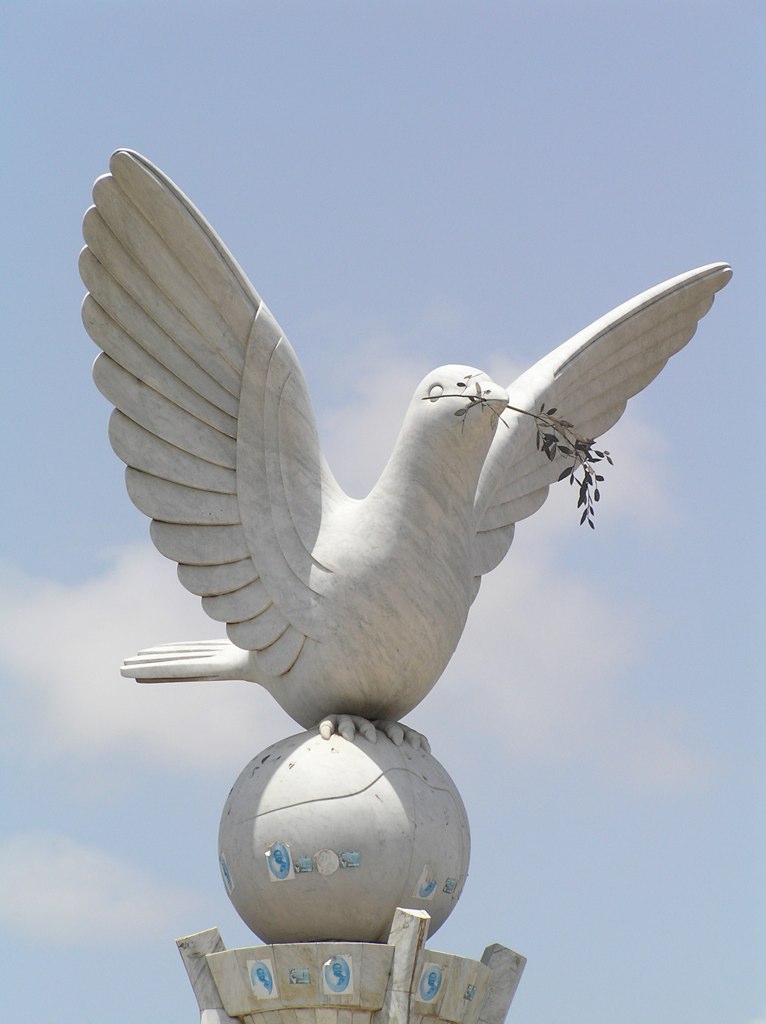
Peace dove: Wikimedia Commons CC 2.0

What does this sound like? Well, to me it sounds like what Jesus always intended his church to be. The redeemed community, the colony of God’s kingdom, is to be the place where the rich and the poor, the highly educated and the barely literate, Europeans, Africans and Asians, the neurotypical and the neurodivergent, old and young, male and female, all care for one another and promote each other’s welfare. Because that’s what Jesus does. That’s the sort of society the Messiah builds.

And imagine not only enjoying a fellowship like that (even though it entails hard and painful work at times). Imagine also inviting someone in to experience it, and being able to say, this is what life is like when Jesus is in charge.

Indeed, this is what regime change under Messiah Jesus brings.


[1] James Montgomery (1771-1854)

[2] Methodist Worship Book, p100.

[3] John Goldingay, Isaiah (New International Biblical Commentary), p84.

[4] Op. cit., pp 85, 88.

[5] p85.

Sermon: Wisdom And Folly

English: Iain Duncan Smith, British politician...
English: Iain Duncan Smith, British politician and former leader of the Conservative Party. (Photo credit: Wikipedia)

Ecclesiastes 9:13-10:20

It’s not often I would identify myself with Iain Duncan Smith MP. I certainly can’t square the recent benefit changes with his alleged support for social justice and his country house home. He went to the Royal Military Academy at Sandhurst, but the only places I have visited at Sandhurst have been Marks and Spencer and Tesco.

But I do share the odd trait with him. The politically aware among you may remember how there was a huge contrast in personality between himself as Leader of the Opposition and Tony Blair, as the charismatic Prime Minister. At the 2002 Conservative Party conference, Duncan Smith tried to make a virtue of the difference. “Do not underestimate the determination of a quiet man,” he said. Unfortunately for him, when he got to the House of Commons again, Labour MPs would put their fingers across their lips and say, “Shush” every time he got up to speak.

His quietness was derided, and that has sometimes been my experience in the church as well: a quiet leader can be derided. Either people want a larger than life minister or you find you have consistently made the same point in meetings, only for people at future meetings of the same committee to say that something has not been addressed.

Why tell you this? Do I want your sympathy? No. Well, not on this occasion. Our passage has a lot to do with the contrasts between wisdom and folly.  The first image of wisdom we have here is that wisdom is quiet, but folly is loud:

The quiet words of the wise are more to be heeded
than the shouts of a ruler of fools.
18 Wisdom is better than weapons of war,
but one sinner destroys much good. (9:17-18)

There is no shouting, or aggression, let alone violence, that goes with true wisdom. It is quiet and gentle. It does not arrest you, it does not grab you warmly by the throat and shake you. It is the still, small voice of God.

I have told before the famous story about the former Liverpool football manager Bob Paisley, who spoke very quietly at press conferences. One day, a journalist asked him why he spoke so quietly. “I speak quietly, so that you will listen,” he replied.

Might it be that the words of wisdom are spoken quietly by God and by God’s people in order that we might listen? It would be nice and easy if wisdom were served up on a plate for us, brought to us by waiter service. But it isn’t. We have to go in search of it, tuning our ears in to its quiet sounds that frequently are drowned by the noise of sin in our world.

That means God isn’t just going to splash his wisdom everywhere. Yes, it is available to all, but it will only be found by those who have a heart to search for it. We must want his wisdom badly – badly enough to set out on a quest for it, determined not only to find it but to put it into practice when we finally discover it.

Now clearly some of this means we need to develop a dogged determination in our devotional lives to hear the voice of God. Yes, it does mean a regular commitment to a style of Bible reflection that is suitable to us. It does mean spending time in prayer. It does mean commitment to a small group as well as to Sunday worship, and so on. All these things I’ve mentioned before, and will continue to emphasise. It’s why I remain concerned at the findings of our worship questionnaire, where a number of people identified Sunday services as the only times they seriously engaged with the Bible. We just can’t do that and get away with it if wisdom is quiet. It’s no good giving up quickly on spiritual disciplines when we don’t immediately have a stunning experience of God. Like a lover, he woos us, but he also plays hard to get, because he wants us to be serious about him.

And that leads into the second image of wisdom the Preacher gives us: wisdom is rare, but folly is common. To take some representative verses:

As dead flies give perfume a bad smell,
so a little folly outweighs wisdom and honour.
The heart of the wise inclines to the right,
but the heart of the fool to the left.
Even as fools walk along the road,
they lack sense
and show everyone how stupid they are. (10:1-3)

A small bit of foolishness creates a big stink in society, says the Preacher, and fools parade their foolishness for all to see. It’s not hard to see that, is it? Some people seek the spotlight, but have very little of substance to offer society. Plenty of people who gain the dubious status of celebrity could fall into this category.

Or we have people who become famous and are thrust into the limelight, simply because of their abilities in one particular field, and who are then labelled ‘rôle models’ by tastemakers and cultural commentators for some questionable reason. Footballers who end up biting members of the opposition might be included here. It’s hard to know who is the more foolish: those who deem footballers to be rôle models, or fame-hungry sporting stars who lack the wherewithal to set an example.

When we live in a society like this, feeling outnumbered by a catwalk parade of idiocy, what are we to do? We bemoan the triumph of style over substance. We despair of how a little trivia becomes a major thing. Having spied the front page of a certain red-top tabloid this last week leading on the story of a boy band splitting up, because presumably they have a strong idea that is important to their readers, I share that same sense of exasperation.

But it’s never acceptable for the Christian to give up in the face of a folly-ridden society. It remains our missionary call to keep speaking the wisdom of God, whatever the odds. After all, according to the New Testament, Christ is the wisdom of God, and how can we not speak about him? How can we not see all the more clearly our society’s need of Christ when we witness the epidemic of foolishness around us, and are struggling not to become infected ourselves?

Yet it feels difficult to hang on and to remain consistently faithful when so much of what surrounds us makes it feel like we are paradoxically drowning in an ocean of shallowness. To that end, I find something that Graham Kendrick said over thirty years ago. He said,

“When the odds get too big, I just remember that Jesus plus me equals an invincible minority.”

Yes, we may be up against the odds, and things may not always be going our way, but as the First Letter of John puts it,

‘Greater is he who is in you than he who is in the world.’

Ultimate victory belongs to Jesus. God raised him from the dead and made him king of the universe. Whatever direction things are going at present, that direction is only the short term. We know the long term outcome for all creation. We are on the victory side when we witness faithfully to Jesus Christ, the wisdom of God.

The third and final picture of wisdom I want to share with you is this: wisdom is gracious, folly is wicked.

That sounds harsh on foolishness, doesn’t it? When someone is a fool, we either laugh at their idiocy or sympathise with their ignorance. But wisdom and folly are moral qualities in Scripture. Wisdom is not merely about intellect, and so in a week when the atheist scientist Richard Dawkins has topped a magazine poll as the world’s top thinker of the last twelve months, the Christian may accept the man’s intellectual abilities, but would never call him wise. After all, as one American theologian I know put it on Facebook this week,

his views on religion … are simplistic, ill-informed, and simply wrong.

Here is the part of the reading that makes this point:

Words from the mouth of the wise are gracious,
but fools are consumed by their own lips.
13 At the beginning their words are folly;
at the end they are wicked madness –
14     and fools multiply words. (10:12-14)

We are equally not exercising wisdom in the church when we use our knowledge or cleverness to put someone else down. We are using wisdom – the wisdom which ultimately is Jesus Christ himself – when grace is our theme and our motive. We show wisdom when we speak with grace about grace.

It is surprising how often grace is excluded from Christian conversation. After the recent convictions of Mick and Mairead Philpott for the killing of six of their children, I saw within a short time on the Internet Christians putting messages that they longed for them to burn in Hell. Where is the grace there? It is as if what we really think goes something like this: we are good, other people are bad, and we will get to Heaven because we are good. Nothing could be further from the Gospel, yet this lie goes round in church circles.

None of us would be here but for grace. The people we look down on in the church family are recipients of the same grace. The people in our society who commit terrible, yes, wicked acts, are in need of that grace. That grace is centred on the Cross of Christ. And the Cross is a divine foolishness that outranks human wisdom, according to Paul in 1 Corinthians 1. It is indeed the wisdom of God.

We have said already that wisdom is a quiet voice and a minority voice. Well, nowhere more than here, where wisdom is characterised by grace is it a quiet, minority voice, even sometimes in the church. It is time to come back to the Cross, if we have strayed away. It is time to remember our experience of being humbled by love at the Cross. And when we recall our own humbling at the feet of divine love, then would it not be normal for us to begin extending that same grace to others within the church and beyond?

In a few minutes, we shall come to the climax of this service in the central act of gathered Christian worship, when we take Holy Communion together. Let our eating of the bread and our drinking of the wine this evening remind us of the grace and love God poured out for us in his Son.

Along with that, can we also recall that every Sunday is an Easter Day? Every week, the fact that the Christian church moved the Sabbath from Saturday to Sunday reminds us of the history-changing events we mark on Easter Sunday. God calls us back to that empty tomb constantly. For there we see the grace of God every bit as much as we do at the Cross itself. At the empty tomb, God by his grace and power transforms hope-drained people into hope-filled people.

This is the source of our life, our life in Christ. I pray that it will feed us, and – through us – feed others, too.

Is Internet Access A Human Right?

Various websites are reporting a study for the BBC in which 79% of respondents (27,000 people around the world) say that Internet access is a fundamental human right. The BBC report itself is here, and the full report in PDF is here. Tech sites such as PC Pro report it, too.

Much as I love techie stuff, I think we have to be careful about our language. I find it interesting that the lively comments on the PC Pro report are not all fawning agreement. The idea of net access as a fundamental right is described as ‘hogwash’ by one commenter and ‘a privilege’ by another.

The point in the report is one about communication. Here is one extract from the BBC news report:

“The right to communicate cannot be ignored,” Dr Hamadoun Toure, secretary-general of the International Telecommunication Union (ITU), told BBC News.

“The internet is the most powerful potential source of enlightenment ever created.”

He said that governments must “regard the internet as basic infrastructure – just like roads, waste and water”.

“We have entered the knowledge society and everyone must have access to participate.”

We need to communicate. The Internet is now fundamental to that. Ergo, internet access is a fundamental human right.

‘Rights language’ is all around us. Have you noticed how politicians, when they describe some improvement in welfare or health provision, say it is what people deserve? Gordon Brown certainly does. It’s on a par with the execrable ‘Because I’m worth it’ adverts.

Am I alone in being bothered by the use of ‘human rights’ language? By the looks of those PC Pro comments, I’m not. Just to raise a doubt about human rights language today is to risk being labelled as an oppressor, but from a Christian perspective it needs challenging. In fact, I would argue such terms are used recklessly and thoughtlessly by Christians.

Why? Because – as the late Lesslie Newbigin argued – the language of human rights is secular. It arises in a post-Enlightenment society where faith in God had been relegated to the private sphere. In the public, ‘secular’ discourse, humankind was the highest rank of creature and virtually deified. Rights language is about what belongs to deities, Newbigin said. Therefore, to speak of human rights is to talk in idolatrous terms.

To many ears, this will be shocking. How else do we protect some basics of human existence? But would it not be better from a Christian perspective to speak of human dignity (because we are made in the image of God) and human need? Welfare and health provision – to return to the example of politicians – are issues of dignity and need. The ability to communicate – as Dr Touré indicates – is pretty basic to human life. Whether we all need to communicate in every which way is debatable, of course, but the fundamental need is there. If society becomes so dependent upon information via the Internet, then Christians may perceive that the gap between the information-rich and the information-poor could be a moral issue.

However, we probably need to qualify the link between the Internet and information. Firstly, it isn’t entirely the case – surely we’re not going to dignify everything from Facebook status updates to pornography with the label of ‘information’. Secondly, ‘information’ is an insufficient category for Christians. What we value is ‘wisdom’, which is more than a pile of facts: it is what moral choices we are going to make and live with those facts, in the light of God. And that is even more basic to human flourishing than information.

Create a website or blog at WordPress.com

Up ↑