Joy-Bringer, Isaiah 35:1-10 Advent With Isaiah 3 (Advent 3 Year A)

Isaiah 35:1-10

One popular Christmas carol, especially among American Christians, is ‘Angels we have heard on high.’ Its first verse reads,

Angels we have heard on high
Sweetly singing o’er the plains
And the mountains in reply
Echoing their joyous strains
Gloria in excelsis Deo!

Unfortunately, one source of the music misprinted ‘Echoing their joyous strains’ as ‘Echoing their joyous trains.’
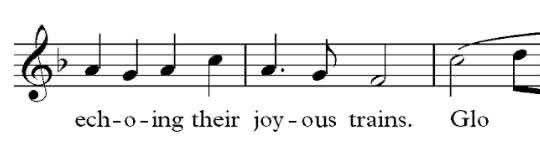
Source unknown. From the Church Service Typos group on Facebook.

I don’t suppose anyone who commutes would readily think of ‘joyous trains.’ I know my wife didn’t on Thursday evening when her train from Waterloo didn’t initially have a driver, when the passengers were told to disembark to find another train, only then to be told to stay on board. They left twenty-seven minutes late. Joyous trains, indeed.

But if the trains were transformed, that truly would be reason for joy.

The theme this week is ‘Joy’ but it is connected with transformation. So maybe a better title might be, ‘Joy in Transformation.’ These verses in Isaiah give five examples of the transformation the coming Messiah will bring, which lead to joy. It was something the southern kingdom of Judah needed to hear, nervous as the nation was due to the military power of Assyria, which had already conquered the northern kingdom of Israel.

But as so often in Isaiah, we shall see that no earthly king could completely fulfil the prophecy. Even with Jesus, the true Messiah, he would begin the transformational work prophesied, but it will only come to complete fruition with his return in glory.

However, in the meantime, in our in-between time, these point to our work for God’s kingdom today. There are five arenas for joy in the reading; I shall deal with each one briefly.

Firstly, joy for the desert:

The desert and the parched land will be glad;
    the wilderness will rejoice and blossom.
Like the crocus, 2 it will burst into bloom;
    it will rejoice greatly and shout for joy.
The glory of Lebanon will be given to it,
    the splendour of Carmel and Sharon;
they will see the glory of the Lord,
    the splendour of our God.

In the Middle East, the people know all about parched deserts in the heat. But God will restore life to the desert as he breaks the drought and beautiful plants bloom and flourish there.

Our droughts today are often caused by our failure as the human race to fulfil the command we were given when God created us: namely to rule over the created order wisely on his behalf. Instead of caring for it, we have exploited it. Now we pay the consequences – but worse, it is the poorer nations who are suffering first and most.

As Christians, we have common cause with those who are concerned for our environment. But we have a unique reason for being involved. It is that we are doing so as stewards of God’s creation, and as a prophetic sign that God will make all things new in his creation. We agree that the world is in a mess, but we engage out of a spirit of hope, not panic.

So let us engage in our creation care as an act of worship and of witness to the Messiah who will renew the earth. And if we listen carefully, we may catch the sound of the world rejoicing, too.

Secondly, joy for the fearful:

3 Strengthen the feeble hands,
    steady the knees that give way;
4 say to those with fearful hearts,
    ‘Be strong, do not fear;
your God will come,
    he will come with vengeance;
with divine retribution
    he will come to save you.’

At the time of the prophecy, Israel could well have been afraid of Assyria. But as we know, fear comes in many flavours. Fear of war. Fear of death. Fear of other people’s expectations. Fear of losing someone. The list of fears is long.

In the specific context, Isaiah promises that those who are afraid of wrongdoers can take heart, because God will judge the wicked who are scaring them.

And yet there is still a universal application. It is often said – and I confess I have not checked the veracity of this – that the words, ‘Do not be afraid’ occur three hundred and sixty-five times in the Bible. One for every day of the year. You can have one day of fear in a leap year!

God does not want us paralysed by fear. He wants us animated by love. And so, he promises to banish the forces and the people that cause us to fear. The life of the messianic age to come will not be characterised by fear. It will be an eternal age of love.

And if God promises that for us, we can ask ourselves, what can we do to help remove fear from the lives of other people? Sometimes we can banish the cause of fear. In other circumstances, we may not be able to do that, but we may be able to show how to live without fear when unwelcome things happen.

I know how easy it is to panic. My body goes into panic mode before my mind catches up with the truth. For me, God’s message of peace and love comes through human beings, not least my wife. There has been more than one occasion when people who didn’t like me in churches have made up false and malicious Safeguarding accusations against me. One time, my Superintendent phoned me and said, ‘Watch your back on Sunday morning.’ Debbie has helped me be anchored in truth when lies have flown about.

Thirdly, joy for the silenced:

5 Then will the eyes of the blind be opened
    and the ears of the deaf unstopped.
6 Then will the lame leap like a deer,
    and the mute tongue shout for joy.

There is more than one way of reading these words. Some take them literally as a promise of healing, and we saw in our Gospel reading from Matthew: Jesus did heal the blind, the deaf, and the lame. I wouldn’t want to deny that, nor the promise of full healing when Jesus comes again and makes all things new. I would encourage us to pray for the sick, just so long as we don’t treat chronically ill or disabled people purely as prayer projects rather than people with dignity. As the title of one book puts it, My Body Is Not A Prayer Request.

But I will say there is a wider meaning to these words. Why did I introduce this point as ‘joy for the silenced’? For this reason. Our English translations say at the end of the quote, ‘the mute tongue [will] shout for joy.’ But the words ‘for joy’ are not there in the Hebrew. The mute will shout. That’s it. People who have been silenced by those who oppress them find their voice in the kingdom of God. The persecuted are vindicated and set free. The people that society does not value are of great worth and significance to Jesus.

The early church did this by the way they gave importance to slaves and women. Jesus calls us too to value those who would not be elevated by our society. He longs for them to find their place in his family and his kingdom purposes. Let’s not evaluate people by worldly standards, but by the fact that they are loved and cherished by God in Jesus.

Fourthly, more joy for the desert:

Water will gush forth in the wilderness
    and streams in the desert.
7 The burning sand will become a pool,
    the thirsty ground bubbling springs.
In the haunts where jackals once lay,
    grass and reeds and papyrus will grow.

We’re back in the wilderness, but to make a different point. This time, we see the conditions coming together so that life can flourish. Water to drink. Papyrus to make documents. Reeds to make household items.

In this context, artisans, craftsmen, and business can flourish. Their raw materials are plentiful again.

And so, I want to suggest to you that one way we can be a sign of the Messiah’s coming kingdom is by supporting human flourishing, including our local businesses.

Is that a Christian thing to do? I think so. Remember how later the people of Judah were taken into exile in Babylon. The prophet Jeremiah wrote a letter to the exiles. You can find it in Jeremiah 29. In that letter, he tells these Jews who have been separated from their own land and temple that were so vital to their understanding of salvation that they were to seek the prosperity of the city to which they had been taken. Yes – even a pagan city. Go and bless the pagans, says Jeremiah: it is a sign of God’s covenant love.

Let’s cultivate our relationships with local shops and businesses. Not only by giving them our custom, but that when we do so we take an interest in them and we build relationships with them. I have known ecumenical groups of churches in a village take boxes of chocolates to every business in that village at Christmas, with a card thanking them for all they do, and offering to pray for them if they would like it.

Which shops, businesses, or community groups do you appreciate here? Can you bless them? I’m sure you can. Maybe it will provoke questions.

Fifthly and finally, joy for the temple:

8 And a highway will be there;
    it will be called the Way of Holiness;
    it will be for those who walk on that Way.
The unclean will not journey on it;
    wicked fools will not go about on it.
9 No lion will be there,
    nor any ravenous beast;
    they will not be found there.
But only the redeemed will walk there,
10     and those the Lord has rescued will return.
They will enter Zion with singing;
    everlasting joy will crown their heads.
Gladness and joy will overtake them,
    and sorrow and sighing will flee away.

The highway of holiness, on which only the redeemed and not the unclean may walk, is surely the road to the temple in Jerusalem.

This reminds us that when Jesus is present among his people, there is joy. Yes, of course we will be reverent: I am not calling for some religious chumminess with God. But for all that, to have the Messiah in our midst will be a cause for joy and it will reflect in the way we are together in worship and in the sharing of our lives together. With Jesus, church is to be a place of joy.

Today, we only have that experience of Jesus by the presence of his Spirit within us and in our midst. But part of the fruit of the Spirit is joy! And one day, we shall all be together in the presence of Jesus and his Father, too.

It’s nice that we look forward to seeing our friends at church. But that doesn’t make us any different from anyone else. Do we have a sense of joy that Jesus will be present with us, and indeed that we are each bringing him with us to our gathering? That is what the messianic community is like.

Conclusion

Joy to the world, we sing at this time of year, the Lord is come. And when the Lord comes, there is joy. Joy for the broken, joy for God’s people and joy for all creation.

And when he comes again, the joy will be magnified and sorrow banished.

Let us, the followers of Jesus, then, also be joy-bringers.

Advent, The Prologue and Relationships: 4 Jesus and Moses (John 1:1-18)

John 1:1-18

Moses isn’t the first Old Testament character that comes to our mind at Christmas, I’ll give you that. Maybe we think of Isaiah prophesying the virgin birth or the One who is called Wonderful Counsellor, Mighty God, Everlasting Father, and Prince of Peace. We might remember Micah and his prophecy that the Messiah would be born in Bethlehem, which Herod’s advisers quote when the Magi show up.

But Moses?

Well, John seems to think it’s worth contrasting Jesus with Moses at the end of our great passage. Hear verses 14 to 18 again:

14 The Word became flesh and made his dwelling among us. We have seen his glory, the glory of the one and only Son, who came from the Father, full of grace and truth.

15 (John testified concerning him. He cried out, saying, ‘This is the one I spoke about when I said, “He who comes after me has surpassed me because he was before me.”’) 16 Out of his fullness we have all received grace in place of grace already given. 17 For the law was given through Moses; grace and truth came through Jesus Christ. 18 No one has ever seen God, but the one and only Son, who is himself God and is in the closest relationship with the Father, has made him known.

Why didn’t I just read verse 17, which is the only verse here that explicitly mentions Moses? Because even when he’s not named, John is alluding to him. And by doing so, John tells us more about what the Good News of Jesus is.

I’m going back to three episodes in Moses’ life that John has in mind and we’ll see how the comparison and contrast with Jesus tells us about the wonder of the Incarnation.

Firstly, we go to the wilderness:

14 The Word became flesh and made his dwelling among us. We have seen his glory, the glory of the one and only Son, who came from the Father, full of grace and truth.

When we read, ‘The Word became flesh and made his dwelling among us,’ the English ‘made his dwelling’ if translated more literally would be ‘tabernacled’ Jesus tabernacled among us. Why is that significant?

Do you remember the tabernacle that Moses was instructed to get Israel to construct? It was the dwelling-place of God’s presence that the Israelites carried with them in the wilderness. And indeed it remained so until the Temple was built, centuries later, in Jerusalem.

The tabernacle was the portable presence of God. When John says that Jesus tabernacled among us, he is telling us that in coming to earth Jesus is the very presence of God with us. He wasn’t just some prophet. He was the very presence of God in the midst of human life.

We do not believe in a God who has stayed remote from us. Contrary to the Julie Gold/Nanci Griffith song that Cliff Richard covered, God is not simply watching us from a distance. God has traversed the distance and in Jesus he is Emmanuel, God with us. He knows what it is to live the human life with all its joys and struggles. He is not an ivory tower God.

When we struggle with suffering or injustice, Jesus has lived it. This is what he came to do. As I often say at funerals, when I go through a bad experience in life, the people who come up with the clever answers that explain my predicament are no help. They are as smug as Job’s comforters. But those who have walked the road I am on, and who come alongside me – they make a difference. So it is with Jesus.

One simple example from my life: a few years before I met Debbie, I had a broken engagement. (Or a narrow escape, as my sister called it. I married the right woman in the end!) One day, when I was particularly down, two friends of mine, Sue and Kate, rang the doorbell and said, “We’re taking you out to lunch.” What I discovered over lunch was their own histories of broken relationships.

Jesus tabernacled among us. He understands. He is still present with us by the Holy Spirit. Hear the Good News of Christmas that the Son of God tabernacled among us. He is Emmanuel, God with us.

And it’s the model for the way we spread that Good News. For after the Resurrection, Jesus told his disciples,

As the Father has sent me, so I am sending you. (John 20:21)

So the way we begin sharing the Gospel is by openly living for Christ in the midst of those who do not yet believe. We do not go on helicopter raids to bring people in, we start by going among other people, living our Christian lives before them. This is what Jesus himself, the Word made flesh, did, when he tabernacled among us. So too us.

In one town where I ministered, some Christians left the local United Reformed Church and said they were going to start a new church on a deprived estate. They hired a hall there for meetings. But did any of them move to the estate and live out their faith among the people they were supposedly going to evangelise? No.

The Word was made flesh and tabernacled among us. It is Good News for us in all that life throws at us, and it is the model for us sharing that Good News even today.

Secondly, let’s look generally at the exodus and for this we go to verse sixteen of John chapter one:

16 Out of his fullness we have all received grace in place of grace already given.

Many people say that the Old Testament is about God’s Law and the New Testament is about God’s grace. Wrong! There is grace in the Old Testament. The New Testament tells us so, in verses like this. So when Jesus comes, his mission of grace builds on what has gone before and takes it to new levels.

In Moses’ case, grace is seen in the Exodus. God sees the suffering of his people in Egypt as they are enslaved, as Pharaoh worsens their already bad working conditions, as he attempts to have male Israelite babies killed.

The Israelites themselves are not perfect, but God in his mercy and grace will save them. Moses whom he calls to lead them is also far from perfect – in fact that’s an understatement, he’s a murderer. But in grace God calls him and mercifully redirects his passions.

Grace comes before anything we ever do for God. He acted in grace to deliver the Israelites from Egypt. And when Jesus comes, he does so to bring grace on a far greater scale, a cosmic scale, even. Yes, God is still interested in setting free people who are suffering due to the sins of others, but in Jesus he comes to do even more. He comes to set people free from their own sins. He comes to bring reconciliation not only with God but with one another. And he comes to heal broken creation. For when Jesus is raised from the dead, it will be the first fruits of God’s project to make all things new, even heaven and earth, as we learn in the Book of Revelation.

If from Moses and the wilderness we learn that Jesus is Emmanuel, God with us, then from Moses and the Exodus, we learn that Jesus is – er – Jesus, the One who will save his people from their sins.

This tells us why the Word was made flesh and tabernacled among us. He came to bring this comprehensive salvation. To save us from what others do to us. To save us from what we do. To save creation from its brokenness.

Never let us reduce salvation to a personal and private forgiveness of my own sins which earns me my ticket to heaven. Yes, we do need our own sins forgiving, we do need to repent of them and put our faith in Jesus, but that is just the beginning. God saves us to involve is in the whole project of grace that Jesus heralded. We have a job to do, and Jesus is enlisting us in the ways of grace.

I love to tell the story of a keen young Christian who found himself on a train sharing a compartment with a man of the cloth dressed in a purple shirt, in other words a bishop. The young Christian had heard about these religious establishment figures and was sure the bishop would not have any vital experience of Christ, and so he said to him, ‘Bishop, are you saved?’

The bishop looked up and calmly replied, ‘Young man, do you mean have I been saved? Or do you mean am I being saved? Or do you mean will I be saved?’

Before the bemused young man could respond the bishop continued: ‘Because I have been saved – Jesus in his grace has forgiven my sins. I am being saved – Jesus by his grace is slowly making me more like him. And I will be saved – because one day there will be no more sin in this creation. I have been saved from the penalty of sin, I am being saved from the practice of sin, and I will be saved from the presence of sin.’

The bishop understood what it meant for Jesus to have given us ‘grace in place of grace already given.’

Thirdly and finally, let’s go to Mount Sinai with Moses.

17 For the law was given through Moses; grace and truth came through Jesus Christ.

Ah, the law: that’s what we associate Moses with, isn’t it? Coming down from Mount Sinai with God’s prescription of two tablets, and then all those other laws, some of which perplex us today.

So it was law in the Old Testament and grace in the New Testament after all? Except you have to remember when it was that God gave the law to Israel. It was after he had delivered them from Egypt in the Exodus and they were on their way to the Promised Land. So it’s not true that keeping God’s law was the way to salvation, it was rather how they responded to salvation.

Even so, there was a problem. Israel failed to keep the law. Prophet after prophet called them to repentance, but either they rejected the message or it didn’t stick.

Hence, the coming of Jesus with grace and truth. For grace is not just about forgiveness. It is about that on-going salvation from sin that the bishop told the earnest young Christian about.

And he does not only bring the truth, he is the truth. Jesus the truth lives among us and eventually within us by his Spirit. The truth of God is no longer laws external to us on tablets of stone. Now that truth lives within us and enables us to be different. This is the promise of Christmas. Not only God with us, not only God saving us from our sins, but God within us.

An old lady once collared me after a service and told me that what this country needed to do was simply to get back to the Ten Commandments, and then all would be well. But she missed the grace that Jesus offers here. Because on our own we fail to keep the Ten Commandments, or indeed any of God’s law. We need the grace of forgiveness, and the grace of God’s presence in our lives to transform us. If faith was just a rule-keeping exercise, Jesus would never have needed to come.

But he did come. He came to be present with us, even when we wander in a wilderness, and he calls us to do the same in the midst of others. He came to bring the greatest exodus of all, in the many ways he liberates us and this world from sin. He came to bring the inner strength we need if we are to respond to God’s love for us by being with us and within us.

If anyone has reason for joy and celebration this Christmas, it’s the disciple of Jesus. Don’t be miserable in the face of inappropriate celebrations in the world at Christmastime. Instead, show that we have greater reasons to throw a party than anybody else.

I know there are lots of things that affect our mood and our ability to celebrate at Christmas. We may have had a good or a bad year. There may be an empty seat at the table this year, or there may be new life in our family.

But in terms of our faith, the coming of Jesus gives us true strength. Christmas really is ‘good tidings of great joy.’

You Are Not Alone: The Temptations Of Jesus, Matthew 4:1-11 (Lent 1 Year A 2023)

Matthew 4:1-11

So we begin Lent and our journey with Jesus to the Cross. When we get to the Cross, we are used to saying things such as, ‘Jesus died for us,’ and indeed he did.

But one thing we miss is that Jesus could only die for us because he lived for us. Yes, his death was an atoning sacrifice for our sins, as the New Testament says, but there is more to it than that. In his death and our faith in him, we are united to his life and the benefits of his life for us. He did not only die for us (as if everything up until Calvary was just filling in time), he also lived for us.

I think that’s important when we consider the temptations of Jesus. It’s important to say he was tempted for us. And that’s the way I want us to explore this oh-so-familiar story that we read in one of the Gospels on the First Sunday of Lent every year.

So here are three strands of the temptations story that help us because we are united with Christ:

Firstly, fellowship.

Most weeks when I prepare a service I have to choose the hymns before I have written the sermon or even know what direction I’m going in with the Bible passage. More often than not that works out all right, but I have to confess that this week we’re now going to be singing a hymn after the sermon that takes a completely different tack from what the passage says.

What we’ll be singing is the hymn ‘Lead us, heavenly Father, lead us.’ It imagines Jesus in the wilderness and the hymn-writer says,

lone and dreary, faint and weary,
through the desert thou didst go.

And that’s how I’d conceived Jesus’ wilderness experience – as a tough, solitary time.

However, then I began to read and consult scholars about the passage, and I’ve had to admit I was wrong. Ian Paul points out that Jesus wasn’t alone. At the beginning, the Holy Spirit leads him into the wilderness (verse 1), and at the end of the story ‘angels came and attended him’ (verse 11).

So if last week when we thought about the Transfiguration we sang the old 80s song ‘Weak In The Presence Of Beauty’ by Alison Moyet, this week we sing with Michael Jackson, ‘You Are Not Alone.’

Jesus was not alone in facing temptation. Neither are we, and that’s good news. It’s easy to feel that we are on our own when temptation comes, but it’s not the case that we are isolated. The Holy Spirit is with us to give us strength to do what is right. God’s angels are not far away to encourage us in the ways of the kingdom.

We may well feel alone when temptation comes, but that is all part of the lie. God’s Spirit is on hand to help us to say no to temptation and yes to Christ. It may be that all the noise and pressure of the temptation is there to stop us recognising God’s presence with us, but present he is.

Or it may of course be that really to our shame we want to give in to this particular temptation, and so we ignore the presence of the Holy Spirit with us in our hour of testing.

But God is there. He is our escape route. He is our strength in times of weakness.

When we are tempted, let’s look for God. He won’t abandon us.

Secondly, obedience.

I once heard a preacher declare as if it were blindingly obvious to everyone, ‘Of course Jesus was unable to sin,’ but I sat there thinking, well if that’s the case, the whole story of the temptations is pretty pointless!

I think the preacher’s error came from so wanting to defend the divinity of Jesus (which is a right and noble thing to do) that he forgot Jesus was fully human as well as fully God. And because Jesus took on sinful human flesh, it would have been possible for him to sin.

The Good News, though, is that he didn’t. Here at the temptations as at every stage of his life, Jesus, in the words of John Calvin, took sinful human flesh and turned it back to obedience to the Father.

You can’t miss the parallels between Jesus in the wilderness for forty days and Israel in the wilderness for forty years. But whereas Israel disobeyed and her life became futile, Jesus obeyed. He redeemed sinful human flesh by his obedience.

So when you and I find ourselves facing temptation, our union with Christ means that we have his obedience available to us. Before we resist the devil we submit to him and say, ‘Lord, give me the gift of your obedience.’

Our world doesn’t appreciate talk of obedience. It claims we are only answerable to ourselves and only need take others into account by ensuring we don’t hurt them. Obedience to anyone – let alone the Almighty – is out of date and repressive.

But you know what? Obedience to God is nothing of the sort. It is in fact the way we enter into true freedom. For true freedom is not the chance to do anything we like, but freedom to do what is right instead of being enslaved to sin. And as such, obedience to God is the most liberating of practices.

The expression, ‘Do what thou wilt’ is actually one of the cardinal tenets of Satanism. But ‘Do what God wills’ is the road to freedom. It may seem difficult, if not unattainable at times, but it is possible for the Christian because we are united with Christ and he gives us the gift of his obedience.

Thirdly, example.

The thing about the temptations story when it comes to us preachers is that it looks like an easy shoo-in for one of our favourite three-point sermons, one point for each temptation. And I’ve done that plenty of times over the years.

But while I’m still giving you three points this morning, I’m trying to show you the bigger picture. And so I want to think about all three temptations under this one heading about Jesus’ example. Because the temptations that the devil tries on Jesus come in some form to every generation. And Jesus’ example shows us how to rebut them.

So the devil tries to attack Jesus’ identity – who God says he is. God has just spoken from heaven at his baptism to say that Jesus is his beloved Son, and so the devil kicks off two of the temptations with the words ‘If you are the Son of God.’

Likewise to us he would love us to take on any identity except that of being beloved children of God. I could say that my identity is male heterosexual, a husband, a father, a Methodist minister, and a photographer, but these all pale into insignificance beside the fact that God loves me as his child. There is no more secure identity than that, and it’s important not to let the enemy to tempt us into skewing what our most fundamental identity is.

The devil wants Jesus to live by bread alone, just as much of our society, especially that influenced by atheists, wants us to believe that life is solely comprised of material things, that there is no soul or spirit, and unless something is material, it doesn’t exist. You and I know otherwise, and we cannot afford to compromise or forget that truth.

The devil wants Jesus to test God by jumping off the top of the Temple to certain death, and many people today say they will only accept the existence of God if he passes a test they set for him. It even comes in apparently heart-rending forms: ‘I will believe in God if he heals my auntie from cancer.’ Now it isn’t that God lacks compassion, but it is that allegiance to him must come first, whether he blesses us by fulfilling our requests and tests or not.

Finally, the devil comes out with his most naked temptation: you can have all the kingdoms of this world, Jesus, if you will only worship me. And this reminds us that we are all worshippers, whether we accept it or not. As Bob Dylan sang,

You’re gonna have to serve somebody
It may be the devil or it may be the Lord
But you’re gonna have to serve somebody.

To what do we give our time, our affections, our money, and our energy? This will give us a good idea of who or what we worship. Those which are lesser than God may well be good things, but if they command our affection ahead of him then in our lives they are instruments of Satan.

Conclusion

Lent can be quite severe as we engage the spiritual discipline of warring against evil. But Jesus teaches us here not to lose heart, and to be encouraged.

For he is with us, and we can draw on his presence when we fight evil.

His obedience is available to us through our union with him so that we can conquer.

And his example shows us that what we face today is nothing new but rather simply old tricks given a new polish. They can be resisted in his name as he did, and we can live for the glory of his Name.

Palm Sunday (Sixth Sunday in Lent): Worship In The WIlderness – A surprising Journey

Israel longed for the homecoming of God to Jerusalem. Jesus fulfilled this hope on Palm Sunday, but not in the ways Israel expected. His journey into Jerusalem holds surprises for us, too. That’s what I explore this week.

Isaiah 35:1-10

Have you ever anticipated a homecoming? Perhaps it was your oldest child coming home after their first term at university. Maybe it was a reunion with a long-lost friend.

If you have, then you probably imagined what it would be like. But then the person arrives, and they look different. Your son home from university has grown his hair long. Your daughter has arrived home with a tattoo. The friend you haven’t seen for years has aged badly.

Somehow, homecomings do not always turn out how we imagine they will.

Israel was longing for the homecoming of her God to Jerusalem. We read that in Isaiah 35. But when it happens, as Jesus enters Jerusalem on what we call Palm Sunday, it isn’t entirely in the form they had popularly imagined from their interpretations of the prophetic hope.

It is a surprising homecoming at the end of this wilderness journey we have been exploring through Lent.

Let’s look at the elements of God’s homecoming in Isaiah 35 and see where the surprises lay in the light of Palm Sunday.

The first element is joy:

The desert and the parched land will be glad;
    the wilderness will rejoice and blossom.
Like the crocus, it will burst into bloom;
    it will rejoice greatly and shout for joy.
The glory of Lebanon will be given to it,
    the splendour of Carmel and Sharon;
they will see the glory of the Lord,
    the splendour of our God.

The joy is so unconfined that even the inanimate parts of creation seem to shout with gladness. Poetically, creation sings. It is renewed.

The New Testament takes up this theme when it fills out the Old Testament prophecies about a new creation. Before that time, we see creation groaning in expectation, but we look forward to a day when, as Augustine of Hippo put it, every part of creation will mediate the presence of God to us. The homecoming of God is not just about personal salvation, it’s about the renewal of all creation. This is something to shout, sing, and celebrate!

But where is the surprise on Palm Sunday? Isn’t it in the failure of the religious establishment to welcome this and join in? They tell Jesus to silence the children who are singing praises, but Jesus says that if their mouths are shut, then even the stones will cry out.

How easy it is for our meanness and jealousy to close our own mouths to the praise of God and to close our hearts and minds to seeing and rejoicing in the fulfilment of his purposes. For that is what many of the religious leaders of Jesus’s day did.

Has a mean spirit silenced our praise? Has our jealousy of what another Christian can offer stunted our faith? It’s time to repent of these unworthy attitudes. They rip churches apart, and they suffocate our faith.

The second element is hope:

Strengthen the feeble hands,
    steady the knees that give way;
say to those with fearful hearts,
    ‘Be strong, do not fear;
your God will come,
    he will come with vengeance;
with divine retribution
    he will come to save you.’

Think how Israel struggled for hope in the face of Roman occupation. To them, it was like being in exile despite being in their own land. So they looked forward to the day when God would come and right these wrongs, and his Messiah would boot the Romans out, leaving Israel to live in peace within her own borders.

Where’s the surprise? Well, the Christian hope does include the righting of all wrongs and the judgment of the wicked and the unrepentant. No-one in the Bible talked more about Hell as a place of punishment than Jesus.

But the difference is this. Jesus postponed the judgment. It wasn’t to be now, but at the end of time. When he preached at Nazareth in Luke chapter 4, he stopped his reading from Isaiah 61 before the verses about judgment.

So when Jesus comes riding into Jerusalem on Palm Sunday, he adopts instead the prophecy of Zechariah, by entering on a donkey, not a war horse. His gift of hope comes in a peaceful manner, not a warlike one. When he receives the cries from the crowd of ‘Hosanna’ (which loosely  means, ‘O God, save us’) that opportunity for salvation is not just for Israel. When he dies on the Cross, a convicted thief and a Roman centurion will confess faith in him. The hope is offered both to Israel, and to Israel’s enemies.

And that must make us think about how we frame our hope in Christ. Do we see that he also offers hope through his saving love at the Cross to the people we don’t like? Are there people whom we would rather God just zapped with a thunderbolt, but who are also candidates for hope, according to Jesus?

The third element is healing:

Then will the eyes of the blind be opened
    and the ears of the deaf unstopped.
Then will the lame leap like a deer,
    and the mute tongue shout for joy.
Water will gush forth in the wilderness
    and streams in the desert.
The burning sand will become a pool,
    the thirsty ground bubbling springs.
In the haunts where jackals once lay,
    grass and reeds and papyrus will grow.

In these verses we see both the kinds of personal healings that Jesus himself performed (curing the blind and the lame) and also the healing of creation, where even inhospitable places like the wilderness become beautifully inhabitable, and safe instead of being places of danger.

One thing we might dwell upon is how some Christians favour physical healing and others favour the work of the Church to heal the wider creation. However, neither Isaiah nor Jesus give us a choice in this. We are called to both. The Christian with the healing ministry may need to learn about climate change, and the Christian politician may need to pray for the sick.

But there’s another surprise here. Strictly it doesn’t come on Palm Sunday, but what we’ve said in the point about hope being offered not just to Israel but to her enemies might make us think further on into Holy Week. Remember when Jesus was arrested in Gethsemane after Judas betrayed him. Then remember how Simon Peter lashed out with a sword and cut off the ear of the high priest’s servant. What did Jesus do? He healed the servant, even though that servant was part of the group that was arresting him and about to take him away to certain torture and death.

So the surprise here for God’s people in God’s homecoming is the call to bless all the broken people and all of broken creation, even including the enemies of God. The healing mandate brought by Jesus encompasses a call to love our enemies as well as those for whom we feel an affinity.

Who is God calling me to bless this week?

The fourth and final element is holiness:

And a highway will be there;
    it will be called the Way of Holiness;
    it will be for those who walk on that Way.
The unclean will not journey on it;
    wicked fools will not go about on it.
No lion will be there,
    nor any ravenous beast;
    they will not be found there.
But only the redeemed will walk there,
10     and those the Lord has rescued will return.
They will enter Zion with singing;
    everlasting joy will crown their heads.
Gladness and joy will overtake them,
    and sorrow and sighing will flee away.

God makes his homecoming on a particular road. It is called the Way of Holiness. Israel rejoices that ‘The unclean will not journey on it’: they can’t have any Romans or even native sinners joining in this celebratory march to Jerusalem.

But the surprise here is that God’s people cannot simply look down their self-righteous noses at those they consider unworthy to be on the Highway of the Lord. The call to holiness is a call for all of us to shape up. It’s a call that reminds us that the only way we can march to Zion with Jesus is if we too take the Way of Holiness.

And as Jesus enters Jerusalem on Palm Sunday, the event we often call ‘The Triumphal Entry’, we need to remember that his greatest triumph is to come at the Cross and the tomb. Jesus took that journey, doing what was right. It led him to Calvary, but then to the vacating of his grave.

If we want to walk with Jesus, it is on this road, the Way of Holiness. We shall slip up from time to time, but the basic question is whether this is the direction we are willing to take or whether we have deluded ourselves that we can take a different route to glory. The Cross to which Jesus was headed was not only for our forgiveness, but it was also to make us more like Christ.

Second Sunday in Lent: Worship in the Wilderness – A Simple Journey

This week we consider how the spiritual disciplines Jesus used in the wilderness are ones we can use to put him first in our lives.

Luke 4:1-13

One of the regular moans I always used to hear in churches was older people complaining that younger people lacked discipline. It used to be accompanied by comments regretting the abolition of National Service. Well, the latter is fading into distant memory now – even I am too young to have been ‘called up’.

But what strikes me is that a place where we really could do with more discipline is in the Church. I would say that discipline is a required characteristic of a Christian disciple. I say that because Jesus in his life exhibited serious discipline. And we are called to imitate him.

Nowhere is the discipline of Jesus more apparent than in the story of the wilderness temptations. On a day when in our series we’re thinking about the simplicity of the wilderness journey, I want to show you how spiritual discipline is at the heart of that simplicity.

Those who teach about spiritual disciplines such as Richard Foster and the late Dallas Willard talk about ‘disciplines of engagement’ and ‘disciplines of abstinence’. The disciplines we see in Jesus’ forty days in the wilderness are very much disciplines of abstinence, where he puts aside something for a season to concentrate on God.

Here, then, are three disciplines of abstinence that helped Jesus focus on his Father and which also help us to focus on our God.

The first, then, is simplicity itself.

Jesus, full of the Holy Spirit, left the Jordan and was led by the Spirit into the wilderness (verse 1)

Jesus leaves behind civilisation with all its trappings to go to a stark place where he will concentrate on his Father. In church history, we’ve seen the Desert Fathers, monks, and nuns, and especially hermits, do something similar.

Sometimes the cares of this world and its trappings get in the way. People make demands on us. Possessions distract us. Money worries or tempts us. It can be good to put these things to a side for a limited period to focus on prayer. And by doing so we are making a radical statement: ‘Lord, you are more important to us than money, work, and possessions. You are Number One in my life.’

How do we do it today? It can be helpful as part of our simplicity to travel to somewhere else so that we don’t have those material distractions in front of us. There aren’t too many deserts around here, but we have plenty of heathland.

For those of us who have a smartphone, then it is probably a good idea to turn off all the notifications and perhaps put it on Airplane Mode.

Clear your diary for a few hours, or a whole day if you can. Get as far away from material clutter as you can. Take a Bible. Listen to God and read the Scriptures. Pour out your heart to God about all things large and small. Have a notebook so that you can write down your impressions of what God says to you in your conversation.

Amazingly, you will still have distractions! Your mind will run off on all sorts of tangents. At that point, it is worth remembering the Apostle Paul’s example when he said ‘We take every thought captive to make it obedient to Christ’ (2 Corinthians 10:5). Do that either by writing down the thought in your notebook so that you can return to it at a better time or turn the thought into prayer.

The second discipline of abstinence for a simple journey is solitude.

It’s apparent from the story that Jesus went alone into the wilderness. Leaving the Jordan also meant leaving people behind.

Solitude is different from loneliness. Solitude is where we lay aside the distractions of people (even loved ones) with their requests, requirements, needs, and demands, to put God first and foremost in our life. Solitude is thus a clear choice, whereas loneliness is more something that happens to us, and is usually experienced as something unwanted and not chosen.

We have experienced a lot of aloneness this last year due to the pandemic. Some of us have experienced that as deeply unwanted loneliness. Others of us, especially those of us who get energised by being alone, have managed to make it into an experience of solitude, even solitude with God.

The last thing I want to do in talking about this is to diminish the sense of loneliness that many people have experienced in the last year. But I do want to challenge those of us who love our social lives and maybe even like to be the centre of attention. For the discipline of solitude is one that says we are willing temporarily to put aside the people who energise us and the people we love to concentrate on our Father in heaven. Solitude is a time when I confess that I am not the centre of the universe and I am not to be everyone’s centre of attention. Rather, our God is to be the centre of our attention. The act of prayer in solitude is thus an act of worship, acknowledging that God the Father is on the throne, not me.

Yes, as I said, you may need to have your smartphone with you when you go off for your time with God in case there are family emergencies, but the discipline of solitude is there to emphasise by physical act that our God comes first before every single other person, even those we love the dearest.

A married couple I know only committed themselves to Christ and to Christian faith in their adult life, several years after they had married. The point came when, a few years after becoming Christians, one day the wife confessed to the husband: ‘There is someone I love more than you.’

After the shocked silence she added, ‘It’s Jesus.’ Her husband was thrilled.

I am not suggesting we neglect our loved ones. But relationships have been so elevated in our society to the point where people expect their spouse or partner to provide for their needs in a way they can’t, namely in a way that only God can. We need to redress that imbalance, that idolatry. Solitude with God is one way of doing that.

The third discipline of abstinence practised by Jesus in the wilderness is, of course, fasting.

Jesus, full of the Holy Spirit, left the Jordan and was led by the Spirit into the wilderness, where for forty days he was tempted by the devil. He ate nothing during those days, and at the end of them he was hungry.

This is the one we expect to hear about in Lent. It’s the discipline on which all our ‘giving up something for Lent’ is based. And although these days that has also been turned around into a positive idea of taking up something good for Lent, I suggest that taking up something rather misses the point of giving up something.

For one thing, maybe we want to take up something because we can’t face giving up something. If we recognise that tendency, we should be concerned.

But for another, taking up something overlooks the whole idea of disciplines of absence, which is to say that God is more important to us than our possessions, than people, and – in the case of fasting – food.

That’s why fasting is connected so much to prayer in the Bible. When we fast and pray we are saying to God, you matter more to us than even the food that keeps us alive. And what’s more, it is more important to us to hear you speak and see you do something about this issue we are bringing to you in prayer.

Now I am aware that there will always be people for whom it is medically questionable to fast. I am not going to ask anyone to do something that their doctor would say was inadvisable or dangerous.

But fasting does say something important to a society like ours that is so obsessed with consumption. Because of that, I do support the idea of extending the notion of fasting from food to other things. What has gained too much of our affection in place of God and needs to be put back where it belongs? Do we need to fast from Netflix or Spotify? What is that thing of which we say, ‘I can’t get enough of this,’ and which therefore needs putting back in its place below the throne of God by fasting from it?

To conclude, the purpose of spiritual disciplines is to cultivate in thought and action the core Christian confession that Jesus is Lord. The disciplines of abstinence we have thought about today are ways of doing that.

This is not about being a killjoy. And it is not about expecting everyone to become a hermit. It is about pursuing disciplines that put created things and people in their right place under the reign of Christ, and cultivating those disciplines so that they become ingrained as virtuous habits in our lives.

May God grant us the grace to live a disciplined life of love and faith in his Son.

First Sunday In Lent: Worship In The Wilderness – A Spirit-Led Journey

Having begun the ‘Worship in the Wilderness’ series on Ash Wednesday, we move now to the First Sunday in Lent and a theme where we look at the good God can bring out of our wilderness experiences.

Deuteronomy 8:1-5, 15-18

Mark 1:9-13

When we speak of having a ‘wilderness experience’, we don’t tend to mean something good. A wilderness experience is a time when life is hard and discouraging, when we feel far from good and unable to gain spiritual nourishment. Nothing grows. We hunger and thirst but are not satisfied.

It’s not good.

Would you consider it strange, then, to hear this week’s title: ‘A Spirit-Led Journey’?

‘At once the Spirit sent him out into the wilderness’ (Mark 1:12) says Mark of Jesus. It’s just after his baptism, and at that wonderful experience the Holy Spirit has descended on him. ‘like a dove’ (Mark 1:10). According to Mark, being sent into the wilderness is every bit as much an experience of the Holy Spirit as that of the dove and the voice from heaven.

In fact, as I’m fond of pointing out when preaching on the temptations of Jesus, to say the Spirit ‘sent’ Jesus out into the wilderness or ‘led’ him there does not reflect the full force of the Greek. Perhaps it’s our British fondness for understatement, but a more literal translation would be, ‘At once the Spirit threw him out into the wilderness.’

The Greek word is ekballo. The ‘ballo’ part is where we get our word ‘ball’. So think of a sports competitor hurling a ball a long distance, and you have some idea of what Mark is saying here. Imagine a fielder in cricket running round to stop a ball going for four, and then hurling it back to the wicket-keeper.

So the Holy Spirit has very forcefully taken Jesus into the wilderness to face temptation. And as Jesus resists that temptation, he wins key battles that that refine and strengthen the calling he has had affirmed at his baptism.

And that may be the first reason why some of our wilderness experiences are Spirit-led journeys: they are training exercises.

You may have seen television documentaries that follow prospective recruits to elite military outfits like the SAS, where the candidates are put through a series of tough, uncompromising, and even distressing experiences. Those who overcome are further on the journey to selection.

And for us, when the Holy Spirit leads us into a bleak place for a training exercise, we are being refined for when we face future battles. If we win victories over difficulty in a wilderness experience, we may be more ready for the trials of life later so that we can overcome them by faith in Christ for his glory.

You will not become an elite soldier by watching Netflix episodes from the comfort of your sofa. Nor will you grow in spiritual strength as a Christian if all you have is an easy life. So sometimes the Holy Spirit removes our comforts and prepares us for what is to come.

That’s one way to see the disciplines of Lent, such as giving up certain things. Our lack of those creature comforts for a season can be a way that the Holy Spirit trains us in the way of Christ.

A second reason why a wilderness experience can be a Spirit-led one can be found in our reading from Deuteronomy 8. It’s about learning humble dependence on God.

Remember how the Lord your God led you all the way in the wilderness these forty years, to humble and test you in order to know what was in your heart, whether or not you would keep his commands. He humbled you, causing you to hunger and then feeding you with manna, which neither you nor your ancestors had known, to teach you that man does not live on bread alone but on every word that comes from the mouth of the Lord. Your clothes did not wear out and your feet did not swell during these forty years. Know then in your heart that as a man disciplines his son, so the Lord your God disciplines you.

Who or what do you really want, God asks us. Do you want me, or do you want an easy life? Learn to depend on me, he says, and to listen to my word, because that is where you will find life.

It’s not about us. It’s about God. Things may seem fine and dandy when we have plenty of good things to eat (‘bread alone’) but we need to learn the lesson that our priorities are not the same as those of the rest of the world.

Remember what Jesus said in the Sermon on the Mount in Matthew 6, when he told his disciples not to worry about food, drink, and clothes:

32 For the pagans run after all these things, and your heavenly Father knows that you need them. 33 But seek first his kingdom and his righteousness, and all these things will be given to you as well.

For me it was the experience of living without a guaranteed income for my first three years as a student when I didn’t qualify for Government grants. I learned as time after time people gave money that enabled me to study and to live.

Again, a Lenten discipline of giving up something may help us cultivate this humble trust in God. It may also be that the experience of being deprived of many good and valuable things through the coronavirus pandemic has done something similar.

God wants our trust, and sometimes he takes us to the wilderness to find it.

A third reason why a wilderness experience can be a Spirit-led journey can be found in the prophecy of Hosea. In the book, and I’m particularly concentrating on chapter 2 here, Israel is compared to an adulterous wife who is always running after other lovers than her husband. In particular, one of her ‘lovers’ is the false god Baal.

But God wants Israel to know that he is the source of all good things, such as grain, wine, and oil. So what will he do?

At first it is severe. Israel will lose her crops of grain, wine, wool, and linen, making her metaphorically exposed before the world. Her festivals will stop, and her vines and fig trees will be ruined.

It all sounds like devastating punishment.

But the thing is, it doesn’t stop there, with Israel in a new but figurative wilderness. For what is the next thing God says?

14 ‘Therefore I am now going to allure her;
    I will lead her into the wilderness
    and speak tenderly to her.
15 There I will give her back her vineyards,
    and will make the Valley of Achor a door of hope.
There she will respond as in the days of her youth,
    as in the day she came up out of Egypt.

This is the third way in which a wilderness experience can be a Spirit-led journey: God brings us back to himself when we have gone far from him.

In other words, when God takes away things from us in the wake of our walking away from him, it’s not the final punishment. Instead, he is removing items from the scene so that all we have is him. He wants us to see him and him only, so that our love for him may be rekindled.

It is a severe form of mercy, but mercy it is. God removes our idols and in doing so shows they have no power. ‘Who will you worship?’ he asks us. And better that he asks us that now than later when it will be too late.

So in conclusion, I haven’t specifically chosen to give up anything for Lent this year. But maybe sometimes the Holy Spirit makes the choice for us. He leads us into the wilderness and removes props from our lives as he trains us to be stronger spiritually for future battles. He takes away our creature comforts so that we may depend on Christ. And he gets rid of our idols so that we may devote ourselves wholeheartedly to our God and Father.

How is the Spirit leading you in the wilderness right now?

Video Sermon: How God Cures Grumbling

This week, I reflect on the story of God providing manna in the wilderness for the Israelites in Exodus 16:1-15. Given that human nature hasn’t changed over three thousand years, I look at how the ways God cured their moaning can be effective when we become religious whingers today.

If you liked this, please share it on other social media channels. Thanks!

Sermon: Moses And The Feeding Of The Five Thousand

John 6:1-21

When I trained for the ministry in Manchester, we went out on preaching appointments all over the north west – everywhere from Liverpool to Newcastle under Lyme. If we were in a circuit morning and evening, we had lunch and tea with members of that circuit. I remember the Liverpool couple who were proud they lived just across from the estate where Brookside was filmed – unfortunately, I’ve always been allergic to soaps. I recall the farming couple in Chester who tried to marry me off to their daughter. I remember visiting a former superintendent of mine from home who was then in Newcastle under Lyme.

Less happy are my memories of a trip to a Methodist church in Swinton, Greater Manchester. Apart from my college principal turning up unannounced to assess my service, I got a frosty welcome in the vestry. The stewards had telephoned for the hymns during the week, and when I walked into the vestry they demanded I change two of them. “We don’t know this one and we don’t like that one.” I refused. I told them they could learn the unfamiliar one, and they could put up with the hymn they didn’t like, because it fitted my theme.

What was the hymn they disliked? ‘Moses, I know you’re the man’ (this link is a PowerPoint download). And I mention that this morning, because this famous story about the feeding of the five thousand – the only story to appear in all four Gospels apart from the death and resurrection of Jesus – is full of Moses references. Let me show you what I mean – and how that is relevant to us – not by taking things in the order they appear in this story, but by taking the ‘Moses’ elements of this account and placing them in the order they originally happened in Israel’s history.

Firstly, there is the element of Passover. According to John, this incident happened when ‘the Passover … was near’ (verse 4). You’ll remember that the Passover commemorated the deliverance of God’s people when God judged Egypt for enslaving them. It is a festival of freedom and justice.

And in Jesus’ day, many of God’s people felt the need for something similar. They may have been back in their own land, but they were occupied by the Romans. Even in this reading, the Sea of Galilee is also referred to by its alternative Roman name, the Sea of Tiberias (verse 1). The Jewish people once again needed deliverance. It’s telling that after this miraculous sign, they wanted to take Jesus by force and make him king (verse 15).

But as we know with hindsight and with faith, the deliverance brought by Jesus was a different kind of freedom. Not that he was or is indifferent to the plight of those who are under the cosh of a powerful enemy, but he knew that everyone also needs a far deeper liberation, not just the freedom from the sins of others but freedom from their own sins.

And that is where Christians celebrate a festival meal of freedom and justice. We call it Holy Communion, where we proclaim that Christ our Passover has been sacrificed for us. Yet the moment you try to make that connection with John’s Gospel, you have trouble. John is the only Evangelist not to record the institution of the Lord’s Supper. The nearest he has is the feeding of the five thousand, followed by the conversation later in John 6 where Jesus describes himself as ‘the bread of life’. You also see in this story Jesus not simply saying grace before the bread and fish are distributed, but giving thanks, in language similar to that which he used at the Last Supper. It is no wonder that the nineteenth century Christian F D Maurice, when asked whether this passage was about the Lord’s Supper, said no, but that equally, there was no better place in the Scriptures to learn about Holy Communion than here.

I have always had a problem with the way we give such small amounts of bread and wine to worshippers at Holy Communion. But perhaps God intends us to expect a feeding miracle at the sacrament. As we receive small morsels of bread and take tiny sips of wine, God multiplies them in our hearts, as he makes himself real to us by his grace through our faith.

So we might wonder, especially in a well-fed western society what the feeding of the five thousand means for us, but we can immediately see one application. It helps us come to the Lord’s table with expectant faith that he will work in us.

Secondly, we have the Mountain. The disciples go up a mountain with Jesus (verse 3) after he has healed many sick people (verse 2), just as Moses went up the mountain to be with God, after God delivered the children of Israel from Egypt. Moses receives the Ten Commandments.

Now before we note what the Jesus equivalent here to the Moses parallel might be, we do well for a moment to think about the Ten Commandments. Sometimes we think these are rules for a healthy society, and everyone should follow them. Well – yes, they reflect God’s standards. But we are mistaken if we think we can commend them to others or command others to follow them and all will be well. As a young Local Preacher, I remember an elderly lady saying to me after a service, “If we could just get our country to follow the Ten Commandments again, everything would be all right.”

But it’s important to remember something about the timing of the Ten Commandments. God gave them to Israel after he delivered them from Egypt. In other words, keeping the Ten Commandments was never going to earn salvation for Israel. Rather, keeping the Ten Commandments was a grateful response to God’s faithful covenant love in delivering them. They were to keep the commandments as a sign of gratitude.

Now when Jesus invites the disciples up the mountain in this story and he is then joined by the large crowd (verse 5), what is the Son of God looking for? He looks for a response to his saving acts. The crowd know he has been healing people and the disciples know he has been performing wonders such as turning water into wine (2:1ff) and has been referring to himself as ‘the living water’ (4:10), relying on food from his Father (4:33). In other words, they know some amazing acts and statements of deliverance from him. Do you not think that he too looks for some grateful obedient faith?

And just as Moses didn’t get a great response from the Israelites – you’ll recall that a golden calf was involved – neither does Jesus. When he tests the disciples with the question of what to do about the problem (verses 5-6), Philip responds that six months’ wages would not be enough to feed everyone (verse 7).

Andrew does a little better, though.  Just as in an earlier chapter he brought his brother Simon Peter to Jesus, now he brings a small boy. ‘There is a boy here who has five barley loaves and two fish. But what are they among so many people?’ (Verse 9) He doesn’t sound full of hope. Just a boy in a grown-up world. Just five loaves – and barley loaves at that, the food of the poor. Not only that, but the two fish are not fresh fish but dried or pickled fish – again, elements of a poor family’s diet. There’s not much, and it’s not of great quality.

Yet that is what Jesus uses. It may not be much and it may not be good, but he performs the miraculous sign with it. Just as Andrew’s faith was not much. Just as our faith may not be much.

What is God looking for? He is searching for grateful obedient faith in response to all he has done for us in Christ. We may not think we have anything much to give, but the challenge then is not to reject God like the Israelites, nor to be faithless like Philip, but to offer even the meagre faith of an Andrew. Even a response like that is enough. It puts us in God’s hands, at God’s disposal. That’s what we need to do.

Thirdly and finally, this all happens in a withdrawn place (verse 3 cf. verse 15). There may have been ‘a great deal of grass’ on which to sit down (verse 10), but it was clearly remote. It was the equivalent of the Wilderness. This story is about food being provided in a wilderness. So not only does it resonate with the Passover, it also makes connections with the provision of the manna.

You’ll remember that when God supplied the manna to the children of Israel in the wilderness, he did so after a bout of complaining. They were missing the home comforts of Egypt – a rich claim from a group of people who had been forced to make bricks without straw, but they were fed up with the plainness and simplicity of their desert life. They hardly had the best of motives. Yet God provided for them.

And here, you could say that the crowd didn’t entirely have the best of motives. I’m sure there was a certain amount of genuine human need mixed in as they followed the Healer to his mountain hideaway, but there was a clear element of going for what was in it for them – hence they label Jesus as the prophet they had expected (verse 14) and try to make him king by force (verse 15) to serve their purposes.

Yet just as in the wilderness where God provided for an unworthy bunch, so he did the same in Christ here. That may be revolutionary to us in a society where our welfare state is based on the idea of the ‘deserving poor’, but grace doesn’t simply give to the deserving. It wouldn’t be grace then. God in grace gives blessings to the undeserving.

Before I studied Theology and then trained for the ministry, I was a civil servant, working in what was then known as the Department of Health and Social Security (or the Department of Stealth and Total Obscurity, as some frustrated wags called it). I remember being on a Christian holiday one year, where a rather Hyacinth Bucket type woman asked me what my work was. Replying that I worked for the DHSS, she said, “Well at least you are on the right side of the counter.” That’s the kind of attitude that doesn’t understand grace.

No – the grace of a God who blesses the undeserving in the wilderness looks very different. It may be something apparently trivial, like the story of Steve Chalke who first went to church because that was where the pretty girls were, only to find himself bowled over by Jesus Christ. It may be someone who tries to strike a bargain with God – “If you do this for me, I will follow you.” It may be somebody in desperate straits that are partly or completely their own fault. In a book I recently read, Neil Cole said that you can ask the non-Christians in a street who most needs the Gospel, and they will usually be right. They will point you to the person in the most terrible situation. You can visit that person, and often they will be open to the Gospel. It may even be a heinous sinner who has become a social outcast, the modern equivalent of a Zaccheus. Whoever it is, the gracious God who in Christ blessed undeserving people in the wilderness wants to do the same today, through his Son who went to the wilderness of the Cross on our behalf. It is our privilege to be his ambassadors, introducing this reckless and extravagant love to a suspicious world.

And that means we too shall need to learn the habits of recklessness and extravagance if we are to model that grace. May God lead us willingly to the undeserving. For we were – and still are – ourselves among their ranks.

Sermon: The Wilderness – Jesus’ Favourite Getaway Destination

Mark 6:30-34, 53-56

At this time of year, much conversation revolves around, “Are you going on holiday? Where are you going?” One of Rebekah’s classmates was missing on Friday’s final day of term, because his family was driving and ferrying to France. Others have flown to Disneyland. Our children wonder why they haven’t been on an aeroplane yet, but we have more modest ambitions and budgets. It still doesn’t seem long since we weren’t confined to the school holidays, and could book cheaper holidays.

Where would you get away to, if you had the choice? I would fancy New Zealand (not just because I’ve seen the Lord of the Rings films), parts of the United States and I’d like to return to Norway, having once done a mission there. After all, where else would you spend nine days in August, but north of the Arctic Circle?

Where would Jesus go? Like a couple in my first circuit who every year travelled with a holiday company specialising in camping in the wildest parts of the world, Jesus’ preferred destination was the wilderness. When he wants a break with the apostles, he invites them ‘to a deserted place’ (verse 31), and that almost certainly means a wilderness.

I don’t know about you, but I don’t think of a wilderness as a good place for a spot of R and R. I think of somewhere that is too hot, and too dry. That’s why it’s a wilderness, after all. I think about the children of Israel wandering aimlessly and disobediently in the wilderness for forty years, between leaving Egypt and arriving in the Promised Land. A wilderness doesn’t have good associations for me.

But I want to talk today about how the wilderness is a good place in the spiritual life. It is somewhere the Christian Church has known in former centuries as a desirable destination, but in our comfort-saturated world we have lost sight of that. I am thinking not simply of the wilderness in a literal, geographic sense, but also the spiritual wilderness, when our lives seem dusty and barren. Come with me, and see why it is good to be in the wilderness with Jesus.

The Apostles
At my first theological college, we were introduced to the tradition of the Quiet Day once a term. A visiting speaker would address us in chapel two or three times during the day, but we spent the rest of the day in silence – even our lunch. One of my friend made a cardboard speech balloon with the word ‘hello’ on it and brought it to the dining room once!

One year, I decided I would spend the day reading a short book about community. Only a hundred and twelve pages long, I thought I could easily devour it and think about it in a few hours. It was called ‘Life Together’ and was by the famous German Christian who resisted Hitler, Dietrich Bonhoeffer.

A hundred and twelve pages? Fat chance! If I got through twenty, that was all. Why? Because every paragraph was challenging. The comment I most remembered was one where Bonhoeffer said that nobody should attempt to live in community if they couldn’t cope with solitude.

The apostles in our reading learn community and solitude in the wilderness. Jesus invites them there in order to rest, because he wants to get them away from the notion that non-stop busyness is what makes someone a good or valuable person. You have to come away from that way of life at times in order to reset your priorities. And our priorities are not just to do, but to be. After their recent mission, Jesus calls them away from people to the loneliness of the wilderness, so that they might be with him. When he had chosen them in Mark chapter three, he had not only set their ‘job description’ as including preaching, healing and exorcism. Before all that, their call was ‘to be with him’.

How we forget that for ourselves, too. We reduce Christianity to a series of lists – a to-do list, a tick list, a shopping list. We forget that we are also called to spend what one Christian called ‘A Royal Waste Of Time’ with God. So Jesus urges us sometimes to put the busy schedule away, because it is ruining us. We become like car drivers who never fill their tanks with petrol, and then wonder why we stutter to a halt. And if it requires the drastic action of removing us from the busy place to restore us, then Jesus will take us to a wilderness, so that all we have is him – not our status, not our rôle in the church, just him.

Whether you are an introvert or an extravert, this is a challenge. For the extravert, who gets energy from other people, the wilderness reminds her to depend not on other people but on God. For an introvert like me, who is energised by being alone with books and the like, I am challenged to rely on God and not on other tools. But what is sure is this: Jesus knows we need to ‘be’ as well as to ‘do’, and he will take us to the solitude of a wilderness if that is what it takes.

The Multitude
And yet the apostles still can’t get away completely. They escape in a boat (verse 32) from the ‘many [who] were coming and going’ (verse 31), but when they arrive at the deserted place, there is no peace for them:

‘Now many saw them going and recognized them, and they hurried there on foot from all the towns and arrived ahead of them.’ (verse 33)

The apostles have preached the good news, cast out demons and cured the sick (verse 13). It’s like they are victims of their own success. Well, not their success, because it is the work of God, but right now the multitude can’t see that. All they see is need – their own need – and that this group can help them.

Thus we traditionally interpret this episode as being about the importance of putting aside your own need for rest in order ‘to spend and be spent’ for others. But what if we turned it around and considered the thought that God had a purpose for the multitude in bringing them to the wilderness to receive what they needed? What if we concentrated on that?

If we did, I think we’d see that when we are in need, God may well bring us to a wilderness for our own well-being, renewal and healing. Why? Because God calls us to come out of our ‘Egypt’ and journey to our ‘Promised Land’, but the route often goes through a wilderness. We need to leave Egypt behind, with all its temptations and bad influences, but the journey to Canaan is not a quick and simple one. In purifying the pagan influences of our own personal Egypt, God takes us to a stark place in the wilderness where he strips away the toxins that have infected our souls.

When God draws us into a wilderness experience, it is the most natural reaction in the world to kick and scream as we are dragged there. But God the loving Father does this for pure, holy purposes.

One thing is for sure: when God leads people into a wilderness, his intention is to do great things. What happens to this multitude? What we’re reading is the preface to the Feeding of the Five Thousand. They have tracked down the apostles, rather like first century stalkers of paparazzi, but whatever their motives, they end up stranded a long way from civilisation and without food. In that wilderness place, God through Jesus provides generously for their needs.

So it may be with us. We may wonder why we are in a wilderness. It may be due to our own rash choices, or it may directly be in the purposes of God. But God in Christ has good things for us in the parched places of life.

Jesus
Finally, we read about Jesus and the multitude:

‘As he went ashore, he saw a great crowd; and he had compassion for them, because they were like sheep without a shepherd; and he began to teach them many things.’ (Verse 34)

What does that have to do with a wilderness theme?

The clue comes in the phrase ‘like sheep without a shepherd’. To which a considered response might be, ‘Huh?’

If it makes no sense, the clues come from the Old Testament. When Jesus thinks the crowd are ‘like sheep without a shepherd’, there is a strong Old Testament background to that thought. In Numbers 27:17, Moses in the wilderness asks God to provide a new leader for Israel ‘so that the congregation of the LORD may not be like sheep without a shepherd.’ They need a leader in the wilderness.

And in Ezekiel 34:5, God’s people are scattered in the wilderness of exile ‘because there was no shepherd’.

Both times, God’s people are in a kind of wilderness, and they need shepherds, or leaders. However much God wants to bless his people in the deserted places, they still need a leader. But how does a Jesus-like shepherd lead the people of God in the wilderness? Isn’t it complicated, leading people in strange, unfamiliar and unwelcome lands – rather like we find ourselves in today?

Surely the ministry of Jesus was like leading his people on a new exodus to the salvation he would bring. He helped them navigate the way through the wilderness into the good things of God’s kingdom. You might list a whole catalogue of things that could involve, but the navigational work of the Christian shepherd in the wilderness comes down to the three priorities elucidated some years ago by Eugene Peterson in his book ‘Working the Angles’. They are prayer, Scripture and spiritual direction. Anything beyond that, whether a current fad or a venerable tradition, is probably extraneous. Just because ‘it has always been done that way’ or because loud voices demand a particular course of action are no reasons to depart from the essential practices necessary to navigate the way through the wilderness.

You may say that Jesus walked this earth in a simpler time, and he did. There are complications provided by the society we live in today. But that is no reason for the Christian Church to add unnecessary complications to the cause of leadership in the wilderness we find ourselves in today. The compassion of Jesus when he saw the crowds simply led him, in the words of Mark, ‘to teach them many things’. Through prayer and study of Scripture, he knew the word of his Father and how to navigate the rocky terrain of the wilderness. There, in the barren desert, Jesus led the multitudes by teaching them the kingdom of God, and by feeding them and healing them. Simple stuff – and therefore a challenge for the likes of me!

Conclusion
So – it may be surprising to cosseted twenty-first century Christians that Jesus wants to bless his apostles and his multitudes in the wilderness. It may surprise us that his favour does not rest on fevered activity, but on a rhythm of ‘being’ followed by ‘doing’ (and never the other way around).

Yet we’re used to Jesus turning the values of the world upside-down, aren’t we? This is the kingdom where the king was enthroned upon a Cross. Perhaps we shouldn’t be so astonished that Christ would use the privations of a bleak location as the scene for our growth in grace.

And in a complex world, the way in which Jesus leads and guides us through the rocky places towards lands of milk and honey lacks much of the complexity our culture deems necessary for everyday living. He also cuts out the all-singing-all-dancing approach the Church has mistakenly baptised, in favour of simplicity: prayer, Scripture and spiritual direction.

Maybe it’s time that a church in the wilderness pared things down to essentials.

Maybe then, we might find life.

Create a website or blog at WordPress.com

Up ↑