
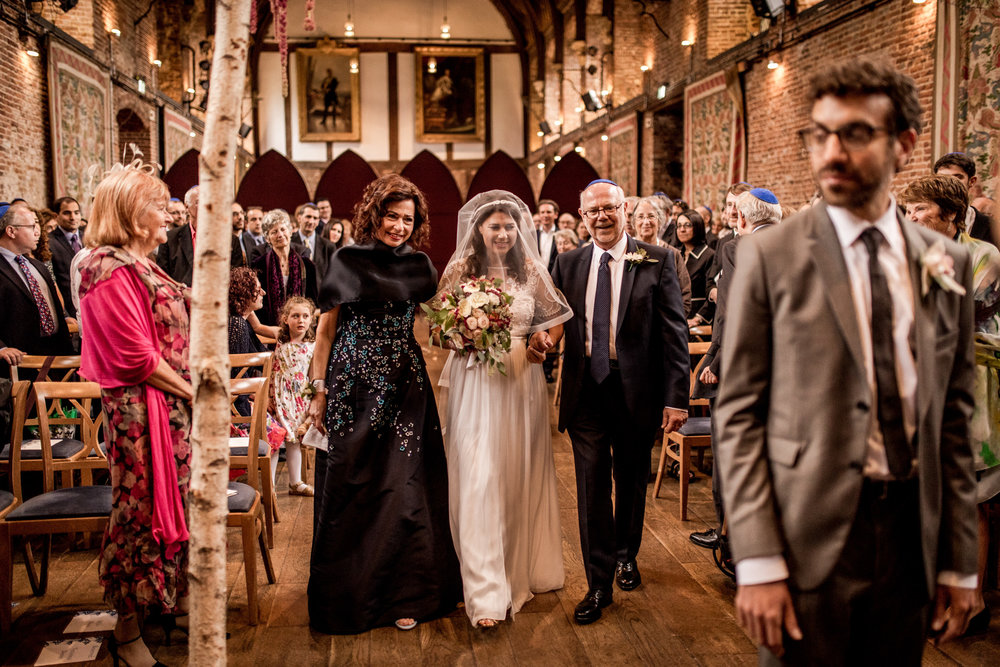
Although only one in six weddings in this country are now religious ceremonies, you can nevertheless imagine that over the years, I have developed a stock of stories about weddings I have conducted.
One of my earliest – which featured the bride’s mother from Hell, who wanted to change everything I’d agreed with the couple – was also memorable for the number of bridesmaids. Fourteen, to be precise. They arrived at the church on a specially hired bus.
The bride was also thirty minutes late. Never have I seen a bridegroom look so petrified as he waited.
We don’t know what the rôle of the ten virgins was at the wedding in Jesus’ parable, but ten young women seems like small fry to me after those fourteen bridesmaids. And they, like that extremely nervous bridegroom, were also waiting a long time.
Kenneth Bailey, a great American scholar who spent most of his time in the Middle East seeking to understand the Bible in the light of local culture, made these observations:
Weddings would normally take place in the seven months of the hot and cloudless summer, and so the celebrations would take place in the cool of the evening and into the night. The bridegroom would leave the celebration party at his own house, and journey through the village to collect his bride, whilst the party remained outside the house awaiting his arrival. The bride would then be placed on the back of an animal, and the groom would lead her back through the village, taking the longest route possible through all the streets so that the whole town could see and join in the celebration. The exact time of the return would therefore be unknown, and could be longer than expected.[1]
With that background in mind of the ten virgins waiting for the bridegroom, understanding that Jesus is the bridegroom whose return we are awaiting, what do we learn about how to wait wisely in contrast to the foolish virgins?
Perhaps a key point for us is that the bridegroom refuses to open the door to the foolish virgins, saying, ‘Truly, I tell you, I don’t know you’ (verse 12). I infer from that statement that the bridegroom in contrast did know the wise virgins.
We prepare for the coming of Jesus by making sure we know him. What does that involve?
Firstly, spending time with him:

At the heart of any relationship is the need to spend time with each other to get to know one another. In this case, however, Jesus already knows us better than we know ourselves. But there is still an onus on us to spend time getting to know him.
That brings me back to what I say quite a lot about using all the spiritual disciplines we can muster to draw near to him. We need time worshipping, and so it’s important that we put aside dedicated time together on a Sunday to do that. Worship is a priority. As I said elsewhere the other week, worshipping together is not simply something we do when we don’t have a better offer. It’s vital.
We can also find ways to worship on our own. We can incorporate that into our regular Bible reading. It’s no good just listening to the Bible in church on Sunday, we need time with Jesus in the Scriptures during the week. We wouldn’t wait seven days to eat ordinary food, so why wait that long for spiritual food? It is, I believe, the primary way God builds us up, and not least because Jesus himself said that the Scriptures point to him so that we may come to him for eternal life.
If you don’t have a regular pattern for spending time on your own reading the Bible, ask your friends what they do. Ask me, if necessary, for some recommendations.
Then there is of course prayer. At its heart, prayer is talking with God. It’s therefore a core way in which we spend time with him and get to know him. Prayer is not just for those emergency situations when they arise. Prayer is not just for when we want or need something. Prayer is talking with God about the whole of life. It prepares us for the day and enables us to reflect on how the day has gone in God’s eyes.
Taking Holy Communion is another way of spending time with Jesus. It’s not something to be mocked or trivialised. It’s about taking the time to meditate upon all that Jesus did for us on the Cross, and then expecting by faith to meet with him when we eat the bread and drink the wine.
You can add to this list with plenty of other ways of spending time with Jesus: fasting, simplifying your life, keeping silence, and so on. If we want to be ready for his coming, we shall want to spend time with him now, in advance.
Secondly, pleasing him:

If you invite someone to your home for dinner, you will usually ask them in advance if there is anything they don’t like to eat or can’t eat. If I turned up at your house for a meal and you served me artichokes, I would know you hadn’t asked that question, because I can’t eat artichokes without being ill. Whenever medical professionals ask me about allergies, I have to list this.
When I was growing up, my Mum often cooked a pot roast on a Sunday as a cheap way of doing a roast. Then on Monday, we would have cold meat with bubble and squeak. Bubble and squeak was the only way my Dad could eat green vegetables. Apparently, he had told my Mum at the beginning of their marriage that he had an adverse reaction to greens, but she thought he was being childish. So one evening she cooked a meal with greens and insisted he ate them, only for him to become violently ill. She quickly learned that to please Dad you didn’t serve fresh greens. They needed a second cook – hence, bubble and squeak – to get rid of whatever irritated him.
If you want to know someone and be in a good relationship with them, then you will want to please them. This holds true for our relationship with Jesus as well. In Ephesians, Paul urges his readers to ‘Find out what pleases the Lord.’ And I think we can safely assume that if we find out what pleases him, we then go ahead and do it! This isn’t a theoretical exercise!
And that’s why this theme for me follows on from spending time with Jesus. Because if we have truly spent time with him in the ways I suggested and more, we will have begun to hear from him about the things that please him and the things that grieve him. We will have gained insight from the Scriptures about his will. In fellowship with our Christian family we shall get an idea of how specifically to put those things into practice.
Remember too that it’s not about finding something spectacular to do. Consider these words of Jesus in the Sermon on the Mount in Matthew 7:
21 ‘Not everyone who says to me, “Lord, Lord,” will enter the kingdom of heaven, but only the one who does the will of my Father who is in heaven. 22 Many will say to me on that day, “Lord, Lord, did we not prophesy in your name and in your name drive out demons and in your name perform many miracles?” 23 Then I will tell them plainly, “I never knew you. Away from me, you evildoers!”
Most of us here have heard a lot over the years about what pleases Jesus. It’s important we get on with those things if we want to be ready for when he appears in glory.
Thirdly, keeping short accounts with him:

‘Keeping short accounts’ was the expression given to a habit of shopkeepers to pay off their tabs immediately. If they had a bill or a debt, they didn’t leave it hanging around. They cleared it as soon as possible.
This idea has been taken up by Christians as an image of the spiritual life. Why would we want there to be barriers between us and Jesus? If we’ve done something wrong, or if something bad has happened between us and someone else, we need to resolve it urgently if we are to be in good relationship with Jesus. If we let things fester, they become harder to resolve.
What does this mean in practice? There are several examples. One is that if we have fallen out with someone, we seek to put things right as soon as possible. In another part of the Sermon on the Mount Jesus tells people even to leave their gift at the altar to go and seek reconciliation with someone. It’s that important. So if you know something is wrong between you and somebody else, seek to put things right at the earliest opportunity. If that person is present at this service, can you have a private word with them during The Peace before we take communion?
We also need regular confession of our sins. One of my aims in devising an order of service is never to leave out the confession of our sins and the assurance of God’s forgiveness. And that’s every week. Each one of us has surely failed Jesus since last Sunday. We all need to confess our sins. Let’s not deny these things nor delay dealing with them. Short accounts.
If someone has hurt us, we need to bring our wounds to Jesus and ask for his help in coming to a point of being able to forgive the offender. I put it that way, because I know that when the hurt is deep it isn’t always easy to come to a point of forgiveness immediately. It’s the destination we need to get to, but there are occasions when the first thing we need to do is pour out our pain to Jesus and then ask him to help us make that journey to forgiveness. Don’t avoid beginning the process, getting started may be the way we keep short accounts here.
Beneath all these examples is the need to avoid the build-up of grudges, guilt, and shame. When we bury such things or ignore them, it has a dangerous and detrimental effect on our relationships. Have you ever had the sad misfortune to meet an extremely bitter person in a congregation? I have on a few occasions, and nothing could be further from the Gospel and the life and teaching of Jesus, right up to his death on the Cross.
Conclusion
The kingdom of God, then, is like a wedding where we know the bridegroom, Jesus, well. We spend time in his presence. We seek to please him. And when things go wrong, we put them right as soon as possible.
If that’s what the kingdom of God is like, then it’s worth asking: does our church look like a colony of that kingdom? And is my life also a signpost to the kingdom?
[1] Kenneth Bailey, Jesus Through Mediterranean Eyes, circa p270, cited by Ian Paul.

