
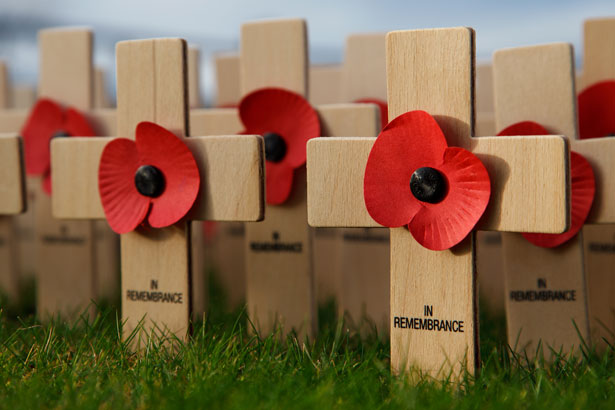
Remembrance Day Free Stock Photo – courtesy Public Domain Photos. Creative Commons Licence 1.0 Universal.
I don’t know whether congregations dread certain Sundays of the year, but I can tell you for sure that preachers do. Remembrance Sunday is one of them. Being planned on this day is the preaching equivalent of what football fans call a ‘hospital pass’: the ball is played to you, but you know an opponent will clatter into you.
For this is a day when whatever you say, there is a high likelihood someone will disagree passionately with you afterwards. You can upset the pacifists and the patriots. Once, as a young minister after I had tried to expound the Beatitudes on this day, a highly opinionated church steward dismissed my efforts by saying, “There’s only one thing to say on Remembrance Sunday, and that is that war is pointless.”
And fundamentally, today is a civic and political day rather than a Christian festival. So you can always upset people politically. You might take the opposite view to someone. Or just saying anything political will annoy those who think the church should stay out of politics.
Well, the Gospel does have political implications, because Jesus is Lord of all creation, and that includes the political sphere. So, we will have something to say about moral and ethical issues. We will have something to say about political leaders who flagrantly contradict God’s Law.
But what we will not do is come up with particular political policies. Those are rightly the realm of the politicians, political advisers, and civil servants with their different rôles to come up with.
What we preachers will do is paint the broad brush-strokes of God’s love, God’s will, and God’s good plans for creation, so that we may live accordingly.
And that, for me, is where our reading from Revelation 22 comes in. Jesus said, ‘The kingdom of God is at hand; repent and believe the Good News.’ Well, here is part of John’s vision about the fulness of God’s kingdom. These verses tell us where we are headed and the kind of society the kingdom of God will be. Therefore, they guide us in how we live today in anticipation of that time. They indicate how we are to live in the midst of a world that contains hatred and violence, pointing instead to God’s kingdom.
That’s why they form something of a manifesto for Christians on Remembrance Sunday.
Firstly, life:
1 Then the angel showed me the river of the water of life, as clear as crystal, flowing from the throne of God and of the Lamb 2a down the middle of the great street of the city.
This part of the vision is inspired by Ezekiel 47, where the prophet sees water coming out from the temple of God and coursing through the land, bringing life in its waters and on its banks wherever it flows. True life and the renewal of the world come from God.
It is not just physical life, but life in every sense, given by God who is Spirit, for in the New Testament the water of life is a way of speaking about the Holy Spirit.
If we want a world and a community where life in all its fulness comes, then we remember that is the promise of Jesus. It is one of his gifts. It can be received from him. He said, ‘I have come that they might have life, and have it more abundantly.’ The trouble with the church, as one preacher said, is that we think Jesus said, ‘I have come that they might have meetings, and have them more abundantly.’
Life in all its beauty and fulness is on offer from God. If you give your life over to Jesus and receive the Holy Spirit, then what you should expect is not to become some spiritual robot, but rather to become more fully human than you’ve ever been. You can expect all your gifts, talents, and passions to flourish like never before, because you are connected to the Source of all life, and all that is good.
It’s significant that in the Roman Empire, if a waterway flowed through the middle of a city like the river of the water of life does here in the New Jerusalem, it wouldn’t be a river. It would be an open sewer.[1] Do not look to the empires of this world for life, be those empires political systems, economic powers, or military might. Of themselves, they will only lead you to the open sewer.
Instead, the Christian God Manifesto is life: life in all its beauty and richness, available through Christ and empowered by the Spirit.
Let’s offer that. And let’s live like it’s true.
Secondly, healing:
2b On each side of the river stood the tree of life, bearing twelve crops of fruit, yielding its fruit every month. And the leaves of the tree are for the healing of the nations.
Now I know that taken literally this is a bizarre image, seemingly describing one tree that stands on both banks of a river. But remember this is a vision. Treat it a little bit like dream language.
And let me point you again to the river of the water of life in Ezekiel 47. Everywhere it goes, as I said, life flourishes in its waters and on the banks. That happens here with the tree of life that we first met in the Bible in the Garden of Eden.
Biblically, the tree of life was taken to represent God’s wisdom, in verses about wisdom such as Proverbs 3:18, which says,
She is a tree of life to those who take hold of her;
those who hold her fast will be blessed.
But God’s wisdom, although always available, has been scorned. Now, however, as the water of life does its work in the New Jerusalem, it flourishes. In the kingdom of God, the wisdom of God prevails over the foolishness of the world.
Is it not the foolishness of the world that has so often led us to wars and conflict? But in the kingdom, God’s wisdom puts a stop to that.
For whereas in Ezekiel, the tree of life healed God’s people, now says John, the tree of life is for the healing of the nations. The Gospel offer of God’s wisdom is a universal offer. Come and find healing and peace in Jesus Christ, the Prince of Peace.
Oh, to be sure I’m not being simplistic and saying, be converted and everything will be fine. It’s not just a case of being forgiven. For in response to the healing of God’s forgiving love in Christ we need his wisdom to live differently. It needs to be lived out.
And there is our challenge. For too often the world looks at the church and does not see a community that has been healed by the wisdom of God. Rather, it sees one full of foolishness and in-fighting. They see us easily duped by politicians, from American evangelicals falling for Donald Trump to British mainstream churches, where every social pronouncement skews in a left-wing direction. They see us fighting too, tearing one another apart at times.
So to offer this second strand of the God Manifesto, we have some changing to do.
Thirdly, restoration:
3 No longer will there be any curse. The throne of God and of the Lamb will be in the city, and his servants will serve him.
No more curse? John’s vision is sending us back to the Garden of Eden again, only this time not to the beauty of the Tree of Life, but to the consequences of Adam and Eve’s sin.
For God tells them that sin leads to a curse over every part of life. The link between humans and the rest of creation is damaged. The joy of childbirth is infected with pain. The beauty of the male-female relationship is damaged by male domination. The realm of work becomes one of frustration rather than fulfilment. Life ends in the dust of death. Is this the beauty of creation? No.
But in the New Jerusalem, ‘No longer will be there be any curse.’ All that is broken is put right. Relationships are restored. The abuse of power is replaced by the spirit of serving one another. What once seemed futile is now worthwhile.
This, then, is another element of the God Manifesto: a thorough-going restoration that applies across the whole of creation from the physical world itself to human relationships. This is God’s vision. This is what we proclaim.
And therefore it is also what we as the Church are called to live out as a sign of that coming kingdom. We are here to nurture reconciled relationships. We are here to treat the earth with kindness. We are here to alleviate pain and to bring meaning to our everyday work.
Most of all, we are here to say that this all flows from a restored relationship with God, where not only are our sins forgiven, we then with gratitude shall live to serve Jesus Christ, who redeemed us. To repeat the second half of verse 3:
The throne of God and of the Lamb will be in the city, and his servants will serve him.
As with every element of this God Manifesto that proclaims a different and contrary reality to that of war and destruction, this is something the church needs both to preach and to live. If we truly believe what we say we believe, then our calling is to live it and thereby show the world by our actions that it is true.
Conclusion
There is so much more I would love to say about these verses. But here is how I want to draw this vision to a conclusion.
It’s common today when talking about what is right or wrong to say, ‘Make sure you are on the right side of history.’ It’s a dodgy saying that assumes everything in the world is becoming increasingly better from a moral point of view, even though it’s self-evident that things are getting both better and worse.
But there is a God way of being on the right side of history, and it is to embrace this vision. It is to say, here in Revelation we have the blueprint of God’s eternal destiny for all those who will say ‘yes’ to him in Christ.
If we want to be part of God’s eternal Manifesto of life, healing, and restoration, then we need to do two things. We need to ‘publish abroad’ these truths in the church and in the world. And we need to live out their truth in our lives as a witness.
[1] Ian Paul, Revelation (TNTC), p359.
 Big Circumstance