
Let me take you back to my first appointment in the ministry, over thirty years ago. I am sitting in a circuit staff meeting, and all the ministers are expressing frustration with difficult people in their congregations.
Then, one of the ministers has a brainwave. “Let’s plant a totally new church in the circuit,” he says, “and transfer all the troublemakers from all the churches there. Keeping them in one place should contain them.’
“We’ll call it the Sin Bin Church.”
Needless to say, we never acted on this idea! But it did release a pressure valve in a tense conversation.
Rather, as has been well said, ministers should no more complain that people come to them with problems than doctors should moan that people come to see them because they are sick.
And Jesus has some troubled disciples in this story. So how does he go about it? Jesus’ example can help all of us when we want to respond to the needs of others in Christ’s name.
Firstly, Jesus spends time with the Father:

Matthew 14 has begun with Herod’s execution of John the Baptist (verses 1-12). Jesus then wants to withdraw for some solitude (verse 13), only to be followed by a huge crowd. He heals the sick and feeds them (verses 14-21). If Jesus had needed time alone after John’s murder, how much more does he need it now?
For Jesus, it is a priority to spend time with his Father in prayer. He prayed and fasted in the wilderness before his public ministry began. He prayed before choosing the twelve apostles. He prayed most passionately of all before the Cross in Gethsemane. There is something about prayer that is essential for him.
What is it? Well, some people today dismiss prayer as useless. I can understand some of those reactions when we see some Christians writing feeble comments like ‘thoughts and prayers’ on social media posts about terrible tragedies in the world. What good are thoughts and prayers, ask the critics, when what people need is practical action?
And the church has inherited this bias towards action rather than prayer. I think it’s telling that the traditional Methodist expression when a minister wants to retire is that they speak of wanting to ‘sit down from the active work.’
And congregations expect their ministers to be busy. If they are not, they must be lazy. This causes many problems, not least that some church members are too afraid to approach their ministers, because they think they will be too busy for them.
What happened to learning from the way Jesus spent time with the Father? Was Jesus just wrong and impractical? Or have we got it wrong?
Eugene Peterson certainly thought today’s church was dangerously mistaken. He wrote an essay called ‘The Unbusy Pastor’ found in his book ‘The Contemplative Pastor’, in which he argued that being busy was a sin. Busyness, he said, can be a sign of vanity, because it betrays a mindset of wanting to appear important and significant. Or it can be a subtle form of laziness, where we abdicate the call to make decisions and fill the space with action instead. Ultimately, he said, busyness was the enemy of spirituality, because it crowds out prayer.
And I confess to that last one at times, not least this week, when I skipped my night-time prayers the evening before I wrote this sermon.
Prayer and action are not opposed to each other. Prayer is the fuel that provides the energy for the best and most holy action. Prayer is where we find direction for what to do when we act. When I don’t forget my night-time prayers, one regular part of my routine is to consider the next day’s diary and pray that I will be a blessing to all those I meet, or phone, or email.
So if we want to make a difference for Christ in the world and if we want to help people, our starting point will not be by throwing ourselves into the needs of the world. It will be by lowering ourselves to our knees before the Father.
Secondly, Jesus spends time with the fearful:

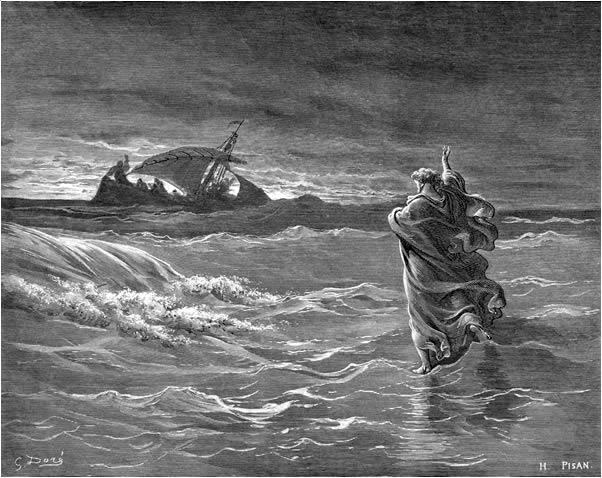
His friends are in trouble in their boat, even though they are experienced fishermen. Yet something has gone wrong. If you put data from the different Gospels’ accounts of this story together, you will find that instead of them staying close to the shore as you would expect when crossing the ‘top’ of the Sea of Galilee, they have drifted three or four miles out. They are off course, and vulnerable to the weather conditions.
Jesus sets out from his solitude on the shore to help them, and the distance the disciples are from land is enough to knock on the head the old sceptical idea that Jesus’ walking on the water was just him walking on stones beneath the surface. However, he’s not doing this as some demonstration of power to impress them: he’s walking on water, because he is using his divine powers to meet a need: the need of those disciples.
And when he reaches them, there is something I’d like you to notice about how he interacts with them. Let me contrast it to what sometimes happens with us.
Do you sometimes find that when you meet anxious people (and the disciples have big-time, life-and-death anxiety here) that their anxiety spills over to you? It happens to me at times: I start to take on their anxiety, and I respond in a stressful way that isn’t helpful. This happens a lot in families, as a psychiatrist called Murray Bowen observed. It also happens in religious congregations, as a rabbi called Edwin Friedman noted, building on Murray Bowen’s work. Friedman called for leaders and helpers to develop something you may have heard of: a ‘non-anxious presence’.
And that is what Jesus does. Yes, he absolutely cares about the fear his disciples have and the anxiety it is causing them. But he doesn’t let it infect him. He stays, in Bowen’s word, ‘differentiated’ from them. Jesus stays secure in the strength he has found in prayer and in knowing his identity as the Son of God. Because of that, he can stay calm as he reaches them. It makes all the difference.
You can hear it in the exchange in the middle of the reading. As Jesus gets to them, the disciples are terrified, and they think he is a ghost. But he says, ‘Take courage! It is I. Don’t be afraid.’ (Verses 26-27)
By beginning in prayer to the Father, not only do we find strength and direction for what we are to do, we find our identity renewed. We are beloved sons and daughters of him, adopted into his family, and assured of his enduring love for us. These truths are underlined and renewed in us through prayer, and they enable us after that first step of spending time with the Father to take the second step of spending time with the fearful. Our peace will be a gift to those who are afraid.
Thirdly and finally, Jesus spends time with the faithless:

Here, I’m talking about Peter’s desire to walk on water. We normally take his basic desire as a positive. We see it as an example of faith, that we need to take risks to achieve things in the kingdom of God.
But here’s my question. Even if Peter hadn’t sunk, what would he have achieved for the kingdom of God by walking on the water like Jesus? I can’t think of anything. And although Jesus responds to Peter’s request by saying, OK, then, come to me, is that necessarily a stamp of approval on his actions? I am by no means certain.
To me, Peter’s actions here seem rather more like the wilderness temptations that Jesus resisted, where Satan urged him to do something spectacular just for the sake of it. ‘Throw yourself off from the top of the Temple.’
But that is not faith. That is testing God. Sure, faith can at times involve doing some quite dramatic things where God intervenes, but there is a purpose behind them when the Father calls us to risky actions. Here, as I said, there is nothing to be achieved by what Peter wants to do. Could it be that what he is actually trying to do is either impress the other disciples or set out on some childish form of exhilaration? Either would fit with his impulsive character.
And I think this is the lack of faith that Jesus cites in him. By allowing Peter’s rashness, he trains him in the ways of sober, sensible faith. He saves him from himself and allows him to learn this lesson. (And if you think that’s a fanciful reading of the text, let me just say that it’s the way John Calvin understood it.)
Now I realise this is a different way of reading the text from the predominant popular ways of seeing it. But when we absorb it, we see that this is good news. It tells us more about the compassionate way in which Jesus meets those in need – this time those who lack faith, or who are prone to foolish decisions. Could that not describe many of us, from time to time: short on faith and long on foolishness?
Well, if it does, then here we have Jesus reaching out to us in kindness to lift us up after we have made a mess of things. Jesus, who is rooted in prayer and his true identity, and who differentiates himself from fear as a result, can minister to us when we have been silly or stupid, when we have embarrassed ourselves and even when we have caused embarrassment to the church. He hears our cry for help, he catches our hand and says, ‘You of little faith, why did you doubt?’ (Verses 30-31)
Don’t let the failures and the foolishness of the past dominate your mind and control your outlook. Jesus comes to lift you up and take you forwards.
And we have the privilege of sharing that same good news with others, who may think God has given up on them, when he hasn’t.
Also be encouraged if your life of faith has not been spectacular. Jesus never called you to show off. He called you to trust him.
Conclusion
Jesus, then, has given us a model for serving others. He first spent time with the Father in prayer, and that enabled him then to spend time with the fearful, not taking on their fear but leading them into peace, and then time with the foolish, restoring them to quiet faith.
Is there an appropriate final response? The final verse of the reading says,
Then those who were in the boat worshipped him, saying, ‘Truly you are the Son of God.’ (Verse 33)
Perhaps that’s where we need to end, too.
In worship.

