Expecting The Trinity And Getting Jesus, Matthew 28:16-20 (Trinity Sunday Year A)

Matthew 28:16-20

The Most Holy Trinity, St George’s Church, Guke near Pljevja – Montenegro on Wikimedia Commons. CC 4.0.

I can guess what many of you are thinking. It’s Trinity Sunday, and in this reading, we’ve heard about disciples being baptised in the name of the Father, the Son, and the Holy Spirit. And in our act of worship, we’ve had another reading, which ended with reference to the grace of the Lord Jesus Christ, the love of God, and the fellowship of the Holy Spirit. So you may have deduced from all of this that you’re getting another mind-bending annual sermon on the Trinity.

But no. I have preached about the basic meaning of the Trinity before. Years ago, I even preached a whole sermon series about the Trinity. I’m not sure what I would say this year that is different, if my aim were to explain the Trinity.

The scholar Ian Paul observed that this is the one Sunday of the year when preachers tend to depart from expounding the Bible readings for the day to preach on a theological idea, albeit one that is so important it distinguishes Christianity from all other faiths.

However, I am going to take up the challenge to expound the Gospel reading. Sure, it mentions the Trinity, but the focus of the passage is Jesus. We’re singing hymns about the Trinity today, but we’re concentrating on Jesus and his greatness.

Firstly, let’s focus on faith in Jesus:

I Could Be Meaner But Jesus Said No at GearEternal. CC 4.0.

16 Then the eleven disciples went to Galilee, to the mountain where Jesus had told them to go. 17 When they saw him, they worshipped him; but some doubted.

Matthew doesn’t give us any of the resurrection appearances. It may well be that he was running out of space on the scroll on which he was writing his Gospel, and so he had to compress things at the end.

But he tells us this story after both the women have found the empty tomb and believed, and the soldiers have chosen money and silence rather than faith. It’s a choice that comes before many of us when we meet with the risen Lord and the claims he makes on our lives.

There is even a split among the disciples here: some worshipped, but some doubted. Jesus doesn’t banish the doubters but reveals more of himself and lets them stay in the company of those who do believe, so that they may come to a point of surrender and faith.

The other day, I read the story of a Muslim man who had read the Gospels and been persuaded that what Jesus offered was far better than Islam. Realising the danger, his family quickly sorted out the prospects of an arranged marriage to a beautiful young woman, and a job in a prestigious company in a lucrative profession. All this he could have, if he just continued to recite that there was no god but Allah and that Muhammad was his prophet.

But he could not deny what Jesus offered. He declined the marriage and the job offer and went with Jesus. He took up his cross as he followed him and his family rejected him.

If Jesus is risen from the dead, then it makes all the difference in the world. This man knew that.

And this challenge is for us. What does it mean for us truly to put our faith in the risen Lord and worship him? What has it cost us? Are there things we have given up or even lost by virtue of trusting him? Have we recognised him as our risen Lord, or is our faith a hobby? Have we been glad to welcome him for all the comforting things such as the way this reading ends – ‘And surely I am with you always, to the very end of the age’ – whilst being reluctant to bow the knee in worship? Do we recognise that such worship is more than singing a few hymns we like but is in fact an act of homage?

So – what does our faith in the risen Jesus look like? What does it involve? Have we paid a cost by choosing him against other attractions in the world?

Secondly, let’s focus on the identity of Jesus:

Jesus Christ, Son of God at Wannapik. CC 3.0.

Here, I’m putting together a few things in the reading. ‘All authority in heaven and on earth has been given to me’ tells us something about his status. So does including him as ‘the Son’ in the baptismal formula of ‘Father, Son, and Holy Spirit’: Jews would have seen a reference to the Father and to God’s Spirit as identifying divinity, so putting Jesus in among that also tells us about Jesus’ identity. Finally, what sort of being could say he was with his disciples to the end of the age?

I suggest that if you add up all these things, it is difficult to avoid the conclusion that Jesus is claiming divine status for himself. He is more than a rabbi. He is more than a prophet. He is the Son of God, a title which in Jewish thought does not make him junior to the Father but equal with him.

What does this mean for us? Well, for a start this immediately plugs back into what we were thinking about in the first point. Jesus’ divine status is the very reason that we have faith in him and worship him. We bow down, give homage, and profess loyalty to the Son of God. It makes sense that all authority is his, and therefore our calling is to follow what he says.

This is why Tom Wright said that the message of the Resurrection is not, ‘Jesus is raised from the dead and so we can go to heaven.’ Instead, it is, ‘Jesus is raised from the dead and we have a job of work to do.’

For the Resurrection and then the Ascension mean that first of all, God the Father has vindicated everything Jesus did and said in his mission before his crucifixion. He has underlined it. He has affirmed it. There is a big tick beside all of it. And secondly, given that the Son of God is now reigning at the Father’s right hand until every enemy is put under his feet, we join in the project of aligning with his will. As we do that, we express our membership of his coming kingdom now. The job of work we have to do because Jesus is raised and exalted is to co-operate with the Holy Spirit in the will of God. We build for his kingdom by being his junior partners in the great task of making all things new. We do this, because of who Jesus is. He is the Son of God, back from the dead to reign.

Do we truly believe this is who Jesus is? If we do, then let us stop to consider this question: what are we doing to participate in his kingdom project of making all things new? Where are we involved in the renewal of people and of this world? Can we answer that? If not, then let us pray until we have an answer. And when we have the answer, let’s start putting it into practice.

Thirdly and finally, let’s focus on the mission of Jesus:
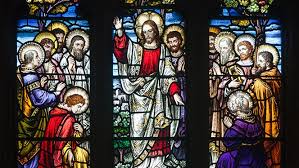
Copyright Andreas F Borchert on Facebook. CC 3.0.

19 Therefore go and make disciples of all nations, baptising them in the name of the Father and of the Son and of the Holy Spirit, 20 and teaching them to obey everything I have commanded you.

There are a lot of verbs in that sentence. But one of them is the main verb, and it isn’t obvious in most English translations. You might think it’s the first verb, ‘go,’ but you’d be wrong. More literally, we would translate it as ‘going.’

No: the main verb is ‘make disciples.’ We make disciples by going, baptising, and teaching.

What is a disciple? As I said at the Lindford Bible Study on Thursday night, a helpful replacement word for disciple might be ‘apprentice.’ An apprentice is someone who learns, but who specifically learns on the job.

Therefore, we are not merely called to persuade people to believe in God and in Jesus. We are called to persuade people to become apprentices of Jesus.

To do that, we need to go. It will not happen if we stay within the comforting walls of the church family. We need to go where people are. Jesus didn’t merely teach and heal in the synagogue. He did that, but he also went out into the fields to where people lived and worked. It is why we need to find our place of service in the world as well as in the church. For that is where we shall look to be witnesses to Jesus in our words and our deeds.

We shall also need to baptise. We must rid ourselves of sentimental ideas that baptism is wetting the baby’s head, or little more than a rite of passage, or something that must be done if that child is to be able to have a church wedding when they grow up. Baptism is when we initiate someone into the ways of Jesus and plunge them into that life. Baptism is a revolutionary new beginning in an apprenticeship with Jesus.

And we shall need to teach – but not abstract theory. Remember, Jesus said we are to teach people to obey everything he has commanded. When you hear it like that, the idea of the apprentice makes sense. This is less about teaching people to memorise the maps on the inside covers of their Bible. It is more about learning the ways of Jesus on the job, in everyday life. You do not need to be an academic theologian to teach discipleship. You just need to be able to model for someone how to live the Christian life.

I wonder what would happen if we remodelled our church life according to this commandment of Jesus. I think we would have fewer church meetings, because we were busy in the world shining the light of Jesus there. Our main non-Sunday meetings would be those that supported us in that task.

I wonder also how many would or could be released into that ministry of showing newer disciples what it means in real-life practical terms what it means to follow Jesus. We need to identify and empower those who can teach by example. Although actually, that should be all of us to a greater or lesser extent.

Conclusion

So – you were expecting the Trinity and you got Jesus. Maybe to talk just about him is less intellectually challenging, but it is still very challenging for our life and our faith.

Has our faith in him cost us? Do we bow before him as Son of God and participate in his kingdom plans to renew all things? Do we put disciple-making as a major priority in our lives and in the church?

These are true tests of our faith in our risen and ascended Lord.

Understanding and Experiencing The Trinity, Romans 5:1-5 (Trinity Sunday Year C)

Trinity Introduction

Knaphill friends have heard me tell the story before about how I was once visited by a pair of Jehovah’s Witnesses and when they knew I was a Christian, they pointed out that the word ‘Trinity’ is not in the Bible.

“Neither is the word ‘trousers’,” I replied, “but I’m not about to take mine off!”

My point was that we needed to invent a word like ‘Trinity’ to describe what underlies the biblical teaching.

Because the Christians of the first few centuries were faced with a dilemma. Their faith clearly originated in Judaism, which emphasises that there is but one God. However, Jesus appeared on the scene doing things only God was allowed to do. For example, do you remember how the religious leaders criticised him when he pronounced the paralysed man lowered through the roof as forgiven? They said only God could do that. They were faced with two alternatives: either condemn Jesus as a blasphemer, or rethink.

And this was further complicated after Pentecost, when the Spirit came, also doing divine work. So how do you account for a God who is one but who is revealed as Father, Son, and Spirit?

Muslims and others will tell us this is just plain nonsense: three persons cannot be One. However, the tribes Muhammad encountered and condemned for this reason were probably ones who were actually ‘tritheists’ – people who believed in the three gods. And there is a genuine difficulty with the word ‘persons’ that we use in connection with the Trinity. It’s the nearest English word we have, but it’s not exactly the same.

And so eventually, after three centuries or so of wrestling with these questions, the Church promulgated the doctrine of the Trinity. And we should think of that doctrine not so much as a tight definition but rather a set of boundaries: while you stay within the boundaries, you are describing the true God; go outside the boundaries, and you are not.[1]

Essentially, those boundaries are three lines of a triangle and we need to hold all three lines. Erase one of the lines, and we fall into heresy.

The three boundaries are that there is one God, eternally in three Persons, who are equal. What happens if you remove one of the three lines?

If you keep one God and three Persons but remove the equality, you get the ancient heresy promoted by a man called Arius, called ‘subordinationism’, where Jesus and the Spirit are subordinate to the Father – they are less than him. This is what Jehovah’s Witnesses believe.

If you keep one God and the equality but rub out the idea that God is eternally three Persons, then you get another ancient heresy, this time called ‘modalism’, which was advocated by a man called Sabellius. He said that God was the Father in the Old Testament, Jesus in the Gospels, and the Spirit from Acts onwards. God changed his mode. You can see it in poor sermon illustrations that compare the Trinity to H2O, saying that it can be ice, water, or steam. But Jesus addresses the Father in prayer and promises the Spirit, so this cannot be right.

Finally, if you keep the three persons and the equality and but remove the ‘one God’ line, then you end up with what I said I think Muhammad encountered, not trinitarianism but tritheism, a belief in three gods, contrary to our Jewish heritage.

Now you may say this is thoroughly brain-bending, and perhaps it is! But why should we expect our understanding of the Almighty to be simple? When Albert Einstein’s theories became popular a century ago and they replaced much of Isaac Newton’s thinking, some commented that God would not have had to have stretched himself that much to come up with Newton’s equations. There was something appropriate, if you believed in God, that Einstein’s work was so complex.

Perhaps that is a principle worth bearing in mind when we find the doctrine of the Trinity difficult.

I could say more, and in the past I once preached a series of five sermons to explore the Trinity. If you want any reading on the subject, I particularly recommend ‘Experiencing the Trinity’ by Darrell Johnson.

Romans 5:1-5

I said the Trinity underpinned the biblical witnesses to the one God, eternally and equally subsisting in three Persons. Here I’m going to look at their various rôles once – as Paul says in the context – we have been justified by faith.

Firstly, God the Father brings peace.

Therefore, since we have been justified through faith, we have peace with God through our Lord Jesus Christ (verse 1)

Living under the Roman Empire, Augustus Caesar had established peace, the so-called Pax Romana, and he claimed to have done so by the principle of Iustitia, or justice. His successors had taken titles such as ‘Lord’ and ‘Saviour’.[2] Does any of this sound familiar?!

Paul takes this language and utterly transforms it. God the Father, not Caesar, has brought justification, treating people as if they had never sinned, through a Lord and Saviour not called Caesar but Jesus Christ.

And from that he had given the gift of peace, not peace brought through the sword and jackboots of an army but by Jesus suffering on the Cross.

It is peace with God. The barriers are broken down, and the relationship of peace between God and humans is now possible.

Moreover, that peace between God and people leads to peace between people in the community of the kingdom that we call the church. And so the church witnesses to God’s alternative kingdom that is so strikingly different from the Roman Empire. Instead of peace by subjugation, we have peace by suffering. Instead of peace by force, we have peace by putting others’ needs ahead of our own.

It becomes a question for us as a church: not only have we individually found peace with God through Jesus justifying us at the Cross, but also do we live out God’s life of peace together in fellowship? Are the quality of our relationships a sign of God’s kingdom, in contrast to the ways of empire that surround us?

Secondly, Jesus brings grace.

Therefore, since we have been justified through faith, we have peace with God through our Lord Jesus Christ, through whom we have gained access by faith into this grace in which we now stand. And we boast in the hope of the glory of God. (Verses 1-2)

‘Gaining access’ and ‘standing’ are clues that what Paul has in mind here is a room that Jesus has brought us into with the Father. It’s like coming not just generally to the Temple but specifically to the altar with a sacrifice. But that sacrifice is of course Jesus himself and we now stand in a place where we experience ‘grace’ not as a one-off encounter with the forgiveness we don’t deserve but more as an ongoing expression of God’s continuing love.[3]

Just think of that for a moment. The grace that Jesus brings us into is so vast that we stand and remain in it – well, we do, unless we choose to walk out on it.

That is why Paul says ‘we boast in the hope of the glory of God’, because God’s intention is to have us in his temple of grace for all time. We have something to enjoy now and to look forward to. This gives us hope. It’s based on God’s enduring love.

When things get bad in ministry, I sometimes look forward to retirement – perhaps more and more as I get older! The knowledge that we have a house in Sussex is something that tells me life will not always be like this in the bad times.

The followers of Jesus celebrate the good news that he ushers us into the presence of a God who has not promised to love us ‘until we are parted by death’, as the marriage service says, but ‘for ever and ever.’

Be encouraged! Jesus gives us a firm foundation by grace in the love of God.

And from that firm foundation let us be prepared to take risks in his name, rather than forever playing it safe.

Thirdly, the Holy Spirit helps us to love.

Not only so, but we also glory in our sufferings, because we know that suffering produces perseverance; perseverance, character; and character, hope. And hope does not put us to shame, because God’s love has been poured out into our hearts through the Holy Spirit, who has been given to us. (Verses 3-5)

As I said, things may be tough, but with the enduring presence of God’s love and grace, we have hope. And so Paul goes on to explain how we are enabled to endure, because we have hope.

And so we come to the point where Paul says that the hope we grow into does not disappoint us, ‘because God’s love has been poured out into our hearts through the Holy Spirit, who has been given to us.’

‘God’s love.’ The Greek literally says, ‘the love of God’, and most translators, like the NIV, take it that way. But it could be translated ‘our love for God’, and given that the context is things we do, such as suffer and persevere, I (following N T Wright on this point[4]) favour that translation.

This would mean that what Paul is talking about here is that the Holy Spirit enables us to love God, especially during those times when we persevere and suffer, leading to the formation of our character and hope.

For in the difficult times it is often harder to love God. When we are up against and we want to complain, love is farthest from our minds. Yet we are called to love the Lord our God with all our heart, all our soul, all our mind, and all our strength, and there are no get-out clauses.

Loving God does not always come naturally or easily. But the good news Paul tells us is that this is one reason the Holy Spirit is sent to us: to help us to love.

And that takes us full circle. The peace of God is not just a personal gift but something we live out in community as an alternative kingdom, doing so reassured that Jesus has brought us into the place of God’s enduring grace and love. But living out that love is difficult. We cannot do it alone. For this we receive the Holy Spirit.

Thus the Trinity is intimately involved in the whole life of Christians, and the Christian community.


[1] What follows is based on Darrell W Johnson, Experiencing The Trinity; Vancouver: Regent College Publishing, 2002, pp 41-45.

[2] N T Wright, ‘Romans’ in The Interpreter’s Bible Volume X; Nashville: Abingdon, 2002, p 515.

[3] Wright, p 516.

[4] Wright, p 517.

Create a website or blog at WordPress.com

Up ↑