The Importance of the Ascension (Easter 7, Resurrection People 7) Hebrews 4:14-16

Hebrews 4:14-16

I saw this image on Facebook on Thursday, which was Ascension Day. A classic painting of Jesus ascending above the bewildered disciples has had a caption added:
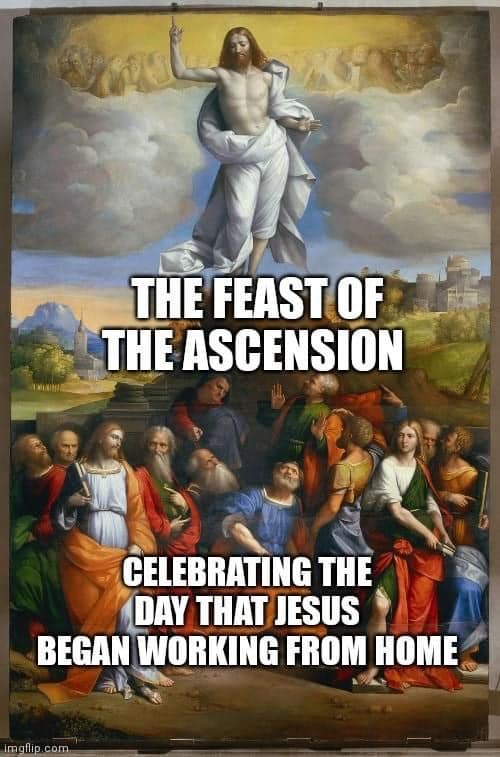
The Feast of the Ascension: celebrating the day that Jesus began working from home.

I rather liked that. I wondered whether devout Catholic politician Jacob Rees-Mogg might ponder it the next time he leaves snarky notes on the office desks of civil servants who are working from home.

What do we make of the Ascension? When I try to explain the event to congregations, I usually suggest it is what John Calvin called one of God’s accommodations to us. He rose into the sky to get the message through to disciples who thought heaven was ‘up there’. Although Professor Tom Wright now says that the Jewish concept of heaven was that it was an invisible realm next door to this life and therefore the crucial part of the story is that Jesus disappears from sight.

But be that as it may, what does the Ascension mean for us? I’m going to divide that into two halves.

Firstly, it’s about the finished work of Jesus.

Hebrews 4:14 tells us that Jesus ‘has ascended into heaven.’ But what does he do there?

Two other parts of Hebrews tell us something that this section doesn’t, and they both use the same expression. In both chapter 10 and chapter 12 we read, ‘He sat down.’

It’s like he gets to heaven, he goes in the front door, finds the sofa in the living room, and takes the weight off his feet. Job done. Now he can rest.

In other words, the Ascension tells us that Jesus had completed all he was sent to Earth to do. Through his life, teaching, miracles, death, and resurrection he has achieved his goal. Salvation has been won. It is available to all. The task is being passed to the disciples and any day now the Holy Spirit will equip them for that.

Compare it if you will to the account of the crucifixion in the Gospel according to John. As he is about to die, Jesus cries out, ‘It is finished!’ (John 19:30) When he said ‘It is finished’ he didn’t mean, it’s all over, and my mission has failed, but the very opposite. For the Greek word that English Bibles translate as ‘finished’ means ‘finished’ in the sense of ‘accomplished’. Jesus is saying, ‘Mission accomplished!’ and the Ascension confirms that.

Jesus has done everything we need for salvation. The Cross is sufficient, the Resurrection proclaims it, and the Ascension ratifies it. To come into a relationship with the living God and to live as a disciple of Jesus requires only what he has done for us. At the Cross, the guilt we carry and the sentence we deserve for our sins are taken away and laid on Jesus. At the Cross, evil forces are conquered not by violence but by the suffering love of God in Christ. At the Cross we are set free.

It has all been done. Finished. Mission accomplished.

So one thing we must not do is attempt to add to what Jesus has done. Sometimes when we feel particularly guilty we think we have to do something as an act of penance to earn the favour of God. But as Martin Luther discovered when he studied the New Testament more fully than he had been taught as an Augustinian monk, the word is not ‘penance’ but ‘repentance’. And even then we do that in response to what Jesus is offering us.

Similarly, some people think they have to live a good life in order to win God’s favour. This is at heart an act of pride: ‘I did it myself’ – or even worse, in the words of the dreadful song, ‘I did it my way.’ But the fact that Jesus has done it all is meant to humble us. We cannot save ourselves. That’s the point. Everyone must come to that realisation, whether they are of high rank or low in human society, that we come in humility to Jesus and depend entirely on him for salvation.

On this day when we celebrate Jesus sitting down at the right hand of the Father, I want us all to realise afresh that our relationship with Christ is described in the words of the hymn:

Nothing in my hand I bring
Simply to thy Cross I cling.

What is faith then? It is not stretching out our hands to offer God something from our lives that we think or hope might make us acceptable to him. Instead, it is an opening out of our empty hands to be filled with all that Jesus has to give us from what he has done for us at the Cross.

John Wesley knew this. Last Tuesday was the anniversary of his conversion at Aldersgate Street, when he found that the assurance of God’s love simply came directly to him from God, not from all the labours to which he had devoted himself up until then.

Therefore, if you are ever the kind of person who says of yourself, ‘I’m trying to be a Christian,’ I want to ask you to put that language to bed from today. Either you are a Christian, or you are not. Being a Christian isn’t a boast, it isn’t a matter of personal superiority. It’s a matter of holding out those empty to hands to receive the finished work of Christ.

Secondly, the Ascension is about the unfinished work of Jesus.

Wait a minute Dave, you’ve just been at pains to say that Jesus finished his work. How can you now say his work is unfinished?

Glad you asked. And I hope this is provocative enough to keep you listening. One part of his work is finished, the work I’ve just been describing, to make salvation an offer to all.

But another part of his work is unfinished. And it’s described in our reading. Hebrews calls Jesus our ‘high priest.’ What does a priest do? A priest offers sacrifices for the people – but we’ve covered that in my first point about the finished work of Jesus in speaking about his death. Jesus our high priest offered himself as our sacrifice.

But a priest does something else for the people. A priest prays for them. This is something that Hebrews will refer to three chapters after our reading:

Therefore he is able to save completely those who come to God through him, because he always lives to intercede for them. (Hebrews 7:25)

Two circuits ago, and elderly Local Preacher prayed for me every day. But he died. My parents also prayed daily for me. But they have both died while I have been here.

However, I am not short on the most powerful prayer for me in my need, because Jesus intercedes for me. And he does the same for each of you. Be encouraged! This is his priestly work.

And furthermore, he understands, because as our reading says,

15 For we do not have a high priest who is unable to feel sympathy for our weaknesses, but we have one who has been tempted in every way, just as we are – yet he did not sin. 16 Let us then approach God’s throne of grace with confidence, so that we may receive mercy and find grace to help us in our time of need.

Don’t you find that encouraging, too? I often tell mourners at a funeral that when I am going through a bad time in my life I don’t necessarily find it helpful to have well-meaning Christians come up to me and tell me exactly what they believe about why God has allowed this. I want to lay my hands on such people – but not in the sense of healing!

The people I find most supportive when I am walking through troubles are those who have been there themselves. They understand.

One of my favourite examples of this is that about five years before I met Debbie I had a broken engagement – or, as my sister called it, a narrow escape. One day when I was grieving the break-up of my relationship, two friends called Sue and Kate turned up on the doorstep.

‘We’ve come to take you out for a pub lunch,’ they said.

I don’t remember the food from that meal. What I remember is how both Sue and Kate shared about broken engagements they had been through. They understood. They could support me.

Because Jesus has been through human weakness and faced temptation, he can do all that and more.

If you are facing sorrow or crisis right now, I encourage you to re-read the Gospels. Look for the stories where Jesus too goes through the ringer. Then recall that because he has been there too, he understands what you are facing, and can pray like no-one else to the Father for you.

This is how our ascended Lord spends much of his time. This is his unfinished work. It will continue until he appears again in glory, to judge the living and the dead, and to take us to our eternal home.

In conclusion, I’ve always been disappointed how Methodist churches treat the Ascension as a minor festival or even as a non-existent one. It is so important. It has much to teach us and encourage us.

I hope we will all leave today rejoicing in the finished work of Christ, who has sat down at the right hand of the Father, having completed everything necessary for our salvation.

And I hope we will also all leave today encouraged by the high priestly work of Christ who identifies with us and intercedes for us – his unfinished work.

May both of these great truths be strong foundations for our worship and our witness.

The Resurrection of Jesus and the Healing of Creation: Worship for the Third Sunday of Easter 2021

This week I explore Luke’s account of the risen Jesus appearing to most of the disciples on the evening of Easter Day and ask what it conveys to us.

Luke 24:36-48

If you ask several witnesses to give their accounts of the same incident, their stories will have common themes, but the details will differ. Does this matter? Does it show them to be lying?

Not necessarily at all. The different accounts will be because different elements were important to each of them, because they remembered different parts, their concerns and interpretations varied, and so on. Some may summarise part of the event, and others may spell out things in word-for-word detail.

Those who criticise the accounts of the Resurrection in the four Gospels for being so different need to remember basic elements of human nature like this. And our story this week seems to be Luke’s account of at least the first of the two resurrection appearances behind locked doors that we considered in John 20:19-31 last week.

So in Luke’s account, what does Jesus want his disciples to learn about the Resurrection?

Firstly, Jesus wants his disciples to understand that the physical nature of the Resurrection.

Look at the two proofs he gives them. Firstly, Jesus invites the disciples to touch his hands and feet to prove that he has flesh and bones, unlike a ghost (verse 38), which is what in their fear they thought they had seen (verse 37).

In other words, Jesus isn’t an ethereal being. He isn’t a spirit who has found no place to rest in death. He is not ‘a cadaver brought back to life’[i], nor is he a zombie: this is not an episode of ‘The Walking Dead’. This is no horror movie. There is no need to fear. Jesus has been resurrected to material, physical life. Sure, it is different in some ways. But it is still physical.

This is underlined by the second proof Jesus gives, when the disciples are still too emotional to believe. He asks for food and promptly devours some fish (verses 41-43). As the only fish and seafood eater in his family, I approve enthusiastically!

When Jesus eats the fish, he isn’t just showing he has a physical body, he is also emphasising ‘an “immortal soul” free from bodily existence’[ii]. That’s important for us, because too often we default to that view of life after death. We say things like ‘the body isn’t important, it’s just a shell for the real person’, but this is what the Greek philosophers believed, not what the New Testament apostles believed. And it’s a disastrous belief to follow through on.

Why? Because if the body doesn’t matter, then it certainly doesn’t matter if we abuse it. Nor does it matter if we abuse someone else’s body, despite the physical and emotional pain we cause.

And if the body doesn’t matter it’s probably a sign that physical and material things generally don’t matter. Therefore we just believe in a spiritual heaven. We don’t need to worry about damage to the world, because, like the dreadful old hymn said,

This world is not my home,
I’m just passing through.

So we need to turn this round and be positive. Jesus’ physical resurrection is a sign that God cares about the physical and material. Remember that in the creation story of Genesis 1, he looked at each stage of creation and either pronounced it ‘good’ or ‘very good’. God’s attitude to his material creation hasn’t changed. The Resurrection tells us that he intends to redeem it. Remember how Revelation 21 speaks of a new heaven and a new earth, and of God making all things new. Well, the Resurrection is the beginning of that process.

The Resurrection is therefore why we care about healing. The Resurrection is why we care about justice. The Resurrection is why we care about climate change and creation care. Take away the Resurrection and none of those things matters. But they do matter, because God is about making all things new, including the material world, and the physical Resurrection is his supreme sign to the world that these matter.

So think of Jesus eating the fish next time you eat fish and chips. Our Catholic friends eat fish on a Friday to avoid eating meat on Good Friday, when we commemorate the death of Christ. But I suggest to you it’s every bit as valid to eat your fish and chips on a Sunday, when we celebrate the Resurrection, because it reminds us of Jesus’ physical resurrection and all that rides on it.

And therefore, don’t just think about the physical nature of the Resurrection: go into the world to bring healing to people, to relationships, and to the creation itself. Don’t let the truth of Jesus’ physical resurrection stay residing in your brain: let that truth travel to your hands and feet and make a resurrection difference in the world.

Secondly, Jesus wants his disciples to understand the place of the Resurrection in the purposes of God.

Proof and evidence are important, but they only take us so far. They are the preparing of the ground for commitment. We can provide solid evidence for the Christian faith, but on its own it doesn’t bring anybody to Christ. It prepares someone’s heart and mind for the challenge of commitment. That is what has happened so far in this story, and it’s often what happens in discussions with people today.

To make the jump from understanding to commitment, we need Jesus to send the Holy Spirit to interpret the purposes of God to us. We need that spiritual element.

And that’s what Jesus does when he ‘open[s] their minds so they could understand the Scriptures’ (verse 45). It takes a divine unveiling to appreciate the purposes of God and then be ready to throw our lot in with Jesus.

So now that’s what Jesus does. He reveals the place of the Resurrection in the divine purposes. He says it was always God’s plan that the Messiah would suffer, die, and be raised, and that this would lead to the preaching of repentance throughout the world (verses 46-47).

But that’s rather puzzling. Because taken on their own the Scriptures in question (which are basically the Old Testament as we know it) don’t make such claims in any particularly obvious way. You can only start to see it in the light of the Resurrection. Then you begin to understand what God was up to in the prophecies of the Servant in Isaiah, or the Son of Man coming to the Ancient of Days in Daniel, or the Lord inviting another Lord to sit at his right hand in the Psalms. You wouldn’t have guessed without the Resurrection.

But now the penny drops and Jesus tells his disciples, ‘You are witnesses of these things’ (verse 48). This comes back to that favourite Tom Wright quote of mine, ‘Jesus is alive and we’ve got a job to do.’

Why? The Resurrection shows that God has vindicated Jesus. Those who called for his crucifixion are exposed as in the wrong, and we realise we are all in the wrong before him. We all need to hear the call to repentance, because in the Resurrection God says that Jesus is in the right and we are in the wrong.

So the Resurrection is here to bring two changes in our lives. One is repentance, as we renounce our selfish ways of living to follow Jesus. The second is we are moved from inward-looking to outward-looking, because this concurs with the application of the physical nature of the Resurrection. But not only are we sent into the world with the message of the healing of all creation, we now realise that healing message is also about healing the rift between people and God.

Now I’m not suggesting this means that we use every minute of the day to bludgeon people with the Gospel: many of us have been subjected to that and know how bad it feels. But what it does mean is that we have this outward-looking focus where as disciples of the risen Lord our passion is for the healing of creation, the healing of people, the healing of relationships, and the healing of the breach between people and God. We shall show that in our actions and our priorities, and we shall speak when the time is right and when opportunities come.

Remember: God is making all things new, and he began that task when he raised Jesus from death.


[i] Joel Green, The Gospel of Luke, p854.

[ii] Ibid.

Children And Atonement

On Thursday, I took two assemblies at our children’s school for the first time – one with Key Stage 1 (a.k.a. ‘infants) and one with Key Stage 2 (‘juniors’ to oldies like me). I am doing this as part of a team from two or three local churches. We are taking incidents from the life of Jesus this term. Last week’s speaker, Helen, used the presentation of Jesus in the Temple. I couldn’t get anything together on the visit to Jerusalem when he was twelve. So, with the aid of Scripture Union‘s rather decent Big Bible Storybook, I looked at his baptism. I also purloined a doll of Rebekah’s, which Debbie dressed in the very christening robe she and her sister had worn as babies.

Further, I borrowed a portable font from church. It was interesting to hear the children’s answers when I asked them what I thought it was. Some thought it was an urn (wrong end of life, I guess). My favourite wrong guess was from the child who thought it contained tombola tickets.

Without going into the whole of my talk, I got to the point where Jesus asks John to baptise him and John protests, only for Jesus to say it’s what God wants. I took that as an early sign of Jesus identifying with sinful humanity (it’s OK, I didn’t use that level of language). Therefore, I said, it was a sign of what Jesus would do in his death on the Cross.

Thus I asked the children how they would feel if they had done something naughty and a friend offered to take the blame for them. In both assemblies, the answer was the same: ‘Kind.’ No worrying about whether it was just or ethical for an innocent person to be condemned in place of the guilty, they saw the heart of such an approach was love.

I couldn’t help thinking they might be further on than many of us who discuss the atonement as adults. There are crude statements of substitution that sound like Jesus was placating an angry God, that overlook the rôle of the Trinity or that forget the Resurrection. Some fail to see that the word ‘sacrifice’ is about more than a sin offering in the Old Testament. There are other images of the  atonement in Scripture. (I owe use of the word ‘image’ to George Carey, who prefers it to ‘theory’.) Yet you cannot completely expunge some form of substitution.

And these primary school kids got the fact that it’s about love. Great.

For a more nuanced discussion, Tom Wright’s article for Fulcrum two years ago is always a good starting point. He is glad the church has not defined the theories of the atonement too tightly, yet he rejects both those who caricature and dismiss substitution and also those who hold onto it in a severe way.

Covenant Sermon

This Sunday, my church at Broomfield is experimenting with bringing its annual Covenant Service forward to the beginning of the ‘Methodist year’ rather than the calendar year. Hence what follows is a sermon for a Covenant Service, rather than on one of the regular weekly Lectionary readings.

Romans 12:1-2

Introduction
At my office, I worked with a Muslim guy. Javed (or ‘Suave Jave’ as we called him, for his attitude to the ladies) was more Muslim by upbringing than practice. But one day, he brought in to show us his mother’s copy of the Qur’an. It was edged and blocked in gold leaf. It came in a special tissue-like wrapper. One thing neither Javed nor his mother would have done with that book was write in it. Even touching it seemed risky, in case of damage.

But I don’t treat my copies of the Bible that way. In particular, I was taught as a young Christian to underline words in my Bible. Not only verses that struck me, but also some key words. ‘But’ was a good word to underline. It indicated an important change in Paul’s arguments.

And Romans 12 starts with another key word: ‘therefore’.

I appeal to you therefore, brothers and sisters, by the mercies of God, to present your bodies as a living sacrifice, holy and acceptable to God, which is your spiritual worship. Do not be conformed to this world, but be transformed by the renewing of your minds, so that you may discern what is the will of God—what is good and acceptable and perfect. (Romans 12:1-2)

‘I appeal to you therefore’: therefore indicates all that has preceded Romans 12. It indicates the first eleven chapters of Romans, summarised here as ‘the mercies of God’. We make and renew our covenant because of ‘the mercies of God’. All we offer today is in response to the mercies of God. Not just one-off mercy in initial forgiveness, but mercies. Over and over again, God is merciful to us. Our sins, our mistakes, our foolishness and weakness: for all these things God is merciful to us in Christ through the Cross. And because he is relentlessly merciful – his mercies are ‘new every morning, [so] great is [his] faithfulness’ (Lamentations 3:23) – we offer ourselves to him.

How does Paul ask his readers to respond to the mercies of God? In these two verses are two ways:

1. Sacrifice
Paul urges Christians to ‘to present your bodies as a living sacrifice, holy and acceptable to God, which is your spiritual worship’ (verse 1).

‘Spiritual worship’ here implies that it is reasonable, rational and true. This is the right and proper thing to do in light of God’s enduring mercies to us. The mercies of God come to us through the sacrifice of Christ: is it not appropriate, urges Paul, for us to make sacrifices as a grateful response?

But what are these sacrifices? ‘Present your bodies as a living sacrifice, holy and acceptable to God’, he says. It’s not just something we do ‘spiritually’: we present our bodies. And if I might just re-order the words to reflect what many commentators think is the sense of the Greek, we make ‘sacrifices, living, holy and acceptable to God’. Those adjectives ‘living’, ‘holy’ and ‘acceptable to God’ illustrate the kinds of sacrifices we might make with our bodies.

‘Living’ – we freely offer our bodies to God, because of what he has done for us in Christ. It may cost us something. The author Robert J Morgan tells how one Sunday, the late Corrie ten Boom was preaching in Copenhagen on these very verses. She was eighty years old at the time. Two young nurses at the church invited her to lunch afterwards, but they lived in a tenth floor flat and there was no lift. Not what you want at eighty.

She struggled up the stairs as far as the fifth floor, but her heart was pounding and her legs buckled. Collapsing into a chair, she complained to the Lord. But she sensed God whispering to her that it was important she carried on.

When she finally made it to the tenth floor, she met the parents of one of the nurses. Neither was a Christian, but they were both interested in the Gospel. Corrie ten Boom led them to faith in Christ. All because she reluctantly followed her own sermon and made her life – her very body – a sacrifice in climbing ten flights. She was willing to go where God led her, despite the cost.

‘Holy’ – our dedication to God may also sometimes come at a price. The Covenant Service promises balances the way some parts of our discipleship are attractive and others are costly:

Christ has many services to be done: some are easy, others are difficult; some bring honour, others bring reproach; some are suitable to our natural inclinations and material interests, others are contrary to both; in some we may please Christ and please ourseleves, in others we cannot please Christ except by denying ourselves. Yet the power to do all these things is given to us in Christ, who strengthens us.’ (Methodist Worship Book, p288.)

Holy sacrifices are about being willing to pay the price of unpopularity and difficulty for the sake of dedication to the right thing. It is also a matter of doing so graciously, rather than with complaint, self-righteousness or attention-seeking.

‘Acceptable’ – this probes our motives. Other translations say, ‘well-pleasing to God’. It’s about a desire to please God. In marriage and other human relationships, we make it our first goal not to please ourselves but our spouse, or whoever it is we love. So too with God. When we know how merciful he has been to us and how regularly he has been merciful, the fitting response is to set our minds and hearts on doing the things that bring him joy.

There is a story told in the Old Testament that gives a small illustration of what I am talking about King David wanted to buy some land from a subject and use it for worship. The owner says he can have it free of charge, but David says, no: he insists on paying. Why? ‘I will not give to the Lord that which has cost me nothing,’ he says. Discipleship and giving need to cost us something to be genuine. It may be financial, material, emotional, psychological, even social. If we realise just how merciful God continually is to us, then out of joy we shall be willing to show love in return, even if it comes at a price.

2. Transformation
Verse 2:

Do not be conformed to this world, but be transformed by the renewing of your minds, so that you may discern what is the will of God—what is good and acceptable and perfect.

‘Do not be conformed to this world’ – or, as J B Phillips famously translated this passage, ‘Don’t let the world around you squeeze you into its own mould’. Do not be conformed, be transformed, says Paul. Don’t be squeezed by the world, ‘let God re-mould your minds from within’ (Phillips).

Yet how easy it is to conform to the world, to let it squeeze us into its mould. Often we don’t notice. The late Lesslie Newbigin once observed that just as a goldfish is not consciously aware of the water in which it swims, so we are often unconscious of the culture we live in and its values.

In our society’s case, think about how we easily use popular words such as ‘tolerance’. It is presented as a quality that everybody must have. Woe betide the intolerant! But the word ‘tolerance’ carries with it overtones of a benign attitude to things that are wrong, enduring wrong things or having no deep convictions oneself. It’s a slippery slope towards tolerating sin. All these shades of meaning are therefore anathema to the Christian, but we refer to tolerance as much as anyone! The world is squeezing us into its mould, if we are not careful. I could give examples from other apparently innocent or positive words such as ‘inclusiveness’ and ‘community cohesion’.

So how do we resist social pressures to adopt ways of thinking that are inimical to the Gospel? Paul exhorts us to ‘be transformed by the renewing of [our] minds’, or to let God re-mould us from within, as Phillips puts it. Spiritual transformation involves a battle for the mind, because what we think affects our attitudes and our actions.

This doesn’t mean we all have to be intellectuals. Any Jesus-follower can develop Gospel thinking, Gospel attitudes and Gospel actions. That is Paul’s vision. Where do we begin?

We start with reading and reflecting on the Bible and its great story from the Garden to the New Jerusalem. It is Scripture above all that will help us to be Gospel thinkers. However, we don’t do so alone. Private Bible reading is good and worthy, but most of the books in the Bible itself were written or dictated to be heard less by individuals than by groups of disciples. It’s important, therefore, to get to grips with the Gospel together. If you’re not part of a small group that does that, you’re missing out! For starters, join the Living Faith course! It will help us get to grips with the big picture of our faith together.

But it’s not enough just to read the biblical message and discuss it. There are many people in churches who know their Bibles well, but who are harsh, unloving and judgmental. (Not that any of us is perfect – least of all, me.) So just reading the Bible and talking about it isn’t enough.

In other words, the biblical authors didn’t write their books just to be read or heard. They wrote them to generate action. The Bible isn’t just to be read, it’s to be done.

In my final year as a student minister, I spent half my time on placement in a circuit. At one of the two churches where I worked, I led a Bible study every week. However, the minister who supervised that group had been very frustrated with it. ‘When are they going to stop talking about the Bible and start doing something?’ he said to me once. ‘They’re more interested in the maps on the inside covers of their Bibles than in putting the teaching into practice.’

And that’s what I’m on about. Spiritual formation in Christ – the transformation of our minds to which Paul calls us – involves Bible reading, reflecting on it together where we support and challenge each other, and then getting on with what we’ve learned. It’s when the thinking leads to action that we truly learn. If I were a betting man, I would wager that Katie learned more about God’s love for the poor through her trip to Kenya with Hand In Hand than I would have done simply by reading about the poor.

One famous preacher said, ‘Never finish your sermon without telling your congregation what you want them to do about it.’ I suggest you might almost say, ‘Never finish your Bible reading without deciding what you are going to do about it.’

Conclusion
If God has been so persistently merciful to us, then what might we give him as a present? It would be appropriate if our offering involved sacrifice, when we recall all that he has done for us in Christ.

Transformation is also appropriate: Christ did not die on the Cross only for our forgiveness: he died that we might be saved from sin in every way. Not only the penalty of sin, but the practice of sin (which involves us co-operating with the Holy Spirit in being transformed) but also the presence of sin (as we anticipate God’s New Creation by being colonies of God’s Kingdom).

This Covenant Service, let us pledge ourselves again – in promise and in action – to the God of abundant mercy.

Back

We arrived home at the weekend from a fortnight on the Isle of Wight. I thought I’d type up a few highlights. No, please keep reading: this is meant to be more than those boring ‘let me show you my holiday pics’ conversations. I’ve tried to offer some reflections in what follows. If any of my stories or observations are helpful, feel free to pinch them. You might also smile or laugh – I hope.

Friday 15th August A wild fox entered the garden of the bungalow we were renting. The children (and we) were full of wonder. We are used to direct encounters with tame animals. Meetings with wild animals are usually managed or mediated, such as at the zoo. A direct encounter with the wild is not encouraged in our society – nor in our church. Was it Brennan Manning who called Jesus ‘wild’?

Saturday 16th We’re doing our little bit to make our break as eco-friendly as possible. Although we had to drive here and take the ferry, Southern Vectis Buses do a great ‘freedom ticket‘: £40 for two adults and up to three children for a week. I know friends would advise cycling, but I have a poor sense of balance and can’t ride a bike.

Sunday 17th A return trip from last year to one of the most family-friendly churches we’ve ever come across: Shanklin URC.

Meanwhile (not during the service!) I’m finally reading Tom Wright‘s ‘Surprised By Hope‘. Great quote on page 87, recounting part of Oscar Wilde‘s play ‘Salome‘. Herod the tyrant wants to forbid Jesus from raising the dead. He asks his courtier, ‘Where is this man?’ The courtier replies, ‘He is in every place, my lord, but it is hard to find him.’ Jesus is elusive in so many ways – not just the sense of his absence since the ascension but yet present by his Spirit, also the way that we no more than Herod can control him.

Monday 18th Two newspaper articles over the weekend bring out the dark side of the Olympics. Matthew Syed in The Times points out that the modern Olympics were founded with an elitist bias and they remain so, especially in favour of western sports and the privately educated. Ian Gallagher in the Mail On Sunday tells an awful story of how one Chinese pistol shooter managed his best ever score. He won bronze, only to be humiliated on national TV for not winning gold. And before we get too snooty about the Chinese (who clearly used the Games rather like Soviet Russia and the USA before the Berlin Wall fell), let’s remember the ritual humiliation the British press has handed out to sports stars like Tim Henman in the past.

Tuesday 19th We’re waiting at Ryde bus station to catch either the number 2 or 3 back to Shanklin. Rebekah and Mark have been frustrated that only Mum and Dad have had a bus timetable. They find a box of them on the ground. A customer assistant walks over to take one for a passenger who has made an enquiry. Beautifully, she asks our children if she may take one from the box. ‘Yes,’ replies Mark, ‘but you must put it back!’

Wednesday 20th A trip to Amazon World: not only a chance to see some animals, but the opportunity (if the kids let us read the displays, ha ha) to learn more about conservation projects and the plight of the world’s rain forests. In the gift shop, Rebekah’s eye is taken – as always – by bright and sparkly things. In this case, they are small chunks of rocks and minerals. Since they are only £1.50, I agree she can choose one. She selects Pyrite, a.k.a. ‘Fool’s Gold’. She spends the rest of the holiday desperate to take her Fool’s Gold everywhere. I’m sure you can find your own parallels …

Thursday 21st Fired Art Ceramics Café in Ryde is our venue to decorate a bowl ready for my parents’ golden wedding anniversary in October. We didn’t notice the café bit, but the proprietor was warm and welcoming. She struck the right balance between needing to protect delicate and hot items, yet children feeling safe and happy. Now there’s a challenge for our churches.

Friday 22nd If you’re ever in Shanklin Old Village, you have to buy an ice cream at Pearly Boise. An unbelievable huge range of home made flavours. It’s three months to the next dental check-up. More on ice cream in the next few days’ entries: you’ll see why.

In the afternoon, we take the children for their (and my!) first ever experience of live circus. Jay Miller’s Circus does not use animals, so we are happy. It’s not the biggest one you’ll ever see, but there were some astonishing acrobats, and we were ringside – which meant that Debbie and Rebekah got covered in spaghetti and custard pie from Peppi the clown. They weren’t distressed: Mark was.

Saturday 23rd Rebekah has an invitation next month to a ten-pin bowling birthday party, so we thought we’d better introduce her to its delights. At least it proves to be a delight to her when she wins, but not when she is second or lower. It turns out that on Ryde Esplanade there is a branch of LA Bowl ten-pin. Finding details before we went to the Isle of Wight had been frustrating. Tourist information sites listed the bowling alley, and it’s mentioned on LA Bowl’s home page, but not when you click ‘locations‘! They have a visibility and communication problem – not unlike the church.

Sunday 24th My sister and her boys come over from Hampshire for the day and meet us at Dinosaur Isle. (I’m a theistic evolutionist, not a creationist or Intelligent Design guy.) The Isle of Wight is rich in fossil history. It was over the heads of our kids, who still haven’t grasped that dinos are extinct, unlike my ten-year-old nephew, who fancies a career as a paleantologist. One section of the exhibition invites you to put your hand inside slots in a box and guess what you are feeling. Unfortunately, the first thing Mark feels is dino poo! We hear for the rest of the holiday about how it should have been flushed away.

Later, watching the BBC Ten O’Clock News, James Reynolds reports on the closing ceremony of the Olympics. He opens by saying, ‘In a state which has no god, the Olympics have been a religion.’ He closes with the words, ‘Now these people will have to find something else to believe in.’ Perhaps G K Chesterton was right all those decades ago when he said that when people stop believing in God, they don’t believe in nothing, they believe in anything. Or as Bob Dylan said, you gotta serve somebody.

Monday 25th Rain makes us reverse our plans. An afternoon visit to The Old Smithy at Godshill becomes a morning visit. Instead of gorging ourselves on the finest cakes we’ve ever found in four holidays on the island, we settle for morning scones. Still stunning.

Then we make a return visit to Robin Hill. We’d been the previous Monday, and if you return within seven days, you get in free. Bad news: no longer do they sell New Forest Ice Cream, they’ve gone over to Minghella’s. The latter has apparently won forty-four awards, and was described in the Sunday Times as the best tasting ice cream ever. Could have fooled us. It melts in seconds, is indistinguishable in taste from ordinary stuff, and costs £1.70 per cone instead of £1.40 for New Forest. The biggest taste in Minghella’s is the hype.

Tuesday 26th We’re in Newport when Debbie suddenly sees a bus for Alum Bay. Now I’ve wanted to go there all holiday, I just can’t take her sudden and impulsive plan-changing approach to life. We won’t have time for everything there in a couple of hours. But we do get to the spectacular chairlift. Debbie and Rebekah, the family daredevils, love it. I have to restrain my intermittent vertigo to be safe person for little Mark, who is frightened at first. Sometimes that’s what I’m called to do in other ways as a minister. Churches don’t like looking down at the drop sometimes, but rather than staying on terra firma, I have to encourage them to get out on the chairlift, even if I too am frightened at the thought of looking down.

Wednesday 27th The Isle Of Wight Zoo And Tiger Sanctuary (‘Home Of ITV’s Tiger Island‘, we are repeatedly told) is much smaller than our much-loved Colchester Zoo. Enclosures are overgrown, with some plants even growing up the sides, making it difficult to see some animals. We have overgrowth in the church, making it hard for people to see Jesus.

More light-heartedly, we were watching some lemurs when one spontaneously urinated in front of everyone. Rebekah launched into an instant chant or rap: ‘Do some wee! Do some wee! We want you to do some wee!’ Thank goodness they didn’t know I was a ‘vicar’.

Thursday 28th On an X40 Island Coaster, returning to Alum Bay. The bus is crammed with people most of the journey. We stop en route at Ventnor. The bus driver calls out, ‘Anyone for Ventnor?’ Not thinking everyone has heard he even climbs out of his cockpit and comes upstairs where we are. He repeats, ‘Anyone for Ventnor?’ ‘No!’ cries back Rebekah, obviously thinking she has the right to speak for everyone. Do you know people like that.

Well, I think that will have to do. Hopefully this has raised a few smiles and given the odd pause for thought.

Create a website or blog at WordPress.com

Up ↑