
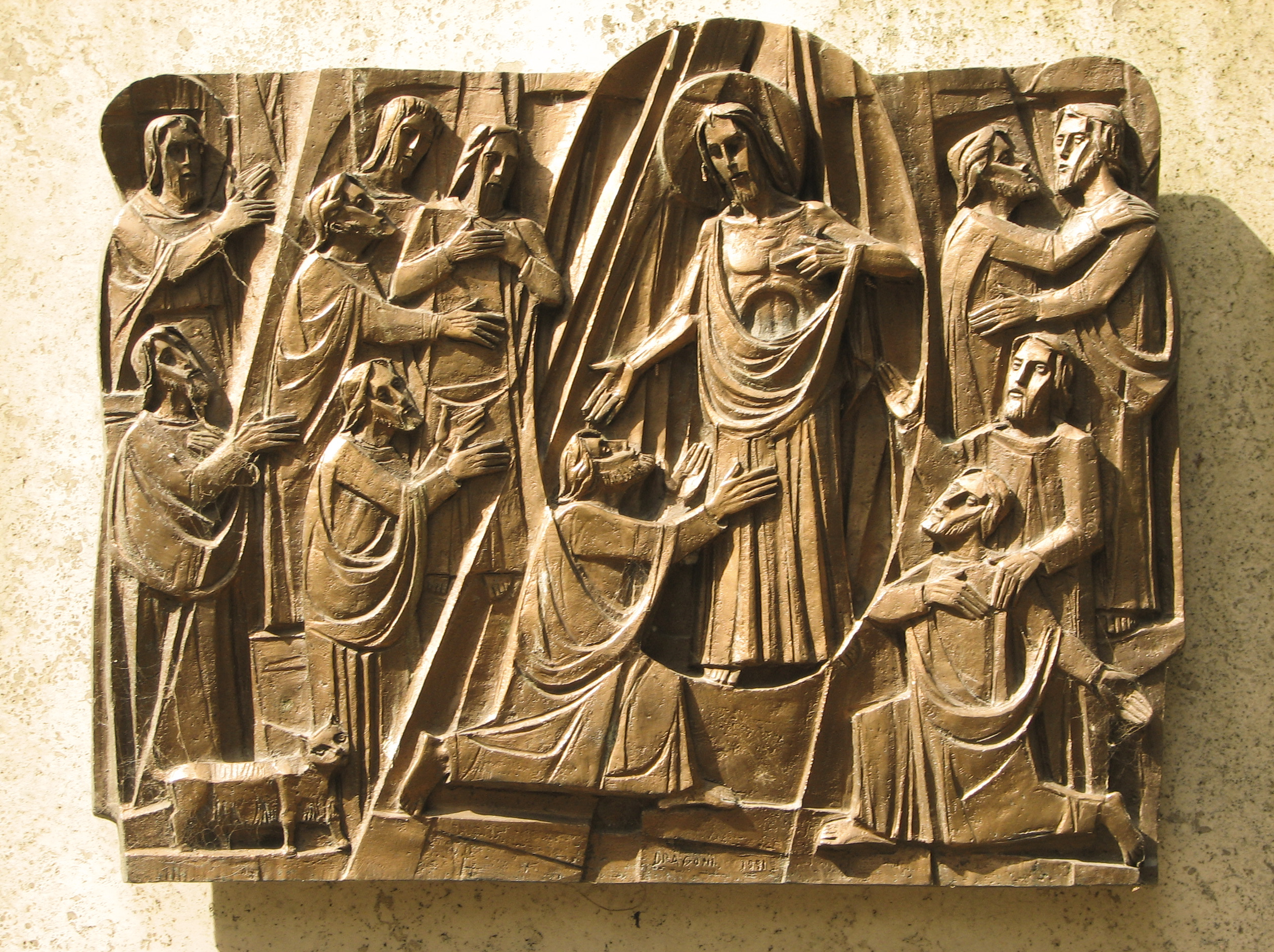
Our Bible reading today is one of my very favourite passages, quite possibly my Number One. I have preached on it often. There are so many wonderful themes: peace to replace fear; joy; the nature of the resurrection body; how the church’s mission is modelled on Jesus’ mission; faith, and how doubting Thomas has been given a raw deal; and so on.
Even my favourite sermon illustration story is based on this reading. So, if you have heard me talk about the missionaries to the Arctic translating the New Testament and what they took from the hunters’ dogs, I would have been preaching on this passage.
Looking on my computer, I have at least ten sermons on these verses. Had I wanted to repeat an old sermon today, I would have been spoilt for choice!
But the other day, I realised that there is one part of this account that I have never preached on. It jumped out on me on two occasions when I wasn’t even thinking about the sermon: once while I was running The Bible Course at Midhurst, and once when I was at Lindford, where they were showing a livestream from this year’s Spring Harvest.
What haven’t I preached on? Verses 30 and 31, which seem to sum up John’s Gospel before the author remembered later to add the story about the miraculous catch of fish and Jesus restoring Peter:
30 Jesus performed many other signs in the presence of his disciples, which are not recorded in this book. 31 But these are written that you may believe that Jesus is the Messiah, the Son of God, and that by believing you may have life in his name.
The whole point of recounting all the stories about Jesus, especially his miraculous signs, is that we who hear them believe in Jesus. And I want to bring two things out of that this morning: firstly a challenge, and secondly, an encouragement.

A Challenge
In one of my previous churches, I had a member called Phil. He was married to Pat, and he was a jazz musician. He led his own band, and once a year brought his band to the church to play a fund-raising concert. It sold out every time.
Sadly, a little while after I left that church, Pat died. Phil asked me to return and conduct her funeral. It was a privilege. Pat had a love of history, and an enquiring mind. She would always have an interesting question to ask me after I had preached.
However, I learned that soon after the funeral, Phil resigned his membership of the church. He said he had only ever come to support Pat. He had never believed. He had sat in church most Sundays. He had come to the communion rail and received the elements. Yet for all his encounter with the Gospel, he had never responded for himself.
It is possible to come to church for years, to participate in church activities and worship, and still not believe in Jesus. So, when I read those words at the end of John 20 again:
But these are written that you may believe that Jesus is the Messiah, the Son of God, and that by believing you may have life in his name
I wondered whether there might be anyone here in the same boat. If you have never made a commitment to follow Jesus Christ as your Lord and Saviour, I want to invite, even urge, you today to do so.
As you will hear if you come to this week’s session of The Bible Course, the four Gospels in the New Testament, including John, have the hallmarks of historical reliability. They show signs of being eyewitness testimony. You may think the events are strange and unlikely, but they were recorded because the authors were astonished by what they witnessed.
And as for the Resurrection itself, the greatest miraculous sign of all, the evidence is extremely strong. There was an old objection that Jesus didn’t really died, he just swooned and then revived in the cool of the tomb. However, he would have been very weak, and how he would have moved the tombstone in such a state beggars belief. Moreover, Roman centurions had to ensure their prisoners were dead. We see the soldiers checking at the end of the crucifixion stories.
The authorities didn’t like the Jesus movement, and especially when they began preaching a few weeks later. If the body of Jesus was still around, they could have produced it and stopped those early believers in their tracks. They didn’t.
Nobody in that society would have concocted fictional stories where the main witnesses were women. They were not allowed to give evidence in court. You wouldn’t write stories where women were the principal witnesses unless it were true.
Then you must wonder why those first disciples gave the next forty years of their lives for something they knew to be a lie, if they had staged false evidence in favour of the Resurrection.
Crazy as it may sound, the best explanation is the biblical one. Jesus was raised bodily from the dead. It shows he is who he said he was, the Messiah, the Son of God. It shows that God says yes to everything he accomplished by his death on the Cross.
If there is anyone hearing this who has never made that final step of turning their lives over to Jesus, now would be a good time to do it. Perhaps you believe in God, you think God has provided all sorts of good things for which you are grateful, but you haven’t made that commitment to be a follower of Jesus.
Or maybe you see coming to church once a week as a kind of religious life insurance policy. You think this is a way of paying a weekly premium to ensure life after death. But Jesus is your Lord and Saviour. He is back from the dead to call for your wholehearted allegiance.

An Encouragement
Around the turn of the century, I went through a mini-crisis of faith. I can’t even recall all the details now, but I do remember that the substance was the disproving of some miraculous claims made by Christians I had trusted. I began to doubt my own judgment. If I’ve got this wrong, what else have I got wrong about life and faith?
Eventually, I reached a state of equilibrium. I concluded that yes, sometimes other Christians let you down. Some even make false claims. You can recognise that without losing your faith. Because Christian faith is faith in Jesus, not faith in human nature. Human nature will always fail.
However, to get to that point wasn’t a quick process. I had one thing that was my rock-solid foundation. I could not shake my belief in the Resurrection of Jesus. I outlined for you in the first point some of the reasons why I believe it is sound on historical grounds to believe that the Resurrection truly happened. It wasn’t made up. It wasn’t a parable to teach spiritual reality. Jesus’ body was raised.
If anyone asks me, why do I believe – and continue to believe – in Jesus, I will always answer: the Resurrection. And that leads me back to verse 31 again:
But these are written that you may believe that Jesus is the Messiah, the Son of God, and that by believing you may have life in his name.
As some Bible translations will tell you in a footnote, the words ‘that you may believe’ may properly be translated, ‘that you may continue to believe.’ For those of you who like languages and grammar, the Greek present tense is a continuous tense. ‘Believe’ is not just about first-time belief: it is about continuing to believe.
And that’s where I offer a word of encouragement today. In the face of our doubts, our questions, our struggles, our failures, and the mess this whole world is in, the truth of the Resurrection gives us a hope we can depend upon.
If you think you are a hopeless sinner and cannot be forgiven, then the Resurrection of Jesus tells you that he has overcome sin. You can be forgiven, and you are forgiven. You can also have the power to begin living differently.
If you are afraid of death, then the Resurrection of Jesus shows us that when we place our lives in his hands there really is nothing to fear. We are safe with him, and our eternal future is glorious.
If you are feeling hopeless, that everything is pointless, and you are struggling to see the point of things, then know that the darkness of the pit at the bottom of the downward spiral cannot cope with the bright light of the empty tomb.
If you are struggling with deep questions about why there is so much evil in the world, then the Resurrection shows us that God overcomes the very worst. What could be more unjust than the execution of Jesus? But the wicked didn’t have the final word: God did. And so, the Resurrection puts those who perpetrate wickedness on notice. In eternity, they will not get away with it. For the Resurrection of Jesus is the promise that one day God will raise up everyone. And then, those who think they can hold onto power by mowing down thousands of their own citizens who protest will find that God is not on their side. Those who think that the way to get justice is to bomb their enemies, including innocent civilians, into submission, will have a shock coming. Those who think they can poison their critics and persecute their opponents will learn they are sorely and dangerously wrong. Those who hoard more money for themselves, especially at the expense of the poor, thinking it is the way to true happiness, will find a misery they could never have imagined. Those who think they can plunder the planet and destroy it for their own gain will be judged by God making a new creation just as he re-creates our bodies.
To be sure, for now we continue to live in the time between the Resurrection of Jesus and that general resurrection of the dead, and so the enemy of death will still take a toll on us. While we grapple with that, let our belief in the Resurrection fill us with hope as we live out the truth of peace with God, peace with ourselves, peace with others, and even peace with creation. We can love God and love others, knowing it’s worth it. We can care about justice, because we know it’s worth it. We can call people to follow Jesus, because we know it’s worth it.
Conclusion
Let’s go back to those words of verse 31 one last time:
But these are written that you may believe that Jesus is the Messiah, the Son of God, and that by believing you may have life in his name.
What do they mean for you today? Is it time finally to come off the fence about Jesus and say you will be a whole-hearted follower of him?
Or is it time to see that the Resurrection is the antidote to the despair and discouragement that have been dragging you down?
It’s common to say ‘It ain’t over until the fat lady sings,’ but the real truth is, ‘It ain’t over until the dead are raised.’

