Joy-Bringer, Isaiah 35:1-10 Advent With Isaiah 3 (Advent 3 Year A)

Isaiah 35:1-10

One popular Christmas carol, especially among American Christians, is ‘Angels we have heard on high.’ Its first verse reads,

Angels we have heard on high
Sweetly singing o’er the plains
And the mountains in reply
Echoing their joyous strains
Gloria in excelsis Deo!

Unfortunately, one source of the music misprinted ‘Echoing their joyous strains’ as ‘Echoing their joyous trains.’
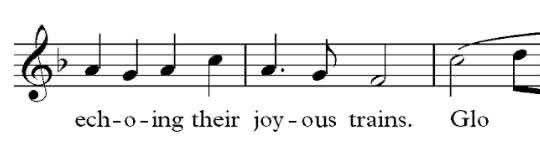
Source unknown. From the Church Service Typos group on Facebook.

I don’t suppose anyone who commutes would readily think of ‘joyous trains.’ I know my wife didn’t on Thursday evening when her train from Waterloo didn’t initially have a driver, when the passengers were told to disembark to find another train, only then to be told to stay on board. They left twenty-seven minutes late. Joyous trains, indeed.

But if the trains were transformed, that truly would be reason for joy.

The theme this week is ‘Joy’ but it is connected with transformation. So maybe a better title might be, ‘Joy in Transformation.’ These verses in Isaiah give five examples of the transformation the coming Messiah will bring, which lead to joy. It was something the southern kingdom of Judah needed to hear, nervous as the nation was due to the military power of Assyria, which had already conquered the northern kingdom of Israel.

But as so often in Isaiah, we shall see that no earthly king could completely fulfil the prophecy. Even with Jesus, the true Messiah, he would begin the transformational work prophesied, but it will only come to complete fruition with his return in glory.

However, in the meantime, in our in-between time, these point to our work for God’s kingdom today. There are five arenas for joy in the reading; I shall deal with each one briefly.

Firstly, joy for the desert:

The desert and the parched land will be glad;
    the wilderness will rejoice and blossom.
Like the crocus, 2 it will burst into bloom;
    it will rejoice greatly and shout for joy.
The glory of Lebanon will be given to it,
    the splendour of Carmel and Sharon;
they will see the glory of the Lord,
    the splendour of our God.

In the Middle East, the people know all about parched deserts in the heat. But God will restore life to the desert as he breaks the drought and beautiful plants bloom and flourish there.

Our droughts today are often caused by our failure as the human race to fulfil the command we were given when God created us: namely to rule over the created order wisely on his behalf. Instead of caring for it, we have exploited it. Now we pay the consequences – but worse, it is the poorer nations who are suffering first and most.

As Christians, we have common cause with those who are concerned for our environment. But we have a unique reason for being involved. It is that we are doing so as stewards of God’s creation, and as a prophetic sign that God will make all things new in his creation. We agree that the world is in a mess, but we engage out of a spirit of hope, not panic.

So let us engage in our creation care as an act of worship and of witness to the Messiah who will renew the earth. And if we listen carefully, we may catch the sound of the world rejoicing, too.

Secondly, joy for the fearful:

3 Strengthen the feeble hands,
    steady the knees that give way;
4 say to those with fearful hearts,
    ‘Be strong, do not fear;
your God will come,
    he will come with vengeance;
with divine retribution
    he will come to save you.’

At the time of the prophecy, Israel could well have been afraid of Assyria. But as we know, fear comes in many flavours. Fear of war. Fear of death. Fear of other people’s expectations. Fear of losing someone. The list of fears is long.

In the specific context, Isaiah promises that those who are afraid of wrongdoers can take heart, because God will judge the wicked who are scaring them.

And yet there is still a universal application. It is often said – and I confess I have not checked the veracity of this – that the words, ‘Do not be afraid’ occur three hundred and sixty-five times in the Bible. One for every day of the year. You can have one day of fear in a leap year!

God does not want us paralysed by fear. He wants us animated by love. And so, he promises to banish the forces and the people that cause us to fear. The life of the messianic age to come will not be characterised by fear. It will be an eternal age of love.

And if God promises that for us, we can ask ourselves, what can we do to help remove fear from the lives of other people? Sometimes we can banish the cause of fear. In other circumstances, we may not be able to do that, but we may be able to show how to live without fear when unwelcome things happen.

I know how easy it is to panic. My body goes into panic mode before my mind catches up with the truth. For me, God’s message of peace and love comes through human beings, not least my wife. There has been more than one occasion when people who didn’t like me in churches have made up false and malicious Safeguarding accusations against me. One time, my Superintendent phoned me and said, ‘Watch your back on Sunday morning.’ Debbie has helped me be anchored in truth when lies have flown about.

Thirdly, joy for the silenced:

5 Then will the eyes of the blind be opened
    and the ears of the deaf unstopped.
6 Then will the lame leap like a deer,
    and the mute tongue shout for joy.

There is more than one way of reading these words. Some take them literally as a promise of healing, and we saw in our Gospel reading from Matthew: Jesus did heal the blind, the deaf, and the lame. I wouldn’t want to deny that, nor the promise of full healing when Jesus comes again and makes all things new. I would encourage us to pray for the sick, just so long as we don’t treat chronically ill or disabled people purely as prayer projects rather than people with dignity. As the title of one book puts it, My Body Is Not A Prayer Request.

But I will say there is a wider meaning to these words. Why did I introduce this point as ‘joy for the silenced’? For this reason. Our English translations say at the end of the quote, ‘the mute tongue [will] shout for joy.’ But the words ‘for joy’ are not there in the Hebrew. The mute will shout. That’s it. People who have been silenced by those who oppress them find their voice in the kingdom of God. The persecuted are vindicated and set free. The people that society does not value are of great worth and significance to Jesus.

The early church did this by the way they gave importance to slaves and women. Jesus calls us too to value those who would not be elevated by our society. He longs for them to find their place in his family and his kingdom purposes. Let’s not evaluate people by worldly standards, but by the fact that they are loved and cherished by God in Jesus.

Fourthly, more joy for the desert:

Water will gush forth in the wilderness
    and streams in the desert.
7 The burning sand will become a pool,
    the thirsty ground bubbling springs.
In the haunts where jackals once lay,
    grass and reeds and papyrus will grow.

We’re back in the wilderness, but to make a different point. This time, we see the conditions coming together so that life can flourish. Water to drink. Papyrus to make documents. Reeds to make household items.

In this context, artisans, craftsmen, and business can flourish. Their raw materials are plentiful again.

And so, I want to suggest to you that one way we can be a sign of the Messiah’s coming kingdom is by supporting human flourishing, including our local businesses.

Is that a Christian thing to do? I think so. Remember how later the people of Judah were taken into exile in Babylon. The prophet Jeremiah wrote a letter to the exiles. You can find it in Jeremiah 29. In that letter, he tells these Jews who have been separated from their own land and temple that were so vital to their understanding of salvation that they were to seek the prosperity of the city to which they had been taken. Yes – even a pagan city. Go and bless the pagans, says Jeremiah: it is a sign of God’s covenant love.

Let’s cultivate our relationships with local shops and businesses. Not only by giving them our custom, but that when we do so we take an interest in them and we build relationships with them. I have known ecumenical groups of churches in a village take boxes of chocolates to every business in that village at Christmas, with a card thanking them for all they do, and offering to pray for them if they would like it.

Which shops, businesses, or community groups do you appreciate here? Can you bless them? I’m sure you can. Maybe it will provoke questions.

Fifthly and finally, joy for the temple:

8 And a highway will be there;
    it will be called the Way of Holiness;
    it will be for those who walk on that Way.
The unclean will not journey on it;
    wicked fools will not go about on it.
9 No lion will be there,
    nor any ravenous beast;
    they will not be found there.
But only the redeemed will walk there,
10     and those the Lord has rescued will return.
They will enter Zion with singing;
    everlasting joy will crown their heads.
Gladness and joy will overtake them,
    and sorrow and sighing will flee away.

The highway of holiness, on which only the redeemed and not the unclean may walk, is surely the road to the temple in Jerusalem.

This reminds us that when Jesus is present among his people, there is joy. Yes, of course we will be reverent: I am not calling for some religious chumminess with God. But for all that, to have the Messiah in our midst will be a cause for joy and it will reflect in the way we are together in worship and in the sharing of our lives together. With Jesus, church is to be a place of joy.

Today, we only have that experience of Jesus by the presence of his Spirit within us and in our midst. But part of the fruit of the Spirit is joy! And one day, we shall all be together in the presence of Jesus and his Father, too.

It’s nice that we look forward to seeing our friends at church. But that doesn’t make us any different from anyone else. Do we have a sense of joy that Jesus will be present with us, and indeed that we are each bringing him with us to our gathering? That is what the messianic community is like.

Conclusion

Joy to the world, we sing at this time of year, the Lord is come. And when the Lord comes, there is joy. Joy for the broken, joy for God’s people and joy for all creation.

And when he comes again, the joy will be magnified and sorrow banished.

Let us, the followers of Jesus, then, also be joy-bringers.

Holy Week Meditations: Jesus Under Question. Render Unto Caesar? (2/3)

Luke 20:20-26

It’s hard if you are of a certain age reading this story not to remember the time when Margaret Thatcher patronisingly said that Jesus ‘got it about right’ with his teaching to render unto Caesar. In one Christian magazine at the time, a writer compared her attitude to that of Field Marshal Montgomery, who one day was appointed to read the Old Testament lesson at Matins in a parish church. Montgomery began, ‘And the Lord said unto Moses – and in my opinion quite rightly …’

What a dangerous thing it is to put ourselves in judgment over Scripture. And it is not even more dangerous that the temple authorities in our story put themselves in authority over the One to whom the Scriptures witness, Jesus Christ himself?

What is at stake?

We left those leaders down on the canvas yesterday after Jesus outwitted them on the question of authority. But they have not been knocked out. They are going to get up and continue the fight. Indeed they must, if they are to preserve their position, their power, and the institution that gives all that to them. Like Arnie, they’ll be back.

And they are back here, albeit at arms’ length. They do not show their own faces immediately but instead send spies. That in itself is sinister enough. They are practising surveillance of their enemy. Think today of governments that plant spies in churches – China, for example. 

Naturally, Jesus is not fooled by this tactic of confronting him from the shadows. He knows who his questioners represent. He knows what Luke tells us in verse 20, that their motive was to have evidence that would enable them to hand him over to Pontius Pilate as a seditionary. 

In fact, the trap the spies lay is threefold. One element is indeed that if Jesus were to say, do not pay taxes to Caesar then that is an easy win for handing him over to Pilate. Look, they will say, here is someone who is undermining the Pax Romana. He is treacherous. Oh, and by the way, aren’t we good citizens for snitching on him? 

And that last element about their own reputation with Pilate was significant. Because Pilate was in a politically weak situation with them, even though he was the Roman governor. 

Why? Because earlier he had authorised some actions that were so offensive to the Jews when he allowed Roman symbols to be set up in the temple that a delegation of Jewish leaders had gone to Rome to complain about him. He had received a telling-off for not respecting the local religious customs and was now on thin ice. One more wrong step and he would be gone. The religious hierarchy here hope to further strengthen their position with him. As it is, they will certainly play on Pilate’s politically weak position later in Holy Week. 

This, then, is the first trap. Jesus may win popular acclaim if he tells people not to pay taxes to Rome – think how the tax collectors were hated. But if he does so, he effectively signs his own death warrant. And the temple authorities are in a strong and increasingly stronger position with Pilate, which suits them nicely. 

The second trap is if Jesus takes the opposite position and simply says, of course you should pay taxes to the ruling authorities. This is what the good believer does. There is a good case in both Old and New Testaments for Christians being loyal citizens – at least far as their consciences will allow – when living under the rule of nations that do not sympathise with their faith. The most striking example of this is the Jewish exile. Jeremiah tells the exiles in chapter 29 of his prophecy to seek the welfare of the city to which they have been sent. Daniel and his friends serve Babylon as far as they can and only stop at the point where to continue obeying would mean disobedience to God. Later, after Babylon has fallen, Nehemiah serves as cupbearer in the court of King Artaxerxes. 

But for all this, if Jesus does endorse paying taxes to Caesar, this will be seen by the ordinary people as caving in to the hated occupying Romans. These are the unclean people who must leave or be driven out of the Promised Land. The land must be cleansed of them. The Torah must be the law of the land and Israel must obey it. Then the Messiah will come. Groups like the Pharisees taught something like this. The Zealots took it to extremes with their violent and military opposition to Rome. 

Not only that, there was what you might call a social justice element to the opposition to rendering to Caesar. Although the Roman tribute only amounted to an annual payment of a denarius, a day’s wages, that would still have been significant for the many peasants who lived on the borderline of economic subsistence. They needed every penny, and even then survival was still precarious. They could do without another tax. 

These are the two traps that are most obvious in the text, and the two we hear about the most. But there is a third trap. I opened the first meditation by talking about the significance of the theme of the temple, and this is where it makes an appearance in this episode. Guess who was responsible for collecting that annual payment of one denarius to Rome? Why yes, it was the Jerusalem Sanhedrin. Some would say they compromised their loyalty to the Jewish faith by doing so, but in their eyes they were making a small concession in order to guarantee the continuation of the temple cult and the identity of the temple. To them, the temple mattered more than anything else. If Jesus opposed the payment of taxes to Rome, he would be undermining the Jerusalem temple itself, and that most certainly was not to be tolerated. 

How does Jesus respond?

Yesterday, we noticed how Jesus responded to a question with a question of his own. He does the same again today. He will not be boxed in by his opponents. He takes the initiative. He is after all Lord, even if they don’t acknowledge it, and he reserves his right to interrogate.

Not only that, but we shall also see that the outcome of his response is not a straight answer to the dilemma posed by the spies. If anyone is looking here for a simple answer about whether we should pay our taxes, Jesus’ answer will disappoint us, because he refuses to ask that. We are going to see that what Jesus does exposes the sin of the religious leadership. No wonder they are silenced afterwards. 

So here is how Jesus responds with a question:

23 He saw through their duplicity and said to them, 24 ‘Show me a denarius. Whose image and inscription are on it?’

‘Caesar’s,’ they replied.

25 He said to them, ‘Then give back to Caesar what is Caesar’s, and to God what is God’s.’

Well, lo and behold the spies do indeed have a denarius, just as Jesus asks. What a surprise! After all, as I mentioned, the Jerusalem Sanhedrin administered the Roman tribute tax for the occupying army. They are caught red-handed. 

And given that, there are two ways in which what Jesus says condemns the temple authorities. First is his language about ‘image.’ What are they going to think of in biblical terms when the word ‘image’ comes up? They are going to remember that all human beings were created in the image of God, and that the commandments forbade any graven images of the one true God. Yet here in the denarius is a coin that bears the inscription, ‘Tiberius Caesar, son of the divine Augustus.’ By colluding with the Roman authorities to collect a coin with that text, the temple leadership, the people who should have been defending and propagating the faith of Israel, are in fact colluding with false gods. They are promoting idolatry. They have no moral or religious authority, because it is undermined by their actions, which utterly contradict the basic tenets of the faith they are supposed to promote. 

The second is when he says, ‘Give back to Caesar what is Caesar, and to God what is God’s.’ Traditionally, we’re used to hearing, ‘Render unto Caesar’, but the emphasis is not simply on ‘Give,’ but on ‘Give back.’ In other words, Jesus is not saying, you have some civic duties and some religious duties. He is not answering a general question about taxation. Margaret Thatcher and others misunderstood him. No: he is telling the Sanhedrin to get out of administering the temple tax. They are more concerned with winning favour with the Roman powers-that-be than they are with winning favour with God. They have compromised their faith for the sake of political gain. 

Don’t get me wrong: Jesus is not saying that true disciples should not be involved in politics, but he is saying that followers of the One True God should not sell their souls to politics. They should not place it above their devotion to God. They should not use politics as a means to an end of personal gain. And if that sounds uncomfortably like what we have seen in the USA with Donald Trump’s MAGA Christian supporters, well, it is. 

Politics is a worthy if difficult place for a Christian to serve God in the world. Christians should take on such a call on the grounds of the old saying that if Jesus is not Lord of all then he is not Lord at all. He is Lord over politics. But going into that field must not be for personal gain. It must be to serve others, regardless of whether any benefit comes our way. 

Besides, when people play with politics for their own ends, what kind of people do well out of it? Is it the poor and the powerless? No. It’s the wealthy. It’s people who already have power. That should concern Christians. Again, look at America, and perhaps this time look at Elon Musk. 

No, Sanhedrin, says Jesus, give back to Caesar. Your job as leaders of God’s people – if that is what you truly are – is to speak truth to power, not to prefer power to truth. It’s a searing critique, and one the church needs to hear in every generation. 

Ultimately, this is not that different from when Jesus said, you cannot serve both God and Mammon. You have to make a choice, you ‘gotta serve somebody’, as Bob Dylan sang, but it can only be one and not both. The temple authorities have chosen to side with the Empire rather than the kingdom of God. 

The spies are silenced. They have been caught out. Moreover, they have been shamed by this public exposure of their utter disloyalty to Israel’s God. 

But while their shame may indicate that their sin has been laid bare, it is no more than remorse at best. It is not repentance. They do not change. They stay on their evil course, as the rest of Holy Week will demonstrate.

Holy Week Meditations: Jesus Under Question. By What Authority? (1/3)

Introduction

We are going to look at three stories that fall early in the Holy Week narrative in Luke’s Gospel, all of them in chapter 20, where Jesus is questioned by the authorities. Sometimes we read these stories in isolation, but it’s important to see that they occur in Holy Week, because they are all part of the authorities ramping up the pressure on Jesus. They are all part of the campaign that leads to the Cross. 

And within that context of the opposition during Holy Week, there is one theme we must bear in mind, and that is the Temple. All of the questioning finds its source in those who run the Temple. You will remember that when Jesus is put on trial, he is accused of saying, ‘Destroy this temple and I will rebuild it in three days.’ 

Well, later in Holy Week Jesus did indeed prophesy the destruction of the Jerusalem temple. It was not an act he was going to accomplish, though: his prophecies relate to the destruction that the Roman legions would execute in AD 70, when they put down the Jewish revolt. 

And we also remember that when Jesus said, ‘Destroy this temple and I will rebuild it in three days,’ he was referring to his own body. For in New Testament terms, Jesus himself is the true temple. The temple was reckoned by Jews to be the place where heaven and earth met. Jesus, being fully divine and fully human, encapsulated that in his own being. In Jesus, heaven and earth met. Hence, he was the true temple. Moreover, his death would replace the Jerusalem temple’s sacrificial system. Again, he was the true temple. He was coming to replace the existing one. 

Jesus, then, is a threat to all who constitute the Jerusalem temple authorities. They may not know all that I have just described, but they know enough to realise that this popular preacher is a hazard to all their vested interests. He must be stopped. 

But this isn’t just a private spat between Jesus and the authorities. It is set in the context of Jesus teaching the people. They are listening to him when the temple authorities turn up and interrupt. In between the three episodes we are going to look at, Jesus addresses the people with his counter-arguments, including a parable that shows up the authorities for just who they are before God. The people represent Israel. Will they follow the Messiah? Or will the temple leaders undermine their faith in Jesus?

So with all that background laid out, let’s look at the first of these three stories where the temple leaders put Jesus under question. 

Luke 20:1-8

The challenge

How ironic it is that the authorities turn up just as Jesus is teaching and ‘proclaiming the good news’. Is it that Jesus is good news and they are bad news? Why would they want to put a stop to someone who proclaims good news? What does this say about them? The contrast is set up at the outset. 

But even the ‘good news’ would have been threatening to them. Remember that ‘good news’ was something proclaimed in the Roman Empire by a ‘herald’ (the Greek word for which became a New Testament word for a preacher or evangelist) who travelled to different towns telling the population there of some wonderful event. ‘There is a new emperor on the throne in Rome!’ ‘Rome’s army has won a great victory!’

When Jesus proclaims the good news it’s all that and more. There is indeed a new king on the throne – not in Rome but in heaven, ruling the universe. After his death and resurrection, the early church will proclaim that as good news, too, because God will have won a great victory, not by killing but by suffering. 

If Jesus is proclaiming good news of a new king, then no wonder the New Testament tells us elsewhere that he was announcing the good news of the kingdom of God. This would have been a challenge for the temple leaders who, although they were not appointed by Rome, certainly had their security in office guaranteed by Rome, just so long as they played along. If there is a different king on the throne, then that Roman backing is undermined. Is it any wonder they don’t like the good news of Jesus?

And so they come along and they try to undermine Jesus on the basis of the location, namely the temple. It’s their territory. This is where they have authority. To ask Jesus, ‘By what authority’ he does these things and who gave him such authority, they are saying, look, this is our patch, we are the ones in charge here. You are the outsider. You haven’t been properly authorised and appointed. So what gives you any right to say or do any of that stuff, especially here? 

I guess it might work if you were dealing with a mere mortal. But Jesus knows where his authority comes from, and so do readers of Luke’s Gospel. Luke has told us that Jesus was conceived under the overshadowing of the Holy Spirit. The same Spirit has descended on him like a dove at his baptism, and the voice of his Father from heaven has affirmed him as his beloved Son. Jesus has laid out his manifesto under the anointing of the Spirit in the synagogue at Nazareth. And then a ministry has followed where all of this has been demonstrated. By what authority? Do the temple leaders really want to know the answer to that question? 

By what authority? It’s still a dangerous question today. We hope and pray that those in leadership in the church today are those who have the authority of the Holy Spirit at work in their lives and that also this is what the church has discerned in the selection and appointment process. Is it always true, though? Sometimes we come up with our own criteria that may sound good and faithful, but then in practice we may not sense the work of the Spirit. We who lead sometimes end up going through the motions rather than relying on divine authority. It’s not really enough for us to fall back on saying, well I was appointed or ordained by the church if we are not attentive to the Holy Spirit.

But Jesus has no such worries. His knowledge of where his authority comes from and who he is in relationship to the Father gives him a security that leads to the boldness of his ministry. He is the Beloved Son, always full of the Spirit. That’s potent. 

So is this how Jesus will respond, by setting out his credentials? Not a bit of it.

The response

It’s very rare that Jesus responds to a question, even a friendly one, with an answer. Often, he replies – as here – with another question. While there is truth in the old slogan ‘Jesus is the answer’ it’s every bit as true that ‘Jesus is the question.’ At least, here and in other places Jesus is the questioner. 

Even though later in Holy Week at his trials he will often be silent, here Jesus goes on the offensive with his question. He is still in the business of exposing unrepentant sin, and that is what he does by throwing a question about authority back at his opponents. 

And moreover – remember that the ordinary people are present in the scene – Jesus picks on an issue of authority that will chime with them, not with the temple leaders. 

That issue is John the Baptist. When Jesus asks, ‘John’s baptism – was it from heaven, or of human origin?’ it’s about more than just John’s baptism. Those two words are like an abbreviation for the whole of John’s ministry. This is a question about the entire authority behind John’s ministry: was it from God, or was it merely human? 

That makes it a huge question. John was a barometer for how people responded to the divine purposes of redemption. Not only that, but he was widely regarded as a prophet. And further, he was depicted as the one who would come before the Messiah, according to Malachi’s image of a returned Elijah heralding God’s anointed. Where you stood on the authority of John really mattered. 

And in particular, the link between John and Jesus meant that if you endorsed John’s divine authority, you endorsed that of Jesus, too. But if you denied John’s spiritual legitimacy, you not only denied Jesus, you also lost the people who was listening to Jesus, who certainly thought John was a prophet. 

Checkmate? Very possibly. That’s certainly how the religious leaders react. They don’t know what to say. They realise that any answer they give to Jesus’ conundrum puts them in a bad situation. At this stage, Jesus is too popular with the ordinary people and so they can’t alienate the crowds by denying the legitimacy of John’s ministry. But if they take the other option, then the logical conclusion is that they should end up following Jesus, and that is out of the question. He is the thorn in their side that they want rid of. 

Jesus wins this round. What was he trying to achieve? Is this an exercise in saving his own skin that succeeds here but will fail later in the week? Regular observers might suppose so. But the readers of the Gospel know, and the disciples should know, that he had prophesied his betrayal, suffering, and death. He is heading towards that destiny, even if the utter horror of it has not hit him yet in the way it will in the Garden of Gethsemane. 

Yet if he knows that the Cross is his destiny, why even bother to debate and outwit the temple hierarchy? Surely it is because wickedness must be exposed by the truth, whatever the cost. Think of how Jeremiah was called to a ministry where it was his calling repeatedly to remind Israel of God’s truth, even though in the short term they were not going to obey. It was still important for there to be a faithful witness to the truth in the face of evil. The people of Jeremiah’s day were without excuse. Those who exercised power during Jesus’ ministry would now also have no excuse before God for their words, attitudes, and actions. 

Does this make us think of situations today where Christians need to witness faithfully to God’s truth in opposition to great evil, and to do so at the risk of paying a great cost? Might that even happen in the USA under Donald Trump’s presidency? 

What about the leaders? They are embarrassed before the people. Their stature and authority before the ordinary Jews has been fundamentally undermined by Jesus. He had made a laughingstock of them. It is almost like the way a satirist uses ridicule to expose the wickedness of a politician and to imply that things should be better than they are. 

Are they going to take this defeat lying down? No. With their hearts hardened by their own choice to the searing moral critique given by Jesus, they are going to defend their position and their interests against all opposition, not least this upstart from up north in Nazareth. 

We haven’t heard the last of them. They will be back. 

Questions for reflection

In what ways today is the Good News of Jesus a threat to the powerful?

Is there any way in which the Good News has been a threat to you? How have you responded?

What makes you recognise the authority of Jesus?

How do you react when the teaching of Jesus shows you to be in the wrong?

What would be a Christian way of handling power today?

Mission in the Bible 5: The River from the Temple (Ezekiel 47:1-12)

I’m back, although not fully recovered yet. So here is a slightly shorter than usual Bible talk. Please excuse the regular water-sipping in the video!

Ezekiel 47:1-12

If you ask most average Christians what the main purpose of the Church is, the most popular answer is, worship.

But in this life that is at best an incomplete answer. It may be true in the life of the world to come, but right now there is more than worship to do as the Church. There is mission as well as worship.

Look in our passage how the living waters, the river of God, ultimately coming to symbolise the Holy Spirit, may start flowing at the Temple in Ezekiel’s dream but they don’t remain there. They flow out to bless the surrounding world.

Let’s look at the flow.

Firstly, in the river beginning at the Temple, mission starts at the place of sacrifice.

Ezekiel’s dream or vision is of a rebuilt Temple after the return of Israel from exile in Babylon. It was the centre of worship and the place of sacrifice. Therefore, this vision says that sacrifice is not just about the benefits for the personal worshipper. It goes out and beyond.

As Christians, we see this most clearly in the Cross of Christ. His death ends all need for sacrifices for sin. It was the ‘one full, perfect, and sufficient oblation’ as the Anglican Book of Common Prayer puts it.

We receive the benefits of the Cross when we come to faith and when we confess our sins every week. It is comforting and healing to know that this is the sign of God’s enduring and faithful love for us, the love that anchors our lives.

But for Ezekiel, the river of life begins at the place of sacrifice. And for Christians, the Cross also means that God will pour out his Spirit, and when he does the benefits of Christ’s sacrifice will be seen as not merely for us but for the whole world. It is what happened at the first Christian Pentecost. The Spirit falls, Peter preaches the Gospel, people of many nations hear, and thousands profess faith.

The first thing to remember, then, is that our blessings are not for us alone. That’s why I can’t stomach attitudes to church that sound like consumerism: what’s in it for me? What do I get out of this, never mind anybody else? Perhaps one of the classic examples is the older person in a declining church who says, ‘All I care about is that this church is here to see me out.’ That is a selfishness that cannot sit in front of the Cross of Christ.

Secondly, also in the river beginning at the Temple, we see that mission is launched in worship.

The river of God, the water of life, the Holy Spirit, does not simply bring joy, refreshment, and power to worship. The river flows from the place of worship to the world.

Again, there’s a challenge to our consumer attitudes to church. Worship is not just a personal bless-up. Yes, there are times when God blesses us graciously out of his sheer love for us. And sure, we often come in great need of blessing ourselves. But worship is not fundamentally a ‘getting’ experience. It is a giving experience. And it takes us beyond Sunday, into Monday and on from there.

What happens on Sunday is part of what equips us for Monday. That’s why an organisation like the London Institute for Contemporary Christianity came up with something called ‘This Time Tomorrow’, where a church member is interviewed in the Sunday service, asked what they will be doing in twenty-four hours’ time, and how people might best pray for what they will be doing then.

Or come with me to an American church that has, over the exit from the building, put the words ‘Servants’ Entrance.’ We go out from worship on mission in the world, showing God’s redeeming love in our words and our deeds.

The Holy Spirit is always thrusting us out into the world with the love of God. In the Gospels, after Jesus has his amazing spiritual experience at his baptism, he next goes into the wilderness. Some English translations rather tamely translate the Greek to say that the Holy Spirit led Jesus into the wilderness, but it’s actually more forceful than that. In at least one of the Gospels, the writer literally says that the Holy Spirit threw Jesus out into the wilderness. The ‘throw’ part is related to where we get our word ‘ball’, and it makes me think of a cricketer in the field on the boundary, positively hurling the ball all the way back to the wicketkeeper with considerable force.

You and I have come to worship today for a purpose. Yes, we may need some blessing or comfort, but what we haven’t come for is, so to speak, just to be tickled by God. We have come to encounter the Holy Spirit, who will energise us for our daily witness in the world.

Thirdly, in the river flowing from the Temple, we see that mission is to transform creation.

The river gets deeper and deeper, even to the point where no-one can swim in it. And for someone like me who can’t swim at all in the first place, that’s scary!

But it’s scary in a good way. What we see here is the awesome power of God transforming creation. Take the reference to life teeming in the Dead Sea, where the extreme saltiness is usually a killer. I visited the Holy Land in 1989, and on the day we went to the Dead Sea, some of my friends got into the water and floated – I’m sure you’ve seen pictures of that there. But for me, the salt was so intense even in the air that my eyes stung and I couldn’t even look in the direction of the water to see my friends, let alone take photos on my camera. And I am a keen photographer.

That’s how salty it gets there. So for Ezekiel to see the salt water become fresh and be filled with fish and other creatures is an image of a miracle.

Then look at the trees on the riverbank, which bear fruit every month rather than every year, whose ‘fruit will serve for food and … leaves for healing’ (verse 12). Reading that from a New Testament perspective makes us think of the way this passage is an inspiration for the Book of Revelation, where trees line not a river but the Holy City, and whose ‘leaves are for the healing of the nations.’

Yes, there are marshes where nothing changes, just as there are many who are resistant to the Gospel of God’s grace in Christ that calls everyone to repentance and faith in Jesus. But overall what we perceive in Ezekiel’s vision is a foretaste of the day when God will make the new heavens and the new earth, where everything that is broken in creation is healed, where relationships with God and one another are reconciled, and where all pain, war, and suffering is abolished.

What does that mean for us? It means that our encounter with the Holy Spirit through the Cross of Christ and through worship throws us out into the world as bearers of God’s love in a multiplicity of ways. The Holy Spirit sends us to call people back to God through Jesus. The Holy Spirit sends us to be people who heal relationships. The Holy Spirit sends us to be people of peace, not violence. The Holy Spirit sends us to bring good news to the poor and the wounded. The Holy Spirit sends us to restore broken creation, not because we are afraid of what will happen to this planet, but because we are full of hope about God’s good intentions for his creation.

When we come to worship each Sunday, the presence of God equips us for these tasks. When we leave gathered worship each Sunday, we go as commissioned officers of God’s kingdom.

Create a website or blog at WordPress.com

Up ↑