Keep Quiet – Jesus Is At Work (Mark 5:21-43)

Mark 5:21-43

Last week, when our reading was about Jesus stilling the storm on Galilee, the story came to quite a climax. Jesus’ disciples said, ‘Who then is this? Even the wind and the waves obey him!’

It’s quite a punchline. Mark leaves us in no doubt that he wants his readers to consider who this amazing Jesus is.

This week is different. While we have two amazing stories woven into one narrative, the climax after the healing of the woman with the flow of blood and the raising of Jairus’ daughter feels like an anti-climax:

43 He gave strict orders not to let anyone know about this, and told them to give her something to eat.

Keep quiet and have a snack. That’s it.

It’s not the only time Jesus tells people to hush their mouths about one of his miracles in Mark’s Gospel, and many people have assumed that the reason Jesus took this apparently rather strange approach was that if word got out that he was the Messiah the expectations people would have of him would be nothing like the way he saw messiahship.

And with that in mind, we have to look more carefully for the themes of Jesus’ mission that Mark wants to highlight here. I’ve found three.

The first is unity.

Look at the contrasts in the story. Jairus’ daughter is young: she’s only twelve. The woman, on the other hand, has had her distressing medical problem for as long as the girl has been alive. She is much older.

The woman is also now in poverty. She had spent all she had on doctors (verse 26). The young girl, on the other hand, is the daughter of a man who is probably quite well-to-do.

The woman creeps up on Jesus from behind (verse 27). Jairus is direct and open, falling at Jesus’ feet to beg him for mercy for his beloved daughter (verse 22).

Young and old, rich and poor, bold and shy – the range is wide but the need is the same. However different they are, Jesus knows they need the mercy and grace of God.

And that’s what he does. He brings people of all circumstances and life experiences into the family of God, because all need God’s grace and love.

That’s a picture of God’s kingdom. Jesus crosses all our human barriers because everybody needs the grace of God. In our social lives and our friendships we might look for people with similar interests or experiences to us. But in God’s family he brings together rich and poor, black and white, northerner and southerner, male and female.

I can look around congregations I’ve served and see people who owned two homes sitting next to others who were on a fixed pension. I can see my West Indian friends from the Windrush Generation and succeeding generations mixing with white Europeans. I’ve even found Arsenal supporters in the church, and that’s hard for me as a Tottenham fan!

Seriously, this work of Jesus to bring all sorts of people into the love of God is the first sign of his work of reconciliation. He reconciles people to God and he brings them into a family where those same people, often or different or even opposing backgrounds end up being reconciled to one another.

I like to put it like this. Jesus accomplished that reconciliation at the Cross. And the Cross has both a vertical beam, indicating our relationship with God and a horizontal beam, indicating that we are also reconciled with one another.

Do you need that reconciliation with God or with other people? Receive all you need for that from Jesus.

The second theme I’ve found is sovereignty.

Sometimes I wonder how I would be feeling in this story if I were Jairus. After all, I have a daughter, too. But to come in desperation and plead with Jesus, who agrees to come to my house (verse 24), only to find that he then stops and spends time trying to find out who touched him (verse 30) when time is of the essence – I think that would shred any remaining nerves that I had in my body.

Not only that, we get to Jairus’ house and we’re told that the daughter is dead (verse 35). Why did Jesus delay?

It’s a little like the story in John 11 where Jesus’ friend Lazarus dies but he doesn’t rush to Bethany where Lazarus lived with his sisters Mary and Martha. Jesus bides his time.

And so too here. Jesus isn’t ruffled. He encourages Jairus to continue believing (verse 36) and he isn’t rattled by the commotion caused by the professional mourners or the crowd laughing at him for saying the child is only asleep (verses 38-40).

It may not look like it to us, but Jesus has the situation under control. Taking only the girl’s parents and his three closest lieutenants, he goes to the girl and heals her (verses 40-42).

I wonder whether there is something that feels like it’s running out of control in your life? Is there something that seems to be descending into chaos and you’re afraid of where that will leave you?

If you are, I encourage you to invite Jesus into the situation. You can sound as desperate as Jairus if you like, it doesn’t matter. Jesus won’t be fazed. Let him walk calmly with you through what you fear will be an impending disaster.

That’s why I say this is about sovereignty. He’s still in charge. So turn to him.

The third and final theme I’ve noticed in the narrative is purity.

The condition of the woman made her ritually unclean in Judaism. For Jesus to come into contact with her would make him unclean.

And similarly, if you touched a dead body, as Jesus did when he took Jairus’ daughter by the hand (verse 41), that also made you ritually unclean.

It’s as if the uncleanness always pollutes the clean.  It’s like dropping one blob of ink into a glass of water and seeing the ink affect all of the water.

Except that doesn’t happen here. You could say that the purity of Jesus is so strong that it overpowers the ritual impurity of the woman and of Jairus’ daughter.

In this story, darkness doesn’t finally overcome good. It isn’t even a fight between two equals as some make it out to be. It isn’t even a fair fight at all. Jesus has all the power of divine holiness. That which would ruin lives cannot compete in his presence.

It makes me think about a couple of verses from the First Letter of John:

The reason the Son of God appeared was to destroy the work of the devil. (1 John 3:8)

Greater is he who is in you than he who is in the world. (1 John 4:4)

Sometimes when we’re involved with all our fallibilities the fight against suffering and sin is long and grim. But with Jesus in charge the final outcome is certain. None of this can stand in his presence. Instead of the virus of sin contaminating him, his holiness infects the darkness, exposes it, and cleanses it.

Isn’t it good news that ultimately the pure holiness of Jesus overcomes all the darkness and despair of this world? If you’re disheartened because the bad stuff so often ends up on top, look at this story and see signs that what Jesus does here puts all the powers of darkness on notice for what will ultimately happen when he appears again on Earth in glory.

Take heart from the superior purity of Jesus!

In fact, take heart from all three of the themes we’ve been thinking about today. Be glad that Jesus opens the kingdom of God to all people, that God longs to see all people reconciled to him and to one another. Rejoice in the sovereignty of God in Christ, where even when we get frantic and time seems to be slipping away he is still in charge. And take heart that suffering and death do not have the final word in all of creation, because the purity of Jesus is superior.

None of this might sound as spectacular as the calming of the storm on Galilee, but believe me, it’s every bit as important.

Zooming In On The Ministry Of Jesus

Here’s this week’s video worship. I discovered some good music this week for the confession, Lord’s Prayer, and blessing.

As usual, the text of the message is below the video.

Mark 1:14-20

Many of you know that I’m an amateur photographer. When I want to make a photo of an object that is a long distance away and I can’t physically get close to it, I use a zoom telephoto lens. I have two such lenses.

This first lens will go from making things about one and a half times larger than we naturally see them to about four times. This second lens is my monster and will make objects look between about four and ten times larger than our normal field of vision.

Our reading today is like the experience of zooming in closer on Jesus’ ministry. Here, he begins his public ministry, and we get to see him laying out the fundamentals of that ministry. In a week where we’ve seen the inauguration of a new American President, and where like many new Presidents, Joe Biden has set out his plans for his first hundred days in office to show what he hopes to be the important threads of his presidency, so here we see Jesus setting out the essential elements of his ministry.

Firstly, we see the context. This is the wide view.

14 After John was put in prison, Jesus went into Galilee

Something is lost in the NIV’s translation here. It’s OK to translate the opening words as ‘After John was put in prison’, and we know from later in Mark that he was imprisoned. But a strict translation would say, ‘After John was handed over’. He has been handed over (or betrayed, possibly) to the henchmen of Herod Antipas.

One or two things flow from this. John has done his work of preparation. Now the stage is set for Jesus. Just as he has been handed over, so he hands over the public ministry to Jesus.

But also, the language of handing over will reappear in Mark and the other Gospels. For in Gethsemane, Jesus too will be handed over.

And so too may some of the first readers of this Gospel. It’s likely that Mark wrote his Gospel for Christians suffering under the persecution of Nero in Rome in the mid-sixties.

So the wide context of John handing over to Jesus is that the shadow of suffering for one’s faith is cast across the landscape. It’s present here near the beginning of the Gospel, and it doesn’t go away. With our comfortable life in the West we often don’t see this shadow, but millions of our Christian brothers and sisters around the world will recognise this, and we have a duty to stand up for them.

Secondly, we see the theme of Jesus’ ministry.

14 After John was put in prison, Jesus went into Galilee, proclaiming the good news of God. [Italics mine.]

‘Good news’ here is a technical term. The Greek used here is the same as where the Septuagint, the famous Greek translation of what we call the Old Testament, speaks about reports of victory coming from a battlefield[i]. Similarly, when a Roman herald came to a town or village in the empire and said he was proclaiming good news, it was usually the news that Rome’s armies had won a great victory somewhere.

So when Jesus comes to herald ‘the good news of God’, it is a public announcement that God himself has won a great victory. The ordinary people will have received such an announcement with great joy.

But of course they will be disappointed. They will discover that Jesus does not herald a God who wins great battles by the force of his armies. No legions of angels appear to dispatch the hated Romans.

Instead, this Gospel which begins with the shadow of suffering introduces us to a God who wins his victories in completely different ways. He wins them not with violence but with compassion, as seen in the healing miracles of Jesus.

And he wins the greatest victory of all through suffering, as Jesus goes to the Cross, which becomes not a place of defeat but of triumph.

What an amazing message this is for those living under the shadow of unjust suffering as those Christians in Rome did. It is the same for those who suffer for the name of Christ today.

And what a confounding message for those in our day who cannot accept God unless he deals with pain and suffering in their prescribed ways. Loud and clear comes the message from the throne of the universe, ‘I do not do things your way. Learn what I am like and how I achieve the ultimate conquest.’

Thirdly, we get closer still to the action as we hear the content of Jesus’ ministry.

15 ‘The time has come,’ he said. ‘The kingdom of God has come near. Repent and believe the good news!’

The time has come, the kingdom of God has come near. You bet it has. When Jesus says the kingdom of God has come near he means it has come close in a spatial sense. It’s close in physical distance rather than being close in time.

And that’s because the kingdom comes in and with him. So his arrival makes the kingdom near. And thus the time really has come. When God’s kingdom comes this close, it’s time to do something. This is the hinge of history.

In Jesus God is acting in kingly power. And while it’s good news, that God is doing this, it’s also why the necessary response is ‘Repent and believe the good news’.

Why? Plenty of people say they believe in Jesus. They believe he existed and they have a warm regard for him. But if we truly want to believe in him then we have to accept what he says here, which is that no belief in him exists without first being preceded by repentance.

And that’s because believing in Jesus requires conforming to the ways of God’s kingdom. Yes, God coming and acting in kingly power is good news for his people, but it isn’t as simple as booting out the enemies of God’s people. It also means God’s people need to polish up their act.

I wonder whether the Holy Spirit is prompting any of us in this way? ‘You say you believe in Jesus, well great – but are you conforming your life more and more to his ways and his pattern?’

Fourthly and finally, we zoom right in on the ministry of Jesus in the calling of the first disciples.

16 As Jesus walked beside the Sea of Galilee, he saw Simon and his brother Andrew casting a net into the lake, for they were fishermen. 17 ‘Come, follow me,’ Jesus said, ‘and I will send you out to fish for people.’ 18 At once they left their nets and followed him.

19 When he had gone a little farther, he saw James son of Zebedee and his brother John in a boat, preparing their nets. 20 Without delay he called them, and they left their father Zebedee in the boat with the hired men and followed him.

Simon, Andrew, James, and John have missed out on the opportunity to be disciples of a rabbi. Those chances went to the bright lads. So they’ve gone off into their family businesses.

But here comes a second chance, and it’s a surprising one. Normally, a young Jewish man would ask a rabbi if he could apprentice himself to him. It wasn’t the done thing for a rabbi to come and call people to be his followers. But Jesus did that.

And the call was different in another way[ii]. The usual pattern was for a disciple to say that they were following Torah (the Jewish Law). They didn’t say they were following a person, not even an eminent rabbi. But Jesus is different. He’s on a different plane from the normal rabbis. To follow him is to follow the law of God, for he is the instigator of it.

Further, this was not to be some academic call to learn Torah and its meaning. It was a call to service: ‘I will send you out to fish for people.’ Thus, it’s possible for Jesus to issue this kind of call to anyone. No qualifications are needed.

And even more than this, it was a call to fellowship, for Jesus creates the beginnings of a community here. This is not an isolated individual call. This is about the making of a new community. Jesus calls all his people to that, too, for he is making us into a sign to the world of how human community is meant to be as he makes all things new. That’s why we have to dispense with all the ways in the church that we carry on as if we are just a club or a social organisation. Our destiny is far greater than such trivia.

So this is where we get to when we zoom in on the ministry of Jesus. In the shadow of suffering, God wins a great victory. Jesus calls us to a belief in him that requires aligning ourselves with his purposes. It involves loyalty to him, a commitment to service, and the building of a new community.

Is that what we are about in our churches? It needs to be, if we care about the kingdom of God.


[i] James R Edwards, The Gospel According To Mark, p24, discussing the meaning of ‘gospel’ in 1:1.

[ii] What follows is based on Edwards, pp49-51.

Treasure in Dark Places: Interview with Liz Carter

Two years ago, I read Liz Carter‘s stunning and challenging book ‘Catching Contentment: How to be Holy Satisfied‘. Her insights into finding peace and joy in God with no help from life circumstances made it my book of the year. It found an instant place in a collection of books I dub my ‘Pastoral First Aid Kit.’

Now Liz is back with a new title, ‘Treasure in Dark Places: Stories and Poems of Hope in the Hurting‘. Written mainly during lockdown and enforced shielding, and my copy arrived on publication day, last Saturday.

I’ve had the pleasure of interviewing Liz by email about her life situation and her writing. Enjoy.

Tell us a bit about yourself.

I live in Shropshire with my husband Tim, a vicar, and my two young adult children. I’ve been writing for most of my life – from a young age I knew it was what I wanted to do.

How long and in what ways has chronic illness affected your life?

I’ve been ill since infancy with a rare lung disease. I was the sickly child, the one always missing school. The disease is degenerative, so over years has taken more room in my life than I would wish. As a youngster I often felt different; a weakling, an object of scorn when I struggled once again in a PE lesson, someone who simply wasn’t trying hard enough, according to some of my reports. As an adult my illness arrested a teaching career after only five years, leaving me unable to work outside the home at a fairly young age. I was left feeling as if I had nothing to give, as if I was a failure, at life and at faith – surely, I thought (and some people said), I should have been healed, by now? I’d had enough prayer for healing through my lifetime – but it hadn’t happened. I’d only got sicker. Nowadays, I am often hospitalised with pneumonia, and struggle with multiple infections a year, leaving me in a constant state of fatigue and often breathlessness and pain.

Self-isolation during the COVID-19 lockdown must have been distressing. What was it like for you, and what got you through it?

When I received the shielding letter in March I was shocked and fearful. The words haunted me: I had been identified as someone at risk of severe illness if I caught the virus. I had to go into extreme shielding, away from my family, cut off in my room. I did not hug another human being for almost five months, and it was tough. I thought at first I would be okay with it, being used to some periods of isolation due to the infections I catch. But I wasn’t really okay at all, I found. Days were long and nights were sleepless, I was sad and I was scared. I’d been writing a book I thought I would finish, but the words stopped coming. I knew I needed to stop, to allow myself to admit this experience was painful, to sit within it a while. As I did so I found other words beginning to flow; words of honest poetry and re-imaginings of encounters with Jesus, words that took me closer into the depths of God when my own depths seemed fathomless. As I wrote, I found that God’s depths were even deeper still, and more than that, God was abiding there in those depths with me, holding me, in a way no other could.

Your first book, ‘Catching Contentment’, was about being content in Christ regardless of whether someone’s life circumstances were favourable. How did you first learn that for yourself?

To be honest, I’m still learning it – definitely a work-in-progress! It’s been a long journey over years, but the last few years in particular has led me to a greater peace in who I am and my situation, as I’ve delved deeper into what the Bible says about contentment – and how it doesn’t promise a pain-free life for those who follow Jesus. I loved reading more deeply around the words of St Paul, who said he’d found the secret to contentment, and wrote so profoundly of the truths he had discovered, of dying to self and rejoicing in all circumstances, of setting his mind on Jesus and living in the glorious hope we have been given. The more I read of scripture the more I can catch hold of the contentment not found in my wholeness, but in God’s holiness.

In your new book, ‘Treasure In Dark Places’, you are also tackling the question of suffering, but using other modes of creativity, such as poetry. How did you decide to approach this important theme from such a different angle?

I think that sometimes it’s difficult to capture something of the depths of pain and the breadth of hope in prose alone. The book of Psalms is my favourite book of the Bible because it expresses in such beautiful poetry something of the truth of who God is and how God loves, and I think that we need such forms today, as well. Often words of poetry will resonate and comfort deeper places where other words might not reach.

Can you share a short piece from ‘Treasure In Dark Places’ with us, please?

Yes, of course!

I wrote this one early on in the pandemic, when there was much talk of how the vulnerable and shielded would be placed at the bottom of the list for treatment when healthcare became overwhelmed. It was a response born of emotion but also of lament for all those who are suffering through illness or disability, and have been made to feel lesser in these times:

#SHIELDED

So what am I worth

in this scourge of the earth

it seems I am cursed

as my body is worse

than the young and the fit

I’m a number, an it

I know I’d be missed

but I’m on The List

condemned in a letter

until the earth’s better

I’m measured as less

in infirmity’s mess

But my value’s in more

than my CFS score

worth beyond age

or words on a page

more than a look

at lines in a book

a flawed reflection

of holy perfection

a new creation

of glory’s narration

loved beyond measure

in deep sacred treasure.

You’ve written these books despite the tremendous difficulties of your personal circumstances. Are people with chronic illness undervalued by the church, and if so what can we do to put that right?

Sometimes, yes, I’m afraid so. The undervaluing is expressed in 3 different ways, in general:

1. Sick people who have not been healed do not show enough faith, and therefore we should invest more in those who do.

2. People with chronic illnesses often cannot come to church, or to meetings, or can be ‘flaky’ and drop out far too often, therefore can be difficult to involve fully in the life of the church.

3. People who are long-term ill can be incredibly inspirational and brave, but we shouldn’t ask them to do anything because they probably don’t have enough energy.

All of these make assumptions: unless we are asked, we do not have the choice to say yes or no. Unless we are invited, we cannot grow into the calling God has upon us – for ministry, or hospitality, or anything else. Unless reasonable adjustments are made for our mobility needs and also for the fact that we do ‘flake out’ a lot, we are left on the edges, looking in to where it’s all happening without us.

I think that the pandemic has exposed something of this and many churches have responded so well, offering more and more content online to those who are housebound, and involving these people in leadership more. Churches will do well to keep up online worship when everyone else goes back to normal and sick people are left back in their isolation – I’m so glad my own church is being very pro-active about doing this.

With regards to those churches who assume lack of faith, that’s a simple case of re-examining some of the theology and bringing more compassion and understanding to the table. I’d love to see more of that!

Do you have any particular words of hope or encouragement for others who, like you, are enduring chronic illness or a life-limiting condition?

I find such great hope and glimpses of light when I reflect upon Jesus’ own life, suffering, death and resurrection. The more I think upon it, the more I am amazed at his outrageous and astonishing love for me, and the more this hope shines through the darkness. I would also want to add that it’s okay to release yourself from the bonds of feeling as though you have let God – or others – down, by continuing to be ill, whether physically or mentally. We must find space to be honest before God and others, to share our lament and our sorrow, and it’s in that place of honesty God so often does his redemptive work in our lives.

What is the main message of ‘Treasure in Dark Places’ and who should buy it?

Treasure in Dark Places is a collection of poetry and short stories that point towards hope, especially when it hurts. Its message is a reminder of God’s grace, love and supernatural peace, and a call towards the heart of God, to encounter more of God in our own depths and to lay out our own pain in candour and relief, as God meets us within our own dark places. It’s for everyone who sometimes finds life tough going – not only for those who live with illness, but for people who struggle in any way – I think that’s all of us, really.

Thank you so much, Liz.

I warmly encourage you to buy Liz’s books, Treasure in Dark Places and Catching Contentment.

You can also follow her blog and her YouTube channel.

Finally, here’s another poem from Treasure in Dark Places:

Forthcoming: Interview with Liz Carter

I know I’m largely only posting video devotions every Sunday morning at present, but I have in the pipeline an interview with Liz Carter about her new book ‘Treasure in Dark Places‘.

Two years ago, IVP published Liz’s book ‘Catching Contentment‘, a biblical look at how to be content when no life circumstances can provide that contentment.

Liz knows what she’s talking about, as she has had a serious chronic degenerative lung condition since her youth. ‘Catching Contentment’ was my book of the year two years ago.

Here’s a flavour of what’s coming. The interview is planned to appear on 21st October.

Sermon: Acts – Supporting Mission (The Church At Antioch)

Acts 11:19-30

Knowledge
Knowledge by Jean-Jacques Halans on Flickr. Some rights reserved.

We Know More Than Our Pastors’. That was the title of an article written ten years ago by a former pastor who argued that Christian participants in the emerging world of social media on the Internet (at that time, largely confined to blogging) had a greater reach and a greater access to knowledge than the typical church minister.

Actually, ‘we know more than our pastors’ isn’t a recent phenomenon. There have been many occasions in church history when new vision has come not from the centre but the margins of the Christian community.

And we have one such example in today’s reading. We have spent the last few weeks caught up in the apostle Peter’s agonies over taking the Gospel beyond the Jewish community to Cornelius the Gentile Roman centurion. But today we discover that some anonymous disciples had shared the Good News of Jesus with Gentiles before he had!

Now those who had been scattered by the persecution that broke out when Stephen was killed travelled as far as Phoenicia, Cyprus and Antioch, spreading the word only among Jews. 20 Some of them, however, men from Cyprus and Cyrene, went to Antioch and began to speak to Greeks also, telling them the good news about the Lord Jesus.21 The Lord’s hand was with them, and a great number of people believed and turned to the Lord. (Verses 19-21, italics mine)

Stephen is killed in chapter seven, and the persecution breaks out in chapter eight – all before Peter is challenged to visit Cornelius. So-called ‘ordinary Christians’ are miles ahead of the apostle here.

When that happens in our religious institutions today, the common instinct is to come up with a set of rules, many of which are about prohibitions to make sure such messy and disorderly behaviour doesn’t occur again. But thankfully, the reaction of the early church was positive. It recognised a work of God. And rather than trap people with regulations and tie them up with red tape, the dominant tone of our reading is encouragement.

And encouragement is a vital quality when it comes to Christian mission. Which makes this an appropriate reading for a service I am sharing with the church Mission Team. I think it’s fair to say that most of what our Mission Team doesn’t so much involve us in direct mission, but in encouraging others who are involved in mission. That isn’t to say we should use that as a cover for not engaging in mission ourselves, but it is to say we need to draw attention to the importance of encouragement in the sustaining of Christian mission.

So if we’re talking about encouragement, then step forward Barnabas, whose name means ‘Son of encouragement’, and who has lived up to his name earlier in Acts. How does encouragement work in relation to Christian mission in this passage? Here are three ways:

Teach/Learn
Teach/Learn by Duane Schoon on Flickr. Some rights reserved.

Firstly, encouragement is needed in the teaching of new disciples:

News of this reached the church in Jerusalem, and they sent Barnabas to Antioch.23 When he arrived and saw what the grace of God had done, he was glad and encouraged them all to remain true to the Lord with all their hearts. 24 He was a good man, full of the Holy Spirit and faith, and a great number of people were brought to the Lord. (Verses 22-24)

The missionary task of bringing people to faith by evangelism isn’t enough. Any church that is serious about mission will also be serious about teaching the faith to the congregation, old and new. It won’t usually be in some detached, theoretical, academic style. It will be teaching with a specific purpose. And that purpose is one of discipleship. It will be teaching how to live in the ways of Jesus. After all, that’s how Barnabas encouraged the people here: he ‘encouraged them all to remain true to the Lord with all their hearts’ (verse 23). Christian teaching that merely tickles an intellectual fancy is a waste of time. (Which is not to deny that we should think hard about our faith.)

After all, what are we about as a church if we are not about making new disciples of Jesus Christ and growing in our discipleship? It’s why the teaching ministry is so vital – whether from the pulpit, in the home group, or one on one as mature individual Christians teach newer Christians how to walk closely with Christ. This teaching ministry takes precedence over institutional requirements, administration, socialising, and all sorts of other areas. If our church is doing too many things to squeeze this in, then we need to look at our priorities.

Furthermore, it needs to be a priority among ordinary Christians. Each one of us ought to be able to answer questions such as these: what have I done in the last twelve months in order to be more like Jesus? How have I changed? (Granted, that one might better be answered by those who know us well.) What am I doing in my life right now that is an intentional step in learning the way of Christ? If this is so important and I am not doing it, what will I give up in order to focus on being more Christ-like? What trade-off will I accept? What sacrifice will I make? Have I filled my mind with too much trivia?

In terms of the wider mission of God’s church, this is why we release church leaders such as ministers to go to areas of the country and of the world where there are new disciples of Jesus. Help is needed to establish new converts in the faith. It’s something we can support when we give to World Mission or Mission In Britain, and when we pray for it.

Following the leader in sunset reflection
Following the leader in sunset reflection by John on Flickr. Some rights reserved.

Secondly, encouragement is needed in the development of new leaders.

Then Barnabas went to Tarsus to look for Saul, 26 and when he found him, he brought him to Antioch. So for a whole year Barnabas and Saul met with the church and taught great numbers of people. The disciples were called Christians first at Antioch. (Verses 25-26)

Saul still isn’t Paul. He may have begun preaching soon after his conversion, but he isn’t the hotshot apostle yet. He is someone of whom the early church leaders were understandably suspicious. But just as Barnabas vouched for him in the early days, now he encourages him again by giving him a chance to spread his wings and develop as a leader in God’s mission. Barnabas sees that potential in Saul, and recruits him. It looks like he is spot on, given both the year that the two men spend teaching in Antioch, and of course subsequent history when Saul became Paul.

The work develops – don’t just assume it’s a note of historical detail when Luke says, ‘The disciples were called Christians first at Antioch’ (verse 26). They take on a new name and a new identity. This is probably a group of Jesus followers who are a mixture of both Jews and Gentiles – remember that those who came to share the Gospel there spoke not ‘to Greeks’ but ‘to Greeks also’ (verse 20, italics mine). No longer is this merely a Jewish sect, but a group of Jews and Gentiles who, though previously enemies, have been reconciled to God and to one another through Jesus Christ. As such, they are a new entity, and they take on a new identity with a new name: ‘Christians’.

It is a rôle of Christian leaders to help disciples grow into their new identity as Christ’s followers. It is a calling, if you will, to help people ‘become who they are’ – that is, to become who they are in Christ. Jesus Christ gives us a new identity when we turn our lives over to him. We become children of God, and this is not only a new individual identity, it is also a new identity as a member of God’s pilgrim people.

It is not a rôle of Christian leaders to baptise every new and existing idea in the congregation. It is not part of the job description to turn up like Young Mister Grace in ‘Are You Being Served?’ saying, “You’ve all done very well” at any and every social function. It is not the rôle of church leaders to be managers of a building, but leaders of a movement. Nor is it the place of Christian leaders to be the ones who do all the witnessing and evangelising, as if that lets everyone else off the hook. It doesn’t.

What, then, are the practical implications for church members here? Allow (and encourage!) your leaders to concentrate on the essential tasks of leading God’s people. Let them have resources to develop themselves and so develop others – time for reading, time to go to training courses and conferences, time for sabbaticals and retreats. Support fund-raising for world mission so that leaders can be nurtured and supplied in developing churches around the globe. Support the Methodist Fund for Training in this country to provide good quality training for ministers, Local Preachers and others.

And most of all, pray for those in leadership. During my ministry, I have known of four people who have committed to pray for me every day. There may well be more than the four who have privately identified themselves to me over the years. However, two of them are now dead. Could you take it on board to pray regularly for people you know in Christian leadership? I can’t tell you what a morale-booster it is to hear that people are doing this for you.

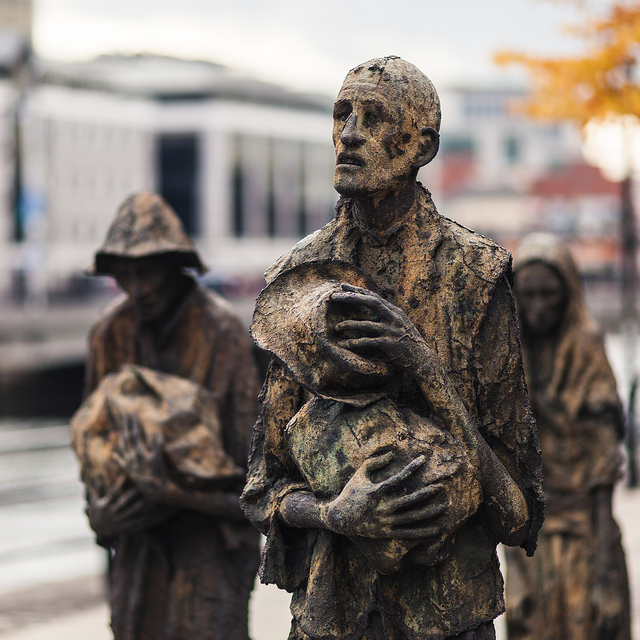
Famine Memorial
Famine Memorial by Tobias Abel on Flickr. Some rights reserved.

Thirdly and finally, we move from Barnabas to Agabus. The third and final encouragement is the provision for the suffering.

During this time some prophets came down from Jerusalem to Antioch. 28 One of them, named Agabus, stood up and through the Spirit predicted that a severe famine would spread over the entire Roman world. (This happened during the reign of Claudius.) 29 The disciples, as each one was able, decided to provide help for the brothers and sisters living in Judea. 30 This they did, sending their gift to the elders by Barnabas and Saul. (Verses 27-30)

Agabus will turn up in one more incident later in Acts. He will have another prophetic message, when he warns Paul that suffering and imprisonment is awaiting him if he takes a particular proposed decision. He is proved right, and he is shown to be right here. We have other New Testament references to a collection for those suffering the effects of a famine, especially those in Judea. Paul’s teaching on Christian giving in 2 Corinthians 9 has this particular tragedy as its backdrop.

Of course, giving to disaster relief is one expression of Christian mission with which we are sadly too familiar. We have just had plates out in recent weeks for Christian Aid’s Iraq appeal. We are used to televised appeals from the Disasters Emergency Committee. But millions of others do the same, who do not claim the name of Christ, so what could be explicitly Christian about our acts of giving for the relief of suffering?

I guess there has to be a Christian dimension to the giving and a Christian dimension to the people using the gift. The Christian dimension to the giving is perhaps something we shall only know in our hearts. It is the concern to bring things in this world in alignment with heaven – ‘Your kingdom come, your will be done on earth as in heaven’.

The Christian dimension expressed by the people using the gift means, I think, that we are talking about giving to organisations that act in the name of Christ. It may be those that simply are Christians who engage in disaster relief (and, perhaps, some political campaigning), such as Christian Aid. To do so may bring a visible sign of encouragement to the downtrodden.

Or it may be an organisation that sees all Christian mission as a whole, and integrates disaster relief with uniting the churches in a particular area of the world and proclaiming a gospel message that calls people there to find hope in Jesus Christ and follow him. Here I am thinking of outfits such as TEAR Fund. And what better word of encouragement is there to someone than Christ? We just need to remember the words of William Booth: ‘If you want to give a tract to a hungry man, make sure it is the wrapping on a sandwich.’

So – in conclusion, let’s go back to the beginning. I began with that slogan, ‘We know better than our pastors.’ I rather feel that what I have presented to you this morning constitutes only some very basic ideas about the place of encouragement in the development of Christian mission. Giving, supporting, encouraging, praying – there is nothing new or unusual in the applications I have suggested.

Now if that’s the case, I think you can prove the virtue of ‘We know better than our pastors.’ Because you can do all of these things. And with baptised imaginations, you can dream, think, and do so much more. We haven’t even mentioned prayer, nor even the possibility of answering a call to mission ourselves.

So why not get dreaming? After all, you know more than me.

Sermon: On The Dashing Of Babies Against Rocks

Again, blog posting has been light recently. One reason is alluded to in this week’s sermon. See the comments early on about my mother’s health, and you will know where most of my spare time has gone. What blogging time I have had has gone on my even more overtly new ‘work’ blog that I mentioned in my last post, Thinking About Mission. Please do follow that blog, too. Each day there is a short, punchy discussion starter post on an aspect of Christian mission.

But now, to this Sunday’s sermon, and an attempt to preach on one of the most difficult passages in the whole Bible.

Psalm 137

Today’s sermon could be one of those in which a foolish minister rushes in where angelic preachers fear to tread. There has been a lively debate on the UK Methodists page of Facebook about the fact that Psalm 137 is set in this week’s Lectionary. What do we do with passages like this? I expected some shock at your hearing this psalm right the way through to the death wish expressed for Babylonian babies.

A number of us agreed that we have to think about and discuss these readings, because we know people are troubled by them. It was a matter of debate whether such thinking should be done out loud in a Sunday sermon or in a home group. Some people thought it would be better discussed informally in a fellowship group rather than raised in a sermon, and I’m sure there is merit in that thought. There would be more opportunity to thrash out issues that way.

But in the end, I decided that this kind of text can’t be ignored in Sunday worship, either. For one thing, this is a psalm – it is a piece of worship material. It appeared in Israel’s hymn book. And just because it’s worship doesn’t mean it can be prettied up with a bouncy tune, such as in the song ‘Rivers of Babylon’:

Further, I think there is a pastoral word to be said in relation to where Psalm 137 sits in relation to the rest of the Bible that is important for us all to hear.

Here is an illustration to help us see a way of understanding why such a psalm, with its frightening calls for vengeance, has a place in Holy Writ. My mother was discharged from hospital on Friday after nearly eight weeks. She had fallen and fractured her hip, and this was followed by a series of other unrelated mishaps that kept her in for longer. But come home she did, and Friday was an excellent day for that, because on that day she and Dad celebrated their fifty-fifth wedding anniversary.

However, Mum – at the age of eighty-three – is inevitably frail after these traumas, and Dad – who was eighty-six on Tuesday – is no longer strong enough to look after her without help. So it was agreed that she would come home with a care package. However, the care agency couldn’t start until tomorrow, so there had to be an emergency provision for the weekend. Originally that was going to be supplied by the hospital’s rapid response team, but in the end various of us in the family covered the necessary duties in the short term.

I want to say that Psalm 137 is a short term, rapid response, emergency reaction to the crisis that Israel finds herself in. Let’s remind ourselves what has happened. For years, prophets such as Jeremiah have warned the people of God that their sin will render them liable to God’s judgement. Always, they have thought themselves to be a special case, possessing a ‘Get out of jail free’ card that would prevent them suffering the consequences that the so-called doom merchants were predicting. But now it has come true. King Nebuchadnezzar’s armies have marched on Jerusalem and conquered God’s people. Many are murdered, a large number have been taken captive into Babylon itself, including Israel’s own Gifted and Talented stream (among whom we shall later find the likes of Daniel and his friends). Only a small number have been left at home, mostly those the triumphant army thought incapable of making a worthwhile contribution to Babylonian society.

This is a trauma of the highest magnitude for the chosen race. They had thought that Jerusalem was inviolable – but it wasn’t. They had assumed that God would not allow harm to come to his holy temple – but he did. Their faith, based so strongly on the idea of occupying the land promised to them, has been ripped to shreds.

And perhaps we have some similarities to them, at least on the metaphorical level. We Christians are no longer at the centre of our society. We live in some kind of exile, where our convictions are increasingly marginalised and ridiculed. For those who have grown up familiar with a culture in which the church and her leaders were respected, this is an alien land, our Babylon. We might just as easily cry out to God about this as we might about other things.

So what do you do when such a terrible event happens to you? Many of us scream out in pain, and perhaps even in anger, lashing out. That is certainly what the psalmist does here. As he and his people weep in Babylon and vow never to forget Jerusalem, they turn their frustrations upon their captors and call for violent revenge.

Now, at that point, you might think, “That’s all very well, it goes some way to explaining why the tribes of Judah were feeling this way, but it doesn’t explain why a text like this in the Scriptures. After all, are we not called to forgive and to love our enemies?”

Well, indeed we are, and that is one of the biggest problems with this psalm. It doesn’t seem to fit with the teaching of Jesus, does it? And if it stands alone, it would be very dangerous.

Let me suggest to you, though, that you have to feel anger before you can forgive. We can be so keen in the church to ensure that people forgive and do not become bitter that we actually abuse people who have already been hurt. If we aren’t careful and jump in immediately to ask someone who has been wronged, “Did you forgive the person who did this to you?” they will not in fact forgive, they will merely suppress their anger. And suppressed anger tends to come out again at a later date, like a Jack in the Box, in harmful forms. Sometimes it comes as rage, sometimes it mutates into depression.

For that reason, I was once horrified to hear the story of a church member who had been raped. People jumped in and asked the woman, “Have you forgiven your attacker?” without giving her permission to feel her pain and anger about the evil that had been done to her.

We rush into all sorts of things in our instant society, and in the church we seem to have included forgiveness among the things that we have powdered down and can quickly reconstitute with boiling water. But we need to allow time. I recently witnessed an unfortunate misunderstanding which I won’t spell out here, where someone was accidentally let down by another church member, and the results were distressing. A week later, the person who had been hurt was still mad at the person who had failed her, and was overheard to say, “I don’t feel very forgiving.” A well intentioned member of the congregation asked me if I would intervene, and I said I wouldn’t immediately. It needed another week to see whether this was a case of someone still feeling the pain or whether it truly was a case of nursing a grudge. Should it prove to be the latter, I said, then I would certainly speak with the person in question. But we have to give these things time.

Psalm 137, then, reminds us by even the expression of anger in an ancient hymn, that we need to feel the hurt. Not only that, it gives us permission to express that pain to God himself. If we are not careful, we make worship purely into a celebration (which in many respects it is – of course!) and nothing else. But Scriptures such as this show us that a fuller understanding of worship includes such things as bringing our laments as well as our songs of praise to God.

My observation is that some of us in the church think that we have to be prim and proper with God, being careful to say the right things before him as if he cannot cope with the heat of our tears and the fire of our fury. We think that unless we come to him full of faith and in the right spirit, he will get one of his specially prepared thunderbolts out of the cupboard and hurl it at us.

But scriptures like this tell us otherwise, just as our Gospel reading in which Jesus quotes another psalm on the Cross – Psalm 22 – does, is that God is big enough to cope with us coming to him in anguish. Somebody once said that they felt like they were beating their fists against God, and this felt so wrong, but they came to understand that they were – so to speak – beating their fists against God’s chest, but that he was holding them in his arms as they did so. Could God be better than we think he is? Could it be that the One of whom we say this most basic statement – ‘God is love’ – truly is like a Father to his children, holding them in their suffering and wiping their tears from their eyes?

And because it is a God of love in whom we believe, we can eventually come through the lashing out to the point of forgiveness. Just as we listened to Jesus crying out, “My God, my God, why have you abandoned me?” so we remember that the same Jesus also said, “Father forgive them, they do not know what they are doing.” We need to feel the anger, but if we choose to make anger our permanent abode, then we shall degenerate into bitterness, with all the results that brings, both in the shrinking of the spiritual life because it gives us antipathy towards Jesus, and also in the physical harm that bitterness can cause to our mortal bodies.

It is worth us remembering that in the New Testament, the word translated into English as ‘to forgive’ means ‘to set free’. When we forgive somebody, we set them free. It is no accident that Jesus told parables about forgiveness in which he talked about the forgiveness of financial debts. People are set free from spiritual debt by forgiveness. Until we forgive, do we not feel like the evildoer owes us something?

But there is another side to the setting free that comes in forgiveness. It is not only the offender who is set free: the injured party is also liberated. When we choose not merely to feel our anger but to stay with it permanently, the bitterness that takes over our lives becomes like chains wrapped around us. When we forgive, not only do we set the wrongdoer free of any debt to us, we also find that the chains of resentment and animosity fall away from us.

And that’s why I said that Psalm 137 and passages like it take their place in the Scriptures as the rapid response to the sorrows and wrongs that are inflicted upon us. We need that stage, but we cannot stay there. The long term care package is forgiveness.

Sermon: Suffering And Faith

Psalm 130

The pastor of a Christian Science church was talking to a member of his congregation. ‘And how is your husband today?’

‘I’m afraid he’s very ill.’

‘No, no,’ corrected the pastor, you really shouldn’t say that – you should say that he’s under the impression that he’s very ill.’

The woman nodded meekly. ‘Yes, pastor, I’ll remember next time.’

A few weeks later, the pastor saw her again.

‘And how is your husband at the moment?’

‘Well, pastor,’ she replied, ‘he’s under the impression that he’s dead.’[1]

It isn’t long in life before a bright beginning is touched by suffering. A child is born, and discovers pain. Even Prince George will find that out. A wedding and honeymoon is followed by the reality of each partner’s frailties. Someone is converted to Christ, but then learns it isn’t a rose garden.

Meanwhile, we have people who want to play pretend about suffering. They want to act as if it doesn’t exist, or they demand it be magically removed from existence in an instant. Maybe they even try to get round it in a religious way by saying that the body doesn’t matter, it is only a shell for the real person. That isn’t a view you can take while still believing in the New Testament, with its strong emphasis on the resurrection of the body.

The first thing our Psalm of Ascent this week does is be frank about the reality of suffering.

Out of the depths I cry to you, Lord;
    Lord, hear my voice.
Let your ears be attentive
to my cry for mercy. (Verses 1-2)

The Scriptures do not get into philosophical discussions about the existence of suffering and belief in a good and powerful God. They simply enter the story of suffering, and describe that narrative. Our Psalmist here is in deep suffering – he cries ‘out of the depths’. While there are great accounts of deliverance from suffering in the Bible – the Exodus, the healing miracles, and so on – we are not presented with faith as a ‘Get out of jail free’ card. Faith enters human suffering.

Henri Nouwen (1981?) at his apartment in New Haven
Henri Nouwen (1981?) at his apartment in New Haven (Photo credit: jimforest)

And so, before anything else, simplistic and obvious as it might sound to some of us, we need to embrace the reality of suffering and stop playing games. Henri Nouwen wrote,

Many people suffer because of the false suppositions on which they have based their lives. That supposition is that there should be no fear or loneliness, no confusion or doubt. But these sufferings can only be dealt with creatively when they are understood as wounds integral to our human condition. Therefore ministry is a very confronting service. it does not allow people to live with illusions of immortality and wholeness. It keeps reminding others that they are mortal and broken, but also that with the recognition of this condition, liberation starts.[2]

Are there areas where any of us is pretending? Are there times when – much as we believe that God heals – he is in truth going to take us the long route to wholeness? We like to believe that if God works a miracle it will be a great testimony, and it certainly can be. However, are there times when we say that, but what we really want is a short cut out of our personal difficulties rather than the testimony? Could it be that God will also bring glory to his name when he takes us on what seem to be detours rather than the direct route?

For me, that was true in one particular instance. In my first year at theological college, I suffered a collapsed lung. My lung had previously collapsed three times a few years earlier, and I had only avoided surgery then when the consultant was inconveniently on holiday. But on the weekend when it happened to me at college, the father of a student friend was visiting. My friend’s Dad was known for having a healing ministry. Surely he would pray for me and I would be healed. But he had left to go home a few minutes before I got back from A and E. This time, I had to have the operation. It meant a week and a half in hospital, a month’s convalescence at home, and three months before I was back to anything like full strength. But God used that experience so that when I visit people in hospital, I have a way of identifying with them and a reason to bring them a word of hope.

That leads to the second piece of frankness in the Psalm: we hear about the reality of God. The Lord is addressed throughout the Psalm. The Psalmist cries out to him (verses 1-2); he acknowledges and relies on the Lord’s mercy and forgiveness (verses 3-4); and the Lord is the reason to wait and hope (verses 5-8).

God is there. God is present. God is even in the depths. The Old Testament describes a God who hears his people’s suffering, even if he does not always act on it as quickly as his people would desire him to do. But the cry of suffering reaches him, and he liberates his enslaved people from Israel. He brings them back from exile in Babylon.

Not only that, the same Old Testament begins to describe God as being involved in his people’s suffering, even functioning as some kind of representative or substitute. I really don’t think you can avoid reading passages such as the Suffering Servant in Isaiah 52:13-53:12 that way.

What the Old Testament doesn’t have, but which we have, is the filling out of that belief in Jesus, who came as a servant, lived among the poor and suffered death on a Cross.

Ours, then, is the God of the depths – even the depths of Hades. In Christ God stands with us in suffering and he stands for us in suffering. And in doing so, he shows supremely the divine answer to the Psalmist’s cry for mercy and the forgiveness of sins. The merciful God is the One who enters the depths of human suffering, who drinks the cup to its dregs.

English: Eugene Peterson lecture at University...
English: Eugene Peterson lecture at University Presbyterian Church in Seattle, Washington sponsored by the Seattle Pacific University Image Journal. (Photo credit: Wikipedia)

As Eugene Peterson puts it,

God makes a difference. God acts positively toward his people. God is not indifferent. He is not rejecting. He is not ambivalent or dilatory. He does not act arbitrarily in fits and starts. He is not stingy, providing only for bare survival.[3]

He goes on to say,

And this, of course, is why we are able to face, acknowledge, accept and live through suffering, for we know that it can never be ultimate, it can never constitute the bottom line. God is at the foundation and God is at the boundaries. God seeks the hurt, maimed, wandering and lost. God woos the rebellious and confused. … Because of the forgiveness we have a place to stand. We stand in confident awe before God, not in terrorized despair.[4]

Suffering is awful, but it is not the final word. God has seen to that in Christ. At the Cross and the Empty Tomb we find that God has the last word. God has not stayed remote and sent us a philosophical answer to our suffering. Instead, he has got his hands dirty. He has come alongside us, and also in his suffering he has accomplished what we cannot do for ourselves due to our sin. He has provided for forgiveness and so we can serve him with reverence (verse 4), or ‘stand in confident awe before [him]’, as Peterson put it.

Now this leads us on to the third and final piece of honest faith in the face of suffering that the Psalmist models for us, and that is the reality of waiting. Hear how he uses words about watching, waiting and hoping:

I wait for the Lord, my whole being waits,
and in his word I put my hope.
I wait for the Lord
more than watchmen wait for the morning,
more than watchmen wait for the morning.

Israel, put your hope in the Lord,
for with the Lord is unfailing love
and with him is full redemption.
He himself will redeem Israel
from all their sins. (Verses 5-8)

In the Old Testament, the words ‘waiting’ and ‘hoping’ are very close. There are passages where in one Bible translation the English word used may be ‘wait’ and in another English Bible it may be ‘hope’. You could say that the faithful disciple of Old Testament days waited in hope. Certainly when we face suffering we often need to wait, and our waiting will have meaning and significance if we can wait with hope. That is what we do as New Testament Christians for sure, living in some respects between the suffering of Good Friday and the hope of Easter Day.

But what do we do while we are waiting hopefully? The Psalmist suggests we apply for the job of nightwatchman:

I wait for the Lord
more than watchmen wait for the morning,
more than watchmen wait for the morning. (Verse 6)

In my home church was a gentle, devout Jamaican Christian called Clarence. He was employed as a security guard. Anyone less likely to tour a building site at night accompanied by fierce Rottweilers you would find it hard to imagine. But for most of the time, he told us, he was able to sit in the site office. Each night he would take his Bible and his Moody and Sankey hymn book, and study his faith. He may have been the most unlikely candidate for the job, and heaven knows how he got it, but he used his waiting time fruitfully and every morning, the dawn came.

So it is for us. We are on the night watch in our faith as we wait for God who is with us in our suffering to act on our behalf. What we think should not take him a trice is something he chooses for reasons only he can see to take longer about resolving. Meanwhile, in the darkness we wait.

But … we wait knowing that the dawn is coming. Hence we wait in hope. And during that waiting, it would be good if we put the time to good use, as Clarence did.

How can we use our waiting time? We too can certainly take advantage of opportunities to deepen our faith, too. We can express our trust, even if at times it is a bemused trust, in the God for whom we are waiting. We can share our hopeful waiting with others who are also struggling, so that we may encourage them. Such people can be found both inside and outside the church.

I’ll give the final word again to Eugene Peterson:

The depths have a bottom; the heights are boundless. Knowing that, we are helped to go ahead and learn the skills of waiting and hoping by which God is given room to work out our salvation and develop our faith while we fix our attention on his ways of grace and salvation.[5]

Sermon: Sustained By The Risen Lord

Revelation 1:4-8

What did you think when you heard there was to be a reading from Revelation in the service? Many Christians switch off. Revelation is regarded as the book for the weirdoes and extremists. It is full of strange language and has been the basis for all sorts of bizarre beliefs.

But Revelation is a book worth rescuing. It is written in the way it is, because it was addressed to persecuted Christians in the late first century. For them, it made sense to communicate in an unusual style that they understood, and maybe the Roman authorities didn’t. To such Christians, the news that Jesus, crucified  by the Roman authorities, had risen from the dead and was reigning, was the very best of good news. Hence Revelation begins with this big vision of the risen Jesus.

What does that do for us? We cannot claim we are being persecuted for our faith, although certain aspects of legislation and public opinion have certainly moved against us, and that is making some Christians nervous, especially as the General Election approaches. It may be that we end up further out on the margins due to our faith, and if it does, this reminder of our risen Lord will sustain us as we seek to follow him.

How does it do that?

Firstly, we have confidence based on who Jesus is. According to John, Jesus is

the faithful witness, the firstborn of the dead, and the ruler of the kings of the earth (verse 5).

Taking those three descriptions in turn, we have each time something to fortify us in our witness if the going gets tough in society for us.

Jesus is ‘the faithful witness’. He was faithful in his witness to the kingdom of God. He was faithful, even to the point of death. Remember that the Greek word for ‘witness’ in the New Testament is the one from which we derive our word ‘martyr’. Jesus’ own life, then, showed that faithfully following the call of God is costly. It may even cost our lives, when we peaceably but firmly stand for God’s message. The early Christians, then, who faced persecution, knew they were walking in the way of their Master.

What, then, of when we face opposition? We too are called to be ‘faithful witnesses’. We hold resolutely to our faith, even when it is thought stupid, irrational or even morally wrong. We refuse to compromise. But we do not do so in some militant, aggressive way. We recognise that difficulties may come our way, including from those in political power. Jesus has not withdrawn his call to deny ourselves, take up the cross and follow him. Do you face something tough in your life because of your faith? Jesus is calling you to do what he did, to follow in his footsteps. It should not surprise us as Christians that this happens.

Is that depressing? If it is, that is where the next description of Jesus comes in. He is ‘the firstborn of the dead’. Jesus’ faithful witness led to the Cross. But it didn’t end there. He vacated the tomb when he was raised from the dead. Thus we have hope as faithful witnesses. Our witness may be costly, but evil will not have the final word. God will have that: he will vindicate his people in the resurrection and the judgment. As God raised Jesus from the dead to new life, so he will also raise us. This is our hope.

But not only is Jesus the first to be raised from death, promising the same for us in God’s great future, his title of ‘firstborn’ of the dead indicates his sovereignty. The firstborn of a king inherits the throne. Jesus is not simply back from the dead, he is reigning. So those who think they are in charge and controlling everything are mistaken. Fatally mistaken, you would have to say. The risen Lord has been given ‘all authority in heaven and on earth’ (Matthew 28:18).

And that is what leads to the third ascription: Jesus is ‘the ruler of the kings of the earth’. Who are these pretenders who think they control the destiny of an obscure religious sect two thousand years ago? They are not the ultimate rulers they think they are. They are subject to Jesus himself. If they do not submit to his rule now, they will be brought to justice. Again, it is part of the vindication God promises to his faithful people.

But more than that, it has a particular application for us during this General Election campaign. Whenever a politician proposes policies that go against the will of God or seek to marginalise his church, let us remember who rules over the kings of the earth – Jesus does. Any time one of our political leaders comes over all messianic is a time to remember that Jesus rules over the kings of the earth. Any time they start to promise heaven and earth is also a time to remember that Jesus reigns over the rulers of the earth. And any time we as an electorate look to our politicians and expect them to bring in the kingdom of God is also an occasion to recall that Jesus is king over all creation, and every human ruler must submit to him.

So this is who Jesus is. He is the faithful witness, who shows Christians that fidelity to God may well be costly, even to the point of death. However, he is also the firstborn of the dead, showing the resurrection hope of vindication in which the faithful share. And he is the ruler of the kings of the earth, to whom even the most unjust rulers will have to answer. In these respects, when we know who Jesus is, he truly is our hope when Christians are marginalised, pressurised or even persecuted.

Secondly, we have confidence based on what Jesus does. Now I will admit that a distinction between ‘who Jesus is’ and ‘what Jesus does’ is artificial, because we know who someone is by what they do. But I use the distinction between who Jesus is and what Jesus does in this sermon to match up with the different ways in which our text uses language.

And I say ‘what Jesus does’, because I want to draw attention to a series of verbs in verses 5 and 6. Sorry if this sounds like an English lesson! Here they are:

To him who loves us and freed us from our sins by his blood, and made us to be a kingdom, priests serving his God and Father, to him be glory and dominion for ever and ever. Amen. (Verses 5b-6)

He loves us, he freed us and he made us. These three assertions also give us confidence in all manner of situations, including the times we are under pressure for our faith.

Firstly, ‘he loves us’. I remember a friend telling me that nothing gave her greater security in life than knowing that her husband wanted to spend the rest of his life with her. Forty or so years later, they are still together, and the husband gave up promotions in his career to stay at an ordinary rank so he could care for his wife, who has suffered persistently from mental illness. But even in her periodically fragile state, the wife knows she is loved, and it does her the power of good.

It’s similar with Jesus. He loves us. He is committed to us. He has no intention of letting us go. His hold on us is stronger than our hold on him. He has loved us with an everlasting love, from creation through the Incarnation, the Cross and Resurrection to the present day and beyond. Whatever we face, he loves us and is with us.

More specifically, the second thing Jesus has done in this reading is that he has ‘freed us’ – ‘freed us from our sins by his blood’. Here is the most decisive example of Jesus’ committed love for us. What we most need is to be freed from our sins, for they bind us. His death on the Cross loosens the chain and we walk free in forgiveness. The Cross is not only the example Jesus sets of being the ‘faithful witness’ I talked about earlier, it is also the greatest sign of God’s love, because it took God substituting himself for us in Christ to break the curse of sin.

This isn’t just someone saying he loves us; this is someone proving it in the most costly of deeds. If that is how we are loved in Christ, we can be all the more sure of God’s commitment to us through thick and thin. We may not always be accepted by the world, but if Jesus does this much for us, he is not about to give up on us when life gets sticky.

The final example John gives of what Jesus does for us is that he has ‘made us’. Made us what? He has ‘made us to be a kingdom, priests serving his God and Father’. His love which extends as far as redemption through the Cross does not finish there. We are not simply forgiven and then wait around on a platform with our ticket for heaven. Christ’s redeeming love has a purpose: it is to make us into something now. Whatever the world thinks of us, Jesus has made us with a purpose, to be a kingdom of priests, serving God the Father.

What does that mean? For starters, it means that we all have a special dignity in that Jesus has given us a purpose in life. Rejection and mockery from the world is contrasted by acceptance and purposefulness from God. As a kingdom, we have a royal standing in the eyes of God. Those whom the world despises have immense status in the eyes of God. Whatever the world sometimes thinks of us and however we appear to the world, we are in fact royalty in disguise.

But what is the purpose? We are priests, John says. Each one of us represents people to God in prayer and represents God to people in word and deed. We may bring the needs of anyone to the merciful presence of God. While we might especially do that for our sisters and brothers in Christ, we have the privilege also of doing that for those outside the family of God. Debbie and I offer to pray for people in the school community going through troubles. Lots of Christians do things like that. We don’t simply pray secretly behind people’s backs, though – we ask if we may.

Furthermore, we have a particularly special trick up our sleeves: we can pray for our enemies. When oppressed, the true Christian response is not to lash out. It is to pray for them. It heaps burning coals on them, but does not bind us up as bitterness does when we refuse to forgive.

Then on the other side of the priestly rôle, we represent God to the world. We do this in our words and matching deeds. Whether the world likes us or not, we are priests to them. Whether they accept what we offer is up to them, but divinely appointed priests is what we are. So the world cannot do without us! The purpose Jesus gives us in making us all priests not only gives us personal dignity, it gives us a vital rôle to play in the world.

In conclusion, if we are struggling because we are being pushed to the margins of society, Jesus has good news for us. By what he is and by what he does, he gives us confidence, purpose and dignity. He gives us the inner resources to sustain us in the face of apathy or hostility. No wonder this little passage leads to a doxology from John: ‘to him be glory and dominion for ever and ever. Amen’ (verse 6). May his goodness to us lead us also to doxology.

Pregnancy The Easy Way?

(And another old post.)

“So how’s Debbie?”

I knew the reason for the question. Debbie was seven months pregnant with our first child. The woman who asked barely knew her, so it was a kind question.

“She’s doing well, thank you,” I replied, “there have been odd little things, but really we couldn’t have wished for a better pregnancy. She’s having the best pregnancy of all the mums-to-be in our ante-natal class.”

“Ah well, you know why that is, don’t you?”

I recognised the implication: Debbie’s model pregnancy was because we were Christians. I countered:

“But of the eight couples in the ante-natal class, we aren’t the only Christians. We are one of three Christian couples, and they haven’t been let off as lightly as we have.”

“Oh.”

Not only that, but around that time, two other Christian women we knew gave birth to babies with major health problems. One baby had just a one in three chance of survival; the other had a hole in the heart and a bowel disorder. A colostomy bag from birth until she was strong enough for corrective surgery.

So God isn’t just some celestial insurance policy. Believe in God and life will be ‘lovely jubbly’, as Del Boy would say. It’s not like that.

A young child is reputed to have asked its mother, “Mummy, do all fairy-tales end with the words ‘And they all lived happily ever after’?”

“No,” said Mum, “some say, ‘When I became a Christian all my problems disappeared’.”

Christians live between the glory and the flame, the joy and the suffering. God’s reign has begun in Jesus, but there is still plenty of cosmic and human resistance.

I still believe in an ‘optimism of grace’, that God loves to hear and answer our prayers. I don’t know why I don’t always get what I think I need. I simply don’t have all the answers.

But I’ve seen enough of God in Jesus to believe he is trustworthy. And in the meantime I’ll pray and act in the cause of the flame giving way to glory.

Sermon: The Identity Of Jesus And His Disciples

Mark 8:27-38

Just the other day I came across a spoof news report from two years ago which claimed that the then Home Secretary Jacqui Smith wanted people to use their loyalty cards more, and for stores which didn’t have them to introduce them. This was to combat terrorism, in the light of the Glasgow bombers having bought their supplies from B & Q, which didn’t at the time have a loyalty card. According to the article, she wanted loyalty cards to replace the unpopular idea of identity cards, and for the data collected by loyalty cards to be used in intelligence gathering operations. In the article, these words are put into Jacqui Smith’s mouth:

“The plan is not just for the ID cards, but to outsource the whole of MI5 to Tesco,” said the Home Secretary. “Frankly they seem to know more about what people in this country are doing than we do.”

Identity. It’s a big theme today. Identity cards and identity theft are but two major areas of concern and controversy about the identity of individuals in our society.

And identity is a central theme of our Gospel reading. It’s about the identity of Jesus, and the consequent identity of his disciples. I see this revelation of identity coming in three phases.

Firstly, we have a confession.

If you like reading stories, I wonder what kinds you prefer. Thrillers, romance, epics? If you enjoy whodunits or mysteries, you will be somewhat disappointed by Mark’s Gospel. In the very first verse, he tells us it is the Gospel of Jesus the Christ, the Son of God. Jesus is both the Christ (or Messiah) and the Son of God. At the Cross, the Roman centurion confesses that Jesus is the Son of God, and here, Peter says ‘You are the Messiah’ (verse 29), when Jesus asks the disciples who they think he is, as opposed to the opinions of people they know.

This, then, is one of the high water marks of Mark’s Gospel. Here, after all the build-up, with Jesus’ popularity among ordinary people and the opposition starting to rise from those who feel threatened by him, is a decisive confession by Peter. ‘You are the Messiah.’ Lesser options, like the ones proposed by others, will not do. Jesus is more than ‘John the Baptist; and others, Elijah; and still others, one of the prophets’ (verse 28).

And it’s similar today. Lesser confessions will not do. Around the time I first became seriously interested in faith for myself, musicals like Godspell and Jesus Christ Superstar had been popular. Both contain elements that are worthy of appreciation by Christians, and it’s interesting to see how people without a clear Christian faith perceive Jesus, but both fall short. Godspell is ambivalent about the Resurrection. Jesus is dead at the end, and you simply have the ambiguous song ‘Long live God.’ And Jesus Christ is more than a superstar. Indeed, his whole approach to life would critique attitudes to stardom and popularity.

Do we run the danger of making a lesser confession in the Church sometimes? Possibly. Might liberal Christians be so enamoured by the social justice implications of Jesus’ teachings that they forget the importance of salvation from our own sins? Might catholic Christians be so entranced by the power of the sacraments in remembering Jesus that they overlook the personal responsibility we have in embracing faith? Might evangelical Christians be so caught up with the personal blessings of salvation that they pass over the social implications of his message and ministry?

These are all over-simplifications, I know, but I hope I make this simple point. Encounter with Jesus leads to a full-blooded confession of him as Messiah. It involves the blessings of forgiveness, new life and salvation for us. It starts with God’s initiative towards us, and we need to respond. And it isn’t merely for our own benefit, but for sake of God’s love for the world. All these things are implied in confessing Jesus as Messiah.

So let’s make sure our confession of Jesus is not a truncated one, not restricted by the vision of the world or by our church tradition. Let’s accept that confessing Jesus as Messiah leads us to a big, inspiring vision of who he is, what he does, who he blesses and what he calls us to do.

Secondly, there is confusion. Early in my ministry, I asked a congregation how they might have imagined their new minister before I arrived. Perhaps I was married with children, with brown eyes and right-handed. At the time, I was single (without children!). My eyes are blue (please don’t say ‘red’ after the service!) and I’ve always been part of that elite minority of people who are left-handed.

Similarly, when I moved from that appointment, I obtained a profile from one circuit I was interested in, only to find buried in it a description of their ideal minister as being married with children. At the time, I was still single (and still without children!). I found it sobering to talk the other morning with our Chair of District about our move from this circuit when she said I would be a more attractive option to some circuits because I was married with kids.

People can imagine all they like what someone is like, only for reality to deal a shock to them. that’s certainly what happened to Peter when Jesus explained that as Messiah he would have to suffer and die (verse 31). You’ll remember that Peter was shocked and began to rebuke Jesus (verse 32), only to earn the response

‘Get behind me, Satan! For you are setting your mind not on divine things but on human things.’ (Verse 33)

Peter’s fantasies about the Messiah have to be exploded. No warmongering conqueror of the Roman occupying forces, but the suffering conqueror of occupying sin. We think of other Gospel stories, like James and John getting mad when a village doesn’t respond to the message of Jesus. They ask him whether calling down fire from heaven would be a good response, and Jesus declines their suggestion. No wonder they were nicknamed the Sons of Thunder.

All this is obvious to us with hindsight. We know that Jesus came as a suffering Messiah, not a military general or a freedom fighter. We know the way of the Messiah is the journey to the Cross. So you might think it would be easy for us to live without the confusion of Peter and the first disciples.

I am not so sure. We may know in our heads that the path of Jesus would take him to Calvary, but there are times when we want to call on a warlike Messiah, just like his first followers. Think about how we pray sometimes about evil. We may want God to sort it with a quick fix. We may ask God to zap evildoers, whether they are tyrants inflicting injustice on their people or folk we know who have treated us unfairly or even cruelly.

I wonder whether those are the kinds of prayers to which God answers, ‘No.’ I wonder whether heaven even says, ‘Get behind me, Satan’ to us when we pray like that. I wonder whether the way we need guiding out of our confusion about Jesus is to focus our thoughts and devotions much more solidly on the Cross. Having seen some churches ripped apart by bitterness and lack of forgiveness, I do suspect we have our fair share of Peters and Sons of Thunder in today’s church. But here, especially, and as always, the Cross is what unscrambles our confusion about Jesus.

Thirdly and finally, this passage presents us with a challenge. Many of us may find the world of the prosperity gospel preachers baffling and bizarre. If you’ve caught sight of any on satellite TV, you’ll know what I mean.

But it’s easy to understand their appeal. ‘God wants you rich’ is an attractive message in a materialistic society. ‘Jesus suffered so that you don’t have to’ plays well in a culture that spends all its time trying to avoid suffering. And while we might see through the ‘God wants you rich’ approach, I think a lot of us don’t so much think about suffering as attempt to avoid it.

But think about it we must, because the challenge of Jesus here is that just as he was to go to the Cross, so too his followers would have to face suffering because they are his disciples. ‘If any want to become my followers, let them deny themselves and take up their cross and follow me,’ he says (verse 34).

It’s not that Jesus thinks we should go looking for suffering, but he calls us all to such an abandonment to his ways that it will bring us in the firing line of evil, just as happened to him. If that happens, then self-preservation is not an option. If I want to save my life, I will lose it, but if I surrender it for Jesus and the Gospel I will save it (verse 35).

Now that thought is one we need to apply not only to ourselves as individuals, but also to churches. How often I hear churches in these days of aging and declining congregations talk about how they are going to survive and keep open. ‘How are we going to keep our church going?’ people ask. I suggest that it is a question based on self-preservation rather than a concern for the Gospel. It’s about how we are going to save our lives, rather than a passion for other people to know the love of God in Christ. Maybe churches that talk like that are the very ones that will lose their lives.

Few people like the idea of embracing suffering head on – I certainly don’t! However, we need to remember that Jesus offers us hope with these challenging words: if we are willing to lose our lives for his sake, we will save our lives. That might be in this life, it might be in the life of the world to come. But Jesus keeps his promises. I recently read this story:

Bernard Gilpin (1517-1583) was a preacher who was taken into custody for preaching the gospel during the time when Queen Mary Tudor was persecuting Protestants. He was being taken to London to certain death, but to the amusement of the guards accompanying him he kept saying, ‘Everything is for the best.’ On the way he fell off his horse and was hurt, so they could not travel for a few days. He told the amused guards, ‘I have no doubt that even this painful accident will prove to be a blessing.’ Finally he was able to resume his journey. As they were nearing London, later than expected, they heard the church bells ringing. They asked someone why this was so. They were told, ‘Queen Mary is dead, and there will be no more burning of Protestants.’ Gilpin looked at the guards and said, ‘Ah, you see, it is all for the best.’[1]

So let us embrace the challenge, knowing Jesus will give us life everlasting, whatever we lay down now.


[1] Ajith Fernando, The Call to Joy and Pain, p36, citing Tom Carter (editor), Spurgeon at his Best, pp323ff.

Create a website or blog at WordPress.com

Up ↑