Following the Risen Jesus in Everyday Life (John 21:1-25)

John 21:1-25

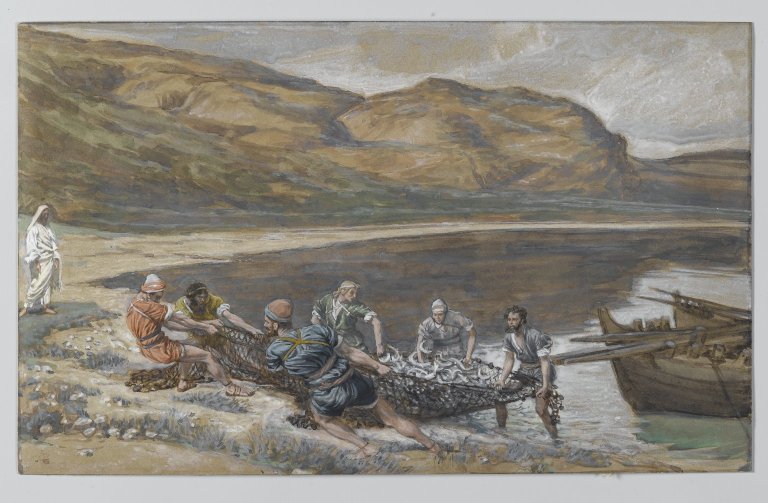
Brooklyn Museum – The Second Miraculous Draught of Fishes – James Tissot. Public Domain.

Last week, I got to preach on one of my favourite Bible passages, the second half of John 20. Today, I have disregarded the Lectionary, which would have taken us to the Emmaus Road story, which was the Bible reading at our wedding, to follow John 20 with – er – John 21, which is also significant for me. It was hearing a Local Preacher speak on this passage in 1985 that began my journey to theological study and eventually ordained ministry.

But today, I don’t want to speak about ordination. I want us to look at how the risen Jesus transforms everyday life.

Firstly, the risen Jesus transforms work:

Aerial view of computer laptop on wooden table photography hobby concept from rawpixel.com at pxhere.com. Public Domain.

The disciples have met the risen Lord. He has promised them the Holy Spirit. But they haven’t been transformed yet. They haven’t begun the mission Jesus has described for them. Simon Peter is hanging around, twiddling his thumbs.

‘I am going fishing,’ he says, and the six friends with him join him. Back to the day job. Back to something familiar. Back to something he knows all about.

But for all the knowledge and experience of fishing among those assembled on the boat, the expedition is a failure. They have gone out to fish at night, which was generally the most fruitful time, but they have caught nothing.

Until a knowing voice from the shore calls out: ‘Children, you have no fish, have you?’ How did he know from that distance?

‘No.’

‘Cast the net to the right side of the boat, and you will find some.’ How could he tell from that distance? He couldn’t see a shoal swimming under the water from there.

But lo and behold. A hundred and fifty-three fish. Many scholars have tried to find symbolic significance in that number, but really it’s just an eyewitness account that testifies to the abundance in contrast to the prior lack. On this occasion, Jesus doesn’t draw a spiritual parallel, such as when he had talked about ‘fishing for people.’ He simply blesses the work of fishermen.

Jesus loves to bless our work. In creation, the human race was made stewards of all God had made. If you look closely, you can see that in so many professions.

It’s not just the obvious work of ministers. Nor is it some of the other professions we have lauded, like medicine and teaching – although we are grateful for them. Do you remember the slogan popularised by Christa McAuliffe, the teacher chosen as a space shuttle astronaut, but who sadly died in the Challenger disaster in 1986? ‘I touch the future. I teach.

But think also of how engineers steward the resources of the earth. Think of those who in many ways engage in creative management of the world’s assets. Consider someone who daily enables people to communicate through electronic means. Think of a hairdresser whose clients leave her feeling better about themselves. Are these not things Jesus wants to bless?

Whether you are still in paid work, or like the majority of this congregation well into retirement, can you consider inviting the risen Jesus into those daily activities? How might that make a difference to you?

Secondly, the risen Jesus transforms our daily needs:

Our daily needs 3 at Wikimedia Commons. CC 4.0.

There is one detail in this story that has puzzled me for a long time. Simon Peter and the gang have struggled to catch any fish, but when they get to shore with a bulging net, there is Jesus, with breakfast ready for them. Including fish! Where did Jesus get his fish?

No scholar has been able to explain this. Was it miraculous? Did he buy them from another fisherman?

Whatever the explanation, Jesus knows his friends are coming off a physically demanding night shift. They will be ravenous. The kippers are ready. (I’m sure he would have made kedgeree if he’d been in Haslemere.)

It’s a minor detail, but it shows Jesus caring for ordinary, everyday needs. Sometimes, we don’t like to bother him with the small things. Surely he’s too busy upholding the universe? But he cares.

My late father and aunt grew up as children in the Depression of the 1930s. Their father was out of work for five years. This was before all the provisions of the Welfare State that we know. Their mother would skip meals herself and be on her knees in the kitchen, praying for God to provide. Food parcels and other items the family needed would appear on the doorstep in the nick of time.

Do not leave Jesus out of the smaller, regular features of life. Does that mean you can pray for a parking space? Well, yes, but with certain provisos! For one, just be sure you’re not just using him to get you off the hook. For another, leave him enough time to organise an answer to your prayer. And also, don’t let it distract you from also praying about the weightier matters of life, like justice and poverty. He cares.

Is there something niggling at you right now? Do you keep thinking, this is trivial? It may be something you can deal with by handing it over to Jesus. He cares about our daily lives and needs.

Thirdly, the risen Jesus transforms our wounds:

Emotional Effects of Robbery: Understanding the Impact – Bryan Fagan Law Office CC 4.0.

Let’s go that central conversation after breakfast between Jesus and Simon Peter. We assume – rightly, I think – that the three times Jesus asks Simon whether he loves him are to mirror and replace the three denials he made in the high priest’s courtyard. Not only that, each exchange finishes with the calling to feed Jesus’ sheep.

This is all the more confirmed when you notice one other details. It happens around a charcoal fire, the one Jesus had used to cook the fish and the bread. There is only one other place in the New Testament where a charcoal fire is mentioned, and it is when Simon Peter warms his hands in – the high priest’s courtyard.

Everything in this little episode is about Jesus taking Simon Peter back to those painful denials and healing them. I believe Jesus cares about the wounds we carry from the past. He does not want emotional damage to determine how we live today.

Let me tell you a story. The details I am about to share have been public for many years. I am not breaking any confidences.

I once had an elderly church member who had been an only child. Her father had adored his little girl, but her mother had wanted a boy. Tragically, her father had died young, leaving her to be raised by the mother who did not want her.

One day, we talked about this, and I suggested we pray together. I asked her in the silence to invite the Holy Spirit to show her an incident from her past. In her mind’s eye, she saw a time when she was a child, baking a cake in the kitchen. Her mother came in, told her she would never be any good at this, and snatched everything away from her.

Next, I suggested she should ask the Holy Spirit to show her what Jesus was doing there. Now she saw Jesus come into the kitchen. He gently eased her mother out of the way. Then he spoke to her. ‘You and me, Joan, let’s make this cake together.’

From that time on, she was healed of those parental wounds. For now – although those past events obviously didn’t change – she knew how Jesus regarded her.

I would hazard that many of us are living with old wounds. What if we too invited the risen Jesus to show us where he was when we were hurt? Might we too find his restoring love and live more healthily as a result?

Fourthly and finally, the risen Jesus cares about our future:

Blue gift box. Free public domain CC0 photo at rawpixel.com.

The final part of the story is the other conversation Jesus and Simon Peter have, where Simon is jealous that the ‘Beloved Disciple’ may have a future vastly different from his, which will end in his own execution. Jesus has told him he will end up being led somewhere he does not want to go, and you may know of the legend that Simon Peter asked to be crucified upside-down, because he was not even worthy of being crucified in the same way as Jesus, unbearably cruel as that was.

Comparison is the thief of joy, goes the saying. How many of us have wasted energy and maybe even years of our lives wanting to be someone else? I have wanted to be more outgoing. I have wanted to be musical – and not least when churches have torn themselves apart in ‘worship wars.’

But it’s all fruitless. We can only find fulfilment when we embrace the gifts and callings Jesus has for us. And when we each discover the place God has allotted us in the Body of Christ, then we can play our part healthily in the divine purpose.

A few months ago, Ray Goddess led the circuit staff in the Network course from Willow Creek Church in the USA. It helps people discern their spiritual gifts, but not only their gifts: how these match with their personalities and their passions. It didn’t reveal to me any gifts I didn’t know I had, but it did show me that I was undervaluing one of my gifts, and I need to work that out.

We have just run the course at Lindford church. While we are still processing the results, it has nevertheless been exciting for some people to be confirmed in where God is leading them, and others to be genuinely surprised by what this has opened up for them.

And so, I wonder whether you are settled in your heart and mind about the future God is calling you to. The world has lots of self-centred ways that claim to offer you fulfilment in life, but the one that brings true peace and satisfaction is in knowing what God has given you and has spoken to you. Whatever it is, it is not something where he leaves you on your own to work it out. It is always framed with those words of the risen Jesus to Simon Peter: ‘Follow me.’ He will be there, with us, and going ahead of us.

Conclusion

Indeed, perhaps ‘Follow me’ is the message for all of us in every aspect of what we have considered today. The risen Jesus says to us ‘Follow me’ into the world of daily work and let me transform it. He says, ‘Follow me’ and you will find me providing for you in your daily needs. ‘Follow me,’ he says again, and your old wounds will no longer hold you back. ‘Follow me,’ and you can be liberated to follow the calling he has for you without worrying about others.

Where are you hearing Jesus say, ‘Follow me’?

Sermon: Worship and the Gifts of the Spirit

Continuing our sermon series on worship:

1 Corinthians 14:26-33

Nancy Duarte is something of a hero to me. She married her husband Mark at eighteen, and they planned to go Bible college and then find a church to pastor. Instead, Mark bought a computer, and set up a business which Nancy now heads. They design visual presentations for major international clients such as Apple. Their most famous work was to design the visuals for Al Gore’s film about the environmental crisis, ‘An Inconvenient Truth’. Nancy is a pastor, though – to her staff.

One of the key themes Nancy Duarte teaches about designing engaging presentations is that they must resonate with the hearers. There must be an empathy, a deep inward ‘Yes!’ to what the speaker is saying.

My problem with today’s passage was that initially I thought it might be difficult to get it to resonate with a good number of you. Some of you will struggle might be troubled by the references to speaking in tongues and prophecy. But it isn’t just that: Paul has a completely different conception of what a typical gathering for worship looks like from traditional twenty-first century Christian worshippers. We are used to most or all things being led from the front, but he assumes that everyone has a contribution. Not for him is the content all down to a trained expert.

So how are we going to appreciate what Paul says here about the common use of spiritual gifts in Christian worship? Well, one thing I need to do immediately is to take you out of the pews. In fact, not just out of the pews, but out of the church building. Because Paul was not writing to a congregation that had its own special religious space like us. The notion of church buildings is so ingrained into us, but it distorts what Paul is saying.

To put it more specifically, I once heard Professor Jimmy Dunn say that when we read that the early church met in homes, we can probably assume that they met in the homes of the wealthier members. Archaeological evidence of large homes in the Roman Empire suggests that we are talking about a space that could accommodate thirty, or at most forty people. It is neither like typical Sunday services as we know them, nor is it like the house groups of our experience.

But it does provide a context that makes sense of so much of what Paul teaches about worship in 1 Corinthians. For example, if you bridle at his command that women should keep silent, remember first of all that they are being allowed to learn in the early church (unlike other religions), but that they are probably saying, “What does that mean?” every now and again to their husbands in a confined space where that will be disruptive. Hence they are to keep their questions until they get home for the sake of good order. It also makes sense of the chaotic scenes at the Lord’s Supper in Corinth, if you read chapter 11.

And I suggest to you as well that a gathering for worship in a large home makes sense of Paul’s teaching here. See if some of what Paul says resonates more with you if I can ask you to imagine thirty or forty people crammed together in a large reception room. They are not all sitting on chairs; many are cross-legged on the floor, and others are reclining. For me, it means recalling a holiday I had with friends many years ago where we hired a villa on the Algarve. Imagine something similar – but definitely delete the pews and the church building from your thoughts this morning.

So – if you can picture this different style of gathering – let us ask three questions of the text to help us understand the place of spiritual gifts in Christian worship. Those three questions are ‘Who?’, ‘What?’ and ‘Why?’

Firstly, we ask ‘Who?’ The answer to this is, ‘Everyone’.

What then shall we say, brothers and sisters? When you come together, each of you has a hymn, or a word of instruction, a revelation, a tongue or an interpretation. Everything must be done so that the church may be built up. (Verse 26, italics mine)

It’s just the way of things in the early church. Paul doesn’t need to command ‘each of [them]’ to bring a contribution to worship: they do, anyway. This statement is indicative of the existing situation, and Paul doesn’t have any problems with it. After all, when he began his teaching about spiritual gifts in chapter 12, he soon used his image of the Body of Christ, where every member plays a part.

You may have heard some preachers say that church is often like going to a football match, where twenty-two thousand people in need of exercise watch twenty-two people in need of a rest. Over the centuries, we have deified forms of worship led by the experts – whether it is the more Catholic insistence on the need for a priest who can lead us into the presence of God, or the more Protestant emphasis on a sermon like this that makes teaching the Word of God more like a lecture. That, of course, comes complete with rows of seating. And as we sit in rows (whether in pews or on chairs), we reduce our sense of community and the congregation becomes passive, listening to the minister.

Now once you get beyond the numbers that were in a typical early church meeting, then the group dynamics change, and they certainly do if you go for a more formalised structure. But that is to beg the question of what to do when you grow – maybe instead of getting bigger a church should divide into two.

Of this I am sure: we have disabled many members of Christ’s Body from being able to contribute in worship. It is not to say that everybody has to lead from the front – Paul doesn’t assume that here – but it is to say that we have squashed people’s gifts. Sometimes we ministers don’t want the contributions of others. Sometimes congregations want to stay passive. Christians judge a church or a preacher by whether they were ‘fed’, but shepherds don’t merely feed the sheep, they also teach the sheep where to feed for themselves.

Hence, I want to announce something this morning that I have been thinking about ever since I came. Just as I have made a modest increase in worship participation at the communion services by involving our Youth Church, so I now want to increase adult participation, and I shall do that in the non-sacramental services. I am introducing a feature that runs in a number of churches, called ‘This Time Tomorrow’. The aim is to make the link between 10 am on Sunday and 10 am on Monday. I would like people who are willing to share (perhaps by being interviewed) what they do in the week away from church, how they approach it as a Christian, and what challenges they face for which they would like prayer. You can be in paid work, you can be retired or unemployed, you can be doing something voluntary in the community. If you would like to do this, please speak with me after the service, but I am on the lookout and will have a sign-up sheet available, too! The key is to connect our worship more clearly with every member, and through every member to the world in mission.

Our second question is ‘What?’ That is, what is every member bringing to worship?

What then shall we say, brothers and sisters? When you come together, each of you has a hymn, or a word of instruction, a revelation, a tongue or an interpretation. Everything must be done so that the church may be built up. (Verse 26, italics mine)

Here is why we can’t allow the rule of experts to disable the ministry of all God’s people. It’s because God has equipped not only the leaders but all of his followers. There is a wide range of gifts here. At one end are gifts that traditional Christians would easily recognise, such as ‘a hymn, or a word of instruction.’ At the other end are the gifts that unnerve some Christians, because they seem so far away from everyday life and conventional behaviour – ‘a revelation, a tongue or an interpretation.’ Yet all good gifts are from God and are to be welcomed in a spirit of trust.

We shouldn’t trivialise this. The thought that someone can bring ‘a hymn’ should not be reduced to some kind of community hymn-singing, or just an opportunity to sing someone’s favourite hymn. It is all about the contribution that can be made to the overall act of worship. I would not be picking a hymn for myself, but for the sake of the gathered body of disciples. ‘A word of instruction’ is not the chance for someone to inflict their hobbyhorse on the congregation, but the prospect of someone who has been close to God in prayer and the Scriptures bringing a word that has the aroma of heaven. Likewise, the more spectacular gifts of ‘a revelation, a tongue or an interpretation’ are not occasions for Christians to show off some supposed spiritual prowess, but an opening to use something precious from God to bless his people.

But here’s where our disparity from the way the early church gathered makes it difficult for us to take this on board. Once you get beyond a certain size, only particular types of people are willing to speak up and ask for their contributions to be included. Sitting in rows doesn’t help, either. It has to be done in more intimate, flexible gatherings we have such as the house groups.

In public worship in our culture it would have to happen in a more controlled way, because we require that someone takes responsibility for ensuring that the content of worship is consistent with the Christian faith as the Methodist Church has received it. That person is the preacher appointed to take the service. But there is no reason why members cannot approach the preacher (in good time, of course!) and say they have something which they think could be of benefit to the congregation. Heaven knows, there are few Local Preachers and ministers who are highly skilled in every aspect of worship. That means the church as a whole is missing out if others do not come forward with their gifts and offerings.  I want to encourage you to break through the barriers that our current practices create, so that we can all be enriched by what God has given you. If that means you having a word with me to tell me you have something that could be a gift for our worship together, then I want to urge you to speak with me.

Our third and final question is ‘Why?’ Come back again to verse 26:

What then shall we say, brothers and sisters? When you come together, each of you has a hymn, or a word of instruction, a revelation, a tongue or an interpretation. Everything must be done so that the church may be built up. (Verse 26, italics mine)

So that the church may be built up. That’s why Paul goes on to give some instructions about how many people should speak, how what is said should be weighed, how some speakers should give way to others, and how generally those who offer their gifts should exercise self-control and demonstrate peace and good order. The gifts of the Spirit in worship are not about manufacturing religious superstars or launching careers in the Church: they are to be used with one motive in mind only, the building up of Christ’s church.

Or let’s see it this way. Never mind those who harbour the vain ambition to be big fish in the small pond of the church, we would probably all agree that the building up of the church is a noble goal for worship. But presently we leave that task of building up largely to one person – the preacher. Paul clearly believed that it took the actions of the whole Body to build itself up. There’s nothing particularly contentious among Christians about a goal to build up the church. But the idea that such a goal requires more than the diligence of the preacher is resisted in places. In one church it was said, “Why buy a dog and then wag your own tail?” Even in churches where there is a lot of participation in various areas of its life, there can still be a disturbing division. The minister is expected to do the ‘spiritual’ work, while the congregation does the ‘practical’ stuff.

Of course, some will ask, “How can I contribute to the edification of the church? I haven’t got anything worthwhile to offer.” To that I would reply in two ways. Firstly, either you already have some latent spiritual gifts you can offer that you haven’t noticed, or you could ask God to give you spiritual gifts that you can use for the benefit of the church. And the second thing I would say is to quote the Apostle Peter:

Draw near to God, and he will draw near to you.

In other words, nurture your spiritual life and you will find that something grows in you that you can share. I talked last week about some of the opportunities we offer in KMC and which we have offered to help you grow in the life of the Spirit. The nub of the matter is that if you share in the view that worship should build us all up, then that implicates you in playing a part that contributes towards that goal.

Where does all this leave us? It gives us a radical view of Christian worship that departs from our traditions in some significant ways. But really it’s our traditions that have departed from the apostolic testimony. When the Holy Spirit is at work, that will happen in an apostolic way, not a traditional way, and if we are not careful we shall find that the new wine of the Spirit is poured into the brittle old wineskins of our traditionalism.

Ironically, that’s why I’ve ended up speaking for a little longer than usual this morning. It has been an attempt to lay out a more thoroughly New Testament vision for worship, one that depends on us all using our spiritual gifts for the maturing of the church.

Friends, we might have to choose between our cherished traditions and the growth of the church.

A Ministry Scrapbook

Regular blogging is quite difficult at present, as we get ready for our move next month. Last night I had my big circuit farewell service. Some had questioned my choice of venue, one of the ecumenical churches I have served. Why not the main church I had served, a small ordinary Methodist church? I didn’t mean to sound arrogant, but I thought that after eight years here and building up all sorts of networks there might be a lot of people who wanted to say goodbye. I thought we needed a larger venue.

I was right: I arrived twenty minutes before the service was due to start and I couldn’t get in the large car park. The whole service went brilliantly well. My sermon, which could have caused a few ruffled feathers, had an amazing response. I would estimate that about a quarter of the congregation came forward at the end to be anointed with oil.

There was a bunfight afterwards, except I never made it to the church hall even to get a cup of tea, due to the number of people wanting to speak to me. By the time I arrived home, around 9:15 pm, I was emotionally shattered. I felt the same when I woke up this morning: legs like jelly, plus a headache. (And no, it was the usual non-alcoholic Methodist communion wine.)

Some of these emotions made a bit more sense when I read the following wonderful words this morning from Nancy Beach’s beautiful book An Hour On Sunday:

‘Take a moment to mentally scroll through names and faces of people in your church. Think of someone who came to faith through your community. Now call to mind a few more people – someone who discovered spiritual gifts, someone else who found healing for family relationships, another who learned how to manage money, care for her body, or worship his Creator in new ways. Can you think of specific names? Those people, those eternal souls, are the fruit of your labor. And people are what matter most to God …

‘Every ministry is a scrapbook of faces, with new pages added every year. As we turn the pages of the scrapbook and look at each person’s eyes, we’re reminded of his or her story, of the impact of our church on that individual’s one and only life. Life change. There’s nothing more rewarding.’ (pp 254, 255)

So after eight years when I had really wondered whether what I had done here had been worth anything, when I had become painfully aware of my own failings (either true failings or those imposed by the unrealistic expectations of others) I think I’ve finally come to see that the jelly in my legs and the headache are about a realisation that I actually do have a ministry scrapbook I can take away from this place.

Create a website or blog at WordPress.com

Up ↑