COVID

Well, this is quite a run on the blog of a few weeks without new content, and I’m sorry about that. This last week, I have been off sick with COVID, so I wasn’t up to taking a service.

Instead, I prepared hymns and prayers, sent the Bible reading, and provided this video from three years ago for the congregation:

I hope to be back in the saddle next week.

Harvest Festival: A Harvest of Restoration, Joel 2:21-32

Joel 2:21-32

Many years ago, listeners to Radio 4’s Sunday morning service choked on their corn flakes when the minister leading a harvest festival announced: “And now, the children will bring up their gifts.”

I am glad I never witnessed that!

At harvest festival, there are certain themes that we regularly celebrate – not least the goodness of God in creation but also God’s concern for justice, because not everyone receives what they need from the harvest of the land. These are important themes to consider, even if harvest festival as we know it was merely the invention of a Victorian clergyman in the Cornish village of Morwenstow in 1843. In case you ever need to know it for a quiz, his name was Robert Hawker.

But our reading from Joel prompts another harvest theme, and that is restoration.

The context of Joel’s prophecy is that a locust swarm has invaded the Holy Land, devastating all the crops, and leaving the people facing starvation. Joel says that this is a warning from God to call the people back to him in repentance, although it’s hard to be sure what particular sins have been committed. Part of their returning to the Lord includes fasting – which they may already have been doing involuntarily due to the food shortages.

But now it appears God has heard their cry for mercy. Crops are growing again and he has driven out the locusts. In this context we hear the wonderful words of restoration in our reading. The people truly have reason to give thanks for having crops to harvest again.

Moreover, Joel tells the people that God’s restoration project is bigger and better than they ever asked or imagined. What does it include?

Firstly and most obviously, restoration of the land:

We hear that once again there will be pasture for the wild animals, autumn and spring rains, threshing-floors filled with grains, and vats overflowing with new wine and oil, and that these are reasons for rejoicing, not fear (verses 21-24).

We are used to supporting charities that help with disaster relief – whether it’s earthquakes, floods, droughts, or war. But in the popular mind we are often only thinking about helping those who are in trouble there and then. Yet many of these organisations will want to be in the affected areas for the long haul. Providing temporary accommodation, food, and medical help is only the beginning for them. They know there is a rebuilding job to be done. It’s not for nothing that ‘All We Can’ used to be called the ‘Methodist Relief and Development Fund’.

So, for example, if I visit the ‘Stories’ section of Tearfund’s website, then yes, I will find one account of emergency relief in South Sudan following floods. Homes, infrastructure, and farming land have all been destroyed, and relief workers are trying to bring in temporary shelters, food supplies, and clean water.

But I will also find the story of a small church in Bangladesh that is transforming its village. Many of the people come from lower castes. One consequence of this is they are often not well educated. Only menial jobs are available. But the outcomes from this church of just 33 members studying the Bible have been listed by their pastor:

‘We have seen financial development along with spiritual development.

‘We don’t only do church-based work, we also do various other things outside of the church. For example, we plant trees on behalf of the church. We also do awareness work about hygiene – not only in our congregation, but we also discuss these things in our community. We teach health awareness about toilet issues, such as having to wear sandals, what to do before going to the toilet, and having to use soap after coming back from the toilet.’

Their communication with the government has led to 24 new homes being built. With a water supply that contains toxic levels of arsenic and iron, they have built a water pump. They soon plan to campaign against child marriage.

All this is because they believe in a God who restores the land. God wants to make his creation new. If a small church of poor, uneducated people can make such a difference in their village, what can we do? By all means let us give our harvest gifts, but can we not be more ambitious than that?

Secondly, we have restoration of the people:

In verses 25-27 we hear that God will repay the people for the years the locusts have eaten. They will eat again and praise God. Twice he says, ‘never again will my people be shamed.’

There is a human toll to disasters: not just things like hunger, but also shame. Given that Israel had suffered the plague of locusts due to some unspecified sin, there will have been shame at the wrongdoing. The Gospel says that in Jesus God restores us from the shame of our sins. Those burdens we have carried are ones we can lay down at the foot of the Cross and find them burned up by the holy love of God. The blood of Jesus deals with them – for in the Old Testament blood symbolises life and Jesus replaces our shame with his life.

But shame is not limited to the guilty. Tragically, it is also felt by those who have been sinned against. If you have been following the news story about the monstrous abuse perpetrated by the late Mohamed al-Fayed, the former owner of Harrod’s this week, and if you have heard the stories of women coming forward to say they were raped by him, then time and time again you will have heard those women say that one of the reasons they said nothing for years was their sense of shame. Abusers control their victims by seeking to transfer shame onto them.

And here the Gospel is again by definition Good News for the shamed. Jesus is as much in the business of healing the broken as he is of forgiving sinners. We know that from the Gospels, don’t we?

Many years ago, I read a book called ‘The Locust Years’. It is the story of a woman called Jacqui Williams who went travelling in the United States but became caught up in the Reverend Sun Myung Moon’s Unification Church – the cult popularly known as the Moonies. They took over her life, reducing her to an existence of little more than selling flowers, sweets, and trinkets on the street to support the cult’s income. When she had to return to the UK to renew her visa, she thankfully found faith in Jesus and her new-found Christian faith was her liberation. The book is called ‘The Locust Years’ after this very passage in Joel with God’s promise to restore the years the locusts have eaten – in her case, her time with the Moonies.

The Christian Church is about the business of seeing people restored in Christ. And if we’re not about that, we barely deserve the name ‘church.’ What used to be called ‘the harvest of souls’ is the restoration of people through the love of God in Christ. It’s why John Wesley said we had no business except the saving of souls.

Thirdly and finally, we have the restoration of all things:

Here we’re moving to the famous verses at the end of the reading (28-32) about God pouring out his Spirit on all flesh – sons and daughters, old, young, and servants alike. And I hope you’re thinking, ‘I hear that every year on Pentecost Sunday, because Peter quotes it in his sermon.’

It’s set in the middle of language about ‘the great and dreadful day of the LORD’ and contains references to the sun being turned to darkness and the moon to blood. The nature of this language is clearly not literal. After references to the sun going dark and the moon turning to blood, do not expect someone like Carol Kirkwood or Elizabeth Rizzini or Tomasz Schafernaker to pop up and add, ‘These will be followed by sunny intervals and scattered showers.’

So we’re in ‘end times’ language here, but that doesn’t mean a short countdown to the Second Coming. We have been in the end times since the Resurrection, and that’s one reason this language occurs at Pentecost. God’s kingdom has come and is coming, but it’s overlapping with the old order of things.

Therefore, God’s goal of ‘making all things new’ with a new creation that includes new heavens, a new earth, and a new Jerusalem that we read about in Revelation 21 doesn’t just all pop up at the end of history as we know it. That stuff begins now. Salvation and deliverance in every form have begun.

Hence, even now God wants to bring restoration in every way. And we the church are his agents of transformation. You name it, God wants to do it. The restoring of relationships with him. The restoring of relationships between people. The restoring of our broken relationship with creation. The restoring of the body. The restoring of a just and peaceful society. All these (and probably more!) are the many and varied harvests of restoration which God desires.

Naturally, not all of these things will come in all their fulness before Jesus appears to wrap things up. Don’t we all have the agonised experience of unanswered prayer? But let’s go for as much as we can get. Let’s not give up in despair, because some things have gone wrong. Let’s set out on this wonderful ministry of restoration that we have been given as the people of God. With the help of the Holy Spirit who is poured out on us, as these verses from Joel say, let’s confront the brokenness of this old order with the ministry of restoration that Jesus began and entrusted to us.

Who knows how much of a harvest we might see?

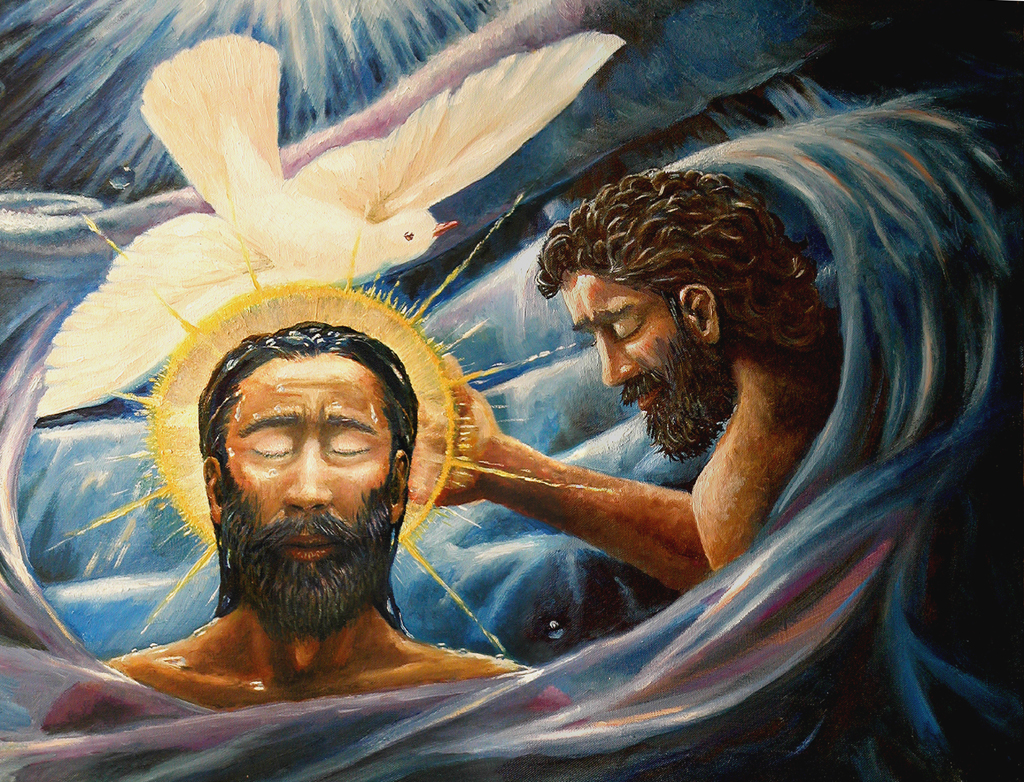
The Upside-Down Baptism Of Jesus, Matthew 3:13-17 (Ordinary 1 Epiphany 1 Year A)

Matthew 3:13-17

One thing I look back on with affection from childhood is the puddings my Mum used to make. She was great at making classic puddings with leftovers. Nobody for me has quite equalled her bread pudding – not least because she didn’t add so many fancy spices that a lot of cooks do.

Ditto her bread and butter pudding – a great way to use stale bread, and I always loved sultanas as a child. Only a holiday once in Shropshire, featuring a visit to Ironbridge, where a café offered various different flavours of bread and butter pudding, ever came close.

But one pudding she always made differently – and in my opinion, better than anybody else – was pineapple upside-down cake. Everybody else made it with slices of pineapple rings and added glacé cherries. Well, I hated cherries, and Mum used not pineapple rings but crushed pineapple, which made the flavour soak right through the cake.

Are you feeling hungry now?

Upside-down cake could be a metaphor for the ministry of Jesus. I’m not the first preacher to tell you that Jesus turned everything upside-down from our expectations. Any attempt to fit Jesus into our expectations, be they social, political, or anything else, is doomed to failure or to distorting him badly.

Today, I want to show you the way his baptism turns everything upside-down.

Firstly, Honour and Shame:

13 Then Jesus came from Galilee to the Jordan to be baptised by John. 14 But John tried to deter him, saying, ‘I need to be baptised by you, and do you come to me?’

John has just done the big introduction to Jesus, like the compère building up to the headline act. He has told the crowds that although he baptises people in water, someone is coming who will baptise with fire! The curtains part, the spotlight picks out this man as he walks onto the stage of history … and he wants to be baptised by John.

Whoa! Hang on, says John. You’re the big shot, not me. But Jesus says, I do things differently. You’re not going to get the prima donna act from me.

Now we acclaim celebrities and stars (even if later we like to shoot them down), but in Middle Eastern culture honour has always been important. People should be honoured. There is nothing worse than shame. That’s why, as I’ve told you before, Islam cannot get its head around the idea of a crucified Messiah.

But in submitting to baptism, Jesus shows his willingness to embrace the same shame as those who had already come to the Jordan to confess their sins. He has come to identify with their shame and to embrace it.

I believe this could be a powerful way of sharing the Good News of Jesus today. We struggle to convince people they are sinners (although strictly that’s the Holy Spirit’s job, not ours) because they think of ‘sinners’ as especially bad people, rather than all of us with our failings, which we tend to excuse.

But many people know feelings of shame. They know things in their lives that they just can’t talk about openly. Jesus has come as one who understands shame and who bears it all the way from the manger to the Cross.

In fact, an old friend of mine called Judith Rossall wrote a book that reclaims the importance of shame in the Bible. It’s called ‘Forbidden Fruit and Fig Leaves[1] and she argues that this all comes to a climax at the Cross, which was such a shameful mode of execution that Romans didn’t talk about it in polite society. Jesus was shamed by the Jewish and Roman authorities at the Cross, but honoured by God at the Resurrection[2].

So if you have something that you find so shameful you can’t bear to talk about it openly, I want you to know that Jesus’ willingness to be baptised is an early sign that he above all will embrace you in your sense of shame to make you whole. Whether it was something awful you did or something terrible that was done to you, I believe Jesus wants to raise you up and give you hope, honour, and dignity.

Secondly, Humility and Salvation:

15 Jesus replied, ‘Let it be so now; it is proper for us to do this to fulfil all righteousness.’ Then John consented.

Now when we hear the word ‘righteousness’ we might think this is about moral or ethical behaviour. But it’s more than that here, because it’s paired with the word ‘fulfil’, and Matthew has a big thing about the fulfilment of Scripture. Go back to the birth stories we’ve been reading at Christmas and you’ll see that a lot there. Fulfilling all righteousness means not only doing what Scripture requires, but that Jesus is fulfilling God’s whole plan revealed in the Scriptures. He fulfils Israel’s history and destiny by identifying with them here in baptism, and he takes that all the way to identifying with their sin at the Cross[3]. In submitting to John’s baptism of repentance even though he had not sinned, he showed where he was going: to the Cross, where he would identify not only with sinful Israel but the whole sinful human race. He would experience abandonment by God, but be vindicated in the embrace of the Resurrection.

Again, there is something relevant for people today. Who feels abandoned by God? Who thinks that God has left them, because of their sin? Jesus came to heal that. In undergoing a baptism of repentance he showed that he would stand in for us whose sins separate us from God.

And not only that, by doing so he would show us that the God who cannot look on our sin is nevertheless on our case, calling us back to him. The way back is the Cross.

If you have a sense of being abandoned by God and you know you have done things which have separated you from him, then hear the Good News here as Jesus fulfils all righteousness in his baptism of repentance and ultimately in his death at the Cross. God’s plan all along was to make a way back to him when we are far away due to our own fault.

If that is you, then you can start the journey back today through what Jesus did for you at the Cross.

Thirdly and finally, Hero and Servant:

16As soon as Jesus was baptised, he went up out of the water. At that moment heaven was opened, and he saw the Spirit of God descending like a dove and alighting on him. 17 And a voice from heaven said, ‘This is my Son, whom I love; with him I am well pleased.’

What a guy to do all this! And the Holy Spirit comes down on him in the form of a dove, just as

the dove appears as the harbinger of a new world after the flood, which other early Christian literature employs as a prototype of the coming age[4].

The new world is coming! This is what Jesus is bringing! Wow! And the voice from heaven commends him, and says how pleased he is with his Son. What a hero!

But wait. The language of affirmation from heaven is modelled on Isaiah 42, the first of the so-called ‘Servant Songs’ in that book. Godly heroics are not achieved by a superstar, by a celebrity, by someone in peak physical condition, or by a warrior. They are achieved by a servant.

I talked once before about how sad it is that when many children are asked today what they want to be when they grow up, the most common answer now is, ‘I want to be famous.’ But the example of Jesus shows how shallow this is. The Son of God himself rejects this way of life!

And that is good news for all of us. Because if you don’t have to be a famous celebrity or some kind of hero in society in order to change things for the good in line with God’s kingdom, then this way of life is open to everyone! Very few people will become nationally-known heroes that it’s really not worth aiming for. If it comes along, it comes along – but there are dangers.

However, everyone can find other people to serve. There are no limits. The upside-down way of Jesus opens up the way for everyone to make a difference for good in the world.

Conclusion

Jesus at his baptism gives some of the earliest signs that the ways of the world are disordered and that his upside-down approach will restore this world to a healthy and life-giving order.

So let us not seek honour for ourselves. If we live among the shamed, let us embrace it, for God will honour us and will transformed the shamed by his love.

Let us take the road of humility, knowing that it is the pathway to salvation, rather than pride and self-exaltation.

And let us not worry for a moment about whether people will regard us as heroes. Instead, let us give ourselves over to a life of service, knowing that this is how God brings in his kingdom.


[1] Judith Rossall, Forbidden Fruit and Fig Leaves: Reading the Bible with the Shamed; London, SCM, 2020.

[2] See Judith Rossall, Whose Honour? Whose Shame? Some Reflections on the Bible; Anvil volume 37 issue 2 at https://churchmissionsociety.org/anvil/whose-honour-whose-shame-some-reflections-on-the-bible-judith-rossall-anvil-vol-37-issue-2/

[3] Craig S Keener, The Gospel of Matthew: A Socio-Rhetorical Commentary, p132.

[4] Keener, p133.

Good News For Short People, Luke 19:1-10 (Ordinary 31 Year C)

Luke 19:1-10

This week we have seen a short, wealthy man find his way into 10 Downing Street. How fitting that our Gospel reading today is one where a short, wealthy man wants to find his way into God’s kingdom.

Most of us have known the story of Zaccheus since childhood. We heard it at Sunday School. We sang songs based on it where Jesus invited himself for tea at Zaccheus’ house. All this despite there being no evidence whatsoever of tea-drinking anywhere in the Bible.

I want to ask a simple question of this story. It’s a question we could regularly deploy in our reflection on Bible passages. Here it is:

What is the Good News for Zaccheus?

I want to reflect on two areas where we see that Jesus is Good News for Zaccheus.

Firstly, I want to speak about Good News for the Rich.

Just to say those words will wind up some people. Good news for the rich? Really? It’s the poor who need good news.

And besides, Jesus said in Luke 4 he came to bring good news to the poor, not the rich. Not only that, Jesus told the rich in Luke’s version of the Beatitudes (Luke 6:20-26) that the rich have already received their comfort.

Furthermore, this was prophesied while Jesus was still in the womb. At that point she sang the song we know so well as The Magnificat. It includes the line, ‘He has sent the rich away empty’ (Luke 1:53).

So how can there be good news for the rich? The good news is for the poor and there is only bad news for the rich.

The answer is this. You have to define what you mean by good news. The Good News which is the Gospel is not a good news that tells someone everything about the way they live is fine. In fact, it’s rather different.

‘Good news’ for a citizen of the Roman Empire meant hearing a herald come to their town or village with a proclamation either that there was a new Emperor on the throne or that Rome’s armies had won a great victory.

The Good News of the Gospel Christianises that. It is the proclamation that there is a new king on the throne of the universe, and that his name is Jesus. And furthermore, he has won the greatest of all battles by conquering  sin, suffering, and death at the Cross.

That is Good News for everyone, including the rich. However, I will concede that it is challenging good News for the wealthy. If the rich are going to acknowledge that Jesus is on the throne of the universe then the good news for them will include some rethinking of financial habits.

And if you had gained your wealth by morally dubious means as Zaccheus had, then the Good News of Jesus’ reign was more challenging.

We know Zaccheus was corrupt, and there was little way out of being corrupt if you are a tax collector, due to the way the Romans managed the system. The tax collectors were given a target by Rome of how much tax they had to raise in their district. But the tax collectors had to gather their own income from the taxation, too, and so they charged residents over and above the amount Rome had set for them, otherwise they and their family would starve. So you can imagine that those tax collectors who wanted, shall we say, a somewhat comfortable life charged a higher taxation that those who were content with a more modest lifestyle.

But regardless of income, tax collectors would have been treated as ‘sinners’ because their very work meant they were collaborators with the occupying Roman armies. Indeed, that’s the scandal of what Jesus does for the crowd here:

‘He has gone to be the guest of a sinner.’ (Verse 7)

Somehow Jesus knew that just railing against Zaccheus for his sin wouldn’t melt his heart. The tax collector already knew he was a sinner, not only in the sight of the crowd, but of God. He knew what he was doing was wrong. It’s rather like going into a prison with the Christian message: you don’t need to tell the prisoners they are guilty, they are only too conscious of that fact. It is Jesus’ act of grace in seeking out hospitality from such an unpopular man that makes the difference.

Now Zaccheus can address his sin and show that his repentance is real by matching it with transformed actions. He offers half of his possessions and to repay what he has cheated fourfold – and fourfold was

the penalty for those who have stolen animals[1].

In addition, Zaccheus addresses Jesus as ‘Lord.’ He is a changed man.

This helps us with how we proclaim the good news to the wealthy today. How will they respond to the Good News that Jesus is on the throne and that he has conquered evil? Can we model to them the grace that leads to their conviction of sin by the Holy Spirit?

And it also challenges us, as it did Zaccheus. Do we own money or possessions that are not rightfully ours? What would Jesus, the king of the kingdom, say to us about those things?

Secondly, this story is about Good News for the Shamed.

Zaccheus has to climb a sycamore-fig tree in order to see Jesus (verse 4) and we assume the only reason he did that is the one Luke tells us about, namely that he was ‘short’ (verse 3).

All that is true, but here is something I discovered this week about sycamore-fig trees. The nature of their leaves is such that if a man climbed up into them, he would most likely be well-hidden. Jesus literally had ‘to seek and save the lost’ (verse 10).

Combine this with the way that Zaccheus runs ahead of the crowd on the route out of Jericho, anticipating Jesus’ route, where he is surely trying to put some distance between himself and the crowd who will hate him, then we can see an important truth. Zaccheus wanted to stay hidden.

And why was that? Surely it was an issue of shame – the shame he felt for his way of life.

But Jesus can see the man whose shame hides him and puts him at a distance from others. He sees through and brings the word of grace:

‘Zacchaeus, come down immediately. I must stay at your house today.’ (Verse 5)

Shame makes us run away from others. It makes us hide from them. Like Adam and Eve hiding in the Garden of Eden, shame even makes us want to hide from God. But for those who are shamed by their lives Jesus reaches out to restore them.

From my experience as a minister, there are stories I could tell you about the shameful things people have confessed to me. Often, they have been people who were among the most loved and respected church members in a congregation, but they held a dark secret.

Now of course I cannot share any specific stories with you, because they were shared with me in confidence. I’ll just say, think of the sins the church routinely says are very bad, and I’ve probably heard them confessed by Christians. But it has been my privilege to tell these people that there is indeed a God who forgives them, restores them, and welcomes them back to the heart of his family.

That is what Zaccheus found with Jesus, who calls him ‘a son of Abraham’ (verse 9) – a member of the family, the people of God, not an outcast.

So from this let me offer a couple of encouragements to you. One is to emphasise this word of  hope to any of you who are carrying the burden of shame. If there is something from your past that means you are secretly weighed down by shame, I want to encourage you to talk to someone like a minister, so that you can hear the reassurance of God’s forgiving love in Jesus Christ for you. The only reason I say a minister is not because we have special powers but because in all but the most exceptional circumstances we are required to keep confidential what you share with us.

Shame, however, is not just for those who carry guilt. Some of us carry shame for things that have been done to us. This is particularly true of abused people, of whom there are many in our churches and society. Let someone like a pastor reassure you in confidence that Jesus wipes away the false shame of being sinned against.

My other encouragement is to say that this is good news for the world. People may not talk about sin as much as they did, but they certainly talk about shame. That Jesus offers a way home to God for those who experience shame would be good news for many in our world.

Sadly, sometimes these people think the church is the last body to help them because they expect to hear little more than condemnation from us. But what if in our friendships with people outside the church we can speak and demonstrate a message where Jesus says to people today, ‘I must stay at your house today’?

So this wonderful story gives us both a challenge and an encouragement. The Good News that Jesus is on the throne of the universe is a challenge for us to respond and put our lives in harmony with his kingdom ways.

And the Good News that this King Jesus wipes away all the effects of shame through his victory over all sin and suffering at the Cross means liberation for us and for all who will hear and embrace it.

All that remains is for us to put these things into practice, both in our own lives and in our witness to others.


[1] https://www.psephizo.com/biblical-studies/jesus-calls-zacchaeus-in-luke-19/; also see Exodus 22:1 and 2 Samuel 12:6.

Create a website or blog at WordPress.com

Up ↑