Following the Risen Jesus in Everyday Life (John 21:1-25)

John 21:1-25

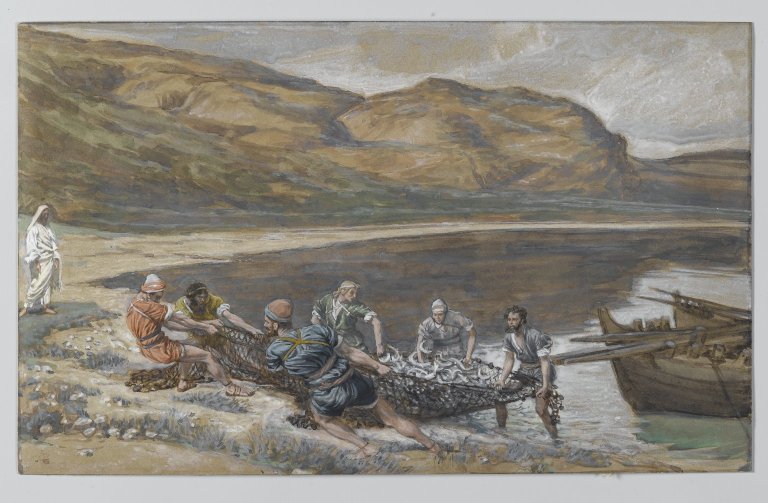
Brooklyn Museum – The Second Miraculous Draught of Fishes – James Tissot. Public Domain.

Last week, I got to preach on one of my favourite Bible passages, the second half of John 20. Today, I have disregarded the Lectionary, which would have taken us to the Emmaus Road story, which was the Bible reading at our wedding, to follow John 20 with – er – John 21, which is also significant for me. It was hearing a Local Preacher speak on this passage in 1985 that began my journey to theological study and eventually ordained ministry.

But today, I don’t want to speak about ordination. I want us to look at how the risen Jesus transforms everyday life.

Firstly, the risen Jesus transforms work:

Aerial view of computer laptop on wooden table photography hobby concept from rawpixel.com at pxhere.com. Public Domain.

The disciples have met the risen Lord. He has promised them the Holy Spirit. But they haven’t been transformed yet. They haven’t begun the mission Jesus has described for them. Simon Peter is hanging around, twiddling his thumbs.

‘I am going fishing,’ he says, and the six friends with him join him. Back to the day job. Back to something familiar. Back to something he knows all about.

But for all the knowledge and experience of fishing among those assembled on the boat, the expedition is a failure. They have gone out to fish at night, which was generally the most fruitful time, but they have caught nothing.

Until a knowing voice from the shore calls out: ‘Children, you have no fish, have you?’ How did he know from that distance?

‘No.’

‘Cast the net to the right side of the boat, and you will find some.’ How could he tell from that distance? He couldn’t see a shoal swimming under the water from there.

But lo and behold. A hundred and fifty-three fish. Many scholars have tried to find symbolic significance in that number, but really it’s just an eyewitness account that testifies to the abundance in contrast to the prior lack. On this occasion, Jesus doesn’t draw a spiritual parallel, such as when he had talked about ‘fishing for people.’ He simply blesses the work of fishermen.

Jesus loves to bless our work. In creation, the human race was made stewards of all God had made. If you look closely, you can see that in so many professions.

It’s not just the obvious work of ministers. Nor is it some of the other professions we have lauded, like medicine and teaching – although we are grateful for them. Do you remember the slogan popularised by Christa McAuliffe, the teacher chosen as a space shuttle astronaut, but who sadly died in the Challenger disaster in 1986? ‘I touch the future. I teach.

But think also of how engineers steward the resources of the earth. Think of those who in many ways engage in creative management of the world’s assets. Consider someone who daily enables people to communicate through electronic means. Think of a hairdresser whose clients leave her feeling better about themselves. Are these not things Jesus wants to bless?

Whether you are still in paid work, or like the majority of this congregation well into retirement, can you consider inviting the risen Jesus into those daily activities? How might that make a difference to you?

Secondly, the risen Jesus transforms our daily needs:

Our daily needs 3 at Wikimedia Commons. CC 4.0.

There is one detail in this story that has puzzled me for a long time. Simon Peter and the gang have struggled to catch any fish, but when they get to shore with a bulging net, there is Jesus, with breakfast ready for them. Including fish! Where did Jesus get his fish?

No scholar has been able to explain this. Was it miraculous? Did he buy them from another fisherman?

Whatever the explanation, Jesus knows his friends are coming off a physically demanding night shift. They will be ravenous. The kippers are ready. (I’m sure he would have made kedgeree if he’d been in Haslemere.)

It’s a minor detail, but it shows Jesus caring for ordinary, everyday needs. Sometimes, we don’t like to bother him with the small things. Surely he’s too busy upholding the universe? But he cares.

My late father and aunt grew up as children in the Depression of the 1930s. Their father was out of work for five years. This was before all the provisions of the Welfare State that we know. Their mother would skip meals herself and be on her knees in the kitchen, praying for God to provide. Food parcels and other items the family needed would appear on the doorstep in the nick of time.

Do not leave Jesus out of the smaller, regular features of life. Does that mean you can pray for a parking space? Well, yes, but with certain provisos! For one, just be sure you’re not just using him to get you off the hook. For another, leave him enough time to organise an answer to your prayer. And also, don’t let it distract you from also praying about the weightier matters of life, like justice and poverty. He cares.

Is there something niggling at you right now? Do you keep thinking, this is trivial? It may be something you can deal with by handing it over to Jesus. He cares about our daily lives and needs.

Thirdly, the risen Jesus transforms our wounds:

Emotional Effects of Robbery: Understanding the Impact – Bryan Fagan Law Office CC 4.0.

Let’s go that central conversation after breakfast between Jesus and Simon Peter. We assume – rightly, I think – that the three times Jesus asks Simon whether he loves him are to mirror and replace the three denials he made in the high priest’s courtyard. Not only that, each exchange finishes with the calling to feed Jesus’ sheep.

This is all the more confirmed when you notice one other details. It happens around a charcoal fire, the one Jesus had used to cook the fish and the bread. There is only one other place in the New Testament where a charcoal fire is mentioned, and it is when Simon Peter warms his hands in – the high priest’s courtyard.

Everything in this little episode is about Jesus taking Simon Peter back to those painful denials and healing them. I believe Jesus cares about the wounds we carry from the past. He does not want emotional damage to determine how we live today.

Let me tell you a story. The details I am about to share have been public for many years. I am not breaking any confidences.

I once had an elderly church member who had been an only child. Her father had adored his little girl, but her mother had wanted a boy. Tragically, her father had died young, leaving her to be raised by the mother who did not want her.

One day, we talked about this, and I suggested we pray together. I asked her in the silence to invite the Holy Spirit to show her an incident from her past. In her mind’s eye, she saw a time when she was a child, baking a cake in the kitchen. Her mother came in, told her she would never be any good at this, and snatched everything away from her.

Next, I suggested she should ask the Holy Spirit to show her what Jesus was doing there. Now she saw Jesus come into the kitchen. He gently eased her mother out of the way. Then he spoke to her. ‘You and me, Joan, let’s make this cake together.’

From that time on, she was healed of those parental wounds. For now – although those past events obviously didn’t change – she knew how Jesus regarded her.

I would hazard that many of us are living with old wounds. What if we too invited the risen Jesus to show us where he was when we were hurt? Might we too find his restoring love and live more healthily as a result?

Fourthly and finally, the risen Jesus cares about our future:

Blue gift box. Free public domain CC0 photo at rawpixel.com.

The final part of the story is the other conversation Jesus and Simon Peter have, where Simon is jealous that the ‘Beloved Disciple’ may have a future vastly different from his, which will end in his own execution. Jesus has told him he will end up being led somewhere he does not want to go, and you may know of the legend that Simon Peter asked to be crucified upside-down, because he was not even worthy of being crucified in the same way as Jesus, unbearably cruel as that was.

Comparison is the thief of joy, goes the saying. How many of us have wasted energy and maybe even years of our lives wanting to be someone else? I have wanted to be more outgoing. I have wanted to be musical – and not least when churches have torn themselves apart in ‘worship wars.’

But it’s all fruitless. We can only find fulfilment when we embrace the gifts and callings Jesus has for us. And when we each discover the place God has allotted us in the Body of Christ, then we can play our part healthily in the divine purpose.

A few months ago, Ray Goddess led the circuit staff in the Network course from Willow Creek Church in the USA. It helps people discern their spiritual gifts, but not only their gifts: how these match with their personalities and their passions. It didn’t reveal to me any gifts I didn’t know I had, but it did show me that I was undervaluing one of my gifts, and I need to work that out.

We have just run the course at Lindford church. While we are still processing the results, it has nevertheless been exciting for some people to be confirmed in where God is leading them, and others to be genuinely surprised by what this has opened up for them.

And so, I wonder whether you are settled in your heart and mind about the future God is calling you to. The world has lots of self-centred ways that claim to offer you fulfilment in life, but the one that brings true peace and satisfaction is in knowing what God has given you and has spoken to you. Whatever it is, it is not something where he leaves you on your own to work it out. It is always framed with those words of the risen Jesus to Simon Peter: ‘Follow me.’ He will be there, with us, and going ahead of us.

Conclusion

Indeed, perhaps ‘Follow me’ is the message for all of us in every aspect of what we have considered today. The risen Jesus says to us ‘Follow me’ into the world of daily work and let me transform it. He says, ‘Follow me’ and you will find me providing for you in your daily needs. ‘Follow me,’ he says again, and your old wounds will no longer hold you back. ‘Follow me,’ and you can be liberated to follow the calling he has for you without worrying about others.

Where are you hearing Jesus say, ‘Follow me’?

Sermon: The Emmaus Road (Stations of the Resurrection)

After a week in which I’ve caught up with being human after the madness of the Easter routine, I’m back into preaching tomorrow – this time at another church in the circuit, not one of ‘mine’, where they are exploring the Resurrection appearances in a sermon series.
‘Look away now if you don’t want to know the result.’
You may have heard this sentence on the news when they are giving out the sports results, but when highlights are going to be shown later, perhaps on ‘Match of the Day’.
Similarly, I’ve known friends record entire football or rugby games, and plead with their friends not to tell them the result ahead of them watching the recording.
If you’re not a sports fan, you still have the same problem if you like television programmes, films or books. Advance reviews of some contain what are called ‘spoiler alerts’ – that is, if you read the review, you will find out a key element of the plot that you might not want to know ahead of watching or reading.
Christians have the same problem when reading the Gospels. To enter into the action as if we don’t know the ending or the result it close to impossible. In one sense, that gives us hope: we know that the outcome of history, will, in some form be, ‘Jesus wins’, as Tony Campolo puts it.
But in another way it makes it difficult for us to enter into the feelings of, say, Cleopas and his companion on the Emmaus road, and hence feel the impact of their mysterious encounter with Jesus. We read it, having read it many times over the years, knowing that the stranger is the risen Lord. We may not be so foolish as to think that if we were in their place we would have recognised him straightaway, but it is still hard to get inside their blindness.
And indeed, that is the first thing we need to consider when reflecting on this ‘Station of the Resurrection’ – the blindness of these two disciples. Luke tells us that when ‘Jesus himself came near and walked with them’ (verse 15) ‘their eyes were kept from recognising him’ (verse 16). What was it? I think we can rule out any sense of Jesus wanting to hide himself, even if you might get the feeling that Jesus is being rather playful with them. Ultimately, Jesus wants them to recognise him, and to live faithfully in the light of his resurrection.
I think we must look at the disciples and their spiritual and emotional state. They clearly do not believe the resurrection stories they have already heard from the women (verses 22-24). For one thing, women were not regarded as reliable witnesses in their day, to the point of not being allowed to give testimony in court. But more significant than that, resurrection is just not on their radar. They are not expecting it. They are good Jews who either believe that the resurrection will happen at the end of time (if they believe the Book of Daniel) or, like the Sadducees, they don’t believe in resurrection at all. It’s all outside their belief system, just as the idea of a suffering Messiah was. Remember that when Jesus prophesied his betrayal and death to his disciples, they either rejected it (like Simon Peter) or ‘they did not grasp what was said’ (18:34).
Isn’t their blindness, then, caused by their preconceived ideas? Isn’t their blindness caused by what is often called their ‘worldview’? in other words, people have a view of the way life is, and it determines how they see everything else – and indeed what they also fail to see. So for example the scientific atheist will have a worldview that says everything can be explained by reason, experiment and cause and effect. There is no such thing as purpose in our universe, and there are certainly no miracles. Their worldview rules out on principle something like the Resurrection. Cleopas and his companion in the story will have ruled out a resurrection in the middle of history, because it was contrary to their worldview.
Often our worldview is simply that of the prevailing culture in which we live, and that culture is so pervasive that we barely recognise it’s there. The overall perspective by which we understand the world, and the beliefs we hold about life and the universe are all around us. The late Lesslie Newbigin said we no more notice the worldview of our culture than a goldfish notices the water it is swimming in. It’s just there. Sometimes this worldview is helpful and illuminating, but sometimes – like here – it blinds us to ultimate truth.
What, then, is the challenge we might draw from reflecting on how the disciples’ worldview blinded them to the risen Jesus? Is it not something like this? The Christian needs to shape their view of the world not firstly by uncritically absorbing the views around us. If we do that, we may end up believing that the meaning of life is … shopping. Instead, we need a worldview shaped by Jesus. He needs to be the centre and horizon of how we view life. To change the metaphor, we need to look at life through the lens of Jesus. This means taking seriously every part of who he is and what he does. It means an immersion in his life, story and teaching. Like Cleopas, his companion and the other disciples, there will be aspects we just don’t grasp immediately. But to live as disciples of the risen Lord, we need to engage thoroughly and consistently with him.
The second thing we need to consider, then, is how Jesus made himself known to his two followers. The key element seems to be his use of Scripture:
Then he said to them, ‘Oh, how foolish you are, and how slow of heart to believe all that the prophets have declared! Was it not necessary that the Messiah should suffer these things and then enter into his glory?’ Then beginning with Moses and all the prophets, he interpreted to them the things about himself in all the scriptures. (Verses 25-27)
Just to mention Scripture is to open up a potentially difficult subject, especially as this is only one point within a wider sermon, and even one sermon would not do the subject justice. For instance, take the wide divergence of views about the nature and authority of Scripture, even among Christians. How does it relate to other sources of truth such as reason, tradition or experience? Christians who value the Bible equally highly still differ with each other over the interpretation of certain passages and doctrines. Whether your faith is conservative or liberal, you will know that there are difficult passages in the Scriptures. Atheists are quick to use the more violent passages in the Bible in their arguments against us. On the other hand, there are passages of unsurpassed beauty.
Without trying to settle all these arguments (and I’m not sure I could, anyway), let me simply point to the key issue Jesus raises about the Scriptures here: ‘he interpreted to them the things about himself in all the scriptures’ (verse 27).
Jesus, using what we call the Old Testament, says that the critical matter is the way the inspired testimony points to him. The point is not to treat the Bible as having fallen down out of heaven (which in any case is more like a Muslim approach to a holy book than a Christian one), nor is it just to see it as a jumbled and confused collection of human strivings after God. It is to see its overarching purpose as being testimony to Jesus the Messiah. It’s not just about individual proof texts that we think prophesy certain details about Jesus, it’s about the great story of Israel, God’s people, being fulfilled in Jesus. It’s about what we sing of at Christmas in the carol: ‘The hopes and fears of all the years are met in thee tonight.
So what does this mean for us now? We who know more of the story than Cleopas and his companion had while walking the dusty road to Emmaus also have more Scriptures, and much of what we have speaks explicitly of Jesus. We can engage with the sacred writings in order to engage with the risen Lord who appeared to his disciples two thousand years ago. Yes, we engage with him as not only risen but also ascended. He does not walk with us physically as he did in the story we are reflecting on today. But let us embrace one simple aim for our studying, meditating and praying of the Scriptures: how does this point me to Jesus? I believe it’s what he’d want us to do.
If the first two elements here in engaging with the risen Lord are firstly to interpret life through him and secondly to see the Scriptures as pointing to him, there is a third element in the Emmaus Road story that helps us to meet with him today. There may well be others, too, but I am going to make this third point my final one this morning. That third aspect is to meet the risen Lord in ordinary life.
How is Jesus recognised in the end? It’s when he as guest becomes host, when he takes the bread, blesses it, breaks it and gives it to them (verse 30).
For years I interpreted this as a hint of Holy Communion, because the four actions Jesus does here are the four he does at the Last Supper – he takes, blesses, breaks and gives. We even structure our sacramental services around those four actions. We have taken this up into our hymns, such as ‘Be known to us in breaking bread, but do not then depart.
However, what happens when you discover that the four actions Jesus performs – the taking, blessing, breaking and giving of the bread – are simply the four that a devout Jew would have done at an ordinary meal? Is there not a case here for expecting to meet the risen Lord not merely in a ‘religious’ setting such as a sacrament, but in the most ordinary acts of everyday life? After all, as both risen and ascended he is present everywhere, reigning over all things. The problem is, we rush by and fail to take notice that he is present, wanting to reveal himself to us. In our world full of so-called labour-saving devices which really only create more time for us to do more things, we hurry past where God is travelling on foot at three miles an hour and miss his revelation. Back in 1917, the German theologian Rudolph Otto said, ‘Modern man cannot even shudder properly.’  In the nearly one hundred years since he said those words, I suggest the problem has got far worse.
It is time, I believe to recall the words of another early twentieth century European Christian, the French mystic Simone Weil, who said, ‘Prayer is simply coming to attention.’  I believe we need to ‘come to attention’ to Christ’s presence in the world. It is, if you like, to underline what I am sure you have heard other preachers say about the monk Brother Lawrence ‘practising the presence of God’. What it requires to come to attention to Christ’s risen presence among us, with us and beyond us, though, is this: coming to attention means stopping in order to listen. We have to curb the business, we have to pare down the cramming in of more things. We have to delete good things from our lives to concentrate on the best. We need to edit our lives at times to make space for giving attention to Christ’s presence in the world.
One of my hobbies is photography. The photographer whose work I most admire shot mainly black and white pictures in the 1930s and 1940s in the American national parks. His name was Ansel Adams, and here is one of his famous photos taken in Yosemite National Park. Adams used something my children only know of as an historical artefact – a film camera. It was large and bulky. He often had it on a specially made tripod on top of his car. He had to take time to line up his shots, to consider the light, the composition and the exposure. Even in this scene of a clearing winter storm, you can sense that he took his time to pay attention to the scenery and his equipment in order to produce this masterpiece. Does it not fill you with a sense of wonder? You can find many of his images online if you like this.
There is such a contrast with our all-too-quick digital photography today. We point and shoot speedily and indiscriminately, because we can delete the bad ones and we can alter the reasonable ones with software later. Much as I like digital gadgets, I acknowledge there is an incomparable value in those disciplines that require us to take time to pay attention.
I wonder where we might reorder our lives so that we can come to attention that the risen Lord is among us?

Create a website or blog at WordPress.com

Up ↑