Pentecost: The Spirit Brings Life, Purpose, And Hope (Ezekiel 37:1-14)

Ezekiel 37:1-14

I don’t know what associations go through your mind when you hear the reading from Ezekiel about the valley of dry bones. Perhaps you hear the words of the old spiritual, ‘Dem bones, dem bones, dem – dry bones.’

I always remember hearing an Anglican bishop read the passage and then ask the question of his congregation, ‘Can these dead Anglicans live?’

It goes without saying that ‘Can these dead Methodists live?’ is an equally valid paraphrase!

Well, maybe ‘dead Methodists’ is a bit harsh (although not in some places!) but perhaps we ask, ‘Can these struggling Methodists live?’ You don’t need me to rehearse the issues of smaller congregations with older members.

And to that issue, God’s promise to send the Holy Spirit speaks powerfully. In Ezekiel, the people of God are struggling in exile in the alien culture of Babylon. And we struggle as now a minority in a culture which no longer uses Christian values as a foundation for life.

So let’s go digging for hope in Ezekiel 37, and the way I propose to do it is this. Three times in the passage God tells the prophet to prophesy the coming of the Spirit on the dry bones, and each time the promised result gets bigger and better. Come with me and catch a vision of hope in these verses.

Firstly, life:

Then he said to me, ‘Prophesy to these bones and say to them, “Dry bones, hear the word of the Lord! This is what the Sovereign Lord says to these bones: I will make breath enter you, and you will come to life. I will attach tendons to you and make flesh come upon you and cover you with skin; I will put breath in you, and you will come to life. Then you will know that I am the Lord.”’

So I prophesied as I was commanded. And as I was prophesying, there was a noise, a rattling sound, and the bones came together, bone to bone. I looked, and tendons and flesh appeared on them and skin covered them, but there was no breath in them.

There is no cure for the state of God’s people other than a spiritual one. At the risk of stating something that is a hobbyhorse of mine, no amount of new programmes will change the fortunes of the church. No new creative techniques will bring life to dry bones. It is our foolishness that we fall for these parodies of the spiritual life so often. It is to the shame of our denominations that national leaders so often propagate them.

The only cure is for the Sovereign Lord to breathe his breath, the Holy Spirit, into us. If the flowers and plants in the garden are withering, we water them. It is the same with us. We need to be watered with the living water that Jesus promised, namely the Holy Spirit.

I want to tell you one of my favourite sermon stories. It concerns the nineteenth century American evangelist, D L Moody. On one occasion, he was visiting the United Kingdom and spoke to a group of church leaders. For his text he chose Ephesians 5:18, where Paul urges the recipients of his letter to ‘Be filled with the Spirit.’ Moody pointed out that this is legitimately translated into English as ‘Continue to be filled with the Spirit.’

At the mention of this, a vicar objected. ‘Why do I need to continue to be filled with the Spirit? I was filled with the Spirit at conversion.’

‘I need to continue to be filled with the Spirit,’ replied Moody, ‘because I leak.’

And we all leak. We may well be able to point back to glowing times in our lives when we were particularly conscious of the Holy Spirit’s power at work in us, and nothing I say is intended to diminish those experiences. But we cannot live on past glories. As our cars need refilling with petrol or recharging with electricity, so we need refilling with the Spirit.

Perhaps life or our Christian duties have drained us. Think of the time in the Gospels when the woman with the issue of blood touched the hem of Jesus’ garment and we read that he knew that virtue had gone out of him. It happened to Jesus. We know he recharged in times with his Father. Why not us, too?

Surely, Pentecost is the best day of all to make this our prayer. ‘Lord, we leak. Fill us again with your Spirit.’

Secondly, an army:

Then he said to me, ‘Prophesy to the breath; prophesy, son of man, and say to it, “This is what the Sovereign Lord says: come, breath, from the four winds and breathe into these slain, that they may live.”’ 10 So I prophesied as he commanded me, and breath entered them; they came to life and stood up on their feet – a vast army.

Now if we get nervous at the mention of an army, let me just say that this is a vision, not something literal. There is nothing that follows this which is military. Nor are we meant to conjure up images of extreme militant believers, like the Christian Nationalists in the USA or anything else of that ilk.

I think the force of the image that the coming of the Spirit creates ‘a vast army’ is about the way the Holy Spirit equips all God’s people to be a missionary people, to be a movement that is a force for good rather than evil in the world.

To hear some Christians talk about their experience of the Holy Spirit, you would think that the function of the Spirit was little more than the supplying of a personal bless-up. And while I have no doubt that on occasions the Spirit provides comfort and encouragement for us, and enables us to experience God’s love, I am also certain that the Holy Spirit is not here for our self-indulgence.

On the day of Pentecost, the coming of the Spirit sent one hundred and twenty disciples of Jesus onto the streets of Jerusalem among a multinational crowd with the good news of Jesus.

If you want a contemporary example of this, then the 24-7 Prayer Movement re-formed an ancient lay Christian order called the Order of the Mustard Seed. Its participants take three vows, which are worked out in six practices, that are seen as flowing from the Holy Spirit. Together, they form a corporate body that takes God’s love to the world. These are the vows the associated practices:

What does it mean to be true to Christ?
We live prayerfully
We celebrate creativity to His glory

What does it mean to be kind to people?
We practice hospitality.
We express God’s mercy and justice.

What does it mean to take the gospel to the nations?
We commit ourselves to lifelong learning that we might shape culture and make disciples by being discipled.
We engage in mission and evangelism.

Were we to pray, as Moody recommended, to be refilled with the Spirit because we leak, then I suggest this is the sort of body we would look like, too.

Thirdly and finally, restoration:

11 Then he said to me: ‘Son of man, these bones are the people of Israel. They say, “Our bones are dried up and our hope is gone; we are cut off.” 12 Therefore prophesy and say to them: “This is what the Sovereign Lord says: my people, I am going to open your graves and bring you up from them; I will bring you back to the land of Israel. 13 Then you, my people, will know that I am the Lord, when I open your graves and bring you up from them. 14 I will put my Spirit in you and you will live, and I will settle you in your own land. Then you will know that I the Lord have spoken, and I have done it, declares the Lord.”’

Now, just as with the word ‘army’, we have to be careful here. The promise of the land was central to Judaism, and certain interpretations of that are central to the current war between the Israeli government and Hamas in Gaza. But the promise of hope for Christians has never been about a geographical nation.

We also have to be careful not to see the idea of returning to the land as meaning for us a thought that things will be restored to the way they were in the supposed ‘good old days.’

Restoration for us is the recovery of our hope. After generations of decline, where in the next couple of decades some long-established Christian denominations may no longer exist in this country, where respect has turned to grudging toleration and then to the attempted silencing of Christians in areas of public life including politics, it’s not surprising that we have become disheartened.

There may or may not be some green shoots of recovery in our society. Justin Brierley, the Christian broadcaster, podcaster, and thinker, has written and spoken about what he calls ‘The Surprising Rebirth of Belief in God’. The professed conversions of the former atheist Ayaan Hirsi Ali and the media personality Russell Brand, along with the interest in Christianity shown by public intellectuals such as the historian Tom Holland after an answered prayer may start to shift the atmosphere in the public arena.

But whether that happens or not, the Spirit restores our hope not on the basis of whether Christianity’s popularity is waxing or waning, but on the promise of Jesus that he will build his church and the gates of Hades (that is, death) will not prevail against it. It is the hope that even death cannot destroy God’s People, because of the Resurrection and the promise of the new heavens and new earth. The Holy Spirit settles us in that hope, whatever is happening in the wider world.

This becomes yet another reason to pray, ‘Come, Holy Spirit.’ It may not be one of the ministries of the Spirit that most readily occur to us, but it is an important one nevertheless.

In conclusion, when we may be troubled about the future of the church, we pray again, Come, Holy Spirit.’ For the Spirit will give life to the tired and discouraged in the People of God. And the Spirit will make us a corporate body of God’s redeeming love in Christ for the world. And the Spirit will give us rock-solid hope, whatever fluctuations there are in the culture around us.

Can these dry bones live? Let us not simply say, ‘Sovereign Lord, you alone know.’ Let us instead say, ‘Come, Holy Spirit.’

New Beginnings 4: You Have Not Been This Way Before (Joshua 3:1-17)

Joshua 3:1-17

The late American church leader John Wimber used to say that Christians are like people who go down to the quayside, expecting to board a ship that will take them on a luxury cruise, only to find when they get there that their ship is gunmetal grey in colour. It’s a battleship.

He used to recall how, when he first found faith from a background as a rock musician (he was the keyboard player for the Righteous Brothers), he would go to church and hear all the Bible readings about Jesus and the apostles performing great miracles of healing. And he would say to the other church members, “Great! When do we do this?”

To which they would reply, “Oh no, we just talk about it.”

At some point for Christians, the rubber has to hit the road. We’re good at talking, planning, and preparing. But actually ‘doing the stuff’? Hmm, that’s a bit radical.

What I’ve said so far in my three previous sermons about New Beginnings was potentially challenging, but it could just be treated as preparation. Israel still had to take that final step of entering the Promised Land. We have to take that final step from theory to practice.

So yes – we must not live in the past but look to what God wants to do today. Yes – we must live by faith in what God says he wants to do, and not be constrained by fears based on our human limitations. And yes – we need courage and obedience to the Scriptures, all nourished by the promise of God’s presence.

We have to do something new. ‘You have never been this way before,’ say the Israelite officers to the people (verse 4). But that’s no excuse for staying put. This goes way beyond just singing an unfamiliar hymn! It means getting out of our comfortable space in church fellowship and taking God’s redeeming love in Christ into the world in both our deeds and our words.

Here are four things that Joshua 3 teaches us we need in order to live out our calling in the world.

Firstly, follow God’s lead.

“When you see the ark of the covenant of the Lord your God, and the Levitical priests carrying it, you are to move out from your positions and follow it. Then you will know which way to go, since you have never been this way before. But keep a distance of about two thousand cubits between you and the ark; do not go near it.”

The ark of the covenant is the portable presence of God with Israel, especially in the centuries before the Temple is built at Jerusalem. For the ark to go ahead of Israel is to signify that God goes ahead of them. Their calling is to follow God’s lead. God will lead them forward into the land.

The Christian call is also to follow God’s lead. He leads and directs the mission to which he calls us. We don’t invent things and just do what we fancy. We seek God’s lead and we respond.

That is built right into all Christian theology in one way or another. In the Methodist tradition, we talk of God’s ‘prevenient grace’, which means that God acts graciously before we ever do anything.

There are some similarities in the way Christians widely talk about mission today. We say that Christian mission is the mission of God, not our mission. We are called to find out what God is doing, and join in.

But how do we do that? Well, there is no getting around the need to practise what Wesley called ‘The means of grace’ and which modern Christians ecumenically call ‘The spiritual disciplines.’ It means actively seeking to be in tune with God. That requires a serious commitment to prayer and to meditating on Scripture. It’s no good thinking that we can just tick those off as done on Sunday mornings in the service, these need to be daily personal habits.

There are many ways to practise these disciplines, and we shall vary according to our personalities and gifts how we do them. I don’t have time to list different options now, but speak with me if you want some ideas.

What is certain is that the church sinks without them.

Secondly, imitate God’s character.

Joshua told the people, “Consecrate yourselves, for tomorrow the Lord will do amazing things among you.”

To consecrate oneself is to dedicate oneself to God’s service. It is to be set aside for holy work. It is not just for the priests (or modern-day ministers, for that matter!) but for all of God’s people.

God’s mission is not something that merely requires a certain amount of religious competence. It needs character, too: God’s character. God’s mission is to make all things new, and that includes our character. If we are to be in harmony with God’s purposes, we need to grow in his likeness and utterly dedicated to his cause.

If you want an engineer or a plumber, character may not matter, only their competence. But not with the mission of God. It requires a people who are growing in Christlikeness.

So we are called to consecrate ourselves before God does amazing things among us.

Joshua does not tell us here how the people did this, but we may have a clue from a similar event. When they had arrived at Mount Sinai after leaving Egypt, Israel had been called to be consecrated at the foot of the mountain while Moses climbed up to meet with God. How did they do it then? By various forms of fasting. Not simply fasting from food, but married couples also abstained from marital relations.

Fasting takes various forms. We can fast from food, from marital relations, from TV, from gadgets, and so on. In each case we are giving up something good for a season to concentrate on something far better and much more important. That’s why when we fast we also pray.

And as we show God just how serious we are about his will by abstaining from something good in order to find extra time for prayer, so he will respond to a commitment like that by forming us more like his Son through the gift of the Holy Spirit in us.

It is no good being recklessly unholy when God turns up in power to do amazing things. If we are, either his power will burn us or in his mercy he will not act powerfully at all.

But if we long for God to act in power, we need to consecrate ourselves.

Thirdly, grow in faith.

Tell the priests who carry the ark of the covenant: ‘When you reach the edge of the Jordan’s waters, go and stand in the river.’”

Have you noticed the similarities and differences in this passage with the account of Israel crossing the Red Sea out of Egypt into the wilderness? Here at the end of their wilderness wanderings, they are again faced by a mass of water, and the waters divide.

Only this time, Joshua’s command differs from that of Moses. At the Red Sea in Exodus 14, Moses told the frightened people that all they needed to do was stand still and they would see the deliverance of their God. But here, the command is not to stand still at the water’s edge.

On this occasion, however, they don’t get to wait on dry land. Or at least, the priests are going to need some towels afterwards, because they have to go and stand in the river before God divides the water this time. They were called to do something more by faith before God enacted his promise.

Faith, like love, is something that needs to grow. If I still loved Debbie the same amount today as I did on our wedding day, our marriage would be long over. If I still had the same faith that I had on the day I was confirmed and received into Methodist membership at the age of sixteen then my faith would have collapsed years ago. It is for good reason that God calls us to grow in faith.

In my first circuit as a minister, I got involved in some youth ministry that worked across most of the churches in the town. We began by holding Sunday night youth services, but they became a bit cheesy, and in order to challenge ourselves in a more difficult situation, we then hired a vacant shop in the town. We couldn’t use as much gear, and so we did what we called ‘Worship Unplugged.’ If any of you remember the MTV Unplugged shows from the 1990s, you’ll have an idea of what we did.

But we had too many numbers to cram into the shop, and so we moved to the church hall at the URC. Again, that was fine for a time, until the numbers made that venue too uncomfortable. There was only one venue in the town that would hold us, but it required a step of faith. It was the local nightclub.

One of our team, a Christian businessman, approached the nightclub owner, and he said he was willing to take our booking for one Sunday night a month. He would provide bar staff who would only sell non-alcoholic drinks on those occasions.

There was just one thing: the fee he wanted went beyond our existing budget.

This was the time which we identified as our ‘put your feet in the water’ moment. God wanted us to go further than we had before. We agreed to the terms for the nightclub without having the money.

But when we did, another Christian businessman in the town stepped forward and underwrote the project.

If you want to go forward in faith (and why wouldn’t you?), then is it time for you to get your feet wet, metaphorically speaking?

Fourthly and finally, remember God’s deeds.

12 Now then, choose twelve men from the tribes of Israel, one from each tribe. 

What’s that about, then? The twelve men get mentioned but then Joshua goes back to talking about the priests.

We find the answer in chapter 4, which we didn’t read. These men take stones from the river and create a memorial to the miracle God does here.

Why? This is no monument or museum. This is no living in the past. This is about learning from the past. It is easy to forget what God has done. In later Old Testament times, tragically the prophets record that Israel had forgotten her God. Not that she forgot God existed, but she forgot what God had done for her. And when she did, she went off the rails spiritually.

We need to do something similar, because it stirs our faith to believe again in a God who does mighty things. The supreme memorial for Christians is of course Holy Communion, when we remember what God did for us in Christ at the Cross.

But we need to create smaller memorials too, by recording things God has done individually for each of us. Here’s how I have found that to be important.

Like many ministers, I have on more than one occasion become discouraged and considered resigning. If that shocks you, then you would be even more shocked to know the substantial percentage of ministers who have felt like that.

But when I have been down in the depths, on some occasions Debbie has said to me, how can you consider such a course of action when you look back at all the ways in which God guided you into this calling? My metaphorical memorial stones brought me back – even if reluctantly at times!

What are your memorial stones? If you don’t have a heap of them, then perhaps now is the time to start collecting them.

Because it’s time to set out on that new beginning to which God has called us, following his lead, living in his ways, stretching our faith, and being sustained by remembering his mighty deeds.

New Beginnings 3: Occupy The Land (Joshua 1:1-9)

Joshua 1:1-9

Moses my servant is dead. (Verse 2a)

It’s not quite what we experience in Methodism when one minister leaves and a new one arrives. Or, as is the case here, one minister in the circuit changes responsibilities and a new one arrives. But it is that time when we break with the past and set out on a new adventure. 

Now then, you and all these people, get ready to cross the River Jordan into the land I am about to give to them – to the Israelites. (Verse 2b)

I know our call is not literally to occupy geographical land, as was Israel’s. Nor is it military conquest. For Christians, crossing the Jordan and occupying the land is metaphorical. It is about breaking out of our holy huddles and bringing the Good News of God’s victory in Jesus Christ into the world. 

But even so, there are some parallels between the commands God gives Joshua and what he requires of us as we begin moving forward. These are commitments we can renew at our Covenant Service. Here are three. 

Firstly, be strong and courageous.

6 Be strong and courageous, because you will lead these people to inherit the land I swore to their ancestors to give them.

7 ‘Be strong and very courageous.

I think Joshua gets the memo! Be strong and courageous; be strong and very courageous. 

There is no doubt that we need strength and courage to announce the Good News of God’s victory in Jesus Christ to the world. We know that we risk being mocked, ignored, or maybe at best patronised. We know that we live in a society that understands life in a very different way from the historic Gospel. On occasions, the difference can be so much that we are assumed to be a threat to the well-being of our society, and we are treated as enemies. The number of people with a residual sympathy for Christianity is declining fast.

When our world is like that, it’s little wonder that we can feel nervous about speaking up for Christ. No wonder we get worried. Unlike Israel, we do not face military enemies who can take our lives, but we do face people who may be cruel with words and other actions. 

We too need to hear the injunction to be strong and courageous. We need strength that will overcome our paralysing fears so that we act in word and deed for the Gospel. 

We need strength and courage to overcome the excuses we make for keeping silent about Jesus. I’ve heard some Christians engage in worthy social action programmes but keep quiet about their faith, while claiming that their social action was their evangelism. No, it wasn’t. It was a demonstration of the Gospel, but the Good News still needs to be proclaimed and explained. That requires our words. 

We don’t all need to be confident evangelists with slick presentations, we just need to be people who are willing to speak of what Jesus has done for us and what he means to us. We are witnesses: we speak of what we have seen and heard. 

Neither do we all need to be people with clever answers to the questions and objections people raise against our faith. We can say with all honesty, I don’t know an answer to what you are saying, but I will come back to you. In the meantime, we can bring their questions to the Christian community for reflection, and where people who are more specialised in their knowledge can offer some thoughts. We can and should do our own thinking, too – O for more Christians to do serious reading about their faith in between Sundays. 

At heart, we simply need to be people who will speak of the difference Jesus has made in our lives. A friend of mine is an Anglican priest, and he is serving in parishes in the Church in Wales. Every week, he puts a video on Facebook of an ordinary church member speaking about the difference Jesus has made them. 

Can we do that? If Jesus went to the Cross for us, surely we can do that? The Cross gives us the strength and courage we need. 

Secondly, be scriptural.

Be careful to obey all the law my servant Moses gave you; do not turn from it to the right or to the left, that you may be successful wherever you go. 8 Keep this Book of the Law always on your lips; meditate on it day and night, so that you may be careful to do everything written in it. Then you will be prosperous and successful.

Joshua doesn’t have the whole Bible at hand – obviously! He just has the Law that God has given Moses. But he is to follow the revelation he has been given. 

We, on the other hand, do have the entire Bible. It is the collection of books which the Church recognised had the particular signs of the Holy Spirit’s work as the apostles, prophets, and others recorded in their own styles what God had revealed to them. 

And in handling the Bible, we hold no ordinary book, or library of books. We hold a collection that in classical Christian terms is sufficient rule for our faith and practice. Its origins with the Spirit’s guidance of divinely commissioned messengers makes it the written Word of God. Its job is to point us to the living Word of God, Jesus himself. 

As Christians, we therefore have no liberty to depart from and contradict the teaching of Holy Scripture in all that it affirms about our faith and practice. We cannot soften our message when the world doesn’t like it. We cannot adapt our meaning to make it more congenial, for if we do so we are more concerned to please people than please God. And in any case, if we think that making ourselves more like the world will bring more people into the church, we are seriously deluded. If they don’t have to change, there is no need for them to join us! 

In my ministry among you, it will be my task to expound the teaching of the Bible as our primary guidance in their faith. I know there are difficult parts. Some are difficult, because we don’t understand them. Other passages are difficult, because we do understand them and don’t like them. But I will grapple with the difficulties and seek to provide a lead through such exposition. 

And I therefore call every Christian to a regular and sustained encounter with the Bible, so that we may engage seriously with the written Word and let it reveal to us the will of the living Word, Jesus himself. 

Can we renew that commitment at this our Covenant Service?

Thirdly and finally, the promise of God’s presence.

Have I not commanded you? Be strong and courageous. Do not be afraid; do not be discouraged, for the Lord your God will be with you wherever you go.’

There it is a third time: ‘Be strong and courageous.’ Only this time it isn’t simply a command. It’s accompanied by a promise. In the Lord’s desire for us not to lapse into fear or discouragement, he makes Joshua and his people a promise: ‘the Lord your God will be with you wherever you go.’

There is something similar here to the promise of Jesus to be with us always, even to the end of the age in Matthew 28. In both cases, the promise of the divine presence with his people is given in a specific context. And that context is of God’s people being sent out into the world as witnesses to him. Israel and her army will witness to the presence of God as they occupy a land where tribes who practise detestable things such as child sacrifice are. Christians will go into the world with the Good News of God’s victory over death and sin in Jesus Christ. 

It’s not just a general promise for God to be with his people. It’s a promise that God will be with his people at the very time they may need strength and courage. 

It is as if God said, I didn’t make up all this going into places where people will be hostile just for a bit of fun as I watch you suffer. Oh no. I will be with you. 

Christians may not have the sort of visible signs of God’s presence that Israel had in the wilderness, such as the pillar of cloud by day and the pillar of fire by night. In any case, that didn’t always stop Israel from disobeying. 

But the sign of God’s presence with us is the gift of the Holy Spirit. The work of the Spirit is to bear witness to Jesus, and he will do that in many ways in our lives. He will help us see Jesus in our everyday. He will fill us with the peace of Christ, and not only individually, the peace of Christ will dwell in our midst. The Spirit will be there to help us speak when we are opposed. He will be our Advocate when we are under accusation. 

We may be a long time past Pentecost in the church calendar, but this is as good an occasion as any in the Christian Year to cry, ‘Come, Holy Spirit. Come with the presence of God. Come to make us strong and courageous as we witness to Jesus. Come and enliven the Scriptures as we read them so that we may know the will of God.’

Yes indeed: come, Holy Spirit.

Sermon: Baptised Into Freedom (The Baptism Of Jesus)

The Advent and Christmas rush means I’ve missed posting several sermons lately. Hopefully, I’ll post them soon, even though they will be rather ‘after the event’. At least they will be present here then nearer next December for those who search this blog and others for relevant sermons.

In the meantime, here is a sermon for this coming Sunday, when we mark the baptism of Jesus.

Mark 1:4-11

Baptism of Christ
Baptism Of Christ 10 by Waiting For The Word on Flickr. Some rights reserved.

If you follow the movies, you may have noticed that in recent months Hollywood has had a bit of a religious obsession. Much of it has been poor, or at least contentious. God’s Not Dead caricatured atheists, Left Behind took up some dubious fundamentalist theories of the end times based on a questionable series of Christian pulp fiction novels, and Noah divided opinion.

Now Ridley Scott’s Exodus: Gods And Kings has caused a stir. Not just because any such film is bound to provoke polarised opinions (and that’s just in the church!), but because Scott engaged famous white actors to play dark-skinned Egyptians so as to generate box office income. And that’s before we get to the controversies about whether the script took liberties with history and scholarship.

But Hollywood hasn’t usually worried too much about the choice between truth and a juicy story. Coming from a family where my grandmother was a friend of Gladys Aylward, I am only too aware how furious Aylward was with the fictional romance that was invented for the film about her life, The Inn Of The Sixth Happiness (never mind the dubious morals of Ingrid Bergman, who portrayed her).

Let me come back to Exodus, though. Because Mark’s account of John baptising people, including Jesus, has Exodus themes in it. I’ve said before in sermons that the Jewish people of Jesus’ day commonly regarded themselves as being in a kind of exile, even though they lived in their own Promised Land, because they were occupied by Rome. So they longed for freedom. And as well as a theme that was like the liberation from Babylon, the Gospels also contain the imagery of freedom from their original place of captivity, Egypt. The Good News that Mark is beginning to tell is couched at the beginning in Exodus language.

Our problem is that we are so used to hearing these stories in the light of more recent Christian debates and themes that we miss this. Perhaps we hear the baptism stories and start thinking about what we believe about baptism. Is it for infants, or is it for committed disciples?

But we need to return to the Exodus theme. ‘Exodus’ is a Greek word. It is usually taken to mean ‘departure’, and so the second book of the Old Testament narrates the departure from Egypt. ‘Exodus’ as a word is a compound of two other words – ‘ek’, meaning ‘out of’, and ‘hodos’, meaning ‘road’ or ‘way’. This is the road or way you take out of somewhere. It is the escape route that you follow. And so an Exodus theme is a freedom theme. It is about liberation and liberty. I want to explore the baptism of Jesus, then, and its implications for us, under this theme of ‘freedom’.

Firstly, the baptism itself. It’s implicit in Mark what is made more obvious in other Gospel writers, namely that John’s baptism is a baptism of repentance. Mark simply notes,

Confessing their sins, they were baptised by him in the River Jordan. (Verse 5b)

Exodus
Exodus By Giorgio Raffaelli on Flickr. Some rights reserved.

It’s therefore strange that Jesus embraces John’s baptism. Why does he need to repent? Again, the other Gospel writers are more explicit about this problem, but Mark characteristically keeps his account brief. Jesus certainly identifies with the people. He is the One who will lead people out of slavery – not, in this case, the slavery of Israel in Egypt, but slavery to sin. As the Israelites came through the waters of the Red Sea (or Sea of Reeds) to freedom from Egypt and her powers, so Jesus leads his people through the cleansing waters of baptism to freedom from sin.

This is the good news of Jesus’ baptism: the Messiah has come to lead his people to freedom from sin. It begins with confession and forgiveness, but it becomes a whole pilgrimage from ‘Egypt’ to the ‘Promised Land’, as that initial setting free becomes a journey in which God leads us into freedom not only from the penalty of sin but also into increasing freedom from the practice of sin, until one day, in the New Creation, we shall be free from the presence of sin.

For Jesus, that journey will embrace what our baptism service calls ‘the deep waters of death’. His Red Sea will not only be the waters of the Jordan at John’s baptism, but Calvary and a tomb. But he will rise to new life and ascend to his Promised Land, promising that we will one day go with him at our own resurrection.

This is Good News that says to us, life doesn’t always have to be like this. It doesn’t have to remain a catalogue of remorse and failure. There is hope. We do not have to hate ourselves, because God loves us to the point of offering forgiveness and new life.

Thus begins our transforming journey, in a baptism that calls us out of Egypt and on the road of increasing freedom. It’s worth reminding ourselves of this from time to time.

One person who did that in his life was Martin Luther. He was a man prone to mood swings between elation and darkness. He could be the wittiest person alive, but he could also plumb the depths. But he said that whenever he was most tempted to doubt or to give up, he would remind himself of one fact: ‘I am baptised.’

I am not saying that baptism is some religious magic trick, but I am saying that to remember our baptism is to remember the promises of God to forgive our sins, and the power of God to change us and ultimately all creation, too. It is a sacrament of hope, as well as of beginnings.

Secondly, the Holy Spirit. On the one hand, John promises,

I baptise you with water, but he will baptise you with the Holy Spirit (verse 8)

And on the other, we read,

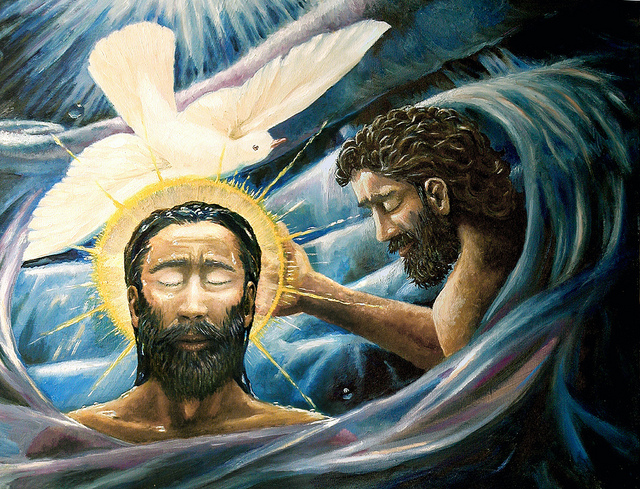
Just as Jesus was coming up out of the water, he saw heaven being torn open and the Spirit descending on him like a dove. (Verse 10)

Veni Sancte Spiritus
Veni Sancte Spiritus by Fr Lawrence Lew, OP on Flickr. Some rights reserved.

What does this have to do with the Exodus freedom story? It’s about the manner of God’s presence.

I’m sure you will recall that when Israel was being led through the wilderness, it was by a pillar of cloud by day and a pillar of fire by night.

But now, in the New Covenant, God’s people get an upgrade. Not only will the presence of God (cloud and fire) lead them, now that same presence will come upon all of them and dwell within them. For you frequent flyers, they have effectively gone from economy class to business class.

In Jesus’ case, there is something else. The descent of the Spirit upon him shows that he is the Messiah, for Messiah means ‘Anointed One’. He is anointed, not with the oil used to mark an earthly monarch, but with the oil of God, the Holy Spirit.

And if Jesus the Messiah is anointed with the Holy Spirit and we receive the Spirit too, then that confirms our Christian identity – we are to be ‘little Christs’. No, we are not Messiahs, and heaven deliver us from any more people in the Church with Messiah complexes, but the upgrade to the indwelling Spirit equips us for our pilgrimage to freedom. It is the witness of the Holy Spirit that confirms we are forgiven and loved. It is the work of the Holy Spirit to lead us into increasing freedom from the practice of sin, thus making us more Christ-like. (Although we may more modestly feel it’s a case of becoming less un-Christ-like!)

We need not fear the gift of the Holy Spirit. He is the Spirit of freedom. ‘Where the Spirit of the Lord is, there is liberty,’ wrote the Apostle Paul. He brings God’s freedom to us, and empowers us then to be ministers of God’s freedom in the world. Through the Spirit’s work, we offer Christ and his liberating work to those in the chains of sin – the chains of their own sin, and the chains imposed by others upon them.

And not for us the limited distribution of the Holy Spirit in the Old Covenant. Now the Spirit is given not only to a select number of God’s people, he is given to women and men, young and old, privileged and poor – anyone who desires to follow Jesus the Messiah, the leader of freedom.

Those in higher church traditions than us have a liturgical symbol for this in the way the bishop applies anointing oil (‘chrism oil’) to the foreheads of candidates for confirmation. I came to like that tradition when I used to take part in ecumenical confirmation services with Anglicans, and concluded that we were missing out on that symbolism. I can offer something ad hoc, in that I possess a bottle of anointing oil, which has a beautiful smell of frankincense, and some people find it helpful to link the fragrant aroma of the oil with the presence of the Holy Spirit, who brings freedom.

Thirdly, the voice of God. The terrifying thunder from the mountain on the Exodus route now becomes the voice from heaven as Jesus comes up out of the water. Heaven is ‘torn open’, the Spirit descends like a dove (verse 10), and the voice from heaven speaks:

‘You are my Son, whom I love; with you I am well pleased.’ (verse 11)

Door To Heaven
Door To Heaven by Tragopodaros on Flickr. Some rights reserved.

Tom Wright says[1] that we should not see the opening of heaven as like a door ajar in the sky, because heaven in the Bible is rather the dimension of God’s reality that is invisible to us. So instead, this is like an invisible curtain being pulled back so that we see the whole of life in the light of this different reality. And in this case, when heaven opens the curtain into our life, we hear the divine voice that addressed Jesus addressing us, too:  ‘You are my child, whom I love; with you I am well pleased.’

And certainly that is a totally different reality in which to live. Think about God addressing Jesus this way. Mark hasn’t recorded any virtuous acts by Jesus yet at all. His baptism is his first action in this Gospel, and even that is done to him. There is not even a reference to the humility of the Incarnation in Mark. What, then, has Jesus done to earn his Father’s pleasure here? Absolutely nothing. But he hears the voice of unconditional love. God loves him and is pleased with him.

Those of you who are parents, recall those times when you went into your children’s bedrooms at night when they were fast asleep. They might have delighted you that day, or they might have been utter pickles. But still you gazed at them and whispered words about how much you loved them. You had unconditional love for them.

So ask yourself this: is God angry with me, or does he love me? Can I really believe the Good News that God delights in me? This is the liberating news of our New Testament Exodus.

And that is a transforming insight. If God loves us like this, why do we not love ourselves? I don’t mean in a self-centred way. Rather, I mean something that the author Donald Miller has recently written about. In a booklet available online called Start Life Over, he lists five principles towards changing our lives for the better. The second of these is that – strange as it may sound – we are in a relationship with ourselves, so we should make it a healthy one.

What he says is this. To some extent, we all seek the approval of others, but what we don’t notice is how we seek our own approval. It is as if we are two people: one doing the actions of daily life, the other watching those actions in judgement. Miller noticed that a friend whom he deeply admired was always doing respectful things. And he wondered: if I start doing more respectful things, will I respect myself more, and thus change for the better? He writes,

And it worked. I would find myself wanting to eat a half gallon of ice cream while watching television and I asked myself “if you skipped this, would you have a little more respect for yourself?” and the truth is I would. So I skipped it. And I had much more self respect.

I liked myself more.

This sort of thing translated into a whole host of other areas of my life. I started holding my tongue a little more and found I respected myself more when I was more thoughtful in conversation. I found myself less willing to people please because, well, people who people please aren’t as respectable, right? (Page 9)

I suggest to you that this kind of transformation is open to us when we embark on our baptismal journey of freedom, in the power of the Holy Spirit, and hear God’s voice from heaven telling us we are loved unconditionally. It makes change possible.

So often, the way we seek to promote change in ourselves and in others is through threat. We are no carrot and all stick. But all that produces is fear and paralysis. We might see some change, but it is the change wrought by sleeplessness and night terrors, rather than love. Ultimately, it doesn’t achieve much, and it affects us badly as people.

God chooses the way of unconditional love to lead us into freedom.

[1] N T Wright, Mark For Everyone, p5f.

Create a website or blog at WordPress.com

Up ↑