This is not a full sermon this week. I am participating in an act of worship led by some church members. I have been asked to give the final reflection that leads the congregation from Palm Sunday into Holy Week.
A former minister of mine who influenced me greatly came to us after he had got in trouble in his previous circuit. It was said that he had divided a church. Because of that, he was given an official telling-off by Methodism. After all, you can’t have people dividing churches, can you?
Or can you?
I don’t think ‘unity at all costs’ survives scrutiny by the ministry of Jesus. The moment we get past the joy and celebration of the Palm Sunday procession, Jesus’ ministry provokes conflict.
Would we give Jesus a welcome? The Palm Sunday procession suggests we would, but these stories question that. Would we turn on Jesus? The joyful mood is turning dark.
Let’s briefly examine the two conflicts in these verses.
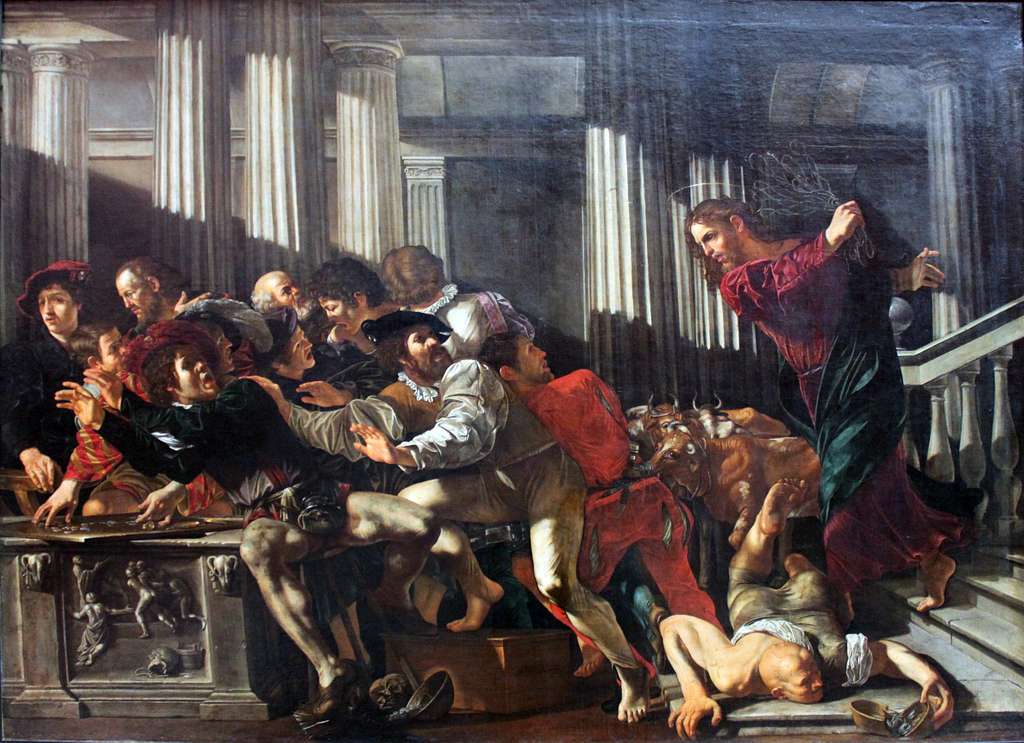
Firstly, the turning of the tables:
1610 Cecco del Caravaggio Christ expulses moneychangers anagoria at picryl.com. Public Domain.
What is the charge Jesus levels at all those who are buying and selling in the Temple?
“My house shall be called a house of prayer”; but you are making it a den of robbers.’
‘A house of prayer (for all peoples)’ is from Isaiah 56; the ‘den of robbers’ from Jeremiah 7. He stands in the great tradition of the prophets in announcing this conviction of evil.
A den of robbers? The pilgrims coming to Jerusalem had to risk being attacked by bandits on the way. Criminals lurked in the hillsides next to the pilgrim roads. But if they had survived that and got to Jerusalem, they now face the real bandits, says Jesus – the people running the Temple. Their concern is less with it being a holy, spiritual, and welcoming place – a house of prayer – they are running the enterprise for their own benefit.
Let this be a warning to us before we end up taking that approach, too. Think back to our discussions about the finances of the church. When we know that our regular giving is not covering the assessment we must pay to the circuit and that we rely on hiring out the premises, we are in trouble. But there is another danger here, and that is concentrating so much on the finances that we become a religious business rather than a spiritual family. We can come up with all the fund-raising ideas we like, and we do of course have to be responsible stewards of the finance and the property, but unless we address the spiritual nature of the church family first, we will go in the same direction as the moneychangers in the Temple.
Let me put this on the agenda for this church, then: we can talk about increasing our membership, and we can talk about raising more income, but unless our top priority is to be a ‘house of prayer’, a spiritual community, we shall only be a church in name, not nature.
How many of us have taken up some of the spiritual disciplines we’ve been talking about during Lent? What are we doing together to grow in grace? Jesus says, this is important.
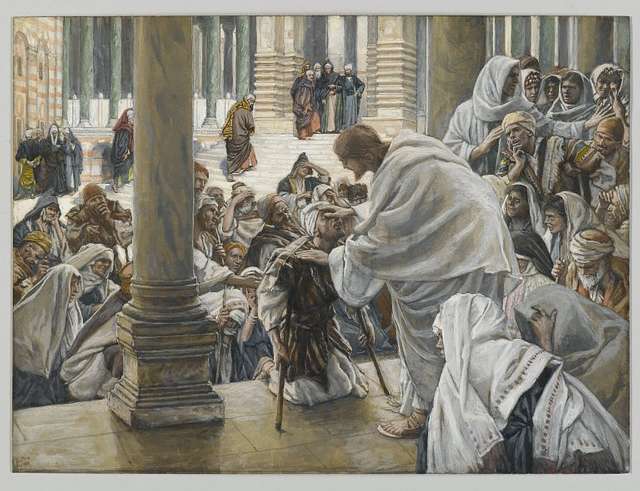
Secondly, the praise of the children:
Brooklyn Museum: He heals the lame (James Tissot) at picryl.com. Public Domain.
Jesus heals the blind and the lame, and the children praise him, saying, ‘Hosanna to the Son of David.’ The chief priests and scribes hate this and say, ‘Do you hear what they are saying?’ (Verses 14-16a) How dare you accept this praise!
But Jesus says it’s right for him to do so, and quotes a verse where he equates the praise of the children to him with praise being given to God himself:
“Out of the mouths of infants and nursing babies you have prepared praise for yourself” (Verse 16b, quoting Psalm 8:2 LXX)
If the authorities didn’t like Jesus already, then now they will hate him. He is accepting praise like he is God. Moreover, Jesus is implying that they have been shown up by children! The children have got their beliefs right, and the religious leaders haven’t!
Now that is provocative. This is not gentle Jesus, meek and mild. You’ve been shown up by the kids, he says, and that in a culture that thought little of the younger generations.
Imagine what the authorities are thinking. He is a blasphemer, and he expects us, with all our education, to take lessons from children!
Can you feel the tension rise? Soon, people will have to take a side. And events will take the darkest of turns.
We too shall need to choose a side. Even if that leads us into a dark place.
‘God’s people’? If you know this psalm in older versions of the Bible you will know this verse as ‘How good and pleasant it is when brothers dwell together in unity.’ Strictly, that is an accurate translation. But today, with the concern for inclusive language, just to render it as ‘brothers’ would in the eyes of many exclude women. We want to get the same truth across in a different way.
But the choice here of ‘God’s people’ as a modern substitute loses the emphasis on family. ‘Brothers and sisters’ would be better, maybe ‘siblings’, depending on your views about transgender and non-binary.
Because it really is a miracle sometimes when brothers and sisters live together in unity! How many of you fell out with your sisters or brothers when you were young? My sister and I certainly did. It took growing and maturing, perhaps also along with a shared faith, to leave our childhood squabbles behind.
You would hope, then, that in a church, a gathering of those who are brothers and sisters in the family of God, that there would be the mature love for one another as we are bound together in unity by the love of God in Christ.
But you know and I know that it isn’t always true. Many churches are more like the childhood siblings engaging in petty arguments. People fall out with one another. They make disparaging remarks about someone behind their backs. Strong personalities clash and neither side backs down. Gossip. Negative comments are repeated without checking whether they are true.
You may think this all sounds trivial. It isn’t. This immature and cavalier attitude to our unity destroys the church, because it undermines our very identity as those who are united in Christ. Habits like gossip are cancer in the church.
What can we do about it? Jesus had a fair bit to say about how we handle our differences, and we could consider them some time. At one church in a past circuit I made it a rule that no-one could bring a complaint about someone to the Church Council if they had not already tried to talk it over with the person they were unhappy with. I did so, because someone drove a couple out of that church by orally attacking them at the Council without warning.
But the Psalmist doesn’t offer solutions here. Instead, he (most likely it was a man in that society) offers a compelling vision of what unity among the believers looks like and accomplishes. There are two images he gives us that make us want to aspire to greater unity in the faith. They are the oil on Aaron’s beard and the dew on Mount Hermon. Put like that, they sound culturally alien to our world today. But it’s quite easy to see what the Psalmist is getting at, and as a result we can be inspired and challenged by the vision he puts before us.
The oil on Aaron’s beard
2 It is like precious oil poured on the head,
running down on the beard,
running down on Aaron’s beard,
down on the collar of his robe.
Aaron, the brother of Moses, and his male descendants were set aside to be the priests of Israel. For this they were anointed and consecrated with holy oil poured on their heads. Therefore, when the psalmist says that the unity of God’s family is like the oil on Aaron’s beard he is saying that unity is a priestly thing for the whole family of God.
But what would it mean for us as the family of God to be priestly? Are we to offer sacrifices? Well, not in the sense of sacrifices for sin. They are all fulfilled, completed, and replaced by the death of Jesus on the Cross. We can, however, offer sacrifices of praise, according to the New Testament.
That will also include making personal sacrifices for one another in Christian love. I saw that at my first theological college when a student from South East Asia lost her mother back at home and a bunch of students, who mostly didn’t have much money, rallied around to make sure she had her return air fare. I saw it in my last circuit when a Nepalese church member was made stateless and the church rallied around to make sure he could afford to apply for British citizenship. We even got that campaign into the local press and gained community support.
But the other ongoing part of the priest’s life is prayer for the people of God. And that’s also where we as brothers and sisters in the family of God can be priestly together. It is our privilege to bring one another to God in prayer.
Yes, of course we all have direct access to God in prayer through the Cross of Christ, and you might therefore wonder why we would ask someone else to pray for us. However, this is about mutual support as part of our unity in Christ. Sometimes there are other ordinary tasks in life that we can normally accomplish but where we need someone else’s help from time to time, especially if we are feeling weak. Prayer is no different.
This came home to me with some force in one pastoral situation at a former church. One lovely couple really did have what the late Queen once called an ‘annus horribilis’, a terrible year. In the space of twelve months, they both lost both of their parents, and then a beloved uncle also died. Five close bereavements in a year. Can you imagine the toll it took on them?
In one conversation, the wife shared with me that this was a season where she found it hard to pray, but she was glad to be carried by the prayers of the church. That’s the oil on Aaron’s beard: a priestly ministry of prayer for one another that enhances our unity.
One other comment on this theme is to point out that you will note I am talking about praying for other Christians, not praying against them. There are some Christians who default too quickly to the latter, effectively using prayer as a way of cursing their brothers and sisters. There are limited extreme circumstances where we might pray against the influence of a brother or sister Christian, but usually it is where they are damaging the unity of the church.
I had one such instance early in my ministry where one of the church organists deliberately sided with a couple who were stirring trouble in the congregation. I learned that the organist and the husband in the couple were both Freemasons in the local lodge. They carried a greater loyalty to one another there than to the church. (There are other reasons to say that Freemasonry is incompatible with Christianity, not least the way it makes human merit rather than divine grace the way to salvation.)
Eventually, I was driven to extreme prayer about the organist and I prayed, ‘Lord, please either change him or move him. I’d far rather you changed him, but if he will not change then please move him.’ A week later, he and his wife put their house up for sale and a few months later they moved a hundred miles away.
But as I say, prayers like that are the exception. Normally, the oil on Aaron’s beard means that we are blessing one another in prayer and thus deepening our unity together in Christ as his family.
The dew of Hermon
3 It is as if the dew of Hermon
were falling on Mount Zion.
For there the Lord bestows his blessing,
even life for evermore.
It’s time for a bit of geography. Mount Hermon is in Lebanon, to the north of Israel. The climate is not quite as hot. Unlike peaks in the Holy Land, Mount Hermon is a place where snow can settle at the top. It thus generates cool water in a way unknown in the Promised Land. The dew on Mount Hermon is thus a symbol for being refreshed.
There is a link, says the psalmist, between our unity as believers and experiencing a sense of refreshment in our lives. When we are one in Christ, we pull together, and we look out for one another.
It’s something we have experienced in the last few weeks. Both ministry and life in general have been profoundly affected by the damage that was caused to the manse and the necessary measures while it has been repaired. Having had to live a distance away has not only meant the strange combination of doing more decamping than you would for a self-catering holiday but less than a full house move, the extra travel combined with road works and road closures to negotiate on our routes has made for getting in substantially later at night and leaving for meetings significantly earlier in the morning. You will not be surprised to know that one effect upon us of such an arrangement has been an increased tiredness.
We have therefore been so glad when people in the churches and circuit have shown particular understanding of our situation. People have not asked more of us than they had to. Some specifically told us not to worry about certain regular commitments for the duration. These attitudes have refreshed us. They have helped us cope with a difficult situation. I can think of other appointments I’ve been in where people would still have wanted their pound of flesh out of me, regardless.
And you know what? When members of the church family decide they are going to do things that refresh others it draws us closer together. The opposite pulls us apart.
Therefore it’s worth us all pondering what we can do to refresh our brothers and sisters in the family of Jesus. Is there a way we can show understanding to someone in difficulty? Is there someone carrying a burden where we can take some of their load? Is there somebody having to cope with a challenging situation where a gesture of service would make a difference to them?
Actually, let me suggest to you a simple prayer we can pray each day. In fact, this one goes wider than just refreshing our brothers and sisters in Christ: there are no boundaries to it. But it will bless the Body of Christ and engender deeper unity when applied there. The prayer is this:
Lord, please show me who I can bless today.
It’s really that simple. Imagine the effect if we all prayed that every day. Imagine what kind of a spiritual family we would become.
Then put it together with the priestly actions indicated by the oil on Aaron’s beard where we are praying for each other and sacrificing for each other. Can you have a vision for the kind of community we would grow into? Can you envisage what it would be like for strangers to encounter a spiritual family like that? How might they react?
Well, no. Of the four Gospel writers, only John tells us about the palm branches. We read from Mark, who gets the next closest by telling us that
others spread branches they had cut in the fields (verse 8b)
but he doesn’t specify that they are palms. He tells us more about the cloaks that the disciples put over the colt for Jesus to sit on (verse 7) and the cloaks that people spread on the road (verse 8a).
So I think we can be justified in renaming today Cloak Sunday.
In fact, to get more to the point of what this story is about, it’s helpful to note the heading that the NIV Bible gives it: ‘Jesus comes to Jerusalem as king.’ I don’t normally like the headings of Bible passages to be read out because they’re not part of the text, and they sometimes detract from the theme I am going to take from the reading, but on this occasion it’s spot-on. Jesus comes to Jerusalem as king.
Firstly, let’s look at the signs of kingship:
The colt, the colt, the colt, the colt. Four times in the first seven verses we read, ‘The colt.’ That’s without where a pronoun like ‘it’ substitutes for it. Those first seven verses are all about the colt.
And although Mark doesn’t directly quote it as Matthew does, you know what’s in his mind and you know what will be in the mind of those present – it’s Zechariah 9:9:
Rejoice greatly, Daughter Zion! Shout, Daughter Jerusalem! See, your king comes to you, righteous and victorious, lowly and riding on a donkey, on a colt, the foal of a donkey.
Even the cloaks on the colt’s back might indicate Jesus’ kingship, because the king’s steed could not be ridden by anyone else.[1]
But certainly the fact that Jesus rides into the city whereas all the pilgrims walk in sets him apart. And the ground was often covered for the arrival of a visiting dignitary. We can be in little doubt that Jesus is making an explicit claim to being Jerusalem’s king.
And that’s a change of tactic from Jesus. Up until now, Mark’s Gospel has recorded several incidents where Jesus has forbidden people to reveal who he is. He has wanted to keep his identity secret. (Scholars call it ‘The messianic secret.’)
But at this point, Jesus goes public. He is Israel’s true king, God’s anointed One. This is only going to do one thing, and that is to ratchet up the tension with both the Roman authorities who will not brook a challenge to their power, and the Jewish leadership who have rejected Jesus but will look bad if they reject their true king.
It had to come out at some point, but not earlier, when it would have ruined Jesus’ ministry in Galilee and other places. But all along Jesus has known his destiny and the climax of his mission. It isn’t what most people would consider a climax to their work, but yet again Jesus flips on its head the notions and the values of the world. His kingdom is different. It is different by one hundred and eighty degrees from the kingdoms of this world.
Many years ago, I read a book by an American Mennonite called Donald Kraybill that called the kingdom of God in Jesus’ teaching ‘The Upside-Down Kingdom.’ As the publisher’s blurb puts it:
What does it mean to follow the Christ who traded victory and power for hanging out with the poor and forgiving his enemies? How did a man in first-century Palestine threaten the established order, and what does that mean for us today? Jesus turned expectations upside down. The kingdom of God is still full of surprises. Are you ready?
So we need secondly to consider the type of kingship that Jesus was demonstrating on Cloak Sunday:
The crowds acclaim the coming kingdom of their father David (verse 10a), which is surely a sign of messianic expectation. You can imagine the hopes that this might be the one who will rid them of the hated Romans.
But if they did think that, then they missed the Zechariah hint with Jesus coming ‘lowly and riding on a donkey, on a colt, the foal of a donkey.’
Lowly. Not war-like. Among the disciples, I wonder what Simon the Zealot felt? Remember that the Zealots were committed to the overthrow, by violence if necessary, of Israel’s enemies. And did this contribute to Judas Iscariot’s disillusionment with Jesus? We don’t know, but I do wonder.
Jesus is clearly coming as king, but his enthronement will happen at of all places the Cross, where the charge against him will be ‘The King of the Jews’ (Mark 15:26). The Cross is enthronement and victory, not defeat.
It’s very easy for us to react with disillusionment, too. Some of the biggest conflicts and acts of sabotage in a local church are undertaken by people whose anxieties about the future have escalated. I was reading about this on Friday in an email from the organisation Bridge Builders, who train church leaders in how to transform conflict. Their Director of Training, Liz Griffiths, wrote this:
Triggers for that anxiety are plentiful – uncertainty about the future of many churches; declining numbers and aging congregations; rapid social change and concern as to how to respond to these with integrity and faithfulness; and the wider issues that impact far beyond the church – rising inequality, climate and environmental issues, and the aftermath of a global pandemic. It’s not surprising that anxiety is high, and reactive behaviour is so prevalent.
Now there may be all sorts of reasons in our family background and the history of our churches that lead to these anxieties, but in the long term what we need to do is bring them to Christ and submit them to his very different form of kingship. His way of overcoming evil is not by the crash-bang-wallop methods that some would advocate. It is by peace, lowliness, and ultimately, suffering.
I guess that Judas Iscariot bottled up all his frustrations and then his weakness for money became the flaw through which his dissatisfaction came to fatal expression with his betrayal of Jesus and his own subsequent suicide.
What about Simon the Zealot? He is still part of the eleven apostles come the Resurrection. Could it be that he submitted his own prior commitment to violent resistance to the ways of Jesus and followed the lowly, peaceable king? It looks to me like he did.
Will we bring our anxieties, our frustrations, our dissatisfaction with the state of the church and the world to Jesus, the king of peace and humility? Only his way brings healing.
And all that means that thirdly, we are talking about our responses to Jesus’ kingship.
How are we going to respond to the Jesus who rode humbly into Jerusalem as King? I have just posed it as a choice between Judas Iscariot’s pent-up frustrations and Simon the Zealot’s ability to put aside his prior commitments and go the way of Jesus. But there is another way of framing the binary choice we have, and it’s more directly in the passage. As with some earlier comments in this sermon, I owe what I am about to say to the Anglican New Testament scholar Ian Paul[2].
Mark refers to the two villages of Bethphage and Bethany at the Mount of Olives (verse 1), whereas Matthew only mentions Bethany. We know from John’s Gospel that Bethany was a safe place for Jesus, because that is where his friends Lazarus, Martha, and Mary lived. One Christian author, Frank Viola, even entitled a book of his about their relationship at Bethany ‘God’s Favourite Place On Earth.’
But Bethphage was different. The name of the village means ‘House of unripe figs’, and that seems rather significant given that one of the first things Jesus does in ‘Holy Week’ is to curse a fig tree that is not producing fruit. A fig tree sometimes symbolised Israel, and Jesus’ action was a prophetic sign of his assessment of the state of God’s people.
Symbolically, then, Bethany and Bethphage show us two contrasting responses to the kingship of Jesus. Either we draw close to him, learn from him, and follow him as Lazarus, Martha, and Mary did, or we make no serious response to him and end up unfruitful and even cursed.
This is a time, then, to take Jesus seriously.
And this week, I read a short devotional article entitled ‘Taking Jesus Seriously.’ The author, a retired American Baptist pastor named Mike Glenn, began by talking about how we don’t take Jesus seriously. We like to explain away some of his teaching. Some of us even think he was rather extreme in saying that he had to die on the Cross for our sins. Can’t we just say sorry and be done with it?
But this is a season which shows how much it does matter, just how serious the rupture between God and human beings caused by sin is.
Glenn ends the article by talking about the focussed seriousness for Jesus that we need, and which is the only proper response to him at this time:
It takes a focused effort to begin to our lives more seriously and when we begin to think about our lives and purpose, we begin to seek Jesus again. He’s the only one who knows how to make life matter. As Peter confessed, “Only You, Lord, have the words of life.”
Only by focusing on Christ are we able to take our attention away from the sin that tempts us and still seeks to destroy us. We don’t overcome temptation by fighting it. We overcome temptation by ignoring it, by no longer desiring it.
Believe it or not, it’s in watching Jesus die that we learn to live. It’s only when we begin take Jesus seriously that we can take ourselves seriously.
Easter tells us how seriously Jesus takes us. Now, the question we have to answer is how seriously we’ll take Jesus.
Earlier this week I was asking one of my churches whether we had a stock of palm crosses to give out for Palm Sunday. But not to worry if we didn’t, I told them, we could (in the words of one biblical scholar) call it ‘No Palm Sunday.’
You’ll note I didn’t say Napalm Sunday – although that might be a Scottish pronunciation!
Why ‘No Palm Sunday’? All four Gospel writers tell the story of Jesus’ triumphal entry into Jerusalem in the lead-up to his death. But Luke, whose account we read, doesn’t mention the spreading of palm branches. It’s a detail he misses out. He talks about the crowd spreading their cloaks on the ground instead. Maybe we should wave coats instead of palm branches – what do you think?
Be that as it may, if you’re an experienced Christian you’ll know from sermons in the past how the way Jesus enters Jerusalem signals his claim to be the Messiah, and he signals that he’s not coming with an army but in humility. I’m going to assume those things this year rather than go over them again. Instead, I’m going to look at what Luke’s account tells us about how Jesus exercises his kingly status.
Firstly, King Jesus acts in power:
37 When he came near the place where the road goes down the Mount of Olives, the whole crowd of disciples began joyfully to praise God in loud voices for all the miracles they had seen:
You would expect a king in those days to exercise power. But the way Jesus uses his power is in the performing of miracles.
Most of the miracles the disciples had seen were healings. They had also seen him use his power and authority over the elements to calm a storm. In other words, King Jesus used his great power that demonstrated his kingdom as acts of compassion for people.
And the crowd don’t know it, but in the coming week they are going to see the power of their King in unexpected ways. His weakness in dying on the Cross will be an act of power to bring the forgiveness of sins. His raising from the dead will bring new life.
Jesus doesn’t use his power to push people around or humiliate them. He uses his kingly power in compassion.
What does this mean for us if we live under his reign? A couple of things: firstly, it means that Jesus has compassion for us. Yes, as King he has the right to tell us what he wants us to do. But he is not bullying us. And he takes note of our frailties. He helps us with our weakness to sin. He is there with us and to act for us in our trials and pains.
Secondly, we are called to reflect his compassionate power in the world. This is a key part of our witness to him. Where can I show compassion this week, Lord? How about making that a regular prayer?
It may involve offering sanctuary to Ukrainian refugees. It may be caring for a neighbour along the road. It may be praying for someone who needs the intervention of Jesus in their lives.
What is certain is this: if King Jesus uses his power in compassion, then his church acting in compassion in the community should not be an exceptional thing. It should be the norm.
Secondly, King Jesus comes in peace:
38 ‘Blessed is the king who comes in the name of the Lord!’
‘Peace in heaven and glory in the highest!’
Peace in heaven and glory in the highest. Those words should sound familiar to readers of Luke’s Gospel. They are so like the song of the angels who announced the birth of Jesus in Luke 2:
14 ‘Glory to God in the highest heaven, and on earth peace to those on whom his favour rests.’
It’s something the early church majored on. You only have to look at the way the Apostle Paul began his letters. The standard way to begin a letter in his culture was to greet people with the word ‘Grace’. He went one further. He began with ‘Grace and peace.’
But what kind of peace? I don’t think there are any limits. We cannot separate off peace with God from peace with our neighbours – remember the connection between giving and receiving forgiveness in the Lord’s Prayer.
King Jesus is riding into Jerusalem, whose very name means ‘City of peace’, to bring this all-encompassing peace. But what the crowd of disciples hasn’t realised is that the way he will bring that peace will be by what happens a few days later, as he is nailed to the Cross. In his death, God offers peace to us. And that costly peace calls us to be peacemakers with others.
This challenges churches to be communities of peace. If we believe the Gospel, we won’t necessarily agree on everything, but we will deal with our differences peaceably. We will have the joy of knowing that we are forgiven sons and daughters of the living God. And we will seek peace in our communities. I saw this in Knaphill a few years ago when two businesses were in serious conflict. Someone from the Baptist church offered their services as a mediator. It wasn’t successful – success isn’t guaranteed – but that person was living out the Gospel of peace.
So if you want to put Palm Sunday (or even No-Palm Sunday) into practice, go and make peace with somebody.
Thirdly and finally, King Jesus receives praise:
39 Some of the Pharisees in the crowd said to Jesus, ‘Teacher, rebuke your disciples!’
40 ‘I tell you,’ he replied, ‘if they keep quiet, the stones will cry out.’
When our daughter was about three years old, she used to love to dance to the music of the hymns in church. She would dance in the aisle, or maybe up front next to me. One day she was dancing in an all age service when a grumpy man in his eighties bellowed at her to stop.
The Pharisees are still with us. If we become embittered or cynical we will be offended by joyful praise.
Ian Paul, whom I quoted at the beginning, says that there may even be a pun behind the comments of Jesus in the original speech. For eben, the Hebrew word for ‘stones’, is close to ben, the word for ‘son’. If the sons of Israel won’t praise then the stones will, says Jesus.
Stones? Inanimate objects? Maybe it’s poetry, in the same way that many Psalmists envisage the time when all of creation will praise its Maker – ‘the trees of the field will clap their hands’, and many other passages reveal this sentiment.
For Jesus is not just King over individuals: he is King over all of creation. When we Christians engage in creation care, we have much loftier ideals for the whole creation. It’s not just a case of ensuring that the earth survives, it’s a case of being good stewards and leading ‘everything that has breath’ to praise the Lord.
We know this crowd of disciples will be shocked later in the week when a different crowd is whipped up into a frenzy and demands the execution of Jesus. But the disciples will discover the healing power of the Cross, and the healing of creation in the Resurrection.
So what about us? Have we allowed ourselves to become so cynical like the Pharisees, perhaps through years of disappointment in the church and the Christian faith, that we are more like The Grinch than Jesus? If heartfelt praise offends us, then we have a heart problem.
If that describes any of us, then I offer the invitation to use Holy Week as a time to reset and to heal. Take time to get alongside Jesus as he teaches in the Temple, as he issues amazing rebuttals to his critics, and then as he is silent before most of his accusers and goes to his suffering on our behalf.
Then, when we have drunk deeply of that – and only when we have – let the joy and craziness of Easter morning touch your soul. Let the stones – and the sons and daughters – cry out.
So – Jesus is a very different king. For him, not the power of coercion but the power of love. For him, not peace enforced by the jackboot, but peace brought by his own suffering. For him, praise not coming from crowds bussed in and forced to parade but from those captivated by his self-giving love.
Israel longed for the homecoming of God to Jerusalem. Jesus fulfilled this hope on Palm Sunday, but not in the ways Israel expected. His journey into Jerusalem holds surprises for us, too. That’s what I explore this week.
Have you ever anticipated a homecoming? Perhaps it was your oldest child coming home after their first term at university. Maybe it was a reunion with a long-lost friend.
If you have, then you probably imagined what it would be like. But then the person arrives, and they look different. Your son home from university has grown his hair long. Your daughter has arrived home with a tattoo. The friend you haven’t seen for years has aged badly.
Somehow, homecomings do not always turn out how we imagine they will.
Israel was longing for the homecoming of her God to Jerusalem. We read that in Isaiah 35. But when it happens, as Jesus enters Jerusalem on what we call Palm Sunday, it isn’t entirely in the form they had popularly imagined from their interpretations of the prophetic hope.
It is a surprising homecoming at the end of this wilderness journey we have been exploring through Lent.
Let’s look at the elements of God’s homecoming in Isaiah 35 and see where the surprises lay in the light of Palm Sunday.
The first element is joy:
The desert and the parched land will be glad; the wilderness will rejoice and blossom. Like the crocus, 2 it will burst into bloom; it will rejoice greatly and shout for joy. The glory of Lebanon will be given to it, the splendour of Carmel and Sharon; they will see the glory of the Lord, the splendour of our God.
The joy is so unconfined that even the inanimate parts of creation seem to shout with gladness. Poetically, creation sings. It is renewed.
The New Testament takes up this theme when it fills out the Old Testament prophecies about a new creation. Before that time, we see creation groaning in expectation, but we look forward to a day when, as Augustine of Hippo put it, every part of creation will mediate the presence of God to us. The homecoming of God is not just about personal salvation, it’s about the renewal of all creation. This is something to shout, sing, and celebrate!
But where is the surprise on Palm Sunday? Isn’t it in the failure of the religious establishment to welcome this and join in? They tell Jesus to silence the children who are singing praises, but Jesus says that if their mouths are shut, then even the stones will cry out.
How easy it is for our meanness and jealousy to close our own mouths to the praise of God and to close our hearts and minds to seeing and rejoicing in the fulfilment of his purposes. For that is what many of the religious leaders of Jesus’s day did.
Has a mean spirit silenced our praise? Has our jealousy of what another Christian can offer stunted our faith? It’s time to repent of these unworthy attitudes. They rip churches apart, and they suffocate our faith.
The second element is hope:
3 Strengthen the feeble hands, steady the knees that give way; 4 say to those with fearful hearts, ‘Be strong, do not fear; your God will come, he will come with vengeance; with divine retribution he will come to save you.’
Think how Israel struggled for hope in the face of Roman occupation. To them, it was like being in exile despite being in their own land. So they looked forward to the day when God would come and right these wrongs, and his Messiah would boot the Romans out, leaving Israel to live in peace within her own borders.
Where’s the surprise? Well, the Christian hope does include the righting of all wrongs and the judgment of the wicked and the unrepentant. No-one in the Bible talked more about Hell as a place of punishment than Jesus.
But the difference is this. Jesus postponed the judgment. It wasn’t to be now, but at the end of time. When he preached at Nazareth in Luke chapter 4, he stopped his reading from Isaiah 61 before the verses about judgment.
So when Jesus comes riding into Jerusalem on Palm Sunday, he adopts instead the prophecy of Zechariah, by entering on a donkey, not a war horse. His gift of hope comes in a peaceful manner, not a warlike one. When he receives the cries from the crowd of ‘Hosanna’ (which loosely means, ‘O God, save us’) that opportunity for salvation is not just for Israel. When he dies on the Cross, a convicted thief and a Roman centurion will confess faith in him. The hope is offered both to Israel, and to Israel’s enemies.
And that must make us think about how we frame our hope in Christ. Do we see that he also offers hope through his saving love at the Cross to the people we don’t like? Are there people whom we would rather God just zapped with a thunderbolt, but who are also candidates for hope, according to Jesus?
The third element is healing:
5 Then will the eyes of the blind be opened and the ears of the deaf unstopped. 6 Then will the lame leap like a deer, and the mute tongue shout for joy. Water will gush forth in the wilderness and streams in the desert. 7 The burning sand will become a pool, the thirsty ground bubbling springs. In the haunts where jackals once lay, grass and reeds and papyrus will grow.
In these verses we see both the kinds of personal healings that Jesus himself performed (curing the blind and the lame) and also the healing of creation, where even inhospitable places like the wilderness become beautifully inhabitable, and safe instead of being places of danger.
One thing we might dwell upon is how some Christians favour physical healing and others favour the work of the Church to heal the wider creation. However, neither Isaiah nor Jesus give us a choice in this. We are called to both. The Christian with the healing ministry may need to learn about climate change, and the Christian politician may need to pray for the sick.
But there’s another surprise here. Strictly it doesn’t come on Palm Sunday, but what we’ve said in the point about hope being offered not just to Israel but to her enemies might make us think further on into Holy Week. Remember when Jesus was arrested in Gethsemane after Judas betrayed him. Then remember how Simon Peter lashed out with a sword and cut off the ear of the high priest’s servant. What did Jesus do? He healed the servant, even though that servant was part of the group that was arresting him and about to take him away to certain torture and death.
So the surprise here for God’s people in God’s homecoming is the call to bless all the broken people and all of broken creation, even including the enemies of God. The healing mandate brought by Jesus encompasses a call to love our enemies as well as those for whom we feel an affinity.
Who is God calling me to bless this week?
The fourth and final element is holiness:
8 And a highway will be there; it will be called the Way of Holiness; it will be for those who walk on that Way. The unclean will not journey on it; wicked fools will not go about on it. 9 No lion will be there, nor any ravenous beast; they will not be found there. But only the redeemed will walk there, 10 and those the Lord has rescued will return. They will enter Zion with singing; everlasting joy will crown their heads. Gladness and joy will overtake them, and sorrow and sighing will flee away.
God makes his homecoming on a particular road. It is called the Way of Holiness. Israel rejoices that ‘The unclean will not journey on it’: they can’t have any Romans or even native sinners joining in this celebratory march to Jerusalem.
But the surprise here is that God’s people cannot simply look down their self-righteous noses at those they consider unworthy to be on the Highway of the Lord. The call to holiness is a call for all of us to shape up. It’s a call that reminds us that the only way we can march to Zion with Jesus is if we too take the Way of Holiness.
And as Jesus enters Jerusalem on Palm Sunday, the event we often call ‘The Triumphal Entry’, we need to remember that his greatest triumph is to come at the Cross and the tomb. Jesus took that journey, doing what was right. It led him to Calvary, but then to the vacating of his grave.
If we want to walk with Jesus, it is on this road, the Way of Holiness. We shall slip up from time to time, but the basic question is whether this is the direction we are willing to take or whether we have deluded ourselves that we can take a different route to glory. The Cross to which Jesus was headed was not only for our forgiveness, but it was also to make us more like Christ.
Disappointment by Dee Ashley on Flickr. Some rights reserved.
The great Christian writer Philip Yancey wrote a book a few years ago called ‘Disappointment With God’. He recognised that people ask at times, is God unfair? Is God silent? Is God hidden?
And when we face those experiences, the last thing we need is to hear Christian clichés and pious platitudes. In a web article called ‘God Has Let Me Down. There. I Said It’, a woman called Joy talks about having one daughter with heart defects, brain injury and cerebral palsy who died young, other children who are bullied, and one child who says to her, “I have tried praying, but I get no answer. People say they hear God, but I don’t.” In the face of all this, Joy has little patience for those who tell her, “People will let you down, but your Father God will never let you down,” or “God’s ways are not our ways,” and so on.
So my theme for Palm Sunday this year is, Jesus Will Disappoint You.
Now you may think that’s outrageous. We’ve just read the story of the so-called ‘Triumphal Entry’. He has been welcomed with palm branches, crowds have laid their cloaks on the ground like first-century Walter Raleighs, they have sung his praises and acclaimed him king … what could possibly go wrong?
I may not agree with Samuel Crossman, the author of the hymn ‘My Song Is Love Unknown’, who posits that the very crowd who praised Jesus on his entry to Jerusalem is the same mob that called for his crucifixion in place of Barabbas – I think that’s a different group of people – but the Palm Sunday supporters of Jesus will be disappointed by him. He comes in peace, not war. He takes on the religious establishment, but not the occupying Roman forces. He ends up on a cross.
I think we can safely say that isn’t what they were expecting when they sang Jesus’ praises.
When I went to Spring Harvest in its earliest years, there was always a seminar on the final full day before going home that tackled the issue of what to do when you got home. The organisers in those early days knew that while it was uplifting to worship for a week in a big tent with four thousand other Christians, led by a team of crack musicians and inspiring preachers and teachers, it would be very different back home. There would be rickety Mrs Smith on the harmonium, a boring preacher in the pulpit, and a few dozen scattered around a stone edifice from which the brown and green paint is peeling.
Or we have wider disappointments. Perhaps we have great hopes for the church. They might be simply for our own congregation, when we think we are entering a new phase where great strides will be made for the kingdom of God, or we may anticipate a new Spring for the church generally, such as in the 1990s, when on the back of certain dramatic events attributed to the Holy Spirit, many church leaders confidently predicted a spiritual revival in .
Our disappointments, then, may be personal or communal, but there is no doubt we shall have them, and there is no doubt that many of them will not be fixed by Jesus in the way we want.
Well, that’s all pretty bleak, isn’t it? You’ve come to church looking to taste something of the Good News of Jesus Christ, only to be told by some Eeyore in the pulpit that there is none.
Not exactly. But we Christians are too quick to jump to the happy ending, like people who give up reading a novel and skip to the last page. We don’t stay with the tension of the story as we wait for problems to be resolved. We came for good news, and if we can skip all the intervening messy stuff and just go to the good bits. We need the reminder the little girl received when she asked her mother, “Mummy, do all fairy tales end with the words, ‘And they all lived happily ever after’?”
“No,” replied Mum, “some say, ‘When I became a Christian all my troubles were over.’”
We live out our faith in Jesus in a broken, sin-cracked world. And yes, we do know the ‘happy ever after’ ending, and yes, that is the basis for our hope. But we do people a disservice when we minimise their present troubles by rushing to the end of the story.
Imagine Gethsemane, but envision it differently from the way you know the story. See Jesus praying in agony, needing the support of his friends. But instead of them falling asleep and letting him down, can you conceive of Jesus coming to them, asking them to watch and pray even though ‘the spirit is willing but the flesh is weak’, and Simon Peter leaping to his feet, saying, “I don’t know what you’re worried about, Master. I know you predicted that you would be betrayed, suffer and die, but you also prophesied that you would be raised from the dead! Everything’s going to be fine!”
Do you suppose that was the kind of support Jesus was looking for in the Garden? Somehow I don’t think so. Yet it’s the kind of encouragement we sometimes offer to people in the church. And when we do this, we let people down. We trivialise their present suffering. We dissolve their current questions. It doesn’t exactly affirm them, does it? Of course the future brings light into darkness, but the road to the empty tomb is riddled with stones and potholes. As the Anglican bishop Nick Baines wrote five years ago at this season,
On Easter Day it is traditional for the service to begin with the vicar proclaiming: ‘Alleluia, Christ is risen!’ The congregation responds: ‘He is risen indeed. Alleluia!’ I think this might be a bit wrong. If we are faithful to the Gospels, the congregation should really respond to the proclamation of resurrection: ‘What?! Don’t be so ridiculous!’ Why? Because the disciples of Jesus did not respond to his resurrection with unbridled joy, but rather with bewilderment and suspicion and doubt.
Even on Palm Sunday, Matthew whispers to us, disappointment can be detected in the atmosphere. As the crowd spread cloaks for him, reminiscent of what people did when Elisha anointed the warrior Jehu king over Israel, and as they acclaim him ‘Son of David’, a messianic title, they fail to notice his mode of transport. He is coming in peace to establish the kingdom of God. Therefore to engage in conflict the powers and authorities as he soon will is more or less to guarantee a grisly fate. Institutions don’t easily release their grip on power, and will often do all sorts of things – scrupulous and unscrupulous – to keep their talons clinging on. That is what they will do with Jesus, and he knows it when he selects a donkey and a colt.
This, though, tells us that although Jesus will disappoint the hopes of his most ardent supporters, he will let them down in order to do something deeper and more wonderful than they could ever have imagined. It cannot be revealed by jumping past the unpleasant parts. It can only come as Jesus journeys all the way into the darkness. And we need to take that same trip with those who today are suffering or disappointed.
But at the same time, the hope is there for those who will not look for a short-cut but who will embrace the disappointment of Jesus in order to find his purposes. It is indeed true that ‘his ways are not our ways’, but we do not learn that by repeating it as a platitude, we learn that by going into the depths with him.
And we need to be ready for the fact that the way he will deliver us in the end will be something we could not possibly have imagined, let alone requested. Just as none of Jesus’ followers expected the Cross as central to salvation, so they also did not expect the Resurrection. If they were good Jews (and provided they were not Sadducees, which none of his disciples seems to have been) then they believed that God would raise the dead at the end of time, following the prophecy of Daniel 12. But not one of them was looking for an empty tomb, despite Jesus’ own predictions of it. Those times when Jesus foretold of his suffering and resurrection simply didn’t register in their minds at the time, because it didn’t fit with their sincere but limited understandings of God’s ways.
The disappointment of Jesus, then, opens us to new ways of God’s working in the world. I don’t mean that in order to give licence to the kind of people who jump onto the latest cultural bandwagon and say it’s what God is doing in the world, but I do mean that our vision of God is limited, and our understanding of his ways – however faithfully we study the Scriptures – will always be finite. Sometimes we get so caught up in our own assumptions and our spiritual short-sightedness that we miss what God is doing.
Or consider those who object to musical instruments other than the organ in church worship. Guitars and drums are apparently unholy. But such people forget that at one stage in church history that was exactly how people thought of organs in church! It used to be a requirement in Methodist churches that hymn-singing be unaccompanied, and until recent times even the singing at the annual Methodist Conference was without musical instrumentation, facilitated rather by a precentor.
Or think about those who have witnessed the decline and death of a church, or even suffered such hostility in an existing church, that they have gone outside the existing patterns, grieved for their loss, and then started something new with a small group of friend in their living room, or maybe in a pub. Oh, wait – that last example would be Knaphill Methodist Church in 1866, wouldn’t it?
Yes, the God who disappoints is also the God who re-creates, the God of new creation. I think of one of Paul’s prayers in Ephesians where he praises ‘him who is able to do immeasurably more than all we ask or imagine’ (Ephesians 3:20). Or I think back to last week’s Lectionary and my sermon at Addlestone on John 11, the raising of Lazarus, where Jesus causes immense disappointment by refraining from visiting Bethany where Lazarus and his sisters lived until after he had died. But then, having allowed Mary and Martha to begin a journey into grief, he does something extraordinarily beyond their expectations in raising their brother back to life.
I don’t know whether you see Palm Sunday as frothy or as joyful. But either way, I urge you not to let the emotional ecstasy of the crowd mislead you. Start this year’s Holy Week journey as a trajectory downwards into darkness and disappointment. Our God does answer prayer, but he doesn’t have a white beard and he doesn’t wear a red costume. At some point either his answers will disappoint you, or his lack of an answer will disappoint you. it’s even how he treated his Son.
But then, when all hopes have been dashed to pieces on the rocks, witness what God does instead. It may well not be what you originally desired. But it will be new, transforming, and far better than you dared imagine.
This is the faith we embrace as we enter Holy Week. Let us open our arms to greet it.
I expect you’re familiar with the ‘Where’s Wally?’ pictures and illustrated books. You see a large, detailed picture containing hundreds of people and your task is to find Willy. Unless you are tuned in to what Wally looks like, or you have eagle eyes, it will take you quite a while to find him. Our dentist has a large ‘Where’s Wally?’ picture on the wall in her surgery to occupy the children.
Similarly, our children’s school recently had a Book Week and on the Friday invited children to dress up as their favourite book characters. So did the staff. The Head came dressed as Wally, and challenged the children to find him later in the day. It was a bit unfair: he hadn’t told them he would be changing back into his suit and going to a meeting elsewhere!
What does that have to do with Palm Sunday? It’s a story with a lot of hiddenness about it. We are so used to thinking that Jesus comes in on a donkey to demonstrate that he is the Messiah, fulfilling the prophecy of Zechariah. In particular, we point out that to come in riding an ass means that he was coming in peace, not in war. We think he is acclaimed as Messiah by the crowds as they sing, ‘Hosanna’.
But, but, but! We may know that Jesus fulfils Zechariah’s prophecy, but Mark doesn’t quote it. You need eyes to see. We may know that he was claiming to be king, but the Romans didn’t seem worried about this little demonstration. We may acclaim Jesus as Messiah, but when the crowds sang ‘Hosanna’ they didn’t quite go that far in what they said.
It’s all hidden. It only becomes apparent later. You need to know the rest of the story. You need to read the Scriptures in the light of Jesus. You need the help of the Holy Spirit. At the time, had you lived in Jerusalem and witnessed what we call ‘The Triumphal Entry’, you wouldn’t have guessed.
What, then, do we know that wasn’t apparent at the time?
Firstly, we see the Triumphal Entry as a sacred duty. On Palm Sunday, I always recall an Anglican church that was a neighbour to one previous Methodist church I served. Every Palm Sunday, they would always have a donkey in church. The reason I never forget this, is because the donkey had a name. Dave. Dave the Donkey appeared every year. For some reason, certain people made it their business to ensure I always knew about him.
And the donkey – laughing stock character as it is to some – is where we get the sense of sacredness and holiness on Palm Sunday. How so? Well, have you ever wondered why Mark goes to such detail to talk about the animal? Clearly it’s significant. Note Jesus’ specification: it is to be ‘a colt that has never been ridden’ (verse 2). This seems to reflect the Old Testament requirements that animals used for holy purposes had in every way to be unblemished. Jesus is making clear to his disciples his intention that the manner in which he will enter Jerusalem shows that this journey is a sacred duty.
The nature of Jesus’ entry as a holy task, a sacred duty, will not surprise you. But who in heaven and earth focusses on a donkey for such work?
Jesus, that’s who. A humble ass is the way he makes clear to those with eyes to see the nature of what he is doing. It’s part of that whole approach to life in our faith which deeply values the physical and the material. Archbishop William Temple said that Christianity is ‘the most avowedly materialist’ of all religions. That is a claim that sounds shocking to our ears when we have been taught that materialism is wrong. And if materialism means worshipping material things, then it is wrong.
But if materialism simply means valuing the material aspects of life, then we see that our faith is shot through with materialism. We believe in a Creator God. We believe in Jesus who took on human flesh, and whose lasting symbols are water, bread and wine. We believe in the resurrection of the dead – and that means bodily resurrection, there is no other kind. Our ethical beliefs touch on the most material and physical aspects of life – money, sex and so on.
Sometimes, though, we veer off this course. When someone dies we are prone to saying that their body was just a shell for the real person, but this is wrong. When we grieve a death, we are waiting for the day when that person will be raised to new life with a resurrection body animated by the Holy Spirit.
All of which is to say that when we look at Jesus’ use of the donkey for his purposes, let us dedicate the physical and material dimensions of our lives to his glory. Let us seek to use our physical bodies and material possessions in a holy way. When we take up the offering later in the service, let us remember that we are not simply raising enough subscriptions to keep an institution going, we are offering the physical to God in holy worship and service. We shall live out the meaning of the offertory prayer every day.
Secondly, let’s look at the use of the Scriptures in this story. There are a few things to put together here. One is what I mentioned at the beginning, namely that there are hints in this story that Jesus fulfils the prophecy of Zechariah about a messianic king coming to Jerusalem in peace. Another in the use of the donkey seems to reference at text in Genesis (49:11) which is part of Jacob’s blessing of his sons, but which was later taken as a messianic prophecy. Finally, we have the crowds singing ‘Hosanna’, and in doing so quoting one of the Psalms, and in particular one that was used by pilgrims coming to Jerusalem either for the Passover or the Feast of Tabernacles. It isn’t strictly a messianic psalm, but again Mark may want us to see the reference to ‘the coming kingdom of our ancestor David’ (verse 10) as a messianic hint.
What’s going on here, then? A common thread seems to be this: none of these texts – Zechariah, Genesis or the Psalms – gets limited to their original meaning. Often the way we are trained to approach the Scriptures today is to say that the primary question is to ask what meaning the original author intended. Or alternatively, we sit around in a Bible study fellowship group, asking, ‘What does this verse or passage mean for me?’
But Bible verses are not used in either of these ways in the Bible itself! Helpful as it is to have a foundation in the original meaning, the fact remains that the New Testament authors approached the scriptures they already had differently. And relevant as it may seem to ask, ‘What does this mean for me?’ that can degenerate into reading the Bible in a me-centred way.
No: the New Testament writers had a different question about the scriptures they inherited. I think it was this: what do the Scriptures mean in the light of Jesus? That’s why they sometimes come up with some surprising applications of Old Testament passages. At heart, it’s the old slogan that ‘history is his story’. Life has meaning in the light of Jesus Christ, and so we interpret everything in the light of him. That includes our supreme written testimony to him, the books of the Bible.
Now you can take this to ridiculous extremes. You probably know the story of the preacher giving a children’s address and who asks the question, ‘What is grey, furry, with a tail and climbs trees?’ A little girl nervously raises her hand and says, ‘I know the answer should be Jesus but it sounds like a squirrel to me.’
In other words, I do not mean that we look for all sorts of doubtful interpretations in the most obscure of Bible verses, but I do mean that the overall thrust of the Bible in all its diversity and difference is to point to Jesus Christ.
There is still a place for those of us who can offer something by delving into the original meaning of the Scriptures. It gives us a base from which to work. But we are not limited to what the original authors meant, because what we are called to do is see that the biblical books have what some people call ‘a direction of travel’ – they point to Jesus. And that means we can all with the help of the Holy Spirit profitably read and discuss the sacred writings with a view to drawing nearer to Christ and following him more closely.
Thirdly and finally, let us see worship with new eyes here. For this I want to concentrate on the shouts of the crowd:
Hosanna!
Blessed is the one who comes in the name of the Lord!
Blessed is the coming kingdom of our ancestor David!
Hosanna in the highest heaven!
(Verses 9b-10)
There is a lot conflated here. Take the word ‘Hosanna’. We perhaps think of it as a word of praise, rather like ‘Hallelujah’. It did turn into that, but it began as a cry of ‘Save us’ and then became praise or an acclamation for a revered figure, such as a rabbi. In with all that you have the longing for the kingdom, and it could be either a restoration of David’s throne that is desired or a passion for final redemption. Somewhere in these words, then, you potentially have a number of elements of worship mixed up: praise, intercession and declarations of allegiance.
Again, the natural meaning at the time for the crowd would have been perhaps to honour Jesus as a great teacher and to pray that God might bring deliverance (of a political variety) through him as he rode into Jerusalem. Nevertheless, it couldn’t have been terribly militant, or – as I said in the introduction – the Romans would have taken more of an interest.
But for Christians, we see these hopes transformed and magnified in what we have come to know about Jesus. He is more than a rabbi; he will bring a salvation of a kind nobody could have imagined; he is bringing in a kingdom altogether vaster and more comprehensive in scope than previously dreamed.
And this Jesus – the king who would be enthroned on the Cross – is worthy of worship. This Jesus – who does more than merely meet our own aspirations but ushers in a universal kingdom where all will be put right – is worthy of worship. This Jesus – so much more than a rabbi – is worthy of worship.
When the crowds shout their well-meaning hosannas, the Christian sees with new eyes the allegiance of which Jesus is worthy. When the crowds seek salvation, the Christian sees the salvation to come. When the crowds shout in anticipation of the kingdom, the Christian sees the call to pray and work for that kingdom, to the glory of Jesus Christ the Lord.
The worship we offer on Palm Sunday, then, is more than some hymns, prayers, readings and reflections. If Christians have eyes to see Jesus through Palm Sunday, worship will be an expression of commitment and devotion. It will be an oath of allegiance, a renewal of vows. After all, every part of life – past, present and future – has meaning in the light of him. And therefore in our worship we dedicate not only the ‘spiritual’ but the physical and the material to him in praise for who he is and gratitude for what he does.
This Palm Sunday, let us have the eyes to see Jesus as he truly is, and to respond fittingly to him.
Today, I start a new series of videos produced by Damaris Trust for Holy Week. In the first one above, Richard Collins talks about Jesus’ rather unusual entrance into Jerusalem. He discusses the significance of this event in terms of what it tells us about the kind of king that Jesus is, and the kind of kingdom into which he calls us.
Palm Sunday can be taken as a joyful day. We think of the crowds waving their palm branches, welcoming Jesus into Jerusalem. Yet as we know, pain is in the background. ‘Bow thy meek head to mortal pain, then take O Christ, thy power and reign,’ we sing in the hymn ‘Ride on, ride on in majesty’, which is laced with the anticipation of the Passion.
Right now, Debbie and I feel pain for friends. In the last few months, three Christian couples we know have separated. All have children. Sometimes we think we might know a partial truth of what has happened, but we have been careful to keep quiet and definitely not to extrapolate a small amount of data on its own to form conclusions. Our rôle is to be available if wanted, and most of all to pray.
I think each time the two of us talk privately about these tragedies, we give each other a certain look. It says, ‘There but for the grace of God we go.’ Not that God’s grace isn’t available to our friends – of course it is – but the sense that things can start sliding from small things, or something from the past we thought was buried might boomerang back from over the horizon and hit us, or we might make an uncharacteristic slip.
Not that I’m saying this is what happened with any of our friends, because we simply don’t know, and we don’t want to speculate. Rather, it’s that sense that we all need the mercy of God. We also need to keep that fine balance between the sense of security in mutual love and yet not allowing ourselves to take things for granted.
I think that’s all I want to say tonight. Say a prayer for these couples, for us, and for yourselves, whatever your domestic and family circumstances. May God guard us all. May we do our part in response. And may God work in the lives of our wounded friends.



 Big Circumstance