
Circuit Lent Sermon Series 5: Corporate Disciplines, James 5:13-20

James 5:13-20

Rule Of Life. From rawpixel.com. Public Domain.

We come to the fifth and final sermon in our Circuit Lent Sermon Series. It began by asking what the purpose of Lent was and answered by saying it was about reorienting ourselves towards Jesus. It continued in the second week by examining our relationship with God, something I looked at in terms of friendship with Jesus.

But to grow and maintain that relationship requires we adopt virtuous habits – or ‘spiritual disciplines’ – that help us tune into God better. And so over the last two weeks the series has been about inward and outward disciplines. Those are often disciplines (or habits) that we practise on our own. In this final week, we look at habits we exercise together – corporate disciplines.

Today, we are going to explore four corporate disciplines that help us draw closer to God in Christ.

Firstly, guidance:

Road Sign at pxhere.com. Public Domain.

Are any among you suffering? They should pray. (Verse 13a)

Perhaps we think of guidance as an individual discipline, and it certainly is that as well. If we are serious about following Jesus, we shall want to know his direction for our own lives.

But it is also something we need to do together. Not only are our brother and sister Christians involved in discerning our individual guidance (as we shall see), we also need to seek guidance together for our life as the church. Is that not what this church did under my predecessor’s leadership when you went through the process that Methodism calls Our Church’s Future Story?

And just because this church did that a few years ago doesn’t mean we can now not worry about God’s continued guidance. We always need to be like ancient Israel in the wilderness, who followed God’s presence as seen in a pillar of cloud by day and a pillar of fire by night. It is a continuous process.

So what are helpful ways of discerning God’s guidance together? One author described it like this. He spoke of a harbour that was treacherous for boats to navigate safely, due to rocks. However, the harbour authorities had cleverly erected three lights. If the three lights were lined up as seen from a boat, then that boat was on the right course to make harbour safely.

He then suggested that Christian guidance is like that. For major decisions, we need three ‘lights’ to line up. They are the teaching of Scripture, the counsel of wise friends, and circumstances. It is the Enemy who wants us to rush our decisions. In contrast, the God and Father of our Lord Jesus Christ is full of grace, mercy, and love, and he is happy for us to test out things to be confident of his guidance.

An old acquaintance of mine used to say that any time she thought God was asking her to do something, she would reply ‘No.’ Why? Because she knew that if it truly were God, he would ask her again.

Let’s be serious about seeking God’s guidance together, but let’s also take the time to line up our harbour lights.

Secondly, worship:

Vibrant worship experience with raised hands by Caleb Oquendo at pexels.com. Public Domain.

Are any cheerful? They should sing songs of praise. (Verse 13b)

God is always worthy of our songs of praise. (I shall say something separate but related about cheerfulness in the next point.) Whether we are cheerful or sad, we can know his faithfulness in his goodness in creation and his love for us in Jesus. We may have our doubts and our questions, but God continues to be faithful, even when we don’t understand him. We may only understand later, but as an act of faith we continue to praise and worship him.

Worship can also be individual, but it is powerful when we gather together and worship as a corporate body. We bring our differing gifts and use them to worship, because we share in common the truth that God has redeemed us in Christ and his saving death on the Cross.

Therefore, let worship be a commitment and a priority in our lives. Let us not make feeble excuses to avoid assembling together as the Body of Christ in worship. None of that ‘It’s raining so I won’t bother coming to church’ talk. That doesn’t honour God. How much is he worth? What about those in other countries who travel many miles over poor roads and possibly in dilapidated vehicles to come together as God’s people and praise his holy Name?

God is worthy of our worship. It is our sign of allegiance. I am fond of pointing out that the Greek word most commonly translated ‘worship’ in the New Testament is one which literally means, ‘To move towards and kiss.’ But this is not a romantic kiss. It is the kiss of allegiance. Think in our culture of a new Prime Minister or a new bishop being appointed. Each of them has to go and see the King and ‘kiss hands’ as a sign of loyalty to the monarch.

Worship is how we do that, and particularly at the sacraments. Remember that we get that word ‘sacrament’ from the Latin ‘sacramentum’, which was the oath of allegiance that a Roman soldier took to the emperor. At the sacrament this morning, we pledge again our allegiance to Christ. That is what worship is for us, and it is at its most powerful when we do so together.

Thirdly, celebration:

Aftermath of a festive celebration scene at freerangestock.com. Public Domain.

Are any cheerful? They should sing songs of praise.

Those words again, but this time I want to major on the words ‘Are any cheerful?’ Just because we believe in the majesty and the holiness of God, we do not need to excise joy from our common life as the church.

And just because we rightly weep with those who weep, it does not mean we should not also rejoice with those who are rejoicing. And that is what celebration is about.

Is it not wonderful to hear how God is working in our lives? Is it not a cause of great joy to know that God has answered a prayer, that he has provided for a need, that someone has cause to know that he has come near to them?

But do we give opportunity for that? One of my past churches did, in a very specific way. They designated one Sunday a month as ‘Testimony Sunday’, and there was a part of that service on that day where anyone who had a testimony of God having been at work in their lives could come to the front and share that briefly with the congregation. We laughed, clapped, and sang together in response. It built up our sense that God was very much alive and active. Therefore, it built a heightened atmosphere of faith in the church.

Would it not be good to do something like that here? Maybe we too could do it in the morning service. At the very least, let me encourage you to write up accounts of what Jesus has done recently for you and send them in to be published in the church magazine. Perhaps that could be part of the appeal for articles every time we are putting together the next newsletter. Please tell the church family how God has blessed you lately.

Doing things like this encourages people. It lifts a sense of gloom and replaces it with light. It builds up the church. Don’t you think we’ve had enough discouragement in the church in recent years and decades? Don’t you think that God is still in the business of being God and of transforming lives for the better?

Then let us tell our stories. And therefore, let us celebrate together.

Fourthly and finally, confession:
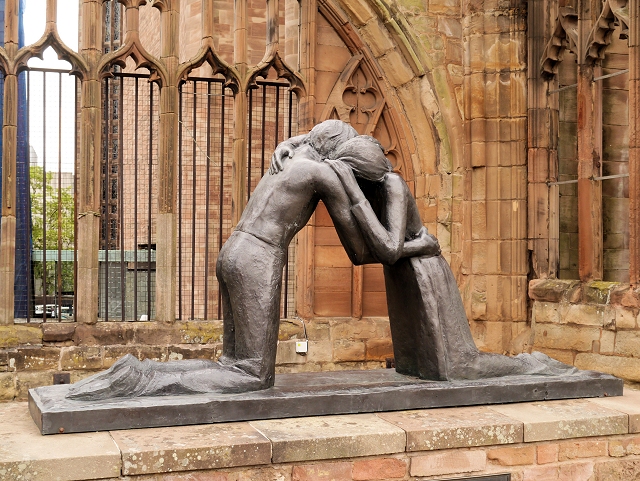
Reconciliation, Coventry Cathedral at geograph.org.uk. © Copyright David Dixon and licensed for reuse under this Creative Commons Licence.

Therefore confess your sins to one another, and pray for one another, so that you may be healed. The prayer of the righteous is powerful and effective. (Verse 16)

You might think that after all the talk of guidance, worship, and celebration, it’s a bit of a downer to conclude with confession. Dave, if you want joy in the church, why do you now end on a note of misery?

But actually, this is not about doom and gloom, even though we are sorrowful for our sins. Look at the context. This confession is in the context of seeking healing. And while I am not for one moment saying that all sickness is caused by sin, what I do see here is that confession removes barriers to blessing. Unconfessed sin gets in the way of God’s work. It is a blockage. We confess our sins at least in part so that God’s grace may flow with less hindrance among us. Living with unconfessed sin is a sure way to block the blessing of God in our lives, so let us confess as a way of removing the blockage.

Here’s another thing, though: I’m listing confession as a corporate discipline. Isn’t that a bit alien for Protestant Christians?

No, not at all. For one thing, it’s by no means accidental that we include the confession of our sins and the assurance of our forgiveness in our corporate acts of worship. Not only will each of us individually have failed Jesus in the seven days since we previously met, we also sin together and therefore jointly need confession and forgiveness.

Moreover, there are biblical examples of God’s people confessing their sins together, not least when they as a body have gone seriously astray from their Lord.

But it is also helpful sometimes for an individual to confess to another Christian. I am not advocating Catholic-style confession, because I have serious reservations about what is prescribed in that form in response to confession. Nor do I think there is something priestly about ordination, because all Christians are priests before God: we all have access to him through Jesus Christ.

Yet it can be healing to say in confidence to someone we trust – and yes, this can be someone who is in a pastoral relationship with us – I have messed up badly, and I need to know the forgiveness of God. Without giving concrete examples that would betray confidentiality, I can assure you that as a minister I have had people come to me and confess the darkest of sins, some of which they have lived with for many decades. To let them know that they are forgiven is to see a burden fall from them and to release them into new freedom in Christ.

Now perhaps I hope you see why I say confession is not in the final analysis about doom and gloom: it leads to the joy of the Gospel.

Conclusion

And the joy of the Gospel is where all these spiritual disciplines lead us. Whether inward or outward, solo or corporate, the cultivation of virtuous habits that enable us to tune in more to Jesus can only lead us to the abundant life he came to bring.

So let us use these time-honoured practices of the church to set our minds on things above and let our lives be shaped by Jesus.

You know the old adage beloved of computer programmes, ‘Garbage in, garbage out.’ Let’s stop feeding our minds with garbage, feed them instead with the goodness of Jesus, and instead live ‘Goodness in, goodness out.’

Mission in the Bible 8: The Great Commission (Matthew 28:16-20)

Matthew 28:16-20

So here it is, the reading most people would have expected as the big one in this series on mission. It’s the passage often called ‘The Great Commission.’

These are the verses responsible for many Christians being called to become missionaries or evangelists. And maybe because of that, a lot of us can feel it isn’t for us. We like to lift the end of verse 20,

And surely I am with you always, to the very end of the age

and draw comfort from it, but the earlier stuff, we think, is for others.

But that won’t work. Jesus is addressing the same people throughout. In fact, this teaching is for all Christians. Why do I say that? Two reasons. Firstly, this is the incident that many scholars think the Apostle Paul was referring to in 1 Corinthians 15:6, when talking about the resurrection of Jesus:

After that, he appeared to more than five hundred of the brothers and sisters at the same time, most of whom are still living, though some have fallen asleep.

How many? ‘More than five hundred.’ So it wasn’t just the apostles.

My second reason comes more explicitly from the reading, and it’s found in verse 17:

When they saw him, they worshipped him; but some doubted.

In among the worshippers were the doubters. Whether their faith was strong or weak, Jesus included them in the call.

And as an aside, doubt isn’t the same as unbelief. Doubt means we are still in two minds but could still land on the side of faith. Unbelief is an outright rejection of faith.

Jesus’ call, then, is for all of his followers. Not just the leaders. And not just those with a strong faith. All of us.

Our question, then, is this:  if Jesus is commissioning every Christian here, what is he asking of us?

Some would say there are four commands here: go, make disciples, baptise, and teach. However, it’s not as flat as that in the Greek, which is more like ‘Going, make disciples, baptising, teaching.’ In other words, the main command here is ‘make disciples’, and we make disciples by going, baptising, and teaching.

Hence, it’s a three-point sermon, all about how we are all called to make disciples. Make disciples by going; make disciples by baptising; make disciples by teaching.

Firstly, make disciples by going:

When Jesus tells us that making disciples will involve going, does this mean we all need to go abroad as missionaries? After all, the disciples are going to made from ‘all nations’, Jesus says.

Well, it does mean that for some Christians. Whatever the faults of the missionary movement, we should never throw out the idea that Christianity is a worldwide movement. And it also means we need to welcome missionaries here from nations where the faith is growing. They could reinvigorate us.

But most Christians aren’t called to go abroad, although we might easily be called to move somewhere else in general terms. If we accept that employers can move our jobs, why should we not think that God can call us to a new place to serve him?

Yet generally we will remain where we are. The word for most of us is what Paul tells the Corinthian Christians about their social status:

Brothers and sisters, each person, as responsible to God, should remain in the situation they were in when God called them. (1 Corinthians 7:24)

So how do we go? Most of us go in Christian mission by getting out of our comfortable places to show the love of God on territory where those who are not yet followers of Jesus feel at ease.

We need to ditch the idea that our mission happens on church premises. Maybe a few people will come to events and services that we host here, and perhaps the carol service is our best opportunity, but we must be realistic that fewer and fewer people feel comfortable – even safe – in a church building, and therefore it is our responsibility in the cause of the Gospel to go where they feel happy.

I suspect one of the reasons we have held onto church-based mission is that we are afraid of showing Jesus elsewhere. We end up making all sorts of excuses: a popular one I’ve heard in the Methodist church is that the groups which hire our premises are mission contacts. But they generally hire our halls as a commercial transaction: we have the facilities and a good price. By no means does it necessarily indicate spiritual openness.

Let’s see our going out into the world beyond our own private boundaries as a going with the presence of Christ to live out his way in those places where he calls us. For some, it will be a workplace. For others, it will be a social group like the U3A. Another place will be community groups that we are involved in. Many of us will go in mission in this way when we meet non-Christian relatives and friends.

In all these places Jesus calls us to live as his disciples, to radiate Christlikeness, such that our lives are an invitation or even a provocative question to others. We don’t need to harangue the people we meet, but we do need to be ready to speak about Jesus at an appropriate time.

Secondly, make disciples by baptising:

Here’s where we need to let go of all the sentimental and superstitious detritus that has clung to infant baptism. There is a place for infant baptism, because it arose in the early church when the first generation of Christians wondered about the spiritual status of their children, and they began to regard baptism rather like the way the Jewish faith sees circumcision for boys.

But all the social and superstitious accretions, like the need to be baptised as a baby if you are to have a church wedding in adulthood, or the thought that the unbaptised can’t go to heaven (which falls down the moment you think about the penitent thief on the cross) has obscured the relationship between baptism and discipleship. Baptism, says Jesus, is in the name of God, and the name of God is ‘Father, Son, and Holy Spirit.’

We are one of the Christian traditions that calls baptism a ‘sacrament’, and that’s worth thinking about. Now you hear certain definitions of sacrament as being ‘an outward and visible sign of an inward and spiritual grace’ and those are fine, but why the word ‘sacrament’? It comes from the Latin ‘sacramentum’, which was the oath of allegiance that Roman soldiers took to the Emperor. The sacraments are the Christian’s oaths of allegiance. Baptism is the initial oath of allegiance, Holy Communion is the ongoing one.

And that helps us see why baptism is linked to mission. It is the initiation ceremony where someone makes their oath of allegiance to God and his kingdom. It is a radical commitment to which we are calling people. None of this ‘Make a decision for Christ and then wait for heaven’: the early church called people to confess that Jesus was Lord, the very title the Emperor claimed for himself as a sign of divinity. In other words, it was a call to repudiate the powers that be, because confessing Jesus as Lord also meant that Caesar wasn’t Lord.

If we reduce baptism to ‘wetting the baby’s head’, we miss its fundamental message: that the Christian Gospel calls people to confess that Jesus is in charge of their lives and commands their ultimate loyalty, not the idols of our day, be they politics, technology, money, sexuality, or anything else.

This is where we have to be careful in all our talk today about inclusivity, much of which we pinch from the world rather than Jesus. Yes, Jesus wants us to invite all people, but when he welcomed people, such as the ‘tax collectors and sinners’, he did so with a view to calling them to leave behind their lives of sin and follow him.[1] Baptism should remind us of this.

Thirdly, make disciples by teaching:

Our three points are actually in a chronological sequence. Our discipling begins with going in order to reach people, it continues when they make a commitment with the oath of allegiance to Jesus at baptism, and finally the follow-up is our third point: teaching.

We need to get out of our heads the idea that teaching is filling our heads with facts and no more. It’s much more. Teaching involves getting people to learn things that they then apply in life. That is certainly true here in what Jesus says:

and teaching them to obey everything I have commanded you. (Verse 20a)

Someone who comes to faith in Christ needs to learn how to live the Christian life. In truth, we all need to learn that: to be a disciple of Jesus is to be a lifelong learner.

How does it happen? Only partly from the front on Sunday morning! I hope the sermons do some of the work of explaining what living the Christian life involves, but they are not the whole process. However much ministers should have a teaching gift, the sermon is only the start.

Small groups are a vital part of it. Bible study and fellowship groups are meant to be places where we reflect all the more on the teaching of Jesus, how we are going to put it into practice, and also to be accountable to one another about how we are living out what we have already learned. This is what Wesley did with some of his small groups in the Evangelical Revival in the eighteenth century. A church that is short on small groups, or where the small groups don’t get to grips with what it means to live as a disciple, are seriously lacking.

In one of my previous churches, we asked all the preachers to bring discussion questions based on their sermons so that the small groups could work on putting into practice. It did go a little awry in one group where an elderly man decided this was his opportunity to tear every preacher to pieces – it’s the old gag, ‘What’s the favourite Sunday dinner in a church household?’ Answer: ‘Roast preacher.’ But mostly the groups who stuck to the programme benefitted from it.

One-to-ones can help, too. Matching people together so that a more experienced Christian can nurture and mentor someone younger in the faith is valuable. I gained a lot in my early years as a Christian from the person I described as my ‘spiritual elder brother.’

I hope you can see from these examples that while the minister certainly plays a part in teaching the faith, it is an exercise for the whole church. We do not have to be theological specialists in order to help teach people how to live out the teaching of Jesus. At heart, we just need to love Jesus, want to go his way, and be willing to share our experience of that with others.

In conclusion, Jesus gives us a sequence here for our task as disciple-makers. We begin by going out of our comfort zones to live for Christ in front of the world. We call people not simply to receive the blessings of forgiveness, but to make the baptismal oath of allegiance to Jesus as Lord over all. And then we build relationships with people in the church family where we share our learning how to follow the teaching of Jesus.

It’s straightforward to describe, but we may feel nervous about putting it into practice. And I think that’s why Jesus’ final words here are

And surely I am with you always, to the very end of the age. (Verse 20b)

These are not just general words of comfort, good as they are for that. These words are Jesus’ promise that he hasn’t sent us out on the challenging task of mission on our own. Where we go, he goes. And usually, he’s even gone there ahead of us. We can count on that as we seek to make more disciples.


[1] See Ian Paul, In what way does Jesus ‘welcome’ sinners?

Create a website or blog at WordPress.com

Up ↑