Harvest Sermon: Reversing the Curse (Genesis 8:15-22)

A brief apology for omitting one technical step in my set-up before recording the video this week which led to the focus being on my bookshelves and not on my face. I didn’t have time to re-shoot. However, you may consider it an improvement!

Genesis 8:15-22

If I turned up this morning with all three volumes of The Lord Of The Rings, opened one of them at random, and read to you about the battle of Isengard, you might think it was interesting but how much sense would it make to you?

If you saw on the stage a scene from Romeo and Juliet where the two lovers are professing their devotion to each other but you knew nothing about the hostility between the Montagus and the Capulets, what meaning would you draw?

And if the first instalment you ever watched of Eastenders was Dirty Den serving divorce papers on his wife Angie in a Christmas Day episode one year, might you ask yourself, ‘Well, what led to that?’

These things don’t make much sense on their own, do they?

Yet that’s exactly how we often treat the Bible in church. It’s why I like to preach on a sequence of readings from the same book if I can. That’s why many of my sermons and videos in recent weeks have been from the Gospel according to Mark.

But on a special occasion like today we have to break the pattern and it means taking a passage out of nowhere. If only this week’s reading from Mark had been suitable!

Now you will recognise some of the context of Genesis 8 immediately. You will realise this is the end of the Flood, and that’s useful for understanding these verses, but we’ll need to set it in a wider story. This passage makes more sense in the context of what has already happened earlier in Genesis, and in the context of the great story that all the books of the Bible in their vast diversity combine to tell.

Putting it in that wider context, I’m calling this story of harvest and other good things one of ‘Reversing The Curse.’

The key reference here is not so much Genesis 6, where the story of the flood begins, although that is relevant. The big connection is with Genesis 3, where Adam and Eve fail to follow the terms and conditions on the apple and the tree of life. That poetic story of human sinfulness contains references to the damage that sin causes. It isn’t just that it fractures our relationship with God, it also damages our relationships with other human beings and so men dominate women (which only comes in the curse). Our connection with the wider creation also takes a hit. We see hard, physical toil at work as one sign of the curse, and we see the pain of childbirth as another. In the words of Bob Dylan, ‘Everything is broken.’

The flood in Genesis shows then that the problems in the Garden of Eden have escalated to the whole human race. This is the point where wickedness is in such a frenzy that God resorts to drastic measures.

But now, after the flood, God expresses his deepest desire, which is for salvation rather than judgment, and it’s a salvation that reverses all the curses of sin – the breaks with God, one another, work, family, and creation. And so we heard at the end of the reading,

21 The Lord smelled the pleasing aroma and said in his heart: ‘Never again will I curse the ground because of humans, even though every inclination of the human heart is evil from childhood. And never again will I destroy all living creatures, as I have done.

22 ‘As long as the earth endures,
seedtime and harvest,
cold and heat,
summer and winter,
day and night
will never cease.’

Despite ‘every inclination of the human heart [being] evil from childhood’ God will seek to save people from sin. One day it won’t be Noah’s burnt offerings of clean animals and clean birds (verse 20), God will take sacrifice for sin into his own being in the Person of his Son.

The brokenness between human beings is something God longs to heal, too, and we get a fresh start in this story with Noah’s family. They are far from perfect, and soon even righteous Noah himself causes embarrassment for his sons by getting drunk.

And as God shows this preference for salvation, the other ruptured parts of existence are up for healing, even if they are not mentioned here. If work now brings toil and pain, then it is a Christian call to work to heal that. Right now in golf, the Ryder Cup is underway between the USA and Europe. Samuel Ryder, who donated the gold trophy, was a Christian entrepreneur, who pioneered paying sick pay to his employees, not wanting anyone to go penniless because they were too unwell to work.[1]

Other Christian business founders have done similar things down the years. You’ve probably heard the stories about George Cadbury and Joseph Rowntree, but you can add to that list people such as Sir William Hartley the jam-maker, William Colgate, Henry Heinz, Henry Crowell the co-founder of Quaker Oats, and in more recent years Anthony Rossi, the founder of the Tropicana drinks company. All said that their Christian values should imbue their businesses and make things good and honest for their employees and their customers.[2]

The response to the curse of pain in childbirth mentioned in Genesis 3 is found in many ways, as Christians get involved in medicine, in pregnancy crisis centres, and in adoption and fostering agencies.

But by now you’re probably thinking, ‘This is all very well but I came to a harvest festival! Where’s the harvest theme in all this?’ It’s there at the climax of the reading. Verse 22 again:

22 ‘As long as the earth endures,
seedtime and harvest,
cold and heat,
summer and winter,
day and night
will never cease.’

Harvest is all of a piece with this. God with his desire for salvation is not content to look at a broken world where people do not have enough to eat, whether it is a crisis, ongoing unemployment, steeply rising energy bills, or the damage of climate change, especially in the developing world.

And that calls all of us to involvement. We cannot leave things as they are. We cannot tolerate unjust suffering and the treatment of human beings as just some kind of collateral damage in a wider political project.

Remember, God’s final word is not judgment but salvation. And salvation is not just a private spiritual knees-up between me and God, it is the remaking of the whole broken creation. So God lays it out that this means a good and steady source of food for all (seedtime and harvest), facilitated by a balanced climate (cold and heat, summer and winter, day and night).

Therefore, when we bring our harvest gifts today and we dedicate them to Woking Food Bank, we are not just saying that we are grateful we can enjoy our food. We are saying that, but we are saying much more.

As we have laid our gifts before the Lord this morning, I believe we are saying this: we will not rest while people do not have the harvests that we have. We will give. We will pray. We will campaign and we will act. And what we shout for in the larger world we will show in our smaller worlds, by our acts of hospitality.

Because the will of God is one where not only the rich can feast, but that all can be invited to the feast of the kingdom. Every time we come to Holy Communion we look backwards to the Cross where we are put right with God, forwards to the wedding feast of the Lamb, and to the present where the Holy Spirit enables us to become junior partners in the work of God.

And within all that, harvest festival is a pledge of allegiance to the kingdom of God. As the Holy Spirit helps us to co-operate with the will of God, we promise our own parts in the remaking of the world:

  • Our witness to the redeeming love of God in Christ that brings sinners into fellowship with him;
  • Our experience of reconciliation with one another which we put into practice to help heal other relationships;
  • Our efforts to return purpose and wholeness to the drudgery of work;
  • Our concern to be pro-life, not just from conception, but all the way to the grave;
  • Our campaigning and our lifestyle that seek to ensure all have a climate in which they can grow a healthy harvest.

For that is where the divine promise we read today of seedtime and harvest, summer and winter belongs in the great story of God – in a story in which our God is making all things new.


[1] https://licc.org.uk/resources/the-ryder-and-solheim-cups-golfing-for-gods-glory/

[2] https://issuu.com/salvationarmyuk/docs/wc_15_august_2020_web

Sermon: Baptised Into Freedom (The Baptism Of Jesus)

The Advent and Christmas rush means I’ve missed posting several sermons lately. Hopefully, I’ll post them soon, even though they will be rather ‘after the event’. At least they will be present here then nearer next December for those who search this blog and others for relevant sermons.

In the meantime, here is a sermon for this coming Sunday, when we mark the baptism of Jesus.

Mark 1:4-11

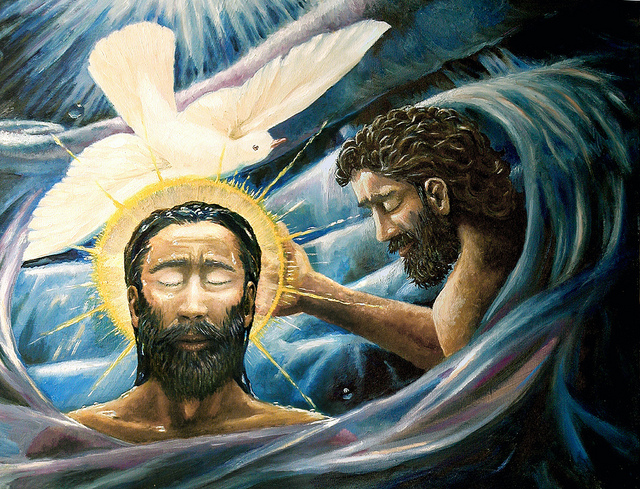
Baptism of Christ
Baptism Of Christ 10 by Waiting For The Word on Flickr. Some rights reserved.

If you follow the movies, you may have noticed that in recent months Hollywood has had a bit of a religious obsession. Much of it has been poor, or at least contentious. God’s Not Dead caricatured atheists, Left Behind took up some dubious fundamentalist theories of the end times based on a questionable series of Christian pulp fiction novels, and Noah divided opinion.

Now Ridley Scott’s Exodus: Gods And Kings has caused a stir. Not just because any such film is bound to provoke polarised opinions (and that’s just in the church!), but because Scott engaged famous white actors to play dark-skinned Egyptians so as to generate box office income. And that’s before we get to the controversies about whether the script took liberties with history and scholarship.

But Hollywood hasn’t usually worried too much about the choice between truth and a juicy story. Coming from a family where my grandmother was a friend of Gladys Aylward, I am only too aware how furious Aylward was with the fictional romance that was invented for the film about her life, The Inn Of The Sixth Happiness (never mind the dubious morals of Ingrid Bergman, who portrayed her).

Let me come back to Exodus, though. Because Mark’s account of John baptising people, including Jesus, has Exodus themes in it. I’ve said before in sermons that the Jewish people of Jesus’ day commonly regarded themselves as being in a kind of exile, even though they lived in their own Promised Land, because they were occupied by Rome. So they longed for freedom. And as well as a theme that was like the liberation from Babylon, the Gospels also contain the imagery of freedom from their original place of captivity, Egypt. The Good News that Mark is beginning to tell is couched at the beginning in Exodus language.

Our problem is that we are so used to hearing these stories in the light of more recent Christian debates and themes that we miss this. Perhaps we hear the baptism stories and start thinking about what we believe about baptism. Is it for infants, or is it for committed disciples?

But we need to return to the Exodus theme. ‘Exodus’ is a Greek word. It is usually taken to mean ‘departure’, and so the second book of the Old Testament narrates the departure from Egypt. ‘Exodus’ as a word is a compound of two other words – ‘ek’, meaning ‘out of’, and ‘hodos’, meaning ‘road’ or ‘way’. This is the road or way you take out of somewhere. It is the escape route that you follow. And so an Exodus theme is a freedom theme. It is about liberation and liberty. I want to explore the baptism of Jesus, then, and its implications for us, under this theme of ‘freedom’.

Firstly, the baptism itself. It’s implicit in Mark what is made more obvious in other Gospel writers, namely that John’s baptism is a baptism of repentance. Mark simply notes,

Confessing their sins, they were baptised by him in the River Jordan. (Verse 5b)

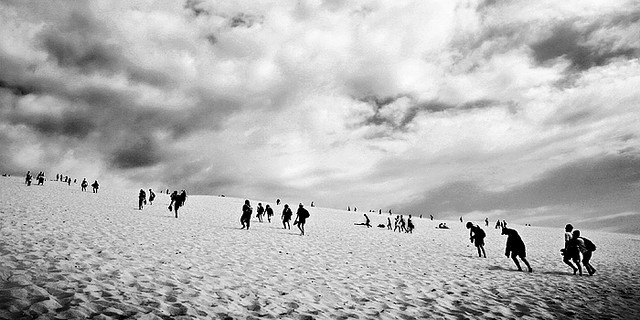
Exodus
Exodus By Giorgio Raffaelli on Flickr. Some rights reserved.

It’s therefore strange that Jesus embraces John’s baptism. Why does he need to repent? Again, the other Gospel writers are more explicit about this problem, but Mark characteristically keeps his account brief. Jesus certainly identifies with the people. He is the One who will lead people out of slavery – not, in this case, the slavery of Israel in Egypt, but slavery to sin. As the Israelites came through the waters of the Red Sea (or Sea of Reeds) to freedom from Egypt and her powers, so Jesus leads his people through the cleansing waters of baptism to freedom from sin.

This is the good news of Jesus’ baptism: the Messiah has come to lead his people to freedom from sin. It begins with confession and forgiveness, but it becomes a whole pilgrimage from ‘Egypt’ to the ‘Promised Land’, as that initial setting free becomes a journey in which God leads us into freedom not only from the penalty of sin but also into increasing freedom from the practice of sin, until one day, in the New Creation, we shall be free from the presence of sin.

For Jesus, that journey will embrace what our baptism service calls ‘the deep waters of death’. His Red Sea will not only be the waters of the Jordan at John’s baptism, but Calvary and a tomb. But he will rise to new life and ascend to his Promised Land, promising that we will one day go with him at our own resurrection.

This is Good News that says to us, life doesn’t always have to be like this. It doesn’t have to remain a catalogue of remorse and failure. There is hope. We do not have to hate ourselves, because God loves us to the point of offering forgiveness and new life.

Thus begins our transforming journey, in a baptism that calls us out of Egypt and on the road of increasing freedom. It’s worth reminding ourselves of this from time to time.

One person who did that in his life was Martin Luther. He was a man prone to mood swings between elation and darkness. He could be the wittiest person alive, but he could also plumb the depths. But he said that whenever he was most tempted to doubt or to give up, he would remind himself of one fact: ‘I am baptised.’

I am not saying that baptism is some religious magic trick, but I am saying that to remember our baptism is to remember the promises of God to forgive our sins, and the power of God to change us and ultimately all creation, too. It is a sacrament of hope, as well as of beginnings.

Secondly, the Holy Spirit. On the one hand, John promises,

I baptise you with water, but he will baptise you with the Holy Spirit (verse 8)

And on the other, we read,

Just as Jesus was coming up out of the water, he saw heaven being torn open and the Spirit descending on him like a dove. (Verse 10)

Veni Sancte Spiritus
Veni Sancte Spiritus by Fr Lawrence Lew, OP on Flickr. Some rights reserved.

What does this have to do with the Exodus freedom story? It’s about the manner of God’s presence.

I’m sure you will recall that when Israel was being led through the wilderness, it was by a pillar of cloud by day and a pillar of fire by night.

But now, in the New Covenant, God’s people get an upgrade. Not only will the presence of God (cloud and fire) lead them, now that same presence will come upon all of them and dwell within them. For you frequent flyers, they have effectively gone from economy class to business class.

In Jesus’ case, there is something else. The descent of the Spirit upon him shows that he is the Messiah, for Messiah means ‘Anointed One’. He is anointed, not with the oil used to mark an earthly monarch, but with the oil of God, the Holy Spirit.

And if Jesus the Messiah is anointed with the Holy Spirit and we receive the Spirit too, then that confirms our Christian identity – we are to be ‘little Christs’. No, we are not Messiahs, and heaven deliver us from any more people in the Church with Messiah complexes, but the upgrade to the indwelling Spirit equips us for our pilgrimage to freedom. It is the witness of the Holy Spirit that confirms we are forgiven and loved. It is the work of the Holy Spirit to lead us into increasing freedom from the practice of sin, thus making us more Christ-like. (Although we may more modestly feel it’s a case of becoming less un-Christ-like!)

We need not fear the gift of the Holy Spirit. He is the Spirit of freedom. ‘Where the Spirit of the Lord is, there is liberty,’ wrote the Apostle Paul. He brings God’s freedom to us, and empowers us then to be ministers of God’s freedom in the world. Through the Spirit’s work, we offer Christ and his liberating work to those in the chains of sin – the chains of their own sin, and the chains imposed by others upon them.

And not for us the limited distribution of the Holy Spirit in the Old Covenant. Now the Spirit is given not only to a select number of God’s people, he is given to women and men, young and old, privileged and poor – anyone who desires to follow Jesus the Messiah, the leader of freedom.

Those in higher church traditions than us have a liturgical symbol for this in the way the bishop applies anointing oil (‘chrism oil’) to the foreheads of candidates for confirmation. I came to like that tradition when I used to take part in ecumenical confirmation services with Anglicans, and concluded that we were missing out on that symbolism. I can offer something ad hoc, in that I possess a bottle of anointing oil, which has a beautiful smell of frankincense, and some people find it helpful to link the fragrant aroma of the oil with the presence of the Holy Spirit, who brings freedom.

Thirdly, the voice of God. The terrifying thunder from the mountain on the Exodus route now becomes the voice from heaven as Jesus comes up out of the water. Heaven is ‘torn open’, the Spirit descends like a dove (verse 10), and the voice from heaven speaks:

‘You are my Son, whom I love; with you I am well pleased.’ (verse 11)

Door To Heaven
Door To Heaven by Tragopodaros on Flickr. Some rights reserved.

Tom Wright says[1] that we should not see the opening of heaven as like a door ajar in the sky, because heaven in the Bible is rather the dimension of God’s reality that is invisible to us. So instead, this is like an invisible curtain being pulled back so that we see the whole of life in the light of this different reality. And in this case, when heaven opens the curtain into our life, we hear the divine voice that addressed Jesus addressing us, too:  ‘You are my child, whom I love; with you I am well pleased.’

And certainly that is a totally different reality in which to live. Think about God addressing Jesus this way. Mark hasn’t recorded any virtuous acts by Jesus yet at all. His baptism is his first action in this Gospel, and even that is done to him. There is not even a reference to the humility of the Incarnation in Mark. What, then, has Jesus done to earn his Father’s pleasure here? Absolutely nothing. But he hears the voice of unconditional love. God loves him and is pleased with him.

Those of you who are parents, recall those times when you went into your children’s bedrooms at night when they were fast asleep. They might have delighted you that day, or they might have been utter pickles. But still you gazed at them and whispered words about how much you loved them. You had unconditional love for them.

So ask yourself this: is God angry with me, or does he love me? Can I really believe the Good News that God delights in me? This is the liberating news of our New Testament Exodus.

And that is a transforming insight. If God loves us like this, why do we not love ourselves? I don’t mean in a self-centred way. Rather, I mean something that the author Donald Miller has recently written about. In a booklet available online called Start Life Over, he lists five principles towards changing our lives for the better. The second of these is that – strange as it may sound – we are in a relationship with ourselves, so we should make it a healthy one.

What he says is this. To some extent, we all seek the approval of others, but what we don’t notice is how we seek our own approval. It is as if we are two people: one doing the actions of daily life, the other watching those actions in judgement. Miller noticed that a friend whom he deeply admired was always doing respectful things. And he wondered: if I start doing more respectful things, will I respect myself more, and thus change for the better? He writes,

And it worked. I would find myself wanting to eat a half gallon of ice cream while watching television and I asked myself “if you skipped this, would you have a little more respect for yourself?” and the truth is I would. So I skipped it. And I had much more self respect.

I liked myself more.

This sort of thing translated into a whole host of other areas of my life. I started holding my tongue a little more and found I respected myself more when I was more thoughtful in conversation. I found myself less willing to people please because, well, people who people please aren’t as respectable, right? (Page 9)

I suggest to you that this kind of transformation is open to us when we embark on our baptismal journey of freedom, in the power of the Holy Spirit, and hear God’s voice from heaven telling us we are loved unconditionally. It makes change possible.

So often, the way we seek to promote change in ourselves and in others is through threat. We are no carrot and all stick. But all that produces is fear and paralysis. We might see some change, but it is the change wrought by sleeplessness and night terrors, rather than love. Ultimately, it doesn’t achieve much, and it affects us badly as people.

God chooses the way of unconditional love to lead us into freedom.

[1] N T Wright, Mark For Everyone, p5f.

Create a website or blog at WordPress.com

Up ↑