Regime Change, Isaiah 11:1-10 (Advent With Isaiah, 2) Advent 2 Year A

Isaiah 11:1-10

Here are some extracts from a friend’s Facebook post:

3 WISEMEN KILLED ATTEMPTING TO ENTER U.S.

(Bethlehem) The 3 Wisemen were killed attempting to enter the U.S. early this morning. They were still hundreds of miles away from the actual border, but the White House determined there wasn’t time to actually investigate their suspicions.

A White House spokesperson said, “We could tell from the satellite photos that these were bad people. They had gold (probably stolen), myrrh and something that was possibly fentanyl.  It was hard to tell from the picture, but the President knew just enough to kill them without an actual investigation.”

Also arrested were two immigrants named Joseph and Mary, an unnamed child, and an angel. The White House elaborated, “We can tell you that the two suspects were trying to check into a hotel. When asked if they were married, they responded that they were “betrothed.” We can’t have people flaunting Christian moral conventions at this sacred time of the year.

“The undocumented mother was also secretly recorded as saying “(God) has brought down rulers from their thrones, and has lifted up the humble. God has filled the hungry with good things but has sent the rich away empty.” That sounds like communism, pure and simple. These were probably Antifa terrorists.”

I could read you much more, but I don’t have time!

In amidst all our cosy preparations, with Christmas adverts that tug at the heart-strings like this year’s Waitrose ad, we miss the fact that the coming of the Messiah is much more messy and radical. And I don’t mean the mess in the manger.

It’s about regime change.

Sometimes, we get so fed up with our leaders we want change. Maybe we don’t do it like some powerful nations do, where they act nefariously in another country to change the leadership. But look at last year’s General Election here. Broadly speaking, the country was so fed up with the Conservatives that people voted for anyone who wasn’t Conservative. It wasn’t so much a vote for, as a vote against. No wonder the Labour majority was called a ‘loveless landslide.’

In the ancient world, of course the general population didn’t have a say, but kings were replaced and sometimes entire dynasties were removed. It was their version of regime change.

Isaiah 11 proposes the most radical regime change of all. A regime change that brings in the Messiah. Verse 1:

A shoot will come up from the stump of Jesse;
    from his roots a Branch will bear fruit.

Not even a shoot from the stump of David, for he was far from perfect. An adulterer, it not actually a rapist, and a murderer. The greatest king of all had his faults. Instead, Isaiah prepares us to sing

Hail to the Lord’s Anointed,
Great David’s greater Son![1]

So what will characterise the much-needed Messiah, who alone can bring true regime change?

Three qualities:

Firstly, wisdom:

2 The Spirit of the Lord will rest on him –
    the Spirit of wisdom and of understanding,
    the Spirit of counsel and of might,

    the Spirit of the knowledge and fear of the Lord –
3 and he will delight in the fear of the Lord.

Do you recognise these words? We have adapted them for the laying-on of hands at Confirmation and Reception into Membership of the Methodist Church. The minister prays this for the candidates:

By your power and grace, Lord,
strengthen these your servants,
that they may live as faithful disciples of Jesus Christ.
Increase in them your gifts of grace,
and fill them with your Holy Spirit:
            the Spirit of wisdom and understanding;
            the Spirit of discernment and inner strength;
            the Spirit of knowledge, holiness, and awe.[2]

And doubtless we expect the Holy Spirit to impart these qualities: wisdom, understanding, discernment, inner strength, knowledge, holiness, and awe. I’m sure it’s right to expect that.

Wisdom: Public Domain Pictures

But there is a specific context to these qualities of wisdom in Isaiah 11. All of the qualities he lists – wisdom and understanding, counsel and might, the knowledge and fear of the Lord – are lacking in the people of Judah and also of their enemies, such as Assyria. There are various quotes in the preceding two or three chapters that illustrate this.[3]

The Messiah is the One who brings true godly wisdom without lack – we might say it’s wisdom, the whole wisdom, and nothing but the wisdom of God.

When Jesus comes and begins his ministry in the power of the Spirit, we see this without a shadow of a doubt. In Matthew’s Gospel, there are five blocks of Jesus’ teaching, reinforcing the fact that here is the ‘One greater than Moses’ who was prophesied, given that there are five books colloquially known as ‘The Five Books of Moses’ in the Old Testament.

We can gain wisdom from other sources, but nothing is like the wisdom of Jesus. It’s why our high church friends stand for the Gospel reading in worship. They are saying, here is the centre of divine wisdom and revelation in the life and teaching of Jesus.

If we believe we are living under the regime change of the Messiah (which Christians are as citizens of God’s kingdom) then there is a clear application of this truth to us. To honour Jesus as the coming Messiah, our calling is to immerse ourselves in the wisdom of his teaching and commit ourselves to following it more fully.

For that, we too will need the Spirit – just as even Jesus himself, the Son of God, did, at his baptism.

If we are citizens of the coming kingdom, then this is what we do.

Secondly, justice:

He will not judge by what he sees with his eyes,
    or decide by what he hears with his ears;
4 but with righteousness he will judge the needy,
    with justice he will give decisions for the poor of the earth.
He will strike the earth with the rod of his mouth;
    with the breath of his lips he will slay the wicked.
5 Righteousness will be his belt
    and faithfulness the sash round his waist.

Justice. We all want that, don’t we? Our governments should deliver justice. Just so long as we are the ones who are in the right, and those we don’t like are condemned. And we’d like just to leave us feeling comfortable.

Lady Justice Silhouette: Public Domain Pictures

If those are our hopes, then the justice of the Messiah’s regime change will not be what we want. He will bless the poor and the needy (verse 4) – well, that won’t be so great for those of who are used to living with comfort and privilege. For to elevate them, to give them what they need and what is rightfully theirs will means less for us.

And as for all that uncouth talk about striking the earth with the rod of his mouth and slaying the wicked with the breath of his mouth – oh, we don’t like all that violent stuff, do we? Isn’t this one of those parts of the Bible we’d rather strike out? Where’s gentle Jesus, meek and mild? Where’s inclusive Jesus in that?

Or let’s be honest: where’s nice, cosy, liberal, middle-class Jesus?

I’m sorry: he doesn’t exist.

But show passages like these and the similar ones in Revelation that we like to dismiss as altogether too gory to those who are suffering for their faith, and they will rejoice in them. Through the Messiah, God will put things right! If we believe in a God of justice, we must not deny that he will deal with the impenitent.

However, it will be delayed. When Jesus comes and gives his manifesto as Messiah to the synagogue at Nazareth in Luke 4, he reads from Isaiah 61, but he stops before it goes on to talk about ‘the day of vengeance of our God.’ That is coming, but not yet.

Why? Because in his mercy, the Messiah offers the opportunity for even the most reprehensible to repent and amend their ways.

But Jesus is indeed coming to bring good news for the poor. He is coming, as his mother prophesied in the Magnificat, to bring down rulers from their thrones, lift up the humble, fill the hungry with good things, and sent the rich away empty. This is what regime change under the Messiah looks like.

And so again, our duty as citizens of that coming kingdom can be stated very simply, even if it is challenging to implement. It is to advocate for the poor and challenge the powerful.

Thirdly and finally, peace:

6 The wolf will live with the lamb,
    the leopard will lie down with the goat,
the calf and the lion and the yearling together;
    and a little child will lead them.
7 The cow will feed with the bear,
    their young will lie down together,
    and the lion will eat straw like the ox.
8 The infant will play near the cobra’s den,
    and the young child will put its hand into the viper’s nest.
9 They will neither harm nor destroy
    on all my holy mountain,
for the earth will be filled with the knowledge of the Lord
    as the waters cover the sea.

The thought of peace between different animals is appealing. As you know, we are dog lovers, and our cocker spaniel can be a bit of a grumpy old man with other animals, especially other dogs, and most notably on his night-time walk. There’s something about the dark. We have taken to referring to one other dog on our estate as ‘Enemy Dog’, because ours has taken a particular dislike to the red flashing light he wears on his collar at night. The wolf will live with the lamb, the leopard will lie down with the goat, the calf, the lion, and the yearling together? I’d vote for that.

Sadly, we’re dealing with prophetic imagery here rather than a literal prediction. As John Goldingay, the scholar I cited last week, says here:

Context suggests that the talk of harmony in the animal world is a metaphor for harmony in the human world. … A literal interpretation of verses 6-8 would also have difficulty in explaining how wolves and leopards can remain themselves if they lie down with lambs and goats.[4]

So what is the metaphor saying? Goldingay again:

The strong and powerful live together with the weak and powerless because the latter can believe that the former are no longer seeking to devour them.[5]

The Messiah brings together and reconciles the strong and the weak, the powerful and the powerless. They are not divided, they are family. No-one takes advantage of anyone else. What matters in relationships is everybody’s well-being. The ‘goodwill to all on whom God’s favour rests’ that the angels spoke about to the shepherds becomes ‘goodwill among all’.
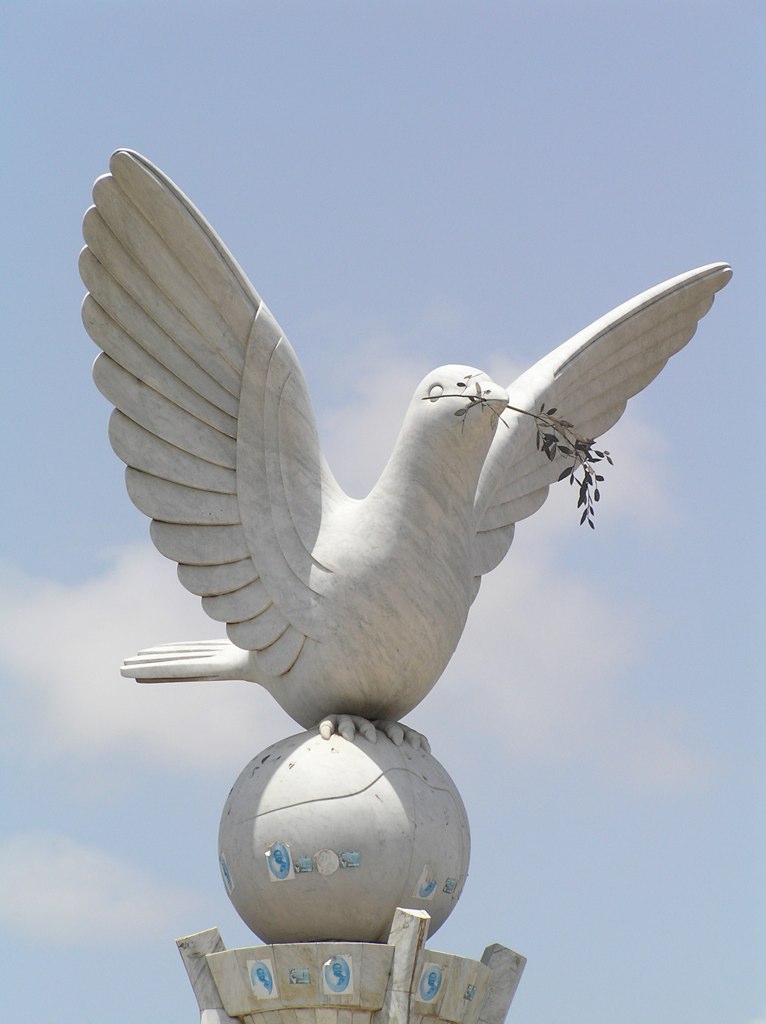
Peace dove: Wikimedia Commons CC 2.0

What does this sound like? Well, to me it sounds like what Jesus always intended his church to be. The redeemed community, the colony of God’s kingdom, is to be the place where the rich and the poor, the highly educated and the barely literate, Europeans, Africans and Asians, the neurotypical and the neurodivergent, old and young, male and female, all care for one another and promote each other’s welfare. Because that’s what Jesus does. That’s the sort of society the Messiah builds.

And imagine not only enjoying a fellowship like that (even though it entails hard and painful work at times). Imagine also inviting someone in to experience it, and being able to say, this is what life is like when Jesus is in charge.

Indeed, this is what regime change under Messiah Jesus brings.


[1] James Montgomery (1771-1854)

[2] Methodist Worship Book, p100.

[3] John Goldingay, Isaiah (New International Biblical Commentary), p84.

[4] Op. cit., pp 85, 88.

[5] p85.

The Good News Covenant, Luke 4:14-21 (Ordinary 3 Epiphany 3)

No video this week: on Friday afternoon, while working on this sermon, a workman’s van crashed into our kitchen wall, causing structural damage to our manse.

No-one was hurt. But it does mean I’ve got behind. Anyway, here’s the text of this week’s sermon.

Luke 4:14-21

How did you hear about the assassination of John F Kennedy in November 1963? I am too young to remember how we heard the news in the UK, but I imagine people heard on the next available TV news bulletin. 

But I do know how I heard about the death of Princess Diana in August 1997. I came downstairs that Sunday morning, and as was my habit I turned on the BBC breakfast news. There was the rolling coverage provided by 24-hour news services. 

And I remember how I heard about the death of the Queen in 2023. Debbie and I were sitting in a branch of Pizza Express, waiting for a meal before going to a concert. A news alert flashed up on my phone. 

How did people hear major news in the Roman Empire two thousand years ago? A messenger would come to their town or village and make a public announcement, probably in somewhere like the marketplace. I guess they were a little bit like town criers. They would tell the people that there was a new Emperor on the throne in Rome, or that Rome’s legions had won a great victory against an enemy.

And do you know what they called their proclamations? You do. ‘Good News.’

So when the New Testament speaks about Good News it takes over this model and gives it a refit according to the life and ministry of Jesus. It would be something like this:

‘Good News! There is a new king on the throne of the universe. His name is Jesus. He has conquered sin and death not with violence but by his own suffering love and death. And God has vindicated him by raising him from the dead.’

Jesus speaks of ‘Good News’ in Luke 4, and – to state the obvious – he is by definition doing so before his death and resurrection. But he is telling his hearers about the nature of the kingdom he is inaugurating, including what it is like to live under his reign and by implication what it requires of its citizens. 

Therefore, what we are considering today is both the offer Jesus makes to us by his grace and the call he makes on us in response. 

Firstly, good news to the poor:

I find that Christians go into battle with each other on this one. What is good news to the poor? Is it that we evangelise them? Or is it that we campaign politically for them? 

I think the answer is ‘yes.’ In other words, I don’t see this as an either/or choice.

But we need to understand who people in Jesus’ world would have understood as ‘the poor.’ Certainly, it included the economically poor, but it also it also included those who had no status or honour in society. So we’re not only talking about the destitute, we’re talking about women, children, lepers, Gentiles, prostitutes, and so on. 

And by making a list like that, you will I am sure be saying to yourself, that sounds pretty much like the main constituency Jesus served. He brought the Good News that there was a new king on the throne of the universe to these people, and they welcomed it. This king was for them. They could be citizens of his kingdom. God’s love was offered freely to them in word and deed by Jesus, and they too could enter the kingdom by repentance and faith, just like anyone else. 

The early church clearly followed up on this. When Paul writes to the Corinthians, he observes that not many of them were of high rank. And after the apostolic age, we find former slaves becoming bishops in the church. 

For John Wesley, it all kicked off on 1st April 1739, when, at the urging of George Whitefield, he preached for the first time in the open air to the miners of Kingswood, between Bath and Bristol. The Good News was for them, he realised. And he would later become concerned about their social needs as well. 

If we are to take the mission of God seriously today, we must put this front and centre, because Jesus did. Yet in this country, church historians say that the Christian church has not seriously taken the Gospel to the poor since the Industrial Revolution. John Wesley was probably the last person to do this on a significant scale. 

I am not saying that we are doing nothing in this respect. I am sure some of the people who come to ‘Connect’ fall into the categories I am talking about. As we give a welcome and acceptance to them, we need to find the right ways and times to share the Good News with them. 

And I am aware that this town is very much divided into two halves. But at the same time, it is a town with Marks and Spencer’s at one end and Waitrose at the other. This is the only church I have served where the hand gel provided to the minister before handling bread and wine at communion comes from M and S! 

So allow me to flag this up, because in this area it would be easy for us to lose sight of this important strand of Jesus’ teaching. There are few things more dangerous for Christians than getting comfortable. 

Secondly, freedom for the prisoners and recovery of sight for the blind:

What did Jesus mean by quoting this from Isaiah? Clearly, ‘freedom for the prisoners’ didn’t mean he went around the jails of Palestine opening prison doors and letting the convicts out. It has more to do with him pronouncing freedom from the guilt of sin in the offer of forgiveness, freedom from the power of sin in his casting out of demons, and freedom from being sinned against by standing for justice and also enabling people to forgive wrongdoers. 

Recovery of sight for the blind is a little more straightforward, given the healing miracles Jesus performed. 

But a lot of that might sound a little distant to us. The church limits the number of people who exercise a deliverance ministry because it needs all sorts of safeguards and protections built in. Most of us don’t have a healing ministry, either. I only know for sure of two occasions in my life when I have prayed for someone to be healed and they were. Not that I want to discourage anyone from praying for healing, though: I’m just saying that only a few Christians have an ongoing ministry of healing. 

So what can we take from this? Plenty, actually. We may not all be evangelists, but we are all witnesses who are called to share our faith in word and in deed with people beyond the Christian community. That’s why we’re beginning the Personal Evangelism course tomorrow morning. This is a chance for us to find ways of being able to speak about our faith gently to others. How else are people going to find faith and the Good News of God’s forgiveness in Christ? I encourage you to sign up!

It’s also about our example. When we are wronged, the world will look at how we respond. When terrible things happen, our culture is full of language about certain actions and crimes being ‘unforgivable.’ And while I obviously wish no harm on anyone, our neighbours will be watching us when we suffer wrongly. If they see forgiveness in us, or at the very least a working towards forgiveness, you can be sure it will make an impression. 

Further, we can be involved socially in campaigns for those who have suffered wrongs. Yes, this includes our fellow Christians who are persecuted around the world, but we should not limit ourselves to our spiritual kith and kin. Anyone who is an unjust victim, even if it is someone we don’t agree with, is someone for whom Jesus wants freedom. In fact, standing up for those we disagree with can itself be a powerful witness. 

As for the recovery of sight for the blind, apart from the question of physical healing there is the matter of those who are spiritually blind. Jesus spoke truth to the wilfully blind, such as many of the religious leaders of his day. He also spoke truth to reveal God’s love to those he was calling out of darkness. 

Therefore, we can do two things. We can pray that blind hearts and minds be opened to the truth of God’s Good News. And we can also be the ones who share that truth, backed by prayer. 

Thirdly and finally, to set the oppressed free, to proclaim the year of the Lord’s favour:

All the talk of releasing and setting free is brought together in the talk of ‘the year of the Lord’s favour.’ And that language is the language of the Old Testament Jubilee. The Jubilee Year, which in the Law of Mosese was to occur once every fifty years. And in that year debts were forgiven, slaves were set free, and land was returned to its original owners. Whether Israel ever truly observed it is debatable, but here Jesus says it’s coming in with his kingdom and so it’s a sign not only of how to live now but also of the age to come. It is a manifesto for how the community of God’s kingdom will be and how his people are to live now. 

The forgiveness of debts was financial. What a test of discipleship to hone in on how attached we are to our money. Will we always stand on our rights, demanding what is ours, or will we forgive a debt?

I saw that demonstrated by my father when I was still living at home in my early twenties. I had a friend who was an only child and an orphan. His father had been killed in a car crash when he was eight, and then when he was fifteen, just before our mock O-Levels, his mother died of cancer. Then in his early twenties he had a broken engagement. With few relatives, he came to live with us for a couple of weeks while he tried to get himself together again. 

But in that time he just expected my mother to do his laundry and cook for him, and he never offered any money towards his keep. After he left to go back to his home, we had a family conference over dinner. What were we going to do about his debt to us?

And my father simply said, ‘We’re going to put it down to God’s account.’ 

And we know Jesus builds that into the Lord’s Prayer: Forgive us our debts, as we forgive those who are indebted to us. Yes, of course it’s a vivid metaphor for the forgiveness of sins and our forgiveness of those who sin against us, but we should never let that fact obscure the challenge of the literal words. 

There is much more I could say about the Jubilee. I could talk about our attachment to the land, which may have implications for our national and international politics. I could mention the ongoing problem of slavery that still exists in our world, and which you might encounter in the staff at the local car wash or nail bar. 

But I don’t have time to go into that. I’ll just say that the way we are willing to forgive and release people, money, land, and possessions will be a powerful witness in our world that frequently talks of things being ‘unforgivable’. 

The Jubilee was part of God’s covenant with Israel. He had delivered them from Egypt, and this was part of their response of grateful obedience to him. In the renewal of our covenant with God, we are called to a similar response, as we also are in bringing good news to the poor along with freedom and sight to people. 

In our commitment this morning, may these be formed as our continuing participation in God’s mission. For then we will be proclaimers of Good News today.

Create a website or blog at WordPress.com

Up ↑