Second Sunday in Advent: The Messiah’s Job Description (Isaiah 9:2-7)

Isaiah 9:2-7

I wonder whether you know what your name means.

In my case, my parents gave me the name ‘David’ because it means ‘beloved.’ And I was certainly beloved of them, right through to their deaths.

I am sure you know that in the Bible someone is often given a name with a particular meaning to signify their life’s calling. Thus, God sometimes commands parents to give babies certain names. Most prominent of all in this is the detail in the nativity stories, where Joseph is told by the angel to name the infant Mary is carrying ‘Jesus’, which means ‘God saves.’

We see something similar in the famous verse 6 of Isaiah 9:

For to us a child is born,
    to us a son is given,
    and the government will be on his shoulders.
And he will be called
    Wonderful Counsellor, Mighty God,
    Everlasting Father, Prince of Peace.

Whoever Isaiah had in mind in his day, the early church saw this as only completely fulfilled in the coming of the Messiah, Jesus. Those four names or titles – Wonderful Counsellor, Mighty God, Everlasting Father, Prince of Peace – are like a job description for the Messiah.

And so we’re going to explore those four titles from the perspective of the New Testament.

Firstly, Wonderful Counsellor:

In the Old Testament, a counsellor tended to be an adviser to the king at the royal court. And that interpretation would do very nicely for some people: if the Messiah, Jesus, were just an adviser to us, we might be pleased. He could advise us, but we would be under no obligation to follow everything he said. All that pesky stuff about caring for the poor, sharing our possessions, and so on: we could reject awkward stuff like that and simply follow the bits we like.

And some people live pretty much like that, including regular churchgoers.

But in the New Testament we get a different sense of the word ‘counsellor.’ You may be familiar with the way the Holy Spirit is called ‘The Counsellor’ in John’s Gospel: well, in fact, when Jesus introduces that topic he speaks of the Holy Spirit as ‘another Counsellor.’ The sense is that the Spirit will come as Counsellor to replace the Counsellor who is leaving, namely Jesus.

And what does ‘counsellor’ mean here? ‘One called alongside.’ That’s why alternative translations to ‘Counsellor’ are Comforter, Helper, or Advocate.

The Holy Spirit comes alongside us to replace Jesus, who previously came alongside us. And this gets to the heart of the wonder of the Incarnation. In coming to earth, taking on human flesh, and living an ordinary (if not poverty-stricken) life, Jesus came alongside us.

Some people talk as if God is remote. There is that dreadful song that Cliff Richard covered some years ago called ‘From A Distance’, which includes the refrain, ‘God is watching us from a distance.’ But God has done so much more. In Jesus, he has come alongside us, in all the mess and the confusion of everyday living.

Don’t you want someone like that when you are in need? When I had a broken engagement a few years before I met Debbie, two friends of mine turned up on my doorstep and said they were taking me out to lunch. I hadn’t realised that both of them had been through broken engagements before meeting their husbands.

When we pray, let’s remember that Jesus is the ‘Wonderful Counsellor’, who in the Incarnation has come alongside human beings in the grimiest, bleakest parts of life. He is Good News.

Secondly, Mighty God:

A couple of weeks ago after the morning service, Haslemere Methodist Church hosted a nativity production by a group of Ukrainian refugees. Adults and children together in native costumes told the nativity story in what they said was a traditional Ukrainian way. Almost all of it was in their native tongue, so they provided a translation sheet. Their one concession to English was to sing ‘Silent Night’ in both languages. All of this was to raise money for a small charity set up by some British Christians in Portsmouth called Ukraine Mission, which takes relief supplies out there to suffering people.

They explained beforehand how elements of the Christmas story had become all the more relevant to them since Putin’s invasion, not least the flight into Egypt to escape murderous Herod, which spoke to them about the many Ukrainian mothers who had fled their homeland with their children.

And most notable to me in their presentation of the nativity was the attention they gave to Herod’s plot to kill the infant boys in Bethlehem. However, they did vary from the script of the Gospels by including an elite hit squad of angels who turned up to kill Herod and his henchmen. I can’t imagine what hopes they were expressing …

We’d like a ‘Mighty God’ like that. One who sent his hit squads of angels like some heavenly SAS unit to knock out the tyrants and evildoers of this world. Of course, it’s altogether too easy for us to assume that we are the goodies and this God would have no bones to pick with us.  Which makes this vision of God dangerous.

But our Mighty God is not like that, and it’s certainly not what we see of the Messiah in the Christmas story. Tom Wright says this:

When God wants to sort out the world, as the Beatitudes in the Sermon on the Mount make clear, he doesn’t send in the tanks. He sends in the meek, the broken, the justice hungry, the peacemakers, the pure-hearted and so on.[1]

He doesn’t send in the tanks. He sends in the meek. That sounds very Christmassy to me. That sounds like the way Jesus came. Mighty God? Oh yes. He turned history upside-down.

In the chorus of a song called ‘Cry of a Tiny Babe’, the Canadian Christian singer Bruce Cockburn put it like this:

Like a stone on the surface of a still river
Driving the ripples on forever
Redemption rips through the surface of time
In the cry of a tiny babe

Thirdly, Everlasting Father:

Well, this could be tricky: as Christians, we don’t want to confuse Jesus and the Father in our understanding of the Trinity.

But maybe what we need to remember here is this. There is plenty of biblical material to say that no-one has seen God. Even Moses, who wanted to see the face of God, was denied that.

But on the other hand, Isaiah says in chapter 6 of his prophecy that in the year King Uzziah died, he saw the Lord in the Jerusalem Temple. And we need to put this alongside Jesus’ assertion that if you have seen him, you have seen the Father.

Jesus himself is divine, and he is the revelation of God. If we want to know what God is like, we look at Jesus. And we get to see that in the Incarnation.

Michael Ramsey, Archbishop of Canterbury in a former generation, famously said,

God is Christlike, and in him is no un-Christlikeness at all

The other night, Debbie and I were watching Sky News when the ad break came. One of the ads was for Asda supermarkets. Now I expect companies like that to be promoting all their Christmas wares at this time – although as one of my Midhurst members said, much of it is insensitive at a time when food banks are being used more than ever.

But what really got me was the slogan at the end: Asda – the Home of Christmas.’ How shallow. How depressing. The home of Christmas is a manger.

And if Jesus came to reveal the Everlasting Father to us, then Christmas is so much more. It is a time when God is revealed to the world.

That’s why I’ll always have a short evangelistic talk in a carol service. God is revealed to the world at Christmas. It’s our unique message at this time.

Fourthly and finally, Prince of Peace:

This is a huge title for the Messiah. Paul talks about us receiving peace with God through Christ in Romans, and in Ephesians he talks about Jews and Gentiles finding peace with each other and bringing all things together in unity under Christ. Is it any surprise that the angels appear to the shepherds in Luke’s Gospel and proclaim peace on earth to those on whom God’s favour rests?

So this is big! It’s the Hebrew peace of shalom, where all is restored in the world. Not just the absence of war, but reconciled relationships, justice, healing of people and planet, basically everything right with the world. In other words, Jesus has come to reverse all the curses of Eden when everything went wrong.

Indeed, if we go back to Genesis 3 and the story of the Fall, we see brokenness everywhere. Adam and Eve hide from God – but now there will be peace with God through the Messiah. Adam and Eve are alienated from each other – because the man will rule over the woman – but in Christ human beings are reconciled with one another. Eve will suffer pain in childbirth – but Jesus brings healing. Adam is alienated from the earth, because his daily toil will be subjected to frustration – but the creation, which Paul says in Romans is ‘groaning’, will also find peace.

Let’s not just pick and choose our favourite bits from this and ignore the rest. Let’s not call people to conversion while missing the social dimensions. And equally, let’s not just make ourselves into religious politicians and downplay the call to personal commitment to Christ. Because if Jesus is the Prince of Peace we need to embrace the whole package. Jesus the Prince of Peace ushers in the new creation, and he calls us to be his disciples in this project.

Howard Thurman was an American Christian theologian at Boston University and civil rights leader who acted as a spiritual advisor to people like Martin Luther King. His most famous piece of writing is called ‘The Work of Christmas’. This is the best-known passage from it:

When the song of the angels is stilled,When the star in the sky is gone,When the kings and princes are home,When the shepherds are back with their flock,The work of Christmas begins:

To find the lost,
To heal the broken,
To feed the hungry,
To release the prisoner,
To rebuild the nations,
To bring peace among brothers,
To make music in the heart.

Conclusion

Jesus the Messiah comes alongside us in even the darkest parts of life. He mightily transforms the world in his meekness. He reveals the Father to us, and he brings peace to every aspect of creation.

This is Jesus’ job description. This is his calling. This is the mission on which he came at the Incarnation.

This is what we celebrate.


[1] N T Wright, The Challenge of Jesus; cited at https://www.goodreads.com/quotes/9023698-when-god-wants-to-sort-out-the-world-as-the

Paul’s Favourite Church 5: The Wrong Passport (Philippians 3:1-14)

Philippians 3:1-14

When we go abroad, we have a problem at Passport Control. Many ports, airports, and train termini have automated electronic passport checking. No human being required. It makes things faster.

Or it should.

But not in our case. Because when our current passports were delivered by the postie, the dog collected them from the letterbox and added his own teeth-based signature to my wife’s passport. The teeth marks went through the electronic chip. Returning from her last foreign jaunt to see the ABBA Museum in Stockholm, the Swedish authorities were very sniffy about this, seeking additional ID, and telling her that she really needed a replacement passport.

The journey of our lives is meant to take us, in Paul’s word, ‘heavenwards’ (verse 14). What passport will get us in when we arrive?

What Paul talks about in our passage is how he knew he had had the wrong passport and how easy that is for religious people.

Look how he lists his religious qualifications to prove what an impeccable Jew he was:

If someone else thinks they have reasons to put confidence in the flesh, I have more: circumcised on the eighth day, of the people of Israel, of the tribe of Benjamin, a Hebrew of Hebrews; in regard to the law, a Pharisee; as for zeal, persecuting the church; as for righteousness based on the law, faultless.

You couldn’t be better than that. And that little word ‘zeal’ points us to what kind of Pharisee he was. In his day, there were two competing schools of Pharisees: those who followed Rabbi Hillel, and those who followed Rabbi Shammai. The Hillelites were lenient, and the Shammaites were strict. The Hillelites had a ‘live and let live’ approach to the political authorities, just so long as they could study God’s Law in peace, but the Shammaites said peace would only come when Israel was free from Gentile oppressors. Guess which one Paul was? A Shammaite.[1]

But whereas for the modern Christian ‘zeal’ is something you do on your knees, or in evangelism, or in works of charity, for the first century Jew ‘zeal’ was something you did with a knife.[2]

You wanted a pure, undiluted Jew? Paul thought he was pretty much there. But on the Damascus Road he had discovered it wasn’t putting him in God’s favour: it was putting him in opposition to God, even persecuting him.

I had a pretty good passport, too, or so I thought. Methodism was almost embedded in my DNA. When my sister took over the family ancestry work from our father, she concluded that she and I had been ‘fifth generation, same congregation.’ Our family’s involvement with our home church, Edmonton Methodist, had gone back five generations to a woman who joined the ladies’ meeting.

It did me no good. In fact, it led me astray. I thought that Christianity equalled believing in God plus doing good things. Salvation by works, as we call it. I thought I was close to God. In reality, I was a long way away.

As a minister, I have had people start attending one of my churches on a Sunday, having moved into the area and previously belonged to another church. They have asked to be considered for membership ‘if [they] were good enough.’ Those words are a sure sign of someone who holds the wrong passport.

And I still get people who, on their first meeting with me, want to tell me all about their Methodist heritage and what good Methodists they are. My heart sinks. If they are relying on their Methodist credentials, then they have the wrong passport.

What I need to hear about is their love for Jesus. Because that is the right passport.

And Paul tells his readers that our passport for our heavenly journey is – Christ:

But whatever were gains to me I now consider loss for the sake of Christ. What is more, I consider everything a loss because of the surpassing worth of knowing Christ Jesus my Lord, for whose sake I have lost all things. I consider them garbage, that I may gain Christ and be found in him, not having a righteousness of my own that comes from the law, but that which is through faith in Christ – the righteousness that comes from God on the basis of faith.

That old passport based on his religious credentials? He considers it ‘loss’, in fact he calls it ‘garbage’ in our refined and delicate English translations. The word is actually a little less cultivated than that. It’s what we flush down the loo. I’m sorry if you’re shocked, but that’s what it is.

All that relying on our Christian heritage as our way to heaven needs to be flushed away. When we rely on that, it’s toxic. It needs to go.

The right passport is Christ, not us. Our heavenly destiny depends on our union with him and on his virtues, not ours.

Think of it like marriage vows. At the giving of the rings in the current Methodist Worship Book service, the words the bride and groom say to each other include these:

All that I am I give to you,
and all that I have I share with you[3]

In older generations, the words will have been, ‘All my worldly goods I thee endow.’

Coming into relationship with Christ is like this. We give him all we have. He gives us all he has. We give him our sin (which he disposes of at the Cross). He gives us his righteousness. And having the righteousness of Christ by repentance of those sins we have given him and by faith in him is what qualifies us for the passport for our heavenly journey.

The problem with the wrong passport, the one that lists our religious bona fides, is that it is about pride. Look at me. Look at how good I am. Look at what I’ve achieved. Me, me, me.

But the right passport is him, him, him. Christ has died for us. Christ has been raised to new life for us. Christ reigns on high.

When our daughter recently wanted to change jobs, she updated her CV and sent it off to various employers. But it is no good presenting our religious CV as our heavenly passport. It does not pass muster. It cannot reach the heights of the heavenly standards, because those have been set by Christ.

If we want the heavenly passport, we need to be relying entirely on Jesus.

Why say this to a group of people, most of whom have embraced the Christian faith for decades? Because Paul knew there was a danger of lapsing back into old ways of thinking. It had happened to the Galatians. He seems here to be wanting to put in preventative measures so it doesn’t happen to the Philippians.

Let’s examine ourselves and make sure we haven’t lapsed back into using the wrong passport. Let’s make certain that we are relying entirely on Christ as our passport to glory.

Now that might be a good place to conclude. But Paul doesn’t stop there. He has something else to say here, and it’s about living with the right passport:

10 I want to know Christ – yes, to know the power of his resurrection and participation in his sufferings, becoming like him in his death, 11 and so, somehow, attaining to the resurrection from the dead.

This union with Christ where we give him all we have and he gives us all he has leads to certain implications. Just as in a healthy marriage the couple get to know each other more deeply (even if men will never really understand women, and women will never really understand men) so we shall want to know Christ. And just as a couple will share one another’s sorrows and joys so we shall enter more deeply into both the suffering and the resurrection of Jesus.

But what does all that mean? Knowing Christ means we engage ever more deeply with his teaching. We read it in the Scripture. We ponder its meaning. We start putting it into practice.

Sharing in his sufferings and becoming like him in his death means that we too pay the cost of doing what is right and godly. And we also allow our hearts to be broken by the things that break his.

Attaining to the resurrection of the dead shows where we are heading, just as Jesus did, who was the first fruits of the resurrection of the dead, according to 1 Corinthians 15.

All in all, that union with Christ that provides our heavenly passport is like taking up all the marriage vows with him:

For better, for worse,
for richer, for poorer,
in sickness and in health,
to love and to cherish,
from this day forward[4]

We just delete the words ‘until we are parted by death’, because this is a union for eternity.

Therefore, union with Christ which provides our heavenly passport is not simply a ticket to heaven. It is a relationship that stretches into eternity. But it begins now.

Moreover, this is not just an individual thing. For we in the church in all our marital diversity – single, married, divorced, widowed – are together the Bride of Christ. And therefore this union with Christ that takes us to glory is something we work out together – not just united with Christ but united with one another. We cannot take the journey alone. As the church we are not just a bunch of snooker balls who bounce off each other every Sunday morning, we are a community that together works out the joys and sorrows of union with Christ.

And it’s OK to admit that we haven’t got our act together perfectly yet, that we are a project in the making, that – as Paul said in chapter 1 of Philippians, he who began a good work in us will complete it on the day of Christ Jesus. It’s OK to admit that – as long as we are committed to the relationship with Christ and each other and to its continual deepening. Paul himself knew he wasn’t the finished article, but he put his name to that development of the relationship. For as he said at the end of today’s passage:

12 Not that I have already obtained all this, or have already arrived at my goal, but I press on to take hold of that for which Christ Jesus took hold of me. 13 Brothers and sisters, I do not consider myself yet to have taken hold of it. But one thing I do: forgetting what is behind and straining towards what is ahead, 14 I press on towards the goal to win the prize for which God has called me heavenwards in Christ Jesus.

I hope and pray that’s what we’ve all signed up for. Rejecting the wrong passport of boasting about our religious credentials; taking up the true passport of Christ; and living out that union with Christ together.

That is what church is.


[1] Tom Wright, What St Paul Really Said, p26.

[2] Op. cit., p27.

[3] Methodist Worship Book, p375.

[4] Op. cit., p374.

Easter Day 2024: God Ships His Blessings On The Third Day (Mark 16:1-8)

Mark 16:1-8

Here’s a true story I heard on Thursday. Somebody was looking up on Google the famous blessing prayer from the Book of Numbers. I’m sure you’ll know the one:

The Lord bless you and keep you; the Lord make his face shine on you and be gracious to you; the Lord turn his face toward you and give you peace.

But the top result wasn’t from a Bible site like Bible Gateway, they only came in second to Amazon, who were selling a print of that text in a picture frame. As a result, the entry read:

 The Lord bless you and keep you; the Lord make his face shine on you and be gracious to you; the Lord turn his face toward you and give you peace. Usually ships within 2 to 3 days.

When the person shared this, somebody commented:

I do wish more of His promises came with delivery dates and tracking!

Welcome to Easter Sunday, where we celebrate the fact that God’s blessing has shipped within 2 to 3 days! For on the third day, the tomb was empty.

What blessings ship from God to us on Easter Day? There are many! I want to share four with you.

Firstly, a new body:

You may recall that during Holy Week, a woman at Bethany has anointed Jesus’ body with expensive perfume. Jesus says she has anointed his body for burial. You might say the woman did so prematurely, but perhaps prophetically.

Now, along comes this group of women to do what? Exactly the same.[1] The Greek implies they are bringing liquid spices. This is not the same as the solid spices that John tells us Nicodemus used. The women are coming to do what the woman at Bethany had prophetically foretold.

But if the woman at Bethany was early, the women at the tomb are too late! They knew Jesus was physically dead , otherwise they wouldn’t have come. But now, the body isn’t there, because he has risen.

They weren’t expecting that. Three times in Mark’s Gospel Jesus prophesies that he will suffer and die, but be raised from the dead, yet it hadn’t sunk in. It didn’t fit their prior beliefs. They were persuaded not by the divine words of Jesus but by God’s divine action.

Make no mistake, the Resurrection is bodily. This is not about an immortal soul, this is about God raising Jesus’ body from the dead and making it new – even with new powers, as we read in other Gospels such as John.

God is interested in redeeming the physical, the material, the bodily. Our faith is not simply an ethereal, spiritual matter. Resurrection tells us that the whole of creation is on God’s agenda for renewal.

And that’s why our mission is not only to call people to repentance and faith in Christ, it is also to things like healing, social justice, and the renewal of our planet. Everything that God created has been tainted, and everything that God created is up for redemption. The Resurrection assures us of that.

The second blessing to ship on Easter Day is a new family:

Who is ‘Mary the mother of James’ in verse 1?[2] In the previous chapter, among the women at the Cross, is ‘Mary the mother of Joses and James’ (15:40), which is then shortened to ‘Mary the mother of Joses’ (15:47). It’s likely that ‘Mary the mother of James’ at the empty tomb is ‘Mary the mother of Joses and James.’

But here’s the surprising thing. There is only one woman in Mark’s Gospel who is called ‘Mary the mother of Joses and James.’ She appears in chapter 6 verse 3 where she is the mother of Jesus’ brothers. In other words, this is Mary the mother of our Lord herself.

But just as Jesus had said that his true family were those who did his will, so here at the empty tomb Mary herself is discovering that the risen Jesus is indeed making a new family. His new family is the family of believers in him.

We sometimes talk about the church as a family, and that’s absolutely right. We are the family of God, the community of the King, the sign and foretaste of God’s coming kingdom. In our tradition, we may not go in for the hackneyed way that some Christians address one another as ‘brother’ or ‘sister’ and that’s fair enough, but that’s what we are. At both baptisms and funerals we refer to the subjects as ‘our sister’ or ‘our brother’, and that is because Jesus creates a new family in the Resurrection.

And his Resurrection will be ours one way. I guess that’s why he told the Sadducees during Holy Week that there would be no marrying and giving in marriage in the life of the age to come. There would be no more need for procreation, because no more would dead people need replacing in the population.

One of my colleagues recently told the circuit staff a story of how he was visiting a residential care home, and he met one resident who was dying for what would be the last time. Before my colleague left, the resident said to him, ‘I expect this will be the last time we see each other.’

He replied, ‘I’ve got news for you! I think you’ll find we’re going to be spending rather a long time together!’

So look around this morning in church. Here are members of your forever family. It’s worth us learning to get on with one another!

The third blessing to ship on Easter Day is a new commission:

Having seen the place where Jesus’ body had been laid, the ‘young man dressed in a white robe’ (verse 5) (which is just a long way of saying ‘angel’) tells the women to ‘Go’ (verse 7). They are to go with the message of the Resurrection.

Hang on – who is to go? The women. In our more egalitarian culture, that detail can pass us by. But this was a society in which women couldn’t even give evidence in a court of law. If you were going to choose witnesses to support your case, you wouldn’t select women. The fact that it’s women who are the first witnesses to the Resurrection is a sign that this is not a cobbled-together fiction.

And we might reflect on all those who still say only men can lead the church because Jesus chose twelve male apostles. He also only chose Jews. It’s apparent here that God doesn’t keep to our social conventions. Anyone and everyone who has encountered the Resurrection and wants to follow Jesus can be witnesses to Jesus.

How many of us feel disqualified from serving Jesus in any significant way? It may be through the disapproval of others. It may be through our own low self-esteem that we disqualify ourselves. We may feel unworthy or unfit. ‘I’ve let God down in the past.’ ‘I don’t have the necessary gifts.’ ‘I’m not strong enough.’

But could it be that in fact our risen Lord is giving us a poke on Easter Day and saying, the only thing that qualifies you is that you’ve encountered me and you want to follow me?

I want to invite you to consider whether there is some call you have been resisting, putting off, or filing away because you don’t think you fit the template. I certainly didn’t think I fitted the right mould to be a minister. I’ve had the odd congregation who have agreed! I still at times live with ‘imposter syndrome.’

But on Easter Day, we can put all that aside. Have we met with the risen Lord? Do we love him? If so, let’s take on a commission.

The fourth and final blessing is a new beginning:

But go, tell his disciples and Peter (verse 7)

says the angel to the women.

The disciples and Peter? Huh? Wasn’t Peter a disciple too, an apostle, even? Why mention him separately?

I’m sure we can guess. Peter is so mortified by his three denials of Jesus that he doesn’t even consider himself a true disciple anymore. He may even have returned to his old profession as a fisherman. It’s all over, especially with Jesus having been executed.

But in God’s economy, the end is not the end unless there is good news. And here we have that hint of what John’s Gospel will tell us in greater detail: that restoration is on the way for Peter. ‘No condemnation now I dread, Jesus and all in him is mine,’ as Charles Wesley wrote.

The new commission that I just spoke of is available to Peter as well. He has a new beginning.

This is after all the Gospel, isn’t it? That our sins and failures don’t have the final word, any more than the sins of those who conspired to have Jesus crucified had the last word. They didn’t. Jesus vacated his grave.

As the late Christian singer Larry Norman put it,

They nailed him to the cross,
They laid him in the ground,
But they should have known
You can’t keep a good man down.[3]

If anyone here thinks they have messed up so badly they can never be valuable to God, then the Resurrection says, think again. There is a new beginning for you.

If anyone here thinks they have committed the unforgivable sin, then the Resurrection says, think again. There is a new beginning for you, too.

The grace of God is bigger than our sins and failures. Even the worst of our betrayals of Christ do not have the final word in life: that place belongs to the love and mercy of God.

As a minister, I have heard respected church members privately tell me about the most awful sins they have committed. It has been my privilege to assure them of God’s forgiveness and the certainty that they, like Peter, have a new beginning with Christ. Easter Day is the reason I can do so. We all have a new beginning today.

I can’t conclude today without drawing attention to the theme of the women’s fear that is present in the reading.

‘Don’t be alarmed,’ says the angel, but despite his reassurances, the final verse says this:

Trembling and bewildered, the women went out and fled from the tomb. They said nothing to anyone, because they were afraid. (Verse 8)

I’m aware that I can give you all the arguments in the world for the joy, hope, and freedom of the Easter faith, but an encounter with almighty resurrection power can still leave us shaking.

And it seems such a strange way to end the Gospel – so much so that others have speculated that the original ending is lost, or have written alternative endings.

But maybe it all indicates that the necessary response is for us to write our own endings in each of our lives. For as Tom Wright has put it,

‘Jesus is risen, and we have a job of work to do.’


[1] This paragraph and the next are influenced by Ian Paul, The women at the empty tomb in Mark 16.

[2] Again, for what follows I am dependent on Ian Paul’s article.

[3] Larry Norman, ‘Why should the devil have all the good music?’, Only Visiting This Planet, MGM Records, 1972.

Understanding and Experiencing The Trinity, Romans 5:1-5 (Trinity Sunday Year C)

Trinity Introduction

Knaphill friends have heard me tell the story before about how I was once visited by a pair of Jehovah’s Witnesses and when they knew I was a Christian, they pointed out that the word ‘Trinity’ is not in the Bible.

“Neither is the word ‘trousers’,” I replied, “but I’m not about to take mine off!”

My point was that we needed to invent a word like ‘Trinity’ to describe what underlies the biblical teaching.

Because the Christians of the first few centuries were faced with a dilemma. Their faith clearly originated in Judaism, which emphasises that there is but one God. However, Jesus appeared on the scene doing things only God was allowed to do. For example, do you remember how the religious leaders criticised him when he pronounced the paralysed man lowered through the roof as forgiven? They said only God could do that. They were faced with two alternatives: either condemn Jesus as a blasphemer, or rethink.

And this was further complicated after Pentecost, when the Spirit came, also doing divine work. So how do you account for a God who is one but who is revealed as Father, Son, and Spirit?

Muslims and others will tell us this is just plain nonsense: three persons cannot be One. However, the tribes Muhammad encountered and condemned for this reason were probably ones who were actually ‘tritheists’ – people who believed in the three gods. And there is a genuine difficulty with the word ‘persons’ that we use in connection with the Trinity. It’s the nearest English word we have, but it’s not exactly the same.

And so eventually, after three centuries or so of wrestling with these questions, the Church promulgated the doctrine of the Trinity. And we should think of that doctrine not so much as a tight definition but rather a set of boundaries: while you stay within the boundaries, you are describing the true God; go outside the boundaries, and you are not.[1]

Essentially, those boundaries are three lines of a triangle and we need to hold all three lines. Erase one of the lines, and we fall into heresy.

The three boundaries are that there is one God, eternally in three Persons, who are equal. What happens if you remove one of the three lines?

If you keep one God and three Persons but remove the equality, you get the ancient heresy promoted by a man called Arius, called ‘subordinationism’, where Jesus and the Spirit are subordinate to the Father – they are less than him. This is what Jehovah’s Witnesses believe.

If you keep one God and the equality but rub out the idea that God is eternally three Persons, then you get another ancient heresy, this time called ‘modalism’, which was advocated by a man called Sabellius. He said that God was the Father in the Old Testament, Jesus in the Gospels, and the Spirit from Acts onwards. God changed his mode. You can see it in poor sermon illustrations that compare the Trinity to H2O, saying that it can be ice, water, or steam. But Jesus addresses the Father in prayer and promises the Spirit, so this cannot be right.

Finally, if you keep the three persons and the equality and but remove the ‘one God’ line, then you end up with what I said I think Muhammad encountered, not trinitarianism but tritheism, a belief in three gods, contrary to our Jewish heritage.

Now you may say this is thoroughly brain-bending, and perhaps it is! But why should we expect our understanding of the Almighty to be simple? When Albert Einstein’s theories became popular a century ago and they replaced much of Isaac Newton’s thinking, some commented that God would not have had to have stretched himself that much to come up with Newton’s equations. There was something appropriate, if you believed in God, that Einstein’s work was so complex.

Perhaps that is a principle worth bearing in mind when we find the doctrine of the Trinity difficult.

I could say more, and in the past I once preached a series of five sermons to explore the Trinity. If you want any reading on the subject, I particularly recommend ‘Experiencing the Trinity’ by Darrell Johnson.

Romans 5:1-5

I said the Trinity underpinned the biblical witnesses to the one God, eternally and equally subsisting in three Persons. Here I’m going to look at their various rôles once – as Paul says in the context – we have been justified by faith.

Firstly, God the Father brings peace.

Therefore, since we have been justified through faith, we have peace with God through our Lord Jesus Christ (verse 1)

Living under the Roman Empire, Augustus Caesar had established peace, the so-called Pax Romana, and he claimed to have done so by the principle of Iustitia, or justice. His successors had taken titles such as ‘Lord’ and ‘Saviour’.[2] Does any of this sound familiar?!

Paul takes this language and utterly transforms it. God the Father, not Caesar, has brought justification, treating people as if they had never sinned, through a Lord and Saviour not called Caesar but Jesus Christ.

And from that he had given the gift of peace, not peace brought through the sword and jackboots of an army but by Jesus suffering on the Cross.

It is peace with God. The barriers are broken down, and the relationship of peace between God and humans is now possible.

Moreover, that peace between God and people leads to peace between people in the community of the kingdom that we call the church. And so the church witnesses to God’s alternative kingdom that is so strikingly different from the Roman Empire. Instead of peace by subjugation, we have peace by suffering. Instead of peace by force, we have peace by putting others’ needs ahead of our own.

It becomes a question for us as a church: not only have we individually found peace with God through Jesus justifying us at the Cross, but also do we live out God’s life of peace together in fellowship? Are the quality of our relationships a sign of God’s kingdom, in contrast to the ways of empire that surround us?

Secondly, Jesus brings grace.

Therefore, since we have been justified through faith, we have peace with God through our Lord Jesus Christ, through whom we have gained access by faith into this grace in which we now stand. And we boast in the hope of the glory of God. (Verses 1-2)

‘Gaining access’ and ‘standing’ are clues that what Paul has in mind here is a room that Jesus has brought us into with the Father. It’s like coming not just generally to the Temple but specifically to the altar with a sacrifice. But that sacrifice is of course Jesus himself and we now stand in a place where we experience ‘grace’ not as a one-off encounter with the forgiveness we don’t deserve but more as an ongoing expression of God’s continuing love.[3]

Just think of that for a moment. The grace that Jesus brings us into is so vast that we stand and remain in it – well, we do, unless we choose to walk out on it.

That is why Paul says ‘we boast in the hope of the glory of God’, because God’s intention is to have us in his temple of grace for all time. We have something to enjoy now and to look forward to. This gives us hope. It’s based on God’s enduring love.

When things get bad in ministry, I sometimes look forward to retirement – perhaps more and more as I get older! The knowledge that we have a house in Sussex is something that tells me life will not always be like this in the bad times.

The followers of Jesus celebrate the good news that he ushers us into the presence of a God who has not promised to love us ‘until we are parted by death’, as the marriage service says, but ‘for ever and ever.’

Be encouraged! Jesus gives us a firm foundation by grace in the love of God.

And from that firm foundation let us be prepared to take risks in his name, rather than forever playing it safe.

Thirdly, the Holy Spirit helps us to love.

Not only so, but we also glory in our sufferings, because we know that suffering produces perseverance; perseverance, character; and character, hope. And hope does not put us to shame, because God’s love has been poured out into our hearts through the Holy Spirit, who has been given to us. (Verses 3-5)

As I said, things may be tough, but with the enduring presence of God’s love and grace, we have hope. And so Paul goes on to explain how we are enabled to endure, because we have hope.

And so we come to the point where Paul says that the hope we grow into does not disappoint us, ‘because God’s love has been poured out into our hearts through the Holy Spirit, who has been given to us.’

‘God’s love.’ The Greek literally says, ‘the love of God’, and most translators, like the NIV, take it that way. But it could be translated ‘our love for God’, and given that the context is things we do, such as suffer and persevere, I (following N T Wright on this point[4]) favour that translation.

This would mean that what Paul is talking about here is that the Holy Spirit enables us to love God, especially during those times when we persevere and suffer, leading to the formation of our character and hope.

For in the difficult times it is often harder to love God. When we are up against and we want to complain, love is farthest from our minds. Yet we are called to love the Lord our God with all our heart, all our soul, all our mind, and all our strength, and there are no get-out clauses.

Loving God does not always come naturally or easily. But the good news Paul tells us is that this is one reason the Holy Spirit is sent to us: to help us to love.

And that takes us full circle. The peace of God is not just a personal gift but something we live out in community as an alternative kingdom, doing so reassured that Jesus has brought us into the place of God’s enduring grace and love. But living out that love is difficult. We cannot do it alone. For this we receive the Holy Spirit.

Thus the Trinity is intimately involved in the whole life of Christians, and the Christian community.


[1] What follows is based on Darrell W Johnson, Experiencing The Trinity; Vancouver: Regent College Publishing, 2002, pp 41-45.

[2] N T Wright, ‘Romans’ in The Interpreter’s Bible Volume X; Nashville: Abingdon, 2002, p 515.

[3] Wright, p 516.

[4] Wright, p 517.

The Importance of the Ascension (Easter 7, Resurrection People 7) Hebrews 4:14-16

Hebrews 4:14-16

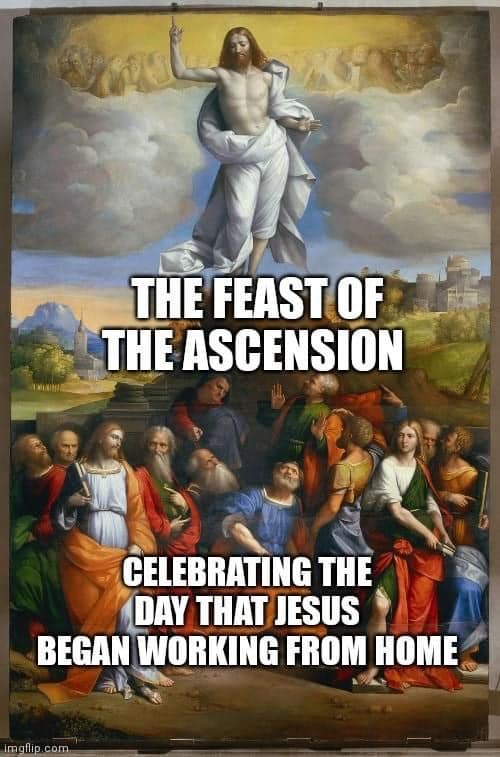
I saw this image on Facebook on Thursday, which was Ascension Day. A classic painting of Jesus ascending above the bewildered disciples has had a caption added:

The Feast of the Ascension: celebrating the day that Jesus began working from home.

I rather liked that. I wondered whether devout Catholic politician Jacob Rees-Mogg might ponder it the next time he leaves snarky notes on the office desks of civil servants who are working from home.

What do we make of the Ascension? When I try to explain the event to congregations, I usually suggest it is what John Calvin called one of God’s accommodations to us. He rose into the sky to get the message through to disciples who thought heaven was ‘up there’. Although Professor Tom Wright now says that the Jewish concept of heaven was that it was an invisible realm next door to this life and therefore the crucial part of the story is that Jesus disappears from sight.

But be that as it may, what does the Ascension mean for us? I’m going to divide that into two halves.

Firstly, it’s about the finished work of Jesus.

Hebrews 4:14 tells us that Jesus ‘has ascended into heaven.’ But what does he do there?

Two other parts of Hebrews tell us something that this section doesn’t, and they both use the same expression. In both chapter 10 and chapter 12 we read, ‘He sat down.’

It’s like he gets to heaven, he goes in the front door, finds the sofa in the living room, and takes the weight off his feet. Job done. Now he can rest.

In other words, the Ascension tells us that Jesus had completed all he was sent to Earth to do. Through his life, teaching, miracles, death, and resurrection he has achieved his goal. Salvation has been won. It is available to all. The task is being passed to the disciples and any day now the Holy Spirit will equip them for that.

Compare it if you will to the account of the crucifixion in the Gospel according to John. As he is about to die, Jesus cries out, ‘It is finished!’ (John 19:30) When he said ‘It is finished’ he didn’t mean, it’s all over, and my mission has failed, but the very opposite. For the Greek word that English Bibles translate as ‘finished’ means ‘finished’ in the sense of ‘accomplished’. Jesus is saying, ‘Mission accomplished!’ and the Ascension confirms that.

Jesus has done everything we need for salvation. The Cross is sufficient, the Resurrection proclaims it, and the Ascension ratifies it. To come into a relationship with the living God and to live as a disciple of Jesus requires only what he has done for us. At the Cross, the guilt we carry and the sentence we deserve for our sins are taken away and laid on Jesus. At the Cross, evil forces are conquered not by violence but by the suffering love of God in Christ. At the Cross we are set free.

It has all been done. Finished. Mission accomplished.

So one thing we must not do is attempt to add to what Jesus has done. Sometimes when we feel particularly guilty we think we have to do something as an act of penance to earn the favour of God. But as Martin Luther discovered when he studied the New Testament more fully than he had been taught as an Augustinian monk, the word is not ‘penance’ but ‘repentance’. And even then we do that in response to what Jesus is offering us.

Similarly, some people think they have to live a good life in order to win God’s favour. This is at heart an act of pride: ‘I did it myself’ – or even worse, in the words of the dreadful song, ‘I did it my way.’ But the fact that Jesus has done it all is meant to humble us. We cannot save ourselves. That’s the point. Everyone must come to that realisation, whether they are of high rank or low in human society, that we come in humility to Jesus and depend entirely on him for salvation.

On this day when we celebrate Jesus sitting down at the right hand of the Father, I want us all to realise afresh that our relationship with Christ is described in the words of the hymn:

Nothing in my hand I bring
Simply to thy Cross I cling.

What is faith then? It is not stretching out our hands to offer God something from our lives that we think or hope might make us acceptable to him. Instead, it is an opening out of our empty hands to be filled with all that Jesus has to give us from what he has done for us at the Cross.

John Wesley knew this. Last Tuesday was the anniversary of his conversion at Aldersgate Street, when he found that the assurance of God’s love simply came directly to him from God, not from all the labours to which he had devoted himself up until then.

Therefore, if you are ever the kind of person who says of yourself, ‘I’m trying to be a Christian,’ I want to ask you to put that language to bed from today. Either you are a Christian, or you are not. Being a Christian isn’t a boast, it isn’t a matter of personal superiority. It’s a matter of holding out those empty to hands to receive the finished work of Christ.

Secondly, the Ascension is about the unfinished work of Jesus.

Wait a minute Dave, you’ve just been at pains to say that Jesus finished his work. How can you now say his work is unfinished?

Glad you asked. And I hope this is provocative enough to keep you listening. One part of his work is finished, the work I’ve just been describing, to make salvation an offer to all.

But another part of his work is unfinished. And it’s described in our reading. Hebrews calls Jesus our ‘high priest.’ What does a priest do? A priest offers sacrifices for the people – but we’ve covered that in my first point about the finished work of Jesus in speaking about his death. Jesus our high priest offered himself as our sacrifice.

But a priest does something else for the people. A priest prays for them. This is something that Hebrews will refer to three chapters after our reading:

Therefore he is able to save completely those who come to God through him, because he always lives to intercede for them. (Hebrews 7:25)

Two circuits ago, and elderly Local Preacher prayed for me every day. But he died. My parents also prayed daily for me. But they have both died while I have been here.

However, I am not short on the most powerful prayer for me in my need, because Jesus intercedes for me. And he does the same for each of you. Be encouraged! This is his priestly work.

And furthermore, he understands, because as our reading says,

15 For we do not have a high priest who is unable to feel sympathy for our weaknesses, but we have one who has been tempted in every way, just as we are – yet he did not sin. 16 Let us then approach God’s throne of grace with confidence, so that we may receive mercy and find grace to help us in our time of need.

Don’t you find that encouraging, too? I often tell mourners at a funeral that when I am going through a bad time in my life I don’t necessarily find it helpful to have well-meaning Christians come up to me and tell me exactly what they believe about why God has allowed this. I want to lay my hands on such people – but not in the sense of healing!

The people I find most supportive when I am walking through troubles are those who have been there themselves. They understand.

One of my favourite examples of this is that about five years before I met Debbie I had a broken engagement – or, as my sister called it, a narrow escape. One day when I was grieving the break-up of my relationship, two friends called Sue and Kate turned up on the doorstep.

‘We’ve come to take you out for a pub lunch,’ they said.

I don’t remember the food from that meal. What I remember is how both Sue and Kate shared about broken engagements they had been through. They understood. They could support me.

Because Jesus has been through human weakness and faced temptation, he can do all that and more.

If you are facing sorrow or crisis right now, I encourage you to re-read the Gospels. Look for the stories where Jesus too goes through the ringer. Then recall that because he has been there too, he understands what you are facing, and can pray like no-one else to the Father for you.

This is how our ascended Lord spends much of his time. This is his unfinished work. It will continue until he appears again in glory, to judge the living and the dead, and to take us to our eternal home.

In conclusion, I’ve always been disappointed how Methodist churches treat the Ascension as a minor festival or even as a non-existent one. It is so important. It has much to teach us and encourage us.

I hope we will all leave today rejoicing in the finished work of Christ, who has sat down at the right hand of the Father, having completed everything necessary for our salvation.

And I hope we will also all leave today encouraged by the high priestly work of Christ who identifies with us and intercedes for us – his unfinished work.

May both of these great truths be strong foundations for our worship and our witness.

Transfigured Jesus, Transfigured Lives (Mark 9:2-9): Worship for the Last Sunday Before Lent (Transfiguration SundaY)

This is the last of our Epiphany/Ordinary Time themes before Lent kicks off on Wednesday. I shall then be following the series ‘Worship in the Wilderness‘ from Engage Worship throughout Lent. If you want to follow that devotionally, you can buy a book to go along with it.

Mark 9:2-9

Our set reading from Mark’s Gospel takes quite a leap this week from last week. For the last few weeks we’ve been in the beginning of the first half of Mark, looking at the early ministry of Jesus.

But this week we jump to the beginning of the second half of Mark’s Gospel. Just before this reading, the first half has come to a climax with Simon Peter confessing that Jesus is the Christ. However, his understanding of that proves to be deficient, when he reacts adversely to Jesus’ first prophecy of his forthcoming suffering and death.

Peter has the right words, the right creed if you like, but not the right understanding. He appears not to be alone, because Jesus teaches the whole crowd about his suffering and also the suffering that his followers will face.

Then he prophesies that some of those present will not taste death until they have seen the kingdom of God come with power (verse 1).

I go into this detail, because Mark clearly links today’s story with that episode in his opening words: ‘After six days’ (verse 2). If Peter and any other disciples cannot understand the link between who Jesus is and how his mission will be carried out through words and arguments, then the experience of a dramatic divine encounter may do the trick.

As a scholar named James Edwards writes,

In Peter’s confession Mark teaches how disciples should think about Jesus (8:33), and in the subsequent transfiguration narrative he allows them to behold his true nature.[i]

If theological argument won’t work, then perhaps experience will.

Firstly, the Transfiguration is a story of divine revelation. Mountains were often places in the Bible where God said or did something special, and all the more if – like this one – it was described as a ‘high mountain’ (verse 2). Specifically, this account is reminiscent of Moses going up Mount Sinai to meet with God and receive the Law. Even the six-day gap between this story and the previous one may echo the six days Moses spent at Mount Sinai with God.

All this, then, should prepare Peter, James, and John for a word of revelation from God. Frightened as we know later on they are (verse 6) – and no surprise at that – the clues are there for them as devout Jews to recognise that they should prepare for a revelation from heaven itself.

Sometimes I wonder how prepared we are to hear from God. Is it because we bumble along from the day to day without tuning ourselves in that we rarely hear from him? Is it that so often God has to interrupt our daily routines in an attempt to catch our ears? Might it be that we could tune ourselves in, ready for when he wants to reveal something to us?

This is why I bang on from time to time about our use of the spiritual disciplines, such as personal Bible reading and prayer. These practices get us used to the voice of God. That voice will not always speak something big and dramatic as in today’s story, but as a baby learns soon to recognise its parents’ voices, so we need to do the same with God. The more we practise the spiritual disciplines, and the more we look and listen for the signs of his presence in our routine duties.

Secondly, the Transfiguration is an account of divine glory.

2b There he was transfigured before them. 3 His clothes became dazzling white, whiter than anyone in the world could bleach them.

Think back to Christmas for a moment. Maybe not this last Christmas specifically, but the Christmas season generally.

Specifically, think back to singing ‘Hark! The herald-angels sing’ and that line, ‘Veiled in flesh the Godhead see.’ God coming in human flesh meant that we were shielded from the dazzling brilliance of God’s glory. It is almost too much to bear, rather like the way we warn children not to gaze directly at the Sun.

But here at the Mount of Transfiguration, all the layers that protect sinful humanity from encountering the divine glory are stripped away.

Despite the faltering description, v. 3 succeeds in conveying that the transfiguration is so complete that Jesus’ clothing as well as his person is transformed. …

The diaphanous garments and brilliant face of Jesus signify total transformation and suffusion with the divine presence.[ii]

Jesus reflects the presence of God every bit as much as Moses did on Mount Sinai, if not more so. God hasn’t spoken his revelation yet, but he is showing up.

So again, Peter, James, and John are being called to attention. What they find themselves in counts. It’s important.

Not every Christian has dramatic experiences of God, but most of us would talk about times in our lives when God has seemed especially close. Sometimes those seasons of closeness and almost tangible presence are there to comfort or reassure us through a hard time, but on many other occasions, like the Transfiguration, God is not simply wanting to give us a spiritual thrill, he is wanting to transform us more into people who reflect his glory.

I simply want to ask whether we are open to that.

Thirdly, the Transfiguration is a narrative of divine supremacy, and specifically of Jesus’ supremacy.

4 And there appeared before them Elijah and Moses, who were talking with Jesus.

Why Elijah and Moses? There have been various theories, but the important thing is this: the way this is worded originally gives an indication that they are not equals with Jesus: ‘they hold an audience with Jesus as a superior.’[iii] They appear and they disappear. There is no command to listen to them. They are ‘representatives of the prophetic tradition that, according to the belief of the early church, would anticipate Jesus.’[iv]

Jesus is superior to both of them. Their lives and ministries pointed ultimately to the fulfilment of God’s plans in Jesus. And Jesus is not merely a prophet, as religions like Islam would have you believe.

Jesus is more than our Friend and our Brother. He is more than the celestial lover that some hymns and worship songs portray. He is more even than Saviour. He is Lord.

Peter, James, and John here are learning that Jesus isn’t just a wonderful rabbi. He’s even more than Israel’s promised deliverer. They owe him their allegiance.

And so do we.

Fourthly, the Transfiguration speaks to us of divine presence.

5 Peter said to Jesus, ‘Rabbi, it is good for us to be here. Let us put up three shelters – one for you, one for Moses and one for Elijah.’ 6 (He did not know what to say, they were so frightened.)

Poor Peter. He and his friends are scared out of their wits. What comes out of his mouth is something that would be worthy of a typical pious Jew. He wants to build shelters, or tabernacles, and the Jews looked forward to a time when God would build a new tabernacle or dwelling for his presence on earth to replace the old one that Israel had had in the wilderness.[v]

But what he doesn’t yet grasp is that the new tabernacle is here already. Jesus is the new tabernacle. He is the presence of God on earth.

So Jesus is more than one who is ranked higher in God’s ranks than Elijah and Moses. He is the presence of God on earth. That is enough to blow the fuses in the mind of a devout Jew. It is why many learned Jews rejected Jesus.

But when you meet Jesus, you meet God. Later Christians would look at all the biblical data and formulate the doctrine of the Trinity, but here is one major sign of how Jesus expanded and exploded traditional Jewish beliefs about one God, the chosen people, and the messianic hope.[vi]

Jesus, being God who came in human flesh to earth, is the climax of God’s plans. And as such, we see everything through the light of him. We interpret our hopes and dreams in the light of Jesus. We interpret the Scriptures in the light of Jesus. We frame our very lives in the light of Jesus.

When we realise that God has been present on earth through Jesus and that he is still present through his Spirit, how does that change the way we live?

Because it should.

Fifthly and finally, the Transfiguration speaks to us of divine vindication.

7 Then a cloud appeared and covered them, and a voice came from the cloud: ‘This is my Son, whom I love. Listen to him!’

8 Suddenly, when they looked around, they no longer saw anyone with them except Jesus.

You may recall that a voice from heaven spoke to Jesus in similar terms at his baptism: ‘You are my beloved Son, I am well pleased with you.’ Here, the words are similar, but they are not addressed to Jesus. Instead, God the Father speaks to Peter, James, and John: ‘This is my Son, whom I love. Listen to him!’

They were to listen to all that Jesus had told them. Doubtless – and most importantly – that referred to his prophecies of his coming suffering and resurrection, which had offended Peter so much.

No: the voice from heaven tells the disciples that what Jesus has said is right and true. You must take it on board, even if you don’t understand it.

When we make Jesus out to sound so much like us, with similar views to us, similar ethical standpoints, similar political views, and so on, then we no longer have Jesus, we have an idol. Jesus will always say and so things that go against the things we cherish. But because of his divine nature, we are the ones who need to change.

And here, that’s just what the Father expects of Peter, James, and John. Put aside your objections to the Cross. Put aside your assumptions that you know better.

And that’s a very fitting place for us to end this week’s reflection, especially as we prepare to enter Lent on Wednesday. The Transfiguration calls us to a life where we increasingly conform our will and our ways the will and the ways of Jesus, who has the right to do this, as God who came to Earth. And whose journey to Earth led to the Cross.

We start that journey again now, and as we go into Lent.


[i] James R Edwards, The Gospel According To Mark, p261.

[ii] Edwards, p263, p264.

[iii] Edwards, p265.

[iv] Edwards, p265.

[v] Edwards, p266.

[vi] ‘Monotheism, election, and eschatology’ in NT Wright’s words.

Sermon: The Sheep And The Goats Revisited

There is no video version of the sermon this week, and probably no more video before Christmas. I’ve begun a series that uses some copyright material I’ve bought but I think I would infringe that copyright if I shared it here.

So it’s back to the old ways and a text-only version of the sermon this weekend.

I might be able to separate out my talk and just post that part of the video, I’m not sure (I’ll need to check what my WordPress account allows.) But I can’t do that this week, as I’d deleted that video before thinking of that possibility!

Anyway – here is what I hope to be a fresh take on Jesus’s story about the sheep and the goats.

Matthew 25:31-46

This is one of those passages where we think we know what it means, but the popularly accepted meaning is a bit off-kilter.

We’re used to hearing that this is about how at the end of time Jesus will judge everyone on the basis of their treatment of those in need, and that this is important because Jesus is present in every human being.

Unfortunately, there are a lot of misconceptions in that summary, and the popular interpretation needs a fair bit of tweaking.

I’m not about to say that we’re going to be let off treating the poor and the suffering with dignity – nothing of the sort! – but just as your car may need tuning up and cleaning at its MOT and annual service, so there are some things to clear away and see better in this story.[i]

Firstly, let’s not call this a parable. This isn’t the most important point I’m going to make, but just to clear this up at the outset: we often call this ‘the parable of the sheep and the goats’, but there is no parable language here. Jesus’ characteristic expression, ‘The kingdom of God/heaven is like …’ is absent. There is nothing ambiguous here about the meaning. The meaning is not hidden from the hearers.

Some writers have called this a ‘vision’. What we can be sure of is it’s not a parable. For simplicity, I’ll call it a ‘story’.

Secondly, when is this happening? We are used to saying that this is a scene of the Last Judgment. It’s certainly true that this leads to eternal consequences, for the story ends with the goats going away to eternal punishment and the sheep to eternal life (verse 46).

However, we also need to pay attention to the beginning of the story:

When the Son of Man comes in his glory, and all the angels with him, he will sit on his glorious throne. (Verse 31)

We have assumed that this means the Son of Man (Jesus) coming again. But this is language based on Daniel 7 where the exalted Son of Man comes not to earth but to the Ancient of Days (Almighty God). It is language not about the Second Coming but the Ascension. Jesus is already reigning from heaven.

You may think that is just a technicality, but it has an important application. Yes, there are eternal consequences to people’s actions, but know that even at this moment Jesus is watching and judging. The Last Judgment is merely the climax of the judging Jesus is doing even now.

So that means – well, what specifically? Hang on while we clean up a few more parts of the story, and eventually we’ll have a fuller picture.

Thirdly, who is being judged?

All the nations will be gathered before him (verse 32a)

We assume from an expression like ‘all the nations’ that this means everybody. This is how everyone will be judged.

But not so fast. ‘The nations’, or ta ethne in the Greek, is a technical expression. The Greek translates from Hebrew the way in which Jews talked about everyone who was not part of Israel. It’s close to saying, ‘The Gentiles.’

That would mean that here we have in view how Jesus will judge those who are not part of the People of God. And when we put that in the context of Jesus’ whole teaching, it would mean not so much ‘The Gentiles’, that is, all non-Jews, but rather, those who are not a part of his reconstituted Israel, namely, his disciples.

If that is true, then this story is about how Jesus judges those who are not his disciples.

How is he going to judge them? Let’s keep going, and things will become clearer.

Fourthly, who are ‘The least of these brothers and sisters of mine’? We have commonly taken ‘The least of these’ to mean all the global poor and suffering.

But that is to wrench these words out of the context of Matthew’s Gospel. For this is an expression Jesus uses more than once to refer to his disciples. He expects that his followers will end up as hungry, thirsty, strangers, naked, ill, and imprisoned. He has a lot to say about the cost of discipleship.

If you doubt that, come back from here, which is the climax of the fifth and final teaching block in Matthew’s Gospel, to the beginning of the first teaching block, namely the Sermon on the Mount. There, where Jesus addresses his disciples, he describes them in the Beatitudes as poor in spirit, mourning, meek, hungering and thirsting for righteousness, merciful, pure in heart, peacemakers, and persecuted. (Matthew 5:1-12)

The way of Jesus is not easy. It has a price.

Hence, when Jesus says to the sheep,

Truly I tell you, whatever you did for one of the least of these brothers and sisters of mine, you did for me. (verse 40)

he is saying, ‘you did this to my people’. That’s what ‘you did for me’ means – not that Jesus lives in all human beings, but that he is with his people.

So the nations here are being judged by how they treat the disciples of Jesus.

It’s consistent with what Jesus says elsewhere in Matthew’s Gospel:

And if anyone gives even a cup of cold water to one of these little ones who is my disciple, truly I tell you, that person will certainly not lose their reward. (Matthew 10:42)

Of course, it all rather assumes that we Christians are actually living as disciples of Jesus, proclaiming the kingdom of God, calling people to repentance, ministering to the sick, the demonised, the poor, and so on. The nations are being judged on how they respond when they see the People of Jesus living like that.

This is not about whether the Church is accorded political privilege. It is not about Western Christians rushing to scream ‘Persecution!’ the moment we don’t get our way. Nor is it about the world legitimately criticising the Church when she has done wrong, such as with child-abusing clergy and officers.

The point is: when Christians act like Christ, how do the nations respond? Because Jesus is watching and judging.

Right, I think we’ve tuned up our understanding of the passage now. Where does this leave us?

We have a picture where the Last Judgment has begun, even now. Jesus is watching and judging from his heavenly throne. What people do now will seal their fate for eternity.

The story emphasises how he is watching those outside his disciples for how those nations treat his followers. Perhaps these include those who – despite, perhaps encountering Christians – never really hear the good news. They will be judged on the light they have received, seen in how they respond the disciples of Jesus.

We can be sure that Jesus is watching as China under President Xi arrests and unjustly imprisons Christians. He is doing the same as North Korea persecutes and often kills Christians. He is watching as the Iranian regime locks up Christians, and as Christians in Pakistan are subjected to spurious charges of blasphemy against Islam, while Imran Khan’s government does nothing. However much these nations get away with their violence now, Jesus is sealing eternal judgment for them at this very moment, if they do not repent.

But Jesus is also blessing those who stand up for his people, especially the suffering church. And on this front, it is worth us praying and campaigning that Boris Johnson will replace Rehman Chishti MP, who resigned as his Special Envoy on Freedom of Religion or Belief in September. So far, there is no known movement. Under Theresa May’s premiership, her Foreign Secretary Jeremy Hunt received the Mountstephen Report on the persecution of Christians and started to act on it. How will Jesus judge our nation?

All that said, although there is a specific focus of this story, that doesn’t mean I’m saying Christians don’t have to care for the poor. There are plenty of Bible passages to make it clear that’s a priority for us. What I’m saying today isn’t a ‘Get out of jail free’ card on that one.

In our case, Jesus calls us into his kingdom through repentance and faith in him, based on his work at the Cross. Then, having received his free grace, we respond in gratitude by aligning our lives more closely with his kingdom. And that includes our care for the poor, the sick, the hungry, the thirsty, and the imprisoned.

So even as we learn that Jesus has a way of judging those who are not part of his people, it is also worth us reflecting on whether we are showing our gratitude for the love of Christ by living in his kingdom ways, giving prime concern to the last and the least.


[i] My sources this week include Michael Green, Matthew For Today; Tom Wright, Matthew For Everyone Volume 2; G R Beasley-Murray, Jesus and the Kingdom of God; Ian Paul, The ‘parable’ of the sheep and the goats in Matthew 25.

Sermon: Baptised Into Freedom (The Baptism Of Jesus)

The Advent and Christmas rush means I’ve missed posting several sermons lately. Hopefully, I’ll post them soon, even though they will be rather ‘after the event’. At least they will be present here then nearer next December for those who search this blog and others for relevant sermons.

In the meantime, here is a sermon for this coming Sunday, when we mark the baptism of Jesus.

Mark 1:4-11

Baptism of Christ
Baptism Of Christ 10 by Waiting For The Word on Flickr. Some rights reserved.

If you follow the movies, you may have noticed that in recent months Hollywood has had a bit of a religious obsession. Much of it has been poor, or at least contentious. God’s Not Dead caricatured atheists, Left Behind took up some dubious fundamentalist theories of the end times based on a questionable series of Christian pulp fiction novels, and Noah divided opinion.

Now Ridley Scott’s Exodus: Gods And Kings has caused a stir. Not just because any such film is bound to provoke polarised opinions (and that’s just in the church!), but because Scott engaged famous white actors to play dark-skinned Egyptians so as to generate box office income. And that’s before we get to the controversies about whether the script took liberties with history and scholarship.

But Hollywood hasn’t usually worried too much about the choice between truth and a juicy story. Coming from a family where my grandmother was a friend of Gladys Aylward, I am only too aware how furious Aylward was with the fictional romance that was invented for the film about her life, The Inn Of The Sixth Happiness (never mind the dubious morals of Ingrid Bergman, who portrayed her).

Let me come back to Exodus, though. Because Mark’s account of John baptising people, including Jesus, has Exodus themes in it. I’ve said before in sermons that the Jewish people of Jesus’ day commonly regarded themselves as being in a kind of exile, even though they lived in their own Promised Land, because they were occupied by Rome. So they longed for freedom. And as well as a theme that was like the liberation from Babylon, the Gospels also contain the imagery of freedom from their original place of captivity, Egypt. The Good News that Mark is beginning to tell is couched at the beginning in Exodus language.

Our problem is that we are so used to hearing these stories in the light of more recent Christian debates and themes that we miss this. Perhaps we hear the baptism stories and start thinking about what we believe about baptism. Is it for infants, or is it for committed disciples?

But we need to return to the Exodus theme. ‘Exodus’ is a Greek word. It is usually taken to mean ‘departure’, and so the second book of the Old Testament narrates the departure from Egypt. ‘Exodus’ as a word is a compound of two other words – ‘ek’, meaning ‘out of’, and ‘hodos’, meaning ‘road’ or ‘way’. This is the road or way you take out of somewhere. It is the escape route that you follow. And so an Exodus theme is a freedom theme. It is about liberation and liberty. I want to explore the baptism of Jesus, then, and its implications for us, under this theme of ‘freedom’.

Firstly, the baptism itself. It’s implicit in Mark what is made more obvious in other Gospel writers, namely that John’s baptism is a baptism of repentance. Mark simply notes,

Confessing their sins, they were baptised by him in the River Jordan. (Verse 5b)

Exodus
Exodus By Giorgio Raffaelli on Flickr. Some rights reserved.

It’s therefore strange that Jesus embraces John’s baptism. Why does he need to repent? Again, the other Gospel writers are more explicit about this problem, but Mark characteristically keeps his account brief. Jesus certainly identifies with the people. He is the One who will lead people out of slavery – not, in this case, the slavery of Israel in Egypt, but slavery to sin. As the Israelites came through the waters of the Red Sea (or Sea of Reeds) to freedom from Egypt and her powers, so Jesus leads his people through the cleansing waters of baptism to freedom from sin.

This is the good news of Jesus’ baptism: the Messiah has come to lead his people to freedom from sin. It begins with confession and forgiveness, but it becomes a whole pilgrimage from ‘Egypt’ to the ‘Promised Land’, as that initial setting free becomes a journey in which God leads us into freedom not only from the penalty of sin but also into increasing freedom from the practice of sin, until one day, in the New Creation, we shall be free from the presence of sin.

For Jesus, that journey will embrace what our baptism service calls ‘the deep waters of death’. His Red Sea will not only be the waters of the Jordan at John’s baptism, but Calvary and a tomb. But he will rise to new life and ascend to his Promised Land, promising that we will one day go with him at our own resurrection.

This is Good News that says to us, life doesn’t always have to be like this. It doesn’t have to remain a catalogue of remorse and failure. There is hope. We do not have to hate ourselves, because God loves us to the point of offering forgiveness and new life.

Thus begins our transforming journey, in a baptism that calls us out of Egypt and on the road of increasing freedom. It’s worth reminding ourselves of this from time to time.

One person who did that in his life was Martin Luther. He was a man prone to mood swings between elation and darkness. He could be the wittiest person alive, but he could also plumb the depths. But he said that whenever he was most tempted to doubt or to give up, he would remind himself of one fact: ‘I am baptised.’

I am not saying that baptism is some religious magic trick, but I am saying that to remember our baptism is to remember the promises of God to forgive our sins, and the power of God to change us and ultimately all creation, too. It is a sacrament of hope, as well as of beginnings.

Secondly, the Holy Spirit. On the one hand, John promises,

I baptise you with water, but he will baptise you with the Holy Spirit (verse 8)

And on the other, we read,

Just as Jesus was coming up out of the water, he saw heaven being torn open and the Spirit descending on him like a dove. (Verse 10)

Veni Sancte Spiritus
Veni Sancte Spiritus by Fr Lawrence Lew, OP on Flickr. Some rights reserved.

What does this have to do with the Exodus freedom story? It’s about the manner of God’s presence.

I’m sure you will recall that when Israel was being led through the wilderness, it was by a pillar of cloud by day and a pillar of fire by night.

But now, in the New Covenant, God’s people get an upgrade. Not only will the presence of God (cloud and fire) lead them, now that same presence will come upon all of them and dwell within them. For you frequent flyers, they have effectively gone from economy class to business class.

In Jesus’ case, there is something else. The descent of the Spirit upon him shows that he is the Messiah, for Messiah means ‘Anointed One’. He is anointed, not with the oil used to mark an earthly monarch, but with the oil of God, the Holy Spirit.

And if Jesus the Messiah is anointed with the Holy Spirit and we receive the Spirit too, then that confirms our Christian identity – we are to be ‘little Christs’. No, we are not Messiahs, and heaven deliver us from any more people in the Church with Messiah complexes, but the upgrade to the indwelling Spirit equips us for our pilgrimage to freedom. It is the witness of the Holy Spirit that confirms we are forgiven and loved. It is the work of the Holy Spirit to lead us into increasing freedom from the practice of sin, thus making us more Christ-like. (Although we may more modestly feel it’s a case of becoming less un-Christ-like!)

We need not fear the gift of the Holy Spirit. He is the Spirit of freedom. ‘Where the Spirit of the Lord is, there is liberty,’ wrote the Apostle Paul. He brings God’s freedom to us, and empowers us then to be ministers of God’s freedom in the world. Through the Spirit’s work, we offer Christ and his liberating work to those in the chains of sin – the chains of their own sin, and the chains imposed by others upon them.

And not for us the limited distribution of the Holy Spirit in the Old Covenant. Now the Spirit is given not only to a select number of God’s people, he is given to women and men, young and old, privileged and poor – anyone who desires to follow Jesus the Messiah, the leader of freedom.

Those in higher church traditions than us have a liturgical symbol for this in the way the bishop applies anointing oil (‘chrism oil’) to the foreheads of candidates for confirmation. I came to like that tradition when I used to take part in ecumenical confirmation services with Anglicans, and concluded that we were missing out on that symbolism. I can offer something ad hoc, in that I possess a bottle of anointing oil, which has a beautiful smell of frankincense, and some people find it helpful to link the fragrant aroma of the oil with the presence of the Holy Spirit, who brings freedom.

Thirdly, the voice of God. The terrifying thunder from the mountain on the Exodus route now becomes the voice from heaven as Jesus comes up out of the water. Heaven is ‘torn open’, the Spirit descends like a dove (verse 10), and the voice from heaven speaks:

‘You are my Son, whom I love; with you I am well pleased.’ (verse 11)

Door To Heaven
Door To Heaven by Tragopodaros on Flickr. Some rights reserved.

Tom Wright says[1] that we should not see the opening of heaven as like a door ajar in the sky, because heaven in the Bible is rather the dimension of God’s reality that is invisible to us. So instead, this is like an invisible curtain being pulled back so that we see the whole of life in the light of this different reality. And in this case, when heaven opens the curtain into our life, we hear the divine voice that addressed Jesus addressing us, too:  ‘You are my child, whom I love; with you I am well pleased.’

And certainly that is a totally different reality in which to live. Think about God addressing Jesus this way. Mark hasn’t recorded any virtuous acts by Jesus yet at all. His baptism is his first action in this Gospel, and even that is done to him. There is not even a reference to the humility of the Incarnation in Mark. What, then, has Jesus done to earn his Father’s pleasure here? Absolutely nothing. But he hears the voice of unconditional love. God loves him and is pleased with him.

Those of you who are parents, recall those times when you went into your children’s bedrooms at night when they were fast asleep. They might have delighted you that day, or they might have been utter pickles. But still you gazed at them and whispered words about how much you loved them. You had unconditional love for them.

So ask yourself this: is God angry with me, or does he love me? Can I really believe the Good News that God delights in me? This is the liberating news of our New Testament Exodus.

And that is a transforming insight. If God loves us like this, why do we not love ourselves? I don’t mean in a self-centred way. Rather, I mean something that the author Donald Miller has recently written about. In a booklet available online called Start Life Over, he lists five principles towards changing our lives for the better. The second of these is that – strange as it may sound – we are in a relationship with ourselves, so we should make it a healthy one.

What he says is this. To some extent, we all seek the approval of others, but what we don’t notice is how we seek our own approval. It is as if we are two people: one doing the actions of daily life, the other watching those actions in judgement. Miller noticed that a friend whom he deeply admired was always doing respectful things. And he wondered: if I start doing more respectful things, will I respect myself more, and thus change for the better? He writes,

And it worked. I would find myself wanting to eat a half gallon of ice cream while watching television and I asked myself “if you skipped this, would you have a little more respect for yourself?” and the truth is I would. So I skipped it. And I had much more self respect.

I liked myself more.

This sort of thing translated into a whole host of other areas of my life. I started holding my tongue a little more and found I respected myself more when I was more thoughtful in conversation. I found myself less willing to people please because, well, people who people please aren’t as respectable, right? (Page 9)

I suggest to you that this kind of transformation is open to us when we embark on our baptismal journey of freedom, in the power of the Holy Spirit, and hear God’s voice from heaven telling us we are loved unconditionally. It makes change possible.

So often, the way we seek to promote change in ourselves and in others is through threat. We are no carrot and all stick. But all that produces is fear and paralysis. We might see some change, but it is the change wrought by sleeplessness and night terrors, rather than love. Ultimately, it doesn’t achieve much, and it affects us badly as people.

God chooses the way of unconditional love to lead us into freedom.

[1] N T Wright, Mark For Everyone, p5f.

Sermon: Life On The Frontline 5: The Frontline Cry (Kingdom Dreamers)

Whoops. I seem to have forgotten to upload two or three sermons lately. Sorry.

Anyway, here is tomorrow morning’s sermon as I preach again in the Life On The Frontline series at Knaphill Methodist Church.

Matthew 6:9-13 with Isaiah 29:13-24

Heaven
Heaven by Ozan on Flickr. Some rights reserved.

While walking down the street one day a corrupt Senator was tragically hit by a car and died. His soul arrives in heaven and is met by St. Peter at the entrance.

“Welcome to heaven,” says St. Peter. “Before you settle in, it seems there is a problem. We seldom see a high official around these parts, you see, so we’re not sure what to do with you.”

“No problem, just let me in,” says the Senator.

“Well, I’d like to, but I have orders from the higher ups. What we’ll do is have you spend one day in hell and one in heaven. Then you can choose where to spend eternity.”

“Really? I’ve made up my mind. I want to be in heaven,” says the Senator.

“I’m sorry, but we have our rules.”

And with that St. Peter escorts him to the elevator and he goes down, down, down to hell.

The doors open and he finds himself in the middle of a beautiful golf course. In the distance is a clubhouse and standing in front of it are all his friends and other politicians who had worked with him. Everyone is very happy and in evening dress. They run to greet him, shake his hand, and reminisce about the good times they had while getting rich at the expense of the people. They played a friendly game of golf and then dine on lobster, caviar and the finest champagne.

Also present is the devil, who really is a very friendly guy who is having a good time dancing and telling jokes. They are all having such a good time that before the Senator realizes it, it is time to go. Everyone gives him a hearty farewell and waves while the elevator rises.

The elevator goes up, up, up and the door reopens in heaven where St. Peter is waiting for him, “Now it’s time to visit heaven…”

So, twenty-four hours passed with the Senator joining a group of contented souls moving from cloud to cloud, playing the harp and singing. They have a good time and, before he realises it, the twenty-four hours have gone by and St. Peter returns.

“Well, then, you’ve spent a day in hell and another in heaven. Now choose your eternity.”

The Senator reflects for a minute, then he answers: “Well, I would never have said it before, I mean heaven has been delightful, but I think I would be better off in hell.”

So St. Peter escorts him to the elevator and he goes down, down, down to hell…

Now the doors of the elevator open and he’s in the middle of a barren land covered with waste and garbage. He sees all his friends, dressed in rags, picking up the trash and putting it in black bags as more trash falls from above. The devil comes over to him and puts his arm around his shoulders.

“I don’t understand,” stammers the Senator. “Yesterday I was here and there was a golf course and clubhouse, and we ate lobster and caviar, drank champagne, and danced and had a great time. Now there’s just a wasteland full of garbage and my friends look miserable. What happened?”

The devil smiles at him and says, “Yesterday we were campaigning. Today, you voted…”[1]

Now, I find that joke rather delicious as we approach a General Election in six months’ time. But I didn’t tell it for political reasons this morning. I told it, because it assumes the traditional teaching that our destiny for eternity is either heaven or hell.

And that’s a mistake. The New Testament doesn’t teach that.

Really? Did you hear that right? The minister is saying that heaven or hell is not our eternal destiny?

Well, you did hear me correctly, but I still believe in ‘heaven and hell’. It’s just that I believe – as Tom Wright has put it – that ‘heaven is important, but it’s not the end of the world’.

N T Wright
The Rt Revd Tom Wright with new book by Gareth Saunders on Flickr. Some rights reserved

What the New Testament teaches is this: when we die, we rest in either Paradise or Hades. Jesus tells the repentant thief on the cross, ‘Today you will be with me in Paradise.’ In the parable of the rich man and Lazarus, he envisions the evil wealthy man as suffering in Hades, the place of the dead. These are resting places, or waiting rooms, until our final destiny.

And our final destiny is not to float on clouds, plucking harps. The end of all things in the New Testament is God making all things new – the heavens, the earth, and our bodies. God’s kingdom in all its fullness constitutes a whole new creation. That’s why at the Last Day, we shall be raised from the dead physically. The idea that the physical and material doesn’t matter, and all that matters is our ‘soul’ is not originally a Christian idea: it comes from Greek philosophy, and from heresies that the early Church rejected. It’s why C S Lewis said that ‘Christianity is the most material of all religions’.

Now plug all that into the Lord’s Prayer, and especially into the lines

your kingdom come,
your will be done,
on earth as it is in heaven. (Verse 10)

The first line – ‘your kingdom come’ – is explained by what follows – ‘your will be done, on earth as it is in heaven.’ When we pray for God’s kingdom to come, we pray for his will to be done here on this earth, just like it is in heaven, his dwelling-place. We are longing for that kingdom where heaven and earth have been made new, and human bodies made new in resurrection, and where God’s will is done as fully and wholeheartedly as it is in his immediate presence.

So if we want to pray for the coming of God’s kingdom, we do something like this. Knowing what we do of God’s will, we imagine what our world as we know it would look like if people were doing the things that give God pleasure.

That’s effectively what Isaiah does in chapter 29 that we heard read before the Lord’s Prayer. Isaiah imagines the dry land of Lebanon becoming fertile, even like a forest. He imagines deaf people hearing God’s message, and the blind seeing again. He envisions the humble and the needy having cause for great joy, instead of being trampled down by the unjust. In fact, he sees a time when such ruthless people will vanish, when mockers will be no more, and when there will be no more evil people manipulating the justice system to their own twisted ends. He sees shamed people standing in awe of God, and wayward spirits and habitual moaners accepting instruction (verses 17-24). All this imagining becomes a vision for the future, and therefore a captivating image to stimulate prayer, and ask God to bring these things about.

Now let’s plug all this into our lives today, because we can do something similar. And we need to, because one aspect of the poor reputation Christians often have today is that we are a bunch of moaners. We are the people who are only known for the things we are against, the things we complain about. One reason Christian MPs can have a hard time in Parliament is because they and their colleagues are subject to hectoring letters and flame-filled emails.

So – rather than just bewailing all that is wrong with our world (and I wouldn’t deny there is a lot that is at odds with our faith) – why don’t we instead start exercising a prayerful, holy imagination to conceive how we would long the world to be. Rather than railing against the way people use the Internet in negative ways, such as verbally attacking others, or accessing pornography, ask in the presence of God what the Internet would look like if it were used in a pure and kind way. Rather than sitting around as barstool Prime Ministers declaiming against a society that is obsessed with money, possessions, and buying the latest thing, prayerfully consider what our culture would look like if spirituality and relationships were dominating values, and the poor were not all derided as scroungers.

In short, for Christians to pray ‘Your kingdom come, your will be done on earth as it is in heaven’ is to serve notice on the ‘moaning minnies’ version of religion that we often serve up, and commit instead to imagining a better world, praying for it, and working for it in the power of the Holy Spirit. I believe that’s what Jesus wanted of his followers when he taught them the Lord’s Prayer.

And there is a specific application to make in this particular sermon and teaching series that we are following. We’ve been thinking about what we’ve called our ‘frontlines’, those places where we are no longer cossetted among our fellow Christians, but interact with those who don’t share our faith. It may be our workplace, our families, our next-door neighbours, or where we spend our leisure time, from the health club to the U3A.

Crawley U3A poetry group
Crawley U3A poetry group by George Redgrave on Flickr. Some rights reserved.

These locations, too, are often far from what we would ideally like them to be. Much as we enjoy the friendship of others there, these places may be centres of gossip, sharp practice, back-biting, and unjust behaviours. Even if it’s not that bad, they can become mundane and meaningless, and hence the parody of Snow White and the Seven Dwarfs that we sometimes use to describe our paid working life: ‘I owe, I owe, it’s off to work I go.’

So here we choose not simply to carp about the things that annoy us, or stay permanently on a downer about the people who get our backs up. Instead, we employ a holy imagination, and ask ourselves this question: ‘From what I know about Jesus’ teaching, what would this environment look like under the reign of God?’ And then we dream what it would look like.

And having established our ‘kingdom dream’, we then pray it: ‘Your kingdom come, your will be done on earth as it is in heaven.’ Little by little, we shall see signs of transformation as we do so.

Now maybe asking us all to be dreamers – even kingdom of God dreamers – will not go down well in some quarters. Dreamers have a bad reputation. They are detached from reality; they are not practical people. And we have seen worldly dreamers who garner a bad reputation. You only have to think of John Lennon singing, ‘You may think I’m a dreamer’ in his execrable song ‘Imagine’ – a song where he exhorts us to ‘imagine no possessions’, all the while being filmed singing the song in his Ascot mansion. Any dream won’t do.

But kingdom dreams are wonderful things. It isn’t for nothing that the Bible often links dreams with visions. They can give direction. Used prayerfully, they can lead to transformation.

So – er – imagine that you are in Washington DC, and a great crowd has assembled to hear you speak. And as you speak your prepared words, you hear the Gospel singer Mahalia Jackson call to you, “Tell them about the dream!”

And you change your speech on the hoof to tell them about the dream. It won’t fire you for much longer, because soon you will be dead. For Mahalia Jackson actually called out, “Tell them about the dream, Martin,” and you are Martin Luther King, and your speech becomes “I have a dream.” It’s a kingdom of God dream, and it will inspire many to take the torch relay on from you.

This week, then, when you leave the service, I am sending you out to be dreamers. Dream what your frontlines would look like if they were under the kingdom of God, and then pray that God’s will may be done there.

Yes – dream sweet dreams. And change the world.


[1] From the Grove Books weekly email, 10th November 2014.

Sermon: Accepting Conflict

We begin a new sermon series to cover the next three months this Sunday at Knaphill, and as you’ll see from the introduction, it’s on conflict and is loosely based on some Mennonite values.

Conflict
Conflict by Marina Noordegraaf on Flickr. Some rights reserved.

Romans 14:1-15:7

One of the things I’m pleased that today’s ministerial students are trained in that I wasn’t is in handling conflict. You would think that a college training ministers would include that one, knowing the level of disagreement and outright argument that happens in churches, but it didn’t happen in my time. It’s all very well coming up with pious desires that there should be no conflict in the church, but the reality is that it does happen and it needs addressing. The New Testament calls Christians to be of one mind and purpose, but we clash because we have different interests, different perspectives, different gifts, different personalities … and because, frankly, we are all sinners.

That’s why we are going to spend quite a while examining the theme of conflict. We might like to pretend it doesn’t happen here, but it does. We might think it shouldn’t occur, but it still does. And having had the privilege last September of going away on a week’s training course with an organisation called Bridge Builders that specialises in ‘conflict transformation’, I am using some material from them as the basis for this series. Explicitly, the material for this series comes from a group of Mennonite Christians – a tradition that specialises in peace and reconciliation. It is centred on a group of twelve commitments they made in their understanding of conflict and faith.

We begin with this week with the need to accept conflict. And we take this chunk from Paul’s Letter to the Romans, which describes, in Tom Wright’s words,

‘the mutual welcome which … is the concrete, bodily form which ‘forgiveness’ is supposed to take in the present time.’[1]

In other words, this is what the forgiven life in the family of God looks like. It is very much about what we do to avoid unnecessary conflict. We accept that conflict happens, because we are different and fallible human beings, but it is possible in the church to major on minors, and Paul gives us principles to hold us together in the face of our real differences.

Firstly, Paul calls us to accept one another:

Accept the one whose faith is weak, without quarrelling over disputable matters. (14:1)

He gives two examples of conflict, one about food and one about holy days. Carnivores such as me might be amused to read of him saying that those who only eat vegetables have weak faith (14:2), but this is not a dispute about vegetarianism. It is about a debate that ran not just in Rome among the Christians, but also among the disciples at Corinth. It was about a prevalent issue of that time: meat sacrificed to idols. Generally, the meat you bought in the market had already been offered as a sacrifice at a pagan temple. Some Christians felt ‘strong’ about this and said, “It’s all right, the idols are really nothing at all, so although I wouldn’t worship them, there is nothing to worry about here, I’ll eat the meat.” But others said, “There are demons behind the idols at the pagan temples. I want nothing to do with that, so I will not eat meat.” Both in their way are respectable Christian approaches to the problem. Both reflect the desire to serve the Lord, as Paul goes on to observe (14:3-4, 6b-9).

And if that is the case, the different sides had no business in showing contempt for, or looking down upon, those they disagreed with. Whether to eat meat or to abstain, all sides were servants of Christ. Anything that elevates itself over the common commitment to serving Jesus Christ and divides us off from each other in doing that is not the work of God, but of the enemy.

Perhaps it’s easier to understand in our context when we look at Paul’s other example here, where some keep a calendar of holy days, and others treat all days as the same. It’s like those who keep saints’ days, all the Christian festivals, and follow the Lectionary on the one hand, and those who find none of that helpful. At the more extreme ends, it’s like holding Catholics and Baptists together, but you don’t have to go as far apart as that. Methodist to Baptist would do. Indeed, before she met me, Debbie didn’t even know what Lent was, because it was never marked in her home church. But would it be right for us to unchurch them or them to unchurch us? Of course not! It’s therefore wonderful to live in a village where the Baptists, Methodists, Anglicans and Catholics can run an Alpha Course together.

None of this is to downplay our differences, or our varying convictions. Differences exist, even within our traditions. So we as a church where many people expressed a preference for sermon series as part of Christian teaching find that one or two preachers in the circuit prefer to do all their preaching from the Lectionary. We have good reason for what we do, and they have good reason for their preference. It means it is hard to work in partnership, but we should by no means despise each other.

And just as that is true across churches, it needs to be true within churches. We need to commit to a level of acceptance of each other, whilst respecting our differences.

Secondly, and following on from this as the other side of the coin, Paul calls us not to judge one another. We are well advised not to judge others (14:13), because we shall be judged by God (14:10-12). I take that to mean a couple of things: one is that we should leave all judgement to God. The other is: what will God think of us if we have spent our time ripping other people to shreds?

But rather than just seeing the call not to judge our brothers and sisters as a mere negative command, what can we positively do instead of being judgemental? Paul has some ideas.

One is this: to encourage those we disagree with, we can choose to forgo our own rights. The meat-eater should not eat meat and upset those who struggle with meat that has been offered to idols, Paul says. That isn’t love (14:13-16). I do not have to spend all my time demanding my rights when the exercise of them will become a stumbling-block to others (14:13). I am persuaded that it is all right for Christians to drink alcohol in moderation, but I will not condemn those who disagree. I will not bring a bottle of wine with me to your house if you invite us for a meal. For the sake of Christian love, I will happily put aside my enjoyment of wine. On a corporate level, that’s one reason why I’m happy with the Methodist position that we use non-alcoholic wine at Holy Communion. Our first positive step in avoiding judgmentalism, then, is to remove stumbling blocks.

Our second strategy to counter judgmentalism is to set out to edify others:

Let us therefore make every effort to do what leads to peace and to mutual edification. (14:19)

Edification is the construction of an edifice. It is ‘building up’. Paul calls us to build up, rather than to tear down, which is what judgmentalism does. Perhaps we know that there is someone in the church with whom we have a problem. There is something about them that winds us up. We find ourselves thinking all sorts of unworthy thoughts about them. We may even share some of these with our friends – and may not even realise that we have been overheard. Could you set out to affirm that person, even bless them, instead?

An example of what I mean: when one of my cousins was going out with the young woman whom he eventually was to marry, his future mother-in-law made it plain to him that he wasn’t good enough for her girl. You can imagine what this did to my cousin.

But then he took a transforming decision. He vowed that every time he left his girlfriend’s house, he would say ‘God bless you’ to her mother. At first, he said it through gritted teeth. However, in time, the relationship thawed and became warm. It all happened because he chose to bless.

So I want to challenge everyone here this morning. Is there a person you despise? Is it someone in this church? Will you commit to blessing that person instead? Edification instead of judgmentalism makes all the difference in conflict. You still may not agree with that person. But that does not stop you blessing them.

Thirdly and finally in this approach to conflict, Paul’s word to us is that we should seek to please our neighbours, not ourselves, because this builds them up and follows the example of Christ, who did not set out to please himself (15:2-3).

By ‘neighbours’ Paul still has in mind the people we disagree with – those who eat meat sacrificed to idols versus those who don’t, those who very liturgical versus those who are more extempore in their faith. Our neighbours here are not those who are like us, but those in the family of God who are not like us. If our neighbours were the people who thought like us, then pleasing them would be easy. But instead, Paul lays down a challenge – seek to please those people with whom you are at odds.

Indeed, it is countercultural. We are taught, especially by advertisers, that it is good to please ourselves. ‘Go on, you deserve it,’ they say. ‘Because I’m worth it,’ said the infamous L’Oreal advert. But Christians are to please others, even and especially those they are in conflict with, those where they are risking a major fall-out.

What does this look like? Here’s another story. I once had a barney with a fellow minister. He announced an initiative which involved coming into the area where one of my churches was, and he didn’t consult me or the other church leaders in the area. I sent him a rather angry email, complaining that he hadn’t listened to the existing local Christians in that town. We would have welcomed his church as partners in evangelism, but were upset that they were coming in as if there were no disciples of Jesus already there. It had the potential to be a damaging row.

Yet however much we were upset with each other, we both wanted to put it right. He contacted me and invited me out to lunch at a nice hotel. He insisted on paying the bill. I turned up with a box of chocolates for him and his wife and children. We managed to talk through our conflict, understand each other, and find a peaceable way forward, because we both entered into that lunch meeting with a desire for the other person’s good.

What difference would it make when we disagree at this church if we were to set our arguments within a context of actively wanting the best for our opponent? I think the conflict would be transformed. I think the potential for resolution and reconciliation would increase hugely.

In fact, more than that: Paul says that when we bring this attitude to our differences, we bring praise and glory to God (15:6-7).

So let us accept that conflict exists and happens. Let us not cling onto forlorn hopes that we shall never experience it in the church. But let us approach our so-called opponents in such a spirit of acceptance, a rejection of judgmentalism in favour of edification, and a true desire to please those who antagonise us that a miracle of reconciliation happens, even if neither party manages to convince the other.

Yes, let even the way we handle our conflicts be a witness to God’s reconciling love in Jesus Christ. And may God receive all the praise and the glory.

Create a website or blog at WordPress.com

Up ↑