Keeping The Wrong Company, Luke 15:1-10 (Ordinary 24 Year C)

Luke 15:1-10

Back in prehistoric times when I was training for the ministry, one of our tutors told us that we should be at our desks every morning at 9 am with our shoes on. I’m sure I wore out some carpet by wearing shoes rather than slippers in my first manse.

I used to follow that pattern at first. But in one appointment, I was rarely (if ever) at my desk at 9 am. For at this point, we had young children going first through pre-school and then on to primary school. These were at the top of our road, and Debbie and I made a point of building relationships with the other parents.

We didn’t always make it back by the sacred hour of 9 am, and sometimes there would be phone messages from church members who had an expectation of me being there for them at that time.

Christ and a Pharisee. Wikimedia Commons CC 1.0

I think of those church members when I read about the Pharisees and teachers of the law in today’s reading. They thought I was mixing with the wrong people, because to them I was their private chaplain, just as the religious leaders thought Jesus was mixing with the wrong sorts, and that this reflected badly on his character. Their attitude was rather like the saying that you know a person by the company they keep.

Yet it was Jesus’ vocation to be with ‘tax collectors and sinners’. He uses the two parables we heard (plus what follows – the Parable of the Prodigal Son) to lay out why this was so important.

And if it were important for Jesus, it is also important for us. If we are to renew our commitment to following him, then we need to understand why he did this, and then get on with doing it ourselves.

Now the parables have a lot in common. They both (all) speak about finding what is lost and rejoicing. Bringing, or bringing back those who are lost from the love of Jesus into that love and into his family is a high priority for Jesus.

It is not always a high priority for us. We like to run our Sunday services, have a few nice midweek activities, make sure there’s enough money in the kitty to keep the building in good order, and that’s quite enough.

But not for Jesus. Each of these parables has something important to tell us about why he spends so much time outside the synagogue with ordinary (and even disreputable) people for the sake of God’s kingdom. So let’s look at what we pick up from the Parable of the Lost Sheep and the Parable of the Lost Coin.

Firstly, the lost sheep

As you know, we were proud as anything a couple of months ago when our son graduated with a Maths degree from Cambridge. And when people asked us where he got his love of Maths from, I said that it had always been my subject at school. It was later that I developed my interest in Theology.

I have always loved numbers, even if I have not concentrated on Maths for decades now. And there is something about numbers in these parables. A hundred sheep, ten coins, and two sons. In relation to the lost sheep parable, I was reading the New Testament scholar Ian Paul this week, and he cited another scholar, Mikeal Parsons, from whom he learned this:

Counting on one’s fingers (flexio digitorum) was very commonplace in the Roman world, and was in fact seen as an indispensable skill for the educated (See Quintilian Inst 1.10.35). Up to 99, you would count on the left hand, but for three-digit numbers from 100, you would count on the right hand. In an age that preferred the right to the left, Luke’s Jesus is telling us that the whole flock is out of kilter as long as the one is missing—and the whole flock is ‘put right’ when the one returns. No wonder there is so much rejoicing!

The flock is not complete and whole while the lost sheep is missing. And we, the church, are also not whole and complete while there are lost people still to be brought into the orbit of God’s love in Christ, or former sheep to be coaxed back.

Lost Lamb by Roberto and Bianca on Flickr. CC 2.0

To put it another way, the Body of Christ is missing a limb while a lost person is still lost. We cannot stay as our own private association, just enjoying one another’s company or even saying dreadful things like, ‘As long as this church sees me out I’m happy.’ That is to take the opposite attitude to Jesus. The church was not founded by Jesus to be a religious club. It was founded to be his junior partner, working for the kingdom of God. It has an outward focus.

A few years ago, I saw a job advertised for a chaplain at an Army rehabilitation centre for soldiers who had lost limbs in military service. An admirable organisation, I am sure, helping soldiers to adapt and to get on with the fitting of prosthetic limbs.

I fear, however, that the church has spent too much time simply adjusting to living without certain limbs and to be content with the absence of many people. Certainly, much of the institutional leadership has set an agenda which is little more than the management of decline.

You may have come into the church because someone invited you to try it. I can think of someone I know who now attends church because she was invited by her elderly neighbour to try it when she was heartbroken over a relationship breakdown. The elderly neighbour said, I think Jesus might be able to help you in your sorrow.

All this requires us to have friends and relationships outside the church. And it means loving those people. It means being ready for the appropriate time to say something gentle and clear about our faith to them.

I am not asking anyone to go door-knocking. But I am asking that we look for those moments when we need to take a little bit of courage and speak about our faith to people outside the church. Jesus is missing them, and the church will be more complete when they find faith.

Secondly, the lost coin

Ever since the Covid pandemic accelerated the move in our society towards cashless ways of making payments in shops, our family has been divided in our attitudes. One of us occasionally pays by a contactless method but really regards cash as king. Another usually pays by contactless on their phone but keeps a small amount of cash. Another pays by contactless on their phone, and a fourth pays by contactless on their watch. I’ll leave you to guess who’s who!

You might think that in Jesus’ time cash was king when you hear the Parable of the Lost Coin, but actually coins were less common in their use. Kenneth Bailey, a New Testament scholar who spent most of his life in the Middle East, said this:

The peasant village is, to a large extent, self-supporting, making its own cloth and growing its own food. Cash is a rare commodity. Hence the lost coin is of far greater value in a peasant home than the day’s labour it represents monetarily.[i]

Ian Paul suggests that the woman’s ten coins in the parable are either family savings or possibly the dowry her husband gave her on marriage. Dowry coins were often worn by the wife either around the neck or on the forehead.

When you understand this, you realise that the loss of this coin is a catastrophe. She hasn’t mislaid a 5 pence piece. Something profoundly valuable has gone.
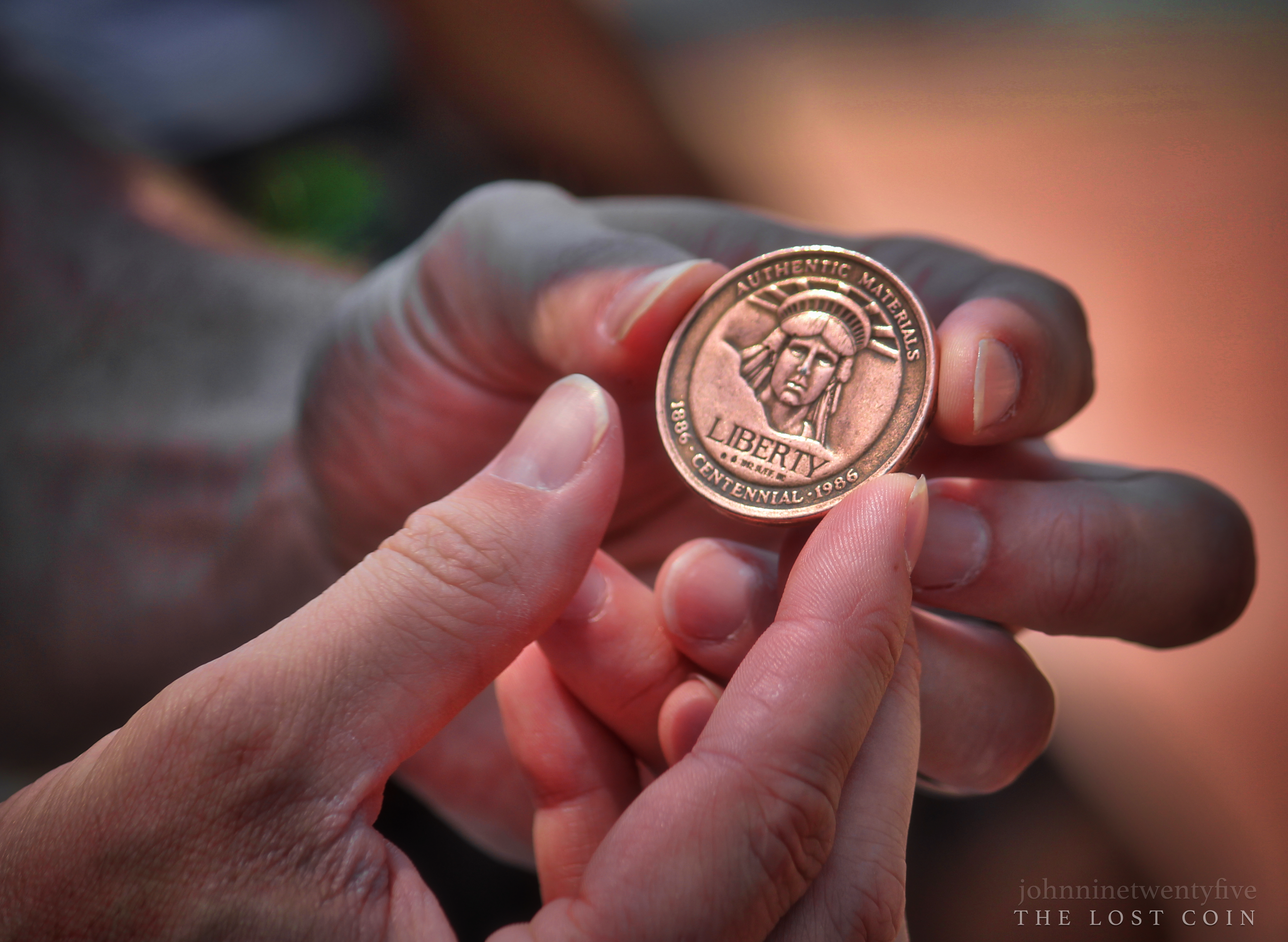
The Lost Coin by On Borrowed Time on Flickr. CC 2.0

What would it be like for me? It would be like me losing my wedding ring. It is not the most expensive item I own, but I do regard it as my most valuable possession, for what it represents. Earlier this week, when our elderly and grumpy cat bit my hand and I had to have a tetanus shot and strong antibiotics, I was told at the Urgent Treatment Centre that I had to remove my wedding ring in case my hand swelled up. I was careful to put the ring somewhere safe.

Those who are lost from the church and faith in Jesus are therefore to be seen as immensely valuable to Jesus. It doesn’t matter whether they are former Christians or never-been Christians, Jesus values them hugely. Sometimes we are very dismissive of judgmental of people outside the church, and of course some of them can be hostile to us, but the Jesus who tells us to love our enemies puts a high value on them. They are precious to him.

Like us, they are made in God’s image. Like us, they are loved so much by God that Jesus died for their sins. They are treasured by God.

Before he wrote worship songs, Graham Kendrick was a Christian folk singer. One of his most popular songs from that period of his life was called, ‘How Much Do You Think You Are Worth?

The first verse says this:

 Is a rich man worth more than a poor man?
A stranger worth less than a friend?
Is a baby worth more than an old man?
Your beginning worth more than your end?

It goes on to consider various ways in which we might or might not value human life highly. Then it comes to a climax with these words:

If you heard that your life had been valued
That a price had been paid on the nail
Would you ask what was traded,
How much and who paid it
Who was He and what was His name?

If you heard that His name was called Jesus
Would you say that the price was too dear?
Held to the cross not by nails but by love
It was you broke His heart, not the spear!
Would you say you are worth what it cost Him?
You say ‘no’, but the price stays the same.
If it don’t make you cry, laugh it off, pass Him by,
But just remember the day when you throw it away
That He paid what He thought you were worth.

Every single person outside the church is valuable to God. The neighbour who annoys you. The child who keeps kicking his football at your fence. The greedy businessman. The politician whose policies you hate. The sex worker. The drug dealer. All these, as well as the ones we find it easy to like! The Cross tells us how much God values them.

And – while they are missing from God’s family, not only are they incomplete, so is the church.

It’s time to expand our networks, increase our love, and let faith prompt our courage.


[i] Kenneth Bailey, Poet & Peasant and Through Peasant Eyes: A Literary Cultural Approach to the Parables in Luke, 1983, p 157

Jesus, Pastor and Apostle of the Resurrection: Luke 24:36-49 (Easter 3)

Luke 24:36-49

Here is a supposed church chain letter from the United States:

The “Ideal” Pastor
The ideal preacher lasts precisely ten minutes.

He is a harsh critic of sin, yet he never causes damage to others.

He works as the church janitor in addition to working from 8 AM to midnight.

The ideal pastor is forty bucks a week, drives a nice car, has nice clothes, reads good literature, and gives thirty dollars a week to the church.

With forty years of experience, he is 29 years old.

Above all, he has great looks.

The ideal pastor spends much of his time with older people and has a strong desire to work with youth.

His sense of humor, which makes him smile all the time while keeping a straight face, helps him maintain his unwavering commitment to his church.

He visits fifteen homes every day and is constantly available in his office for emergencies.

The ideal pastor consistently makes time for every committee within the church council. He is always engaged evangelizing the unchurched and never skips a church organization meeting.

The ideal pastor can always be found in the church next door!

Just forward this notification to six other churches that are also sick of their pastor if yours falls short. Your pastor should then be wrapped up and sent to the church at the top of the list.

You will receive 1,643 pastors in one week if everyone works together.

There should be one that is flawless.

Trust this letter. In less than three months, one congregation broke the chain and welcomed back its former pastor.

And if you think that’s just a wild exaggeration for the sake of humour, then you haven’t seen some of the circuit profiles I’ve read over the years. Not least do I remember one I read when I was single where the circuit said their ideal minister was married with children. In other words, they wouldn’t even appoint Jesus.

I used to think this problem of expecting the Archangel Gabriel to be your next minister was a grassroots issue, until I got involved in supporting and mentoring probationer ministers. Then I got to see Methodism’s official documents about the required competencies to become a minister. I realised the problem went right to the top.

There is only one person who has exercised all the different New Testament leadership gifts, and that is, of course, Jesus himself. Ephesians talks about leadership offices of apostle, prophet, evangelist, pastor, and teacher. Jesus encompassed all of those. No-one else does. It’s why if Jesus is not your minister – and he isn’t – you need a team of people in leadership to cover the bases.

And I say all this, not to have a whinge about my own work, but to introduce the fact that in today’s passage Jesus exercises two of those leadership ministries.

Firstly, we have Jesus the Pastor:

Jesus appears to the disciples and speaks peace to them, offers them reassurance and reasons to grow in faith and deal with their doubts. And even when the disbelief persists, he is patient but persistent with them to bring them to a point of complete belief in his resurrection.

Does this sound like pastoral work to you? Because it does to me.

Where do you turn when fear threatens to overwhelm faith? I think that’s part of the story here. If, as I suspect, this is Luke’s version of the story John later describes in his Gospel where on the first Easter evening the disciples are behind locked doors out of fear that they will be arrested next, then no wonder his first words to them are ‘Peace be with you’ (verse 36). Well, that and the utter shock of his sudden materialisation in their midst, of course.

Sometimes it is the pastoral vocation to speak peace to troubled minds. I wish I could give you examples from my own experience, but I would be breaking pastoral confidences. What I will say is that when I was a young and enthusiastic Christian in my mid-twenties and wondering about my calling, a minister I admired said to me, ‘What most people need is simply the assurance they are loved by God and have a hope in heaven.’

And while that might be a bit simplistic, there is an important truth there. It is a pastoral calling to bring people into an assurance of their faith. And nothing does it like the truth of the resurrection. Those first disciples thought they might be facing imminent and cruel death, just as Jesus had. And the risen Lord doesn’t promise them an escape from suffering, but he embeds resurrection hope in them. When you have that, you can face even death with the peace of Christ.

Therefore, Jesus speaking the word of peace is accompanied by other words and demonstration that his resurrection is true. He isn’t a ghost. He has been raised bodily. He shows them his hands and feet to prove that it is him – just as he will offer Thomas a week later.

The other day, the Co-Op was in the news for pricing errors they made on their goods that would be delivered by the Deliveroo service. Jars of Loyd Grossman pasta sauce, Costa ground coffee, and Fox’s cookies were all free of charge. Robinson’s squash went down from £1.50 to 15p. At least one of those who dived in before the mistakes were corrected forty-five minutes later did at least donate his stash to his local food bank, but not all did.

Others steered clear, because we talk about things being too good to be true, and that seems to have been the disciples’ mindset. Luke says, ‘they still did not believe it because of joy and amazement’ (verse 41). So as well as having shown them his wounds and his flesh and bones (verse 39), Jesus eats fish in front of them (verses 42-43).

Too good to be true? No! It’s too good and it is true.

A few years ago, the Christian musician Matt Redman said that the familiar Christian expression ‘good news’ sometimes almost seemed to weak for what it represents. He wanted to use a stronger expression, and opted for ‘beautiful news.’

But whatever form of words we choose to use, we’re talking about something that goes against everything our culture and education tells us. That’s why it needs to go down deep. That’s why, I think, Jesus doesn’t mind offering more than one proof to the disciples so that it sinks in.

And that’s why the task of the pastor is to encourage us in all the ways that help the radical Christian message of the resurrection go deep into our lives and over-write the negative messages of our society. That’s why I will forever bang on about the importance of engaging with prayer and the Scriptures not only on a Sunday morning but in daily devotions and in small groups for fellowship and Bible study.

Jesus the pastor, then, brings the truth of the resurrection to troubled hearts and distorted minds in words and action.

Secondly, Jesus the Apostle:

Jesus takes the disciples on a Cook’s tour of the Scriptures (as they existed at that point). He shows them how they were all leading up to the Messiah suffering and then being raised from the dead (verses 44-46). All well and good. Just the sort of thing you might imagine happening in a home group. It also sounds quite similar to what Jesus did with Cleopas and his companion on the Emmaus Road, that we thought about last week, when we talked about interpreting Scripture in the light of God’s great story that points to the Resurrection and the New Creation.

Except that this time there’s a punchline:

and repentance for the forgiveness of sins will be preached in his name to all nations, beginning at Jerusalem. (Verse 47)

Now there’s a practical application! And if the disciples hadn’t been expecting a suffering Messiah who would also be raised from the dead before the end of history, then they wouldn’t have been anticipating this, either. For in what we call the Old Testament there is a lot of emphasis on the nations coming to Jerusalem to worship Israel’s God at the Temple, but now instead the divine message goes out from Jerusalem to the world.

And that’s going to require a new approach, one that was rarely seen in the Old Testament. You do have Jonah being sent to Nineveh, but as we know, he wasn’t keen on the idea. Now, it seems, Jesus says, this is the new norm. I’m not waiting for the nations to come to the Temple. I want to take the Temple to the nations.

An apostle is one who is sent with a message. That could describe the coming and the ministry of Jesus. But now, as the supreme apostle, he commissions his disciples with the apostolic call to be sent from Jerusalem to everywhere.

After all, when Jesus, as the risen Lord, returns to heaven in the Ascension, his presence will be available everywhere through his Spirit. Therefore, you don’t need to come to Jerusalem anymore. Jesus, the New Temple, can be accessed anywhere and everywhere. So it’s only appropriate to take that message everywhere and call on people to connect with Jesus where they are.

And by definition, a calling like that cannot be fulfilled by one person. It requires everyone who follows the risen Jesus to hear and respond.

But you might reply to that by saying, wait a minute, Dave, didn’t you say we don’t all have the same gifts, let alone all the gifts? Absolutely, I did. And we are not all apostles or evangelists. Quite right.

However, we are all witnesses (and that is not a leadership gift). Every Christian has encountered the risen Jesus in their lives and can bear witness to what that means for them. We bear witness in our words when we find the appropriate times to tell our friends about what Jesus has done in our lives and what he could do for them. We bear witness in our deeds when we live out the teaching of Jesus not only in the church but also in the world.

In all of this, though, we make that New Testament resurrection change of direction from the nations coming to Jerusalem where the Temple is, to taking Jerusalem to the nations, because Jesus the True Temple is accessible everywhere.

So out with all those lame strategies where we wait for people to come to us. Jesus never lived like that, and he never expected us to do that, either.

And when we leave our churches on a Sunday morning it isn’t merely to go home, it is to go into the world as commissioned by our risen Lord. The thought may make us tremble. We shall need the power of God in the Holy Spirit. But that is to jump ahead in the story.

Prepared For Mission, Luke 5:1-11 (Ordinary 5 Year C)

Luke 5:1-11

Before I was a minister and before I studied Theology, I worked in Social Security. It was, as I have sometimes said, one way of seeing life. I can recall a number of stories from those days which are, shall we say, a little too colourful for the delicate ears of some Christian congregations -notwithstanding other barriers such as the Official Secrets Act.

But suffice to say that in that work I encountered people with chaotic lives, in desperate circumstances, as well as the occasional chancer. I also represented colleagues to their bosses when their personal lives were affecting their work.

Just from that general outline I am sure you can guess that I had some formative experiences that were useful preparation for when I became a minister, even though I had no sense of such a call at the time.

Our story from Luke today is one where Jesus tells Simon that his experience as a business partner in a fishing co-operative will stand him in good stead for a life as a disciple and an apostle.

There is a sermon to be preached on this passage about just how much God values our everyday work, but I will save that for another time. For today, I want to look at the aspects here that prepared Simon for what was to come. Even though we are not fishermen (although I don’t know if anyone has angling as a hobby!) there are elements of Simon’s story that speak to us as well.

Firstly, obedience:

When he had finished speaking, he said to Simon, ‘Put out into deep water, and let down the nets for a catch.’

Simon answered, ‘Master, we’ve worked hard all night and haven’t caught anything. But because you say so, I will let down the nets.’

Simon, James, and John are experienced fishermen. They know what they are doing. That they are washing their nets after a night-time fishing trip tells us exactly what kind of nets they are using. They were called ‘trammel nets’. They were made of linen, were visible to fish in daylight hours and hence why they went fishing at night, and they would be cleaned the next morning[1]. All this is known from historians of the day and confirms that they were conducting their trade according to the best knowledge and practices known then.

But here comes this crazy carpenter – what does he know about fishing? – and he gives them instructions which make no sense to these experienced professionals. It’s daylight, and the fish will see the nets. No way will any fish be caught.

‘But because you say so, I will let down the nets,’ says Simon. Because this is more than a crazy carpenter. This is Jesus, the Expected One, the Hoped-For One, the Messiah himself. And so, even though their friends in other fishing co-operatives based on the lake will think they are mad, they set sail again. They head for the deep water. They let down their nets. And – oh my.

The call of the Christian disciple is to follow Jesus and do what he tells us, even when it seems scarcely credible. He sends us out into deep water, too – into situations that are deeper than we have ever encountered before, circumstances we would resist embracing because they seem too fraught with danger.

It’s something of a threat to our desire for a quiet, comfortable life, isn’t it? But why does it surprise us? Isn’t so much of what Jesus calls us to do the very opposite of conventional expectations? We are to forgive, not hate. We are to give, not take. It’s utterly consistent for Jesus to call us to do unexpected things in his service.

Perhaps what we need to do is to ask him to give us a dream for our lives that is so big and so deep that it can only be fulfilled by relying on him.

Sometimes we hear talk about having ‘smart goals’, where the letters of the word ‘smart’ stand for specific, measurable, achievable, realistic, and targeted. But in the light of this, I want to ask, ‘Achievable by whom? By us? Or by Jesus?’ Because the latter are the goals that fix our Christian obedience.

Secondly, fellowship:

In verse 7, the people working alongside Simon in the boat are called his ‘partners.’ It’s a word that denotes business partners, which makes sense.

But by verse 9, they are no longer ‘partners’ but ‘companions’. The Greek word has changed, and while this word could denote the members of a fishing co-operative, it ‘is capable of much wider nuances’[2] and is related to the word ‘koinonia’, which is often translated with that glorious Christian word ‘fellowship.’ In the work of catching the abundant haul of fish, partners become a fellowship.

And fellowship is central to the life of Christian discipleship. We do not follow Jesus alone, but together in a body. We cannot do it alone. We need the power of the Holy Spirit, and the encouragement of our brothers and sisters.

But this word ‘fellowship’ is open to much misunderstanding, because we have seriously devalued its meaning. To listen to the way some churches conceive of fellowship, you would think it was little more than talking together. ‘Join us after the service for fellowship over tea and coffee.’ It is so much deeper than that.

Strictly, the word means, ‘what we have in common.’ Luke shows us what that meant for the early church in the first chapters of his second volume, the book we call The Acts of the Apostles. The first believers are sharing in fellowship by the end of chapter two. We find that it means they shared their very lives together, including their possessions. They had Jesus Christ in common, and they shared all they were and all they had in common, too.

When we think of the partners becoming a fellowship in Luke 5, it is reminiscent of Paul writing to the Christians in Philippi and giving thanks for their ‘fellowship in the Gospel.’ In other words, they had shared together in the hard work of the Gospel, just as Simon, James, and John, along with their partners, had shared together in the hard work of hauling those full nets into the boats.

The work of the Gospel can be tough, but Jesus has given us each other to do that work in common, supporting and helping one another. We do not need to be alone in the work. Indeed, we should not be alone. We were not designed that way. God always intended that we support our brothers and our sisters in all the ways we share the Gospel in the world. We may be on the frontline with them. We may be supporting them with prayer and financial giving. And together, we haul in the heavy nets.

I think it would be helpful if each one of us asked, with whom am I in fellowship in the Gospel? Who do I know who can support me as I bear witness to Jesus in the world with my words, my deeds, and my character?

One strategy would be for three of you to gather together as a ‘prayer triplet’, regularly praying each other’s spheres of influence. Such a group would meet regularly, review how everybody is getting on, hold one another to account, and be a source of encouragement. This is real fellowship: it’s so much more than chatting over tea and coffee!

Thirdly, grace:

Simon witnesses the amazing catch of fish and is overcome with the sense that this must be a demonstration of God’s holy power. There seems no other explanation for him being astonished to the point of him saying to Jesus, ‘Go away from me, Lord; I am a sinful man!’ (verse 8) In the presence of such holiness, he knows himself unworthy.

But of course, Jesus will not have that. For as well as holiness, he has grace. Don’t go away, Simon, come closer. I have a commission for you: ‘Don’t be afraid; from now on you will fish for people.’ (verse 10)

And that gracious invitation and call leads Simon, James, and John to leave behind their business (just as it is thriving!) and everything else to follow Jesus (verse 11).

Which of us has not echoed the words of Simon, ‘Go away from me, Lord; I am a sinner’? It may be that we witnessed the awesomeness of God’s power in some way. It may be that we are only too aware of our sins and failures: can he really forgive us again? And if he does, surely there is no way he can use me? Or it may just be a sense of our utter inadequacy in the face of Jesus’ blazing purity and beauty of character. We are unworthy. We are not heroes of the faith. What would God want with us?

And yet, and yet. ‘Don’t be afraid,’ says Jesus, ‘I still have work for you to do.’

There is a legend told of Jesus returning to heaven at the Ascension and being welcomed by the angels, who congratulate him on all he has achieved.

Then one angel says, ‘But Lord, what is the next stage of your great plan of salvation?’

Jesus replies, ‘I have left it in the hands of a small group of my followers.’

‘But Master,’ counters the angel, ‘what will you do if they mess things up? What will your plan be then?’

‘I have no other plan,’ says Jesus.

And that’s the plan. His plan is us – sinners that we are.

So if spiritually we are down in the gutter right now, it’s time to hear the good news that Jesus is still calling us. He still has work for us to do in building for his kingdom. He still has people for us to reach with his love. We may be the ideal people to speak and show his love to certain folk.

Let us allow Jesus to wipe us clean with his grace so that we can embrace again his call on our lives. And let’s set out in fresh obedience to him that we may see him do new wonders in our day. And let us do it not as lone rangers but in fellowship with others.


[1] Joel B Green, The Gospel of Luke (NICNT), p232.

[2] Op. cit., p234 n27.

Mission in the Bible 14: Our Of Our Comfort Zone (Acts 10:1-23a)

(This is a lightly revised version of a sermon I preached ten years ago.)

Acts 10:1-23a

There is an old joke that takes a Bible verse about some people not dying before the Second Coming of Jesus and applying it as a motto for a crèche or other gathering of babies:

“We shall not all sleep but we shall all be changed.”

Change. Children change your lives like nothing else. Marriage is a big change, but having children requires far greater adjustment.

We’ve heard a lot in the election campaign about change, too. Now, with a new government in office, we’re about to find out whether there will be change, and if so, what.

In our Bible reading today, we meet two people who are on the verge of major change in their lives – Cornelius the centurion, and Peter the apostle. Both are in a comfortable place in their lives, but things are about to take dramatic twists for both of them as their lives are about to meet.

First, Cornelius. To the readers of Acts, who are probably Roman, Cornelius as a centurion is an all-round good guy. Roman citizens admired their centurions, rather like the way many in our society see our soldiers as heroes. One Roman writer put it this way:

“They wish centurions not so much to be venturesome and daredevil as natural leaders, of a steady and sedate spirit. They do not desire them so much to be men who will initiate attacks and open the battle, but men who will hold their ground when worsted and hard pressed and be ready to die at their posts.” (Polybius, Histories, 6.24.9)

And not only that, Cornelius would have been regarded as a good egg by Jews – at least, as good as a Gentile could be:

He and all his family were devout and God-fearing; he gave generously to those in need and prayed to God regularly. (Verse 2)

He hadn’t quite gone all the way to becoming a Jewish convert – that would have required a painful snip for him – but in prayer and giving to the poor he practised two of the three basic disciplines expected of a Jew (the other being fasting).

But we can’t stop there. According to the angel who appears to him, even God has taken a shine to him:

Your prayers and gifts to the poor have come up as a memorial offering before God. (Verse 4)

It’s all good, isn’t it? Admired in society, respected in the community of faith, and pleasing to God.

Except … God still has an agenda of change for him. That’s why he needs to meet Peter and hear Peter’s message. He believes in God, he does good deeds, and contributes to the well-being of society. Yet God says, ‘Cornelius, you need more. You need change in your life.’

Perhaps we know similar people today. We might be one of them. Good people – after all, the church has no monopoly on goodness. They may pray or even turn up at worship sometimes, but some say, “I don’t need to go to church to be a good Christian.” They may work hard at their job, love their families, and put in extra effort of an evening to do something positive in the local community. Perhaps they are in a profession that benefits the well-being of others.

And maybe God says the same today. ‘You need more. You need change.’ Specifically, I think he says something similar to what he effectively says to Cornelius. ‘You need to meet someone who will tell you about Jesus.’ Because that is what Peter would go on to do when they finally met.

Why do we need to meet Jesus when we believe in God, and do good in our community? Well, if we are serious about our belief in God and wanting to do what he likes, then we shall want to be acquainted with the One he sent to bring peace, forgiveness and true purpose of life. That One is Jesus. If God has been quietly working in our lives and we’ve been seeking to respond to him, then when we hear about Jesus we’ll be positive. If on the other hand all our talk about believing in God and being good is a smokescreen to avoid serious commitment, then the mention of Jesus will expose the truth of our hearts.

Happily, Cornelius wasn’t like that. He was truly interested in God and God’s ways. Change would come for him. Dramatic change, but good change.

Second, Peter. To get inside Peter’s attitude to life, let me ask you this question: have you ever been concerned with the fear that bad company corrupts good character? Perhaps if you are the father of a daughter and you are bothered what kinds of boyfriends she might have, you will understand this mindset. Can any young man ever possibly be good enough for your princess? What will you want to do to him if he wickedly steps out of line – say, he brings her back from a date five minutes later than promised? Really, you don’t want your angel influenced by such a wayward soul.

Translate that into a religious context and what you’ve got is a guy who has been brought up to believe that you shouldn’t mix with the wrong sort of people or your pure religious faith will be contaminated. And so, as a good Jew, he had believed he should have nothing to do with those who, in religious terms, were ‘unclean’. Cornelius, despite hanging out at the synagogue, was in some sense unclean to him, because he hadn’t become a fully-fledged Jew.

Now, it has to be said, Peter isn’t always consistent in his convictions. We learn in this story that ‘He is staying with Simon the tanner’ (verse 6), and that is suspect behaviour for a devout Jew. Why? Because a tanner in his trade deals with the skins of dead animals, and good Jews were not meant to have anything to do with dead bodies. Yet Peter accepts hospitality from such a man. Either he’s compromising his convictions or he’s beginning to change before this incident. I suspect it’s the former.

But here, everything definitely begins to change for him when he gets hungry at lunchtime. As he falls into a trance he sees this strange vision of a huge sharing platter. Some of the items on the menu are foods regarded as unclean by Jews, but in the vision he forgets that Jesus had declared all goods ritually clean. However, the call to eat ritually unclean food becomes a metaphor for mixing with people he would normally shun (verses 9-20).

If Peter is to live in the will of God according to the love of God, then he has to make a drastic change to his life. He has to begin hanging out with people who are different from him. He needs to start relating to people whom he would otherwise consider anathema. What’s more, he will have to do all this for the sake of sharing God’s love in Jesus Christ.

You see, up until now, the followers of Jesus were effectively nothing more than a small Jewish sect. Just about everybody who had begun following the way of Jesus had been Jewish. There was the odd exception, like the heretics of Samaria, but the new faith hasn’t burst outside Jewish boundaries. The question of whether it should hasn’t even been raised.

But it is about to be raised, and effectively it’s God who does so. God calls Peter to a radical change that will take his life-transforming love in Jesus beyond the Judaism where it has begun to the rest of the world. Christianity as a world faith is about to begin in this story.

And you know what? It means something similar for those of us who are church regulars, too. Those who have heard me a lot here won’t be surprised to hear me say this, but it needs repeating, because we must take this on board. It might feel nice and safe to draw most of our friends from the people like us who share our beliefs and values, but really that’s the way to build a spiritual ghetto. We need to make friends with people outside the church if we are going to make a missionary difference today. I hope we will not be known as the kind of religious people who are forever looking down their noses at those whose values we query.

The church is not a social club. It is a worshipping community and a base from which to launch God’s mission of love for all people. If we are to see God’s love spread to more people, then like Peter we may need to embrace a radical change where we don’t wait within the walls of the church building for people to come to us on our terms. Instead, we risk getting dirty in the world showing the love of God to people.

Maybe then we shall meet the Cornelius types. People where God is already on their case and who are reaching out for him. Perhaps we can have the humble privilege of making the introductions.

You know, it could even happen today if people are reaching out for God.

Mission in the Bible 13: Divine Initiative Seen in the Conversion and Call of Saul/Paul (Acts 9:1-19a)

Acts 9:1-19

I don’t look forward to my eye test every two years. When they ask you how many dots you can see that have flashed up momentarily to test your peripheral vision, I’m always afraid of getting it wrong. I don’t like the sensation of the air pumped into my eye to test for glaucoma. And I’m not fond of the flashing light when they take a photo of my retina.

Last time, having gone into see the optometrist and she had completed all her tests with different lenses and reading letters on a board, and then shone her torch into my eyes, she then said to me, “Were you told last time that you are going to develop cataracts at a later date?”

“No,” I replied, while silently thinking, “Oh great, another sign of getting older.”

This famous story of Saul’s Damascus Road conversion can be organised under the theme of sight. Saul is blinded, but Ananias receives a vision. Note the contrast: blindness and vision.

When the Lord blinds Saul and later heals him, and when he speaks to Ananias in a vision, he is showing that he is in charge and he is taking a divine initiative to bring salvation not only to Saul, but also to many others.

Firstly, then, the blinding of Saul:

To all intents and purposes, Saul has a licence to kill. He is ‘still breathing out murderous threats against the Lord’s disciples’ and asks the high priest in Jerusalem for letters permitting him to take prisoner any ‘followers of the Way’ in Damascus, with the help of the synagogues (verses 1-2). I think we can safely assume that even though he only has permission to arrest people, the religious authorities in Jerusalem will probably turn a blind eye if he also kills anyone. After all, they had stoned Stephen to death, and Saul had approved (Acts 7:1-8:1).

Since Stephen’s summary execution, persecution had broken out against the disciples of Jesus. Apart from the apostles, they had scattered from Jerusalem. Surely things were out of control. They feared for their lives. Some years later, Saul (by then named Paul) would tell the Galatian Christians that he was destroying the church. This is a lethal crisis for those first believers.

But God is in charge, and if his church is powerless, he is not. He takes the initiative. Jesus intervenes.

And he intervenes in a way that counters all the sentimental ‘Gentle Jesus, meek and mild’ nicey-nicey Jesus images. He acts as the holy king in blazing glory.

Of course, Jesus has wider purposes here. Not only does he save the physical lives of believers who would have been arrested and most likely tortured and probably killed, he acts here to bring Saul to him so that many more will be saved in the spiritual sense.

But to get to that point Jesus has to act in a way that the writer and friend of C S Lewis  Sheldon Vanauken called ‘A Severe Mercy.’ Saul is so set in the ways of his misguided zeal that it will only take something radical to stop him, and, moreover, to humble him before his Lord.

So the Damascus Road conversion is dramatic, but for a specific reason. And those of us who worry that we might not be Christians because we have not had what is often called a ‘Damascus Road experience’ need not worry. A survey some years ago showed that little over a third of Christians can name the date or time of their conversion. I am one of that minority. For me, it felt like a sudden revelation. But for most believers, it is a gradual process.

Think of it this way: do you have to remember the moment of your birth to know you are alive? Of course not! None of us does! We know we are alive because we manifest the signs of life. Our heart beats. We breathe. We eat and drink. We think. We get signals from our senses and our nerves.

In the same way, the question for us in terms of faith is less, do you remember the day you were converted, and more, are you showing signs of life in Christ? Do you love Jesus and want to know him more? Is the fruit of the Spirit growing in you? Do you have a desire to worship him and to serve him in the world?

Saul needs to be stopped in his tracks and humbled. I don’t think it’s unreasonable for us in our prayers for some people and places to ask the Lord to do ‘whatever it takes’ to humble people before him and bring them to repentance and faith.

Secondly, the vision of Ananias:

Saul will become famous as Paul and will become probably the most influential follower of Jesus ever. He will carry the Gospel to nation after nation and write letters that reverberate down the centuries. Just one of them – Romans – transformed the lives of St Augustine of Hippo, Martin Luther, and John Wesley, each of whom went on to have major impacts on Christianity and the world.

But Ananias? He makes this one appearance in the story and then disappears from view. Yet, by being the model disciple he leads Saul to Christ and the implications are, as I just indicated, transformative for the world for over two thousand years so far.

When the Lord calls him in a vision, he gives the exemplary response of a Jesus-follower: “Yes, Lord” (verse 10) – or “Here I am, Lord,” as other translations render it. It’s reminiscent of the boy Samuel in the Temple in the Old Testament, hearing the voice of God for the first time and learning from Eli to say the same thing: Here I am.

Yes, Lord. Jesus appears and speaks to one who says yes to him. But if the thought of saying yes to Jesus makes us nervous, note that it did to Ananias, too. When he hears that Jesus wants him to go and lay hands on Saul (verses 11-12), he responds with an understandably anxious question:

13 ‘Lord,’ Ananias answered, ‘I have heard many reports about this man and all the harm he has done to your holy people in Jerusalem. 14 And he has come here with authority from the chief priests to arrest all who call on your name.’

I think he is somewhat like Mary when the Archangel Gabriel appears to her and tells her she is going to conceive the Messiah, despite being a virgin. She certainly had her questions.

And it’s OK for a ‘Yes, Lord’ to be accompanied by questions, because Jesus is patient to explain to Ananias why it is important that he obeys:

15 But the Lord said to Ananias, ‘Go! This man is my chosen instrument to proclaim my name to the Gentiles and their kings and to the people of Israel. 16 I will show him how much he must suffer for my name.’

Ananias has questions, but they are not a reason for him to turn ‘Yes, Lord’ into ‘No, Lord’ (which is a contradiction in terms, anyway).

Jesus gives us no guarantees of whether we will be well-known believers like Saul/Paul, or obscure ones like Ananias. What he requires of each of us is, ‘Yes, Lord,’ even if it is accompanied by questions.

Thirdly and finally, the scales drop from Saul’s eyes:

Blind Saul has nevertheless received a vision of Ananias coming to lay hands on him to restore his sight (verse 12), and now it happens. As Ananias prays, scales fall from Saul’s eyes (verses 17-18).

In a sense, scales have fallen spiritually, too, from both Saul and Ananias. Saul receives the Holy Spirit (verse 17), and he will now be able to redirect his zeal in the holy cause of Jesus and his kingdom. His baptism (verse 18) confirms this radical change of direction. Moreover, he will now have the spiritual strength to endure the suffering that will come his way as he sets out on this mission (verses 15-16).

And in Ananias’ case, he addresses Saul as ‘Brother’ (verse 17). They are not biological family, and nor is this about shared ethnic identity. They are family in Christ. Saul takes food (verse 19), which likely means that he and Ananias share table fellowship[1]. Yes, the persecutor and one who was possibly a fugitive from him[2] are one. This is the miracle of the Gospel. It is similar to Jesus bringing both Matthew the tax-collecting Roman collaborator and Simon the Zealot freedom-fighter together in his twelve disciples. Faith in Jesus does this – even, dare I say, making Spurs and Arsenal supporters one!

There is a lot of talk in the world about how there is only one race, the human race, and that there is more that brings us together than keeps us apart. Unfortunately, that well-meaning talk overlooks the way in which sin has broken relationships. But here, Saul and Ananias’ eyes are opened to see that it is Jesus who restores this unity. That human unity is now found in him.

This is what Saul, later as Paul, will say to the Galatians:

There is neither Jew nor Gentile, neither slave nor free, nor is there male and female, for you are all one in Christ Jesus. (Galatians 3:28)

This is Jesus opening our eyes to the fact that the Gospel is not just personal, individual reconciliation with God – the forgiveness of our sins. It is also the healing and reconciliation of our relationships with one another.

And that’s why it’s important that the church demonstrates this if we are to be a sign of the Gospel. It’s why I love going to my church at Lindford, where the worshipping congregation goes right across the generations, across races, across social and educational backgrounds, and we hang together as one body in Christ. The politicians should be envious! Because they can’t create something like that! But Jesus can!

What will we do so that our church life is not just fellowship with people who are just like us? Do we believe at this election time that we can hold unity in Christ with Christians of differing political convictions, for example? In a deeply divided nation, this is the sort of thing that can become a powerful witness. We need to ‘see’ this so that the world will see Christ.

Conclusion

In using this metaphor of sight and blindness for this sermon, the old chorus popped into my head:

Open our eyes, Lord,
We want to see Jesus,
To reach out and touch him
And say that we love him.
Open our ears, Lord,
And help us to listen,
Open our eyes, Lord,
We want to see Jesus.[3]

But open our eyes, Lord, that we may walk with you and not resist you and need blinding and humbling to find you. Open our eyes, Lord, that we may say yes to you, even when we have questions. Open our eyes, Lord, to see that your Gospel brings reconciliation both with you and with others and help us to practise that to your glory before the eyes of the world.


[1] Craig Keener, Acts, p282.

[2] Keener, p281.

[3] Robert Cull, b 1949; Copyright © 1976 Maranatha Music.

Mission in the Bible 12: Listening with Two Ears (Acts 8:26-40)

Luke 8:26-40

If Debbie tries to speak to me about something while I am watching the television, there is more than a fair chance that I won’t take in what she’s saying. She will have to tell me to stop listening to the TV in order to listen to her. After all, as a man, I can only ever do one thing at a time. And I certainly can’t listen to more than one source simultaneously.

It makes me think of something I was told in a training session for people who were going to engage in prayer ministry. The instructor said that we had two ears, and that we had to listen to the person in need with one ear and the Holy Spirit with our other ear. That sounded tricky! It was better when they advised a team of two people to pray with whoever came forward, with one team member listening to the person and the other listening to the Spirit.

But part of our task as the church is to engage in multiple listening. The late John Stott called it ‘double listening’, where we listen to the Bible and to the world. Not that we squeeze the Bible into today’s standards and values, which happens far too often, but that we find where the Gospel speaks to today’s world.

And in our strange and wonderful Bible reading today, Philip engages in multiple listening. And it’s this multiple listening that enables him to lead the Ethiopian eunuch to faith in Christ.

Firstly, Philip listens to the Holy Spirit:

An angel (speaking on God’s behalf) directs Philip to go to the desert road (verse 26) and when he is there, the Spirit tells him to go near the eunuch’s chariot and stay near it (verses 27-29).

Well, it’s easy to say ‘listen to the Holy Spirit’, isn’t it, but harder to get to grips with it for ourselves. At one end of the Christian spectrum we have people who say they have never known God speak to them along with others who say that God only speaks to us now through the Bible.

At the other end there are Christians who, in the words of one preacher, claim to have more words from the Lord before breakfast than Billy Graham had in a lifetime. Some of these people are harmless fruitcakes, but others are manipulative and abusive leaders.

I once heard a story about a man who went to his vicar and said, ‘Wonderful news, vicar! You know that gorgeous blonde woman in the choir? The Lord has told me to marry her.’

‘No he hasn’t,’ replied the vicar.

‘Yes, he has!’

‘No, he hasn’t.’

‘Yes he has!’

‘NO HE HASN’T,’ insisted the vicar. ‘You’re already married.’

I think there’s a healthy middle path to be found here. I do believe God still speaks to us, but I also believe we test that against what he has revealed to us in the Bible.

And I would also say that some of us who think God hasn’t spoken to us are mistaken. He has told us things, but perhaps we haven’t always recognised it was him. Take the common example of feeling prompted to phone a friend or a relative, only to do so and discover they are ill or in some other predicament. We can then pray for the person or help meet their needs. Isn’t that something the Holy Spirit would do?

An Anglican priest friend of mine used to lead an organisation in London called the Christian Healing Mission. In teaching Christians about prayer, John would invite people to sit quietly and ask God to speak to them, then keep silence. He would encourage them to write down whatever impressions came into their mind, believing that God did indeed want to speak to his children. He never denied the need to be discerning about what people thought they heard, but he believed we should be optimistic about God’s desire to speak to us.

So why don’t we open ourselves all the more to the possibility of the Holy Spirit speaking to us? What adventures might he take us on for the sake of God’s kingdom advancing?

Secondly, Philip listens to the eunuch:

Here I’m thinking of where Philip enters into a conversation with the eunuch about what he is reading and what it means (verses 30-35).

When I was a child, we had a family GP who seemed to start writing you a prescription before you had finished telling him what was wrong with you. He didn’t really listen to your problems.

And we have seen something similar in the current General Election campaign. How many of our leaders, when a member of the public asks them a question, be it in a TV debate or on a radio phone-in, just launch into their prepared answer on that subject without listening to the nuances of that person’s personal concerns?

It happens in the religious sphere, too, when well-meaning evangelists splurge out the Gospel without listening to the people they are trying to reach. And while they have a point that the Gospel is unchanging, we need to find the point of contact or even perhaps the point of conflict so that we can make the Gospel connect with folk.

So Philip takes the trouble to listen to the man’s concerns. On his way back from Jerusalem to Ethiopia, a journey that would have taken a couple of months by chariot, this man is serious in his enquiring after God. He seems to think there is something in the Jewish faith and is reading the Hebrew Scriptures, but as a eunuch he will not be allowed to convert fully to Judaism. I think there is a desire for God and for belonging here, and Philip picks up on it. Philip knows this man’s deepest longings can be satisfied in Jesus.

W E Sangster, the famous minister at Westminster Central Hall in the mid-twentieth century, said that the Gospel is like a diamond with many facets. We need to discover which facet shines on a particular person in order to make the Gospel connect with them.

And the moment we understand that, we see the need to listen to people, not just regurgitate a pre-packaged version of the Gospel that we have memorised. It’s a good thing sometimes to learn summaries of the Gospel and also to be able to recount our own testimony, but we must be careful first to listen to the people we are aiming to reach for Christ so that we may share the Good News in the most appropriate way.

Thirdly, Philip listens to the Scripture:

I think the fact that the eunuch is reading this powerful passage from Isaiah 53 that we often call ‘The Suffering Servant’ means that the Holy Spirit is already at work in his life, preparing him for the Gospel and pointing him in to where he needs to ask questions. Perhaps he realises that attempts to explain this passage in terms of it merely being about the prophet himself can only go so far and are ultimately doomed to fail. There are parts of it that just don’t fit.

And along comes Philip for a meeting orchestrated by the Spirit. He listens to the Bible passage the eunuch is reading, and he responds.

But notice how he responds:

35 Then Philip began with that very passage of Scripture and told him the good news about Jesus.

Philip does what the early church did. They listen to Scripture and interpret it in the light of Jesus. The Hebrew Scriptures had pointed to a coming Messiah. Now he had come in the Person of Jesus, it made sense not just to read the holy writings to quote proof-texts out of context, but to read and understand them in the light of Jesus.

So that’s what Philip does here. He listens to these verses from Isaiah and says that ultimately they only make sense in the light of the Good News of Jesus. And as a result, this man who could not fully belong in Judaism due to his castration can fully belong to Jesus. His baptism (verses 36-39) is surely a joyful expression of that truth.

What Philip is doing is rather like Jesus on the Emmaus Road. As Jesus came alongside the two travellers, he opened the Scriptures and related them to himself. Philip comes alongside the Ethiopian eunuch and relates the Scriptures to Jesus.

This approach grounds us in the centrality of the Bible as the authoritative account of the Christian faith, but we do not act as Bible-bashers. We are not using isolated Bible texts as weapons to hurt people. There will always be the odd prejudiced person who accuses us of that and we can’t do anything about that, but our main task is to listen to the Scriptures and share how they point to Jesus. The Holy Spirit uses this to make Jesus real to people and lead them to him.

However, most of the people we encounter will not be reading Bible passages and asking us to make sense of them to them – although it might happen occasionally. We instead need to be people who are listening to the Bible ourselves anyway and looking for how it points to Christ. As we feed ourselves in this way on Jesus, the Bread of Life, we shall be more fully equipped for the conversations we have with friends and family members who don’t share our faith. Our own willingness to engage in spiritual discipline with the Bible is not only good for us, it has benefits for our witness.

Conclusion

When we consider mission and especially evangelism, we give a lot of emphasis to speaking. And the speaking is of course necessary.

But we need to appreciate the importance of listening too, as Philip knew. We need to listen to the Holy Spirit, who guides us into divine appointments. We need to listen to those we are aiming to reach, so that we may share our hope in Christ in a way that connects with them and challenges them. And we need to listen to Scripture, particularly to the way it points to Christ, because that is the truth we are seeking to share.

Thank you – for listening.

Pentecost: The Spirit Brings Life, Purpose, And Hope (Ezekiel 37:1-14)

Ezekiel 37:1-14

I don’t know what associations go through your mind when you hear the reading from Ezekiel about the valley of dry bones. Perhaps you hear the words of the old spiritual, ‘Dem bones, dem bones, dem – dry bones.’

I always remember hearing an Anglican bishop read the passage and then ask the question of his congregation, ‘Can these dead Anglicans live?’

It goes without saying that ‘Can these dead Methodists live?’ is an equally valid paraphrase!

Well, maybe ‘dead Methodists’ is a bit harsh (although not in some places!) but perhaps we ask, ‘Can these struggling Methodists live?’ You don’t need me to rehearse the issues of smaller congregations with older members.

And to that issue, God’s promise to send the Holy Spirit speaks powerfully. In Ezekiel, the people of God are struggling in exile in the alien culture of Babylon. And we struggle as now a minority in a culture which no longer uses Christian values as a foundation for life.

So let’s go digging for hope in Ezekiel 37, and the way I propose to do it is this. Three times in the passage God tells the prophet to prophesy the coming of the Spirit on the dry bones, and each time the promised result gets bigger and better. Come with me and catch a vision of hope in these verses.

Firstly, life:

Then he said to me, ‘Prophesy to these bones and say to them, “Dry bones, hear the word of the Lord! This is what the Sovereign Lord says to these bones: I will make breath enter you, and you will come to life. I will attach tendons to you and make flesh come upon you and cover you with skin; I will put breath in you, and you will come to life. Then you will know that I am the Lord.”’

So I prophesied as I was commanded. And as I was prophesying, there was a noise, a rattling sound, and the bones came together, bone to bone. I looked, and tendons and flesh appeared on them and skin covered them, but there was no breath in them.

There is no cure for the state of God’s people other than a spiritual one. At the risk of stating something that is a hobbyhorse of mine, no amount of new programmes will change the fortunes of the church. No new creative techniques will bring life to dry bones. It is our foolishness that we fall for these parodies of the spiritual life so often. It is to the shame of our denominations that national leaders so often propagate them.

The only cure is for the Sovereign Lord to breathe his breath, the Holy Spirit, into us. If the flowers and plants in the garden are withering, we water them. It is the same with us. We need to be watered with the living water that Jesus promised, namely the Holy Spirit.

I want to tell you one of my favourite sermon stories. It concerns the nineteenth century American evangelist, D L Moody. On one occasion, he was visiting the United Kingdom and spoke to a group of church leaders. For his text he chose Ephesians 5:18, where Paul urges the recipients of his letter to ‘Be filled with the Spirit.’ Moody pointed out that this is legitimately translated into English as ‘Continue to be filled with the Spirit.’

At the mention of this, a vicar objected. ‘Why do I need to continue to be filled with the Spirit? I was filled with the Spirit at conversion.’

‘I need to continue to be filled with the Spirit,’ replied Moody, ‘because I leak.’

And we all leak. We may well be able to point back to glowing times in our lives when we were particularly conscious of the Holy Spirit’s power at work in us, and nothing I say is intended to diminish those experiences. But we cannot live on past glories. As our cars need refilling with petrol or recharging with electricity, so we need refilling with the Spirit.

Perhaps life or our Christian duties have drained us. Think of the time in the Gospels when the woman with the issue of blood touched the hem of Jesus’ garment and we read that he knew that virtue had gone out of him. It happened to Jesus. We know he recharged in times with his Father. Why not us, too?

Surely, Pentecost is the best day of all to make this our prayer. ‘Lord, we leak. Fill us again with your Spirit.’

Secondly, an army:

Then he said to me, ‘Prophesy to the breath; prophesy, son of man, and say to it, “This is what the Sovereign Lord says: come, breath, from the four winds and breathe into these slain, that they may live.”’ 10 So I prophesied as he commanded me, and breath entered them; they came to life and stood up on their feet – a vast army.

Now if we get nervous at the mention of an army, let me just say that this is a vision, not something literal. There is nothing that follows this which is military. Nor are we meant to conjure up images of extreme militant believers, like the Christian Nationalists in the USA or anything else of that ilk.

I think the force of the image that the coming of the Spirit creates ‘a vast army’ is about the way the Holy Spirit equips all God’s people to be a missionary people, to be a movement that is a force for good rather than evil in the world.

To hear some Christians talk about their experience of the Holy Spirit, you would think that the function of the Spirit was little more than the supplying of a personal bless-up. And while I have no doubt that on occasions the Spirit provides comfort and encouragement for us, and enables us to experience God’s love, I am also certain that the Holy Spirit is not here for our self-indulgence.

On the day of Pentecost, the coming of the Spirit sent one hundred and twenty disciples of Jesus onto the streets of Jerusalem among a multinational crowd with the good news of Jesus.

If you want a contemporary example of this, then the 24-7 Prayer Movement re-formed an ancient lay Christian order called the Order of the Mustard Seed. Its participants take three vows, which are worked out in six practices, that are seen as flowing from the Holy Spirit. Together, they form a corporate body that takes God’s love to the world. These are the vows the associated practices:

What does it mean to be true to Christ?
We live prayerfully
We celebrate creativity to His glory

What does it mean to be kind to people?
We practice hospitality.
We express God’s mercy and justice.

What does it mean to take the gospel to the nations?
We commit ourselves to lifelong learning that we might shape culture and make disciples by being discipled.
We engage in mission and evangelism.

Were we to pray, as Moody recommended, to be refilled with the Spirit because we leak, then I suggest this is the sort of body we would look like, too.

Thirdly and finally, restoration:

11 Then he said to me: ‘Son of man, these bones are the people of Israel. They say, “Our bones are dried up and our hope is gone; we are cut off.” 12 Therefore prophesy and say to them: “This is what the Sovereign Lord says: my people, I am going to open your graves and bring you up from them; I will bring you back to the land of Israel. 13 Then you, my people, will know that I am the Lord, when I open your graves and bring you up from them. 14 I will put my Spirit in you and you will live, and I will settle you in your own land. Then you will know that I the Lord have spoken, and I have done it, declares the Lord.”’

Now, just as with the word ‘army’, we have to be careful here. The promise of the land was central to Judaism, and certain interpretations of that are central to the current war between the Israeli government and Hamas in Gaza. But the promise of hope for Christians has never been about a geographical nation.

We also have to be careful not to see the idea of returning to the land as meaning for us a thought that things will be restored to the way they were in the supposed ‘good old days.’

Restoration for us is the recovery of our hope. After generations of decline, where in the next couple of decades some long-established Christian denominations may no longer exist in this country, where respect has turned to grudging toleration and then to the attempted silencing of Christians in areas of public life including politics, it’s not surprising that we have become disheartened.

There may or may not be some green shoots of recovery in our society. Justin Brierley, the Christian broadcaster, podcaster, and thinker, has written and spoken about what he calls ‘The Surprising Rebirth of Belief in God’. The professed conversions of the former atheist Ayaan Hirsi Ali and the media personality Russell Brand, along with the interest in Christianity shown by public intellectuals such as the historian Tom Holland after an answered prayer may start to shift the atmosphere in the public arena.

But whether that happens or not, the Spirit restores our hope not on the basis of whether Christianity’s popularity is waxing or waning, but on the promise of Jesus that he will build his church and the gates of Hades (that is, death) will not prevail against it. It is the hope that even death cannot destroy God’s People, because of the Resurrection and the promise of the new heavens and new earth. The Holy Spirit settles us in that hope, whatever is happening in the wider world.

This becomes yet another reason to pray, ‘Come, Holy Spirit.’ It may not be one of the ministries of the Spirit that most readily occur to us, but it is an important one nevertheless.

In conclusion, when we may be troubled about the future of the church, we pray again, Come, Holy Spirit.’ For the Spirit will give life to the tired and discouraged in the People of God. And the Spirit will make us a corporate body of God’s redeeming love in Christ for the world. And the Spirit will give us rock-solid hope, whatever fluctuations there are in the culture around us.

Can these dry bones live? Let us not simply say, ‘Sovereign Lord, you alone know.’ Let us instead say, ‘Come, Holy Spirit.’

Why Does The Risen Jesus Appear To The Disciples? Luke 24:36-49 (Easter 3 Year B 2024)

Luke 24:36-49

It’s a thrill for parents when their child starts speaking. It’s less of a thrill when that child learns the word ‘Why.’ Every question becomes, ‘Why?’

As a child, I was certainly fond of asking ‘Why?’ Not only the dreaded ‘Why do I have to do this thing you are telling me to do?’ but also ‘Why’ in terms of wanting explanations for the way things worked in the world. I know I was persistent on that last kind of question, because my parents bought me a subscription to a children’s magazine called ‘Tell Me Why.’ You can still find old copies on eBay. It comes under eBay’s category of ‘Antiquarian Collectibles’, such is my age now.

As I read the familiar resurrection story from Luke, I realised that one of the questions I wanted to ask of this passage was ‘Why?’ Why did Jesus appear on this occasion to the disciples? What was this resurrection appearance about?

Going over the text, I came up with three answers to that question: why did the risen Jesus appear to the disciples on this occasion? I realised too that the reasons why Jesus appeared to the disciples here are also reasons that are relevant to us.

Firstly, the Risen Jesus brings peace:

36 While they were still talking about this, Jesus himself stood among them and said to them, ‘Peace be with you.’

These last couple of weeks I could have done with a dose of ‘Peace be with you’ from Jesus. Straight after Holy Week to Easter Day in which I preached or spoke eight times in eight days, I walked into a legal crisis over the text of my book, which I have had to remove from sale.

Then I had serious warning messages flash up on my car dashboard. An investigation by the dealer found that it needs repairs costing over £2000. The fault is something that the manufacturer should have put on the list for last year’s annual service but failed to do so. They are now trying to wriggle out of responsibility on a technicality.

Yes, I could have done with some peace from Jesus.

The one bright part was that I had to submit some blood pressure readings this week to the pharmacist at the doctors’ surgery, and he described my results as ‘gold standard’, so Debbie said that in fact I clearly haven’t had enough stress!

Now on the one hand ‘Peace be with you’ is a fairly standard Jewish greeting. When I flew to and from the Holy Land on El Al Airlines in 1989, every message over the plane’s PA from the pilot or cabin crew always began with ‘Shalom and good evening.’

But here, the disciples really need peace:

37 They were startled and frightened, thinking they saw a ghost.

A ghost: something not of God. So fear is natural. It’s equally possible to be fearful in the presence of God’s almighty power – which the Resurrection indicates.

The way in which Jesus leads the disciples to peace is basically to reassure them: ‘It’s me. You don’t need to be afraid. You know me.’

It was good news for the disciples then, and it is good news for Jesus’ disciples today. The Resurrection says, don’t stay at a distance from Jesus in your relationship with him.

Do you ever feel nervous about drawing near to Jesus? Here’s a secret: I do. My current devotional pattern comes in two parts. Earlier in the day, I have a reflection on a Bible passage, then at night I ponder how the day has gone in the light of Scripture. I find something to rejoice in, and something to confess. When I keep confessing the same sins and failures regularly, I can tell you I don’t want to draw near to Jesus. But what astonishes me is the way my devotional takes me every day to assurances of forgiveness in the Bible. It’s as if every evening Jesus is saying to me, don’t be afraid, don’t stay at a distance, the best thing you can do is draw near to me.

What about you? Where is the Risen Jesus saying ‘Peace be with you’ to you?

Secondly, the Risen Jesus brings proof:

When people invite others over for dinner, the hosts will usually ask in advance if there is anything they cannot eat or dislike. When people ask Debbie and me that question, they will find out that I am allergic to artichokes and dislike roast pork and gammon. Debbie will say that she cannot face fish or mushrooms. Whenever we go out to a pub or a restaurant for a meal, it is a standing joke that I will order fish to make up for not having it at home. If belly pork is on the menu, you can guarantee Debbie will be tempted.

I take great comfort in the Resurrection narratives, because there (including the one we read today) I learn that Jesus likes to eat fish. In John 21, he cooks a fish breakfast for the disciples after their overnight fishing trip. Here, he shows them his wounds and eats some fish to eat as proof that he is bodily to calm their fears and assuage their doubts (verses 38-43).

Now you may say that what was proof for the disciples two thousand years ago is not proof for us. But it is very strong historical evidence. We do not need to doubt the bodily Resurrection of Jesus.

I never tire of emphasising that the Resurrection is bodily. On Easter Day, I told Midhurst how that was a sign that God is renewing his material creation, and that’s why as Christians we care about things like healing, social justice, and the climate.

Today, I want to say that it also means we don’t need to doubt Jesus but trust in him. It’s why we sing lustily on Easter Day,

No more we doubt thee,
glorious Prince of Life[1]

We can trust Jesus because he has conquered sin and death in the Resurrection.

I know we will doubt him still from time to time. I do. But when I doubt, I always come back to the Resurrection. It’s real. It’s true. It’s bodily. It’s what makes life worthwhile. I hold onto that in my dark times. Or perhaps more accurately, that’s what holds onto me.

I don’t know what all your doubts and struggles are. Feel free to talk with me about them, if that would help. I simply invite you to remember that the bodily Resurrection is true, and so Jesus can be trusted.

I mean, the Risen Jesus must be trustworthy. He eats fish!

Thirdly and finally, the Risen Jesus brings purpose:

The Risen Jesus has brought good news for the disciples: fear replaced by peace and doubts replaced by proof. Now they can draw near to Jesus and trust him.

But if it’s good news for them it’s also good news for the world. And Jesus the Teacher gives his class of disciples a lesson. He recaps how he had told them he would die and rise again as the fulfilment of Israel’s hopes in her Scriptures (verse 44). Then he explains how this was rooted in those Scriptures (verses 45-46) – not so much proof texts, scholars suspect, as allusions to the whole story of Israel as Stephen would tell it before his martyrdom and passages like the Servant Songs, especially the Suffering Servant in Isaiah[2].

Israel’s vocation was to be a light to the nations. Jesus had fulfilled that. Now his disciples had to be the light of the world, taking this good news of peace and trust in Jesus from Jerusalem to the world (verses 47-49).

And in our day, that’s what we continue – being light in the world with the good news of Jesus.

But often we struggle with this vocation. If we have other events in our lives that are good news, we have no problem with sharing: the birth of a child or grandchild, a new job, exam success, a family wedding. We will tell our friends without any problems.

We are more reticent about the good news of Jesus. Has it become stale for us? Are we nervous about the response we shall receive? Are we worried about being a Bible-basher? There are many reasons why we may hold back.

Jesus knows that even though his disciples ‘are witnesses of these things’ (verse 48) they are not ready. They need to wait for the power of the Holy Spirit (verse 49).

We don’t have to wait for the Holy Spirit like they did, but this is a reminder to us that the key to fulfilling our purpose as witnesses is the power of the Spirit. We pray that the Holy Spirit will work through us so that we reflect the light of Jesus in the world. We also pray that the Holy Spirit will guide us to the right time to speak about Jesus, and the right way to talk about him. We further pray that the Spirit will give us courage when we find that difficult.

There’s a catchphrase from the movie and stage musical Mrs Doubtfire, where the title character repeats the words, ‘Help is on the way.’ That’s what Jesus promises his disciples at the end of this reading. Yes, his offer of peace enables us to draw near to him and not remain fearful of him. Yes, his proofs and evidence of his Resurrection enable us to trust him rather than doubt him. And yes, we are called to share this light with the world, which we may find daunting.

But help is on the way, because Easter will connect us to Pentecost.


[1] Edmond Budry (1854-1932), translated by Richard Birch Hoyle (1875-1939): Thine be the glory.

[2] Ian Paul, The risen Jesus meets the Eleven in Luke 24.

Mission in the Bible 7: The Missionaries Went Out Two By Two (Luke 10:1-12)

Luke 10:1-24

If I asked you to name the most influential Bible passage on the subject of mission, I think most people would plump for the one we call ‘The Great Commission’ at the end of Matthew’s Gospel. (And indeed we’ll get to that later in this series.)

I don’t think many in our churches would think of today’s passage. But in the last few decades this is one that a number of mission organisations have used for inspiration. They have each taken different ideas out of it, each amounting to very partial readings of the story. But I’d like to look at a number of helpful and challenging themes in Jesus’ instructions here to the seventy-two that will give shape to our outreach. For even though it is not our regular habit to be going out on mission teams like this, there are useful principles here for us to remember.

Firstly, prayer and action:

He told them, ‘The harvest is plentiful, but the workers are few. Ask the Lord of the harvest, therefore, to send out workers into his harvest field. Go! I am sending you out like lambs among wolves. 

Mission is based in prayer. It is not a series of techniques. It is not a programme. It is not a method. It is not even fundamentally a set of skills. It is a spiritual matter and can only come to birth through prayer.

While I am not sure about the old adage that God does nothing except in response to prayer – that seems to deny God’s freedom and sovereignty – I do know that mission is a work of the Spirit and therefore must be set out on spiritually. One of the simplest ways we can put this into practice is by having our own list of people we know and love that we want to find faith in Christ. I am sure you can instantly think of friends and family.

But it cannot solely be prayer. There has been a major trend on the internet in recent years that when some terrible disaster happens, Christians post well-meaning messages offering ‘thoughts and prayers.’ But the atheists then jump in and ask what the point of prayer is if they’re not going to take any action.

Now of course the atheists will have no time for prayer under any circumstances. But the Christian should make a link between prayer and action. I know sometimes when there’s a major disaster it feels like there’s nothing practical we can do and that we can only pray, but most of the time prayer can be linked with action, and that’s what Jesus says here. Not only does he tell the seventy-two to pray – ‘Ask the Lord of the harvest’ – he follows it up by saying ‘Go!’

We cannot divorce prayer from action. I think it was the late David Watson who used to say that we need to pray as if there is no such thing as action, and act as if there is no such thing as prayer. Sometimes, including in mission, we need, as it were, to be the answers to our own prayers. So when we are praying for God’s love to have an impact on certain people, that may also require us to be the people who carry that love to the people in question. And that may include the way we speak and show God’s love to the loved ones we are praying for.

Secondly, simplicity:

Do not take a purse or bag or sandals; and do not greet anyone on the road.

If I want to disabuse the church of one notion, it’s the idea that mission is a big-budget enterprise with big names, big campaigns, a huge budget, massive publicity, like the religious equivalent of the New Year’s fireworks in London with all the fancy stuff that is done with drones and the like.

Utter tosh. Show that to me in the New Testament. Oh, for sure there are some occasions where Jesus speaks to large crowds, but those incidents don’t justify the laser light show approach to mission – which actually disempowers many Christians from sharing in God’s mission.

No. Jesus says here that the enterprise of mission is simple. It’s ordinary Christians without any fancy accoutrements on the road with the love of God for people. None of us needs a big bank account in order to love people in Jesus’ name. We don’t need hi-tech equipment to tell people that Jesus loves them and wants them to turn their lives over to him. If we have that stuff then fine, but it’s far from essential.

Actually, I think some of us hide behind the big-money, big-event approach to mission. It’s too much for us, and so we think that gives us a free pass so as not to be involved.

But Jesus says, no. It just takes you and me without any fancy props, just the love of God in our hearts, to show the Gospel in our actions and speak the Gospel in our words. Let’s stop dodging the issue.

Thirdly, prevenient grace:

‘When you enter a house, first say, “Peace to this house.” If someone who promotes peace is there, your peace will rest on them; if not, it will return to you. Stay there, eating and drinking whatever they give you, for the worker deserves his wages. Do not move around from house to house.

10 But when you enter a town and are not welcomed, go into its streets and say, 11 “Even the dust of your town we wipe from our feet as a warning to you. Yet be sure of this: the kingdom of God has come near.” 12 I tell you, it will be more bearable on that day for Sodom than for that town.

What’s all this stuff about peace? Well, the opposite is the material about not being welcomed. Do you get a welcome somewhere when you arrive with the love of God? If you do, it’s a sign that God has prepared the way for you. Remember at the beginning of this series we saw that God was the first missionary in the Garden of Eden, that mission is God’s idea, and that we simply join in. Mission is never our initiative, it is his.

And that’s prevenient grace, to use one of John Wesley’s terms. ‘Prevenient’ is to go before. So we are looking for the people and places where God has gone before, where he has prepared the ground. If someone shows signs of being receptive, then take that seriously. It may well mean that you will find evidence that the Holy Spirit is already at work there, preparing them to hear the good news of Jesus. Again, remember the beginning of the series where I quoted Chris Wright saying that it’s not the church of God that has a mission in the world, but that the God of mission has a church in the world.

And when prevenient grace isn’t there, says Jesus, move on. If all you get is hostility, leave. There are others who will willingly hear and receive. Give them your time, and leave those who reject you to God.

I know of one occasion when I experienced that. It was in a circuit appointment where my gifts had never been received and appreciated from the very first Sunday. Around the time that our re-invitation was being discussed, one week I was preaching on Mark’s equivalent passage to this one. As I got to the words about shaking the dust off your feet, I felt a small voice whisper inside me, you’ll be doing that very soon.

So share God’s love in word and deed in circumstances where it is welcomed. If people don’t want to know, move on. This is not just practical thinking. It is the teaching of Jesus himself.

Fourthly and finally, practice:

‘When you enter a town and are welcomed, eat what is offered to you. Heal those there who are ill and tell them, “The kingdom of God has come near to you.”

Here’s what we are to get on with: demonstrating the kingdom of God in our actions, and explaining it with our words so that people hear the call to follow Jesus.

Now you may say it’s all very well for Jesus to tell these people who were evidently almost as close to him as the Twelve just to go around healing people. Well, I believe in the healing ministry but equally I can only enunciate for sure two occasions when I believe people have been healed in response to my prayers. So I want you to know that I feel the tension, too.

I would never want in principle to discourage Christians from praying for healing. Don’t ask, don’t get! But I think it will only ever be a minority of Christians who have a healing ministry. Where does that leave the rest of us?

We may not all be able to heal others in the name of Jesus, but we all can bless other people in Jesus’ name. Because the Holy Spirit lives in us, every Christian has the capacity to show Christ’s compassion and kindness to those who need it. When God interrupts our neat lives by bringing such people across our paths, let us be ready to show the love of Jesus to them, and to explain it when they ask why we have done so.

The other evening I was not at my best on this. Just as I had dished up our dinner, the phone rang and I picked it up to hear the voice of an elderly person who lived alone, who therefore talks at length given the opportunity, and who had just had a life-changing experience that was not for the better for him. I have to tell you, I was a little too keen to keep the phone call brief. When I was praying that night, I reflected that it wasn’t my finest hour.

Better, I understand that at the community lunch some people are saying, what is the cost, or why are you doing this free of charge? This is a perfect opportunity to explain about the God who showed his love for us in Christ before we ever responded to him, whether positively or negatively.

In conclusion, I don’t have time to look at the rest of the passage, where Jesus says more about leaving those who reject the message to God for him to deal with them, and where he urges his disciples to find their identity not in the success of their mission but in their love and redemption by God.

But there has been plenty even in these first twelve verses for us to chew on. Do we marry our prayers and our actions? Do we keep mission simple and not hide behind complexity? Are we attentive to God’s work of prevenient grace, so that we know where to concentrate our energies and where we are wasting our time? And will we practice both the demonstration of God’s love and explanation of it in words with those who God brings into our lives?

All of these are basic to the way we join in with God’s mission.

Mission in the Bible 6: The Apostolic Call (Mark 3:13-19)

Mark 3:13-19

Hearing a reading about the apostles might provoke a reaction in us that says, ‘What’s this got to do with us? We’re not in the same league as the apostles. We’re just a motley crew of ordinary Christians.’

Except we need to remember just how motley the apostolic crew was, too. How did James and John earn that nickname ‘Sons of thunder’ from Jesus? I envisage them turning up for apostolic meetings, gunning the engines of their Harley Davidsons.

We have the whole spectrum of political views from that day, ranging from Matthew the tax collector who helped fund the occupying Roman empire, to Simon the Zealot who wanted to send the Romans packing by the use of force.

We have a range of professions, from the physical labour exercised by the fishermen to the office accountant. That latter one would be Judas Iscariot, by the way: the Gospels tell us he was in charge of the finances.

Maybe the Twelve aren’t so far removed from us after all: the quiet and the loud, the right wing and the left wing, the manual labourers and the white collar workers. That’s not so very different from our diversity as a congregation, is it?

Sure, we may not be called by Jesus to be apostles, and we shall not exercise our calling in exactly the same way. But there are enough similarities for us to draw on here as we live out our calling to spread the apostolic faith. I’m taking verses 14 and 15 as the focus for our thoughts:

14 He appointed twelve that they might be with him and that he might send them out to preach 15 and to have authority to drive out demons.

There are three elements I’m going to pick out from these verses.

Firstly, ‘that they might be with him’ (verse 14).

In the Christian church, and especially in the Protestant traditions, we are very much into the idea that Christian life and witness involves us being highly active. We fill our churches with programmes, and we expect our ministers to be busy. We have a culture that faith is about doing rather than being.

I believe this is one of the reasons our churches are so often tired, dry, and dying. We can no more make Christian witness an endless cycle of action than we can drive our cars without filling up their tanks (or recharging their batteries). Our version of mission has been to run on empty. Is it any wonder it fails?

Before Jesus sent the apostles out, ‘He appointed twelve that they might be with him’ (my emphasis). We have nothing to share with the world if we are not in a vital relationship with Jesus Christ. How can we commend him if we spend no time with him? How can we expect people to see Jesus in us if we keep our distance from him?

For sure that involves our Sunday practices of worship and Holy Communion. But it also includes mutual sharing in small groups. It includes a personal prayer life each day. We can’t just rely on Sundays. Those of you who are married, would your marriage last if you and your spouse only spoke with each other once a week?

There are plenty of aids to help us in Bible reading and prayer. Traditional daily Bible reading notes still exist. You can get various ones from Scripture Union, or the excellent American daily devotional The Upper Room. Every Day With Jesus, which has been so popular for many years in the UK, is now available as an app for your smartphone or tablet.

Or the 24/7 Prayer movement has produced an app called Lectio 365. It gives you two brief prayer exercises a day. There is a morning one with a Bible reflection tuned to matters of prayer and mission. And there is an evening one where we can reflect with God on how the day has gone.

In the Western church, there is really no excuse when we have so many riches to help us with our devotional lives. It doesn’t reflect well on us that our brothers and sisters in far poorer parts of the world just get on with things and often have more vibrant prayer lives than us. Is that one reason why they tend to have more of an impact with their faith than we do?

If we want our church to have life, we need to begin by going back to spending time with Jesus. There is no substitute.

Secondly, ‘that he might send them out to preach’ (verse 14).

OK, so here’s where we might not all do things like the Twelve did. Jesus doesn’t call every disciple to be a preacher. But he does call every Christian to take his message into the world. We know people don’t like being ‘preached at’ today, but we do have good news to share.

In the ancient world, a herald would come to a town or a village, much like a town crier. There were two messages that he would call ‘Good news.’ One would be that Rome had a new emperor on the throne. The other would be that Rome’s armies had won a great battle.

The New Testament writers took inspiration from this. For them, there was not a new emperor on the throne of Rome but a new king on the throne of the universe, for Jesus had ascended to the Father’s right hand. He was not a coercive king like the Roman emperor, but still one who called people to follow the ways of his kingdom.

Similarly, the New Testament heralds proclaimed that Jesus too had won a great victory in battle – not by bludgeoning the enemy to death but by going to death himself at the Cross.

So our message of good news for today is that Jesus has done all that is necessary against the powers of evil in his death on the Cross, and that he now reigns in heaven, calling everyone to submit to his rule.

Our message is that Jesus has overcome all those things in life that frighten us the most, even death itself, and that he how calls for our allegiance.

If we live according to this message then it will provoke questions. If we are not frightened by what life can do to us, and if we are committed to the ways of Jesus, you bet people will notice and want to know more.

Here are the words of one such person[1]:

If you want, I’ll talk to you about God and salvation. I’ll turn up the volume of heartbreak to the maximum, so to speak. The fact is that I am a Christian, which usually rather sets me up for constant ridicule in the Anti-Corruption Foundation, because mostly our people are atheists, and I was once quite a militant atheist myself. But now I am a believer, and that helps me a lot in my activities, because everything becomes much, much easier. There are fewer dilemmas in my life, because there is a book in which, in general, it is more or less clearly written what action to take in every situation. It’s not always easy to follow this book, of course, but I am actually trying. And so, as I said, it’s easier for me, probably, than for many others, to engage in politics. “Blessed are those who hunger and thirst for righteousness, for they will be satisfied.” I’ve always thought that this particular commandment is more or less an instruction to activity. And so, while certainly not really enjoying the place where I am, I have no regrets about coming back, or about what I’m doing. It’s fine, because I did the right thing. On the contrary, I feel a real kind of satisfaction. Because at some difficult moment I did as required by the instructions, and did not betray the commandment.

I wonder if you know who said those words? They have been widely reported in the last week. Because they came in 2021 from Alexei Navalny, the Russian opposition leader who was recently murdered in prison.

So – firstly, be with Jesus. Secondly, preach the good news. Thirdly, ‘to have authority to drive out demons’ (verse 15).

Ooh. That’s a bit scary. And maybe we divide here between those who would run a mile from something like this and a few Christians on the other hand who would get unhealthily excited by it. We have also had the subject sensationalised and distorted by Hollywood and by the media generally.

Every now and again we hear of terrible misuses of this, where some church leader believes somebody to be possessed by demons, and physical force is used, leading to serious injury or even to death.

That’s why most churches restrict who can practise this. In Methodism, you now have to apply and be interviewed before you can be recognised as someone who practises in this area. You are not permitted just to go off and do exorcisms independently.

We may not have the particular authority to drive out demons. But all Christians have a mandate from Jesus to oppose evil. For evil is not just about what the devil does, according to the New Testament, it is also about the world and the flesh.

When the Bible talks about ‘The world’ in negative terms, it means the systems of this world in their opposition to God. So it’s when rulers, politics, or culture line up against God’s kingdom as inaugurated by Jesus. So it includes things such as when politicians don’t care about the poor. It’s about when our culture raises up created things as false idols – so think of the ways people are denigrated today for not being in sexual relationships and you will see one thing that our society treats as an idol. These things need to be opposed.

When the Bible talks about ‘The flesh’ as a bad thing it doesn’t simply mean the human body. It means our sinful human nature. It means that natural bias we seem to have towards doing what is wrong. And this too needs to be opposed.

And just talking about these things may make us realise that opposing evil is not just an external thing: it is also something we fight within ourselves. We have our idols. We have our own inner tendencies towards sin. And as I read this week, even when we take up an offering in an act of worship we engaging in an idol-busting exercise. For as someone said,

“It’s not a time when you’re trying to get money out of people’s pockets. It’s a time when you’re trying to get the idols out of their hearts.”

So in conclusion, the apostolic call to mission can be stated quite simply. It is fueled by spending time with Jesus. It is seen in living and proclaiming the Good News of Jesus’ reign. And it is characterised by opposing evil in all its forms, externally and internally.

It’s simple to state, but challenging to practise. So let us rely on the Holy Spirit to live out this call.


[1] Found on a friend’s Facebook feed. Source unknown.

Create a website or blog at WordPress.com

Up ↑