That You May Believe: John 20:19-31 (Easter 2, ‘Low Sunday’)

John 20:19-31

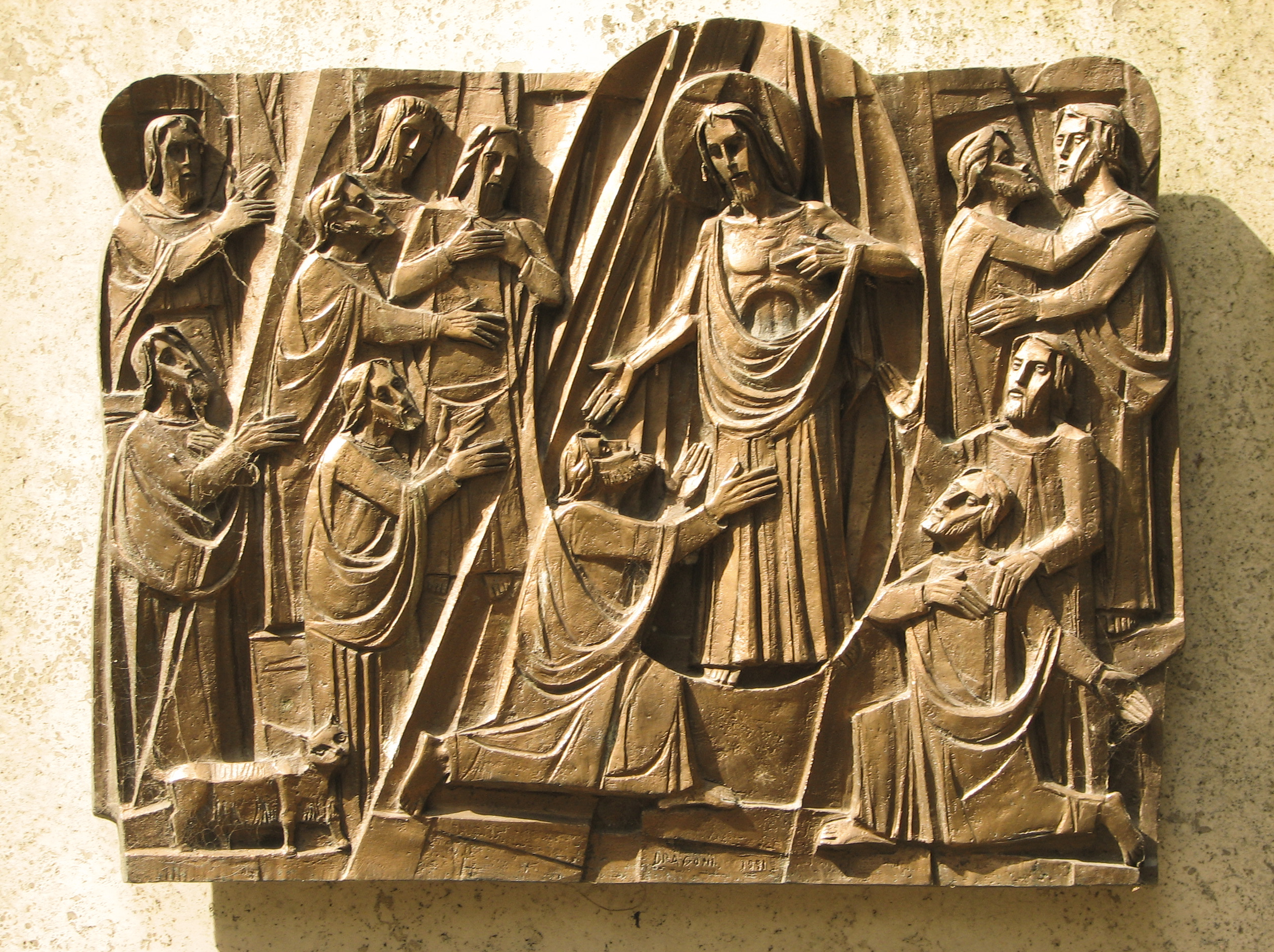
The Risen Lord appears to St Thomas & the apostles by Fr Lawrence Lew, OP. CC 2.0.

Our Bible reading today is one of my very favourite passages, quite possibly my Number One. I have preached on it often. There are so many wonderful themes: peace to replace fear; joy; the nature of the resurrection body; how the church’s mission is modelled on Jesus’ mission; faith, and how doubting Thomas has been given a raw deal; and so on.

Even my favourite sermon illustration story is based on this reading. So, if you have heard me talk about the missionaries to the Arctic translating the New Testament and what they took from the hunters’ dogs, I would have been preaching on this passage.

Looking on my computer, I have at least ten sermons on these verses. Had I wanted to repeat an old sermon today, I would have been spoilt for choice!

But the other day, I realised that there is one part of this account that I have never preached on. It jumped out on me on two occasions when I wasn’t even thinking about the sermon: once while I was running The Bible Course at Midhurst, and once when I was at Lindford, where they were showing a livestream from this year’s Spring Harvest.

What haven’t I preached on? Verses 30 and 31, which seem to sum up John’s Gospel before the author remembered later to add the story about the miraculous catch of fish and Jesus restoring Peter:

30 Jesus performed many other signs in the presence of his disciples, which are not recorded in this book. 31 But these are written that you may believe that Jesus is the Messiah, the Son of God, and that by believing you may have life in his name.

The whole point of recounting all the stories about Jesus, especially his miraculous signs, is that we who hear them believe in Jesus. And I want to bring two things out of that this morning: firstly a challenge, and secondly, an encouragement.

Rafting whitewater challenge at PickPik. Public Domain.

A Challenge
In one of my previous churches, I had a member called Phil. He was married to Pat, and he was a jazz musician. He led his own band, and once a year brought his band to the church to play a fund-raising concert. It sold out every time.

Sadly, a little while after I left that church, Pat died. Phil asked me to return and conduct her funeral. It was a privilege. Pat had a love of history, and an enquiring mind. She would always have an interesting question to ask me after I had preached.

However, I learned that soon after the funeral, Phil resigned his membership of the church. He said he had only ever come to support Pat. He had never believed. He had sat in church most Sundays. He had come to the communion rail and received the elements. Yet for all his encounter with the Gospel, he had never responded for himself.

It is possible to come to church for years, to participate in church activities and worship, and still not believe in Jesus. So, when I read those words at the end of John 20 again:

But these are written that you may believe that Jesus is the Messiah, the Son of God, and that by believing you may have life in his name

I wondered whether there might be anyone here in the same boat. If you have never made a commitment to follow Jesus Christ as your Lord and Saviour, I want to invite, even urge, you today to do so.

As you will hear if you come to this week’s session of The Bible Course, the four Gospels in the New Testament, including John, have the hallmarks of historical reliability. They show signs of being eyewitness testimony. You may think the events are strange and unlikely, but they were recorded because the authors were astonished by what they witnessed.

And as for the Resurrection itself, the greatest miraculous sign of all, the evidence is extremely strong. There was an old objection that Jesus didn’t really died, he just swooned and then revived in the cool of the tomb. However, he would have been very weak, and how he would have moved the tombstone in such a state beggars belief. Moreover, Roman centurions had to ensure their prisoners were dead. We see the soldiers checking at the end of the crucifixion stories.

The authorities didn’t like the Jesus movement, and especially when they began preaching a few weeks later. If the body of Jesus was still around, they could have produced it and stopped those early believers in their tracks. They didn’t.

Nobody in that society would have concocted fictional stories where the main witnesses were women. They were not allowed to give evidence in court. You wouldn’t write stories where women were the principal witnesses unless it were true.

Then you must wonder why those first disciples gave the next forty years of their lives for something they knew to be a lie, if they had staged false evidence in favour of the Resurrection.

Crazy as it may sound, the best explanation is the biblical one. Jesus was raised bodily from the dead. It shows he is who he said he was, the Messiah, the Son of God. It shows that God says yes to everything he accomplished by his death on the Cross.

If there is anyone hearing this who has never made that final step of turning their lives over to Jesus, now would be a good time to do it. Perhaps you believe in God, you think God has provided all sorts of good things for which you are grateful, but you haven’t made that commitment to be a follower of Jesus.

Or maybe you see coming to church once a week as a kind of religious life insurance policy. You think this is a way of paying a weekly premium to ensure life after death. But Jesus is your Lord and Saviour. He is back from the dead to call for your wholehearted allegiance.

The Power of Positive Reinforcement in Fitness Instruction CC 4.0.

An Encouragement
Around the turn of the century, I went through a mini-crisis of faith. I can’t even recall all the details now, but I do remember that the substance was the disproving of some miraculous claims made by Christians I had trusted. I began to doubt my own judgment. If I’ve got this wrong, what else have I got wrong about life and faith?

Eventually, I reached a state of equilibrium. I concluded that yes, sometimes other Christians let you down. Some even make false claims. You can recognise that without losing your faith. Because Christian faith is faith in Jesus, not faith in human nature. Human nature will always fail.

However, to get to that point wasn’t a quick process. I had one thing that was my rock-solid foundation. I could not shake my belief in the Resurrection of Jesus. I outlined for you in the first point some of the reasons why I believe it is sound on historical grounds to believe that the Resurrection truly happened. It wasn’t made up. It wasn’t a parable to teach spiritual reality. Jesus’ body was raised.

If anyone asks me, why do I believe – and continue to believe – in Jesus, I will always answer: the Resurrection. And that leads me back to verse 31 again:

But these are written that you may believe that Jesus is the Messiah, the Son of God, and that by believing you may have life in his name.

As some Bible translations will tell you in a footnote, the words ‘that you may believe’ may properly be translated, ‘that you may continue to believe.’ For those of you who like languages and grammar, the Greek present tense is a continuous tense. ‘Believe’ is not just about first-time belief: it is about continuing to believe.

And that’s where I offer a word of encouragement today. In the face of our doubts, our questions, our struggles, our failures, and the mess this whole world is in, the truth of the Resurrection gives us a hope we can depend upon.

If you think you are a hopeless sinner and cannot be forgiven, then the Resurrection of Jesus tells you that he has overcome sin. You can be forgiven, and you are forgiven. You can also have the power to begin living differently.

If you are afraid of death, then the Resurrection of Jesus shows us that when we place our lives in his hands there really is nothing to fear. We are safe with him, and our eternal future is glorious.

If you are feeling hopeless, that everything is pointless, and you are struggling to see the point of things, then know that the darkness of the pit at the bottom of the downward spiral cannot cope with the bright light of the empty tomb.

If you are struggling with deep questions about why there is so much evil in the world, then the Resurrection shows us that God overcomes the very worst. What could be more unjust than the execution of Jesus? But the wicked didn’t have the final word: God did. And so, the Resurrection puts those who perpetrate wickedness on notice. In eternity, they will not get away with it. For the Resurrection of Jesus is the promise that one day God will raise up everyone. And then, those who think they can hold onto power by mowing down thousands of their own citizens who protest will find that God is not on their side. Those who think that the way to get justice is to bomb their enemies, including innocent civilians, into submission, will have a shock coming. Those who think they can poison their critics and persecute their opponents will learn they are sorely and dangerously wrong. Those who hoard more money for themselves, especially at the expense of the poor, thinking it is the way to true happiness, will find a misery they could never have imagined. Those who think they can plunder the planet and destroy it for their own gain will be judged by God making a new creation just as he re-creates our bodies.

To be sure, for now we continue to live in the time between the Resurrection of Jesus and that general resurrection of the dead, and so the enemy of death will still take a toll on us. While we grapple with that, let our belief in the Resurrection fill us with hope as we live out the truth of peace with God, peace with ourselves, peace with others, and even peace with creation. We can love God and love others, knowing it’s worth it. We can care about justice, because we know it’s worth it. We can call people to follow Jesus, because we know it’s worth it.

Conclusion
Let’s go back to those words of verse 31 one last time:

But these are written that you may believe that Jesus is the Messiah, the Son of God, and that by believing you may have life in his name.

What do they mean for you today? Is it time finally to come off the fence about Jesus and say you will be a whole-hearted follower of him?

Or is it time to see that the Resurrection is the antidote to the despair and discouragement that have been dragging you down?

It’s common to say ‘It ain’t over until the fat lady sings,’ but the real truth is, ‘It ain’t over until the dead are raised.’

Mission in the Bible 11: Courageous Witness (Acts 4:1-31)

Acts 4:1-31

Last weekend, monitoring stations picked up seismic activity in Edinburgh. The activity was picked up as far as six kilometres from the epicentre. The cause? Seventy-three thousand fans singing and dancing at one of Taylor Swift’s concerts in Murrayfield Stadium. Each night the ground moved around twenty-three nanometres.

Swifties had had the same effect when their heroine performed on the west coast of America in Seattle and Los Angeles. Her Seattle concert registered 2.3 on the Richter scale.

Which brings us to the conclusion of our reading:

31 After they prayed, the place where they were meeting was shaken. And they were all filled with the Holy Spirit and spoke the word of God boldly.

Was this less Taylor Swift and more Jerry Lee Lewis – ‘Whole Lotta Shakin’ Goin’ On’?

They didn’t need seventy-three thousand – although they were up to about five thousand by this point. They simply needed the Holy Spirit.

But then the whole episode is based on another seismic event: the Resurrection. Matthew reports in his Gospel,

There was a violent earthquake, for an angel of the Lord came down from heaven and, going to the tomb, rolled back the stone and sat on it. His appearance was like lightning, and his clothes were white as snow. The guards were so afraid of him that they shook and became like dead men.
(Matthew 28:2-4)

And the earthquake of the Resurrection is still being felt here. Make no mistake, if all that had happened was that a lame man had been healed and if Peter had not told the crowd that gathered of their need to reassess their attitude to Jesus because of his Resurrection, then this conflict would not have happened.

If all that had happened was a healing, then that would have been nice, the apostles might have been patted on the back, and people would have thought that this was a commendable act of doing good. Were it to have occurred today, it would be praised as an example of inclusion and social cohesion. If the apostles just kept making people well over many years and set up a charity to administer their work, then maybe they would be nominated for an honour from the King.

I would imagine that if our parliamentary candidates saw something like the churches’ involvement in the Midhurst Community Hub they would praise them. They would applaud the Monday community lunches, the telephone befriending service for the lonely, the debt counselling, and the networking of different organisations.

And none of what I am saying is meant to criticise any of these things. We should be about the healing of bodies, of relationships, of the economy, of the environment, and so on. Absolutely. It’s part of building for God’s kingdom, the making of all things new.

But Peter has brought the Resurrection into play, and it brings with it seismic tremors. If Jesus is risen from the dead and he is responsible for the healing of the lame man, not the apostles, then we have a day of reckoning here. And that’s not only for the ordinary people in the crowd who had not sided with Jesus. More specifically, it’s for the powerful figures who had explicitly conspired to get Jesus executed.

The Resurrection is an earthquake in the middle of history. It’s an earthquake for the powerful, and especially for those who oppose Jesus. Seismic activity leaves them with tremors.

So that’s why when Peter and John are brought before the Sanhedrin, the religious ruling council, and when Peter says again that the healing miracle was wrought by Jesus, whom they had crucified but God had raised from the dead (verse 10) that they want to ban them from speaking about Jesus.

But they can’t. Peter says,

12 Salvation is found in no one else, for there is no other name under heaven given to mankind by which we must be saved.’

And later we read,

18 Then they called them in again and commanded them not to speak or teach at all in the name of Jesus. 19 But Peter and John replied, ‘Which is right in God’s eyes: to listen to you, or to him? You be the judges! 20 As for us, we cannot help speaking about what we have seen and heard.’

Peter and John understand the Gospel. Just as a Roman herald would visit towns and villages proclaiming the ‘gospel’ that there was a new Emperor on the throne or that Roman armies had won a great victory, so they knew the Gospel of God was that there was a new king on the throne of the universe, and his name was Jesus, and that same Jesus had won the greatest battle of all at the Cross.

So they cannot be silent. If Jesus is King, then the power of all earthly authorities is only relative. Absolute commands, such as to stay silent about Jesus, are invalid. And later, when the Christian message reached outside Judaism into the rest of the Roman Empire, they would use the expression ‘Jesus is Lord’, with the implication that if Jesus is Lord then Caesar is not, despite the Empire’s creed that ‘Caesar is Lord.’ The powers must come under Jesus. And they don’t like it.

And you know what, they still don’t like it. My last Methodist District used to run an annual children’s holiday. They would take children who otherwise would not get a holiday away for a week’s fun. The children would come on the recommendation of professionals such as social workers, and would be from poorer families, or they would be children who were carers, and so on. It required a lot of money, and much fund-raising was done.

They applied to BBC Children In Need for a grant, and were awarded one. Now if you think Children In Need is all fluffy Pudsey Bear stuff, I’m about to prick the balloon of your imagination. Because when Children In Need sent the paperwork through to sign, it contained a stipulation that the volunteer workers on the holiday (including a friend of mine who acted as the chaplain) were not to pray with the children.

Now of course, their rationale was that non-Christians had given money to the charity and they would not necessarily want to see their giving used for explicitly Christian causes. But that is at best a short-sighted reason, and frankly entirely specious. They conveniently ignored all the Christians who give to them. In my opinion, it was a deliberate suppression of the Christian message. My chaplain friend spoke at a Synod to warn other churches about the dangers of applying for funding from Children In Need.

What implications for us to do we draw from Peter and John’s example?

Firstly, let us be clear about the Gospel. Everything turned on their understanding of the Good News, as I just described it. The death of Jesus shows up our sin, his Resurrection shows God’s vindication of him, and our need to change. For he is King of the universe (hence our talk about the kingdom of God) and he has won the decisive battle against evil. We need to call people to allegiance to him.

Salvation is found in no-one else (verse 12), otherwise his death on the Cross was pointless. You may have heard the old story that purports to support the idea that all religions lead to God by comparing things to blind men feeling an elephant, and each describing different parts. But the story is nonsense, because God has promised to open blind eyes to his truth.

These things are core to the Christian faith. Water them down, and you no longer have Christianity. Our calling is not to be ashamed of Jesus and his Gospel. We need to be clear about it.

Secondly, let us be close to Jesus. Hear again the observation that members of the Sanhedrin made about Peter and John:

13 When they saw the courage of Peter and John and realised that they were unschooled, ordinary men, they were astonished and they took note that these men had been with Jesus. 

‘Unschooled, ordinary men’: if you want a strong flavour of what Luke is saying here, then a transliteration of his Greek (as opposed to a translation) would say at this point, ‘ungrammatical idiots.’ They would have failed their GCSEs. They had no academic prospects. No other rabbi had taken then on, because Jesus called them to follow him, whereas what normally happened was the other way around: young men approached rabbis. They had depended on their practical skills to be part of their family fishing business. Would they have been selected for the Methodist ministry? Absolutely not.

But they had the most important qualification. They ‘had been with Jesus.’ For all their weaknesses and all their faults, they had been close to him, and it showed. If you’re going to talk about Jesus, it’s a distinct advantage to be able to reflect him because you’re close to him.

We draw near to Jesus in a different way from them. We do so in prayer, devotion, and reading the Scriptures. In particular, it’s so important to read the Gospels and get that feel for our Saviour there.

Clive Calver tells a story in his book ‘Sold Out’ about meeting a lab technician called Charlie after a meeting. Charlie asked him, why when I read in Acts that people noticed the early Christians had been with Jesus, do people not see Jesus in me?

Calver prayed with him that the Holy Spirit would work in him to answer that request.

The next day, Charlie went into work at his lab, and one of his colleagues said to him, ‘What happened to you last night? You’re a different kind of Charlie!’

For me, my two Theology degrees count for nothing unless I’m close to Jesus. What are we proud of that needs to take second place to closeness with Jesus?

Thirdly and finally, let us be courageous in prayer. When the disciples gather to pray after Peter and John are released, they affirm the sovereignty of God in Christ over all, and they also acknowledge the conspiracies and threats of earthly rulers (verses 23-28).

But they do not pray for protection, which I think is what I might be tempted to do. Oh no. They pray for boldness.

29 Now, Lord, consider their threats and enable your servants to speak your word with great boldness. 30 Stretch out your hand to heal and perform signs and wonders through the name of your holy servant Jesus.

Wow. That’s a prayer that effectively says, Lord, please give us the courage to keep doing the stuff that has just got us into trouble! That’s the prayer that leads to the Holy Spirit earthquake.

I am by nature a cautious person. I make my best decisions slowly, after pondering, rather than quickly. And I think I may have become even more cautious as I have got older. Many of us know that tendency as we go through middle age and then into the Third Age of increasingly feeling a need to play safe.

And we live in a culture that emphasises that. Just how many risk assessments do we have to complete before we can hold a particular activity?

But sometimes for the sake of the Gospel we need to say, here’s the risk assessment, but we’re still going to risk. I don’t mean we’re cavalier with the safety of people in our care, but I do mean what the late John Wimber said when he observed that the word ‘faith’ is spelt ‘R-I-S-K.’

Like the apostles, we are called to go into the world and heal (in the broadest sense). That will make us popular. But we are also called to speak the word, and that may not have the same effect. So let us be clear about the Gospel, close to Jesus, and courageous in prayer.

Then we might see our culture disrupted by a Holy Spirit earthquake of the Gospel.

Create a website or blog at WordPress.com

Up ↑