
Back in prehistoric times when I was training for the ministry, one of our tutors told us that we should be at our desks every morning at 9 am with our shoes on. I’m sure I wore out some carpet by wearing shoes rather than slippers in my first manse.
I used to follow that pattern at first. But in one appointment, I was rarely (if ever) at my desk at 9 am. For at this point, we had young children going first through pre-school and then on to primary school. These were at the top of our road, and Debbie and I made a point of building relationships with the other parents.
We didn’t always make it back by the sacred hour of 9 am, and sometimes there would be phone messages from church members who had an expectation of me being there for them at that time.

I think of those church members when I read about the Pharisees and teachers of the law in today’s reading. They thought I was mixing with the wrong people, because to them I was their private chaplain, just as the religious leaders thought Jesus was mixing with the wrong sorts, and that this reflected badly on his character. Their attitude was rather like the saying that you know a person by the company they keep.
Yet it was Jesus’ vocation to be with ‘tax collectors and sinners’. He uses the two parables we heard (plus what follows – the Parable of the Prodigal Son) to lay out why this was so important.
And if it were important for Jesus, it is also important for us. If we are to renew our commitment to following him, then we need to understand why he did this, and then get on with doing it ourselves.
Now the parables have a lot in common. They both (all) speak about finding what is lost and rejoicing. Bringing, or bringing back those who are lost from the love of Jesus into that love and into his family is a high priority for Jesus.
It is not always a high priority for us. We like to run our Sunday services, have a few nice midweek activities, make sure there’s enough money in the kitty to keep the building in good order, and that’s quite enough.
But not for Jesus. Each of these parables has something important to tell us about why he spends so much time outside the synagogue with ordinary (and even disreputable) people for the sake of God’s kingdom. So let’s look at what we pick up from the Parable of the Lost Sheep and the Parable of the Lost Coin.
Firstly, the lost sheep
As you know, we were proud as anything a couple of months ago when our son graduated with a Maths degree from Cambridge. And when people asked us where he got his love of Maths from, I said that it had always been my subject at school. It was later that I developed my interest in Theology.
I have always loved numbers, even if I have not concentrated on Maths for decades now. And there is something about numbers in these parables. A hundred sheep, ten coins, and two sons. In relation to the lost sheep parable, I was reading the New Testament scholar Ian Paul this week, and he cited another scholar, Mikeal Parsons, from whom he learned this:
Counting on one’s fingers (flexio digitorum) was very commonplace in the Roman world, and was in fact seen as an indispensable skill for the educated (See Quintilian Inst 1.10.35). Up to 99, you would count on the left hand, but for three-digit numbers from 100, you would count on the right hand. In an age that preferred the right to the left, Luke’s Jesus is telling us that the whole flock is out of kilter as long as the one is missing—and the whole flock is ‘put right’ when the one returns. No wonder there is so much rejoicing!
The flock is not complete and whole while the lost sheep is missing. And we, the church, are also not whole and complete while there are lost people still to be brought into the orbit of God’s love in Christ, or former sheep to be coaxed back.

To put it another way, the Body of Christ is missing a limb while a lost person is still lost. We cannot stay as our own private association, just enjoying one another’s company or even saying dreadful things like, ‘As long as this church sees me out I’m happy.’ That is to take the opposite attitude to Jesus. The church was not founded by Jesus to be a religious club. It was founded to be his junior partner, working for the kingdom of God. It has an outward focus.
A few years ago, I saw a job advertised for a chaplain at an Army rehabilitation centre for soldiers who had lost limbs in military service. An admirable organisation, I am sure, helping soldiers to adapt and to get on with the fitting of prosthetic limbs.
I fear, however, that the church has spent too much time simply adjusting to living without certain limbs and to be content with the absence of many people. Certainly, much of the institutional leadership has set an agenda which is little more than the management of decline.
You may have come into the church because someone invited you to try it. I can think of someone I know who now attends church because she was invited by her elderly neighbour to try it when she was heartbroken over a relationship breakdown. The elderly neighbour said, I think Jesus might be able to help you in your sorrow.
All this requires us to have friends and relationships outside the church. And it means loving those people. It means being ready for the appropriate time to say something gentle and clear about our faith to them.
I am not asking anyone to go door-knocking. But I am asking that we look for those moments when we need to take a little bit of courage and speak about our faith to people outside the church. Jesus is missing them, and the church will be more complete when they find faith.
Secondly, the lost coin
Ever since the Covid pandemic accelerated the move in our society towards cashless ways of making payments in shops, our family has been divided in our attitudes. One of us occasionally pays by a contactless method but really regards cash as king. Another usually pays by contactless on their phone but keeps a small amount of cash. Another pays by contactless on their phone, and a fourth pays by contactless on their watch. I’ll leave you to guess who’s who!
You might think that in Jesus’ time cash was king when you hear the Parable of the Lost Coin, but actually coins were less common in their use. Kenneth Bailey, a New Testament scholar who spent most of his life in the Middle East, said this:
The peasant village is, to a large extent, self-supporting, making its own cloth and growing its own food. Cash is a rare commodity. Hence the lost coin is of far greater value in a peasant home than the day’s labour it represents monetarily.[i]
Ian Paul suggests that the woman’s ten coins in the parable are either family savings or possibly the dowry her husband gave her on marriage. Dowry coins were often worn by the wife either around the neck or on the forehead.
When you understand this, you realise that the loss of this coin is a catastrophe. She hasn’t mislaid a 5 pence piece. Something profoundly valuable has gone.
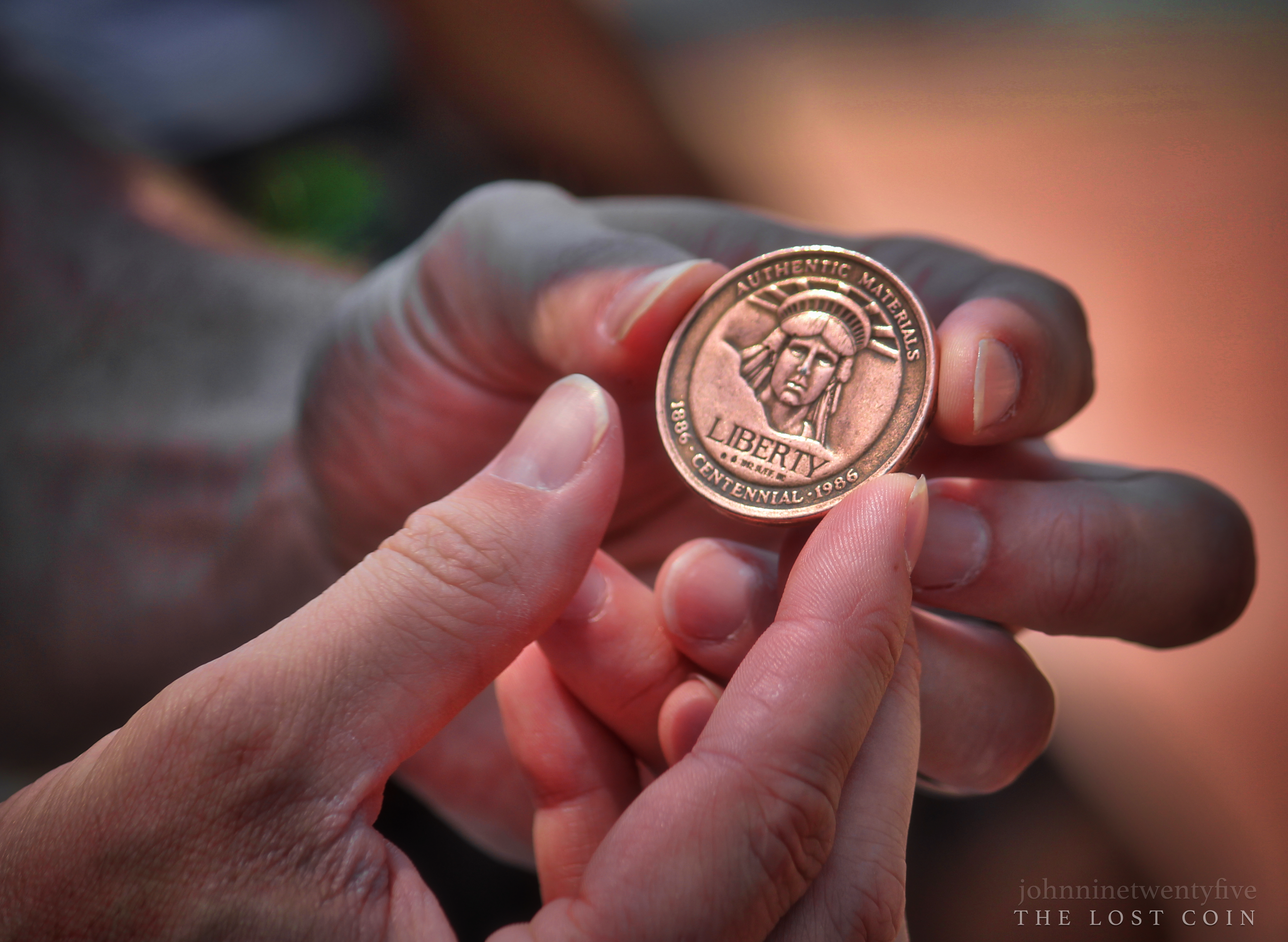
What would it be like for me? It would be like me losing my wedding ring. It is not the most expensive item I own, but I do regard it as my most valuable possession, for what it represents. Earlier this week, when our elderly and grumpy cat bit my hand and I had to have a tetanus shot and strong antibiotics, I was told at the Urgent Treatment Centre that I had to remove my wedding ring in case my hand swelled up. I was careful to put the ring somewhere safe.
Those who are lost from the church and faith in Jesus are therefore to be seen as immensely valuable to Jesus. It doesn’t matter whether they are former Christians or never-been Christians, Jesus values them hugely. Sometimes we are very dismissive of judgmental of people outside the church, and of course some of them can be hostile to us, but the Jesus who tells us to love our enemies puts a high value on them. They are precious to him.
Like us, they are made in God’s image. Like us, they are loved so much by God that Jesus died for their sins. They are treasured by God.
Before he wrote worship songs, Graham Kendrick was a Christian folk singer. One of his most popular songs from that period of his life was called, ‘How Much Do You Think You Are Worth?’
The first verse says this:
Is a rich man worth more than a poor man?
A stranger worth less than a friend?
Is a baby worth more than an old man?
Your beginning worth more than your end?
It goes on to consider various ways in which we might or might not value human life highly. Then it comes to a climax with these words:
If you heard that your life had been valued
That a price had been paid on the nail
Would you ask what was traded,
How much and who paid it
Who was He and what was His name?
If you heard that His name was called Jesus
Would you say that the price was too dear?
Held to the cross not by nails but by love
It was you broke His heart, not the spear!
Would you say you are worth what it cost Him?
You say ‘no’, but the price stays the same.
If it don’t make you cry, laugh it off, pass Him by,
But just remember the day when you throw it away
That He paid what He thought you were worth.
Every single person outside the church is valuable to God. The neighbour who annoys you. The child who keeps kicking his football at your fence. The greedy businessman. The politician whose policies you hate. The sex worker. The drug dealer. All these, as well as the ones we find it easy to like! The Cross tells us how much God values them.
And – while they are missing from God’s family, not only are they incomplete, so is the church.
It’s time to expand our networks, increase our love, and let faith prompt our courage.
[i] Kenneth Bailey, Poet & Peasant and Through Peasant Eyes: A Literary Cultural Approach to the Parables in Luke, 1983, p 157
 Big Circumstance