Mission in the Bible 5: The River from the Temple (Ezekiel 47:1-12)

I’m back, although not fully recovered yet. So here is a slightly shorter than usual Bible talk. Please excuse the regular water-sipping in the video!

Ezekiel 47:1-12

If you ask most average Christians what the main purpose of the Church is, the most popular answer is, worship.

But in this life that is at best an incomplete answer. It may be true in the life of the world to come, but right now there is more than worship to do as the Church. There is mission as well as worship.

Look in our passage how the living waters, the river of God, ultimately coming to symbolise the Holy Spirit, may start flowing at the Temple in Ezekiel’s dream but they don’t remain there. They flow out to bless the surrounding world.

Let’s look at the flow.

Firstly, in the river beginning at the Temple, mission starts at the place of sacrifice.

Ezekiel’s dream or vision is of a rebuilt Temple after the return of Israel from exile in Babylon. It was the centre of worship and the place of sacrifice. Therefore, this vision says that sacrifice is not just about the benefits for the personal worshipper. It goes out and beyond.

As Christians, we see this most clearly in the Cross of Christ. His death ends all need for sacrifices for sin. It was the ‘one full, perfect, and sufficient oblation’ as the Anglican Book of Common Prayer puts it.

We receive the benefits of the Cross when we come to faith and when we confess our sins every week. It is comforting and healing to know that this is the sign of God’s enduring and faithful love for us, the love that anchors our lives.

But for Ezekiel, the river of life begins at the place of sacrifice. And for Christians, the Cross also means that God will pour out his Spirit, and when he does the benefits of Christ’s sacrifice will be seen as not merely for us but for the whole world. It is what happened at the first Christian Pentecost. The Spirit falls, Peter preaches the Gospel, people of many nations hear, and thousands profess faith.

The first thing to remember, then, is that our blessings are not for us alone. That’s why I can’t stomach attitudes to church that sound like consumerism: what’s in it for me? What do I get out of this, never mind anybody else? Perhaps one of the classic examples is the older person in a declining church who says, ‘All I care about is that this church is here to see me out.’ That is a selfishness that cannot sit in front of the Cross of Christ.

Secondly, also in the river beginning at the Temple, we see that mission is launched in worship.

The river of God, the water of life, the Holy Spirit, does not simply bring joy, refreshment, and power to worship. The river flows from the place of worship to the world.

Again, there’s a challenge to our consumer attitudes to church. Worship is not just a personal bless-up. Yes, there are times when God blesses us graciously out of his sheer love for us. And sure, we often come in great need of blessing ourselves. But worship is not fundamentally a ‘getting’ experience. It is a giving experience. And it takes us beyond Sunday, into Monday and on from there.

What happens on Sunday is part of what equips us for Monday. That’s why an organisation like the London Institute for Contemporary Christianity came up with something called ‘This Time Tomorrow’, where a church member is interviewed in the Sunday service, asked what they will be doing in twenty-four hours’ time, and how people might best pray for what they will be doing then.

Or come with me to an American church that has, over the exit from the building, put the words ‘Servants’ Entrance.’ We go out from worship on mission in the world, showing God’s redeeming love in our words and our deeds.

The Holy Spirit is always thrusting us out into the world with the love of God. In the Gospels, after Jesus has his amazing spiritual experience at his baptism, he next goes into the wilderness. Some English translations rather tamely translate the Greek to say that the Holy Spirit led Jesus into the wilderness, but it’s actually more forceful than that. In at least one of the Gospels, the writer literally says that the Holy Spirit threw Jesus out into the wilderness. The ‘throw’ part is related to where we get our word ‘ball’, and it makes me think of a cricketer in the field on the boundary, positively hurling the ball all the way back to the wicketkeeper with considerable force.

You and I have come to worship today for a purpose. Yes, we may need some blessing or comfort, but what we haven’t come for is, so to speak, just to be tickled by God. We have come to encounter the Holy Spirit, who will energise us for our daily witness in the world.

Thirdly, in the river flowing from the Temple, we see that mission is to transform creation.

The river gets deeper and deeper, even to the point where no-one can swim in it. And for someone like me who can’t swim at all in the first place, that’s scary!

But it’s scary in a good way. What we see here is the awesome power of God transforming creation. Take the reference to life teeming in the Dead Sea, where the extreme saltiness is usually a killer. I visited the Holy Land in 1989, and on the day we went to the Dead Sea, some of my friends got into the water and floated – I’m sure you’ve seen pictures of that there. But for me, the salt was so intense even in the air that my eyes stung and I couldn’t even look in the direction of the water to see my friends, let alone take photos on my camera. And I am a keen photographer.

That’s how salty it gets there. So for Ezekiel to see the salt water become fresh and be filled with fish and other creatures is an image of a miracle.

Then look at the trees on the riverbank, which bear fruit every month rather than every year, whose ‘fruit will serve for food and … leaves for healing’ (verse 12). Reading that from a New Testament perspective makes us think of the way this passage is an inspiration for the Book of Revelation, where trees line not a river but the Holy City, and whose ‘leaves are for the healing of the nations.’

Yes, there are marshes where nothing changes, just as there are many who are resistant to the Gospel of God’s grace in Christ that calls everyone to repentance and faith in Jesus. But overall what we perceive in Ezekiel’s vision is a foretaste of the day when God will make the new heavens and the new earth, where everything that is broken in creation is healed, where relationships with God and one another are reconciled, and where all pain, war, and suffering is abolished.

What does that mean for us? It means that our encounter with the Holy Spirit through the Cross of Christ and through worship throws us out into the world as bearers of God’s love in a multiplicity of ways. The Holy Spirit sends us to call people back to God through Jesus. The Holy Spirit sends us to be people who heal relationships. The Holy Spirit sends us to be people of peace, not violence. The Holy Spirit sends us to bring good news to the poor and the wounded. The Holy Spirit sends us to restore broken creation, not because we are afraid of what will happen to this planet, but because we are full of hope about God’s good intentions for his creation.

When we come to worship each Sunday, the presence of God equips us for these tasks. When we leave gathered worship each Sunday, we go as commissioned officers of God’s kingdom.

Mission in the Bible 4: Singing the Lord’s Song in a Strange Land (Jeremiah 29:1-14)

Confession time: I’m exhausted from a 3:45 am start (long story) and so rather than write something completely new, knowing I’ve preached on this passage before and realising I wouldn’t say anything substantially different, I’ve used a sermon from 2018. The full text of that sermon is below, but it is longer than what I deliver in the video and will be delivering in church, because it uses one or two stories I’ve already deployed in this series.

Jeremiah 29:1-14

If you’ve ever watched The Wizard Of Oz – and I’m guessing most of you have – you’ll know the early part of the story where the whirlwind hits Dorothy’s home in Kansas. When it subsides, Dorothy looks around in bewilderment at the strange and different surroundings she finds herself in. She turns to her dog Toto and says, “Toto, I’ve got a feeling we’re not in Kansas anymore.”

Dorothy could be speaking for today’s church. We’ve been caught up in a social whirlwind, and when we’ve opened our eyes to survey the scene it looks nothing like that in which we grew up. The church used to be respected, but then we’ve gone through phases where first it was no longer a normal experience for people to attend church, and now there is a lot of outright hostility towards Christianity.

Similarly, you probably grew up in a culture where the ordained minister was a respected pillar of society. But again, no more. It is said that the average non-Christian man thinks that someone in a dog collar is either fleecing the flock for money or fiddling with kids as a paedophile.

Many of us would really like to cut to the end of the film where Dorothy finds herself back in home sweet home – there’s no place like it – but I have to say, that isn’t happening anytime soon. We must learn to be faithful disciples as a minority part of society. And actually that’s what most Christians down the centuries have had to do. To live as the majority in a society is less common.

Where do we go for help in being faithful to the Gospel in such circumstances? That’s where I find Jeremiah’s letter to the exiles in chapter 29 on his prophecy helpful. The armies of King Nebuchadnezzar have carted off the first lot of Jewish prisoners from Judah to Babylon. Those who found themselves as strangers in a strange land were disorientated and confused, like Dorothy. Had we read more of the letter, we would have heard Jeremiah warning them too not to believe the false prophets who were telling them it would all be over quickly and things would be back to the good old days. Instead, Jeremiah advises them how to live faithfully as aliens in a culture that is different from them and at times hostile.

I believe we can learn lessons for our discipleship today from Jeremiah’s model.

Firstly, it’s about where we live.

‘Build houses and settle down’ (verse 5a), says God to the exiles through Jeremiah.

I wonder whether you’ve noticed in recent years that the church is no longer regarded as the default moral voice in our nation. When Hallowe’en comes, it isn’t the church that is interviewed on BBC Breakfast about the content of the festival or the fears of elderly people about Trick Or Treat, it’s Age UK.

It’s no good pining for the good old days. This is where we are called to be missionaries, not back in some imaginary golden age of decades ago.

God called the exiles to do in some small way what his own Son would do later. What did Jesus say to the disciples in John 20? ‘As the Father has sent me, I am sending you’ (verse 21a). So how was Jesus sent? We have to go back from John 20 to John 1 and a verse that is too good to keep just for Christmas: ‘The Word became flesh and made his dwelling among us’ (verse 14a).

Note that: Jesus dwelt among the people. Although he occasionally ministered in synagogues, for most of the time he didn’t say, ‘Come here and listen to me,’ he did his ministry amid people’s lives. He made his dwelling among people – literally, he ‘tabernacled’. Remember that in the Old Testament the tabernacle was the portable sign of God’s presence. So, then, Jesus was the presence of God in the middle of life.

Eugene Peterson puts it like this in The Message: ‘The Word became flesh and blood and moved into the neighbourhood.’

Friends, Christian mission today can no longer be sustained (apart from a minority) on ‘Come to us’. We have to go to the world and live actively in it. We don’t want to swallow the values of the world, many of which are contrary to our faith, but we still need to live in the middle of the world, not in a Christian ghetto.

I once took the funeral of an elderly church member, and in preparation visited her relatives, who were not Christians. As they told me about the lady’s life, they told me, ‘Her whole social life was based on the church.’ I could tell they thought I would be pleased by that, but in truth I was deeply saddened. We can’t scuttle across the moat, pull up the drawbridge and cosy up behind the turrets of a Christian castle if we are to be faithful missionaries in a world where we are the minority.

Are we known positively, then, in our neighbourhoods and our networks? And what are we known for? We’ll come on to that in other points.

Secondly, it’s about where we work.

‘Plant gardens and eat what they produce,’ says God (verse 5b).

In his book on Jeremiah, Eugene Peterson (him again!) says this means we should ‘Become a productive part of the economy of the place’ (The Quest, p151).

It’s time to bin the idea that the only work worth doing is church work. Church work – such as mine – is support work for those in the frontline of mission as Christ’s representatives in the world, pointing to the Gospel in word and deed, living lives that are so puzzling and magnetic that people end up asking them why they do what they do.

So when a circuit steward’s wife once told me that her husband wanted to spend more time on the important stuff, like church work, rather than his occupation, I was saddened. This man worked in commercial shipping, helping to ensure that vital goods got from one port in the world to another. He also volunteered as a governor at his daughter’s school. Imagine doing both of those things in a Christlike way, being a good steward of resources but not ruthless, caring for the wellbeing of the school community and its place in the wider area, and so on. Imagine doing these things for Christ, occupying ground in his Name.

You can find all sorts of resources for churches to encourage this approach, not least from an organisation called the London Institute for Contemporary Christianity. Their ‘whole life discipleship’ project includes all sorts of courses and resources to help Christians be fruitful on the frontline. It includes material to help preachers and worship leaders support this work.

One of the stories that set them on their way was that of a schoolteacher who also taught in Junior Church on a Sunday. “Why does my church pray for my Junior Church work,” she asked, “when I deal with maybe a dozen children there, but it doesn’t pray for my Monday to Friday work when I get the chance to influence many more children?”

Any church can start supporting people in this. One of LICC’s ideas is called ‘This Time Tomorrow’. You take five minutes out of Sunday services to interview someone from the congregation about where they will be and what they will be doing twenty-four hours later. You ask them what they most need prayer for, and include that in the service. It’s simple. And it is as applicable to retired people as to those still in paid work, because you can include what people do in the community and in their leisure activities.

Remember, church doesn’t stop when we leave this building on a Sunday lunchtime. As an Australian Christian called James Thwaites puts it, how far apart from each other do we have to be in order no longer to be church? Five yards? Five miles? No: we never stop being the church. It’s just that sometimes we are the church gathered, and sometimes we are the church dispersed. All our work in the world is Christian work.

Thirdly, it’s about where we flourish.

The next thing God says is, ‘Marry and have sons and daughters; find wives for your sons and give your daughters in marriage, so that they too may have sons and daughters. Increase in number there; do not decrease.’  (verse 6)

Whoa! Wait a minute! At other times, God’s people are told to be very careful about who their sons and daughters marry. Now, they’re meant to settle down in a pagan land. No wonder Psalm 137 asks, ‘How can we sing the Lord’s song in a strange land?’

Our trouble today is that having been part of the majority culture where we haven’t had to fight for the place of our faith in public life, we now find ourselves singing the Lord’s song in a strange land, and the temptation is to be negative and self-pitying about it. But God says it’s possible for his people to flourish as minorities. Remember, that was certainly the story of the Early Church, too, both in Israel and in the wider Roman Empire. Why should it not be true for us, too?

In Mark chapter 6 we have the story of the disciples rowing their boat on the late at night, straining at the oars in the fourth watch of the night. Jesus comes to them, walking on the water. He thus comes to them from outside the boat.

Now given that the Early Church also read the boat symbolically, as standing for the Gospel community, maybe Jesus was coming to them from outside the church, so to speak. Maybe he had already been at work outside their community before he came to them in the dark of night.

Could it be that our task in order to flourish involves finding out where Jesus has gone ahead of us in the world by his Spirit, and we join in with him there? I’m not saying that people outside the church don’t need to become Christians, I am simply saying that Jesus prepares the way and we catch up.

Our children started school while we were in my last circuit. When you are a parent of primary school children you have a great opportunity to flourish as Christians in the community. Debbie and I made it our point to lurk with intent at the school gate. We made friends with other families. I told my churches not to expect me to be at my desk at 9 am for that reason. Some of them didn’t like that, because they thought the minister was there to be their private chaplain, but we persisted.

In doing that, and letting people know our door was always open and there was always water in the kettle for tea and coffee, we befriended three young mums who went through horrendous divorces. One husband went off with his wife’s best friend. Another drank away all the family income, even spending time in the pub when it was the birthday party for one of his three daughters. That mum and the little girls nearly joined the church.

When we announced our decision to leave, some of the church people cheered, but some of the community wanted to raise a petition to keep us – including our next door neighbour, who was totally clueless about church. On the last day of term that July, twenty of them threw a surprise picnic for us in the local park.

We may not have flourished in the church there, but we certainly flourished as Christians in the community.

Fourthly and finally, it’s about where we bless.

‘Also, seek the peace and prosperity of the city to which I have carried you into exile. Pray to the LORD for it, because if it prospers, you too will prosper.’ (verse 7)

Contrast that with the ways today’s church often reacts to the decline of Christianity in the West and the rise of ideologies we dislike. Either we claim that God is bringing revival soon (but remember God told Jeremiah the prophets who were saying that in his day were false prophets) or we rail against evil, and think we’re being prophetic in that way.

But look what happens here. Rather than condemn Babylon, God calls his people to bless it! I’m not calling us to ignore unrighteousness and injustice, but I am asking this: what difference would it make if Christians were known as a people of blessing?

The trouble is, there are plenty of indicators to suggest that we are not known as a people of blessing. If you ever ask an MP who they don’t want to send them letters, I’m afraid that often the answer is ‘Christians’. We are known at Parliament for our complaining and our judgmentalism.

In America, it’s commonly known in the catering industry that the people who moan the loudest and tip the least at restaurants are the Christians.

How exactly does that reputation stack against New Testament verses like these?

‘Love your enemies and pray for those who persecute you’ (Mt 5:44)

‘Bless those who persecute you; bless and do not curse’ (Rom 12:14)

‘Do not be overcome by evil, but overcome evil with good’ (Rom 12:21)

What would it look like if we were the people who were always wondering what good we could do unconditionally for people? If we were the people who – rather than complaining – were instead always seeking to put in a good word for someone, or leaving a surprise ‘thank you’ gift for somebody? Do we encourage our elected representatives? Do we tip generously at the restaurant, realising that the waitress is a young student trying to make ends meet on her student loan?

What if in the wider society we were getting involved in those civic and political decisions that affect the wellbeing of our communities, as councillors or business people?

The Argentinean preacher Ed Silvoso has a wonderful way of putting this. He says, ‘In the celestial poker game, a hand of blessings always beats a hand of curses.’

So go – and bless your Babylon. See what happens when Christians start blessing. Wait for the questions about why you do this. And then speak of the One who calls you to bless.

Christmas Day Morning Service

COVID-19 and Tier 4 (UK readers will understand) mean no gathering in our buildings on Christmas Day, so I have put together a video service as a substitute.

Thanks go to many groups who have made their material available for free at this time, including Engage Worship, the London Institute for Contemporary Christianity, and the Trustees for Methodist Church Purposes.

A very Happy Christmas to you all, even in our current straitened circumstances.

Sermon: Life On The Frontline 5: The Frontline Cry (Kingdom Dreamers)

Whoops. I seem to have forgotten to upload two or three sermons lately. Sorry.

Anyway, here is tomorrow morning’s sermon as I preach again in the Life On The Frontline series at Knaphill Methodist Church.

Matthew 6:9-13 with Isaiah 29:13-24

Heaven
Heaven by Ozan on Flickr. Some rights reserved.

While walking down the street one day a corrupt Senator was tragically hit by a car and died. His soul arrives in heaven and is met by St. Peter at the entrance.

“Welcome to heaven,” says St. Peter. “Before you settle in, it seems there is a problem. We seldom see a high official around these parts, you see, so we’re not sure what to do with you.”

“No problem, just let me in,” says the Senator.

“Well, I’d like to, but I have orders from the higher ups. What we’ll do is have you spend one day in hell and one in heaven. Then you can choose where to spend eternity.”

“Really? I’ve made up my mind. I want to be in heaven,” says the Senator.

“I’m sorry, but we have our rules.”

And with that St. Peter escorts him to the elevator and he goes down, down, down to hell.

The doors open and he finds himself in the middle of a beautiful golf course. In the distance is a clubhouse and standing in front of it are all his friends and other politicians who had worked with him. Everyone is very happy and in evening dress. They run to greet him, shake his hand, and reminisce about the good times they had while getting rich at the expense of the people. They played a friendly game of golf and then dine on lobster, caviar and the finest champagne.

Also present is the devil, who really is a very friendly guy who is having a good time dancing and telling jokes. They are all having such a good time that before the Senator realizes it, it is time to go. Everyone gives him a hearty farewell and waves while the elevator rises.

The elevator goes up, up, up and the door reopens in heaven where St. Peter is waiting for him, “Now it’s time to visit heaven…”

So, twenty-four hours passed with the Senator joining a group of contented souls moving from cloud to cloud, playing the harp and singing. They have a good time and, before he realises it, the twenty-four hours have gone by and St. Peter returns.

“Well, then, you’ve spent a day in hell and another in heaven. Now choose your eternity.”

The Senator reflects for a minute, then he answers: “Well, I would never have said it before, I mean heaven has been delightful, but I think I would be better off in hell.”

So St. Peter escorts him to the elevator and he goes down, down, down to hell…

Now the doors of the elevator open and he’s in the middle of a barren land covered with waste and garbage. He sees all his friends, dressed in rags, picking up the trash and putting it in black bags as more trash falls from above. The devil comes over to him and puts his arm around his shoulders.

“I don’t understand,” stammers the Senator. “Yesterday I was here and there was a golf course and clubhouse, and we ate lobster and caviar, drank champagne, and danced and had a great time. Now there’s just a wasteland full of garbage and my friends look miserable. What happened?”

The devil smiles at him and says, “Yesterday we were campaigning. Today, you voted…”[1]

Now, I find that joke rather delicious as we approach a General Election in six months’ time. But I didn’t tell it for political reasons this morning. I told it, because it assumes the traditional teaching that our destiny for eternity is either heaven or hell.

And that’s a mistake. The New Testament doesn’t teach that.

Really? Did you hear that right? The minister is saying that heaven or hell is not our eternal destiny?

Well, you did hear me correctly, but I still believe in ‘heaven and hell’. It’s just that I believe – as Tom Wright has put it – that ‘heaven is important, but it’s not the end of the world’.

N T Wright
The Rt Revd Tom Wright with new book by Gareth Saunders on Flickr. Some rights reserved

What the New Testament teaches is this: when we die, we rest in either Paradise or Hades. Jesus tells the repentant thief on the cross, ‘Today you will be with me in Paradise.’ In the parable of the rich man and Lazarus, he envisions the evil wealthy man as suffering in Hades, the place of the dead. These are resting places, or waiting rooms, until our final destiny.

And our final destiny is not to float on clouds, plucking harps. The end of all things in the New Testament is God making all things new – the heavens, the earth, and our bodies. God’s kingdom in all its fullness constitutes a whole new creation. That’s why at the Last Day, we shall be raised from the dead physically. The idea that the physical and material doesn’t matter, and all that matters is our ‘soul’ is not originally a Christian idea: it comes from Greek philosophy, and from heresies that the early Church rejected. It’s why C S Lewis said that ‘Christianity is the most material of all religions’.

Now plug all that into the Lord’s Prayer, and especially into the lines

your kingdom come,
your will be done,
on earth as it is in heaven. (Verse 10)

The first line – ‘your kingdom come’ – is explained by what follows – ‘your will be done, on earth as it is in heaven.’ When we pray for God’s kingdom to come, we pray for his will to be done here on this earth, just like it is in heaven, his dwelling-place. We are longing for that kingdom where heaven and earth have been made new, and human bodies made new in resurrection, and where God’s will is done as fully and wholeheartedly as it is in his immediate presence.

So if we want to pray for the coming of God’s kingdom, we do something like this. Knowing what we do of God’s will, we imagine what our world as we know it would look like if people were doing the things that give God pleasure.

That’s effectively what Isaiah does in chapter 29 that we heard read before the Lord’s Prayer. Isaiah imagines the dry land of Lebanon becoming fertile, even like a forest. He imagines deaf people hearing God’s message, and the blind seeing again. He envisions the humble and the needy having cause for great joy, instead of being trampled down by the unjust. In fact, he sees a time when such ruthless people will vanish, when mockers will be no more, and when there will be no more evil people manipulating the justice system to their own twisted ends. He sees shamed people standing in awe of God, and wayward spirits and habitual moaners accepting instruction (verses 17-24). All this imagining becomes a vision for the future, and therefore a captivating image to stimulate prayer, and ask God to bring these things about.

Now let’s plug all this into our lives today, because we can do something similar. And we need to, because one aspect of the poor reputation Christians often have today is that we are a bunch of moaners. We are the people who are only known for the things we are against, the things we complain about. One reason Christian MPs can have a hard time in Parliament is because they and their colleagues are subject to hectoring letters and flame-filled emails.

So – rather than just bewailing all that is wrong with our world (and I wouldn’t deny there is a lot that is at odds with our faith) – why don’t we instead start exercising a prayerful, holy imagination to conceive how we would long the world to be. Rather than railing against the way people use the Internet in negative ways, such as verbally attacking others, or accessing pornography, ask in the presence of God what the Internet would look like if it were used in a pure and kind way. Rather than sitting around as barstool Prime Ministers declaiming against a society that is obsessed with money, possessions, and buying the latest thing, prayerfully consider what our culture would look like if spirituality and relationships were dominating values, and the poor were not all derided as scroungers.

In short, for Christians to pray ‘Your kingdom come, your will be done on earth as it is in heaven’ is to serve notice on the ‘moaning minnies’ version of religion that we often serve up, and commit instead to imagining a better world, praying for it, and working for it in the power of the Holy Spirit. I believe that’s what Jesus wanted of his followers when he taught them the Lord’s Prayer.

And there is a specific application to make in this particular sermon and teaching series that we are following. We’ve been thinking about what we’ve called our ‘frontlines’, those places where we are no longer cossetted among our fellow Christians, but interact with those who don’t share our faith. It may be our workplace, our families, our next-door neighbours, or where we spend our leisure time, from the health club to the U3A.

Crawley U3A poetry group
Crawley U3A poetry group by George Redgrave on Flickr. Some rights reserved.

These locations, too, are often far from what we would ideally like them to be. Much as we enjoy the friendship of others there, these places may be centres of gossip, sharp practice, back-biting, and unjust behaviours. Even if it’s not that bad, they can become mundane and meaningless, and hence the parody of Snow White and the Seven Dwarfs that we sometimes use to describe our paid working life: ‘I owe, I owe, it’s off to work I go.’

So here we choose not simply to carp about the things that annoy us, or stay permanently on a downer about the people who get our backs up. Instead, we employ a holy imagination, and ask ourselves this question: ‘From what I know about Jesus’ teaching, what would this environment look like under the reign of God?’ And then we dream what it would look like.

And having established our ‘kingdom dream’, we then pray it: ‘Your kingdom come, your will be done on earth as it is in heaven.’ Little by little, we shall see signs of transformation as we do so.

Now maybe asking us all to be dreamers – even kingdom of God dreamers – will not go down well in some quarters. Dreamers have a bad reputation. They are detached from reality; they are not practical people. And we have seen worldly dreamers who garner a bad reputation. You only have to think of John Lennon singing, ‘You may think I’m a dreamer’ in his execrable song ‘Imagine’ – a song where he exhorts us to ‘imagine no possessions’, all the while being filmed singing the song in his Ascot mansion. Any dream won’t do.

But kingdom dreams are wonderful things. It isn’t for nothing that the Bible often links dreams with visions. They can give direction. Used prayerfully, they can lead to transformation.

So – er – imagine that you are in Washington DC, and a great crowd has assembled to hear you speak. And as you speak your prepared words, you hear the Gospel singer Mahalia Jackson call to you, “Tell them about the dream!”

And you change your speech on the hoof to tell them about the dream. It won’t fire you for much longer, because soon you will be dead. For Mahalia Jackson actually called out, “Tell them about the dream, Martin,” and you are Martin Luther King, and your speech becomes “I have a dream.” It’s a kingdom of God dream, and it will inspire many to take the torch relay on from you.

This week, then, when you leave the service, I am sending you out to be dreamers. Dream what your frontlines would look like if they were under the kingdom of God, and then pray that God’s will may be done there.

Yes – dream sweet dreams. And change the world.


[1] From the Grove Books weekly email, 10th November 2014.

Update

No new sermons here for the last two weeks, I know – yesterday week was an all age service, and yesterday I had a Harvest Festival where I repurposed an old sermon. Yesterday at Knaphill, one of our Local Preachers, Rob Gill, preached on the second instalment of the Life On The Frontline course. Hopefully the audio should be up here before too long.

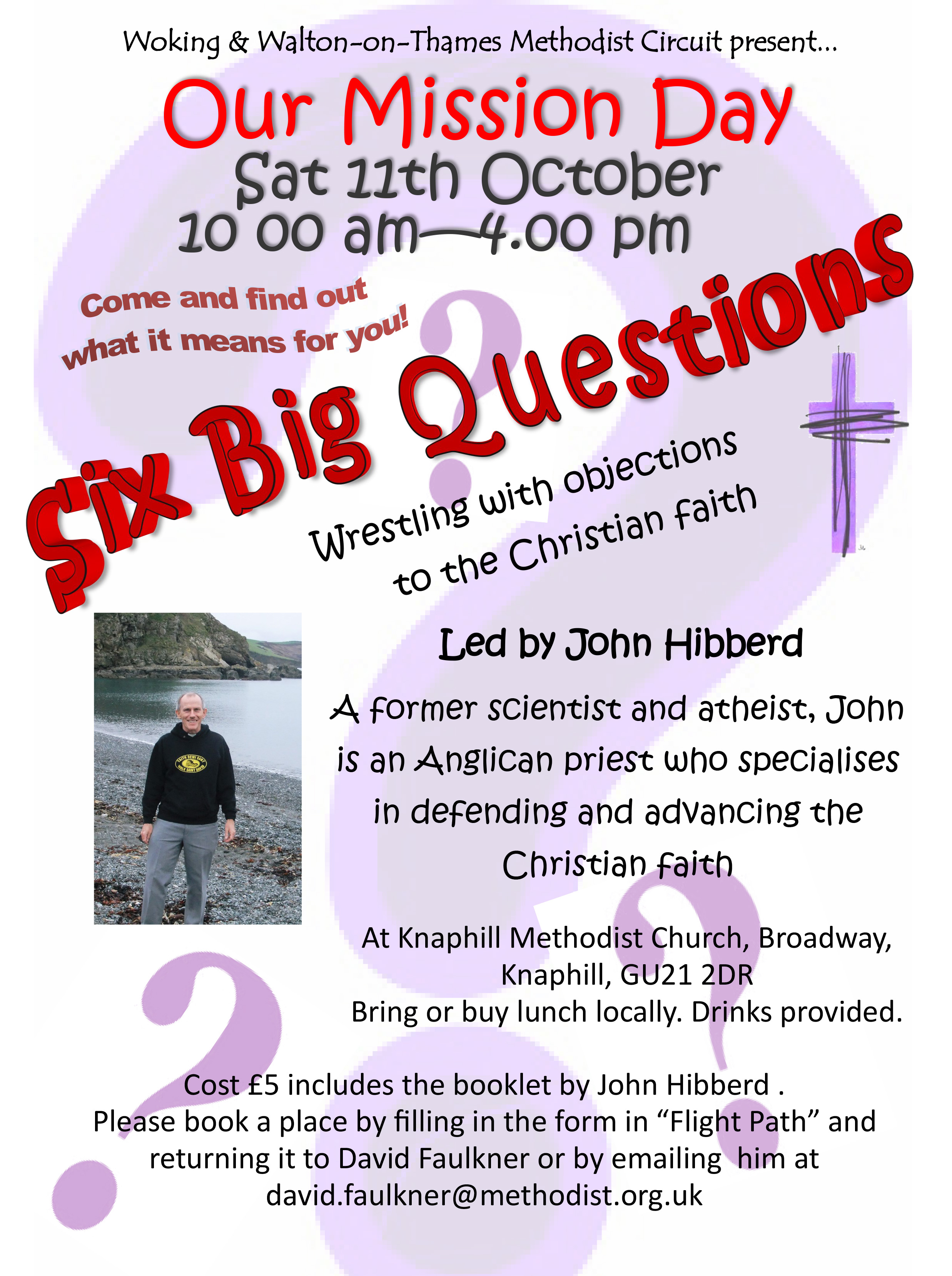
And next Sunday, I won’t be preaching at all. We have a guest preacher at Knaphill, my old friend John Hibberd. He will be following up a day conference we are having on Saturday by tackling the question of suffering.

But why not come to the day conference itself? Details are below. You can email me on the address given, and pay on the day.

Mission Day

Sermon: Life On The Frontline – 1. The Frontline Call

Matthew 28:16-20

LICC Life On The Frontline DVD cover

This morning we start the series of sermons that accompanies our midweek course ‘Life On The Frontline’ that began on Wednesday. And I guess that to use such an image as a ‘frontline’ might need some justifying. If we use the word ‘frontline’ in ordinary speech, we might think of a war zone. And while it is true that Christian mission participates in a spiritual war, that conflict is not with human beings but with spiritual forces. We have no desire to be aggressive towards those who do not share our faith, and those models of evangelism that contain elements of that are styles that we place at a distance from our convictions.

But we do come to a frontline in the sense of a boundary or an interface. Our spiritual frontlines are the places where we connect with those who do not follow Jesus Christ. And that’s what we are exploring in the course and the sermon series.

So this morning’s first sermon has the title of ‘The Frontline Call’. And we get down to some basics about that call using this famous passage that is often called ‘The Great Commission’. Four questions, in fact, about the frontline call: who, where, what and how?

The first question, then, is who? That is, who receives the frontline call? Verse 16 tells us it is ‘the eleven disciples’.

Note those words very carefully: ‘the eleven disciples’. Eleven being one less than twelve, because Judas Iscariot has taken his own life. These were ‘the twelve’. This is the group that Jesus had designated as his apostles. There were twelve of them in order to designate the connection with the twelve tribes of Israel, but now they are reduced to eleven.

And they’re not even called ‘apostles’ here. They are simply ‘disciples’. They don’t come here with special status, but as representatives of all Jesus’ followers. Disciples, not merely apostles, receive the frontline call.

Therefore the call echoes down the centuries to you and me as Jesus’ disciples today. Disciples are the ones who learn from the master, and that’s us. We have so much more to absorb about the way of Jesus. The Greek word for disciple – as I said on Wednesday night – may be paraphrased as ‘apprentice’. We are learning the trade. We are not master craftsmen.

In short, the frontline call, in coming to disciples, comes to a group of people who don’t have it all together. We do not have the spiritual life sussed, we just know that Jesus is the way to go, and we are imperfect followers of his Way.

You might think that Jesus would only call fully trained people to the frontline of his kingdom mission, somewhat in the way that the church doesn’t let a minister loose on a congregation until he or she has had two or three years’ training, or the way a doctor or solicitor has to study for several years before qualifying and practising.

But Jesus has not called a professional élite. He has called ordinary people. While there is a place for certain Christians to be specially trained in understanding other views of life and responding with Christian answers, this is not what Jesus requires of most followers. He simply calls his everyday followers to witness to him in word and deed. We bear witness through our deeds, and we bear witness through our words when we describe what it is like to follow Jesus.

So let no-one here rule themselves out of this high calling. It is for every Christian. It is the privilege of every disciple to let the world see their allegiance to Jesus through their lifestyle and their speaking.

The second question is where? What is the location of our frontline? I know we’ve already answered this in general terms at the beginning of this sermon, but let’s look closely at this passage. Verse 16 again:

Then the eleven disciples went to Galilee … (italics mine).

The resurrection appearances of Jesus (of which this is one) happen in both Galilee and Jerusalem. When in Jerusalem, they are at the centre of religious and political power. But here, the meeting is in Galilee, far from those corridors of power, far from the sort of place that features in the title sequences of news bulletins.

Inside The Hobbit Hole Of Bilbo Baggins
Inside The Hobbit Hole Of Bilbo Baggins by Trey Ratcliff on Flickr. Some rights reserved.

They are back home, in familiar surroundings, even if – as in The Lord Of The Ringsthe Shire can never be the same. They are back where they began, the place of family and work.

And it is in our ‘Galilee’, our familiar surroundings, that we find our frontlines. Sure, the Gospel will go to ‘all nations’ (verse 19), but it starts in our daily territories. For some of us who share households with those who do not share our allegiance to Christ, it begins in our homes. For many of us, it is our place of work. It may well also be the school gate or the place where we spend our leisure time – the fitness club, the Women’s Institute, the U3A, the ground where our favourite sports team plays, and so on. Our Galilee may be in our relationships with our neighbours, next door, down the street, and in our community. It may be in our involvement with local affairs, as we get involved with residents’ associations or in lobbying local councillors. It may be the library, the hospital, or even the dentist’s waiting room. I think you get the idea.

Whatever our regular images of the missionary being the one who goes to ‘darkest Africa’ – as if forever defined by “Doctor Livingstone, I presume” – the fact is that Jesus commissions missionaries for Galilee and Knaphill, St John’s and West End, Pirbright and Bisley. We need not be door-to-door types who thump the Bible like a percussion instrument. But we are called to people who live out publicly our apprenticing in the Jesus way, and who give a reason for the hope we have in him.

The third question is what? That is, what are we meant to be doing on our frontlines? Jesus says,

All authority in heaven and on earth has been given to me.19 Therefore go and make disciples of all nations, baptising them in the name of the Father and of the Son and of the Holy Spirit, 20 and teaching them to obey everything I have commanded you. (Verses 18b-20a)

We have something to do, due to Jesus’ authority. But what? The normal order in which our English translations put these words lead us to think that the key idea is ‘go’. But in fact ‘go’ is ‘going’ in the Greek, and it parallels ‘baptising’ and ‘teaching’. These verbs ending in ‘ing’ (or ‘gerunds’ for grammar fans) serve the main verb, which is actually ‘make disciples’.

We are placed on our frontlines in order to make disciples. We who are already disciples are meant to reproduce! But, like ordinary human reproduction, it doesn’t happen overnight. Even on the rare occasions when we seem to witness an instant response, like the way the first disciples ‘immediately’ follow Jesus in the Gospels, we usually find that God has been on the case for a long time. And we are in this disciple-making enterprise for the long haul. We know it will take time for our witness to have an effect. People may not be interested. They may tease or even despise. We won’t always know at first when some people have been set thinking by our lifestyle or our words. Only after a while may tentative questions surface. But we stay at our post.

What does this boil down to? Simply this: that disciples make disciples. There are those who have a special gift in this area, and sometimes we call them evangelists. But even though we are not all evangelists – someone has suggested that perhaps about ten per cent of church members have an evangelistic gift – all disciples are witnesses. Wherever you are this time tomorrow, it is a place where God has put you to live before others as a disciple of Jesus, not only for the sake of your own holiness but also for the sake of those you meet.

Many years ago, my home church once conducted a survey where they asked members what the main calling of the church was. Back came the resounding and apparently uncontroversial answer: worship. But Jesus’ words here show that it isn’t as simple as that. Worship is our purpose when we gather, and yes our lives are meant to be acts of worship, too. But if we worship when we are together, we disciple when we are dispersed.

The fourth and final question is how? Exactly how do we set out making disciples? This is where we come back to that question of the verbs. If ‘make disciples’ is the main verb, then ‘going’, ‘baptising’, and ‘teaching’ are the verbs that explain the ‘how’.

Just as we are learners and apprentices of Christ, so we invite others to learn his ways. Of course we have to ‘go’ to those frontlines in order to do that – it’s a delusion to think people will come to us. And when we do, we ‘[teach] them to obey everything [Jesus] has commanded [us]’. We don’t just do that after they commit to following Jesus, we can do that as part of the outworking of our missionary call. We can say, “I believe Jesus taught us to approach life this way. Why don’t you try it and see what happens?”

So why not think of all the life issues that we might discuss with our friends – how we cope with family matters, finances, major decisions, moral crises, conflicts at work, relationship breakdowns, and so on. Did Jesus have any wisdom to offer on any of these? Of course he did. Without turning into a Bible-basher, is it not possible to say, “What helps me in these difficult circumstances is the teaching of Jesus, when he said …” Just make it conversational rather than preachy. Say it in such a way that someone can respond. See it in the way that  you can go into Marks and Spencer and try on the clothes you’re thinking buying in the fitting rooms. We can invite people into discipleship by suggesting they try on the teaching of Jesus for size.

The lonely office conversationalist
The Lonely Office Conversationalist by Eric Domond on Flickr. Some rights reserved.

The baptising? If we do that on the frontline, I guess that would be a real ‘water cooler moment’! But seriously, that’s dangling before us the goal. However many people regard it today, baptism began – and still continues in many places – as the sign of irrevocably breaking with the past and following Jesus. It’s the mark of discipleship. It’s why we seek to show and share God’s love on our frontlines, living out our faith before the world.

I think I’ve told before the story of my friend who lost his son to cancer. The young man was diagnosed at around the age of seventeen, and died when he was about twenty. Some months after the death, my friend took a phone call. It was his son’s consultant.

“I’m ringing to invite you to my confirmation service.”

My friend had no idea she was religious.

“I wasn’t,” she said, “but I watched how your son lived out his faith in the face of his cancer, and now I am a Christian.”

You know, I would love not to be repeating that story. Not because it isn’t wonderful – it is. I would prefer not to repeat it, because there were so many similar stories to tell of what happens when we live intentionally as disciples on our frontlines. I’m telling some at the Wednesday meetings for this course. This last week I told one about the witness of a grandmother to her daughter and grand-daughter. I have another one stored up about a Christian woman in the banking industry who changed her company’s attitude to those in deep debt.

But wouldn’t it be great if there were some Knaphill stories to add to the collection? Let’s get to our frontlines – because that, after all, is where Jesus promises to be ‘with [us] always, to the very end of the age.’ (Verse 20b)

Yesterday’s Sermon: Shaped By The Covenant Meal (Covenant Service Sermon)

Mark 14:22-25

What am I reading@
What Am I Reading? by John on Flickr. Some rights reserved.

Henri Nouwen was a much-lauded Dutch Roman Catholic priest. A brilliant man, he held doctorates in both psychology and theology, and rose through various academic posts to become Professor of Pastoral Theology at the prestigious Yale University. He later taught at Harvard, so effectively he taught at the American equivalents to our Oxford and Cambridge. He also had the common touch, and wrote popular books about the spiritual life that sold in quantities that delighted his publishers. We studied one of them, The Return Of The Prodigal Son, in an ecumenical Lent course here in Knaphill.

But for all his acclaim, Nouwen was uncomfortable. It wasn’t until he joined the staff at L’Arche, an international community for people with developmental disabilities, that he felt he was living a truly authentic Christian life.

In looking for a model of how to live the spiritual life in a secular world, he settled upon the Last Supper, and wrote about it in a wonderful book called Life Of The Beloved. What he said there so struck me when I read it that I want to use his framework as we consider our covenant with God again this year. The covenant meal – Holy Communion – provides a structure for the covenant life.

Essentially, what Nouwen is saying is this: what Jesus does with the bread, he does with us. Hear again verse 22:

While they were eating, Jesus took bread, and when he had given thanks, he broke it and gave it to his disciples, saying, ‘Take it; this is my body.’

Note the four actions Jesus does with the bread: took, gave thanks, broke, and gave. Jesus does the same with us, says Nouwen: he takes us, gives thanks for us, breaks us, and gives us.

If that seems a bit far-fetched, then bear with me for the sermon, but also listen to these reflections on the passage before us from Tom Wright:

This Passover-meal-with-a-difference is going to explain, more deeply than words could ever do, what his action , and passion, the next day really meant; and, more than explaining it, it will enable Jesus’ followers, from that day to this, to make it their own, to draw life and strength from it. If we want to understand, and be nourished by, what happened on Calvary, this meal is the place to start.[1]

So, on the day when we once again ‘make this covenant our own’, let us do so by making the covenant meal our own.

Pastoral Baguettes
Pastoral Baguettes by Kurmann Communications on Flickr. Some rights reserved.

First of all, Jesus takes the bread and he also takes us. In our communion service, we represent this simply by unveiling the elements, removing the white cloth. Other traditions process the bread and wine to the table. I don’t do that, and I won’t bore you with the reasons now, but note that we simply take the bread.

And Jesus takes us, too. He takes the initiative to choose and call us. Yes, we made a choice to follow him, but it only came because before we ever thought of him he thought of us, and in his love reached out to us.

We start, then, from a perspective not only of having been chosen by Jesus but in that choosing being taken and held in his hands. Whatever happens from here, we are not alone but in his hands. The covenant life starts in a safe place. As we come to renew our covenant today, we are coming to the One who promises never to leave or forsake us.

So we start from that point of security. Like the child held by the parent, we are safe. Like the friend giving us a hug, we are reassured. Like the beloved held by the lover, we know we are loved. This is the beginning of the covenant. On Covenant Sunday, I am always thinking about those who are nervous about making promises to God which amount to an abandonment to his will and wonder what that would mean. But I come back to the fact that we begin in this place: Jesus takes us. Covenant starts in a good place, not a scary one.

Give Thanks!
Give Thanks! by Kevin Dooley on Flickr. Some rights reserved.

The second action of Jesus is that he gives thanks for the bread – and he gives thanks to the Father for us, too. Again, we might feel uncomfortable, but stay with me to think about this.

One of my nephews used to get so impatient about when a meal was due to arrive that by the time the plate was put in front of him, he was famished. Not wanting to wait a second longer than necessary to eat, he would sometimes abbreviate grace to three words: ‘Father God, Amen.”

Our custom of saying ‘Grace’ derives from the Jewish custom of giving thanks to God for food, and for all sorts of aspects of the material creation. Here, for example, is a traditional prayer said after a meal:

Blessed are You, L-rd our G-d, King of the universe, who, in His goodness, provides sustenance for the entire world with grace, with kindness, and with mercy. He gives food to all flesh, for His kindness is everlasting. Through His great goodness to us continuously we do not lack [food], and may we never lack food, for the sake of His great Name. For He, benevolent G-d, provides nourishment and sustenance for all, does good to all, and prepares food for all His creatures whom He has created, as it is said: You open Your hand and satisfy the desire of every living thing. Blessed are You, L-rd, who provides food for all.

The thanksgiving for the unleavened bread at Passover (and I am assuming Jesus was celebrating a form of Passover with his disciples at the ‘Last Supper’) begins in similar vein. The sense is maintained that created things are good, they are a gift from God, and have a divinely ordained purpose in the world. Therefore God is praised for his good gifts.

And in Covenant, God is praised for his good gift of you. God has made each of us in the church as a gift to one another and a gift to the world. For this reason, Jesus praises the Father for us. It is not that he praises us, but he praises God for us.

Even so, some people find this hard to accept. They feel worthless and insignificant, small and wracked by sin. How can Jesus praise God for me, they ask?

He can, because of God’s work in you. And God has some special purpose for you. He has given you gifts and talents, he has placed you in certain families, neighbourhoods, workplaces, and leisure, and for that Jesus is thankful. However much the holiness of God cannot abide sin, there is no picture here of an angry God, only of the Son of God who is pleased that you are God’s good gift. So rejoice that you are seen this way.

Break Free
Break Free by Nick Wheeler on Flickr. Some rights reserved.

Jesus’ third action is to break the bread, and also break us. Here we may feel we are getting closer to the challenging, if not severe, side of the Covenant that intimidates some church members into not attending this service each year.

At one level, though, this isn’t a fearful picture. For the one bread to be distributed, it has to be broken. And for the one church to be sent on the mission of God, she has to be dispersed to different places. Some of this is just a natural expression of what happens at the end of worship when we are dismissed to serve Christ in the world. It’s like the church building which had a slogan over the exit door: ‘Servants’ Entrance’. We go from here to our separate localities as Christ’s witnesses. We are the church gathered and we are also the church dispersed.

But in another way, being broken by Jesus is part of that submission to whatever he needs to do in our lives. I am not talking about something so extreme as military training, where the civilian is destroyed in order for the soldier to emerge, although we should take seriously the call to a disciplined life as Christians.

And in this respect, Jesus uses the circumstances of life that he allows us to face, or even perhaps brings into our lives, to shape us into better people. However, those life situations are not always pleasant. They may be little different from what people who do not share our faith also encounter, but in our case, Christ allows brokenness to be a tool that leads us to pursue a life that is more like his.

So even in the joy of a marriage, we come face to face with just how self-centred we are. In the loss of something important, we confront the call to decide exactly where our faith and trust lie.

Christiane Caine
Christine Caine by Willow Creek D/CH on Flicr. Some rights reserved.

This week I read an extraordinary testimony by the Australian preacher Christine Caine. An energetic pastor, evangelist, and campaigner against human trafficking, she was diagnosed with thyroid cancer and other conditions in her body. I would love to read you the whole testimony, but it’s long, and I can only focus on a couple of brief parts. Firstly, here are just a few of the words she said to her surgeon after her diagnosis:

Leslie, it’s okay. Cancer is not terminal. Life is terminal. I will live every second of every day that God has ordained for me to live on this earth, and then I will go home. … We are on a battlefield, not a playground; it’s time to go to war. You tell me what to do medically, and I will fight this spiritually, and whatever happens, Jesus will have the final victory.

And then I note how she said,

I wanted to be delivered FROM this situation, but ten weeks later, I discovered God wanted me to walk THROUGH this.

Why walk through this? Because it brought her into contact with other cancer patients. Lonely, fearful people. Those who had lost their hair, were marked with radiation lines, bruised by needles, or unable to walk without assistance. A father wheeling his son in for treatment. In her broken condition, she could minister. As she says,

I wondered why so many people wanted a platform ministry when there was ministry waiting in hospital waiting rooms all over the world.

How many are waiting for us to go to them while we wait for them to come to us?

Waiting rooms are waiting for us.

What are you waiting for?

And this leads me into the fourth and final action of Jesus: he gives the bread, and he gives us, too. That’s where we’ve been heading from the beginning. Just as the bread is destined to be given, so are we. Chosen and cherished by God in his taking of us and Christ’s thanksgiving for us, the breaking that then ensues in the knowledge that we are so loved is in order for us to be distributed into the world.

Just as ancient Israel had to learn that her special covenant with God was not a matter of élite status but in order to bless the world, so the same is true of our ‘new covenant’. It does grant remarkable status to us as children of God, but the purpose is not to luxuriate in that, but to become God’s gift to the world, calling others to meet this astonishing God who calls them too into the covenant community.

LICC
LICC by Brett Jordan on Flickr. Some rights reserved.

And so this theme comes at a good time, with our Life On The Frontline series beginning this Wednesday with a midweek meeting at 8:00 pm and continuing next Sunday with the first sermon in the series. Here is the chance to identify the people and places to which God has given us so that we might be his ambassadors.

If we are serious about renewing our covenant with God this year, we shall be serious about the fact that Jesus gives us to others in his name.

So if you are aware that Christ has taken hold of you and you are safe with him; if you realise that Jesus thanks his Father for the gifts and opportunities he has given you; if you realise that the brokenness in your life has been allowed for a kingdom reason; and if you acknowledge that Jesus is giving you to the world …

… then why not take part in Life On The Frontline. And be ready as part of working out your covenant vows to seek openings to be Christ’s witness in word and deed.

[1] Wright, N. T. (2004-03-01). Mark for Everyone (p. 194). Westminster John Knox Press. Kindle Edition.

On The Problem Of The Writer’s Craft In Protestant Christianity

Oh dear, that title sounds like a thesis, doesn’t it? The issue came into my head the other day when I received the quarterly ‘new titles’ email from Grove Books. They featured a booklet called ‘Telling Ourselves In Ink: Creative Writing in the Church‘ by Corin Child. Just to come across it associated in my mind with critical comments I’ve heard in some church circles directed at people who enjoy writing.

This is personal for me. I enjoy writing. I don’t think I’m great, but I think I have something to offer. Some people have been kind in telling me how my writing has helped them. On my first sabbatical (not the one I recently finished), I spent a week on a creative writing course at the London Institute for Contemporary Christianity, run by the Association of Christian Writers. During that course, one tutor said, “Don’t be afraid to describe yourself as a writer.” I found that liberating. Others, who don’t appreciate my love of writing, don’t. “Why are you wasting time with that?”

So when I saw the Grove book, I mentioned it on the email discussion list of Subway Writers, to which I belong. I don’t feel I should be in their company half the time, most of them are professionals. The book title made me wonder whether they feel understood in their churches. One person emailed about the terrific support she receives. In reply to another member, I wrote a longer screed which set out some of my thoughts and feelings on the subject. This person observed that because ‘the word’, the Bible, has been central in Protestant churches, other uses of words, especially creative ones, can be seen as superfluous or dangerous. Most of the rest of this post is a lightly edited version of what I said there. I’d be interested in your comments.

Yes, [name], I think this is often a particular problem for Protestants. Catholicism and Orthodoxy know the long history of Christian involvement with the arts, and (at least in the visual arena) celebrate it, even depend on it. I heard it argued not so long ago that there are proportionally more Catholics involved in the film industry than Protestants.

Protestants, as you say, focus historically on ‘the word’, and this has the effect of devaluing other words. I’m not about to have a downer on the primacy of Scripture – far from it, as an evangelical! – but I suppose it got taken to extremes in churches that would only sing Scripture, and not other hymns. Hence the Scottish Paraphrases of the Psalms.

The evangelical emphasis on evangelism (especially since the split with liberals over the ‘social gospel’ a hundred years ago) meant that anything not concentrating on evangelism was inferior – especially something as indirect as writing and novels, with the ‘show, don’t tell’ principle. You have to tell, they would say! (And does that explain the ‘preachy’ nature of some written evangelical work? I can think of perfectly good sketches by Christian drama companies that spoke for themselves, only to be ruined by the ‘explanation’ tacked on the end.)

Not only that, the evangelical suspicion of the imagination has a lot to answer for: it seems to pick the word ‘imagination’ out of a concordance and noticing its association with another word, ‘vain’, in Scripture, has led to an erroneous assumption that all imagination is bad. No wonder historians such as David Bebbington see evangelicalism as a creation of the rationalist Enlightenment. That suspicion of imagination has been underlined in recent years by its association with questionable New Age visualisation techniques. So not only is it vain, it’s also demonic!

Add in a particular concern with historicism, and novelists in particular might be marginalised. Evangelicals have a right and proper concern for historical truth. If the story of Jesus is not true, then (as Paul says about the Resurrection) our hope is in vain. Yet as we know, the Bible is a collation of many different types of literature. Fiction can be used to show (not tell, again!) a message – something surely Jesus himself knew in the creation of his parables. Therefore, does it matter if some scholars argue that the books of Job and Jonah are inspired fiction? I think not – and, I think in doing so, they add to the legitimacy of the novelist’s art.

But I also suspect this is a problem for some liberal Christians. While they have been welcoming of things that are not overtly in-your-face-and-down-your-throat Christian, their commendable emphasis on social action means that if you’re not getting your hands dirty serving the poor, you must be wasting your time.

It is reasons like these that made me wonder what reception some of you pros get in your churches. I must say, it was heartening to read of [name]’s positive experiences.

25 Things

I’ve been tagged by my friend Jenny Vass on this web meme. This will take a while, so I’ll type a few random things as I remember them over the day, so here goes:

1. I was born in the Salvation Army Mothers’ Hospital in Clapton, north-east London. 

2. I have a big head (I hope only literally), which made my birth distressing for my mother, and explains why my parents waited six years before having my sister.

3. I grew up in the same road that Bruce Forsyth did. Not at the same time.

4. On a school trip to Whipsnade Zoo, my mum gave me nineteen shillings in spending money. When the teacher announced we could only take seven shillings and sixpence with us, I kept quiet. I spent every last penny in the zoo gift shop. Mum was distraught: she had given me the balance of her housekeeping and had only intended the extra sum for an emergency.

5. I became best friends with my mate Jean when he joined my primary school at the age of seven. Nearly forty-two years later, we’re still friends and he was best man at my wedding.

6. Once, while Jean and I were boys, we were stopped by a van driver asking for directions. We made it all up and off he went.

7. Jean is an accomplished guitarist. We used to write songs together, even though I’m not musical.

8. When I was eight and my sister was two, she hit me over the head with my cricket bat.

9. I was the only child from my primary school to go to my secondary school.

10. I hated school, even though I did well academically. The reason? Bullying.

11. Glandular fever-like infections seriously disrupted my schooling at fourteen and fifteen, and a neck problem at eighteen. But for the neck problem, I would have read Computer Science at Imperial College, London.

12. I was a union rep for my office when I worked in the civil service.

13. I used to go to winter nets to practise with my Dad’s cricket team when I was a teenager. I didn’t know until adulthood that the men couldn’t read my spin bowling. I’d have given up quick bowling if I’d known.

14. Theological study: I had three wonderful years at Trinity College, Bristol and three terrible ones at Hartley Victoria Methodist College, Manchester. 

15. On the surface I’m all academic, theoretical and conceptual, but underneath a creative person is trying to break out. That’s why I did a creative writing course at the London Institute for Contemporary Christianity with the Association of Christian Writers in my last sabbatical, and I’m taking a photography course at Lee Abbey in this one.

16. I am left-handed, have blue eyes and have worn glasses since I was eleven.

17. My first computer was an Amstrad PCW 9512. I ditched the noisy, inflexible daisywheel printer, bought an Epson 24-pin dot matrix and installed that instead. I wrote my MPhil thesis on it. I’ve been fiddling with computers ever since. Had the neck problem not hit when I was eighteen (see 11 above), I would have done so from a younger age.

18. My first car was a hideous yellow Ford Escort with a grim gearchange. I backed it into a tree, the boot sprang open, and for a long while I held it down with a friend’s old tie (= ‘necktie’ for my north American friends).

19. I once saw Oasis before the were Oasis. They were called The Rain and were supporting Roachford at a Manchester University gig. They were rubbish. Still are.

20. Our son Mark is named after my favourite of the Four Gospels. We brainstormed four names, wrote them down, folded them up and put them into a hat for Rebekah, then a small toddler, to pick. Both of our children have middle names taken from grandparents. Mark’s is Alan after my Dad, Rebekah’s is Anita after Debbie’s late Mum. That gives both of them full initials that have something to do with flying. Rebekah is RAF; Mark is MAF (Mission Aviation Fellowship). That’s a coincidence, but a nice one, since I come from an Air Force family.

21. I got into SLR photography after a mission trip to the north of Norway in 1981 when I was the only member of the party not to own a camera. Dad has been an amateur photographer as long as I can remember, and he took me to his favourite shop, City Camera Exchange by Cannon Street station in London, where I bought a Minolta XG-1.

22. I once tried to learn the guitar when a church member offered classes free of charge. As a result, I own a Fender acoustic. Unfortunately, the lessons began clashing with essential church appointments and I was unable to continue. The guitar and its electronic tuning gadget stay dormant in its case.

23. I studied Theology under George Carey. Shame he’s an Arsenal supporter.

24. I went from being a rabid teetotaller to a wine lover and now back to being teetotal. Originally, I held to a teetotal view on what I realised were legalistic grounds. Giving them up, I discovered the joys of wine. Unfortunately, medication I’m on for raised blood pressure now recommends I abstain.

25. The most serious surgery I’ve had is a pleurectomy on my left lung to prevent further recurrences of spontaneous pneumothorax. Go look it up. That’s why I inserted the links.

Right, that’s taken far too long on and off. I’m going to tag twenty-five people on Facebook, once this has uploaded to my notes there.

The Endings Are Beginning

I’ve just emailed my last-ever column to the Medway Messenger. If you want to see the article, it will be published in the edition on Friday 17th and subsequently in the ‘Messenger’ section of my main website.

I’ve been writing for them for four years now, and it’s been very fulfilling. Ever since I did a creative writing course in 2003 at the London Institute for Contemporary Christianity that was run in conjunction with the Association of Christian Writers I’ve felt very affirmed in my desire to write. “Don’t be afraid to say, ‘I am a writer'”, is one of the most powerful things I remember being said at the course.

So to lay it down now in preparation for moving is quite emotional. I’m laying it down, not knowing whether I’ll be able to take it up in another form in the new place. It’s a sort of death without knowing whether there will be a resurrection. Then again, Jesus said that if we wanted to save our lives we would lose them, but if we lost our lives for his sake and the Gospel’s we would save them, and I hope that will be true. It certainly feels like a mini-bereavement.

Perhaps that’s over the top and I need to hear the Gospel as proclaimed decades ago by the Pretenders: ‘It is time for you to stop all of your sobbing …’

Create a website or blog at WordPress.com

Up ↑