Following the Risen Jesus in Everyday Life (John 21:1-25)

John 21:1-25

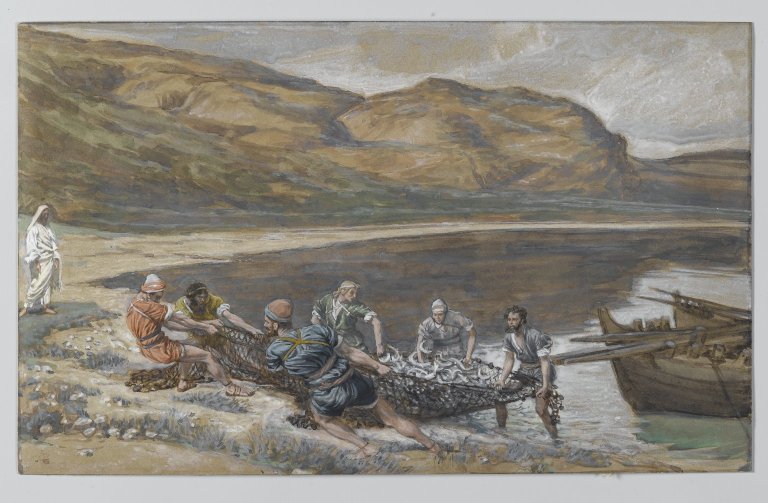
Brooklyn Museum – The Second Miraculous Draught of Fishes – James Tissot. Public Domain.

Last week, I got to preach on one of my favourite Bible passages, the second half of John 20. Today, I have disregarded the Lectionary, which would have taken us to the Emmaus Road story, which was the Bible reading at our wedding, to follow John 20 with – er – John 21, which is also significant for me. It was hearing a Local Preacher speak on this passage in 1985 that began my journey to theological study and eventually ordained ministry.

But today, I don’t want to speak about ordination. I want us to look at how the risen Jesus transforms everyday life.

Firstly, the risen Jesus transforms work:

Aerial view of computer laptop on wooden table photography hobby concept from rawpixel.com at pxhere.com. Public Domain.

The disciples have met the risen Lord. He has promised them the Holy Spirit. But they haven’t been transformed yet. They haven’t begun the mission Jesus has described for them. Simon Peter is hanging around, twiddling his thumbs.

‘I am going fishing,’ he says, and the six friends with him join him. Back to the day job. Back to something familiar. Back to something he knows all about.

But for all the knowledge and experience of fishing among those assembled on the boat, the expedition is a failure. They have gone out to fish at night, which was generally the most fruitful time, but they have caught nothing.

Until a knowing voice from the shore calls out: ‘Children, you have no fish, have you?’ How did he know from that distance?

‘No.’

‘Cast the net to the right side of the boat, and you will find some.’ How could he tell from that distance? He couldn’t see a shoal swimming under the water from there.

But lo and behold. A hundred and fifty-three fish. Many scholars have tried to find symbolic significance in that number, but really it’s just an eyewitness account that testifies to the abundance in contrast to the prior lack. On this occasion, Jesus doesn’t draw a spiritual parallel, such as when he had talked about ‘fishing for people.’ He simply blesses the work of fishermen.

Jesus loves to bless our work. In creation, the human race was made stewards of all God had made. If you look closely, you can see that in so many professions.

It’s not just the obvious work of ministers. Nor is it some of the other professions we have lauded, like medicine and teaching – although we are grateful for them. Do you remember the slogan popularised by Christa McAuliffe, the teacher chosen as a space shuttle astronaut, but who sadly died in the Challenger disaster in 1986? ‘I touch the future. I teach.

But think also of how engineers steward the resources of the earth. Think of those who in many ways engage in creative management of the world’s assets. Consider someone who daily enables people to communicate through electronic means. Think of a hairdresser whose clients leave her feeling better about themselves. Are these not things Jesus wants to bless?

Whether you are still in paid work, or like the majority of this congregation well into retirement, can you consider inviting the risen Jesus into those daily activities? How might that make a difference to you?

Secondly, the risen Jesus transforms our daily needs:

Our daily needs 3 at Wikimedia Commons. CC 4.0.

There is one detail in this story that has puzzled me for a long time. Simon Peter and the gang have struggled to catch any fish, but when they get to shore with a bulging net, there is Jesus, with breakfast ready for them. Including fish! Where did Jesus get his fish?

No scholar has been able to explain this. Was it miraculous? Did he buy them from another fisherman?

Whatever the explanation, Jesus knows his friends are coming off a physically demanding night shift. They will be ravenous. The kippers are ready. (I’m sure he would have made kedgeree if he’d been in Haslemere.)

It’s a minor detail, but it shows Jesus caring for ordinary, everyday needs. Sometimes, we don’t like to bother him with the small things. Surely he’s too busy upholding the universe? But he cares.

My late father and aunt grew up as children in the Depression of the 1930s. Their father was out of work for five years. This was before all the provisions of the Welfare State that we know. Their mother would skip meals herself and be on her knees in the kitchen, praying for God to provide. Food parcels and other items the family needed would appear on the doorstep in the nick of time.

Do not leave Jesus out of the smaller, regular features of life. Does that mean you can pray for a parking space? Well, yes, but with certain provisos! For one, just be sure you’re not just using him to get you off the hook. For another, leave him enough time to organise an answer to your prayer. And also, don’t let it distract you from also praying about the weightier matters of life, like justice and poverty. He cares.

Is there something niggling at you right now? Do you keep thinking, this is trivial? It may be something you can deal with by handing it over to Jesus. He cares about our daily lives and needs.

Thirdly, the risen Jesus transforms our wounds:

Emotional Effects of Robbery: Understanding the Impact – Bryan Fagan Law Office CC 4.0.

Let’s go that central conversation after breakfast between Jesus and Simon Peter. We assume – rightly, I think – that the three times Jesus asks Simon whether he loves him are to mirror and replace the three denials he made in the high priest’s courtyard. Not only that, each exchange finishes with the calling to feed Jesus’ sheep.

This is all the more confirmed when you notice one other details. It happens around a charcoal fire, the one Jesus had used to cook the fish and the bread. There is only one other place in the New Testament where a charcoal fire is mentioned, and it is when Simon Peter warms his hands in – the high priest’s courtyard.

Everything in this little episode is about Jesus taking Simon Peter back to those painful denials and healing them. I believe Jesus cares about the wounds we carry from the past. He does not want emotional damage to determine how we live today.

Let me tell you a story. The details I am about to share have been public for many years. I am not breaking any confidences.

I once had an elderly church member who had been an only child. Her father had adored his little girl, but her mother had wanted a boy. Tragically, her father had died young, leaving her to be raised by the mother who did not want her.

One day, we talked about this, and I suggested we pray together. I asked her in the silence to invite the Holy Spirit to show her an incident from her past. In her mind’s eye, she saw a time when she was a child, baking a cake in the kitchen. Her mother came in, told her she would never be any good at this, and snatched everything away from her.

Next, I suggested she should ask the Holy Spirit to show her what Jesus was doing there. Now she saw Jesus come into the kitchen. He gently eased her mother out of the way. Then he spoke to her. ‘You and me, Joan, let’s make this cake together.’

From that time on, she was healed of those parental wounds. For now – although those past events obviously didn’t change – she knew how Jesus regarded her.

I would hazard that many of us are living with old wounds. What if we too invited the risen Jesus to show us where he was when we were hurt? Might we too find his restoring love and live more healthily as a result?

Fourthly and finally, the risen Jesus cares about our future:

Blue gift box. Free public domain CC0 photo at rawpixel.com.

The final part of the story is the other conversation Jesus and Simon Peter have, where Simon is jealous that the ‘Beloved Disciple’ may have a future vastly different from his, which will end in his own execution. Jesus has told him he will end up being led somewhere he does not want to go, and you may know of the legend that Simon Peter asked to be crucified upside-down, because he was not even worthy of being crucified in the same way as Jesus, unbearably cruel as that was.

Comparison is the thief of joy, goes the saying. How many of us have wasted energy and maybe even years of our lives wanting to be someone else? I have wanted to be more outgoing. I have wanted to be musical – and not least when churches have torn themselves apart in ‘worship wars.’

But it’s all fruitless. We can only find fulfilment when we embrace the gifts and callings Jesus has for us. And when we each discover the place God has allotted us in the Body of Christ, then we can play our part healthily in the divine purpose.

A few months ago, Ray Goddess led the circuit staff in the Network course from Willow Creek Church in the USA. It helps people discern their spiritual gifts, but not only their gifts: how these match with their personalities and their passions. It didn’t reveal to me any gifts I didn’t know I had, but it did show me that I was undervaluing one of my gifts, and I need to work that out.

We have just run the course at Lindford church. While we are still processing the results, it has nevertheless been exciting for some people to be confirmed in where God is leading them, and others to be genuinely surprised by what this has opened up for them.

And so, I wonder whether you are settled in your heart and mind about the future God is calling you to. The world has lots of self-centred ways that claim to offer you fulfilment in life, but the one that brings true peace and satisfaction is in knowing what God has given you and has spoken to you. Whatever it is, it is not something where he leaves you on your own to work it out. It is always framed with those words of the risen Jesus to Simon Peter: ‘Follow me.’ He will be there, with us, and going ahead of us.

Conclusion

Indeed, perhaps ‘Follow me’ is the message for all of us in every aspect of what we have considered today. The risen Jesus says to us ‘Follow me’ into the world of daily work and let me transform it. He says, ‘Follow me’ and you will find me providing for you in your daily needs. ‘Follow me,’ he says again, and your old wounds will no longer hold you back. ‘Follow me,’ and you can be liberated to follow the calling he has for you without worrying about others.

Where are you hearing Jesus say, ‘Follow me’?

That You May Believe: John 20:19-31 (Easter 2, ‘Low Sunday’)

John 20:19-31

The Risen Lord appears to St Thomas & the apostles by Fr Lawrence Lew, OP. CC 2.0.

Our Bible reading today is one of my very favourite passages, quite possibly my Number One. I have preached on it often. There are so many wonderful themes: peace to replace fear; joy; the nature of the resurrection body; how the church’s mission is modelled on Jesus’ mission; faith, and how doubting Thomas has been given a raw deal; and so on.

Even my favourite sermon illustration story is based on this reading. So, if you have heard me talk about the missionaries to the Arctic translating the New Testament and what they took from the hunters’ dogs, I would have been preaching on this passage.

Looking on my computer, I have at least ten sermons on these verses. Had I wanted to repeat an old sermon today, I would have been spoilt for choice!

But the other day, I realised that there is one part of this account that I have never preached on. It jumped out on me on two occasions when I wasn’t even thinking about the sermon: once while I was running The Bible Course at Midhurst, and once when I was at Lindford, where they were showing a livestream from this year’s Spring Harvest.

What haven’t I preached on? Verses 30 and 31, which seem to sum up John’s Gospel before the author remembered later to add the story about the miraculous catch of fish and Jesus restoring Peter:

30 Jesus performed many other signs in the presence of his disciples, which are not recorded in this book. 31 But these are written that you may believe that Jesus is the Messiah, the Son of God, and that by believing you may have life in his name.

The whole point of recounting all the stories about Jesus, especially his miraculous signs, is that we who hear them believe in Jesus. And I want to bring two things out of that this morning: firstly a challenge, and secondly, an encouragement.

Rafting whitewater challenge at PickPik. Public Domain.

A Challenge
In one of my previous churches, I had a member called Phil. He was married to Pat, and he was a jazz musician. He led his own band, and once a year brought his band to the church to play a fund-raising concert. It sold out every time.

Sadly, a little while after I left that church, Pat died. Phil asked me to return and conduct her funeral. It was a privilege. Pat had a love of history, and an enquiring mind. She would always have an interesting question to ask me after I had preached.

However, I learned that soon after the funeral, Phil resigned his membership of the church. He said he had only ever come to support Pat. He had never believed. He had sat in church most Sundays. He had come to the communion rail and received the elements. Yet for all his encounter with the Gospel, he had never responded for himself.

It is possible to come to church for years, to participate in church activities and worship, and still not believe in Jesus. So, when I read those words at the end of John 20 again:

But these are written that you may believe that Jesus is the Messiah, the Son of God, and that by believing you may have life in his name

I wondered whether there might be anyone here in the same boat. If you have never made a commitment to follow Jesus Christ as your Lord and Saviour, I want to invite, even urge, you today to do so.

As you will hear if you come to this week’s session of The Bible Course, the four Gospels in the New Testament, including John, have the hallmarks of historical reliability. They show signs of being eyewitness testimony. You may think the events are strange and unlikely, but they were recorded because the authors were astonished by what they witnessed.

And as for the Resurrection itself, the greatest miraculous sign of all, the evidence is extremely strong. There was an old objection that Jesus didn’t really died, he just swooned and then revived in the cool of the tomb. However, he would have been very weak, and how he would have moved the tombstone in such a state beggars belief. Moreover, Roman centurions had to ensure their prisoners were dead. We see the soldiers checking at the end of the crucifixion stories.

The authorities didn’t like the Jesus movement, and especially when they began preaching a few weeks later. If the body of Jesus was still around, they could have produced it and stopped those early believers in their tracks. They didn’t.

Nobody in that society would have concocted fictional stories where the main witnesses were women. They were not allowed to give evidence in court. You wouldn’t write stories where women were the principal witnesses unless it were true.

Then you must wonder why those first disciples gave the next forty years of their lives for something they knew to be a lie, if they had staged false evidence in favour of the Resurrection.

Crazy as it may sound, the best explanation is the biblical one. Jesus was raised bodily from the dead. It shows he is who he said he was, the Messiah, the Son of God. It shows that God says yes to everything he accomplished by his death on the Cross.

If there is anyone hearing this who has never made that final step of turning their lives over to Jesus, now would be a good time to do it. Perhaps you believe in God, you think God has provided all sorts of good things for which you are grateful, but you haven’t made that commitment to be a follower of Jesus.

Or maybe you see coming to church once a week as a kind of religious life insurance policy. You think this is a way of paying a weekly premium to ensure life after death. But Jesus is your Lord and Saviour. He is back from the dead to call for your wholehearted allegiance.

The Power of Positive Reinforcement in Fitness Instruction CC 4.0.

An Encouragement
Around the turn of the century, I went through a mini-crisis of faith. I can’t even recall all the details now, but I do remember that the substance was the disproving of some miraculous claims made by Christians I had trusted. I began to doubt my own judgment. If I’ve got this wrong, what else have I got wrong about life and faith?

Eventually, I reached a state of equilibrium. I concluded that yes, sometimes other Christians let you down. Some even make false claims. You can recognise that without losing your faith. Because Christian faith is faith in Jesus, not faith in human nature. Human nature will always fail.

However, to get to that point wasn’t a quick process. I had one thing that was my rock-solid foundation. I could not shake my belief in the Resurrection of Jesus. I outlined for you in the first point some of the reasons why I believe it is sound on historical grounds to believe that the Resurrection truly happened. It wasn’t made up. It wasn’t a parable to teach spiritual reality. Jesus’ body was raised.

If anyone asks me, why do I believe – and continue to believe – in Jesus, I will always answer: the Resurrection. And that leads me back to verse 31 again:

But these are written that you may believe that Jesus is the Messiah, the Son of God, and that by believing you may have life in his name.

As some Bible translations will tell you in a footnote, the words ‘that you may believe’ may properly be translated, ‘that you may continue to believe.’ For those of you who like languages and grammar, the Greek present tense is a continuous tense. ‘Believe’ is not just about first-time belief: it is about continuing to believe.

And that’s where I offer a word of encouragement today. In the face of our doubts, our questions, our struggles, our failures, and the mess this whole world is in, the truth of the Resurrection gives us a hope we can depend upon.

If you think you are a hopeless sinner and cannot be forgiven, then the Resurrection of Jesus tells you that he has overcome sin. You can be forgiven, and you are forgiven. You can also have the power to begin living differently.

If you are afraid of death, then the Resurrection of Jesus shows us that when we place our lives in his hands there really is nothing to fear. We are safe with him, and our eternal future is glorious.

If you are feeling hopeless, that everything is pointless, and you are struggling to see the point of things, then know that the darkness of the pit at the bottom of the downward spiral cannot cope with the bright light of the empty tomb.

If you are struggling with deep questions about why there is so much evil in the world, then the Resurrection shows us that God overcomes the very worst. What could be more unjust than the execution of Jesus? But the wicked didn’t have the final word: God did. And so, the Resurrection puts those who perpetrate wickedness on notice. In eternity, they will not get away with it. For the Resurrection of Jesus is the promise that one day God will raise up everyone. And then, those who think they can hold onto power by mowing down thousands of their own citizens who protest will find that God is not on their side. Those who think that the way to get justice is to bomb their enemies, including innocent civilians, into submission, will have a shock coming. Those who think they can poison their critics and persecute their opponents will learn they are sorely and dangerously wrong. Those who hoard more money for themselves, especially at the expense of the poor, thinking it is the way to true happiness, will find a misery they could never have imagined. Those who think they can plunder the planet and destroy it for their own gain will be judged by God making a new creation just as he re-creates our bodies.

To be sure, for now we continue to live in the time between the Resurrection of Jesus and that general resurrection of the dead, and so the enemy of death will still take a toll on us. While we grapple with that, let our belief in the Resurrection fill us with hope as we live out the truth of peace with God, peace with ourselves, peace with others, and even peace with creation. We can love God and love others, knowing it’s worth it. We can care about justice, because we know it’s worth it. We can call people to follow Jesus, because we know it’s worth it.

Conclusion
Let’s go back to those words of verse 31 one last time:

But these are written that you may believe that Jesus is the Messiah, the Son of God, and that by believing you may have life in his name.

What do they mean for you today? Is it time finally to come off the fence about Jesus and say you will be a whole-hearted follower of him?

Or is it time to see that the Resurrection is the antidote to the despair and discouragement that have been dragging you down?

It’s common to say ‘It ain’t over until the fat lady sings,’ but the real truth is, ‘It ain’t over until the dead are raised.’

Create a website or blog at WordPress.com

Up ↑