Farewell 3: The End Is Not The End

Jeremiah 8:18-22 and 1 Corinthians 15:50-58

Last month, a poet friend of mine published a new anthology of his poetry. It is a series of poems for the end of life and beyond. He entitled it ‘The End Is Not The End’.

And if you want a title for the sermon today, that’s it: The End Is Not The End. That doesn’t mean I’m staying in this circuit after all, and that the farewells have all been part of a hoax.

No, I want to face head on the difficulties and discouragements we face in our churches here, and which of course so many churches in the western world do.

A few years ago, I was praying about my time here and I wondered in my praying what would summarise my time here. What popped into my head was a Bible verse I didn’t want to hear. We heard it in the Jeremiah reading:

‘The harvest is past,
    the summer has ended,
    and we are not saved.’

(Jeremiah 8:20)

I knew that many of the hopes and dreams I had had when coming here were not going to be fulfilled. Situations that looked like they had great potential proved to have more style than substance. People who gave an initial impression of being deeply spiritual turned out to be like the seeds that the sower in Jesus’ parable threw on rocky ground or among thorns.

And alongside all this we are fighting an uphill battle in a culture that is increasingly hostile to our faith.

So what does the Methodist Church nationally do? Well, apart from its periodic attempts to impersonate your embarrassing trendy uncle, it chooses not to learn from history but to delete a historic document, the so-called Liverpool Minutes, that show how the first Methodists to face decline dug deep into their spirituality and turned things around.

Meanwhile, it buries its head in the sand when all the evidence is there that the structures we have are creaking towards breaking point and it adds more bureaucracy – the classic behaviour of a decaying organisation. Let’s have even bigger Districts. Let’s amalgamate circuits to such a size that if you are like the one I am moving to, they cannot meaningfully consult the entire circuit about the appointment of a new minister. We defend these structures despite all the evidence from other churches that we need greater continuity between churches and their ordained leaders. And we spread our leaders even thinner.

And we pile even more responsibilities on the leaders without taking anything away from them. Renewing my Safeguarding training has gone from a two-hour session four years ago to eight hours now. There are good ideas added, such as getting all the ministers into a pastoral supervision programme, but no-one tells us what we should drop. Conference clearly thinks we can make bricks without straw.

‘The harvest is past,
    the summer has ended,
    and we are not saved.’

And it’s not just the ministers facing this. I look at what we ask our congregations to do, especially those in leadership positions. Some of them are being worn down to the bone with the amount of practical work and administration we need them to do. Not only that, some of them are holding these responsibilities at ages well beyond that where we always used to let people retire gracefully from positions in the church and let them have a well-deserved rest.

‘The harvest is past,
    the summer has ended,
    and we are not saved.’

Now to some of you this might sound like I am just settling some scores at the end of thirteen years here. Please believe me when I say that’s not what this is about. I believe we need some honesty and reality about the situation.

Of course, that’s what got Jeremiah into trouble in his day. Relentlessly he told God’s people the stark truth of their situation. With no change in direction, they were going to be conquered by Babylon and taken into exile there. He didn’t deal in the frothy shallow positivity of the popular culture.

Or maybe you think I’m just here as a spiritual doom and gloom merchant. We call such people Jeremiahs. But I am not here to be a religious Eeyore. Nor am I here to be Private Frazer from Dad’s Army, crying, ‘Doomed, doomed, we’re all doomed!’

I am here today to be a small-scale Jeremiah, but not in the way you might think. Let me explain.

Forty years ago, when I trained to be a Methodist Local Preacher, we had to sit four written exams. In my Old Testament paper, there was a question where we were asked to assess a statement that Jeremiah was a prophet of doom.

And like all good exam answers, the best response was to say, ‘Yes but’. You see, Jeremiah was about doom – in the short term – but in the long term he was about hope. Short term doom, yes – but long term hope.

He called on the exiled Israelites to find ways of living positively in Babylon and blessing their captors. And he looked beyond the exile to when they would return to the Promised Land.

So I want to proclaim to you today short term doom but long term hope. The End Is Not The End. Just as Jeremiah held out hope that it was still possible to live a fruitful life of faith in an alien and hostile culture, and just as he saw beyond that to restoration, so I want to say something similar to you today, but with a New Testament spin.

And so this is where I want to bring in our reading from 1 Corinthians 15. This is Paul’s great chapter on the Resurrection, and the verses we heard were the climax of that chapter.

This passage has the verse that has been dubbed the verse for the church crèche. It’s verse 51:

Listen, I tell you a mystery: we will not all sleep, but we will all be changed.

But to be more serious, here is God’s great promise that The End Is Not The End. For just as Jesus was raised from the dead, so shall we at the end of time. Death will be swallowed up in victory. Its sting will be neutralised. We gain the final victory through our Risen Lord.

It’s like the famous American preacher Tony Campolo used to put it. He would recount how people would come up to him and ask him how on earth he could be positive and hopeful in such a dreadful world as ours.

His reply? ‘I’ve read the last chapter of the book, and Jesus wins!’

Friends, The End Is Not The End. If it ends in death, then it’s not the end. Not in the light of Jesus our Risen Lord, it isn’t.

Well, you may say, that’s all very well, but isn’t that pie in the sky when we die? What can you say to us as we have to continue living in difficult times as Christians?

I want to give you two words of encouragement.

The first is this. Although we await the great resurrection at the end of time, we do experience in the meantime some little resurrections. Here’s what I mean by that.

Many of you know I was recently on sabbatical, and before I went, some of you asked what I was doing during my three months. One of the things I did was I spent five days at the Lee Abbey community in North Devon. I went there for a Christian conference on the theme of how to handle disappointment in the life of faith. I went knowing that I was wrestling with disappointment towards the end of my time here. I went knowing also that most if not all of us live with disappointments in our lives, and it’s therefore an important pastoral issue.

Now I guess one of the things we’re dealing with in this sermon is the theme of coping with disappointment. Our speaker at Lee Abbey that week focussed on what is commonly called ‘The now and the not yet’ of the kingdom of God. We see some signs of God’s kingdom now in our life of faith, perhaps when we see remarkable answers to prayer, but we also experience the fact that God’s kingdom has not yet come fully. Yes, Jesus reigns, but not everyone nor all creation bows the knee to him yet.

So it is part of the Christian life to live in this tension. And what I simply want to say to you about this today is that even as you find yourself immersed in disappointments, doom, and struggles, never lose sight of the fact that God in his mercy will grant you some little resurrections. He may be silent at times, but he is not absent. As I said to the Knaphill people last Sunday morning, sometimes he is like Jesus walking alongside the two disciples on their way to Emmaus, who do not realise who their companion is. You may not recognise his presence at times in the midst of the sorrows, but he is there, and he will grant you tokens of his grace.

The second word of encouragement I want to give you is this. The passage from 1 Corinthians 15 is very special to me personally, and I’d like to tell you why.

Many of you know that in my last appointment I had a rough time. I was a misfit in the appointment, and for me that meant five miserable years. We actually considered whether I might need to come out of ministry for a few years to recover and see whether I ever wanted to come back into ministry at all. Before we left, I went into counselling for some help.

In all those difficulties, this was the passage which was my lifesaver. At times I confess it only just kept my head above the water. But it did.

You see, you might expect that Paul’s great chapter on the Resurrection would end with inspirational words about the life to come, but he doesn’t. His last words are words that earth how we are going to live now in the light of that resurrection hope. Verse 58:

 Therefore, my dear brothers and sisters, stand firm. Let nothing move you. Always give yourselves fully to the work of the Lord, because you know that your labour in the Lord is not in vain.

Your labour in the Lord is not in vain – so keep going.

I have never really understood why God called us to that last appointment. I have the odd theory, but nothing completely makes sense. But, says Paul, your labour in the Lord is not in vain. Whatever I did for him and his kingdom there, Jesus will take and make into something beautiful because in the resurrection it will endure. It felt like five wasted years to me, but the resurrection means that in the economy of God it will not be wasted.

For those of you here who are particularly living at the coal face of our difficulties in the church today, I want you to hear those words: your labour in the Lord is not in vain.

For my lovely ministerial colleagues who work hard and don’t always feel they see the fruits they long for: your labour in the Lord is not in vain.

For my dear church members, not least some of you in my church leadership teams, who have put in sterling efforts that must at times feel like King Canute trying to banish the incoming tide, I say the same: your labour in the Lord is not in vain.

For those of you like me and some members of my family, who live with the dark clouds of depression, I say to you: your labour in the Lord is not in vain.

Just remember, dear friends, that if you think everything is ending in death and darkness, The End Is Not The End.

Jesus wins.

Going Back

So the sabbatical is over. No more for another seven years.

OK, that last sentence is mean, especially for the vast majority of people who don’t receive sabbaticals. What have I gained from this one? Some spiritual encouragement from the week at Cliff College.  A sense from the time at Trinity College, Bristol that I’m not insane to feel out on a limb as a minister with my personality type. And the sheer pleasure of using my long-dormant hobby of photography in Christian fellowship at Lee Abbey. From both Cliff and Trinity has come the desire to explore PhD research, although there are obstacles. Right now would not be a tactful time, ministry-wise. There would also be the small question of the finance.

What do I bring back from it into ministry? Actually, I’m not sure right now. I’m aware that some people in my churches are already talking about the things I shall be bringing back from the sabbatical for them, as if it has been a three-month trip to some extended version of the Christian Resources Exhibition. Sorry, that’s still for me just one day of the four next week.

What will I bring back for my churches? I don’t think it will be (or ever could have been) specific resources and ideas. I hope it brings a revitalised me, even if – quite honestly – I still don’t have the answers to the questions about why I feel so frustrated in ministry a lot of the time. I only have, as I said above, the sense that I am not mad, after all.

But I hope they’ll see something in me. What that is, I don’t know. I had some comments today. Given the assumption that no sooner shall I be back than I shall be off for a fortnight recovering from the upcoming nasal surgery, we did some things with my churches today. One church was holding a fund-raiser for Chelmsford Street Pastors. A couple at another church were celebrating their golden wedding. People made some strange comments. One person thought I had gained a suntan. 

“Must have been all that snow at Cliff College in February,” I joked.

Another thought I looked relaxed. With small children? Rarely possible!

So I’ll see what tomorrow brings. I have a communion service in the morning at St Augustine’s. In the evening, I have café church at Broomfield, where I am going to show some DVD clips from Lee Abbey. One is ‘Words Are Not Enough‘, some mimes to biblical passages by Dave Hopwood, their creative arts director. The other is ‘Lee Abbey Reflections‘, which contains meditations and music that can be used worshipfully.

Oh, well. Once more into the breach …

Sabbatical, Day 59: Google Hoaxes, Tim Keller And A Poorly Wife

Given that tomorrow is April Fool’s Day, here is a record of Google hoaxes in past years.

I find it a useful practice to read an evangelistic book every now and again. However, it’s a long time since I read one. Last week at Lee Abbey, I noticed they had cheap copies of Tim Keller‘s books ‘The Reason for God‘ and ‘The Prodigal God‘. I haven’t yet read the former, which is a book of apologetics, but I have completed the latter this morning.

It is a winsome and powerful meditation on what Keller calls ‘The parable of the two lost sons’, for both the younger and elder brothers in the famous parable are are lost. The younger is lost in devotion to selfish pleasure, and the elder is lost in self-righteousness. God is the true Prodigal, being reckless with generous love and grace. Only that unconditional grace changes people, and only that gives a healthy motivation for sacrificial service and a life of justice. I warmly recommend it.

Since finishing it today, I have begun to read ‘The Reason for God’ in between clearing down some of last week’s accumulated four hundred plus emails and – more seriously – a poorly wife. Last night, Debbie struggled with a vicious headache. This morning, she was washed out and has spent much of the day in bed. Tonight, she took her temperature at 39.5°C, so we’ll hit that with Paracetamol and keep an eye on it. At bedtime this evening, Rebekah said to her, “I wish I had a wish, because I would wish you back to normal.”

Sabbatical, Day 58: Nosing Around


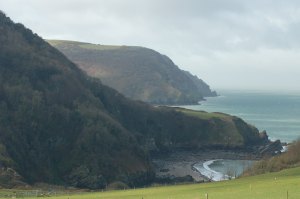
Lee Bay from the rear of Lee Abbey

I’m opening up today’s post with a few final photos from last week’s photography course at Lee Abbey. All of these were taken last Thursday, on the final full day of the course. This is Lee Bay from the rear of Lee Abbey. It’s wonderful to look out on this view every day when you come down for an early morning cuppa. 

Seat in the grounds of Lee Abbey

Here is a seat in the grounds of Lee Abbey, where you can relax. They chose the right email address for general enquiries: it’s relax AT leeabbey DOT org DOT uk. (I am not being paid for all this promotion of the place! I have simply been there five or six times over the years, and it is one of my favourite ‘thin places‘ in the world.)


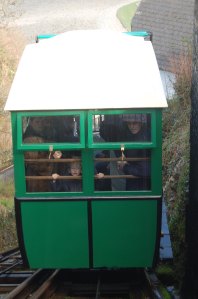
Lynton and Lynmouth Cliff Railway

I spent Thursday afternoon in Lynton and Lynmouth. I took the Cliff Railway down from the former to the latter. It is another reason why I would like to take Debbie and the children there. We did visit the area for a few hours one day some years ago when Rebekah was tiny and we were on holiday elsewhere in North Devon, but I think the kids would love an attraction like this. Especially since at the bottom in Lynmouth there are some great shops for clotted cream (Debbie would love that) and clotted cream ice cream (we’d all love that). Not only that, there is a fish restaurant that sends the most wonderful aroma into the local atmosphere. 


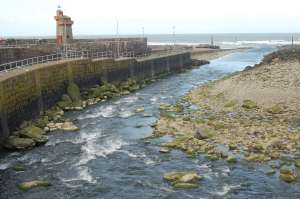
River and Bristol Channel at Lynmouth

Lynmouth itself is small, but pretty. There is a river which runs through the town and out into the Bristol Channel, as depicted here. I also caught various scenes of the river flowing under bridges and houses and hôtels built on the steep bank between the river at the bottom at Lynton at the top. 

But at this point, I think I’m going to leave my memories of the Lee Abbey trip, at least so far as the blog is concerned. I might have wished for further ‘input’ on the course in terms of some theological reflection or some further inspiration on technique (although it was specifically advertised as not being a ‘technique’ course), but overall I am glad I went.

…………

On finally tonight to some personal news from today. I wrote in January about an out-patient appointment regarding my nose and sinuses, then earlier this month about the CT scan I subsequently had. Well, today was the follow-up appointment. I agreed to have the surgery, called septoplasty. It will happen some time in the next three months, involve an overnight stay in hospital and two weeks off work. The scan also showed some information I need to relay to my dentist, because the surgeon quite thought my sinuses were being interfered with by a tooth on the right of my mouth! 

Sabbatical, Day 57: Lee Abbey Photography Course, Part 2


The Three Crosses at Lee Abbey: view from below

Wednesday’s expedition in search of photos saw me consulting a map of the Lee Abbey estate in order to find the location of the famous three crosses the community erected many years ago. They were not difficult to find. Unsurprisingly, several of us on the photography course took pictures of them, although nobody was there at the same time I was. I simply needed to let a group of pilgrims who were following some guided prayers around the land finish ahead of me.

For this first shot, I deliberately took the image from below, in order to include in the foreground the cow pat on the left and the treacherous hole in the ground on the right. Crosses are ugly and dirty, not shiny happy jewellery.


The Three Crosses at Lee Abbey set against a background of sky

For the second photo I have included here, my aim was a little more pragmatic. You will see that again I am below the crosses with a wide-angle lens, but I have included a large amount of featureless cloudy sky. This was one of several pictures I took, thinking they might be useful as backgrounds for PowerPoint or SongPro slides. On the surface, that may not be the most spiritual reason, although I would like to think that if this is used in public worship, it will play a small part in enhancing people’s devotion. However, I castigated myself for moving on all too quickly from the crosses in order to take more images. I think I share the general weakness for moving on as quickly as I can from the foot of the Cross. I certainly did so last week.


Lost sheep among saplings in putative orchard

This third shot is one I might use as a metaphor sometime. The sheep shown should not be in this field. It has escaped from the rest of the flock, and is roaming in a field planted with saplings that will eventually become an orchard. Next time I want a ‘lost sheep’ image, I may pull this one out.

The week was not all about the photography, though. On Thursday morning, one of the host team, Chris, recognised my name on my badge. I had thought he looked familiar, but he didn’t prove to be who I thought he was. Chris turned out to be the son of two people I had known in an ecumenical church in my last circuit. When I knew him, he was about eleven. Now he was eighteen, and spending a year in community while offering for the Anglican ministry. I must say, he looked a natural up in front of a large group of people from different backgrounds and generations. I gave him my email address before leaving, and asked him to tell me how he gets on.

Sabbatical, Day 56: Catching Up On Photography At Lee Abbey

I got back from Lee Abbey last night. As I expected, there was no Internet access, let alone wifi, for guests, but the place is as beautiful and spiritual as ever.

Setting off on Monday morning after the school run, the weather got progressively poorer the further west I drove. The most direct approach to Lynton and the Valley of the Rocks where Lee Abbey is situated requires slogging along the A39 and tackling two 25% (1 in 4 in old money) hills, one at Porlock, the other at Lynmouth. The latter is also combined with a hairpin bend. I chickened out, looking forward to a drive instead across the rugged beauty of Exmoor.

What a mistake. As the rain increased, I found myself driving through low cloud, in fog-like conditions. The 1 in 4s would have been less problematic!

After an initial welcome on Monday night (and my by now customary poor first night’s sleep – this time waking at 4 am and not slumbering again), the course kicked off on Tuesday morning. Our leader was Paul Judson, communications officer for Durham Diocese and editor of their online newspaper. A trained artist and photographer, he is ordained and married to a vicar. His theme, based on the Emmaus Road story, was ‘And their eyes were opened’. Each day, he took a theme from a Paul Gauguin painting and gave us just a few thoughts to set our fingers twitching on our shutters. 

So it was that on Tuesday I walked down from the back of Lee Abbey to the rocky cove at Lee Bay, shooting whatever I fancied, and inspired to look more closely at some features. I found some surprising features. 

dsc_0130
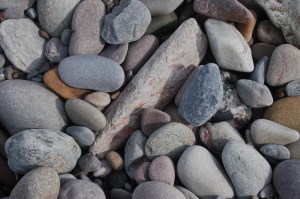
Stones at Lee Bay

Here, for example, is a collection of stones I liked on the beach. I didn’t move them about or do anything fancy with filters either on the camera or in software, they just looked like this and I found the arrangement appealing. I hope you do, too.


Colourful branch washed up at Lee Bay

And I liked the colours here, too. This branch and the green net appeared to have been washed up in the bay. What had made the wood go orange, I wondered? I’m sure there is a simple answer, but again, I have applied no digital trickery to the shot. This is more or less just how I saw it. 

But whatever I say about the lack of any software manipulation, I hit a severe problem that night when I reviewed my shots for the day on the laptop. A couple of marks that I could see in the viewfinder, and which I had thought were just dirt there, appeared in every photo. I didn’t have any blower, brush or lens cloth with me (and I knew it wasn’t a lens issue, because they appeared regardless of the lens I was using). I borrowed a blower and a brush from someone else the next day, but didn’t think I’d got rid of them. Someone else kindly offered to lend me his laptop that had the latest and greatest Photoshop CS4 on it.

I was rather nervous about playing with such high powered and exalted software, and explored other solutions – although I felt at one point like jacking in the course and coming home, because I thought all my pictures were going to be ruined. I thought that especially when I also noticed that shots from Rebekah’s birthday party last Saturday had also been afflicted. Debbie suggested on the phone that since that party had been at a pottery painting studio, maybe clay dust had got into the camera. That would have explained the difficulty in removing the dust, because it would have been more moist. Worse, given the lime component in clay, such dust could have been a nasty irritant inside the camera. The friend who loaned me the blower and brush found an advert in a magazine for Colchester Camera Repairs, and suggested I visit them on my return.

Meanwhile, leafing through my Nikon manual, I thought I had found a solution. I had never installed the accompanying Nikon Capture software. The manual said that if I took a reference shot of white in RAW format and took all other shots in RAW, then the software could compare the two and remove the blemishes. It wouldn’t solve Tuesday’s photos, which I had shot as JPGs, but I could prevent problems with future pictures. So I installed it onto the laptop from the CD. Problem: it needed to be version 4.3 or later, and Nikon had kindly only given me 4.2.

So I thought that on Wednesday, I would drive into Lynton with the laptop, install mobile broadband and download an update. Problem – big one: mobile broadband was so slow that the update would never have completely downloaded before my laptop battery would have expired. I gave up, and decided I’d download when I got home.

Meanwhile on Wednesday afternoon, Paul gave a lecture on using Photoshop. Now Photoshop is far too expensive for us, although we have Photoshop Elements 6 on the desktop here at home. I didn’t have the latter on my laptop for licensing reasons, but as Paul talked about the ‘clone tool’ that will take a colour from somewhere in a photo and apply it over something you want to remove, I wondered whether I had anything like that in any of the free or open source software I had put on the laptop.

Step forward to the rescue, The GIMP 2.6.4 and IrfanView 4.23! Both have such a tool. I removed the marks from all of Tuesday and last Saturday’s images. You wouldn’t know now they’ve had a problem. And although I said I hadn’t engaged in digital trickery for the photos above, both of them were doctored with The GIMP’s clone tool to remove two blemishes.

Maanwhile, none of Wednesday’s pics seemed to have the marks on them at all. So maybe my friend Sedge’s blower and brush had worked, after all.

More on Lee Abbey in tomorrow’s post.

Sabbatical, Day 48: Gambling, G20 And Our Children

Our belovèd government promises concern for problem gamblers and all affected by their habits. Which is why they are doubling the minimum stake in fruit machines to £1 and the jackpot to £70. So that will help.

If you are as offended by this foul act as I am, there is an online petition here and you can also visit Fruitless.

Thanks to today’s monthly e-news email from the Methodist Church for this, which also plugs the Put People First march for Saturday week. 

…………

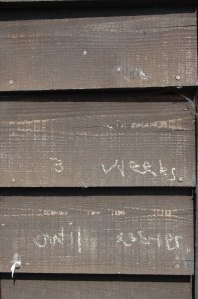
Having kept Mark at home today due to his mystery rash (which has again disappeared), fine weather meant some time outside. He played with some chalk near on our drive and near the front door for most of the morning. He rather got ahead of himself:


Come to Mark's house it's Easter today

Below this first picture, however, you will be able to see that he is aware that Easter is not just for us. It is for everyone. No ‘This is my truth, tell me yours’ approach here!


It's Easter in the world


However, as the next picture shows, I eventually convinced him he was being proleptic and would have to ditch his realised eschatology for a ‘not yet’ approach to the kingdom of God:


3 weeks until Easter

The poor little lad will have to wait like the rest of us. He’s looking forward to chocolate and to the annual Easter party Debbie organises for him, Rebekah and a few of their friends. She started this our first Spring here as a way of trying to help our two make friends in the area. It has worked well. We now have the pleasures of egg rolling competitions on the drive, Easter bonnet-making (no, the boys never gravitate to that) and sundry other fun activities. The invitations have been going out in the last couple of days, not just to established little friends but to some other children whom we’d like encourage our pair to befriend.

We’ve also had further reason to take pride in Rebekah today, when she was moved up again to another level in the school reading scheme. She is delighted, too, but she doesn’t make a big deal about it and put down other children who haven’t reached her standard.

It was such a contrast this morning when I went to give my weekly twenty minutes of reading help in another class. I think they like me, because inevitably they get very few offers of help from men, although they’ll miss me next week when I’m at Lee Abbey. Each week I am given a different group of children. The groups are streamed, so from one Friday to the next I can get a vast contrast in ability. Today, I had three lads who were struggling. One in particular still can’t make the connection between the phonetic sounds of letters and the word he is trying to read. He should have known this a year or two ago, poor lad. The other two boys kept jumping in when this one didn’t know, which did nothing for his confidence.

So it was important this morning to have a simple rôle as an encourager. That was a privilege, just to try and boost the boy a little bit. I wondered how much encouragement he received. Certainly he gets it from the staff, who provide extra help, but clearly he suffers at the hands of other children, in the classic way in which youngsters are so cruel to each other. Some carry the scars for years. Occasionally, we ministers pick up on it decades later.

25 Things

I’ve been tagged by my friend Jenny Vass on this web meme. This will take a while, so I’ll type a few random things as I remember them over the day, so here goes:

1. I was born in the Salvation Army Mothers’ Hospital in Clapton, north-east London. 

2. I have a big head (I hope only literally), which made my birth distressing for my mother, and explains why my parents waited six years before having my sister.

3. I grew up in the same road that Bruce Forsyth did. Not at the same time.

4. On a school trip to Whipsnade Zoo, my mum gave me nineteen shillings in spending money. When the teacher announced we could only take seven shillings and sixpence with us, I kept quiet. I spent every last penny in the zoo gift shop. Mum was distraught: she had given me the balance of her housekeeping and had only intended the extra sum for an emergency.

5. I became best friends with my mate Jean when he joined my primary school at the age of seven. Nearly forty-two years later, we’re still friends and he was best man at my wedding.

6. Once, while Jean and I were boys, we were stopped by a van driver asking for directions. We made it all up and off he went.

7. Jean is an accomplished guitarist. We used to write songs together, even though I’m not musical.

8. When I was eight and my sister was two, she hit me over the head with my cricket bat.

9. I was the only child from my primary school to go to my secondary school.

10. I hated school, even though I did well academically. The reason? Bullying.

11. Glandular fever-like infections seriously disrupted my schooling at fourteen and fifteen, and a neck problem at eighteen. But for the neck problem, I would have read Computer Science at Imperial College, London.

12. I was a union rep for my office when I worked in the civil service.

13. I used to go to winter nets to practise with my Dad’s cricket team when I was a teenager. I didn’t know until adulthood that the men couldn’t read my spin bowling. I’d have given up quick bowling if I’d known.

14. Theological study: I had three wonderful years at Trinity College, Bristol and three terrible ones at Hartley Victoria Methodist College, Manchester. 

15. On the surface I’m all academic, theoretical and conceptual, but underneath a creative person is trying to break out. That’s why I did a creative writing course at the London Institute for Contemporary Christianity with the Association of Christian Writers in my last sabbatical, and I’m taking a photography course at Lee Abbey in this one.

16. I am left-handed, have blue eyes and have worn glasses since I was eleven.

17. My first computer was an Amstrad PCW 9512. I ditched the noisy, inflexible daisywheel printer, bought an Epson 24-pin dot matrix and installed that instead. I wrote my MPhil thesis on it. I’ve been fiddling with computers ever since. Had the neck problem not hit when I was eighteen (see 11 above), I would have done so from a younger age.

18. My first car was a hideous yellow Ford Escort with a grim gearchange. I backed it into a tree, the boot sprang open, and for a long while I held it down with a friend’s old tie (= ‘necktie’ for my north American friends).

19. I once saw Oasis before the were Oasis. They were called The Rain and were supporting Roachford at a Manchester University gig. They were rubbish. Still are.

20. Our son Mark is named after my favourite of the Four Gospels. We brainstormed four names, wrote them down, folded them up and put them into a hat for Rebekah, then a small toddler, to pick. Both of our children have middle names taken from grandparents. Mark’s is Alan after my Dad, Rebekah’s is Anita after Debbie’s late Mum. That gives both of them full initials that have something to do with flying. Rebekah is RAF; Mark is MAF (Mission Aviation Fellowship). That’s a coincidence, but a nice one, since I come from an Air Force family.

21. I got into SLR photography after a mission trip to the north of Norway in 1981 when I was the only member of the party not to own a camera. Dad has been an amateur photographer as long as I can remember, and he took me to his favourite shop, City Camera Exchange by Cannon Street station in London, where I bought a Minolta XG-1.

22. I once tried to learn the guitar when a church member offered classes free of charge. As a result, I own a Fender acoustic. Unfortunately, the lessons began clashing with essential church appointments and I was unable to continue. The guitar and its electronic tuning gadget stay dormant in its case.

23. I studied Theology under George Carey. Shame he’s an Arsenal supporter.

24. I went from being a rabid teetotaller to a wine lover and now back to being teetotal. Originally, I held to a teetotal view on what I realised were legalistic grounds. Giving them up, I discovered the joys of wine. Unfortunately, medication I’m on for raised blood pressure now recommends I abstain.

25. The most serious surgery I’ve had is a pleurectomy on my left lung to prevent further recurrences of spontaneous pneumothorax. Go look it up. That’s why I inserted the links.

Right, that’s taken far too long on and off. I’m going to tag twenty-five people on Facebook, once this has uploaded to my notes there.

Here Cometh The Laptop

To date in my computing life, I have worked entirely with desktops. We have two in the study. One is the old Windows XP machine that so slowed to a crawl despite tripling the memory and regularly defragging the hard drive that it is now mainly the children’s. Their school uses XP, so it makes some sense.

The other is our nearly-two-years-old Windows Vista PC. We bought it a fortnight after Vista was released, due to the dire state of the XP computer. Like many people, we have discovered considerable disadvantages to Vista. We can’t use the quick upload tool to Snapfish when we want to upload digital photos for printing. Having said that, some things are nicer in Vista. What’s more, now I’ve doubled the RAM to a ridiculous 4 gigs, it runs at a decent speed. I can’t put in more RAM with a 32-bit operating system, however.

But in a month’s time, I start a three-month sabbatical. I shall be away for three weeks of that time. One of the places I am visiting, Cliff College, assumes in the emails it sends out that people will arrive with wifi-enabled laptops. Likewise, I shall be spending time at Lee Abbey on a photography course, so having a laptop on which to manipulate some shots will be handy.

Hence I have desired a laptop for a little while. Thankfully, my accountant has worked his usual magic this year and there is enough around in my tax rebate to afford a modest model. This week I paid the princely sum of £341 to Tesco for a machine that was being discontinued, the Acer Aspire 5720. Ideally I’d have liked a bigger hard drive than 160 GB, and I can expand the 2 GB of RAM easily enough.

Tonight I set about beginning to adapt it for my purposes. Off came a raft of software: a load of arcade games for a start, swiftly followed by Microsoft Works and the 60-day trial of Microsoft Office 2007 – I have that on the Vista desktop and don’t intend paying through the nose again. So once I’d downloaded and installed Open Office 3.0 off came the MS products. The only disadvantage to OO is there isn’t a UK English version.

Next stage will be to replace the bloated and expensive trial version of McAfee Security Centre with some free security products. (Not as bad as Norton, I know, but it’s still £50 a year I could do with saving.) Gizmo’s Tech Support Alert website is full of useful reviews. I’ve started to read up on anti-virus, anti-spyware and software firewalls. The XP machine had a number of freebies on it, but I may not choose the same products. I shan’t be downloading emails to the laptop, because that will create a sync problem with the Vista desktop, but I shall read my Gmail on it and use that while I’m away.

I have also downloaded and installed Paragon Partition Manager Express so that I can carve out a separate partition early on where I can install Ubuntu Linux. Having failed miserably to get Ubuntu to run within Windows using wubi.exe on Vista (although it does happily on XP), I’d like to do a proper install, if I’m brave enough.

I shall also buy a large memory stick for moving stuff over to the Vista desktop. (I’ll also sort out the wireless network between them, I trust, but often a memory stick is quicker if the wireless plays up.) 7dayshop have some bargains: this looks like a bargain, 16 GB for £15.49.

Before I go away, I shall probably get some pay-as-you-go mobile broadband. There is a good review of available services in the February 2009 issue of Personal Computer World. Vodafone comes out best for performance, although they charge the earth if you exceed your data allowance.

So that’s my little personal project with which to begin the new year. Any thoughts on my plans are welcome. What are you up to?

Reading

It’s half term, and I’m taking this week on leave. Daytime, I shall be having time with the kids, of course. We’ve been exchanging Tesco Clubcard vouchers for money off ten pin bowling and a meal at Café Rouge.

But in the evening, I’m beginning to delve into some newly arrived books. Yes, they are all Theology, and that might seem a strange choice when I’m away from ‘work’, but few things restore me like a dose of good reading. (Yes, I am an introvert, if you hadn’t guessed.) Here is what those nice people at Amazon and The Book Depository have sent me lately:

Eugene Peterson, The Word Made Flesh: Peterson explores the issue of language as a spiritual concern by examining the parables of Jesus in Luke’s so-called ‘Travel Narrative’ and in some of his prayers.

Klyne R Snodgrass, Stories With Intent: I love the parables of Jesus, and this looks like being the standard work for the next several years. A few months ago, Scot McKnight was raving about it. Then Paul Beasley-Murray did the same in Ministry Today. Already, I’m hooked. He has a subtle, multivalent treatment of the parables. For years I’ve loved Craig Blomberg‘s book Interpreting The Parables, because he so thoroughly took to pieces the anti-allegory school and gave a brilliant history of schools of biblical interpretation. However, it was beginning to feel a bit simplistic in some of its expositions. I think Snodgrass will bring the subtlety.

Colin Greene and Martin Robinson, Metavista: What do we do, mission-wise, after postmodernity? Greene and Robinson are sketching a vision. I met Greene five years ago on a Bible Society course at Lee Abbey, but I’ve never previously read his books. I was pondering buying this one when I saw him interviewed by Alan Roxburgh on the Allelon website. That convinced me.

Christopher J H Wright, The Mission Of God: another Scot McKnight rave. Eleven or twelve years ago, I bought Wright’s commentary on Deuteronomy, in which he interprets the book missiologically. Later, I bought his exposition of Ezekiel, which attempts something similar. This is his magnum opus, bringing together his skills as a biblical scholar and his past experience as the Principal of a missionary training college. Wright argues that the whole Bible is a missionary document. I believe this will be required reading for all of us concerned with the ‘missional’ approach. It promises to be the most important work of missiology since the late David Bosch‘s Transforming Mission.

Ben Witherington III, The Letters To Philemon, The Colossians, And The Ephesians – A Socio-Rhetorical Commentary on the Captivity Epistles: I’ve bought several of BW3’s commentaries in the last year or so. I’ve been looking for something to complement and contrast Andrew Lincoln‘s majestic Word Biblical Commentary on Ephesians. Witherington is a prolific, eloquent and brilliant writer. 

Richard Burridge, Imitating Jesus – An Inclusive Approach to New Testament Ethics: For someone whose calling involves helping people with ethical decisions, I don’t read as much as I should on ethics, although I’m indebted to Changing Values by David Attwood and The Moral Quest by the late Stanley Grenz. Burridge is flavour of the month in some circles I know, not least in Chelmsford, where he gave a Holy Week lecture earlier this year. Not long ago I reviewed his commentary on John’s Gospel, which was superb. This too has been well reviewed, again not least by my friend Paul Beasley-Murray. I had a quick dip into his section on Paul and homosexuality, and while not everything Burridge said convinced me, he said enough to shed new light for me on this painful debate.

I won’t read all these books cover to cover. Some will just go straight on the shelf for reference. In the case of others (e.g., Snodgrass) I shall read the introductory chapters before squeezing them into my statutory thirty yards of bookshelving in this study.

Have any of you read any of these titles? What did you think of them?

What are you reading, or have you read recently, that you would recommend?

I would be fascinated to know.

Create a website or blog at WordPress.com

Up ↑