
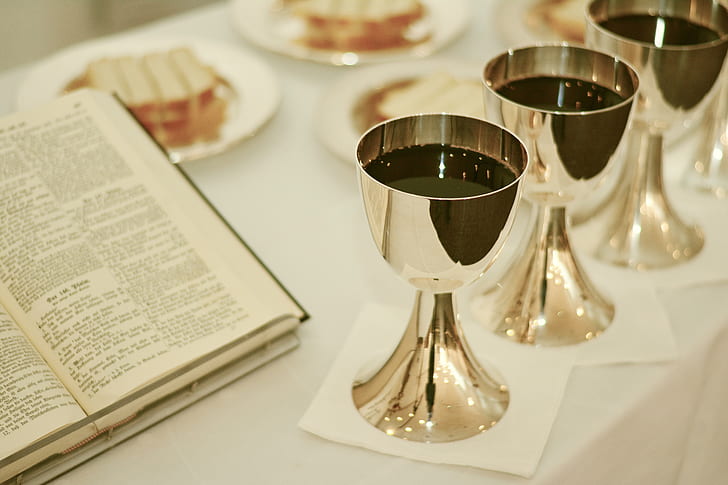
In a book called ‘Liturgy and Liberty’, an Anglican priest named John Leach tells a lovely story about coming in to find his children having lined up all their cuddly toys. Asking what they are doing, they reply that they are ‘Playing Communions.’ And they move from cuddly toy to cuddly toy, giving each some bread, with the words, ‘A piece of the Lord.’
Now you may say that this is an example of children not understanding Holy Communion, confusing ‘The peace of the Lord’ with the giving of the bread. But of course, the rejoinder is surely that many adult Christians also do not understand what is happening at the sacrament.
And where better to reflect on the meaning of the Lord’s Supper than at the Covenant Service? For Holy Communion is the Covenant Meal. As ancient covenants were sealed with blood, so God’s covenant with us in Christ is sealed in his blood, and we remember that at the Lord’s Table.
That said, I am not going to discuss theories of what does or doesn’t happen the bread and wine. I could do that one day, although I’d have to be careful that I was still preaching a sermon and not just giving you a theological lecture. I am content with the broad Methodist position that Christ is present at the sacrament, but exactly how he is present is a mystery that resists definition.
What I want to do instead today is consider what God does with us when we receive the bread and wine. I am following a pattern suggested by the late Catholic priest Henri Nouwen. Listen to the four things Jesus does with the bread at the Last Supper in verse 22:
While they were eating, Jesus took bread, and when he had given thanks, he broke it and gave it to his disciples, saying, ‘Take it; this is my body.’
Took. Gave thanks. Broke. Gave. Go back to ancient communion liturgies and they make those four actions central to their structure. We do it, too. The minister takes the bread and prepares it for use. Then we give thanks. The bread is broken, and finally it is given. In 1945, an Anglican Benedictine monk, Gregory Dix, said this was the fundamental shape that mattered, and this is why a lot of modern communion services of different denominations look similar, even if the words vary.
Henri Nouwen took this one step further. He said that what Jesus did with the bread is what he also does with us. Let’s see what that means for us.
Firstly, as Jesus takes the bread, so he also takes us:
The bread is taken and prepared for holy use. It is set apart for its special purpose in the sacrament.
We too are taken and set aside by God for his special, holy purposes. We are not merely forgiven and given a ticket to heaven that we cash in when we die. We have been chosen and brought into the family of God so that we may play our part in the work of his kingdom.
Each Christian has a calling. Sometimes it involves laying down what we are doing to take on something else, just as Jesus called the fishermen, who left their nets to become disciples and then apostles. For others, the special purpose simply involves living for Christ in the place where he found us in the first place. In 1 Corinthians 7:20 Paul says this:
Each person should remain in the situation they were in when God called them.
If there is no specific call to move to something else, then we recognise that God in Christ has called us to be content where we are, and faithfully serve him in that place and those circumstances.
But let there be no doubt either way that God has set us aside to be his holy people. That’s what holiness is – to be set apart. A certain distinctive lifestyle flows from that, but the essence of holiness is to be set apart for God’s purposes. It is not unique to those ordained by the church, it is what God does with every single one of his disciples.
Secondly, as Jesus thanks God for the bread, so he also thanks God for us:
This is the one where I find most people struggle. How can Jesus thank God for me? I’m a sinner. He knows that! I’m weak and frail. He knows that, too! We come up with a whole series of ‘But’s to object to this idea of Jesus giving thanks to God for us. But, but, but.
But nothing. We thank God for other people. We thank God for other objects, just as Jesus thanks God for the bread. There is nothing impossible here.
Yes, God cares about our sin, and he disciplines us and forgives us, but none of that is about having a grudging attitude to us. It is about the love of a Father who longs for the best in his children. If I may so reverently, God is crazy about us. Think of the father running to meet the Prodigal Son. That just wasn’t done in those days. Any other father would have waited at home for the errant son to return, grovelling. But God the Father runs to meet his children.
The prophet Zephaniah puts it this way:
The Lord your God is with you,
the Mighty Warrior who saves.
He will take great delight in you;
in his love he will no longer rebuke you,
but will rejoice over you with singing.’
(Zephaniah 3:17)
I saw a cartoon over Christmas which claimed to depict ‘Calvinist Santa’, where everyone was on Santa’s naughty list. And while it’s true that we are all sinners in need of salvation, if we just imagine God like Calvinist Santa as some mean, stern, miserable character, we shall have missed the truth that God rejoices over us and lets the angels throw parties for us in heaven. And it is this God, not Calvinist Santa, that we come to, even at such as solemn service as the Covenant Service.
Thirdly, as Jesus breaks the bread, so he also breaks us:
OK, here’s the tough, painful stuff. Is that what you’re thinking? Jesus has to break the bread to distribute it. And to get the Body of Christ where he wants it, he has to separate us.
But he also uses our brokenness for good. As Charles Haddon Spurgeon said,
God gets His best soldiers out of the highlands of affliction.
We resist brokenness. We think we must have our act together – or at least a public face that suggests that. We hide our brokenness for fear of shame or rejection.
But God doesn’t reject us for it. He can take our brokenness and deploy it for good. Like the risen body of Jesus still showing the marks of the nails from the crucifixion, God works with our brokenness a little like the Japanese art of Kintsugi, where broken fragments are restored with gold, silver, or platinum and shine more beautifully than they did before.
In his song ‘Anthem’, the late Canadian singer Leonard Cohen has these words:
Ring the bells that still can ring
Forget your perfect offering
There is a crack a crack in everything
That’s how the light gets in
You’ve heard me talk about some of my experiences of brokenness. The lung surgery in my twenties, the broken engagement, walking with my father’s Alzheimer’s, and the depression. I wish every single one of those things had not happened. I would prefer the ‘magic wand’ God many people wish for, who would instantly remove these things. But usually when I talk about them, people come up to me afterwards and say, ‘You might understand what I’m going through. Can we talk?’
There is a crack in everything. That’s how the light gets in. This year, let us allow God to work for good through our brokenness.
Fourthly and finally, as Jesus gives the bread, so he also gives us:
The bread is a gift of God to us. It is not something we give to him, and that’s why I don’t have the bread and wine brought up to the table with the offering. Jesus offered his body and blood for us, and the bread and wine are analogous to that. The bread is therefore his gift to us and to the world.
And it follows that we too are a gift from Jesus to others.
Again, you may resist that thought. How can I be a gift of God to others? Who would want me?
Yet this says more about our low estimation of ourselves than it does about God’s love for us. God only gives good gifts. He loves us so much that he gives us to others.
Somewhere in our circle of contacts, there is a person who needs us if they are to be blessed according to God’s kingdom purposes. Joining in the Covenant Prayer today is about us assenting to those good plans God has for us to bless others with his love. It is our version of standing with Isaiah, who encountered God in his holy glory in the Jerusalem Temple, and heard him say, ‘Who will go for us?’, and responded, ‘Here I am, send me.’
It is more blessed to give than receive, said Jesus. But today, the giving is not only about our money, our time, our talents, or our possessions. It is about God’s desire to give us to others in the cause of holy blessing.
Many of us here are, or have been, married. We have taken that step of giving ourselves wholeheartedly to another human being in love. At the Covenant Service, God in Christ calls us to co-operate with another act of total self-giving in love. Because in his love and by the power of his Spirit, we are a valuable gift to others in his cause.
We have just celebrated the fact that God gave us the gift of his Son. Let us respond by being available as a gift to be given to others.
 Big Circumstance