Joy-Bringer, Isaiah 35:1-10 Advent With Isaiah 3 (Advent 3 Year A)

Isaiah 35:1-10

One popular Christmas carol, especially among American Christians, is ‘Angels we have heard on high.’ Its first verse reads,

Angels we have heard on high
Sweetly singing o’er the plains
And the mountains in reply
Echoing their joyous strains
Gloria in excelsis Deo!

Unfortunately, one source of the music misprinted ‘Echoing their joyous strains’ as ‘Echoing their joyous trains.’
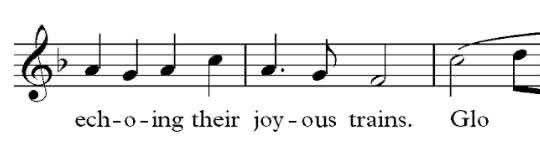
Source unknown. From the Church Service Typos group on Facebook.

I don’t suppose anyone who commutes would readily think of ‘joyous trains.’ I know my wife didn’t on Thursday evening when her train from Waterloo didn’t initially have a driver, when the passengers were told to disembark to find another train, only then to be told to stay on board. They left twenty-seven minutes late. Joyous trains, indeed.

But if the trains were transformed, that truly would be reason for joy.

The theme this week is ‘Joy’ but it is connected with transformation. So maybe a better title might be, ‘Joy in Transformation.’ These verses in Isaiah give five examples of the transformation the coming Messiah will bring, which lead to joy. It was something the southern kingdom of Judah needed to hear, nervous as the nation was due to the military power of Assyria, which had already conquered the northern kingdom of Israel.

But as so often in Isaiah, we shall see that no earthly king could completely fulfil the prophecy. Even with Jesus, the true Messiah, he would begin the transformational work prophesied, but it will only come to complete fruition with his return in glory.

However, in the meantime, in our in-between time, these point to our work for God’s kingdom today. There are five arenas for joy in the reading; I shall deal with each one briefly.

Firstly, joy for the desert:

The desert and the parched land will be glad;
    the wilderness will rejoice and blossom.
Like the crocus, 2 it will burst into bloom;
    it will rejoice greatly and shout for joy.
The glory of Lebanon will be given to it,
    the splendour of Carmel and Sharon;
they will see the glory of the Lord,
    the splendour of our God.

In the Middle East, the people know all about parched deserts in the heat. But God will restore life to the desert as he breaks the drought and beautiful plants bloom and flourish there.

Our droughts today are often caused by our failure as the human race to fulfil the command we were given when God created us: namely to rule over the created order wisely on his behalf. Instead of caring for it, we have exploited it. Now we pay the consequences – but worse, it is the poorer nations who are suffering first and most.

As Christians, we have common cause with those who are concerned for our environment. But we have a unique reason for being involved. It is that we are doing so as stewards of God’s creation, and as a prophetic sign that God will make all things new in his creation. We agree that the world is in a mess, but we engage out of a spirit of hope, not panic.

So let us engage in our creation care as an act of worship and of witness to the Messiah who will renew the earth. And if we listen carefully, we may catch the sound of the world rejoicing, too.

Secondly, joy for the fearful:

3 Strengthen the feeble hands,
    steady the knees that give way;
4 say to those with fearful hearts,
    ‘Be strong, do not fear;
your God will come,
    he will come with vengeance;
with divine retribution
    he will come to save you.’

At the time of the prophecy, Israel could well have been afraid of Assyria. But as we know, fear comes in many flavours. Fear of war. Fear of death. Fear of other people’s expectations. Fear of losing someone. The list of fears is long.

In the specific context, Isaiah promises that those who are afraid of wrongdoers can take heart, because God will judge the wicked who are scaring them.

And yet there is still a universal application. It is often said – and I confess I have not checked the veracity of this – that the words, ‘Do not be afraid’ occur three hundred and sixty-five times in the Bible. One for every day of the year. You can have one day of fear in a leap year!

God does not want us paralysed by fear. He wants us animated by love. And so, he promises to banish the forces and the people that cause us to fear. The life of the messianic age to come will not be characterised by fear. It will be an eternal age of love.

And if God promises that for us, we can ask ourselves, what can we do to help remove fear from the lives of other people? Sometimes we can banish the cause of fear. In other circumstances, we may not be able to do that, but we may be able to show how to live without fear when unwelcome things happen.

I know how easy it is to panic. My body goes into panic mode before my mind catches up with the truth. For me, God’s message of peace and love comes through human beings, not least my wife. There has been more than one occasion when people who didn’t like me in churches have made up false and malicious Safeguarding accusations against me. One time, my Superintendent phoned me and said, ‘Watch your back on Sunday morning.’ Debbie has helped me be anchored in truth when lies have flown about.

Thirdly, joy for the silenced:

5 Then will the eyes of the blind be opened
    and the ears of the deaf unstopped.
6 Then will the lame leap like a deer,
    and the mute tongue shout for joy.

There is more than one way of reading these words. Some take them literally as a promise of healing, and we saw in our Gospel reading from Matthew: Jesus did heal the blind, the deaf, and the lame. I wouldn’t want to deny that, nor the promise of full healing when Jesus comes again and makes all things new. I would encourage us to pray for the sick, just so long as we don’t treat chronically ill or disabled people purely as prayer projects rather than people with dignity. As the title of one book puts it, My Body Is Not A Prayer Request.

But I will say there is a wider meaning to these words. Why did I introduce this point as ‘joy for the silenced’? For this reason. Our English translations say at the end of the quote, ‘the mute tongue [will] shout for joy.’ But the words ‘for joy’ are not there in the Hebrew. The mute will shout. That’s it. People who have been silenced by those who oppress them find their voice in the kingdom of God. The persecuted are vindicated and set free. The people that society does not value are of great worth and significance to Jesus.

The early church did this by the way they gave importance to slaves and women. Jesus calls us too to value those who would not be elevated by our society. He longs for them to find their place in his family and his kingdom purposes. Let’s not evaluate people by worldly standards, but by the fact that they are loved and cherished by God in Jesus.

Fourthly, more joy for the desert:

Water will gush forth in the wilderness
    and streams in the desert.
7 The burning sand will become a pool,
    the thirsty ground bubbling springs.
In the haunts where jackals once lay,
    grass and reeds and papyrus will grow.

We’re back in the wilderness, but to make a different point. This time, we see the conditions coming together so that life can flourish. Water to drink. Papyrus to make documents. Reeds to make household items.

In this context, artisans, craftsmen, and business can flourish. Their raw materials are plentiful again.

And so, I want to suggest to you that one way we can be a sign of the Messiah’s coming kingdom is by supporting human flourishing, including our local businesses.

Is that a Christian thing to do? I think so. Remember how later the people of Judah were taken into exile in Babylon. The prophet Jeremiah wrote a letter to the exiles. You can find it in Jeremiah 29. In that letter, he tells these Jews who have been separated from their own land and temple that were so vital to their understanding of salvation that they were to seek the prosperity of the city to which they had been taken. Yes – even a pagan city. Go and bless the pagans, says Jeremiah: it is a sign of God’s covenant love.

Let’s cultivate our relationships with local shops and businesses. Not only by giving them our custom, but that when we do so we take an interest in them and we build relationships with them. I have known ecumenical groups of churches in a village take boxes of chocolates to every business in that village at Christmas, with a card thanking them for all they do, and offering to pray for them if they would like it.

Which shops, businesses, or community groups do you appreciate here? Can you bless them? I’m sure you can. Maybe it will provoke questions.

Fifthly and finally, joy for the temple:

8 And a highway will be there;
    it will be called the Way of Holiness;
    it will be for those who walk on that Way.
The unclean will not journey on it;
    wicked fools will not go about on it.
9 No lion will be there,
    nor any ravenous beast;
    they will not be found there.
But only the redeemed will walk there,
10     and those the Lord has rescued will return.
They will enter Zion with singing;
    everlasting joy will crown their heads.
Gladness and joy will overtake them,
    and sorrow and sighing will flee away.

The highway of holiness, on which only the redeemed and not the unclean may walk, is surely the road to the temple in Jerusalem.

This reminds us that when Jesus is present among his people, there is joy. Yes, of course we will be reverent: I am not calling for some religious chumminess with God. But for all that, to have the Messiah in our midst will be a cause for joy and it will reflect in the way we are together in worship and in the sharing of our lives together. With Jesus, church is to be a place of joy.

Today, we only have that experience of Jesus by the presence of his Spirit within us and in our midst. But part of the fruit of the Spirit is joy! And one day, we shall all be together in the presence of Jesus and his Father, too.

It’s nice that we look forward to seeing our friends at church. But that doesn’t make us any different from anyone else. Do we have a sense of joy that Jesus will be present with us, and indeed that we are each bringing him with us to our gathering? That is what the messianic community is like.

Conclusion

Joy to the world, we sing at this time of year, the Lord is come. And when the Lord comes, there is joy. Joy for the broken, joy for God’s people and joy for all creation.

And when he comes again, the joy will be magnified and sorrow banished.

Let us, the followers of Jesus, then, also be joy-bringers.

Living A Life Worthy Of The Lord, Colossians 1:1-14 (Ordinary 15 Year C)

Colossians 1:1-14

When I decided I wanted to learn photography, I asked my Dad to take me to his favourite camera shop in London. There, we met a remarkable salesman who had had one hand amputated. Think about that: how do you manipulate something like a camera without one hand? He did.

He sold me a rudimentary 35mm SLR camera. The idea was that I needed to learn the basics first before I ever considered a more complicated beast. That’s what I did.

I even had to repeat the exercise when I moved from 35mm film to digital.

The nature of Paul’s thanksgiving for the Colossians is that they have learned the basics. Now they can go deeper.

What are the basics?

we have heard of your faith in Christ Jesus and of the love you have for all God’s people (verse 4)

Faith in Jesus and love for his people. Faith and love. These come from the gospel and the hope it gives us (verses 5-8).

Now it’s time to build on the basics and go deeper in their faith. Specifically, he wants them to know God’s will (verse 9) so they

may live a life worthy of the Lord and please him in every way (verse 10).

I’d like us to look at these next steps for the Colossians today. If the basics are in place for us – that we have faith in Jesus Christ for salvation and we love God’s people – then what qualities are our next steps? Paul lists four:

Firstly, good works:

bearing fruit in every good work (verse 10)

We know that good works don’t earn us salvation. That is a free gift of God that we receive by putting our faith in Jesus and his death for us on the Cross.

Instead, good works in the Christian life are a grateful response to God, once we know salvation by faith in Jesus. As I’ve said before, remember that God only gave the Ten Commandments to Israel after he had saved them from Egypt. It’s similar for us.

How might we approach this, then? We have just completed the Bible Society’s study course on Paul’s letter to the Romans. In the final session on Thursday, we were challenged as part of our mission to pray a prayer every morning: ‘Lord, who can I bless in your name today?’ I think that would be a helpful approach in knowing at least some of the good deeds God is calling us to do as our thankful response to salvation.

I have encouraged other people to consider the question: how can I make a difference for good in the world? It might be through pursuing a particular career. It might be in other ways. We might seek to live less extravagantly and give more to those who are doing things we aren’t able to do. This might involve our support for organisations working to transform things in the developing world, for example. Or we might cut back our own spending in order to give to those who are bringing positive change for those in poverty in the UK. Where can we make a difference for good in our deeds and in our giving?

Another way to approach this is found in a favourite quote of mine. It comes from the American Christian writer Frederick Buechner, when he was writing on the subject of vocation. Now you may hear me say the word ‘vocation’ and think, this doesn’t apply to me, I’ve retired from paid work. But vocation is about everything we are called to do and to be in response to God’s love.

So here are Buechner’s words:

Your vocation is where your deep gladness meets the world’s deep need.

In other words, is there something you are passionate about that can be set to the purpose of making a difference in the world?

Secondly, knowing God:

growing in the knowledge of God (verse 10)

Now before anybody gets worried, I’m not suggesting we all need to go off and study for a Theology degree! I enjoyed the two I took, but they’re not for everyone.

We do however all as Christians need to know more about God’s character, God’s plans, and what God loves. If we know God more in these ways, we shall want to love God more deeply. It seems strange to me that some Christians just want to stop at the bare minimum knowledge of God. Surely, given all he has done for us in Christ, we would want to know more about him and his amazing love.

And that’s why I’m always banging on about not simply coming to worship on Sunday, although that’s a good start. It’s why we need to read the Bible daily for ourselves and also meet with others to study it so that we can learn from each other. I was so pleased that everyone who filled in a feedback form at the end of our Romans course was looking in one form or another for us to keep meeting and looking at the Bible together. That’s encouraging.

It’s why we need to pray regularly, because prayer is not just us talking to God, it’s about waiting and listening to him.

Also, sometimes we get to know God better merely by doing what he says, even when we don’t understand it. Because in the doing of his will we get to know him better. Jesus said,

Anyone who chooses to do the will of God will find out whether my teaching comes from God or whether I speak on my own. (John 7:17)

So – how are we getting to know God better?

Thirdly, endurance:

being strengthened with all power according to his glorious might so that you may have great endurance and patience (verse 11)

Often when we read words like ‘strengthened’, ‘power’, and ‘might’ in the New Testament, we think it’s going to be about the dramatic or miracle-working power of the Holy Spirit, and I’m not about to poo-poo that.

But here, Paul prays that God will strengthen the Colossians so they ‘may have great endurance and patience.’

We need those qualities in the Christian life. To follow Jesus is not a spectacular 100-metre sprint, it is the endurance of the marathon. And over the marathon course of our lives, there will be ups and downs, joys and sorrows, peaks and troughs. The early Christians got to realise that quickly, through their experiences of suffering and persecution. Many – if not the majority – of Christians around the world today are familiar with this, too.

When we are finding it tough to follow Jesus, we can ask the Holy Spirit to help us. Sometimes, that will be an individual experience. God will give us an inner resilience that we didn’t know we had – perhaps because we didn’t have it before – and he will help us to keep on keeping on, even if it is just tenaciously putting one foot in front of the other, or living day to day or even hour to hour.

Sometimes, God will strengthen our endurance through the help of our sister and brother Christians. I had a couple in one church who underwent five bereavements in a year. Both of them lost both of their parents, and a beloved uncle died as well.

The wife of the couple said, ‘At times like these I find it hard to pray. But I am encouraged to know that the church family is praying for me when I can’t pray.’

Is life and faith difficult for us at present? Let us ask God to strengthen us in patience and endurance, just as Paul asked God to do that for the Colossians.

Fourthly, joyful thanksgiving:

and giving joyful thanks to the Father, who has qualified you to share in the inheritance of his holy people in the kingdom of light (verse 12)

This is remarkable, coming straight after the prayer to have the strength to endure. If our situation is such that we need the gifts of patience and endurance, then presumably life is not easy. And if that’s the case, how are we going to give ‘joyful thanks to the Father’?

Paul says it’s all because it’s a response to what God has done for us. Paul tells the Colossians it’s all because the Father

has qualified [them] to share in the inheritance of his holy people in the kingdom of light.

It’s a case of remembering and rehearsing all the wonderful things God has already done for us, and all the amazing things he is promising to do for us. When we ponder these things in our hearts and minds, isn’t ‘joyful thanksgiving’ the natural reaction?

On Thursday morning, I paid my monthly visit to a local Christian care home. In alternate months, I either lead devotions for the residents and staff, or I bring Holy Communion. This time, it was a Holy Communion month.

So, I led a short service in the lounge, and then Deborah and I took the bread and wine to those residents who had not been able to make it to the service. We offered the elements in each room where someone was, because all the residents are Christians.

Entering one room, we found a lady who had lost most of her sight and a lot of her hearing. But in her adversity, this beautiful saint had still found a way to give thanks and praise to her God. She had an A4 notepad and a Sharpie pen. In her large handwriting (due to her sight loss) she was writing out on one sheet after another the opening verses of her favourite hymns. This was how she expressed her devotion despite her limitations. She presented me with a sheet on which she had written the first verse of ‘Come, Thou Fount Of Every Blessing.’

That lady’s witness was a challenge to me.

How is each one of us growing in our faith? Are our good works making a difference? Are we growing closer to God? Do we know his strength enabling us to endure in faith even in difficulty? Do our hearts leap with joyful praise?

We have every good reason:

13 For he has rescued us from the dominion of darkness and brought us into the kingdom of the Son he loves, 14 in whom we have redemption, the forgiveness of sins.

Principles of Giving (2 Corinthians 9:6-15)

2 Corinthians 9:6-15

There is a certain cluster of topics that a minister can preach on and will know they are likely to provoke guilt feelings in the congregation. One is evangelism: which of us truly is a good witness to Christ? Another is prayer: can any of us say we pray enough, or are close to God?

And another is today’s subject: giving. How easy it is for a preacher to lay the guilt on thick when it comes to money. You may have had someone use emotional manipulation to obtain greater giving from you, either in the church or in the world. You may have been sucked in by the consumerism of our culture. If I had wanted to do that here, I would have preached this sermon before our annual Gift Day, not after – as is the case.

In our reading, Paul is not talking about regular giving. He is organising a collection among the early churches to support those in Jerusalem who are suffering from a famine. What he’s promoting here is closer to the one-off gifts we make when a natural disaster hits somewhere in the world, and the Disasters Emergency Committee springs into action with TV adverts.

One or two of you will say, so why don’t you go to the Old Testament teaching about tithes and offerings, then? Isn’t that about regular giving? If we did a series of sermons on the subject, I would cover it. But at this point I will just say that tithes and offerings are more complicated than some Christians think. Translating them to our situation is not that straightforward.

But in today’s passage, even though it is about one-off gifts, Paul goes back to basic Christian principles about giving to make his appeal here. Those same basic principles should be at the foundation of all our decisions about giving. So let’s explore them.

Firstly, Generosity

6 Remember this: whoever sows sparingly will also reap sparingly, and whoever sows generously will also reap generously.

Now this is a verse that has been abused by some Christian leaders. They have made false promises to congregations on the basis of this verse that if they give a lot of money, then God will bless them with a lot of money. They have appealed to the base instinct that wants to get rich and said, if you want to be wealthy then ‘sow a seed’ – usually into that preacher’s ministry. Sure enough, the preacher then gets enough money to fly everywhere in a private jet, while those who give find no improvement in their financial position and may even be driven into poverty. I think there is a special place in Hell for such preachers.

But there is still an important principle here, and that is the call for the Christian to have a generous character. There is only one way to develop a generous character, and that is to be generous.

We have good reason for doing this: we follow a generous God. I shall have more to say about that in a few minutes, but for now let’s note that Paul ends this passage on that note:

15 Thanks be to God for his indescribable gift!

God’s indescribable gift is Jesus! How generous was God in giving up his only begotten Son to take on human flesh and die and rise again for the salvation of the world? We seek to give generously, because we love and serve a God who is the supreme generous giver.

What kind of earthly parent would ask, how little can I get away with giving to my children? We know instead that loving parents give to their children at their own expense. This is what God has done for us. This is why we are called to be generous givers.

So a question we need to ask of ourselves when assessing our giving to the church is not, ‘How little can I get away with?’ but ‘How much from my income and in my circumstances would constitute generous giving?’

Remember: this is about the growth of Christian character. Do I desire to be like our generous God?

Secondly, Cheerfulness

7 Each of you should give what you have decided in your heart to give, not reluctantly or under compulsion, for God loves a cheerful giver.

‘God loves a cheerful giver.’ The late American Baptist preacher and sociologist Tony Campolo put this verse into practice. When driving on a toll road and coming up to the toll booth, he would wind his window down, give money to the clerk on duty, and say to them, ‘This is for me, and also for my friend in the car behind.’ Then, as he drove away, he would watch in his rear view mirror the ensuing conversation between the toll clerk and the next driver. You’ve guessed: Campolo didn’t know the driver behind him from Adam, but he took joy in his giving.

Your trivia fact for this week is that the Greek word translated in English as ‘cheerful’ is hilaros, from which we get our word ‘hilarious’. Does God love a hilarious giver? Why not? Tony Campolo had much hilarity in paying for the driver behind him. And is not God full of joy and hilarity?

So I’m very much trying to avoid making this sermon one of those gloomy ones that load more and more guilt on people. As I said at the beginning, the moment people hear the sermon is on this subject, the risk of ladling guilt on people is high.

And I hope you heard that in Paul’s language, much as he wants the Corinthians to give generously, there is no emotional manipulation here: the decision on how much to give should not be made ‘reluctantly or under compulsion’.

What if Christians are reluctant to give? When [my predecessor] John Illsley began his ministry in Sheffield, the local Anglican vicar was Robert Warren. He was in charge of a massive church with several satellite congregations across Sheffield: St Thomas, Crookes. They saw four-figure attendances on Sundays, and due to their growth had held several appeals to support more building. Warren said in a book that if people did not want to give, the answer was not to make them feel guilty. Rather, it was to give more grace. It is when we truly understand how gracious and merciful God has been to us in Christ that we shall want to give. Then it will be a freewill decision, and it will be joyful.

Thirdly, Trust

8 And God is able to bless you abundantly, so that in all things at all times, having all that you need, you will abound in every good work. 9 As it is written:

‘They have freely scattered their gifts to the poor;
    their righteousness endures for ever.’

10 Now he who supplies seed to the sower and bread for food will also supply and increase your store of seed and will enlarge the harvest of your righteousness.

Giving is an act of trust. I confess that for a long time I had trouble believing in a God who was a generous Father. My human father certainly showed me love, but my upbringing was one where for the most part my parents didn’t have it easy financially. I would always be the child in the class at school who received the cheapest Christmas presents. I overheard conversations between Mum and Dad about how they were going to manage their money.

But I learned an amazing lesson about the generous Father I could trust when I wanted to go to theological college and explore what God’s call on my life was. It was near the end of the days of student grants, not student loans, and the college that accepted me did not qualify for mandatory grants. My Local Education Authority took that as reason to deny me a grant.

The college told me I needed to guarantee my funding for the first year, and I appealed against the refusal to give me a grant. Forty-eight hours before the deadline the college gave me, I still hadn’t heard about my appeal. Phoning up, I was told, ‘I’m sorry, Mr Faulkner, there is a letter in the post saying we have rejected your appeal.’

It was at this late juncture that people suddenly started giving me money. My parents rediscovered a long-forgotten savings account. A student who was taking a year out between Sixth Form and college to work and save money for a car felt prompted to give that money to me. That student’s boyfriend also felt prompted to give me some funds. As did two elderly ladies at church, one of whom wrote the most moving letter in which she said, ‘It seems like God is calling you to trust him to meet your needs. He will meet ours, too.’

The next Sunday evening I was preaching at another church in our circuit. I preached on ‘Give us this day our daily bread’ and said that God had met my needs for college. In fact, I only had three-quarters, but I didn’t tell them that.

After the service, a middle-aged single man invited me back to his flat for coffee. As we sat in his living room, he explained that he had planned a three-week holiday to New Zealand to see his auntie. But his auntie had since died, and he no longer felt like going. He had already exchanged his sterling currency for New Zealand dollars, but since doing so their dollar had been devalued. Holding onto the money in the hope that the dollar’s value would improve, in fact it kept declining. Now this money was just annoying him. Would I like to take this annoyance off his hands?

Before I could say anything, he had thrown some plastic Thomas Cook envelopes into my lap. I can still remember the precise amount. 2310 NZ dollars. My Dad worked for NatWest and got me a staff rate of exchange: £742.31. Our friend had originally exchanged £1000 – and we’re talking a few decades ago now!

God blesses us, not so that we can financially keep up with the Joneses, but so that we can bless others.  Let us trust him.  

Conclusion, Thanksgiving

11 You will be enriched in every way so that you can be generous on every occasion, and through us your generosity will result in thanksgiving to God.

12 This service that you perform is not only supplying the needs of the Lord’s people but is also overflowing in many expressions of thanks to God. 13 Because of the service by which you have proved yourselves, others will praise God for the obedience that accompanies your confession of the gospel of Christ, and for your generosity in sharing with them and with everyone else. 14 And in their prayers for you their hearts will go out to you, because of the surpassing grace God has given you. 15 Thanks be to God for his indescribable gift!

Originally, I wanted to make a whole fourth point about thanksgiving, but time is not on my side and so I just want to emphasise that thanksgiving is the desired result of true Christian giving. The recipients of our generosity will thank God (verse 11). Their thanksgiving will overflow (verse 12). God will be praised, because people will see us living out our faith (verse 13) as we respond to his grace (verse 14). And as I noted earlier, this is all rooted in our thanksgiving for God’s giving to us (verse 15).

If thanksgiving is at the heart of our giving, then this is about worship. Our giving is not a subscription to a club or even fund-raising: that is why in a service, I refer to the offering, not the collection.

By the grace of God, may we learn to give as an act of worship.

Fourth Sunday in Advent: God Is Coming Home (Luke 1:39-55)

(This is a second consecutive repeat sermon from six years ago – sorry about that, but the week has been thoroughly disrupted by loss of landline and broadband for five days. I’m really not sure the words ‘BT’ and ‘Business’ belong together in the expression ‘BT Business Contract’!)

Luke 1:39-55

‘It’s coming home, it’s coming home, it’s coming – football’s coming home.’

Every time the England football team has qualified for a major tournament since 1996, that songs – ‘Three Lions’ – is dusted down and sung again.

There is a sense of ‘coming home’ when Mary visits her older cousin Elizabeth. It’s not immediately obvious in English translations of the Bible, but there are allusions in this story to 2 Samuel 6:2-19, where King David and his men bring the ark of the covenant to Jerusalem. Just as the ark of the covenant was the portable sign of God’s presence among his people, so now in the Incarnation Jesus will be ‘the portable presence of God’, if that doesn’t sound too irreverent. And just as David danced before the ark of the covenant, so the infant John leaps in his mother Elizabeth’s womb. The prophetic voice in Israel has been silent since Malachi four hundred years earlier, but now God is at work. Like that sentence in ‘The Lion, The Witch, And The Wardrobe’, ‘Aslan is on the move.’

So what happens when God is on the move? Blessing – that’s what happens. Mary is blessed. Her baby is blessed. Elizabeth is blessed – she says she is ‘favoured’, which is a word that explains what blessing is. And surely her leaping, dancing baby is also blessed.

What blessings appear when God comes home to his people?

For Elizabeth’s unborn baby John, it is the blessing of joy. He leaps in the womb (verse 41) and Elizabeth says he ‘leaped for joy’ (verse 44). Why would John leap for joy?

Remember what their relationship will be. They are cousins, but John will be born first and he will herald the coming of his cousin Jesus, the Messiah. John will be the forerunner. He will be the compère, introducing the main event. He will be the best man to the bridegroom. In adult life, nothing will give John greater joy than the advent of Jesus. He will be filled with joy to announce that the Messiah is coming. He will not be interested in promoting himself; instead, his passion will be to introduce Jesus, and then get out of the way so that all the spotlight can fall on his cousin.

Our joy too is to announce the presence of Jesus. For in him, God has come to be with all who will follow him. We are not left alone, for the One called Immanuel, God with us, is here. We have no interest in promoting ourselves, only in highlighting Jesus, for he is our joy and nothing gives us greater joy than to see people recognise him, acknowledge him, and celebrate his love.

Remember what I said that the infant John leaping in his mother’s womb is a New Testament parallel to King David leaping and dancing for joy before the ark of the covenant, the Old Testament sign of God’s presence, being restored to the midst of God’s people. Does anything give us more joy than to know that in Christ God is present? We are not left alone. We are not deserted. Even in the silence, God is here.

So let us be joyful this Christmas. We rightly query the self-indulgence of society at Christmas, and the excessive celebration of – well, what, exactly? But if anyone has reason for joy at Christmas it is the Christian.

That said, being truly joyful in this season can be difficult. There are so many pressures and things to do that if we are not careful, we get so run down that we are unable to celebrate. I know that is true of me as a minister, with all the extra services, and I can remember the time my daughter asked me how grumpy I was going to be this Christmas.

But I also know I am not alone in that experience. It is widespread. How ironic that the loudest voice I have heard in the last year or two urging people to simplify Christmas in order to make it better has been the television and internet money saving expert, Martin Lewis. What’s the irony in Martin Lewis urging people to simplify Christmas in order to enjoy it more? He isn’t a Christian. He’s Jewish.

Can we find space again this year to be filled with joy at the coming of our Lord?

For Elizabeth herself, the blessing of God coming home to his people is to be filled with the Holy Spirit.

41 When Elizabeth heard Mary’s greeting, the baby leaped in her womb, and Elizabeth was filled with the Holy Spirit.

God not only comes near to Elizabeth, God comes right into Elizabeth’s life. It is a sign of what is to come. The coming of God will not end with the departure of Jesus but will continue in the gift of the Holy Spirit.

Now the coming of the Holy Spirit can lead to all sorts of gifts in God’s people. What do we see in Elizabeth? Let’s read on:

42 In a loud voice she exclaimed: ‘Blessed are you among women, and blessed is the child you will bear! 43 But why am I so favoured, that the mother of my Lord should come to me?

Elizabeth’s gift is to ‘recognises blessedness’[1]. In other words, the Holy Spirit enables Elizabeth to recognise what God is doing, to notice where God is bestowing favour. So when God comes close to Elizabeth and fills her with the Holy Spirit, she receives the ability to discern what God is doing, and then to welcome it and live accordingly.

Now when you state the work of the Holy Spirit like that, isn’t that something we long for and desperately need? Isn’t it critical for us too to be able to discern what God is doing and respond appropriately? In today’s church we often lurch from one thing to another, trying this trick or that technique in order to see things turn around, but I rarely hear people say, let us seek God to know what God is doing. It’s as if we can solve the problems of the church by human ingenuity and technology. And we can’t. Not only that, God won’t let us, because if things turned for the better that way we would end up glorifying ourselves, telling ourselves what clever folk we are, rather than bringing praise to God.

Remember that in Elizabeth and Mary’s day things were bad. As I said in the introduction, it had been four hundred years since God had spoken through the prophet Malachi. God’s people were not even free in their own land, they were under the occupying force of Rome. They weren’t truly it at home: they saw themselves as being in exile, similar to when they had been carted off to Babylon in the sixth century BC. The people of God in their day were looking around for ways to turn the situation around, just as we are with the aging and declining numbers of the church.

But unlike the leaders of her day, Elizabeth realised that the problem was a spiritual issue. When God drew near, she was filled with the Holy Spirit and began to see what God was doing. Surely her blessing is a lesson for us. As we long to find a way forward today, it won’t do to follow the fads and fashions. We need instead to pray, ‘God, come close to us. Holy Spirit, fill us with the presence and wisdom of God.’ Should not this be our posture in response to the plight we find ourselves in – prayer rather than conferences and committees?

Finally, Mary: what is her blessing when God comes near? It is the gift of faith. For as the discerning Elizabeth recognises,

45 Blessed is she who has believed that the Lord would fulfil his promises to her!

We need to pause and reflect on just how remarkable Mary’s faith was. Unlike our society, to fall pregnant outside marriage was shameful. And while the imposition of the death penalty by stoning was by no means certain, the ending of her betrothal by divorce and social shaming and ostracization were sure bets. In the face of this, Mary believes her Lord.

Think also about Mary’s age. Marriages were arranged soon after girls reached puberty, and the young men were just a few years older, but not much. Mary is therefore probably about thirteen or fourteen when she learns of her unusual supernatural pregnancy. At that tender age, Mary believes her Lord. In a society where older people were respected and younger people weren’t, Mary is the one who is the example of faith.

The fact that God has moved close to Mary in sending Gabriel to announce the birth and in the Holy Spirit overshadowing her to cause the pregnancy has put Mary in touch with the great tradition of faith in which she stands. She

places herself squarely in solidarity with all God’s people and recognises in her own experience the establishing at least in principle of all that the faith of God’s people had encouraged them someday to expect from God.[2]

It all comes alive in Mary. The great stories of faith and trust in the past, long dormant in the four-hundred-year silence of God, are seen now in a young teenage girl.

And if we feel remote from God and the great heroes of faith, then one thing we can surely do is petition God to draw near to us that our faith might be ignited and we display faith that puts us too clearly within our great spiritual heritage. We might stop banging on about the greatness of the Wesleys and begin instead to emulate them.

But let’s notice too that Mary’s faith is not some vague, general belief. Elizabeth defines it as ‘she who has believed that the Lord would fulfil his promises to her’. Often that is the challenge of faith. God makes many promises to us in the Scriptures and either they seem hard to believe (as was surely the case for Mary with her pregnancy) or we are left waiting a long time for God to come through on what he has promised.

But Mary stood firm. God had spoken. Yes, she sought clarification from Gabriel, but unlike Zechariah she did not lapse into unbelief. It is symbolic, surely, that when Zechariah expresses unbelief he is struck dumb, because he had nothing worthwhile to say, whereas Mary, who asks questions but still believes can hurry rejoicing to her cousin’s house and pour out her praise in the hymn we call the Magnificat (verses 46-55).

Maybe it’s easier when we sense the nearness of God to stand firm. But whether we currently feel God to be close to us or not, are there divine promises where we are still waiting to see the fulfilment? Is God asking us to wait trustingly to see what he will do?

We might be facing the temptation to wobble in our faith. If we do, remember how the children of Israel wobbled at the Red Sea when they felt trapped between the waters and Pharaoh’s army. And remember what Moses said to them: ‘Stand still and you will see the deliverance of the Lord.’ Where is God calling us to stand still and see his deliverance, like Mary?

So this Christmas, as we tell the two-thousand-year-old story of God coming to his people in human flesh, may it not be another act of going through the motions. May it be a time when we sense God drawing near to us and filling us with joy. May we sense God’s nearness as he pours out his Spirit on us and we discern what he is doing, so that we may respond and join in. And may the closeness of God’s presence strengthen our faith so that we may believe his promises and stand firm to see his deliverance.


[1] John Nolland, Luke 1-9:20, p75.

[2] Ibid.

Third Sunday in Advent: Sing For Joy (Zephaniah 3:14-20)

(This is a repeat of a sermon I first preached six years ago.)

Zephaniah 3:14-20

If, like me, you’re a bit of a misery guts in the run-up to Christmas, then the Third Sunday in Advent is your favourite. It’s the day we traditionally remember John the Baptist. And what finer example of pricking the balloon of froth and trivia is there than the man who called the people who rushed to him ‘You brood of vipers’ (Luke 3:7)? We’d be thrilled to have crowds rushing here, wouldn’t we? Imagine if we had a sudden major influx of newcomers on a Sunday morning and I stood in the pulpit, denouncing them in that way? I think you’d be going home and phoning the Superintendent – even though what John tells people to do, in sharing, honest and just behaviour, and plain integrity – isn’t theologically radical. (Although it is disturbing that he does have to be that basic.)

In clearing the way for the Messiah, we often think of the severe images in John’s preaching – the brood of vipers, the winnowing fork and fire of the Messiah, and so on. But what I want to look at this morning is not so much the process of preparation but rather what John was preparing for.

And that’s where Zephaniah’s prophecy comes in. He brings God’s vision of what things will be like after the end of exile. And while God’s people are no longer in a foreign land, you’ll perhaps recall how I’ve said that in Jesus’ day they saw themselves as still in exile, due to their occupation by the Roman forces.

Now we know that Jesus announced a very different end of exile from that which his nation anticipated. Not all of them would have seen the need for the repentance which John proclaimed. And even those who did would have assumed that if they lived in holiness then God would grant their wish of deliverance from the Romans.

But nevertheless the images in Zephaniah give us a great indication of what life is like in the kingdom of God that Jesus inaugurated. You may remember that Jesus was once asked why he and his disciples feasted, whereas the disciples of John fasted. He said that while the bridegroom was present, there would be feasting. So we’re not going to look this morning at the fasting and the preparation, we’re going to consider the feasting that follows the preparation.

I want to highlight two aspects.

Firstly, we find a singing people:

14 Sing, Daughter Zion;
    shout aloud, Israel!
Be glad and rejoice with all your heart,
    Daughter Jerusalem!
15 The Lord has taken away your punishment,
    he has turned back your enemy.
The Lord, the King of Israel, is with you;
    never again will you fear any harm.

Israel is forgiven and no longer under threat from her enemies. The natural reaction is to sing, to shout aloud, to be glad, and to rejoice. No longer are they oppressed due to their sins: God has taken that away. Joy is the natural result!

In my teens, one popular worship song had the words, ‘I get so excited, Lord, every time I realise I’m forgiven.’ We did sometimes deliberately sing wrong words to it: ‘I get so excited, Lord, every time I realise I’m a gibbon,’ but even our laughter at our silly alteration was part of our joy. We knew we were forgiven sinners through the Cross of Christ, and that led to excitement and great joy.

Sometimes, though, it’s hard to find where the joy has gone. As I’ve told you before, coming from a family which has a history of depression, I know what it is for the dark cloud suddenly to appear over my life, even though I’ve never been diagnosed with depression. Sometimes we don’t react in the best ways to circumstances, but at other times we are at the mercy of unbalanced chemicals in our bodies. These situations need talking therapies or tablet cures.

But on other occasions you really wonder where the joy has disappeared in the church generally. I recall a dismal Good Friday ecumenical service when I was young. We happened to be singing ‘I get so excited, Lord’, and our minister, who was leading the service, asked if there really was any evidence that people there were excited that they were forgiven. Were they so caught up with the sense that Good Friday reminded them of their sins that they had forgotten Good Friday also brought them relief from their sins?

As I’ve pondered this, I’ve developed a theory. The longer we go on as Christians and get further away from our heady younger days when we discover the joy of forgiveness for ourselves, and as we slowly with the help of the Holy Spirit correct wrong behaviour, the trouble is that we start to see ourselves not as forgiven sinners but as decent, respectable people.

And when you start to see yourself as fundamentally good, you see less reason to view yourself as a sinner needing the grace that first thrilled your heart. In fact, you become like those opponents of Jesus who criticised him for partying with the disreputable. Jesus told them with, I think, a note of sarcasm, that it was not the healthy who needed a doctor, but the sick. But we who now see ourselves as so healthy no longer connect with what brought us joy. Our spiritual amnesia makes us the miserable self-righteous religious types that nobody likes.

What is the cure? Well, if this condition is a progressive amnesia, what we need is the gift of remembering. We need the grace to look at our past (and at our present attitudes) in the searching light of Christ. We need then to remember what Christ did for us when we knew we were sinners, and then receive that gift of undeserved mercy again.

You may recall that the Preface to the 1933 Methodist Hymn Book began with the famous words, ‘Methodism was born in song,’ and so it was. But the birth of our spiritual tradition in song was not some cultural love of a particular kind of hymnody, it was a spiritual experience that had to be sung. It was the experience of forgiveness and the assurance of God’s love that led the early Methodists to sing for joy. Some Christians have argued that just about every major spiritual renewal down the centuries has been accompanied by a new outburst of music, because that’s the natural and creative outlet for the joy that God brings.

For us to be a joyful people, then, means reconnecting with the life of the Spirit – the Holy Spirit who showed us we were sinners but who also revealed to us the forgiving love of God in Christ; the Holy Spirit who graciously makes us more like Jesus as we open ourselves to him, but who also reminds us of our need of grace, to inoculate us from the risk of becoming Pharisees; the Holy Spirit, who indeed pours the joy of God into our hearts, along with divine love. If we welcome the Holy Spirit, one thing we do is welcome holy joy into the depths of our beings.

Secondly, we find a singing God:

16 On that day
    they will say to Jerusalem,
‘Do not fear, Zion;
    do not let your hands hang limp.
17 The Lord your God is with you,
    the Mighty Warrior who saves.
He will take great delight in you;
    in his love he will no longer rebuke you,
    but will rejoice over you with singing.’

So there you go, right there is ‘the Lord of the dance’: he ‘will rejoice over you with singing’. Sometimes in our Advent preparation as with our Lent preparation we think about the holiness of God in a severe way, and we are conscious of how far short we fall of God’s standards. Certainly, we can react that way to the preaching of John the Baptist, as I indicated at the beginning – although it’s worth noting that at the end of our Gospel reading, we heard Luke say that what John preached was ‘good news’.

And it may therefore be that our image of God is the stern headmaster with furrowed brow, holding us to unattainable standards and punishing us when we fail.

Now there is a place to speak of God’s holiness, and even of his judgment, but here we see another side to God: one who delights in his children and sings for joy over them. If anyone still believes that the Old Testament reveals God as a God of wrath and the New Testament shows him to be a God of love, this passage should thoroughly confuse such people!

Where do we most fully see such a joyful God? Surely it is in the ministry of Jesus. He teaches this about his Father when he tells the Parable of the Prodigal Son, where the father scandalously keeps looking out for his errant son and then throws a great party to celebrate the return. And Jesus lives it out as he turns water into wine at a wedding, as he invites himself to Zaccheus’ house, thus prompting the tax collector’s repentance, as he feasts with the last and the least. Jesus teaches and demonstrates a God who is full of joy when sinners come home to him, and whose joy is such that it leads sinners home.

Perhaps Johann Sebastian Bach got it right with his words, ‘Jesu, joy of man’s desiring.’ Jesus is our joy, for he is full of joy himself. He is utterly outrageous with joy. No wonder those who – perhaps like us, as I said earlier – had spent so much time concentrating on being good that they had forgotten their need of grace as sinners – were so wound up by him.

So out with the idea that God grudgingly or stingily or reluctantly forgives us our sins. The evidence of Scripture is that he longs to forgive, he loves to forgive, and he forgives generously and whole-heartedly. In Zephaniah he has longed for his children to return, and he has brought them home. Now they celebrate – and so does he. In the Gospels, Jesus shows us this same God in flesh and blood.

Perhaps you think that it’s all very well me preaching this, but I don’t know you, and I don’t know your darkest secrets. Believe me, in all my years of ministry I have heard plenty of dark secrets from church members, and yours probably would not surprise me. I have listened from time to time to someone talk about a terrible thing they did decades ago, which no-one at church knows about, and which has haunted them ever since. Then I have had the privilege of assuring them that no pit is too deep that God in Christ cannot haul them out. I have watched as relief, peace, and joy have broken out on their faces. And I believe that as such events have unfolded on earth, Jesus and the angels have been putting up the bunting and decorating the cake in heaven.

In the carol service, we will be reading of angels singing to shepherds. But we don’t need to wait to sense the divine song being sung over our lives. Right now God is lovingly offering restoration to the broken, forgiveness to the sinner, and strength to the weak. He loves to do this. Receive the grace he is offering you, even urging you to take, through Christ. Know and feel his forgiveness, as Jesus invites himself into your house, just as he did with Zaccheus.

And as you see the smile on his face, so let your facial muscles relax and let the joy spread across your countenance, too.

Palm Sunday (Sixth Sunday in Lent): Worship In The WIlderness – A surprising Journey

Israel longed for the homecoming of God to Jerusalem. Jesus fulfilled this hope on Palm Sunday, but not in the ways Israel expected. His journey into Jerusalem holds surprises for us, too. That’s what I explore this week.

Isaiah 35:1-10

Have you ever anticipated a homecoming? Perhaps it was your oldest child coming home after their first term at university. Maybe it was a reunion with a long-lost friend.

If you have, then you probably imagined what it would be like. But then the person arrives, and they look different. Your son home from university has grown his hair long. Your daughter has arrived home with a tattoo. The friend you haven’t seen for years has aged badly.

Somehow, homecomings do not always turn out how we imagine they will.

Israel was longing for the homecoming of her God to Jerusalem. We read that in Isaiah 35. But when it happens, as Jesus enters Jerusalem on what we call Palm Sunday, it isn’t entirely in the form they had popularly imagined from their interpretations of the prophetic hope.

It is a surprising homecoming at the end of this wilderness journey we have been exploring through Lent.

Let’s look at the elements of God’s homecoming in Isaiah 35 and see where the surprises lay in the light of Palm Sunday.

The first element is joy:

The desert and the parched land will be glad;
    the wilderness will rejoice and blossom.
Like the crocus, it will burst into bloom;
    it will rejoice greatly and shout for joy.
The glory of Lebanon will be given to it,
    the splendour of Carmel and Sharon;
they will see the glory of the Lord,
    the splendour of our God.

The joy is so unconfined that even the inanimate parts of creation seem to shout with gladness. Poetically, creation sings. It is renewed.

The New Testament takes up this theme when it fills out the Old Testament prophecies about a new creation. Before that time, we see creation groaning in expectation, but we look forward to a day when, as Augustine of Hippo put it, every part of creation will mediate the presence of God to us. The homecoming of God is not just about personal salvation, it’s about the renewal of all creation. This is something to shout, sing, and celebrate!

But where is the surprise on Palm Sunday? Isn’t it in the failure of the religious establishment to welcome this and join in? They tell Jesus to silence the children who are singing praises, but Jesus says that if their mouths are shut, then even the stones will cry out.

How easy it is for our meanness and jealousy to close our own mouths to the praise of God and to close our hearts and minds to seeing and rejoicing in the fulfilment of his purposes. For that is what many of the religious leaders of Jesus’s day did.

Has a mean spirit silenced our praise? Has our jealousy of what another Christian can offer stunted our faith? It’s time to repent of these unworthy attitudes. They rip churches apart, and they suffocate our faith.

The second element is hope:

Strengthen the feeble hands,
    steady the knees that give way;
say to those with fearful hearts,
    ‘Be strong, do not fear;
your God will come,
    he will come with vengeance;
with divine retribution
    he will come to save you.’

Think how Israel struggled for hope in the face of Roman occupation. To them, it was like being in exile despite being in their own land. So they looked forward to the day when God would come and right these wrongs, and his Messiah would boot the Romans out, leaving Israel to live in peace within her own borders.

Where’s the surprise? Well, the Christian hope does include the righting of all wrongs and the judgment of the wicked and the unrepentant. No-one in the Bible talked more about Hell as a place of punishment than Jesus.

But the difference is this. Jesus postponed the judgment. It wasn’t to be now, but at the end of time. When he preached at Nazareth in Luke chapter 4, he stopped his reading from Isaiah 61 before the verses about judgment.

So when Jesus comes riding into Jerusalem on Palm Sunday, he adopts instead the prophecy of Zechariah, by entering on a donkey, not a war horse. His gift of hope comes in a peaceful manner, not a warlike one. When he receives the cries from the crowd of ‘Hosanna’ (which loosely  means, ‘O God, save us’) that opportunity for salvation is not just for Israel. When he dies on the Cross, a convicted thief and a Roman centurion will confess faith in him. The hope is offered both to Israel, and to Israel’s enemies.

And that must make us think about how we frame our hope in Christ. Do we see that he also offers hope through his saving love at the Cross to the people we don’t like? Are there people whom we would rather God just zapped with a thunderbolt, but who are also candidates for hope, according to Jesus?

The third element is healing:

Then will the eyes of the blind be opened
    and the ears of the deaf unstopped.
Then will the lame leap like a deer,
    and the mute tongue shout for joy.
Water will gush forth in the wilderness
    and streams in the desert.
The burning sand will become a pool,
    the thirsty ground bubbling springs.
In the haunts where jackals once lay,
    grass and reeds and papyrus will grow.

In these verses we see both the kinds of personal healings that Jesus himself performed (curing the blind and the lame) and also the healing of creation, where even inhospitable places like the wilderness become beautifully inhabitable, and safe instead of being places of danger.

One thing we might dwell upon is how some Christians favour physical healing and others favour the work of the Church to heal the wider creation. However, neither Isaiah nor Jesus give us a choice in this. We are called to both. The Christian with the healing ministry may need to learn about climate change, and the Christian politician may need to pray for the sick.

But there’s another surprise here. Strictly it doesn’t come on Palm Sunday, but what we’ve said in the point about hope being offered not just to Israel but to her enemies might make us think further on into Holy Week. Remember when Jesus was arrested in Gethsemane after Judas betrayed him. Then remember how Simon Peter lashed out with a sword and cut off the ear of the high priest’s servant. What did Jesus do? He healed the servant, even though that servant was part of the group that was arresting him and about to take him away to certain torture and death.

So the surprise here for God’s people in God’s homecoming is the call to bless all the broken people and all of broken creation, even including the enemies of God. The healing mandate brought by Jesus encompasses a call to love our enemies as well as those for whom we feel an affinity.

Who is God calling me to bless this week?

The fourth and final element is holiness:

And a highway will be there;
    it will be called the Way of Holiness;
    it will be for those who walk on that Way.
The unclean will not journey on it;
    wicked fools will not go about on it.
No lion will be there,
    nor any ravenous beast;
    they will not be found there.
But only the redeemed will walk there,
10     and those the Lord has rescued will return.
They will enter Zion with singing;
    everlasting joy will crown their heads.
Gladness and joy will overtake them,
    and sorrow and sighing will flee away.

God makes his homecoming on a particular road. It is called the Way of Holiness. Israel rejoices that ‘The unclean will not journey on it’: they can’t have any Romans or even native sinners joining in this celebratory march to Jerusalem.

But the surprise here is that God’s people cannot simply look down their self-righteous noses at those they consider unworthy to be on the Highway of the Lord. The call to holiness is a call for all of us to shape up. It’s a call that reminds us that the only way we can march to Zion with Jesus is if we too take the Way of Holiness.

And as Jesus enters Jerusalem on Palm Sunday, the event we often call ‘The Triumphal Entry’, we need to remember that his greatest triumph is to come at the Cross and the tomb. Jesus took that journey, doing what was right. It led him to Calvary, but then to the vacating of his grave.

If we want to walk with Jesus, it is on this road, the Way of Holiness. We shall slip up from time to time, but the basic question is whether this is the direction we are willing to take or whether we have deluded ourselves that we can take a different route to glory. The Cross to which Jesus was headed was not only for our forgiveness, but it was also to make us more like Christ.

Sermon: No Thank You, I’m C Of E (Low Sunday)

Today I preach at one of the churches in our circuit that isn’t in my pastoral charge. It gives me an opportunity in the sermon to use one or two favourite pieces of material when it comes to today’s Lectionary Gospel reading, and to make the odd point that will be familiar to long-term friends or readers. Still, whether you recognise some of the content or not, I hope you enjoy this sermon.

John 20:19-31

Pass The Peace
Pass The Peace by Vrede Van Utrecht on Flickr. Some rights reserved.

A friend of mine had a book of cartoons about the different approaches Christians have to sharing The Peace at Holy Communion. In one of the cartoons, a worshipper approaches another man, only to be rebuffed from sharing The Peace with the words, “No thank you, I’m C of E.”

In our reading today, the risen Jesus says, “Peace be with you” three times to his disciples. They don’t reject the offer of peace like the “No thank you, I’m C of E” man, in fact I’m sure they need it – one of the things that has struck me repeatedly this Easter season is just how scared the disciples were. Not just at the thought of arrest by the authorities, but the genuine fear they experience when they encounter the angel, the empty tomb and finally the risen Lord himself. They need peace!

But I am also struck in this reading – and it’s one of my favourite passages in the Bible – how the repeated gift of peace is accompanied each time by another gift.

The first gift is joy. The first time Jesus appears behind locked doors, says “Peace be with you”, shows them his hands and side, and ‘then the disciples rejoiced when they saw the Lord’ (verses 19-20).

Not only is this a favourite passage, I also have a favourite story that I love to tell. It concerns the first Christian missionaries to the Inuit people of the Arctic. They were translating the Bible into the local language, but hit a problem when they came to these verses, and in particular, ‘Then the disciples rejoiced when they saw the Lord.’ Their difficulty? There was no Inuit word for ‘joy’ and its related words. What could they do?

Running huskies
Running Huskies by Tambako The Jaguar on Flickr. Some rights reserved.

One day, a missionary went out with the Inuit hunters and their dogs. Upon return, the hunters fed the dogs with meat, and the missionary observed the evident happiness of the dogs as they tucked into their feast. He thought, “There’s a picture of joy. I’ll ask them what their word is for that.” As a result, the first Inuit translation of John’s Gospel reads at this point, ‘Then the disciples wagged their tails when they saw the Lord’!

Jesus is alive. He brings peace. That fills us with joy. Normally you cannot miss the sense of joy at Easter, can you? We have been through the self-sacrifice of Lent and the ever darkening shadows of Holy Week, only for light to burst forth on Easter morning and fill our hearts with joy.

Why are we joyful? Biblically, it isn’t that this is the ‘happy ending’ to the story – in fact, this is more like the beginning than the end. Nor is it only the promise that there is life after death and that we shall be with him forever after death. And as someone who lost his own mother just two months ago, believe me I don’t belittle that hope.

We are joyful because the resurrection shows God’s new world. As the Father has made his Son’s body new by the Spirit, so he is making all things new. It is the first event in the work of new creation. It is the foretaste of the new heavens and the new earth. You could say it is heaven on earth. Rejoice! God is not leaving things as they are. The resurrection says otherwise.

Look at it from the disciples’ point of view, before you get to any subsequent New Testament scriptures that make this point, such as Revelation 21. Think about how those good Jewish disciples expected the resurrection of the dead to happen at the end of history as we know it, when everyone would be raised back to life, either to blessedness for the righteous or judgement for the wicked, as Daniel 12 taught them. Well, suddenly this end time event has happened in their midst – a resurrection! Therefore God is bringing heaven to earth, and this is reason for great joy.

Let us also rejoice this Easter, because the life of heaven is coming to earth. We do not have to wait until death to experience at least a foretaste of God’s kingdom.

The second gift is mission. The second ‘Peace be with you’ is a preface to Jesus saying, “As the Father sent me, so I send you” (verse 21), and is followed by his [prophetic? Proleptic?] gift of the Holy Spirit (verse 22).

San Francisco - Mission District: Mission Street
San Francisco – Mission District: Mission Street by Wally Gobetz on Flickr. Some rights reserved.

Mission makes sense after joy. We cannot keep quiet about the joy of knowing that God is bringing heaven to earth. God isn’t simply doing this for us, he is doing it for the whole world. It must not only be the subject of Joy, it must also be shared. Resurrection people are good news people.

And furthermore, it makes sense to talk about mission only after having received the peace of Christ. For how many of us get nervous about mission? It is a challenge, but Jesus offers us peace so that we may exercise the gift of mission.

But – what is this mission? Is it the much-feared door-knocking and button-holing? Before we make assumptions, let’s remember how Jesus described it. ‘As the Father sent me, so I send you,’ he said. Which begs the question: how did the Father send Jesus? And for that we have to go back from John 20 to John 1, to a verse we often read at Advent or Christmas, but which we need to hear all year round: ‘The Word became flesh and dwelt among us’ (John 1:14).

In other words, Jesus’ mission was not hit and run, however much he sometimes moved from place to place. It involved being with and living in the midst of the people to whom he was called. His life was visible to them, as well as his words and mighty deeds.

Likewise, we are not called to hit and run mission. We are called to costly involvement with the people among whom we live. We are meant to be present for the long haul. We are meant to be known for the kind of people we are as a result of our faith, sharing God’s love unconditionally, so much so that people want to know what it is that makes us tick. And that gives us the opportunities to talk about Christ. Most mission, Jesus style, is among our neighbours. If we know the peace of the risen Christ, then it is a natural act of gratitude to pay it forward by pouring our lives into the communities where we are situated, demonstrating God’s love and looking for the chance to speak about the One who leads us this way.

Not only that, our peace-based mission is exercised in the same power as Jesus. Here he tells his disciples to receive the Holy Spirit. We’ll put aside this morning the question of how we relate this command to receive the Spirit with the delay until Pentecost in Luke’s writings, for which there are various explanations. But let us note that this is another case of doing mission just like Jesus himself. His public ministry did not start until he received the power of the Holy Spirit at his baptism. Similarly, we are to seek the Spirit’s power in order to engage in his mission. There will be no signs of heaven coming to earth through our ministry in our own strength. We too must rely on the Holy Spirit. Too often we look for the latest techniques in order to revitalise our churches. These are dead ends. The only revitalisation will come from the life of God himself, and that means looking to the Spirit.

The third and final gift of peace is faith. When Thomas is present a week later, again Jesus turns up suddenly in their midst out of nowhere. Again, the disciples need to hear his greeting, “Peace be with you” (verse 26). This time, what follows is the invitation to Thomas to check him out and to believe.

Love And Trust
Love And Trust by Mike Baird on Flickr. Some rights reserved.

It is of course from this story that we get the nickname ‘Doubting Thomas’. He has said that he will not believe unless he examines for himself the wounds of the crucifixion in Jesus’ body.

But why do we regard Thomas as worse than the other male disciples? Is he really so different from the other apostles who doubted the women’s initial report of the resurrection according to the other Gospels? They too wanted strong evidence. I think my father was the first person to say to me that Thomas had had a rough deal from the church over the centuries, and I am inclined to agree with that assessment. The other men had no reason for a superiority complex: they had held the same attitude.

I don’t therefore see Jesus being any more censorious with Thomas than he was with any of the other apostles. He has just offered peace, after all. Yes, he points to the greater blessedness of those who believe without seeing him, but he still gives Thomas the gift of faith. And if early church tradition is to be believed, then although we don’t read of Thomas in the Acts of the Apostles, he most likely founded Christianity in India, where to this day there is a denomination named after him – the Mar Thoma Church.

I suspect that if we compared notes among us as a congregation, we would find a wide range in our experiences of faith. Some of us may find faith quite easy and serene, and others only find deeper faith after much wrestling with deep questions. And some of us individually oscillate between serene faith and questioning faith in different phases of our lives. The good news of peace from the risen Christ is that he invites us all on the journey of faith and trust in him, whether that comes easily to us or only with much struggle. The resurrected Lord comes to all his disciples, those who find it easy and those who don’t, with the gift of his presence and the bestowal of his peace. Just because you or I may be wrestling with some deep questions about God does not preclude us from the gift of his peace.

And because Christ still offers his peace to those who think they are bumping along the bottom of belief, that very gift can make the difference which allows faith to flourish and to be exercised with boldness. If the traditions about Thomas going to India are true, then maybe that is what happened to him. Did the peace of the risen Christ invigorate his faith, not only in the Upper Room but for the rest of his life? It is certainly possible for him, and it is for us, too.

As we conclude, then, let’s come full circle back to our ‘No thank you, I’m C of E’ man. There are people in our churches who don’t like The Peace. Maybe some present today are uncomfortable. But regardless of what we think about it as a formal practice, we cannot receive and keep the peace of Christ as solitary Christians. Since his peace brings joy, that most naturally overflows to others. Since his peace leads us into mission, that leads us to share Christ’s peace in word and deed with others. And as his peace leads us to deeper faith, we observe that is something that cannot solely be exercised in isolation.

This Easter season, then, let us say ‘Yes please’ to the risen Christ’s gift of peace. And may it enable our lives as disciples to grow and flourish to the praise of his name in the church and in the world.

Sermon: Jesus Be The Centre

1 John 1:1-4
The Prologue. Say those words to Brits of a certain age and above, and they think of Frankie Howerd plying Lurcio in the TV series Up Pompeii.

But ‘the Prologue’ deserves a much more distinguished meaning for Christians. From the first eighteen verses of John’s Gospel, those famous words that begin, ‘In the beginning was the Word. The Word was with God and the Word was God’, to the reading we have heard this morning, which constitutes the Prologue to the First Letter of John.
We reflect this morning on the Prologue to the First Letter of John as we begin a sermon series on that Epistle. Why 1 John? Because – at the risk of sounding like John Major – it helps us get ‘back to basics’. 1 John gets back to basics in two main areas – what we believe about Jesus and how we behave as Christians. Both were under threat in the community to which John wrote. It appears that some people had come along saying that Jesus hadn’t really taken on human flesh, it only looked like it. They also seemed to be saying that you could lower your ethical standards as a Christian. These people felt superior to the ordinary Christians, and had broken away. Who knows, perhaps they were trying to persuade others to go with them?

Are there not some similarities today? Are we tempted to water down what we believe about Jesus in order to keep the peace with people? And are there not serious issues about how some of us choose to behave in the church today? In a sermon at Knaphill last week, I alluded to problems of heavy drinking in some church circles. But whether it’s drinking or some other issue, isn’t it the case that we often amend our behaviour to fit in with society? If so, then 1 John is for us.

But enough by way of general introduction. What about the Prologue itself this week? How does that set the agenda for what is to come?

You may have heard the story about the preacher who gives a children’s address and asks the children, “What is either grey or red, is furry, has a tail and climbs trees?”

A child puts up her hand and says, “I know the answer should be Jesus, but it sounds like a squirrel to me.”

Well, the Prologue to 1 John is one place where the answer is Jesus. John puts Jesus up front and central for our faith from the word ‘go’. In fact, not merely up front and central: Jesus is essential, says John in the Prologue, in three areas.

Firstly, Jesus is central to life. Hear again all those references to life in the first two verses: Jesus and his message are ‘the word of life’ (verse 1). ‘This life was revealed’ (verse 2) – that is, Jesus, the eternal Word of God, according to the Prologue of John’s Gospel, took on human flesh. John and co ‘declare to [their readers] the eternal life that was with the Father and was revealed to [them]’ (verse 2). That is to say, Jesus, who always has been and always will be, and who also gives eternal life, is the content of John’s preaching.

So Jesus is the life, and he is the life-giver. And when John says ‘life’, he does not merely mean ordinary life into which we are born. John means spiritual life, eternal life, the life of faith in God through Jesus Christ.

If Jesus is central to life, then, what we have here is the claim that you cannot contemplate any true discussion of what it means to have faith in God and find spiritual life unless it is centred on Jesus. God does not base entry into his kingdom on being good, being nice or being sincere, but on faith in Jesus Christ crucified and risen, whom he gave up for us.

And so we cannot water down our commitments when it comes to faith being centred on Jesus. This doesn’t prevent us from talking courteously and lovingly with people who disagree with us, whether they be people of other faiths or of no faith. It certainly doesn’t mean we have to put on our spiritual hobnail boots. In fact, it means the opposite, because the centre of our faith is Jesus Christ crucified. It is a faith that is based not on inflicting violence upon others, like a crusade or a jihad. It is a faith grounded in suffering love.

But because it is about Jesus and the Cross, it is difficult to speak as if all roads lead to God. If we say that all roads lead to God, then we are telling Jesus that his death on the Cross was unnecessary. Why go through that if there were paths to God that didn’t involve the suffering?

It will be tempting to compromise on the uniqueness of Jesus in our witness to faith today. To many, it seems that the different religions are just trying to claim that they are right, everybody else is wrong and using coercion or fear to persuade. However, as I said, the Cross is not about force. It is about the opposite. And what we know as Christians is that there is nothing else to compare with the transforming power of Christ and his Cross. It means the forgiveness of sins. It means the defeat of evil. It means there is a God who loves us so much he will stop at nothing to bring us back from the disastrous mess we have made of life and creation. How many of us know that it is Christ crucified who has changed our lives beyond recognition?

However tempting it may seem, let us not shrink back from humbly but clearly holding onto Jesus and his Cross as the centre of life and faith.

Secondly, Jesus is central to fellowship. Listen to verse 3 again:

we declare to you what we have seen and heard so that you also may have fellowship with us; and truly our fellowship is with the Father and with his Son Jesus Christ.

All true Christian fellowship is based on Jesus and his Father. It starts with them, it extends to us and all that we truly share as Christians is in Christ. I want us to get away from that notion that fellowship is just a warm, fuzzy feeling of friends being together, perhaps induced by a caffeine buzz we get from the coffee we drink. I heard one minister say he was in favour of church bazaars, because they promoted fellowship. I suppose he was getting at the camaraderie that comes from working together, but it seems to me that he – and many of us – have sold the New Testament notion of fellowship short.

The word translated ‘fellowship’ has to do with what we share, with what we have in common. At the heart of the life of the Father and Son is that they share the divine nature and love. What Jesus shares with us is that love of God. What we share together is the love of God in Christ.

Is it not strange, then, that for many Christians we can’t get our conversation past the weather and our aching limbs to talking together about our faith in Jesus? How sad! Of course it happens in home groups and the Discovery Group, but might we not also strengthen each other more on a Sunday if we were able to encourage one another in the faith, and not merely listen to the preacher? (Not that I’m against you listening to the sermon!)

And does not our sharing in Christ go further than that? Remember, 1 John is about both belief and behaviour. You could say our belief leads to our behaviour. When it is Christ that we share in fellowship, then not only do we have that knowledge and experience in common, we also share together the call to walk in his ways. You’ll remember that the early church shared money, possessions and even land together. Why? Because they understood fellowship in Christ. Following Jesus doesn’t just commit each one of us to him: it commits all who follow him to each other.

You’ll often hear me say that the church is a sign of God’s kingdom, a witness to his kingdom. Surely when we share fellowship in these ways we are witnessing to the world that God is building a new community. It isn’t based on greed, it isn’t based on grabbing power and it certainly isn’t based on celebrity. True fellowship – sharing all that we are and all that we have in Christ – is a powerful witness.

Thirdly and finally, Jesus is central to our joy. Verse 4:

We are writing these things so that our joy may be complete.

Why would writing a long tract about belief in Jesus and the behaviour that follows make John’s joy complete? The great New Testament scholar Howard Marshall puts it as simply as this:

He has the heart of a pastor which cannot be completely happy so long as some of those for whom he feels responsible are not experiencing the full blessings of the gospel.[1]

Who or what makes us happy in the church? A good sing? Enough money in the accounts? Increased numbers? None of these is a bad thing, but they are secondary. When we focus on them, we are looking in the wrong places. If they flow from concentrating on the main thing – Jesus himself – then they are good and healthy consequences of that.

As the saying goes, we need ‘to keep the main thing the main thing’. And Jesus is ‘the main thing’. He is our joy. He is the one who brings the blessings of the gospel. When we concentrate on the gifts rather than the giver, the blessings rather than the blesser (to coin a word), we get it all wrong. We worship idols instead of Christ.

And what if we accept the poor substitutes the world offers us for joy. Money? Possessions? A good job? Food? Drugs or drunkenness? Sporting success? All can be idols, and all are pathetic substitutes for the joy that comes from Jesus Christ.

Why? Because in Jesus God gives us the way to himself. In Jesus we have fellowship with the Creator, and so we enjoy his creation, but not for its own sake: we enjoy it with thankfulness to him. In Jesus we see the Father. In Jesus we see and experience the sacrificial love of God. In Jesus we have the forgiveness of sins. In Jesus we have the call to join the cause of God’s transforming kingdom. In Jesus, all we do for him will prove to be worthwhile. Why would we look anywhere else on earth or in heaven for the foundation of joy, happiness and fulfilment?

I said just before I launched into the first of these three points that ‘John puts Jesus up front and central’. At the beginning of this sermon series, and indeed at the beginning of a new Methodist year, may we too put Jesus up front and central in our lives. May we renew our devotion to him in our commitment to worship, reading his Word and prayer. May we allow all that we learn of him to shape our lives so that we don’t just believe things about him, he affects our behaviour too.

May we hold onto him as the centre of our lives and the centre the universe, humbly but without compromise. May he so shape our fellowship that the life of the church is a powerful witness in the world to God’s redeeming love. And as we devote ourselves to him, may we be filled with ‘joy unspeakable’, joy that the world cannot match, joy that the world will envy.

In the words of one modern worship song, ‘Jesus, be the centre.’


[1] I Howard Marshall, The Epistles of John, p 105.

Laugh-A-Minute Faulkner

(Next in my series of old articles is one about joy and personal integration.)

Laugh-a-minute Faulkner, she called me. She had not worshipped at the church where I was the minister during my time, but she had heard the stories. David Faulkner told jokes in his sermons, and it was not the done thing.

It was her misfortune, then, to attend a united service for all the churches in the town one Easter Sunday evening, where I was the speaker. Having read that on Easter Day in Russia the Orthodox priests gathered in the afternoon to tell one another jokes as a sign of their joy, and having also read a line of a poet who called the resurrection of Jesus ‘a laugh freed for ever’, I felt I had adequate theological precedent to begin my talk with a joke.

One person conspicuously avoided me afterwards.

I thought of that occasion again recently, when someone said that I had matured: I had gone from ‘flippant’ to ‘serious’ sermons. I would take great issue with the idea that I was flippant, but I am concerned for those who feel you can’t have a belly-laugh in a service.

My concerns are twofold. Firstly, I think they’ve misread Jesus and the Bible. Yes, Jesus in his sufferings was a ‘man of sorrows, acquainted with grief’. But he was more. He was the one who turned water into wine. Wouldn’t you invite him to your parties? (By the way, Lord, if it’s not too much to ask, mine is a Californian Zinfandel or an Aussie Semillon.) He said he had come to bring ‘life in all its fullness’ – was he bringing a misery package? And he told his petty critics that they were ‘straining out a gnat but swallowing a camel’ – sounds like satire to me.

Jesus wasn’t unique in the Bible. Laughter among the spiritual didn’t begin with him. When Elijah had a ding-dong with the prophets of the idol Baal at Mount Carmel, Baal’s gang got so desperate that their god wasn’t answering their prayers that they even resorted to self-harm. Elijah mocked them, saying, “Perhaps your god has gone to the loo”. Yes, really.

If my first concern is for a lack of wholeness in appreciating the spiritual life, my second concern is that the criticism of laughter in worship implies another lack of wholeness: a lack of inner wholeness as a person, a lack of integration. It manifests itself in other ways: the same person may listen to secular pop music for entertainment, but insist on traditional hymns in a church service. There doesn’t seem to be enough sauce goose to cover the gander.

Such a lack of personal wholeness is often allied with an approach to Christian worship that regards it as an escape from the world. Yet Jesus didn’t come to set up a ghetto of escapists. He came to transform people who would engage with a broken world, people who would bring the whole of themselves to worship and service, not just a religious segment.

It seems to me that these symptoms indicate a number of problems: a inner dualism, a lack of sensing that all of life is lived in relation to Jesus, an unacknowledged inner brokenness. It suggests that life is something to run away from, rather than to look in the eye. Given the healthy postmodern desire for wholeness, is it any surprise that so few people are persuaded by we Christians about our faith when this is often what we are like?

Sermon: Elizabeth And Mary – Gospel Women

Luke 1:39-56

For weeks now, the shops have had a soundtrack of Christmas carols and Christmas songs. (Or is it months? It feels like it.) Slade with ‘Merry Christmas Everybody’, Wizzard singing ‘I Wish It Could Be Christmas Everyday’, Elton John inviting us to ‘Step Into Christmas’, Wham recalling ‘Last Christmas’, and Band Aid’s ‘Do They Know It’s Christmas’ now soundtracking mass consumption rather than relief for the poor.

Oh – and Johnny Mathis crooning ‘When A Child Is Born’. Musically it’s not my taste, but he sings of the hope that a child’s birth will bring. And as Christians we think of the particular hope brought by the infant Jesus.

Not that the announcement of a pregnancy or a birth is joy for everyone. Debbie and I know how carefully we had to release the news of her pregnancies for the sake of dear friends who had been unable to have children, and it was only right we tried to be sensitive about that.

However, when Mary and Elizabeth get together for their first-century NCT ante-natal meeting, the vibes are all positive. Not because both pregnant women are merely excited about the prospects of motherhood, but because both prophetically know something about the significance of their forthcoming arrivals. It is those responses I want us to think about this morning.

The first response is joy. Being six years older than my sister, I have a few memories of when my mother was expecting her. One is of how Mum invited me to put my ear to her tummy to hear the baby. Unfortunately, all my ear got was a kick from the womb!

Elizabeth feels John not kick but leap in her womb when Mary arrived and greeted her (verse 44). Elizabeth herself is filled with joy in her own response to Mary. She is filled with the Holy Spirit (verse 41) and says, ‘Blessed are you among women, and blessed is the fruit of your womb’ (verse 42). None of this is to give Mary some unique status, for Mary only sees herself as a humble servant of the Lord. But it is to illustrate the great joy that surrounds the forthcoming arrival of God’s Son in the world.

Joy, however, is not always our instant reaction to Christmas. Either we witness alcohol-powered celebrations, or our to-do list becomes so crowded with writing cards, buying and wrapping presents, getting decorations down from the loft and a hundred other things that the simple joy of Christ’s coming is squeezed out of us. For me, if it’s a Christmas with a lot of church services, I can just get to Christmas afternoon and collapse. Not that two young children, and one big kid of a wife want me to!

However, in this story, Elizabeth and her unborn son bring us back to the source of true joy:

The attitude of Elizabeth is representative of what Luke desires in any believer. What a joy to share in the events associated with Jesus. What a joy to share life with him.[1]

We too ‘share in the events associated with Jesus’ and ‘share life with him’. For although we do not feature on the pages of Holy Writ with him, we are part of his ongoing story. The invitation to faith is an invitation to share in the story of God through Jesus Christ. We have the privilege of sharing life with him, because he came, because he called us and because he sent the Spirit.

So perhaps the Christmas story is a time to recover the joy at the heart of faith in Jesus. it’s a fair criticism that many churches seem devoid of joy, even when you account for the fact that not everybody expresses joy in a loud, exuberant way.

Now I can’t somehow command people to be joyful – although in various places Scripture certainly exhorts us to have joy. But what I can suggest is that we take time this Christmas simply to meditate on the great story of Christ’s coming again. As we dwell on it, unwrapped from the paper and the tinsel, we shall find our sense of wonder being renewed, and with it the joy that the coming Christ has made us part of God’s story of salvation. How astonishing is it that God took on human flesh?

Martin Freeman, the actor best known for his portrayal of Tim in ‘The Office’, has recently appeared in a film called ‘Nativity!’ It’s a comedy based on a nativity play at a primary school. In an interview to promote the movie, Freeman said he couldn’t help but be impressed by the fact that in the Christmas story greatness is expressed in humility. He couldn’t think of a better story. To my knowledge Martin Freeman is not a Christian, but if he can get excited by the nativity, surely we can recover a spirit of joy, too?

The second response is faith. In her final words attributed to her in the story, Elizabeth praises Mary’s faith:

‘And blessed is she who believed that there would be a fulfilment of what was spoken to her by the Lord.’ (Verse 45)

Mary is blessed in this sense: she is

‘happy because God has touched [her] life. Such divine benefit rains down on those who trust him and his promises. Blessing emerges from God’s ability to bring his promises to completion, but to share the benefits, we must be confident that God does what he says. The first sign of such faith in Mary was her willingness to let God use her (v 38). The second was her immediate (hurried) visit to Elizabeth, who herself served as a sign that God keeps his word and can give life (vv 36, 39).’[2]

Elizabeth and Mary are both examples of faith because they trust God’s word. He will fulfil his promises. They act accordingly, and such is Christmas faith. Our faith is not merely to ‘ooh and aah’ at a newborn baby. It is to stake our lives on God’s promises.

If that is the case, then how crazy it is to celebrate Christmas with schmaltz and sentimentality. If a true Christmas response is about faith in the promises of God, then our celebration should surely be marked with acts of daring belief in our God, because he has spoken and he will deliver on what he has said. Here, there and everywhere in the Christian Church we seem to have contracted a disease which makes us play safe all the time. We are like the man with the one talent who buried, rather than those with more who risked all in the name of serving their master.

For if with joy we have been incorporated into the story of God by the gift of Christ, then one consequence is surely to start going out on the edge for him. Not just for the sake of it, I mean, but because that is what God did for us in the Incarnation: he went out on the edge.

Many of our churches are dying of good taste, where everything has to be ‘nice’ and inoffensive. We’re doomed by a combination of Einstein’s definition of insanity – ‘Insanity is to keep doing the same thing while expecting a different result’ – and ‘If it ain’t broke, don’t fix it’ – except it is broke. Isn’t it time for daring faith in Christ who took the risk of human flesh?

So perhaps we could give Jesus a Christmas present. We could be willing to go out on a limb for him. Not just for the sake of it – otherwise it’s like the temptation he faced in the wilderness to thrown himself from the Temple – but actually to get on with listening to the promises of God and then get on with risky faith.

The third and final response is one of praise. Mary’s great response is praise, and it comes to us in the form of the song we call ‘The Magnificat’. But what kind of praise does she offer?

Put simply, Mary praises God for his works of salvation, and she does so comprehensively. She covers his salvation in the past, present and future – in the past with God’s people, in the present as he is at work in her, in the future as people recall what he has done in her and with all who revere him. She celebrates God’s grace and mercy to those who humbly trust him, and his justice against the rich and proud.

There is so much we could draw from Mary’s song of praise, and I, like many other preachers, have preached whole sermons just on the Magnificat in the past. But for this morning, let me just be content to say that a key aspect of Mary’s praise is that she praises God for his mighty deeds.

Maybe you think that’s unremarkable. So what? Let me suggest that sometimes we base our praise of God on other criteria. How often is our praised based on our feelings? We praise, depending on whether we feel up or down about God, faith or life in general. If our circumstances are good, we feel inclined to worship. If we are down in the dumps, we may not think about praising God.

But what Mary shows us is that God is worthy of praise purely on the basis of his deeds – what he has done, what he is doing and what he will do. Worship may be emotional, or it may not. But regardless of our feelings, God is worthy of praise. ‘I will call upon the Lord, who is worthy to be praised,’ said the Psalmist. It’s why we rehearse the story of salvation from creation to the Cross and on to the return of Christ when we say the Thanksgiving Prayer in Holy Communion.

God has done great things. He is still doing great things. He will continue to do great things. Sometimes the thought of this will stir our hearts and we will be lifted to raptures. Other times we won’t, but our praise will be no less genuine, because we are giving God the praise due to his name as an act of obedient faith. It may well be a ‘sacrifice of praise’ on those occasions, but it is true praise when we choose to acknowledge the truth of God’s mighty deeds in Christ.

So if this Christmas you are feeling disheartened about your faith, it may be an act of faith to choose to praise God. Meditate on his creation, his persistent wooing of a wayward humanity, leading to him sending his Son, who one day will rule the created order unchallenged. You may or may not feel any different for doing so. But you will find your perspective on life more truly aligned with God’s.

And that is good. It’s what the Christmas message and the entire Gospel does.


[1] Darrell Bock, Luke (IVP New Testament Commentary), p44.

[2] Ibid.

Create a website or blog at WordPress.com

Up ↑