Behind Every Great Woman Stands A Great Man, Matthew 1:18-25 (Advent 4 Year A 2022)

Matthew 1:18-25

Now there was a time
When they used to say
That behind every great man
There had to be a great woman[1]

If you’re a fan of Eighties music, you’ll recognise those words. They are the opening verse of ‘Sisters Are Doin’ It For Themselves’, a glorious feminist anthem of female emancipation from simply being the supporters of men to being people who are out front making major contributions to society in their own right.

The story of the Annunciation as related to Joseph reverses the patronising ‘Behind every great man there is a great woman’ slogan of past times which the song references. This is a story in which behind a great woman – Mary – is a great man – Joseph.

I want to show how Joseph is a model not only for supporting Mary but also for following Jesus.

Firstly, Joseph displays humility.

I didn’t realise until this year something that absolutely stares you in the face about Joseph: he doesn’t utter a word in the Gospels. Mary has plenty to say! But Joseph – well, maybe he’s the strong, silent type.

Certainly he makes no play for himself and his own importance. He knows his rôle is to support Mary in her amazing task. He doesn’t seek the limelight. He simply gets on with doing the right thing. Quietly. In the shadows.

The same is true about following Jesus. The rôle of the Jesus-follower is to support him, not draw attention to ourselves.

I’ve been a minister for thirty years. Five years into my ministry, I got the chance to be a seminar speaker at the biggest Christian holiday/conference event in this country, Spring Harvest. One of my minister friends wrote to me and said, “You’re getting into the evangelical big time now!”

Well, as you can tell – no, I didn’t. If I’m honest, I think I would have enjoyed going on to speak at more conferences, but it only ever happened once more, at an event called Easter People. And then the opportunities dried up.

But the important thing was to get on with proclaiming and supporting Jesus wherever God gave me the opportunity. And that proved generally to be in quieter, more obscure places than under the lights.

But that’s OK. Because the deal about being a Christian is not self-promotion. It’s promoting Jesus.

Are you tempted to make a name for yourself? I tell you, it’s an awful lot better making a name for Jesus.

Secondly, Joseph displays courage.

Here we must remember what a different society Joseph and Mary were living in compared to ours. In our culture, we have learned recently that for the first time births outside marriage exceeded those inside marriage. But Joseph and Mary lived in a world where the moral norm was for sex to be restricted to marriage.

Therefore, for Joseph to discover that Mary (who is not yet quite married to him) is pregnant is devastating. Not only that, but it will also bring shame on him in the village. We know that one of the stories which went around about Mary in those days is that she fell pregnant after a liaison with a Roman soldier, an enemy.

It’s not surprising that he thinks of ending the relationship – although his compassion is shown by wanting simply to end it with a divorce (because a betrothal had legal status) rather than exposing Mary to the risk of being stoned for adultery.

Yet in the face of mockery and shame, and with the encouragement of the angelic visitor in his dream, he presses on with marrying Mary. That takes courage.

Often it takes courage to do what God asks of us. When Jesus grew up, he gave a lot of teaching that requires courage to follow in the face of likely social reaction. That is true for us today, too. It can be a challenge to stand up for truth-telling when people want to cover an embarrassment with lies. It can require courage to defend the needs of refugees and asylum seekers when others in our society want to sling anyone not born here out of the country. Bravery is needed to stand in opposition to the idea that disabled babies should be aborted before birth, as if the disabled are of less value than the healthy.

Sometimes Christians are portrayed as wimps. But if you really follow Jesus you won’t be a wimp, you will be courageous. The real wimps are those who opt out of following Jesus, because they just want to be popular or have an easy life.

Which are you?

Thirdly and finally, Joseph displays faith.

Joseph was a good guy. He wanted to be faithful to God’s law and still protect Mary. That’s why he opted for the divorce route, we’re told. He was a salt of the earth type, and even some of those who mocked him (for which he needed the courage we’ve just spoken about) probably also had a sneaking respect for him. He was one of the good’uns.

But being good is not what gets you into God’s people. Having faith is what does that. And it’s when Joseph has the faith to do what the angel tells him that he shows himself to be a true believer.

Many people today still think that if they do good things they will go to heaven. But that is not the Christian message. We all fail God. Not only that, we tend to deceive ourselves. We criticise others for their wrongdoing while cutting ourselves plenty of slack for our own failings. No-one is good enough to reach God’s standards.

Joseph’s action of trusting God’s message through the angel and acting on it reminds us to stop relying on our own goodness to get us into heaven. It won’t get us there. Instead, we need to hold out empty hands in trust to God, so that he can give us all we need for salvation. That means receiving the forgiveness of our sins. That means receiving the goodness of Jesus in place of that sin. That means receiving his Spirit to give us life, just as the same Spirit enabled life to begin in Mary’s womb.

This is the only way we can be good enough for heaven: to receive the goodness of Jesus by holding out the empty hands of faith.

So – where does all of this leave each of us this Christmastime? Will we accept the humility to make our lives all about Jesus rather than about ourselves? Will we take the necessary courage to follow Jesus, even when that puts us at risk in our society? And will we strop trumpeting how good we are to rely instead by faith on the goodness of Jesus qualifying us for heaven?


[1] Eurythmics and Aretha Franklin, Sisters Are Doin’ It For Themselves; Annie Lennox / David Allan Stewart, © Universal Music Publishing Int. Mgb Ltd.; from the album Be Yourself Tonight, 1984.

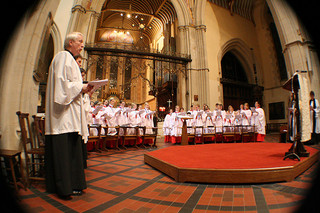
Carol Service Sermon

Carol service
Carol Service by Stewart Macfarlane on Flickr. Some rights reserved.

Here is the address I gave at yesterday’s carol service.

Luke 2:1-20

There are two groups of people I would like us to think about for a few minutes this evening.

Group number one: cast your mind back to July this year, and the birth of the royal baby. Crowds gathering at Buckingham Palace awaiting the posting of the official announcement; other crowds at St Mary’s Hospital, camera phones poised behind the barricades for that first glimpse, and then an outburst of applause and flash as the proud parents came out.

Follow that with the speculation as we awaited the announcement of his name. And sure enough, he was given conventional royal names: George Alexander Louis. Kevin and Tyler weren’t in the running.

Then we had the christening, where there was more media coverage about the gown the young prince would wear than the meaning of the ceremony. Do only the royals dress up their little boys in frilly clothes, or is it just preparation for a public school uniform when he is older?

Trappings, ceremony, accoutrements – and enough coverage in Hello magazine to destroy all the rain forests. We expect that with a royal birth. Facebook and Twitter going crazy, you know the deal.

Yet we celebrate a royal birth at Christmas that looks so different. No privilege, no wealth, no ease. Mary is a teenage girl who may popularly be suspected of a scandal. She doesn’t come from an upwardly mobile family, and she had no chance of an education, let alone one at a prestigious historic university. Joseph wasn’t born licking a silver spoon, and he merely grew up to become an artisan, working as some kind of carpenter, builder or stonemason. You want that extension on your house or that new fitted kitchen? Call Joseph, and he’ll turn up in his old Transit van, with his plaid shirt, beer belly, and a copy of the Daily Mirror.

Royalty? Well, the only connection they got with royal circles was when the local despot Herod felt threatened and sent his death squads into Bethlehem. Mary, Joseph and the young Jesus have to leave everything behind and become refugees. No palace for them.

All of which leads me to believe that the Christmas story is especially for the poor, the forgotten, the obscure and those who think they are nothing or worthless. Do you feel insignificant? Jesus came for you. Do you feel like you don’t count? Jesus came for you, too. Or do you feel like you are on the margins, or rejected, or that you will never be popular? Do you believe that you are the sort of person who, when fame and fortune come along the road, take a detour to avoid you? The Jesus who came in the Christmas story is for you.

Perhaps, though, you are not like that. You may be one of those Surrey residents who has wealth or power or position or influence. If so, then the story of Christ’s coming at Christmas is one that holds dangers for you – or at least warnings. It is no good relying on our social position or our prestige with Jesus. Why would the King of Kings and Lord of Lords be impressed by that? Doesn’t your power or property seem puny in the light of who Jesus is?

Christmas – the time when we celebrate the coming of the humble king – is the time when we can only come to that king in humility ourselves. We don’t get into heaven on the basis of our contacts or whose number is on speed dial in our phone. But if we do come in humility, then we discover the amazing truth that Jesus is for us.

Group number two: they were a gang of heavy drinkers who lived on the outskirts of town. They carried weapons, which they were ready to use and they were known to conduct burglary raids together. Better not get in their way, or they might use a knife. They weren’t unemployed, they had a trade, but people were happy to do business with them, just so long as they stayed out of harm’s way. Although they tended to use other people’s land for their work, and if they came over your boundary, then you’d better not argue. At least, not if you wanted to keep good health.

If you had a gang like that living in your town, what would your attitude be? Would you call the police? Would you band together to hold a public meeting and demand that civic officials took action? Would you lobby your councillors or MP?

And what would you call for? ASBOs? Have them locked up? Perhaps they’re really illegal immigrants and should be deported.

Do you know what you’ve just done? You’ve just kicked the shepherds out of the Christmas story. The shepherds were the rogues, the chavs, the petty criminals of first century Palestine. Not respectable. The Daily Mail would have run front page campaigns against them and their type.

And yet, and yet … these people, these crooks, these bandits, these ne’er-do’wells, these scum of the earth are the first to hear the announcement that the Messiah has been born. If you think that Jesus came just to hang out with the ‘good’ people, forget it. He came for the bad and for the misfits.

If you doubt me, think about some of the crowd Jesus hob-nobbed with during his adult life. They weren’t all scallywags, but plenty of them were. Simon the Zealot was a terrorist or a freedom fighter, depending on your political views. The brothers James and John had a nickname – they were called ‘the Sons of Thunder – well, what kind of guys get that for a nickname? Early Hell’s Angels, perhaps? Matthew was a collaborator with the occupying Roman army.

So Christmas is a time to put to bed once and for all the idea that Jesus came for good people. Right from his birth, throughout his life even to his death on the Cross , when he was crucified with two common criminals, Jesus came to offer forgiveness and a new life to people who knew they were bad.

If you think you are a failure, this is good news for you. if you think you could never possibly be accepted, this is good news for you, too. Jesus wants you to say ‘yes’ to him and follow him.

But others here might be thinking, I don’t see myself like that. I’m a good, decent, hard-working member of society who is trying to be respectable. I put things into society, I’m not a taker. Why should Jesus favour the scroungers and the hoodlums? It’s unfair.

Do you know what the basic problem with that argument is? When we try to argue that we are fundamentally good, we manipulate our image. Like a photo of a plump person with acne being made to look clear-skinned and slim in Photoshop, so we tell the good story about ourselves and we mask the ugly truth about our own selfishness.

And Jesus won’t let us get away with that. Following him can only begin and continue with an acknowledgement of our selfishness, our thoughtlessness, our unjust behaviour. Without that humility he can’t clean us up, much as he wants to.

So I invite you to be like the shepherds this Christmas. Come dirty to the manger, and find the One who accepts your praise, makes you new, and calls you to follow him.

Create a website or blog at WordPress.com

Up ↑