Fourth Sunday in Advent: God Is Coming Home (Luke 1:39-55)

(This is a second consecutive repeat sermon from six years ago – sorry about that, but the week has been thoroughly disrupted by loss of landline and broadband for five days. I’m really not sure the words ‘BT’ and ‘Business’ belong together in the expression ‘BT Business Contract’!)

Luke 1:39-55

‘It’s coming home, it’s coming home, it’s coming – football’s coming home.’

Every time the England football team has qualified for a major tournament since 1996, that songs – ‘Three Lions’ – is dusted down and sung again.

There is a sense of ‘coming home’ when Mary visits her older cousin Elizabeth. It’s not immediately obvious in English translations of the Bible, but there are allusions in this story to 2 Samuel 6:2-19, where King David and his men bring the ark of the covenant to Jerusalem. Just as the ark of the covenant was the portable sign of God’s presence among his people, so now in the Incarnation Jesus will be ‘the portable presence of God’, if that doesn’t sound too irreverent. And just as David danced before the ark of the covenant, so the infant John leaps in his mother Elizabeth’s womb. The prophetic voice in Israel has been silent since Malachi four hundred years earlier, but now God is at work. Like that sentence in ‘The Lion, The Witch, And The Wardrobe’, ‘Aslan is on the move.’

So what happens when God is on the move? Blessing – that’s what happens. Mary is blessed. Her baby is blessed. Elizabeth is blessed – she says she is ‘favoured’, which is a word that explains what blessing is. And surely her leaping, dancing baby is also blessed.

What blessings appear when God comes home to his people?

For Elizabeth’s unborn baby John, it is the blessing of joy. He leaps in the womb (verse 41) and Elizabeth says he ‘leaped for joy’ (verse 44). Why would John leap for joy?

Remember what their relationship will be. They are cousins, but John will be born first and he will herald the coming of his cousin Jesus, the Messiah. John will be the forerunner. He will be the compère, introducing the main event. He will be the best man to the bridegroom. In adult life, nothing will give John greater joy than the advent of Jesus. He will be filled with joy to announce that the Messiah is coming. He will not be interested in promoting himself; instead, his passion will be to introduce Jesus, and then get out of the way so that all the spotlight can fall on his cousin.

Our joy too is to announce the presence of Jesus. For in him, God has come to be with all who will follow him. We are not left alone, for the One called Immanuel, God with us, is here. We have no interest in promoting ourselves, only in highlighting Jesus, for he is our joy and nothing gives us greater joy than to see people recognise him, acknowledge him, and celebrate his love.

Remember what I said that the infant John leaping in his mother’s womb is a New Testament parallel to King David leaping and dancing for joy before the ark of the covenant, the Old Testament sign of God’s presence, being restored to the midst of God’s people. Does anything give us more joy than to know that in Christ God is present? We are not left alone. We are not deserted. Even in the silence, God is here.

So let us be joyful this Christmas. We rightly query the self-indulgence of society at Christmas, and the excessive celebration of – well, what, exactly? But if anyone has reason for joy at Christmas it is the Christian.

That said, being truly joyful in this season can be difficult. There are so many pressures and things to do that if we are not careful, we get so run down that we are unable to celebrate. I know that is true of me as a minister, with all the extra services, and I can remember the time my daughter asked me how grumpy I was going to be this Christmas.

But I also know I am not alone in that experience. It is widespread. How ironic that the loudest voice I have heard in the last year or two urging people to simplify Christmas in order to make it better has been the television and internet money saving expert, Martin Lewis. What’s the irony in Martin Lewis urging people to simplify Christmas in order to enjoy it more? He isn’t a Christian. He’s Jewish.

Can we find space again this year to be filled with joy at the coming of our Lord?

For Elizabeth herself, the blessing of God coming home to his people is to be filled with the Holy Spirit.

41 When Elizabeth heard Mary’s greeting, the baby leaped in her womb, and Elizabeth was filled with the Holy Spirit.

God not only comes near to Elizabeth, God comes right into Elizabeth’s life. It is a sign of what is to come. The coming of God will not end with the departure of Jesus but will continue in the gift of the Holy Spirit.

Now the coming of the Holy Spirit can lead to all sorts of gifts in God’s people. What do we see in Elizabeth? Let’s read on:

42 In a loud voice she exclaimed: ‘Blessed are you among women, and blessed is the child you will bear! 43 But why am I so favoured, that the mother of my Lord should come to me?

Elizabeth’s gift is to ‘recognises blessedness’[1]. In other words, the Holy Spirit enables Elizabeth to recognise what God is doing, to notice where God is bestowing favour. So when God comes close to Elizabeth and fills her with the Holy Spirit, she receives the ability to discern what God is doing, and then to welcome it and live accordingly.

Now when you state the work of the Holy Spirit like that, isn’t that something we long for and desperately need? Isn’t it critical for us too to be able to discern what God is doing and respond appropriately? In today’s church we often lurch from one thing to another, trying this trick or that technique in order to see things turn around, but I rarely hear people say, let us seek God to know what God is doing. It’s as if we can solve the problems of the church by human ingenuity and technology. And we can’t. Not only that, God won’t let us, because if things turned for the better that way we would end up glorifying ourselves, telling ourselves what clever folk we are, rather than bringing praise to God.

Remember that in Elizabeth and Mary’s day things were bad. As I said in the introduction, it had been four hundred years since God had spoken through the prophet Malachi. God’s people were not even free in their own land, they were under the occupying force of Rome. They weren’t truly it at home: they saw themselves as being in exile, similar to when they had been carted off to Babylon in the sixth century BC. The people of God in their day were looking around for ways to turn the situation around, just as we are with the aging and declining numbers of the church.

But unlike the leaders of her day, Elizabeth realised that the problem was a spiritual issue. When God drew near, she was filled with the Holy Spirit and began to see what God was doing. Surely her blessing is a lesson for us. As we long to find a way forward today, it won’t do to follow the fads and fashions. We need instead to pray, ‘God, come close to us. Holy Spirit, fill us with the presence and wisdom of God.’ Should not this be our posture in response to the plight we find ourselves in – prayer rather than conferences and committees?

Finally, Mary: what is her blessing when God comes near? It is the gift of faith. For as the discerning Elizabeth recognises,

45 Blessed is she who has believed that the Lord would fulfil his promises to her!

We need to pause and reflect on just how remarkable Mary’s faith was. Unlike our society, to fall pregnant outside marriage was shameful. And while the imposition of the death penalty by stoning was by no means certain, the ending of her betrothal by divorce and social shaming and ostracization were sure bets. In the face of this, Mary believes her Lord.

Think also about Mary’s age. Marriages were arranged soon after girls reached puberty, and the young men were just a few years older, but not much. Mary is therefore probably about thirteen or fourteen when she learns of her unusual supernatural pregnancy. At that tender age, Mary believes her Lord. In a society where older people were respected and younger people weren’t, Mary is the one who is the example of faith.

The fact that God has moved close to Mary in sending Gabriel to announce the birth and in the Holy Spirit overshadowing her to cause the pregnancy has put Mary in touch with the great tradition of faith in which she stands. She

places herself squarely in solidarity with all God’s people and recognises in her own experience the establishing at least in principle of all that the faith of God’s people had encouraged them someday to expect from God.[2]

It all comes alive in Mary. The great stories of faith and trust in the past, long dormant in the four-hundred-year silence of God, are seen now in a young teenage girl.

And if we feel remote from God and the great heroes of faith, then one thing we can surely do is petition God to draw near to us that our faith might be ignited and we display faith that puts us too clearly within our great spiritual heritage. We might stop banging on about the greatness of the Wesleys and begin instead to emulate them.

But let’s notice too that Mary’s faith is not some vague, general belief. Elizabeth defines it as ‘she who has believed that the Lord would fulfil his promises to her’. Often that is the challenge of faith. God makes many promises to us in the Scriptures and either they seem hard to believe (as was surely the case for Mary with her pregnancy) or we are left waiting a long time for God to come through on what he has promised.

But Mary stood firm. God had spoken. Yes, she sought clarification from Gabriel, but unlike Zechariah she did not lapse into unbelief. It is symbolic, surely, that when Zechariah expresses unbelief he is struck dumb, because he had nothing worthwhile to say, whereas Mary, who asks questions but still believes can hurry rejoicing to her cousin’s house and pour out her praise in the hymn we call the Magnificat (verses 46-55).

Maybe it’s easier when we sense the nearness of God to stand firm. But whether we currently feel God to be close to us or not, are there divine promises where we are still waiting to see the fulfilment? Is God asking us to wait trustingly to see what he will do?

We might be facing the temptation to wobble in our faith. If we do, remember how the children of Israel wobbled at the Red Sea when they felt trapped between the waters and Pharaoh’s army. And remember what Moses said to them: ‘Stand still and you will see the deliverance of the Lord.’ Where is God calling us to stand still and see his deliverance, like Mary?

So this Christmas, as we tell the two-thousand-year-old story of God coming to his people in human flesh, may it not be another act of going through the motions. May it be a time when we sense God drawing near to us and filling us with joy. May we sense God’s nearness as he pours out his Spirit on us and we discern what he is doing, so that we may respond and join in. And may the closeness of God’s presence strengthen our faith so that we may believe his promises and stand firm to see his deliverance.


[1] John Nolland, Luke 1-9:20, p75.

[2] Ibid.

Third Sunday in Advent: Sing For Joy (Zephaniah 3:14-20)

(This is a repeat of a sermon I first preached six years ago.)

Zephaniah 3:14-20

If, like me, you’re a bit of a misery guts in the run-up to Christmas, then the Third Sunday in Advent is your favourite. It’s the day we traditionally remember John the Baptist. And what finer example of pricking the balloon of froth and trivia is there than the man who called the people who rushed to him ‘You brood of vipers’ (Luke 3:7)? We’d be thrilled to have crowds rushing here, wouldn’t we? Imagine if we had a sudden major influx of newcomers on a Sunday morning and I stood in the pulpit, denouncing them in that way? I think you’d be going home and phoning the Superintendent – even though what John tells people to do, in sharing, honest and just behaviour, and plain integrity – isn’t theologically radical. (Although it is disturbing that he does have to be that basic.)

In clearing the way for the Messiah, we often think of the severe images in John’s preaching – the brood of vipers, the winnowing fork and fire of the Messiah, and so on. But what I want to look at this morning is not so much the process of preparation but rather what John was preparing for.

And that’s where Zephaniah’s prophecy comes in. He brings God’s vision of what things will be like after the end of exile. And while God’s people are no longer in a foreign land, you’ll perhaps recall how I’ve said that in Jesus’ day they saw themselves as still in exile, due to their occupation by the Roman forces.

Now we know that Jesus announced a very different end of exile from that which his nation anticipated. Not all of them would have seen the need for the repentance which John proclaimed. And even those who did would have assumed that if they lived in holiness then God would grant their wish of deliverance from the Romans.

But nevertheless the images in Zephaniah give us a great indication of what life is like in the kingdom of God that Jesus inaugurated. You may remember that Jesus was once asked why he and his disciples feasted, whereas the disciples of John fasted. He said that while the bridegroom was present, there would be feasting. So we’re not going to look this morning at the fasting and the preparation, we’re going to consider the feasting that follows the preparation.

I want to highlight two aspects.

Firstly, we find a singing people:

14 Sing, Daughter Zion;
    shout aloud, Israel!
Be glad and rejoice with all your heart,
    Daughter Jerusalem!
15 The Lord has taken away your punishment,
    he has turned back your enemy.
The Lord, the King of Israel, is with you;
    never again will you fear any harm.

Israel is forgiven and no longer under threat from her enemies. The natural reaction is to sing, to shout aloud, to be glad, and to rejoice. No longer are they oppressed due to their sins: God has taken that away. Joy is the natural result!

In my teens, one popular worship song had the words, ‘I get so excited, Lord, every time I realise I’m forgiven.’ We did sometimes deliberately sing wrong words to it: ‘I get so excited, Lord, every time I realise I’m a gibbon,’ but even our laughter at our silly alteration was part of our joy. We knew we were forgiven sinners through the Cross of Christ, and that led to excitement and great joy.

Sometimes, though, it’s hard to find where the joy has gone. As I’ve told you before, coming from a family which has a history of depression, I know what it is for the dark cloud suddenly to appear over my life, even though I’ve never been diagnosed with depression. Sometimes we don’t react in the best ways to circumstances, but at other times we are at the mercy of unbalanced chemicals in our bodies. These situations need talking therapies or tablet cures.

But on other occasions you really wonder where the joy has disappeared in the church generally. I recall a dismal Good Friday ecumenical service when I was young. We happened to be singing ‘I get so excited, Lord’, and our minister, who was leading the service, asked if there really was any evidence that people there were excited that they were forgiven. Were they so caught up with the sense that Good Friday reminded them of their sins that they had forgotten Good Friday also brought them relief from their sins?

As I’ve pondered this, I’ve developed a theory. The longer we go on as Christians and get further away from our heady younger days when we discover the joy of forgiveness for ourselves, and as we slowly with the help of the Holy Spirit correct wrong behaviour, the trouble is that we start to see ourselves not as forgiven sinners but as decent, respectable people.

And when you start to see yourself as fundamentally good, you see less reason to view yourself as a sinner needing the grace that first thrilled your heart. In fact, you become like those opponents of Jesus who criticised him for partying with the disreputable. Jesus told them with, I think, a note of sarcasm, that it was not the healthy who needed a doctor, but the sick. But we who now see ourselves as so healthy no longer connect with what brought us joy. Our spiritual amnesia makes us the miserable self-righteous religious types that nobody likes.

What is the cure? Well, if this condition is a progressive amnesia, what we need is the gift of remembering. We need the grace to look at our past (and at our present attitudes) in the searching light of Christ. We need then to remember what Christ did for us when we knew we were sinners, and then receive that gift of undeserved mercy again.

You may recall that the Preface to the 1933 Methodist Hymn Book began with the famous words, ‘Methodism was born in song,’ and so it was. But the birth of our spiritual tradition in song was not some cultural love of a particular kind of hymnody, it was a spiritual experience that had to be sung. It was the experience of forgiveness and the assurance of God’s love that led the early Methodists to sing for joy. Some Christians have argued that just about every major spiritual renewal down the centuries has been accompanied by a new outburst of music, because that’s the natural and creative outlet for the joy that God brings.

For us to be a joyful people, then, means reconnecting with the life of the Spirit – the Holy Spirit who showed us we were sinners but who also revealed to us the forgiving love of God in Christ; the Holy Spirit who graciously makes us more like Jesus as we open ourselves to him, but who also reminds us of our need of grace, to inoculate us from the risk of becoming Pharisees; the Holy Spirit, who indeed pours the joy of God into our hearts, along with divine love. If we welcome the Holy Spirit, one thing we do is welcome holy joy into the depths of our beings.

Secondly, we find a singing God:

16 On that day
    they will say to Jerusalem,
‘Do not fear, Zion;
    do not let your hands hang limp.
17 The Lord your God is with you,
    the Mighty Warrior who saves.
He will take great delight in you;
    in his love he will no longer rebuke you,
    but will rejoice over you with singing.’

So there you go, right there is ‘the Lord of the dance’: he ‘will rejoice over you with singing’. Sometimes in our Advent preparation as with our Lent preparation we think about the holiness of God in a severe way, and we are conscious of how far short we fall of God’s standards. Certainly, we can react that way to the preaching of John the Baptist, as I indicated at the beginning – although it’s worth noting that at the end of our Gospel reading, we heard Luke say that what John preached was ‘good news’.

And it may therefore be that our image of God is the stern headmaster with furrowed brow, holding us to unattainable standards and punishing us when we fail.

Now there is a place to speak of God’s holiness, and even of his judgment, but here we see another side to God: one who delights in his children and sings for joy over them. If anyone still believes that the Old Testament reveals God as a God of wrath and the New Testament shows him to be a God of love, this passage should thoroughly confuse such people!

Where do we most fully see such a joyful God? Surely it is in the ministry of Jesus. He teaches this about his Father when he tells the Parable of the Prodigal Son, where the father scandalously keeps looking out for his errant son and then throws a great party to celebrate the return. And Jesus lives it out as he turns water into wine at a wedding, as he invites himself to Zaccheus’ house, thus prompting the tax collector’s repentance, as he feasts with the last and the least. Jesus teaches and demonstrates a God who is full of joy when sinners come home to him, and whose joy is such that it leads sinners home.

Perhaps Johann Sebastian Bach got it right with his words, ‘Jesu, joy of man’s desiring.’ Jesus is our joy, for he is full of joy himself. He is utterly outrageous with joy. No wonder those who – perhaps like us, as I said earlier – had spent so much time concentrating on being good that they had forgotten their need of grace as sinners – were so wound up by him.

So out with the idea that God grudgingly or stingily or reluctantly forgives us our sins. The evidence of Scripture is that he longs to forgive, he loves to forgive, and he forgives generously and whole-heartedly. In Zephaniah he has longed for his children to return, and he has brought them home. Now they celebrate – and so does he. In the Gospels, Jesus shows us this same God in flesh and blood.

Perhaps you think that it’s all very well me preaching this, but I don’t know you, and I don’t know your darkest secrets. Believe me, in all my years of ministry I have heard plenty of dark secrets from church members, and yours probably would not surprise me. I have listened from time to time to someone talk about a terrible thing they did decades ago, which no-one at church knows about, and which has haunted them ever since. Then I have had the privilege of assuring them that no pit is too deep that God in Christ cannot haul them out. I have watched as relief, peace, and joy have broken out on their faces. And I believe that as such events have unfolded on earth, Jesus and the angels have been putting up the bunting and decorating the cake in heaven.

In the carol service, we will be reading of angels singing to shepherds. But we don’t need to wait to sense the divine song being sung over our lives. Right now God is lovingly offering restoration to the broken, forgiveness to the sinner, and strength to the weak. He loves to do this. Receive the grace he is offering you, even urging you to take, through Christ. Know and feel his forgiveness, as Jesus invites himself into your house, just as he did with Zaccheus.

And as you see the smile on his face, so let your facial muscles relax and let the joy spread across your countenance, too.

Advent, The Prologue and Relationships: 2, Jesus and John the Baptist (John 1:1-18)

John 1:1-18

Isn’t it strange that just as ‘I’m A Celebrity, Get Me Out Of Here’ is on our screens yet again that John the Baptist comes into focus in the church year? The man whom Matthew tells us wore clothes made of camel’s hair and lived on a diet of locusts and honey[1] sounds perfect for the bush tucker trial.

And speaking personally, I’d rather engage with John the Baptist than Nigel Farage. Which is one major reason I’m not watching this year.

But we think of John at this time due to his connection with Jesus – not simply that they were related through their mothers[2] but that they were related in the purposes of God. We talk about John as the ‘Forerunner’ of Jesus. Their relationship is important for the Advent story.

But it’s not just interesting historical detail. John’s mission of preparing the way for Jesus is also a model for the ways in which God gives us our mission of pointing to Jesus.

I’m going to explore that in two phases today.

Firstly, John was sent.

We are used in the Methodist Church to the idea of ministers being sent. I was sent to this appointment by the authority of the Methodist Conference. The Salvation Army send their officers; the Roman Catholics send their priests. (Other denominations are different and speak less of the church sending and more of God calling.)

But being sent isn’t just a churchy thing. It happens in other areas of life, too. As I mentioned to some around Remembrance Sunday last month, I am the first man in my family for a couple of generations not to go into the Royal Air Force. My Dad only did National Service, but I often thought he might have fancied a longer time in it than that. My uncle served for many years, and so did my three male cousins.

The armed services’ concept of a ‘posting’ is very much a sending, and young families are often in an area only for a short time before the next posting happens, with adverse effects upon socialisation and education. One of my cousins was awarded the MBE for work he and his wife did on RAF bases with lonely families.

John the Baptist’s sending comes not from the church or the armed services, but from God:

There was a man sent from God whose name was John.

And yes, John has a very special calling that we mark at this time of year. And yes, we are used to the idea that certain Christians have particular callings in which they are sent by God.

Sadly, what we forget in all that is that every Christian is called and sent by God in some respect. Being sent by God doesn’t automatically mean being sent to dark jungles to be attacked by ferocious creatures and wild savages. Sometimes, God has already sent us to the place where we are, and this is the place where we are called to be fruitful and faithful for him.

Perhaps we still have that mediaeval Roman Catholic view of being sent that regarded the only vocations worth mentioning as those where someone was called to the church – priests, monks, and nuns. At least the Reformers broadened out that sense of vocation so that Martin Luther, ever provocative in his writing, could say that were the job of village hangman to fall vacant, the devout Christian should apply.

I am not here to recruit any hangmen today! But I am here to invite us all to consider our sense of being sent. Has God sent us to the particular job where we work? The neighbourhood where we live? The social groups in which we mix?

And if we think that’s possible, how does that change our attitude to those workplaces, neighbourhoods, and social groups? Are we on a mission from God in those places? Have we been placed there to live out our faith and bless those we meet with the love of God in our attitudes and actions? Has God sent us there as a sign of his abiding truth to those who may or may not want to know about it?

And for others of us, have we become restless where we are? Is it because we have not embraced the sense that God has sent us here, or is God preparing us to take up another posting and be sent somewhere else? Is this an issue that some of us should be praying about?

Secondly, John was specifically sent as a witness.

One of the things I do when I go to preach at a new church is I always ask for an assurance from the person on the sound desk that they will turn my microphone off during the hymns. Much as I love music, I am not blessed in that area with any personal ability. I was once next to my aunt in a congregation and she said to me afterwards, “I’m glad my bad singing voice has passed down another generation in the family.”

So when my friends in the church youth group formed a band, I was the only one not to be part of it. They became quite popular in local church circles and sold out some concerts.

I talk in the first chapter of my book about some of the socially awkward ways in which I related to them. Yet one Saturday evening in December, and I think it proved to be their biggest concert ever, they involved me by asking me to be the compère.

It stayed with me, because the next morning the Advent theme was John the Baptist, and the preacher spoke about how John was the compère for Jesus. Given my rôle the previous night, that description stuck with me. Just as the compère’s job is not to point to themselves but to the act everyone has paid to see, so the rôle of John the Baptist is not to big himself up but to be ‘a witness to the light’:

He came as a witness to testify concerning that light, so that through him all might believe. He himself was not the light; he came only as a witness to the light.

This rôle of a witness is seen in some of the other New Testament models for those who speak of Christ. We have the herald, who brought ‘good news’, rather like a town crier. ‘Good news’ was a technical term in the Roman Empire for the announcements heralds made that either the Roman army had won a great battle or that there was a new emperor on the throne. The first Christians translated this to their heralding of a different good news, the good news that God had won a great battle against evil at the Cross and that there was now a new king of the universe, Jesus the Lord.

And we have the ambassador that the Apostle Paul talks about. The purpose of an ambassador is to represent the king and the kingdom that sent them to an alien land. Paul and the first Christians saw themselves as representing Christ and the kingdom of God in an alien land.

All of these images – the witness, the herald, and the ambassador – have one thing in common. These spokespeople are not drawing attention to themselves but to Jesus Christ and the good news of God’s kingdom.

This was John’s purpose in a particularly special way when Jesus came into the world and thirty years later began his public ministry. It is also our calling.

For the New Testament also calls us witnesses. We may not all be evangelists, but we are all witnesses. Every Christian has the ability to witness to Jesus Christ by speaking about what he has done for them and what he has done for the world.

Think of a witness in a court of law. The witness speaks of what he or she has seen or heard, or about what he knows to be true. These are the things we do as witnesses for Christ, too. We speak about our experience of Jesus. We speak about what we know about him. Sure, we are not all what the courts call expert witnesses – perhaps those are the evangelists – but if we think about it, can we not all think of what Jesus has done for us, what he means to us, and what we know for sure about him?

Conclusion

Last week we saw that the Father’s relationship with Jesus said something about our relationship with Jesus, too. This week, John’s relationship with Jesus also has something to say about our relationship with Jesus.

Last week we saw that just as the Father’s relationship with Jesus was characterised by unity, love, and light, so too was Jesus’ mission to the world. This week with John we find that we are sent by God as heralds and ambassadors of King Jesus and his kingdom of unity, love, and light.

May the Holy Spirit show us the place where we are sent. And may we depend on that same Spirit to empower us as witnesses to Jesus and all that he has done.


[1] Matthew 3:4

[2] Luke 1:36

John The Baptist: The Marmite Minister Matthew 11:1-19 (Advent 3 Year A)

Matthew 11:1-19

I once succeeded a previous minister in an appointment who was described to me as a Marmite minister. In other words, he divided opinion and everyone had an opinion about him. You couldn’t sit on the fence. You were for or against. He had that effect on everyone.

And in a similar way, John the Baptist was a Marmite minister. You had to take sides over what he preached. Some of that will come out as we think about this week’s reading.

But to our surprise, this story shows us another side of him. The vulnerable, struggling side of his personality.

This means we’re going to divide up four things I want to say about this passage into two halves. In the first half we’re going to think about John’s response to Jesus, and here we’re going to see signs of the weaknesses with which he wrestled.

In the second half we’re going to examine two ways people respond to John, and there we’ll see the Marmite minister in all his glory.

Firstly, then, two ways in which John responded to Jesus.

The first response John makes to Jesus in our reading is doubt.

When John, who was in prison, heard about the deeds of the Messiah, he sent his disciples to ask him, ‘Are you the one who is to come, or should we expect someone else?’

Doesn’t that seem astonishing? John has been preaching that the Messiah is coming and that people should prepare. We know from earlier in Matthew that he recognised his cousin Jesus as that Messiah by the way he saw himself as unworthy to baptise him (3:11-15). So why does he even need to send his disciples with this question?

I think the clue is found in the opening words of verse 2: ‘When John, who was in prison ….’ Things have gone wrong for John. This is not how he planned it. His fearsome preaching has got him in deep trouble with the political authorities. And of course, we know how it will end.

In such strained and stressed circumstances John begins to doubt. Does my imprisonment mean I got it wrong all along?

I have been in situations like that. Have you? Not in prison and likely to lose my life, but times when I thought I knew God’s will and then everything seemed to go wrong. I began to doubt.

One such occasion for me was before going to theological college. I have told you before some of the amazing stories of how God provided the money for me to go when I was denied a grant from my local authority and when I lost my appeal against the refusal of that grant.

Looking back, it is a wonderful story of God’s provision. But when I was at the in-between stage, with no grant and far from enough savings of my own, I too began to doubt.

It’s not that doubt is a good thing, but it is understandable. I follow the Christian thinker Os Guinness in saying that doubt is not the same as unbelief, because doubt is where our faith is in two minds and unbelief has no faith.

What a gift it is, then, to read Jesus’ response to the question:

 Jesus replied, ‘Go back and report to John what you hear and see: the blind receive sight, the lame walk, those who have leprosy are cleansed, the deaf hear, the dead are raised, and the good news is proclaimed to the poor. Blessed is anyone who does not stumble on account of me.’

If you are struggling with doubt in your faith at present, bring your questions to Jesus. Ask him to resolve them. He loves to do so.

John’s second response to Jesus is very similar to doubt: it is disappointment. There is a note in his questioning of ‘This is not how it was meant to be. Israel was meant to turn back to her God when the Forerunner and then the Messiah came. Yes, some have certainly turned back, but there is still opposition. That’s why I’m in prison. How does that fit in the divine plan?’

Many people lose their faith when they feel God has disappointed them. They believe he has let them down at a crucial time in their lives. Someone they loved fell ill and died young. Their marriage broke up, or maybe they lost all hope of ever marrying in the first place. There can be many other things, too.

Jesus sends back that message detailing the great things he is doing, and also describes John to the crowd as a prophet and more than a prophet. But prophets are people who at least in part live with unfulfilled hopes as they proclaim what God wants to do. It is the tension of being a prophet that you declare that God will perform certain actions but you don’t always get to see them yourself.

So John must live with disappointment in the short term. It isn’t that the mission has failed, but it is that before the end of all things it is incomplete.

Jesus will disappoint us, too. We need that prophetic perspective that disappointments now are not the end of the story. They may be terrible things. But the story of God does not end in darkness. It ends in his victory.

Then we have two ways in which people responded to John.

The first of these is something I am going to call determination. I’ll pick out one verse to summarise this:

12 From the days of John the Baptist until now, the kingdom of heaven has been subjected to violence, and violent people have been raiding it.

What do you make of a verse like that? If it’s any comfort to you, I remember this verse being singled out in New Testament Greek classes at college as being one of the very hardest to translate in the whole New Testament!

But let’s cut to the chase and say I believe this is about people who are very determined in their positive response to the message of John and then of Jesus.

One scholar puts it like this:

Jesus regularly borrowed images from his society and applied them in shocking ways, and thus may speak favourably here of spiritual warriors who were storming their way into God’s kingdom now. One second-century Jewish tradition praises those who passionately pursue the law by saying that God counts it as if they had ascended to heaven and taken the law forcibly, which the tradition regards as greater than having taken it peaceably. These were the people actively following Jesus, not simply waiting for the kingdom to come their way.[1]

So I simply want to ask: how are we showing determination and passion in our response to the kingdom of God? Has God given us a great zeal for some aspect of his kingdom work, and if so, are we pursuing it?

It could be that you want to see people find faith in Christ – so are you sharing your faith actively? It could be that you care passionately about the eradication of injustice in the world – so are you getting your hands dirty with that one? It could be that you long to see relationships healed and people reconciled – so are you putting in the quiet, patient, and resilient work behind the scenes which that needs?

Maybe it’s something else. But what is important is that we find how God wants us to respond to the Gospel in a determined and passionate way.

The second way in which people responded to John was by a decision.

Honestly, says Jesus, some of you can’t be pleased. You won’t dance to the music of the pipe and nor will you grieve when a dirge is sung. You don’t like John’s austere lifestyle and yet you condemn me when I enjoy a good party (verses 16-19). There is no pleasing some people.

And there is no pleasing such people because they want to make every excuse possible to avoid making a decision about the message first John and then later Jesus proclaim.

Ultimately, no-one can sit on the fence when it comes to John and to the One he preached about, Jesus himself. In fact, to sit on the fence is to choose against God’s kingdom.

John would say to us, if we’ve been putting off that decision about following the Messiah, it’s time to stop doing that now. It’s urgent and crucial, he says, that we make up our minds about Jesus.

Some of us cover up our refusal to get off the fence by manufacturing respectable churchgoing lives. We look for all the world like a dedicated follower of Jesus, but we are in fact using religious behaviour as a cover for our failure to declare for Christ.

And therefore I cannot finish my words today without putting out that challenge. Is anyone listening to this avoiding making that commitment to Jesus Christ that John urges us to do?

Remember, this is a Marmite matter: you have to decide one way or the other.


[1] Craig S Keener, The Gospel of Matthew, p340.

The Prophetic Question: Who Are You? Matthew 3:1-12 (Advent 2 Year A 2022)

Matthew 3:1-12

I had always thought that the parent I most resembled was my father. Temperament, build, hair colour, interests – not identical, but pretty similar.

It was therefore a surprise when I went into a room in the office where I began my working life to find there a woman called Olive say, “You must be Joan Faulkner’s son! You look so like her.” It turned out Olive had worked with my mum many years previously.

Who are you like? Sometimes I approach a Bible passage like that. Which of the characters are we like, and what does that tell us about our faith?

And I want to take that line with today’s passage. Who am I like in the reading? Who are you like?

Are we like John the Baptist?

I don’t know how many times I’ve read this story during my life, but what I do know is that when I came to it this week my first reaction was, ‘Yes, I identify with John the Baptist!’

Why?  Because I like locusts and honey? No. Because I want to wear something made from camel’s hair? No: I just ordered a new winter coat from Mountain Warehouse in a Black Friday deal.

It was the line about being ‘one calling in the wilderness’ (verse 3). And the word ‘wilderness’ grabbed me. I thought, that’s what my ministry is like. Much of the time I haven’t seen the things I’d have hoped for, and much of the Methodist Church feels as parched as the wilderness. Woe is me!

But then I dug deeper instead of feeling sorry for myself. I thought of what the wilderness symbolises in the Scriptures. One thing it symbolises is ‘testing’, just as God tested the faithfulness of Israel in the wilderness between Egypt and the Promised Land.

And so I wondered whether a prolonged period of spiritual drought was one where my faithfulness to God was being tested. Furthermore, I wondered about the drought the Christian church finds itself in, as evidenced by the substantial fall in the numbers of people calling themselves Christians, as we have learned this week the 2021 Census data shows.

But then perhaps we are being tested by God to see whether we will be faithful to him in disappointing circumstances. The temptation at a time of decline is to start adjusting our message to fit what people popularly believe, but that is a serious mistake. For one thing, it means we won’t be faithful to Christ even when it means we are unpopular. For another it’s a tactical mistake, because if we make ourselves just like the rest of the society then there is no longer any point in conversion.

The Anglican evangelist J John put it like this in response to the census figures:

In my view, and I claim the Bible on my side, what is needed is not a stripped-down creed tuned to the prevailing mood of the culture.

That won’t work: no one goes to church to hear exactly what they get from the media and from their friends and colleagues. What will bring them in and see them committed to the church is the full- blooded, confident preaching of Christ in the power of the Holy Spirit.

Paradoxically the way to change the census figures is to ignore them and instead focus on producing changed lives through Jesus Christ.

But the wilderness is also the place of renewal. God promises to bring his people back from exile in Babylon through the wilderness to their land. So it’s fitting that John locates his campaign for the renewal of Israel in the wilderness. So as we witness more and more decline and death in the British church, we also pray, Lord, turn this wilderness into a place of renewal and growth.

Meanwhile, what do we do? We trust in God. This is what the locusts and honey are about. They are not a description of a bush tucker trial from I’m A Celebrity, Get Me Out Of Here, they were the basic foods available to him if living simply in the desert. Honey was a regular sweetener for the poor and for others in his culture; other wilderness-dwellers often fed on locusts[1]. Just don’t go looking for them among the more unusual foodstuffs at Waitrose. John was saying, I am willing to live simply and live on what God provides here.

How willing are we like him to trust God like that?

Or are we like the crowds?

It isn’t difficult for the people to go and hear John. His location is just twenty miles from Jerusalem. The Jewish historian Josephus tells us that the crowds were so large that Herod Antipas, the local ruler on behalf of the Romans, feared an uprising[2].

But if it was easy for them to get there, it wasn’t so easy for them to fulfil what John was calling them to do. He preached that they needed to repent (verse 2), and here ‘repentance’ doesn’t merely mean ‘change your mind’, it means ‘turn your whole life around’. We see them doing this because Matthew tells us that they were baptised by John when they confessed their sins (verse 6).

Let us pause and consider what a humbling thing this was for the average Jew to do. John was not asking them to follow through simply with a liturgical, ritual act. He was expecting a complete change of lifestyle.

But he is expecting this from devout Jews! These are people who are already committed to faith in God! John is saying to them, you might just as well be a pagan Gentile, such is the level of turnaround you need in your lives. They were being treated as if they had never demonstrated any serious commitment to God at all before, despite having followed the Jewish way of life and taken part in its rituals for years!

I gained a small insight into what that must feel like many years ago. As a good number of you know, when I was exploring God’s call to the ministry, I ended up studying Theology as an independent student at an Anglican theological college. When the calling became clear, I had a quandary. Did I stay with my native Methodism or did I go over to the Church of England, because I was seeing a great advert for it there?

It was that thought that I would have to be confirmed just like I had never been a Christian before that ultimately put me off the C of E. To me, it denied the previous work oof the Holy Spirit.

Now what if I or some other preacher told you that all your Methodist heritage was in vain in terms of getting into God’s Kingdom? Just because you were a church steward for many years didn’t count. Just because you knew Wesley’s hymns inside out meant nothing. Just because you had taught Sunday School or been a Local Preacher – well, so what?

Rip it all up and start again. That’s what John expected of the crowds. What if we need to do that? What if all that we do, much as we cherish it, has declined into empty ritual and dead religion? Do any of us need to hear John’s call for a radical turning back to Christ and a complete reset of our spiritual lives? Does anyone hearing this today need to do that?

Or finally, are we like the Pharisees and Sadducees?

Well, if you thought John was hard on the ordinary crowds, just wait until you hear him tear into the religious leaders. A ‘brood of vipers’ (verse 7): That is an ancient insult! There was a belief that had been around for a few centuries going back to the Greek historian Herodotus five centuries earlier that vipers were mother killers – that the children, the brood, killed their mothers in revenge for the fact that the females killed the males during procreation. ‘Mother-killer’ becomes, then, a way of saying that these leaders were utterly depraved morally[3].

Therefore being ‘children of Abraham’ (verse 9) counted for nothing. Some of you have heard me say that my sister once worked out when doing some work on the family genealogy that she and I had grown up as the fifth generation of Methodist in the same congregation. But that would have meant nothing spiritually if we both had not taken the decision to respond to the grace of God and follow Jesus Christ ourselves.

And that’s why I get disappointed when I go to a church and am greeted by someone who tells me with pride that they are a life-long Methodist. It counts for nothing unless the person has embraced Wesley’s call to repentance and faith in Jesus Christ, leading to a life of discipleship.

But John the Baptist exposes these religious leaders as people who rested on their spiritual heritage while using that as a cover for shamelessly immoral lives. I’d like to tell you that doesn’t exist in the church today, but I’d be lying. From time to time I encounter it. I don’t mean those who are genuinely struggling to conquer sin but not always succeeding, I mean those who are happy to use religious respectability as a cover for a totally different lifestyle. You know – the sort of stories that make salacious headlines occasionally, and bring the church into disrepute.

Now I sincerely hope this third and final point is the one that makes least connection with anybody here today. Perhaps it is more made to be preached at Synod or Conference!

But were any of us to be living a double life, outwardly proclaiming our faithfulness to the truth while using that to hide a shameful life, then Advent is  the time to hear Jesus’ warning that he won’t play games with us. He can make new faithful people out of stones, he says (verse 9). We shouldn’t rely on some sense of being indispensable to him.

Conclusion

All these three sets of people we’ve considered point us to the fact that Advent is a season of preparation, but it is preparation that happens by repentance. Not for nothing have some Christian traditions called Advent ‘The Lesser Lent.’

We prepare for Christ’s coming by inviting the Holy Spirit to examine our hearts. He prepares the way of the Lord in us and makes straight paths for him in our lives (verse 3).


[1] Craig S Keener, The Gospel of Matthew: A Socio-Rhetorical Commentary, p118f.

[2] Ian Paul, https://www.psephizo.com/biblical-studies/john-the-baptist-jesus-and-judgement-in-matthew-3/

[3] Keener, p122f.

The Baptised Life (Luke 3:7-18) Advent 3, Year C

Luke 3:7-18

A favourite story I like to tell about the birth of our son concerns the first time we took him as a baby to one of the churches I was serving. One man looked at him, then looked at me, and said: “Don’t you ever bring a paternity suit against your wife over this lad, because the judge will take one look at him, then one look at you, and laugh the case out of court.”

Even now, seventeen years later, you can see the physical resemblance. You would do all the more if you’d known me at that age. We may have different colour hair, but his hair colour comes through from my father’s side of my family. He is a mathematician, as I was. He is blue-eyed, like me. He is left-handed, as I am – albeit that he is more like my father, who was a relatively ambidextrous left-hander, whereas I am much more left-handed. Like my father, he has an excellent sense of direction and is extremely good at navigating with maps.

But he won’t make his way in life based on whose son and grandson he is. That will depend more on how he uses his gifts, talents, and opportunities.

And John the Baptist is trying to get over something similar to his hearers in our passage today. He tells people who claim they are the offspring of Abraham that they are more like the offspring of snakes. You can have all the religious heritage you like, he says, but it counts for nothing if you’re not living a transformed life. Being raised in the Jewish faith won’t count for anything on its own. Being baptised won’t mean diddly-squat unless your life changes. (Verses 7-9)

It’s something that is painfully relevant to some of the pastoral conversations I have when I first meet people in Methodist churches. It’s not uncommon for people to tell me how they’ve been a Methodist for decades, maybe all their lives.

And I wonder, why is that the first thing they want to tell me about themselves? Because it won’t count for anything with Jesus – unless, of course, they are faithfully living according to the life-changing teaching and spiritual experience that John Wesley underwent and then taught to others.

So you were baptised a Methodist? Well, big deal. Actually, nobody is baptised a Methodist, they are baptised into the Christian faith.

But if you were brought to church as an infant and a minister poured water on your head in the name of the Father, the Son, and the Holy Spirit, then it doesn’t matter one bit that the Methodist Church says that any administration of water in the name of the Trinity is a valid baptism, because John the Baptist says that baptism only matters if you go on to lead a baptised life.

So enough of all this claiming of a religious heritage as if it’s a ticket to heaven. It’s nothing of the sort. Presenting your baptism certificate will not work in the way that showing your passport does at Immigration Control in a new country. All that God accepts as the passport to glory is a life of repentance and faith, a baptised life more than a baptised body.

If you want to come to a minister and start telling us that you’ve been a Methodist for fifty years, then make sure you’re actually living as a Methodist in the sense John Wesley taught. Make sure that you come to God not dependent on your own good works, but by faith in Jesus who died for you. Be thankful for his forgiveness and show it by your love for God and for other people. After all, Wesley was fond of quoting from Galatians: ‘The only thing that counts is faith working through love.’ Seek a constant renewing and reordering of your life, joining a small group of other Christians where you each hold one another accountable. Be generous and have a concern for the poor. Share your faith with others.

If you think that’s a bit strong, look at what John the Baptist required of the people who came to him for baptism. They were to share with the poor, not cheat, be truthful, and avoid greed. That wouldn’t be a bad starting place today, either! (Verses 10-14)

And if that’s the sort of person you are, then I’m highly likely to believe that you’re a traditional Methodist! That would show the kind of spiritual DNA that Wesley wanted to see replicated in people.

But if all you can do is wave a baptism certificate or produce your latest membership ticket with a flourish, well, John Wesley would have had harsh words for you and so too would John the Baptist. Both of them would have warned you about the judgement that Jesus will bring.

And so John talks about how Jesus the Messiah will come to baptise with the Holy Spirit and fire – with fire being an image of judgement. He talks about how he will separate the wheat into the barn but burn up the chaff with unquenchable fire. It’s a challenging and powerful description of Jesus. (Verses 15-17)

Of course, some people won’t have it. They will say, that can’t be Jesus, he was all about telling us to love one another. Well he was about teaching us to love, but he also had strong words for those who would not love. He had particularly harsh words for those who used their religion for their own power or to put others down. Jesus was absolutely clear in his teaching that if you claim to be a disciple of his, then it needs to be seen in the way you live.

So all the people who call him ‘Lord, Lord’ but don’t do his bidding will have a shock. All the people who can’t be bothered to be prepared for his coming like the five foolish virgins in the parable will find that their future is not what they complacently assumed.

I have to ask myself, how am I preparing for the coming of Jesus? Not in the sense of, have I bought all the presents I should for Christmas, but in the sense of, am I adjusting my life to make it more fit for the arrival of the One who is King of Kings and Lord of Lords?

Do you ask yourself the same sort of question? Because we all need to do so.

This is why historically Advent has not been a time for feasting on mince pies but rather a season of penitence, like Lent. Preparing for the coming of the Messiah is a challenging matter.

But Jesus does come with the Holy Spirit. We are not left with only our own feeble power to alter our lives. When Jesus challenges us, he also provides the strength we need to make those changes. And we find that ability and energy in the gift of the Holy Spirit.

I want to conclude by saying that all week the ending of the reading has puzzled me.

18 And with many other words John exhorted the people and proclaimed the good news to them.

Good news? It doesn’t much sound like good news, does it, all this fire and brimstone preaching?

But it is good news. It is good news in the ancient sense, in the way the term ‘good news’ would have been used in the Roman Empire. When a Roman herald arrived in a place and said he was going to proclaim good news, it would be the announcement that there was a new Emperor, or that the armies of Rome had won a great battle against an enemy.

In that respect this is good news. It is the news that the kingdom of God is arriving in the person of the King himself, Jesus. It will later become the news that the king himself has won the greatest battle of all on the Cross against all the forces of evil. And it is the good news that in the reign of King Jesus he brings love, justice, reconciliation, harmony, healing, and much more.

Therefore when we are challenged to repent and to reorder our lives, the call is to bring our lives into step with the kingdom of God – that is, to be loving, to pursue justice, to work for reconciliation, to bring harmony, to exercise healing, and so on.

If we are to prepare for the coming of Christ, then this is the kind of life to which we are called.

Good News in a Bad News Story (Mark 6:14-29) Ordinary 15 Year B

Mark 6:14-29

I expect that, like me, most or all of you have been besieged in the last few years with scam messages – some by phone, some by email, others by text message.

The other day my mobile phone began ringing and it identified the calling number as being in Czech Republic. I have no connections with that country. At a push, I could name one or two of their footballers, but that’s about it. So I ignored the call.

It nevertheless went to my voicemail, and I later retrieved a message accusing me of misusing my National Insurance number and demanding I press 1 on my keypad to speak to an officer. Well, not likely! And all the more so, given that much of my work in the Civil Service was to do with National Insurance numbers! I can’t say I lost any sleep over it.

But sometimes these messages hope to trick people by playing on a possible sense of guilt. That’s certainly the idea behind those messages which say they’ve loaded software on your computer and they know all about your viewing of pornographic websites. The criminals hope that someone who has done that will be so terrified that they will be duped into the scam.

When there is lurking guilt over our past actions, all sorts of things can trigger a response of fear. I think that’s what happens in our reading when Herod Antipas hears about the ministry of Jesus. He thinks that John the Baptist, whom he ordered to be beheaded, has been raised from the dead (verses 14-16) and perhaps he’s come back to haunt him or expose him.

This is not the same Herod as who tried to kill the infant Jesus – that was the so-called Herod the Great. This is one of his sons. Herod Antipas proved to be every bit as ruthless as his wicked father, but he didn’t have the same political skill. He wasn’t actually a king, but he liked to be known as one – hence ‘King Herod’, as Mark calls him, is an ironic title. He also loved luxury and magnificent architecture. Jesus summed up his character in Luke’s Gospel when he called him ‘that fox’[1].

If you want an example of his lack of political skill, the divorce which John condemns morally here got Herod into trouble politically as well. His first wife, whom he so cruelly dumped for his sister-in-law, was the daughter of Aretas, king of Nabatea, a region east of the Red Sea. Aretas took out reprisals against Herod, inflicting a crushing military defeat on him in AD 36. Three years later the Emperor Caligula had had enough of Antipas, and he banished him and Herodias to Gaul (modern-day France)[2].

Ultimately, the life of Herod Antipas is a story of someone who was never willing to be free of his baser instincts. They harmed him and others. Imagine the innocent people killed when Aretas took out his reprisals – all because Antipas wouldn’t control his lusts. Imagine the pain of John’s disciples and family at his execution, because Antipas wanted to suppress his conscience and also made such a foolish vow in front of witnesses to his daughter.

When we would rather pursue our own selfish desires there are costs not just to ourselves but to others as well. It’s surely clear that one of the reasons for the huge rates of family breakdown in our society is to do with that. I know the situation is more complicated than that, but by way of illustration consider this: Becky more or less forgot Father’s Day this year. Why? Because she had planned to go out that evening with five friends. None of those five friends had a father living at home, and so Father’s Day just wasn’t on their agenda, and hence Becky, mingling with these friends, forgot too. Obviously, I don’t know why all her friends’ parents split up, but inevitably I wonder.

The life of Herod Antipas, then, is a sombre warning for us about what life looks like and what life leads to when we live without the grace of God in Jesus Christ. Sin has devastating consequences. If we cherish our sin above other things, we wreak havoc in our lives and the lives of others, both those close to us and strangers.

And that’s without even talking about the eternal consequences of choosing sin over grace. In some respects the consequences in this life can be variable. Depending on how just the society is and how much power the offender has, someone may or may not get away with brutality or slavery to one’s own senses and appetites.

But eternity is different. There, a verdict is certain and so is a sentence. It involves eternal separation from God, the source of love, truth, and beauty. What kind of existence would that be?

But while that sentence may be certain it is not inevitable. What Herod Antipas needed was grace. It was tantalisingly close to him, if only he had accepted it. John the Baptist’s call to repentance was the call to put himself in the place where he could receive the free and unmerited grace of God. The ministry of Jesus that he heard about and which evidently troubled his conscience would have done the same, only more.

When we struggle with unhealthy desires, or with good desires gone bad, there is a remedy, and it is the grace of God. For in Christ God looks at each of us with favour yet in the full knowledge of our sin, providing forgiveness at the Cross. There is hope for us when we struggle with our besetting sins. There is hope for those who are addicted to their passions. That hope is found only in Jesus. To him we turn in our own need; to him we point when others are in similar need.

So, if one thing we learn from history in this passage is about our need of grace, what might we learn from the context of the reading?

You see, all we’ve done here is read this particular episode. But this story is the filling in a sandwich, something Mark does quite a bit. He puts one narrative inside another. So, if this is the filling, we need to look at what forms the slices of bread.

The filling ends with the decapitation of John, his head presented on the same kind of platter from which Herod’s dinner guests had been eating, and then we get the grief of John’s disciples as they bury his body (verses 28-29). The taste of the filling is pretty horrible.

It makes us think of persecutions right up to this day, where evil regimes and organisations seek to ‘decapitate’ a movement by targeting its leaders[3]. Only the other day I read the story of how the Chinese police had arrested the pastor of a church under false charges of fraud, so that he was removed from his congregation. It used to be that the Chinese authorities targeted the unregistered churches, but now they are also going after the churches that registered with the government as well.

And every week, my prayer email from Christian Solidarity Worldwide documents similar stories around the world – from obvious places like China, North Korea, Pakistan, and Iran to Nigeria, Mexico, India, Sri Lanka and many other nations.

We often give thanks for the freedom with which we can worship God, but we live in a generation where across the world there has never been more persecution of those who own the name of Christ. It’s something the first readers of Mark’s Gospel would have understood well, living in Rome where Claudius had expelled Jews, including leaders of some early Christian groups, and where Nero was using the Christians as scapegoats. Many of them would face the same fate as John the Baptist.

As I said, it’s an ugly filling to the sandwich. It’s enough to cause despair.

But that’s why you need the slices of bread on either side. Because Mark has sandwiched this inside the account of Jesus sending his disciples two by two on mission to villages to proclaim and demonstrate the kingdom of God. In verse 13, immediately before our reading, we hear that they cast out many demons and healed a lot of people; in verse 30, the verse immediately after our reading, they return to Jesus and tell him all their amazing stories.

Therefore if the filling of the sandwich is a sombre warning that being a disciple can come at a terrible cost, the bread of the sandwich tells us that no matter what happens, no matter how much evil forces seek to decapitate the kingdom of God movement, the mission always goes on. God will not allow his mission to be defeated by the forces of evil.

Here is the good news for the faithful believing church. Whatever attempts are made to curb the influence of the Gospel, be it secular opponents, hostile groups from other religions, or even those within the church structures want the Gospel to capitulate to modern cultural norms, the assurance here is that the Gospel will prevail. We could lose our leaders, we could lose our buildings, we could lose our finances and charitable status, but Jesus will never stop building his church.

This apparently gruesome tale, then, is a good news story. There is good news for God’s faithful people even in the face of opposition and suffering. And there is good news for sinners who will cast themselves upon the mercy of God in Jesus Christ.


[1] Luke 13:32

[2] On Herod Antipas, see James R Edwards, The Gospel According To Mark, p184.

[3] I take this idea from Ian Paul’s blog post What Is God Doing During The Beheading Of John The Baptist?

Zooming In On The Ministry Of Jesus

Here’s this week’s video worship. I discovered some good music this week for the confession, Lord’s Prayer, and blessing.

As usual, the text of the message is below the video.

Mark 1:14-20

Many of you know that I’m an amateur photographer. When I want to make a photo of an object that is a long distance away and I can’t physically get close to it, I use a zoom telephoto lens. I have two such lenses.

This first lens will go from making things about one and a half times larger than we naturally see them to about four times. This second lens is my monster and will make objects look between about four and ten times larger than our normal field of vision.

Our reading today is like the experience of zooming in closer on Jesus’ ministry. Here, he begins his public ministry, and we get to see him laying out the fundamentals of that ministry. In a week where we’ve seen the inauguration of a new American President, and where like many new Presidents, Joe Biden has set out his plans for his first hundred days in office to show what he hopes to be the important threads of his presidency, so here we see Jesus setting out the essential elements of his ministry.

Firstly, we see the context. This is the wide view.

14 After John was put in prison, Jesus went into Galilee

Something is lost in the NIV’s translation here. It’s OK to translate the opening words as ‘After John was put in prison’, and we know from later in Mark that he was imprisoned. But a strict translation would say, ‘After John was handed over’. He has been handed over (or betrayed, possibly) to the henchmen of Herod Antipas.

One or two things flow from this. John has done his work of preparation. Now the stage is set for Jesus. Just as he has been handed over, so he hands over the public ministry to Jesus.

But also, the language of handing over will reappear in Mark and the other Gospels. For in Gethsemane, Jesus too will be handed over.

And so too may some of the first readers of this Gospel. It’s likely that Mark wrote his Gospel for Christians suffering under the persecution of Nero in Rome in the mid-sixties.

So the wide context of John handing over to Jesus is that the shadow of suffering for one’s faith is cast across the landscape. It’s present here near the beginning of the Gospel, and it doesn’t go away. With our comfortable life in the West we often don’t see this shadow, but millions of our Christian brothers and sisters around the world will recognise this, and we have a duty to stand up for them.

Secondly, we see the theme of Jesus’ ministry.

14 After John was put in prison, Jesus went into Galilee, proclaiming the good news of God. [Italics mine.]

‘Good news’ here is a technical term. The Greek used here is the same as where the Septuagint, the famous Greek translation of what we call the Old Testament, speaks about reports of victory coming from a battlefield[i]. Similarly, when a Roman herald came to a town or village in the empire and said he was proclaiming good news, it was usually the news that Rome’s armies had won a great victory somewhere.

So when Jesus comes to herald ‘the good news of God’, it is a public announcement that God himself has won a great victory. The ordinary people will have received such an announcement with great joy.

But of course they will be disappointed. They will discover that Jesus does not herald a God who wins great battles by the force of his armies. No legions of angels appear to dispatch the hated Romans.

Instead, this Gospel which begins with the shadow of suffering introduces us to a God who wins his victories in completely different ways. He wins them not with violence but with compassion, as seen in the healing miracles of Jesus.

And he wins the greatest victory of all through suffering, as Jesus goes to the Cross, which becomes not a place of defeat but of triumph.

What an amazing message this is for those living under the shadow of unjust suffering as those Christians in Rome did. It is the same for those who suffer for the name of Christ today.

And what a confounding message for those in our day who cannot accept God unless he deals with pain and suffering in their prescribed ways. Loud and clear comes the message from the throne of the universe, ‘I do not do things your way. Learn what I am like and how I achieve the ultimate conquest.’

Thirdly, we get closer still to the action as we hear the content of Jesus’ ministry.

15 ‘The time has come,’ he said. ‘The kingdom of God has come near. Repent and believe the good news!’

The time has come, the kingdom of God has come near. You bet it has. When Jesus says the kingdom of God has come near he means it has come close in a spatial sense. It’s close in physical distance rather than being close in time.

And that’s because the kingdom comes in and with him. So his arrival makes the kingdom near. And thus the time really has come. When God’s kingdom comes this close, it’s time to do something. This is the hinge of history.

In Jesus God is acting in kingly power. And while it’s good news, that God is doing this, it’s also why the necessary response is ‘Repent and believe the good news’.

Why? Plenty of people say they believe in Jesus. They believe he existed and they have a warm regard for him. But if we truly want to believe in him then we have to accept what he says here, which is that no belief in him exists without first being preceded by repentance.

And that’s because believing in Jesus requires conforming to the ways of God’s kingdom. Yes, God coming and acting in kingly power is good news for his people, but it isn’t as simple as booting out the enemies of God’s people. It also means God’s people need to polish up their act.

I wonder whether the Holy Spirit is prompting any of us in this way? ‘You say you believe in Jesus, well great – but are you conforming your life more and more to his ways and his pattern?’

Fourthly and finally, we zoom right in on the ministry of Jesus in the calling of the first disciples.

16 As Jesus walked beside the Sea of Galilee, he saw Simon and his brother Andrew casting a net into the lake, for they were fishermen. 17 ‘Come, follow me,’ Jesus said, ‘and I will send you out to fish for people.’ 18 At once they left their nets and followed him.

19 When he had gone a little farther, he saw James son of Zebedee and his brother John in a boat, preparing their nets. 20 Without delay he called them, and they left their father Zebedee in the boat with the hired men and followed him.

Simon, Andrew, James, and John have missed out on the opportunity to be disciples of a rabbi. Those chances went to the bright lads. So they’ve gone off into their family businesses.

But here comes a second chance, and it’s a surprising one. Normally, a young Jewish man would ask a rabbi if he could apprentice himself to him. It wasn’t the done thing for a rabbi to come and call people to be his followers. But Jesus did that.

And the call was different in another way[ii]. The usual pattern was for a disciple to say that they were following Torah (the Jewish Law). They didn’t say they were following a person, not even an eminent rabbi. But Jesus is different. He’s on a different plane from the normal rabbis. To follow him is to follow the law of God, for he is the instigator of it.

Further, this was not to be some academic call to learn Torah and its meaning. It was a call to service: ‘I will send you out to fish for people.’ Thus, it’s possible for Jesus to issue this kind of call to anyone. No qualifications are needed.

And even more than this, it was a call to fellowship, for Jesus creates the beginnings of a community here. This is not an isolated individual call. This is about the making of a new community. Jesus calls all his people to that, too, for he is making us into a sign to the world of how human community is meant to be as he makes all things new. That’s why we have to dispense with all the ways in the church that we carry on as if we are just a club or a social organisation. Our destiny is far greater than such trivia.

So this is where we get to when we zoom in on the ministry of Jesus. In the shadow of suffering, God wins a great victory. Jesus calls us to a belief in him that requires aligning ourselves with his purposes. It involves loyalty to him, a commitment to service, and the building of a new community.

Is that what we are about in our churches? It needs to be, if we care about the kingdom of God.


[i] James R Edwards, The Gospel According To Mark, p24, discussing the meaning of ‘gospel’ in 1:1.

[ii] What follows is based on Edwards, pp49-51.

Video worship – The Baptism Of Jesus As His Ordination And Ours

Here’s the video for this week’s devotions. A text version of the talk is below.

Mark 1:4-11

My ordination service was memorable for all the wrong reasons. For one thing, I never experienced the spiritual exhilaration that others report, only a sense that at last I was no longer under suspicion from the church authorities.

For another, my sister and brother-in-law weren’t there. They had been invited, they had booked into an hôtel, and they had ordered a buffet there afterwards for a family celebration. But there was no sign of them.

You have to understand that this was in a time when few people had mobile phones. So my father went outside to look for them. When they didn’t arrive for the service, we decided afterwards to find a phone box. Then we discovered that they had been to a wedding the day before, and my sister had suffered a fish bone getting stuck in her throat at the wedding breakfast. They had tried to get a message to me, but it hadn’t got through.

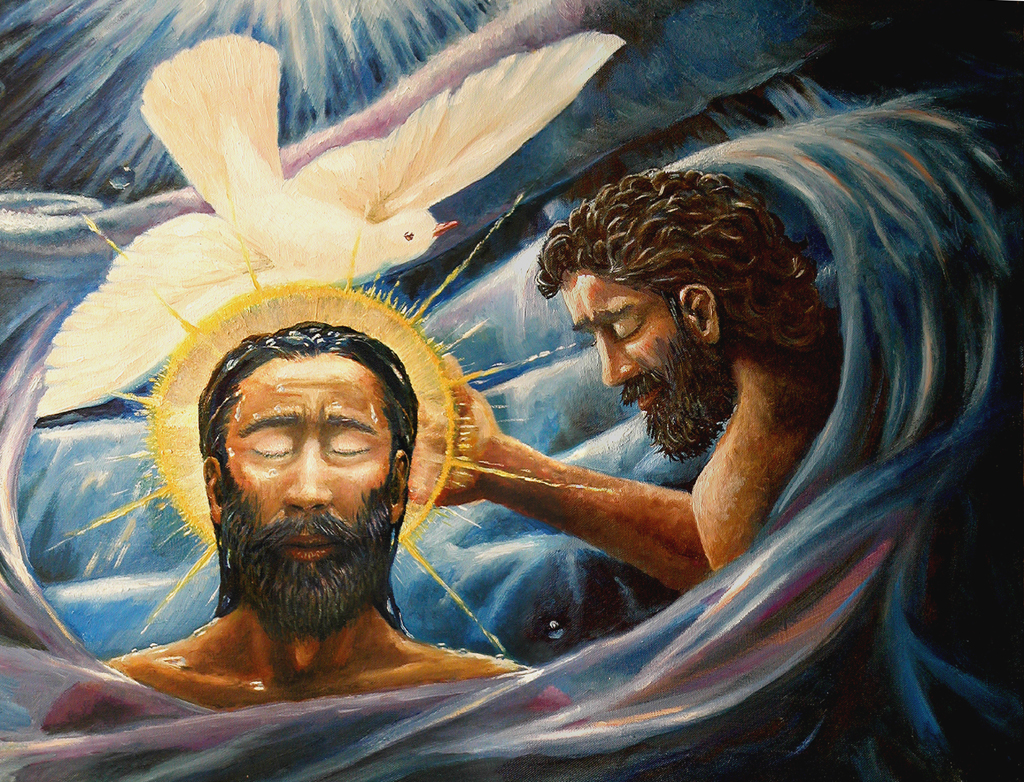
I have often viewed the baptism of Jesus as his ordination service. Here is the public confirmation and commissioning of the ministry to which he had been called since before the beginning of human history.

And like our ordination services, the place of the Holy Spirit is significant here. At an ordination, we often sing the ancient hymn ‘Veni Sancte Spiritus’ (‘Come, Holy Spirit’) and we lay hands on the ordinands, praying that the Holy Spirit will equip them for their calling.

So in this talk, I want to reflect on what the descent of the Holy Spirit on Jesus tells us about the public ministry he is about to begin.

10 Just as Jesus was coming up out of the water, he saw heaven being torn open and the Spirit descending on him like a dove. 11 And a voice came from heaven: ‘You are my Son, whom I love; with you I am well pleased.’

These words are loaded with scriptural resonances from elsewhere, and when we realise that their significance for the ministry of Jesus will become apparent.

Firstly, Jesus ‘saw heaven being torn open’ (verse 10).

When heaven is opened in the Scriptures, it usually means God is about to reveal his glory and his will. Ezekiel’s inaugural vision that makes him a prophet begins when ‘the heavens were opened and [he] saw visions of God’[i]. Stephen the martyr, on trial for his life and facing stoning, saw ‘heaven open and the Son of Man standing at the right hand of God.’[ii] The revelation Simon Peter receives to mix with Gentiles and ultimately proclaim the Gospel to them begins in a trance when he sees ‘heaven opened’[iii]. There are at least eight examples in the Book of Revelation itself[iv]. And so on.

Therefore in this incident the Father is telling Jesus that something important is about to be communicated.

We may think that such spiritual experiences are rare, unusual, or even non-existent for us. However, there are occasional times when we are conscious that the presence of God is close or even virtually tangible. It does not feel like the sky has a ceiling and our prayers bounce back down to us without reaching heaven. We have those times when we know the lines of communication are clear.

If we do, then this passage tells us to pay attention. God may be opening heaven to say something important to us, or to do something important with us.

I wonder whether we stand to attention at such times?

Secondly, Jesus saw ‘the Spirit descending on him’ (verse 10). This has echoes of the creation story in Genesis 1, where ‘the Spirit of God was hovering over the waters’[v] before the six days of creation begin.

So here too God is about to begin a work of creation. Except creation already exists! With Jesus he begins the work of the new creation. Through Jesus all things will be made new.

This shows us that Jesus is way bigger and more important than the ways in which we often treat him. For all our confessions of him as Son of God and Saviour, there are too many times when we treat Jesus as if he were someone who helps us to improve our lives, or who mentors us in good ways of living. We treat life with Jesus as some kind of deluxe addition to life.

But that is not why Jesus came, it is not why he ministered, and he will not have it. Jesus came that we might say goodbye to all that is old, decaying, and twisted due to sin and instead to welcome in a world where not only are we individually made new in our lives, but that all creation will be made new. Even our bodies will be made new at the Resurrection.

Following Jesus is not like buying a new car, where we look at the specifications and say, I’ll add on some extra features, like a parking camera to help my reversing, and a heated driver’s seat to keep me comfortable.

No: the ministry of Jesus is one where our old life is put in the grave and we are raised to a completely new life. It is one where we look forward to the old world going and living in the new heavens and new earth.

To welcome Jesus into our lives, then, requires that we are willing to sing the words to the old chorus ‘Spirit of the living God’: ‘Break me, melt me, mould me, fill me.’ When we allow him to do that in our lives, he will make us new and make his world new.

Thirdly, Jesus saw ‘the Spirit descending on him like a dove’ (verse 10, italics mine).

That the Spirit descends like a dove takes our last thought further. The most obvious biblical precedent here is of Noah using a dove to find out whether the flood waters had receded[vi].

This is an indication, then, that as Jesus comes to make his new creation, he does so as One who rolls back the damage of the past, and who shows that the judgment of God no longer pertains to all who own the name of Christ. Yes, ‘Break me, melt me, mould me, fill me’ can be challenging, disconcerting, and disturbing, but Jesus also comes as the gentle One who restores where we have been broken by the actions of others and who tells us that no longer have to live under our past, because through him God has offered us forgiveness.

If you are already broken, let Jesus put you back together in a new and beautiful way. Maybe you think that the brokenness will still show. Maybe in this life it will, but don’t let that daunt you. After all, the risen Jesus showed his scars to the disciples.

Think if you will about the Japanese art of kintsugi. This is the practice of putting broken pottery pieces back together with gold. Even the flaws and imperfections are beautified, to make a more attractive piece of art. See that as a picture of what Jesus wants to do in your life. Why not invite him to do his work of restoration in you?

Fourthly and finally, verse 11:

And a voice came from heaven: ‘You are my Son, whom I love; with you I am well pleased.’

The first thing that has always struck me here is that the Father proclaims his delight in his Son before he has even begun his ministry. It is a powerful statement of unconditional love.

But if we want to dig into the biblical background here, then the obvious stopping-off point is the so-called Servant Songs in the Book of Isaiah, especially the first of those songs[vii]. It begins with the words,

‘Here is my servant, whom I uphold,
    my chosen one in whom I delight;
I will put my Spirit on him,
    and he will bring justice to the nations.’ (Verse 1)

The main difference is that whereas in Isaiah the designation ‘servant’ is used, here in Mark it’s ‘Son’. We draw the conclusion that God’s own Son came as the Servant of the Lord. The Son of God is the Servant.

Later in Mark Jesus will tell his disciples that servanthood rather than status is what matters in the kingdom of God, and that even the Son of Man came not to be served but to serve, and to give his life as a ransom for many[viii].

But it’s established right here at the beginning of the Gospel that Jesus will carry out his ministry of salvation in the form of a servant. The Son of God will bring in the new creation and all heal the broken not in the way that many assume an Almighty God will do, with force and irresistible energy, but by treading the path of servanthood.

And so he comes to serve – not in the sense that he waits on our every indulgence but that he provides our every need and he knows that the only cure for the wounds of he world lies at the Cross.

When we receive that, he then enlists us to serve him by serving others that they may see through us the nature of God’s transforming love. That is what Jesus is ordained to do. This is what all his followers, reverends or otherwise, are all ordained to do as well.


[i] Ezekiel 1:1

[ii] Acts 7:56

[iii] Acts 10:11

[iv] Revelation 4:1; 5:3; 8:1; 10:8; 11:19; 13:6; 15:5; 19:11.

[v] Genesis 1:2

[vi] Genesis 8:8-12

[vii] Isaiah 42:1-7

[viii] Mark 10:35-45

Create a website or blog at WordPress.com

Up ↑