The Importance of the Ascension (Easter 7, Resurrection People 7) Hebrews 4:14-16

Hebrews 4:14-16

I saw this image on Facebook on Thursday, which was Ascension Day. A classic painting of Jesus ascending above the bewildered disciples has had a caption added:
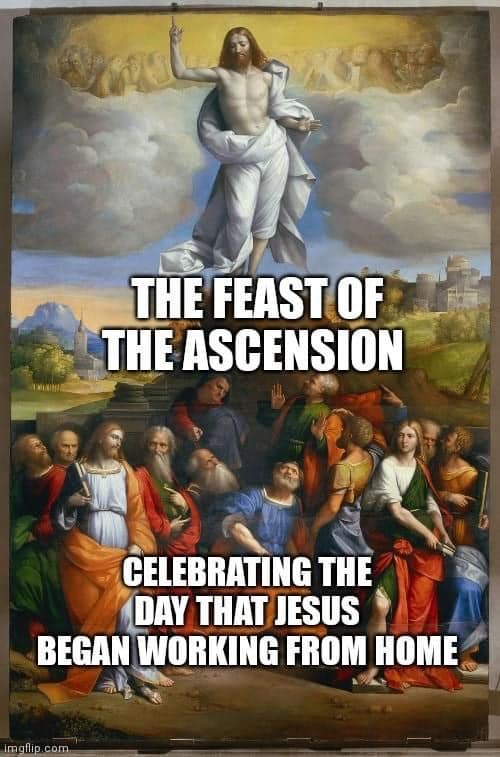
The Feast of the Ascension: celebrating the day that Jesus began working from home.

I rather liked that. I wondered whether devout Catholic politician Jacob Rees-Mogg might ponder it the next time he leaves snarky notes on the office desks of civil servants who are working from home.

What do we make of the Ascension? When I try to explain the event to congregations, I usually suggest it is what John Calvin called one of God’s accommodations to us. He rose into the sky to get the message through to disciples who thought heaven was ‘up there’. Although Professor Tom Wright now says that the Jewish concept of heaven was that it was an invisible realm next door to this life and therefore the crucial part of the story is that Jesus disappears from sight.

But be that as it may, what does the Ascension mean for us? I’m going to divide that into two halves.

Firstly, it’s about the finished work of Jesus.

Hebrews 4:14 tells us that Jesus ‘has ascended into heaven.’ But what does he do there?

Two other parts of Hebrews tell us something that this section doesn’t, and they both use the same expression. In both chapter 10 and chapter 12 we read, ‘He sat down.’

It’s like he gets to heaven, he goes in the front door, finds the sofa in the living room, and takes the weight off his feet. Job done. Now he can rest.

In other words, the Ascension tells us that Jesus had completed all he was sent to Earth to do. Through his life, teaching, miracles, death, and resurrection he has achieved his goal. Salvation has been won. It is available to all. The task is being passed to the disciples and any day now the Holy Spirit will equip them for that.

Compare it if you will to the account of the crucifixion in the Gospel according to John. As he is about to die, Jesus cries out, ‘It is finished!’ (John 19:30) When he said ‘It is finished’ he didn’t mean, it’s all over, and my mission has failed, but the very opposite. For the Greek word that English Bibles translate as ‘finished’ means ‘finished’ in the sense of ‘accomplished’. Jesus is saying, ‘Mission accomplished!’ and the Ascension confirms that.

Jesus has done everything we need for salvation. The Cross is sufficient, the Resurrection proclaims it, and the Ascension ratifies it. To come into a relationship with the living God and to live as a disciple of Jesus requires only what he has done for us. At the Cross, the guilt we carry and the sentence we deserve for our sins are taken away and laid on Jesus. At the Cross, evil forces are conquered not by violence but by the suffering love of God in Christ. At the Cross we are set free.

It has all been done. Finished. Mission accomplished.

So one thing we must not do is attempt to add to what Jesus has done. Sometimes when we feel particularly guilty we think we have to do something as an act of penance to earn the favour of God. But as Martin Luther discovered when he studied the New Testament more fully than he had been taught as an Augustinian monk, the word is not ‘penance’ but ‘repentance’. And even then we do that in response to what Jesus is offering us.

Similarly, some people think they have to live a good life in order to win God’s favour. This is at heart an act of pride: ‘I did it myself’ – or even worse, in the words of the dreadful song, ‘I did it my way.’ But the fact that Jesus has done it all is meant to humble us. We cannot save ourselves. That’s the point. Everyone must come to that realisation, whether they are of high rank or low in human society, that we come in humility to Jesus and depend entirely on him for salvation.

On this day when we celebrate Jesus sitting down at the right hand of the Father, I want us all to realise afresh that our relationship with Christ is described in the words of the hymn:

Nothing in my hand I bring
Simply to thy Cross I cling.

What is faith then? It is not stretching out our hands to offer God something from our lives that we think or hope might make us acceptable to him. Instead, it is an opening out of our empty hands to be filled with all that Jesus has to give us from what he has done for us at the Cross.

John Wesley knew this. Last Tuesday was the anniversary of his conversion at Aldersgate Street, when he found that the assurance of God’s love simply came directly to him from God, not from all the labours to which he had devoted himself up until then.

Therefore, if you are ever the kind of person who says of yourself, ‘I’m trying to be a Christian,’ I want to ask you to put that language to bed from today. Either you are a Christian, or you are not. Being a Christian isn’t a boast, it isn’t a matter of personal superiority. It’s a matter of holding out those empty to hands to receive the finished work of Christ.

Secondly, the Ascension is about the unfinished work of Jesus.

Wait a minute Dave, you’ve just been at pains to say that Jesus finished his work. How can you now say his work is unfinished?

Glad you asked. And I hope this is provocative enough to keep you listening. One part of his work is finished, the work I’ve just been describing, to make salvation an offer to all.

But another part of his work is unfinished. And it’s described in our reading. Hebrews calls Jesus our ‘high priest.’ What does a priest do? A priest offers sacrifices for the people – but we’ve covered that in my first point about the finished work of Jesus in speaking about his death. Jesus our high priest offered himself as our sacrifice.

But a priest does something else for the people. A priest prays for them. This is something that Hebrews will refer to three chapters after our reading:

Therefore he is able to save completely those who come to God through him, because he always lives to intercede for them. (Hebrews 7:25)

Two circuits ago, and elderly Local Preacher prayed for me every day. But he died. My parents also prayed daily for me. But they have both died while I have been here.

However, I am not short on the most powerful prayer for me in my need, because Jesus intercedes for me. And he does the same for each of you. Be encouraged! This is his priestly work.

And furthermore, he understands, because as our reading says,

15 For we do not have a high priest who is unable to feel sympathy for our weaknesses, but we have one who has been tempted in every way, just as we are – yet he did not sin. 16 Let us then approach God’s throne of grace with confidence, so that we may receive mercy and find grace to help us in our time of need.

Don’t you find that encouraging, too? I often tell mourners at a funeral that when I am going through a bad time in my life I don’t necessarily find it helpful to have well-meaning Christians come up to me and tell me exactly what they believe about why God has allowed this. I want to lay my hands on such people – but not in the sense of healing!

The people I find most supportive when I am walking through troubles are those who have been there themselves. They understand.

One of my favourite examples of this is that about five years before I met Debbie I had a broken engagement – or, as my sister called it, a narrow escape. One day when I was grieving the break-up of my relationship, two friends called Sue and Kate turned up on the doorstep.

‘We’ve come to take you out for a pub lunch,’ they said.

I don’t remember the food from that meal. What I remember is how both Sue and Kate shared about broken engagements they had been through. They understood. They could support me.

Because Jesus has been through human weakness and faced temptation, he can do all that and more.

If you are facing sorrow or crisis right now, I encourage you to re-read the Gospels. Look for the stories where Jesus too goes through the ringer. Then recall that because he has been there too, he understands what you are facing, and can pray like no-one else to the Father for you.

This is how our ascended Lord spends much of his time. This is his unfinished work. It will continue until he appears again in glory, to judge the living and the dead, and to take us to our eternal home.

In conclusion, I’ve always been disappointed how Methodist churches treat the Ascension as a minor festival or even as a non-existent one. It is so important. It has much to teach us and encourage us.

I hope we will all leave today rejoicing in the finished work of Christ, who has sat down at the right hand of the Father, having completed everything necessary for our salvation.

And I hope we will also all leave today encouraged by the high priestly work of Christ who identifies with us and intercedes for us – his unfinished work.

May both of these great truths be strong foundations for our worship and our witness.

Seventh Sunday of Easter (Sunday After Ascension): Waiting Well

For the foreseeable future, the videos are only going to be the Bible reading and the talk. My workload at present makes it difficult to find time for sourcing and editing the music and prayers that I have been including. (On top of a full appointment, I am temporarily the Acting Superintendent of my circuit while my boss is on sabbatical.)

Luke 24:44-53

Since this video goes beyond my usual congregations via YouTube, I hope my churches will forgive me if I begin this Ascension reflection with some material they may have heard before.

At this time I always remember the story told by one famous Anglican bishop about how he was invited to perform the reopening of a local Post Office. It happened to be on Ascension Day.

When he arrived, he found a hot air balloon tethered in the field. There was also a brass band. He learned that the Post Office had planned to combine his reopening with Ascension Day. So they expected him to soar up into the sky in the balloon while the band played the hymn ‘Nearer My God To Thee’!

The idea of Jesus ascending into the sky is an intimidating story for us today. I was also intimidated one year when as a theological student the local Methodist minister invited me to fill his pulpit on the Sunday after Ascension. There in the congregation was the local university Professor of New Testament, following the Bible reading in his Greek New Testament. If ever I had to get a difficult reading right it was that morning!

I have found most help from a source not commonly quoted in my own theological tradition, indeed someone who is often reviled among Methodists. And that is John Calvin. He wasn’t all double predestination and executing his enemies, he had some good points!

One of them was his doctrine of ‘accommodation’. He said that in revealing himself and his truth to people, God often had to ‘accommodate’ the way he did that to the limited understanding of human beings.

The Ascension would be a good example of this. Jesus ‘lifting off’ like a rocket from Cape Canaveral seems strange to us, but how else was he going to show his followers that he was returning to heaven? So the Ascension story isn’t designed to tell us that heaven is literally above us, the miracle is there to communicate a theological truth about where Jesus is in terms that would have been understood two thousand years ago. How Jesus would do it today I’m not at all sure, but this is how he needed to communicate it at the time.

Now when Jesus ascends, his disciples are left waiting for Pentecost and the arrival of the Holy Spirit. He expressly tells them to wait in Jerusalem for that event:

49 I am going to send you what my Father has promised; but stay in the city until you have been clothed with power from on high.

Waiting can be an exciting time, as we anticipate something we’re looking forward to. But it can also be a difficult time spiritually. ‘Lord, when are you going to fulfil your promises? When are you going to do what we need you to do?’ Does that sound familiar to you?

I recall a time as a child of primary school age when in the school holidays I went over the park that was opposite our house to play with my schoolfriend Tony. We were set upon by bullies, and Tony ran away. I was terrified.

But a few minutes later I discovered why Tony had run away. He had gone back to our house and returned with my father. The bullies then ran away!

It was awful waiting for those few minutes and not even knowing why Tony had gone, but the wait brought a good outcome.

Unlike those first disciples, we don’t have to wait for the Holy Spirit. But those other times of waiting for the promise of God that I alluded to a moment ago are common to our spiritual experience.

And therefore a question that the Ascension helps us with is this: how do we wait well as Christians?

I see two elements in the story about how we can wait well for what God wants to do.

The first is that the disciples are blessed people.

50 When he had led them out to the vicinity of Bethany, he lifted up his hands and blessed them. 51 While he was blessing them, he left them and was taken up into heaven.

That’s how Jesus leaves them – with a blessing upon them. But what does it mean to be blessed by Almighty God?

Essentially, if God blesses you, then you receive his favour. Perhaps the most dramatic example is when the Archangel Gabriel appears to Mary to announce her pregnancy. He says she is ‘highly favoured’ and that ‘the Lord is with [her]’[1]. That’s a blessing – well, that particular one may be a blessing and a half!

When I as a minister pronounce a blessing at the end of a service, what I am praying for is that everyone in that congregation leaves knowing that they are favoured by God. This is the good news: sinners receive the favour of God.

And it forms our core identity as Christians. It’s the most important thing about us, that through no merit of our own we are blessed, we are favoured by God.

If we don’t make it our core identity, then things go awry. I had an elderly lady in one previous appointment who made the fact that she was a Local Preacher central to her sense of worthy. But the time came when her mind and body began to fail. The most telling occasion was a service where she introduced the Lord’s Prayer three times. We asked her if she would step down gracefully and we would hold an event to celebrate all her years of preaching, but she refused. I know it would have been hard for anyone in her position, but she carried that bitterness with her as her health declined, instead of recognising the unchanging fact that she was a beloved child of God.

But more positively, if we do accept that we are favoured by God as his dearly loved children, then this holds us through the waiting times. On a small scale it happened to me earlier this week when I was preparing this talk. That morning I received an email that caused me some stress. I was rather anxious as I waited some hours for the outcome of it, and in the meantime had to go off and do other things.

But then the very teaching I’m giving you here hit me. What doesn’t change is that I am a beloved child of God. I am blessed by him. Therefore I can trust God to work this thing out. And he did.

So can I encourage you, then, to live out your identity as a son or daughter of the living God? That he has adopted you into his family is a sign of the most monumental blessing you can possibly imagine. Let that truth hold you up in the times of waiting.

The second element is that the disciples are worshipping people.

52 Then they worshipped him and returned to Jerusalem with great joy. 53 And they stayed continually at the temple, praising God.

Why do they worship Jesus? For sure, one reason is the blessing they’ve just received, but there has to be more. As good Jews, they would only worship Jesus if they thought he had divine status. They know now that he is more than a prophet. At the beginning of our reading, he has taken them through the Scriptures and shown how necessary his suffering, death, and resurrection were, and how that good news must now go out to the nations. Instead of the nations coming to Jerusalem, now God’s people will go from Jerusalem to the nations. All these things are wonderful signs that God’s purposes are being fulfilled, and that God has kept his promise to Israel – just not in the way they were expecting.

And when they appreciate all that they are filled with wonder. And that wonder comes out in praise and worship.

It’s interesting to compare this with the description the crowd at Pentecost gives the disciples when they hear them speaking in tongues: they say they hear them ‘declaring the wonders of God’[2], which could be a pretty good description of worship.

Yes, they are full of wonder at what God has done. They were slow to get it during the three years that they followed Jesus around, but now the shekel has dropped and it makes sense.

How does this help us when we are waiting? It would be good for us to be reminded of the amazing ways in which God has fulfilled his purposes over the centuries, supremely in his Son Jesus. It would be good for us to recount the promises God has made to his people and kept.

Sometimes we recount them in broad brushstrokes during the great prayer of thanksgiving at a communion service. We go back to the marvels of creation. We move on to God making a people for himself and continually calling people back when they stray through patriarchs, judges, and prophets. Ultimately, we celebrate the coming of Jesus, with his birth, ministry, death, resurrection, and – yes – ascension. The next time you’re at a communion service, listen for the minister covering those great topics in the thanksgiving prayer.

These things fortify us because they remind us of the great truths relating to our God. Our faith and confidence increase. We sing his praise. And we become more certain that he will see us through the difficulties of the waiting time, because he is a purpose-fulfilling, promise-keeping God. His ascended Son is at his right hand praying for us, and his Holy Spirit is within us and praying through us.

Don’t neglect worship. We engage in it because God is worthy of our praise. But as we worship, it builds up our own faith and trust.

So there you have it – two elements from the period between the Ascension and Pentecost that strengthen us in those periods when we have to wait to see God at work. One is done to us – we are blessed, we are favoured as adopted children of God by grace. The other we ourselves do in response – we worship, because God keeps his promises and fulfils his plans, and he will do the same for us.

I hope and pray that as a result, each of us will be able to bear the waiting times with greater faith.


[1] Luke 1:28

[2] Acts 2:11

We Love The NHS

I may have been critical of our current Labour Government again on Wednesday, but I am generally supportive of them when it comes to the NHS. Some of the recent attacks from the States (and even here) look dumb in the extreme. Can we just remind the Investor’s Business Daily that Stephen Hawking is both British and alive, for example? (Even the corrected version of the article, to which I have just linked, doesn’t fully correct all the facts and still leaves room for doubt about the role of the NHS with respect to the brilliant scientist’s health.) And as for the views of Conservative MEPs Daniel Hannan and Roger Helmer that we should abolish it because 80% of Americans get better health care, well hang on: for all the faults of the NHS (and I’ll come to some of them), a Christian has to remember not just the 80% but the 20% – that is, the poor. Oh, and twice as much GDP is spent on health care in the US than here. Who is going to campaign to double our spending, even on top of the rises under the current administration?

So it’s not surprising that Gordon Brown, the Prime Minister who ‘got down wiv da kids’ by making policy announcements on YouTube, has now sent a message of support to the Twitter campaign #welovethenhs. Of course it’s political that he does so, but – hey – I actually agree with him here. (Just as I do on his concern for the welfare of the poorest nations in the world.)

Why? For theological reasons. We are our brother’s and sister’s keepers. That has to be seen corporately. I have had it argued to me in the past by conservative American Christians that it is the sole preserve of the church to offer healthcare and healing to society. Yeah, right. Because that is going to cover everyone, isn’t it?

Less cynically, although I come from the Arminian theological tradition and am therefore meant to view almost everything John Calvin said with suspicion, I find value in his concept of ‘common grace’ – that the sun shines on the righteous and unrighteous, as Jesus said. Surely health and healing would be among such common blessings.

Personally, I have benefitted from the NHS. Most recently in major terms, it was the nasal surgery I had in May (a septoplasty and submucus resection, for those who like the medical swearwords). That surgery corrected a lifetime’s breathing problem. Nobody questioned me about the level of my medical cover, or whether my premiums were paid. I was simply treated. Then, a week ago, on the night before going away on holiday, I began to suffer pain in the right rib area. A phone call to NHS Direct led to advice that I should attend our nearest Accident and Emergency unit at a nearby hospital. They soon reassured me I didn’t have the feared spontaneous pneumothorax (OK, I’m showing off, that’s a collapsed lung) but had something close to a torn abdominal muscle. Triage, chest x-ray, time with a doctor, all without question, through until 2 am from dedicated professionals. Then away on holiday the next morning. First class.

No, it isn’t perfect, and I have some issues with it. The ‘postcode lottery’ is a common concern. For the uninitiated, this refers to differing policies in different areas, resulting in some people being eligible for treatment in their location but others in another area not being, perhaps due to age or general priorities.

Then there are issues of the budget being used up for causes that give me moral problems. The widespread use of abortion is the obvious one. Some uses of cosmetic surgery might be another. I could easily add othercontentious treatments to this list, and I apologise for just brief comments – however, the purpose of this paragraph is not to go into fine detail, but simply to mark up the fact that I have concerns about several significant areas.

But let’s get it straight. Supporting the NHS does not make you a Marxist, so let’s ditch that bit of ignorant propaganda that seeks to label people rather than engage with the issues. That kind of nonsense makes it sound like McCarthyism is back from the dead. Most Christians in the UK of various political and theological persuasions would concur that being in general favour of the NHS (whatever particular quibbles we have) is thoroughly consistent with Christian principles.

Create a website or blog at WordPress.com

Up ↑