How to Understand the Sermon on the Mount and the Beatitudes, Matthew 5:1-12 (Epiphany 4 Year A)

Matthew 5:1-12

There once was a church member who claimed that Jesus said we should disregard the Old Testament. This seemed rather strange to others, not least because Jesus spoke of fulfilling it, and so they asked him why he made this claim.

“Well, that’s easy,” he replied. “Jesus once said, ‘Hang all the Law and the Prophets.’”

Now Jesus did say, ‘Hang all the Law and the Prophets.’ The problem is, that isn’t the whole quotation. It came when he was asked about the greatest commandment. He replied that there were two: firstly, love the Lord your God will all your heart, soul, mind, and strength. Secondly, love your neighbour as yourself.

And his punchline? “On these two commandments hang all the Law and the Prophets.”

Quite different! Context is everything. As has been well said, a text without a context is a pretext.

Hermeneutical Basics by Brett Jordan on Flickr. CC 2.0.

Bear this in mind as we look at the opening of the Sermon on the Mount with the Beatitudes today. There are so many theories about the purpose of the Sermon and the meaning of the Beatitudes. There may be up to thirty-six main theories about the Sermon on the Mount[1]! Don’t worry, I’m not going to describe them all to you!

Context, then, is our first tool for discovering what these famous words mean for us.

We begin with the fact that context tells us who the teacher is. Well, you say, it’s Jesus. Of course it is. But context is making some big claims about him. You cannot read the context and just come away with the idea that he was a great religious teacher. He was claiming more.

How so? There are a couple of indications. One is that this is the first of five major blocks of Jesus’ teaching in Matthew’s Gospel. It is a parallel to the so-called ‘Five Books of Moses’, namely Genesis to Deuteronomy. Moses had prophesied that God would one day send one who was greater than him to his people. The Sermon on the Mount is one of the first indications Matthew gives us that Jesus is the One who fulfils that prophecy. He is not just a teacher. He is greater. How great? Keep reading.

The other indication about who the teacher is comes in the fact that Jesus goes up on a mountainside. It’s another echo of Moses, who went up Mount Sinai to receive the commandments from God. But Jesus doesn’t receive commandments, he gives them. And every time he goes up a mountain in Matthew, something important and revelatory happens. Here, it’s the Sermon the Mount. Later, it will be events like the Transfiguration and the Great Commission. Jesus is the New Moses, the One greater than Moses. If you thought it was important to listen to the Ten Commandments, then it is every bit as important, if not more so, to listen to Jesus in the five blocks of teaching and when he goes up a mountain (of which this is the first example of both).

Context also tells us who is being addressed. Hear verses 1 and 2 again:

1 Now when Jesus saw the crowds, he went up on a mountainside and sat down. His disciples came to him, 2 and he began to teach them.

Jesus addresses his disciples, but the crowds are present, too. Right through the Sermon, this is teaching for disciples. But others are watching and listening. It’s still true at the end of the sermon. These are the last two verses of Matthew’s account at the end of chapter 7:

28 When Jesus had finished saying these things, the crowds were amazed at his teaching, 29 because he taught as one who had authority, and not as their teachers of the law.

It’s consistent. The Sermon on the Mount is addressed to disciples, but they are not alone. The crowds are watching.

The influential American Christian thinker Francis Schaeffer once wrote a book called The Church Before The Watching World. You might say that title encapsulates what we’re about here. Jesus is teaching his followers how to be the church before the watching world. Do you want to know what constitutes a good witness in the world, according to Jesus? Then read, mark, learn, and inwardly digest the Sermon on the Mount.
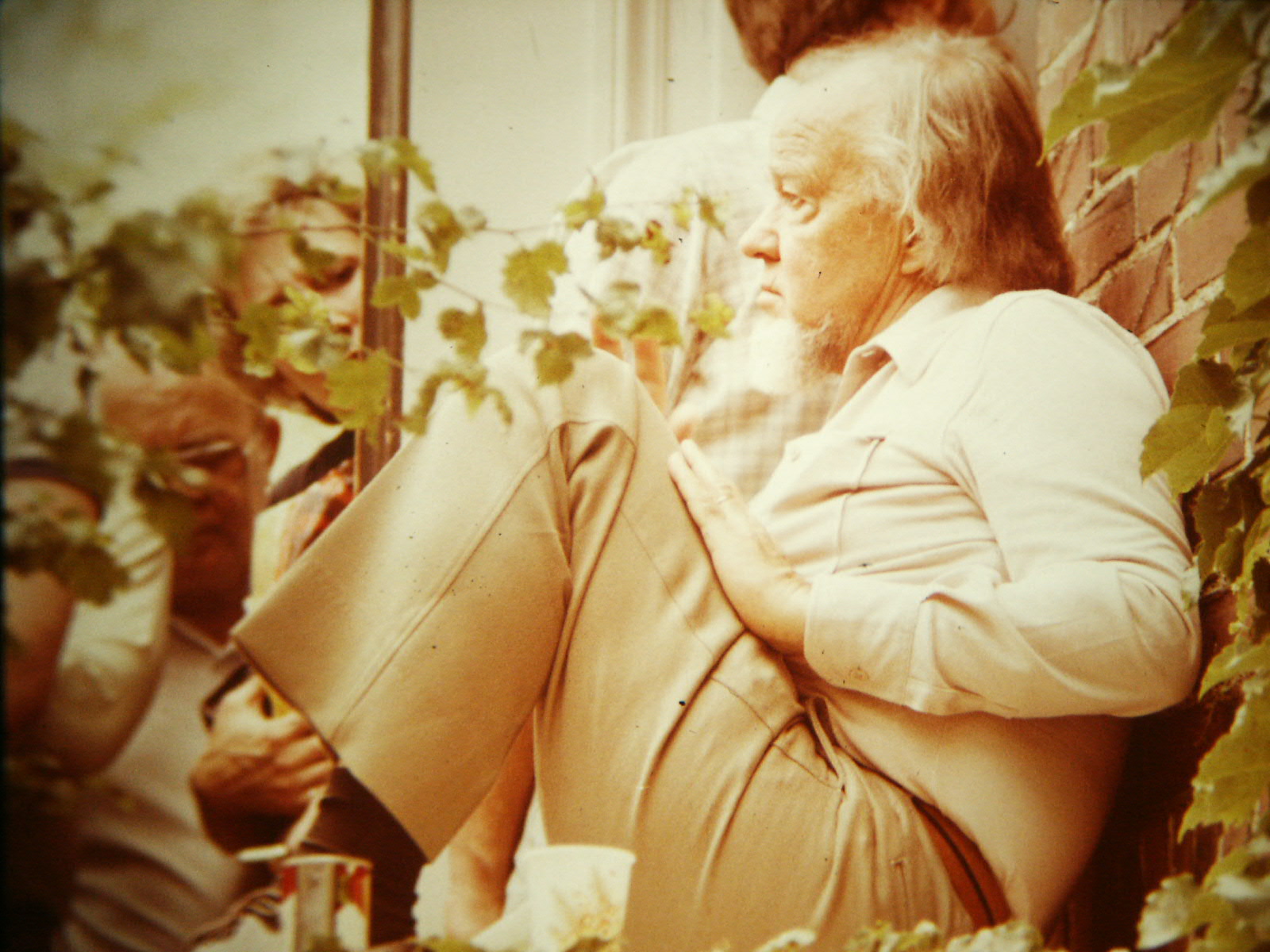
Dr. Francis Schaeffer. Wikimedia Commons, Public Domain.

And so that means we’re beginning to answer another question that context helps us with: what is the theme of the teaching? This is one of the areas where those thirty-six different theories argue with one another. For example, are these political policies we should demand in our national life? No, the primary focus here is on how the disciples of Jesus live.

In fact, the recent context just before this passage might also help us with this. It comes not long after Jesus has begun his public ministry with the call to repent, for the kingdom of heaven is near. If the Sermon on the Mount is for disciples, then it is for those who have responded to the call to repentance. It is a description of what the repentant life looks like. Do I want to know if I am doing what Jesus loves, and have turned from the ways of the world? Again, our answer is to read the Sermon on the Mount. This is a plumbline Jesus holds up for us to examine ourselves as Christians and see how we are getting on with the life of the Spirit rather than the life of the flesh.

To sum up so far: context tells us that Jesus, the teacher of the Sermon on the Mount, is the Great One prophesied for centuries, and that he should be listened to with all the seriousness we give to the Ten Commandments, if not more so. He is addressing his disciples, teaching them what the repentant life looks like, and what it means to live a Christian witness before the watching world.

With all that in mind – which I hope will help you with any part of the Sermon on the Mount that you read – let’s spend the second half looking specifically at the Beatitudes. And here our tool will not be context but structure.

Structure image, Highway Signs 3. Pix4Free.org. CC 3.0.

In the Beatitudes, there is a reasonably consistent structure of each saying. They more or less follow a formula. It’s only the last one, which Jesus expands on, but even there it displays some similarities. It goes roughly like this:

  • Who is blessed?
  • What blessing will they receive?

But let’s just define that word ‘Blessèd’ first. It means, ‘It will go well with the one’ who is named[2].

Then let’s observe that broadly there is a contrast in time between the people who are blessed and when they receive their blessing. The blessèd ones are doing what Jesus commends now, in the present tense. However, the promised blessings generally come in the future[3]. This is not a guide to having an enjoyable life now. Jesus is not promising that if you live your best life now you will receive health, wealth, and prosperity in this life. This is not some manual for successful living.

See it this way. Jesus is saying that here are some of the marks of living the repentant life. These are examples of how he calls us to live before the watching world. Because of that, God is pleased with us. He will bless our obedience. However, that blessing may well only come in the future – perhaps even only in the life of the age to come.

For at present, we live in a time when two different ages are overlapping and clashing with each other. The age of sin is continuing. But Jesus has inaugurated the age of God’s kingdom, which has come but is not yet here in all its fulness. The age of sin and the age of God’s kingdom are incompatible, so they clash. That is why not all the blessings of the age to come are here yet. It is why not everybody we pray for is healed, for example. God’s kingdom has won the decisive battle at Easter – yes! – but the war is not yet finished.

What does this mean for us? Jesus calls us to live the repentant life before the world as a witness. We are not forcing ourselves on the world but showing by our lives what the ways of Jesus are like, knowing that God delights in what we are doing, and that he will show us his favour for responding to him like this. However, we may have to wait patiently to receive the fruits of that approval.

Jesus is calling us to live not as those who choose violence, even in the face of oppression, but who live humbly, seeking peace and reconciliation (which is not the same as caving in). He calls us to be the ones who trust in him, even when we think we don’t have many resources – after all, he doesn’t need a big budget to achieve great things, he just needs surrendered lives. He calls us to be the ones who witness to mercy and compassion; to be the ones who yearn for him above all things, rather than having our imaginations captured by the desires that our society elevates. To become such people, we may well mourn – not only in the general sense of those who are bereaved but mourning for our sin and the sin of the world, which surely leads us to passionate prayer for transformation for ourselves and others. We are the ones to show kindness to others, even if it means we need to carry the burden of unjust suffering.

Such a calling probably sounds unbearable. But a day is coming, he promises us, when God will vindicate us for following these costly choices. We will hear the words, ‘Well done, good and faithful servant.’ We will be blessed.

And in that respect, we shall be following Jesus himself. For surely the Beatitudes describe the kind of life he lived on earth. And he too was blessed in the vindication of the Resurrection.

But isn’t this all impractical and irrelevant? What of when we see the powerful in our world living differently and crushing others, shooting the innocent on the streets of Minneapolis and Tehran? Do we respond in kind? When Donald Trump’s adviser Stephen Miller tells the CNN TV channel,

“We live in the real world, Jake, that is governed by strength, that is governed by force, that is governed by power. These are the iron laws of the world since the beginning of time”

should we not respond with similar use of force? No. We continue to live the Beatitudes. These are the ways of God’s coming kingdom. These show God’s great future. As such, they pronounce God’s judgment in a subversive way on the wickedness of our day. In their peaceable nature they reveal God’s truth and promise the downfall of violence. God will pass sentence on the wicked, but we let him do it in his way.

Let us heed the call of Jesus, to live the repentant lifestyle of peace before the watching world. We must take this seriously, because of the One who tells us that this is his way. The rest we leave to his Father who, as the Psalmist tells us, places the wicked on slippery ground that they might be cast down to ruin[4].


[1] Craig S Keener, The Gospel of Matthew: A Socio-Rhetorical Commentary, p160.

[2] Keener, p165.

[3] As Paul Beasley-Murray says, they are a ‘divine passive’. See also Keener, p167.

[4] Psalm 73:18

Gladys Aylward, Hero Of The Faith

Today I took two school assemblies in the same school – one for the infants, the second for the juniors. We are on a series about ‘saints’, which we have renamed ‘heroes of the faith’. This week I was stuck for ideas, so I put out a request on Facebook and Twitter for ideas, and received plenty of suggestions. Many I shall store up, but I loved my friend Sally Patterson’s suggestion that I tackle Gladys Aylward.

Not only was she a great woman of faith, I have an indirect connection. I come from the same part of north London as her, and my grandmother was friends with her. My grandmother too wanted to be a missionary, but was turned down on health grounds. It didn’t stop Aylward, though, any more than the other objections about her lack of educational ability to cope with Bible college training. She is a great example of faith in following God’s call despite the circumstances. If you ever want an example of the maxim ‘It’s not so much your ability but your availability that counts with God’, then she is an excellent illustration. This small, frail woman whose academic limitations meant she had been working ‘in service’ travelled by train across northern Europe, including Siberia, to reach her destination in northern China.

She is well known for her campaign against foot-binding – the Chinese practice of bandaging girls’ feet to prevent them from growing in the mistaken and cruel belief that small feet were beautiful. This is a woman from a small evangelical church (Tanners End Free Church), practising social justice at a time when such campaigning was largely thought worthless in evangelicalism, because such concerns were ‘liberal’ and we should just get on with rescuing people for heaven before the Second Coming.

Furthermore, what would she have to say today to some of the practices in the contemporary beauty industry? I think she would be pungent.

Then there is her courageous work of leading a hundred children on a hundred mile trek across the mountains to safety from the threat of Japanese soldiers. No comfortable life for her. It’s not Joel Osteen style religion.

She certainly was a feisty woman of faith. She was horrified that Ingrid Bergman was chosen to portray her in the film ‘The Inn of the Sixth Happiness‘. She wasn’t impressed with Bergman’s lifestyle, and therefore considered her unsuitable. Perhaps today we would be too dazzled by the celebrity culture. Not Gladys Aylward.

A friend of mine was a doctor, and a son of a doctor. His father once visited Aylward in a Southampton hospital when she returned to the UK once. She asked him to get out his Bible. But she told him not to read one of the ‘comforting’ passages. She wanted to hear something stirring!

O for more Gladys Aylwards today.

You can still sometimes come across old copies of her biography, ‘The Small Woman‘ by Alan Burgess.

Here is a video clip – not an excerpt from ‘The Inn of the Sixth Happiness’, but the trailer to a cartoon film on DVD for children about her.

Christian Books: Amazon Versus Christian Bookshops

I’ve decided to draft a few thoughts after Phil Groom‘s comment and pingback on the last post. Please pitch in with your own thoughts.

I write as a punter, not a professional in the booktrade. I am a ‘professional’ who needs to keep reading Christian theology.

What is in favour of Amazon and the online stores? First of all, price. Stipends for most ministers are OK but not great (I’m not moaning, I knew what to expect), and this means being careful financially. The discounts available online are broadly, although not always, better than is available in a typical Christian bookshop. It’s important to note, though, that discounts online are not necessarily about being able to afford that on high volume titles, because that is not usually the case with Christian books – unless you count The Shack, I suppose. I am sure that most of the religious hardbacks and paperbacks sold at Amazon would fall within the parameters of what some commentators call ‘the long tail’, that huge array of low-selling stock that they specialise in, rather like online CD and MP3 sites doing well on back catalogue. Furthermore, I can use a price comparison site like Bookbrain to check prices if something has been published in the UK. 

Second is range. Some Christian bookshops are very restricted in what they carry, not only as a function of only being able to afford small premises, but on theological grounds. And yes, I say that as an evangelical! The days may be gone when Michael Saward could caricature Christian Literature Crusade as Constricted Literature Crusade, but it’s not long since I discovered an evangelical bookshop that didn’t stock Eugene Peterson. I really don’t want Joel Osteen or Joyce Meyer: I know they sell and realise there are economic necessities involved here. I think it’s a moot point why that tat sells: is it the advertising power of certain Christian companies, and/or is it pastors promoting nonsense in the pulpit? (That alone is worth a debate, I think.)

But this is not simply about theological narrowness: sometimes the work I want to read is not published in the UK, so the ability of an Amazon to get stock from, say, the States, is a distinct advantage to me. 

What works in favour of the conventional Christian bookshop? It may be a truism, but it’s worth restating: Christian bookshops can (or should) be a ministry, with a certain atmosphere and ambience, whereas Amazon and their ilk are businesses. (Not that I’m having a go at business.) A Christian bookshop can win me over by the personal qualities of the staff, not just the discounts. Some work hard on this, a few don’t.

A few examples from personal experience: when I trained for the ministry in Manchester, the local SPCK shop had a terrible reputation with theological students. It should have been our first port of call, but it had staff who were like the Christian version of Bernard Black in the TV show Black Books. Two disgruntled former employees left and set up a rival operation called St Denys. They knew they needed to reach students, and set about to do so. Good coffee was offered to every visitor. Students producing ID received 10% discount. The staff were theology graduates, and knew the field and gave good advice.

Similarly, my old friend Brenda Franklin at CLC in Chatham when I served in the Medway Towns was the exemplary Christian bookshop manager, and followed a difficult situation. She knew the trade and knew her faith. She always went the extra mile to trace a book. She was familiar with new titles, had read widely herself and could give an opinion. Most of all, she set up a specific scheme to reach out to local church leaders with monthly newsletters. While I didn’t often order expensive academic doorstops from her, I ordered more than I would have done if I had only wanted to save money. You could say that what she did wasn’t rocket science, but having come across the odd Basil Fawlty (as well as Bernard Black) in Christian bookshops, the Brendas of this world are a delight. 

My other example of excellence in the ministry of a Christian bookshop would be a current one: Jo Jones at the ‘Guy Harlings bookshop’ in the Chelmsford Diocesan Resources Centre. You’d expect Jo to have a good idea of what clergy are interested in, and she does. She knows it even more as one training for ordination herself, but I guess that means sadly for us we’ll lose her from the shop before too long. This is the first appointment in which I have ended up taking school assembiies. Jo has been brilliant for her knowledge of useful books. They would have been available online, but the advice couldn’t have been, notwithstanding the customer reviews on websites, which don’t count for as much in my eyes.

One last thing to mention before throwing this open is the rise of Christian online stores. I guess the most prominent one I know for books is Eden. They seem to have a wide knowledge of the church scene, across all sorts of traditions. They also sell CDs, DVDs and other resources. There is a reasonable discount, which I appreciate, although the postage costs are a disincentive and have driven me back at times either to Amazon or a local bookshop. I can’t get advice from them.

Wider than books, I should also mention Cross Rhythms Direct. Their main speciality is CDs, with some DVDs, and they have recently branched out into books but are far less confident there. CR began as a print music magazine for the Christian scene. The CD prices are the most competitive I know for Christian music, although you can opt out of your discount to give to a worthy cause. Many of the CDs have reviews, but that is where I need to make a disclosure: I am one of their CD reviewers!

Well, hopefully that’s enough to get a discussion going. What are your thoughts? Over to you!

Sabbatical, Day 24: No Sleep Till Brekkie, More Lectures And The Bristol Tourist Trail

I don’t do well on first nights in new locations. Not on the evidence of this sabbatical, anyway. Having barely slept before 4 am on my first night at Cliff College a fortnight ago, I didn’t sleep before 1:30 here, then woke at 5:30 with a vile headache. (Not that I know what a nice headache would be, you understand.) At 7 am, I decided I needed a large dose of tannin, so I took the pint-sized mug I’d brought from home and made my first tea of the day. The pain slowly subsided over a period of several hours, until it was gone by late afternoon.

Trinity does worship differently from my time. Twenty years ago, nearly everything was Alternative Service Book. Except when Paul Roberts inflicted chanted Book of Common Prayer services, that is. Though the ASB has been replaced in the C of E by Common Worship, the college seems to have themes for particular weeks. This week it’s Iona Community worship, widely popular in many parts of the British church but something that drives me nuts. I have no problem with a liturgy that emphasises social justice and makes no division between work and worship. However, I have found several of their liturgies and some of their songs hectoring and lecturing. Not only that, the confession used this morning was fundamentally inadequate. I like the mutual confession approach of Iona (service leader confesses and congregation pronounces forgiveness, then the process is reversed), so I’m not critical of everything. But this confession started from the point that we had hurt ourselves, then others, then the world. Absolutely no reference to the rupture between humans and God that is central to confession. Remind me never to use it in worship.

There were good things – not least the brief testimony of a student as to what God did in a prolonged experience of a spiritual desert. And the guy who read the Gospel reading did so with great feeling. Those were highlights.

Lectures were more relevant this morning. The operating paradigm (I’m at a theological college – out come the long words!) was still that of the large church, but I felt that more of today’s material was translatable or adaptable. We began with a session on team leadership and issues around teams. We then looked at how to run a meeting, largely taken from the old John Cleese video ‘Meetings, Bl**dy Meetings‘. Finally, a few thoughts about some common mistakes made by leaders.

This afternoon had an optional session. I opted out. It comprised some BBC videos on assertiveness training. While that’s an area I could do with improving in, I needed some air and some exercise to counter the effects of the much improved food. I decided I would try to find some old haunts. Off I went across the Clifton Downs, down two roads whose names may just betray Bristol’s slave trade past – Blackboy Hill and Whiteladies Road – and on down, eventually to Park Street, where I used to frequent three shops. I knew that SPCK would have been long gone after the business atrocities that have been inflicted on that chain of bookshops. Sadly, Rival Records is no longer around – I remember buying Bruce Cockburn‘s World Of Wonders in there during my first year. And the Evangelical Christian Literature bookshop is now a branch of Wesley Owen, stocking everything from N T Wright to Joel Osteen. Insert words such as ‘sublime’ and ‘ridiculous’ as you see fit. I think I’m right in remembering that ECL had been founded by George Mueller.

Not being home today means I’ve missed Shrove Tuesday with the family, but Debbie told me tonight she and the children had decided to postpone pancakes until Saturday. I’m glad they have. Pancakes and their toppings are one of those simple pleasures where it is a joy to see the fun Rebekah and Mark have. Two small pancakes with toffee ice cream here at lunch time were delicious, but no replacement for being with the children. As to toppings generally, I’m a fan of those English Provender jars – no, not the garlic, ginger or horseradish, rather the raspberry coulis or the Belgian chocolate sauce. The latter has been harder to find in the supermarkets recently, though.Looking at the website tonight, I’ve noticed they now do a Fairtrade chocolate sauce, though.

More seriously, I had to miss a hospital out-patient’s appointment Rebekah had this afternoon. Eighteen months ago she had grommets inserted in her ears after protracted episodes of glue ear and consequent poor hearing. They still haven’t solved the problem. One grommet fell out a few months ago, and today they could see congestion in it. She may have to have more grommets fitted, poor lass. Recently, we’ve let her start answering the telephone, but conversations with her are punctuated with “What did you say?”

Tonight, I’ve just spent the time quietly reading. Next stop a spot of supper then an early night, I hope, to catch up on last night.

Create a website or blog at WordPress.com

Up ↑