Regime Change, Isaiah 11:1-10 (Advent With Isaiah, 2) Advent 2 Year A

Isaiah 11:1-10

Here are some extracts from a friend’s Facebook post:

3 WISEMEN KILLED ATTEMPTING TO ENTER U.S.

(Bethlehem) The 3 Wisemen were killed attempting to enter the U.S. early this morning. They were still hundreds of miles away from the actual border, but the White House determined there wasn’t time to actually investigate their suspicions.

A White House spokesperson said, “We could tell from the satellite photos that these were bad people. They had gold (probably stolen), myrrh and something that was possibly fentanyl.  It was hard to tell from the picture, but the President knew just enough to kill them without an actual investigation.”

Also arrested were two immigrants named Joseph and Mary, an unnamed child, and an angel. The White House elaborated, “We can tell you that the two suspects were trying to check into a hotel. When asked if they were married, they responded that they were “betrothed.” We can’t have people flaunting Christian moral conventions at this sacred time of the year.

“The undocumented mother was also secretly recorded as saying “(God) has brought down rulers from their thrones, and has lifted up the humble. God has filled the hungry with good things but has sent the rich away empty.” That sounds like communism, pure and simple. These were probably Antifa terrorists.”

I could read you much more, but I don’t have time!

In amidst all our cosy preparations, with Christmas adverts that tug at the heart-strings like this year’s Waitrose ad, we miss the fact that the coming of the Messiah is much more messy and radical. And I don’t mean the mess in the manger.

It’s about regime change.

Sometimes, we get so fed up with our leaders we want change. Maybe we don’t do it like some powerful nations do, where they act nefariously in another country to change the leadership. But look at last year’s General Election here. Broadly speaking, the country was so fed up with the Conservatives that people voted for anyone who wasn’t Conservative. It wasn’t so much a vote for, as a vote against. No wonder the Labour majority was called a ‘loveless landslide.’

In the ancient world, of course the general population didn’t have a say, but kings were replaced and sometimes entire dynasties were removed. It was their version of regime change.

Isaiah 11 proposes the most radical regime change of all. A regime change that brings in the Messiah. Verse 1:

A shoot will come up from the stump of Jesse;
    from his roots a Branch will bear fruit.

Not even a shoot from the stump of David, for he was far from perfect. An adulterer, it not actually a rapist, and a murderer. The greatest king of all had his faults. Instead, Isaiah prepares us to sing

Hail to the Lord’s Anointed,
Great David’s greater Son![1]

So what will characterise the much-needed Messiah, who alone can bring true regime change?

Three qualities:

Firstly, wisdom:

2 The Spirit of the Lord will rest on him –
    the Spirit of wisdom and of understanding,
    the Spirit of counsel and of might,

    the Spirit of the knowledge and fear of the Lord –
3 and he will delight in the fear of the Lord.

Do you recognise these words? We have adapted them for the laying-on of hands at Confirmation and Reception into Membership of the Methodist Church. The minister prays this for the candidates:

By your power and grace, Lord,
strengthen these your servants,
that they may live as faithful disciples of Jesus Christ.
Increase in them your gifts of grace,
and fill them with your Holy Spirit:
            the Spirit of wisdom and understanding;
            the Spirit of discernment and inner strength;
            the Spirit of knowledge, holiness, and awe.[2]

And doubtless we expect the Holy Spirit to impart these qualities: wisdom, understanding, discernment, inner strength, knowledge, holiness, and awe. I’m sure it’s right to expect that.

Wisdom: Public Domain Pictures

But there is a specific context to these qualities of wisdom in Isaiah 11. All of the qualities he lists – wisdom and understanding, counsel and might, the knowledge and fear of the Lord – are lacking in the people of Judah and also of their enemies, such as Assyria. There are various quotes in the preceding two or three chapters that illustrate this.[3]

The Messiah is the One who brings true godly wisdom without lack – we might say it’s wisdom, the whole wisdom, and nothing but the wisdom of God.

When Jesus comes and begins his ministry in the power of the Spirit, we see this without a shadow of a doubt. In Matthew’s Gospel, there are five blocks of Jesus’ teaching, reinforcing the fact that here is the ‘One greater than Moses’ who was prophesied, given that there are five books colloquially known as ‘The Five Books of Moses’ in the Old Testament.

We can gain wisdom from other sources, but nothing is like the wisdom of Jesus. It’s why our high church friends stand for the Gospel reading in worship. They are saying, here is the centre of divine wisdom and revelation in the life and teaching of Jesus.

If we believe we are living under the regime change of the Messiah (which Christians are as citizens of God’s kingdom) then there is a clear application of this truth to us. To honour Jesus as the coming Messiah, our calling is to immerse ourselves in the wisdom of his teaching and commit ourselves to following it more fully.

For that, we too will need the Spirit – just as even Jesus himself, the Son of God, did, at his baptism.

If we are citizens of the coming kingdom, then this is what we do.

Secondly, justice:

He will not judge by what he sees with his eyes,
    or decide by what he hears with his ears;
4 but with righteousness he will judge the needy,
    with justice he will give decisions for the poor of the earth.
He will strike the earth with the rod of his mouth;
    with the breath of his lips he will slay the wicked.
5 Righteousness will be his belt
    and faithfulness the sash round his waist.

Justice. We all want that, don’t we? Our governments should deliver justice. Just so long as we are the ones who are in the right, and those we don’t like are condemned. And we’d like just to leave us feeling comfortable.

Lady Justice Silhouette: Public Domain Pictures

If those are our hopes, then the justice of the Messiah’s regime change will not be what we want. He will bless the poor and the needy (verse 4) – well, that won’t be so great for those of who are used to living with comfort and privilege. For to elevate them, to give them what they need and what is rightfully theirs will means less for us.

And as for all that uncouth talk about striking the earth with the rod of his mouth and slaying the wicked with the breath of his mouth – oh, we don’t like all that violent stuff, do we? Isn’t this one of those parts of the Bible we’d rather strike out? Where’s gentle Jesus, meek and mild? Where’s inclusive Jesus in that?

Or let’s be honest: where’s nice, cosy, liberal, middle-class Jesus?

I’m sorry: he doesn’t exist.

But show passages like these and the similar ones in Revelation that we like to dismiss as altogether too gory to those who are suffering for their faith, and they will rejoice in them. Through the Messiah, God will put things right! If we believe in a God of justice, we must not deny that he will deal with the impenitent.

However, it will be delayed. When Jesus comes and gives his manifesto as Messiah to the synagogue at Nazareth in Luke 4, he reads from Isaiah 61, but he stops before it goes on to talk about ‘the day of vengeance of our God.’ That is coming, but not yet.

Why? Because in his mercy, the Messiah offers the opportunity for even the most reprehensible to repent and amend their ways.

But Jesus is indeed coming to bring good news for the poor. He is coming, as his mother prophesied in the Magnificat, to bring down rulers from their thrones, lift up the humble, fill the hungry with good things, and sent the rich away empty. This is what regime change under the Messiah looks like.

And so again, our duty as citizens of that coming kingdom can be stated very simply, even if it is challenging to implement. It is to advocate for the poor and challenge the powerful.

Thirdly and finally, peace:

6 The wolf will live with the lamb,
    the leopard will lie down with the goat,
the calf and the lion and the yearling together;
    and a little child will lead them.
7 The cow will feed with the bear,
    their young will lie down together,
    and the lion will eat straw like the ox.
8 The infant will play near the cobra’s den,
    and the young child will put its hand into the viper’s nest.
9 They will neither harm nor destroy
    on all my holy mountain,
for the earth will be filled with the knowledge of the Lord
    as the waters cover the sea.

The thought of peace between different animals is appealing. As you know, we are dog lovers, and our cocker spaniel can be a bit of a grumpy old man with other animals, especially other dogs, and most notably on his night-time walk. There’s something about the dark. We have taken to referring to one other dog on our estate as ‘Enemy Dog’, because ours has taken a particular dislike to the red flashing light he wears on his collar at night. The wolf will live with the lamb, the leopard will lie down with the goat, the calf, the lion, and the yearling together? I’d vote for that.

Sadly, we’re dealing with prophetic imagery here rather than a literal prediction. As John Goldingay, the scholar I cited last week, says here:

Context suggests that the talk of harmony in the animal world is a metaphor for harmony in the human world. … A literal interpretation of verses 6-8 would also have difficulty in explaining how wolves and leopards can remain themselves if they lie down with lambs and goats.[4]

So what is the metaphor saying? Goldingay again:

The strong and powerful live together with the weak and powerless because the latter can believe that the former are no longer seeking to devour them.[5]

The Messiah brings together and reconciles the strong and the weak, the powerful and the powerless. They are not divided, they are family. No-one takes advantage of anyone else. What matters in relationships is everybody’s well-being. The ‘goodwill to all on whom God’s favour rests’ that the angels spoke about to the shepherds becomes ‘goodwill among all’.
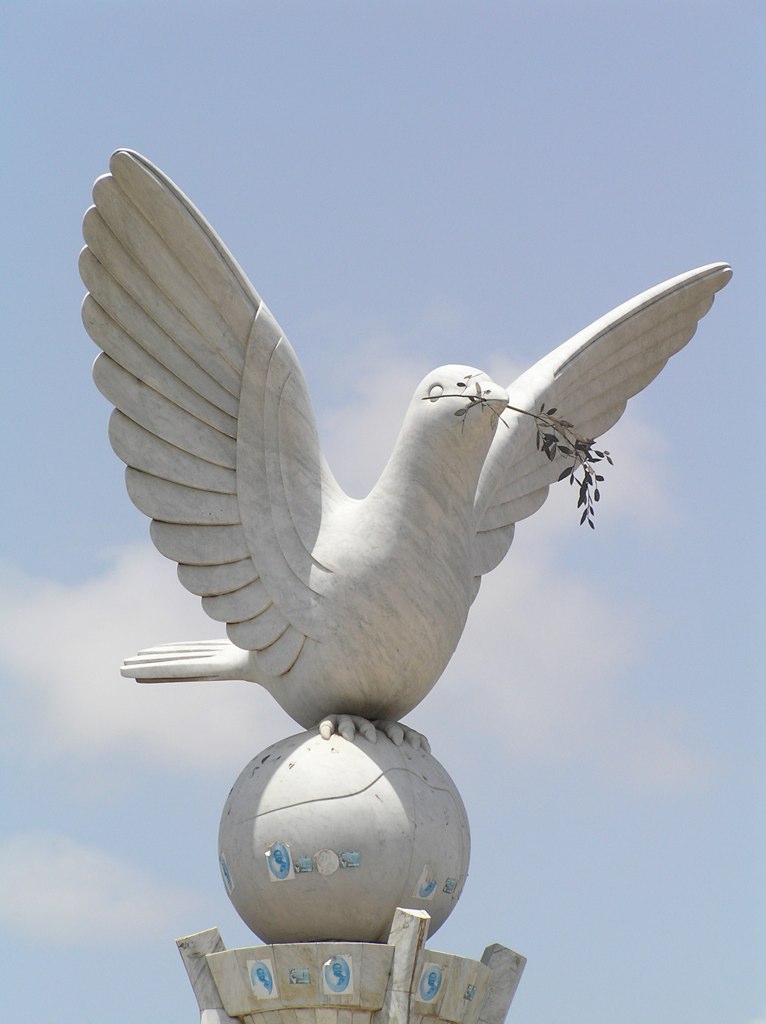
Peace dove: Wikimedia Commons CC 2.0

What does this sound like? Well, to me it sounds like what Jesus always intended his church to be. The redeemed community, the colony of God’s kingdom, is to be the place where the rich and the poor, the highly educated and the barely literate, Europeans, Africans and Asians, the neurotypical and the neurodivergent, old and young, male and female, all care for one another and promote each other’s welfare. Because that’s what Jesus does. That’s the sort of society the Messiah builds.

And imagine not only enjoying a fellowship like that (even though it entails hard and painful work at times). Imagine also inviting someone in to experience it, and being able to say, this is what life is like when Jesus is in charge.

Indeed, this is what regime change under Messiah Jesus brings.


[1] James Montgomery (1771-1854)

[2] Methodist Worship Book, p100.

[3] John Goldingay, Isaiah (New International Biblical Commentary), p84.

[4] Op. cit., pp 85, 88.

[5] p85.

Sermon: Cleopas On The Emmaus Road (People At The Cross And The Tomb)

Luke 24:13-35
This morning we have heard a Bible passage for a wedding service – the Emmaus Road.

What – not 1 Corinthians 13? No. The Anglican Rector friend of mine who preached at our wedding nearly ten years ago chose the Emmaus Road story as his text. He relied on an old tradition that Cleopas and his companion on the journey were a married couple, and proceeded to make five points about marriage from the account. I can’t tell you what those five points were, though, because we never did receive the recording of the service that we were promised.

But today we come to this famous Easter story with a more conventional agenda. What does the experience of Cleopas and his companion of the Risen Christ tell us about true faith? Here are three aspects I have noticed:

Firstly, their experience tells us about the importance of revelation. Faith in Christ is not simply about our free will decision: it requires a revelation from God to understand the truth.

If you come into my study, you will find not only my books but my CD collection. Much as I would like it to be in the main family living space, if I put the shelves of CDs in the lounge, there would probably be no room for the three-piece suite.
Among my large assortment of music you will find plenty by U2, led, of course, by Saint Bono. Their most recent album, No Line On The Horizon (not one of their best – known to some as No Tunes On The Album), there is a song called I’ll Go Crazy If I Don’t Go Crazy Tonight.

It contains this line, which is pertinent to the Emmaus Road story:

How can you stand next to the truth and not see it?

That seems to be the predicament Cleopas is in. He and his companion don’t just stand next to the truth, they walk next to the truth and just don’t see it. They are trapped in their old way of thinking that Jesus was supposed to have redeemed Israel (which I take to mean they thought he would overthrow the Romans) and that all those hopes were dashed in the conspiracy to have him executed (verses 19-21).

Now you know and I know that they were wrong. We know with hindsight and with faith that the reality was different. But what changed it for them? It comes with the response of Jesus:

He said to them, “How foolish you are, and how slow to believe all that the prophets have spoken!  Did not the Messiah have to suffer these things and then enter his glory?”  And beginning with Moses and all the Prophets, he explained to them what was said in all the Scriptures concerning himself. (Verses 25-27)

They needed a word from the Lord. They needed revelation. An encounter with the Risen Christ brings that.

And we need revelation, too. Whatever our human skills and talents, whatever decisions we are capable of making, the life of faith does not start with us. It begins with God revealing himself to us. In our context, with Christ ascended to the Father’s right hand, that means the work of the Holy Spirit.
What implications are there here for us? It reminds us that for anyone to find faith in Christ, there must be revelation from God. Christian witness cannot be reduced just to us saying the right words or doing the right things so that people will come to faith. Think of John Wesley having his ‘heart strangely warmed’. Or hear this testimony from the former pop star Yazz, famous for The Only Way Is Up:

Her life and career had fallen apart after her two or three big hit singles. What was going to heal her life? She says this:

At that point, I’d tried everything to fill this ache inside except Christianity. One evening I asked Mum for a Bible. I didn’t understand what I read, but as I laid the book down next to me I was filled with something that felt like warm peace flowing through me.[1]

So in our witness we rely on the Holy Spirit to reveal Christ and God’s love to people.

But it isn’t purely about the call to conversion. It’s about every aspect of the Christian life. Always we need the revelation of God. However much I study a Bible passage, I need the Holy Spirit. We all do.


Secondly
, Cleopas and his companion discover the importance of a Christ-centred interpretation of Scripture. If there is one thing that non-Christians perceive about Christianity and the Bible, it’s the thought that you can make it mean whatever you want, by picking the bits that suit you. So, for example, the broadcaster Jon Snow, who is the son of an Anglican clergyman, when asked in an interview, ‘Is there anything in the Bible that has particularly resonated with all you have been witness to?’, replied:

‘Yeah, I think treating your neighbour as you would have them treat you is a pretty good idea. I think that turning the other cheek is a pretty good idea. I think there’s a fair amount on conflict resolution in the Bible. But the problem with the Bible, as is well illustrated in Middle America, is that it’s very open to a pick’n’mix approach.’[2]

I’m not about to suggest that I can solve all those problems in one fell swoop, nor resolve all the differences between Christians of various persuasions both presently and throughout history, but the experience of Cleopas does show us one vital, central approach to interpreting the Bible: it all centres on Jesus. It all revolves around Jesus. He is the centre of the Bible, he is the aim of the Bible, he is the key to interpreting it because he is the ultimate focus of it. Hence Luke says,

And beginning with Moses and all the Prophets, he explained to them what was said in all the Scriptures concerning himself. (Verse 27)

Is it any wonder, then, that our High Church friends often stand for the reading from the Gospels in a communion service, and in some traditions also parade the Gospel into the middle of the congregation before the reading? They are proclaiming in a liturgical way their belief that Jesus is at the centre of the Scriptures.
What will it mean for us to interpret the Scriptures in the light of Jesus at the centre? It’s rather more than might be popularly imagined. You will remember that only a few years ago one Christian fashion accessory (how did we get ourselves in such a state?) was a bracelet with the initials ‘WWJD’ – What Would Jesus Do? That’s a good question, but even that is not enough for what I am suggesting here.

Rather than just woodenly thinking of an appropriate Bible text from the life of Jesus, we do something bigger: we ask, how does this fit in God’s great plan of things? How does something fit in God’ grand scheme of salvation in history? Most specifically, how does it read in relation to the story of God taking on human flesh, living among us, dying for our sins, being raised to new life, ascending to the Father’s right hand in glory, sending the Holy Spirit and promising to appear again? How does the Scripture we are wrestling with point to this great narrative of divine blessing?

True, there have been some fanciful Christian approaches to this over the centuries, wanting to see the minutiae of salvation in the prescribed details of Israel’s tabernacle in the wilderness, and so on. But we are less about the minutiae and more about the big picture. And front and centre of our picture as we read the Bible is Jesus, because he is alive.

Thirdly, Cleopas and his companion discover Jesus in the midst of everyday life. He comes alongside them on the road (verse 15), he accepts their offer of hospitality at their home and he eats a meal with them (verses 29-30).
Here is a text where I have changed my mind about its meaning in recent years. I remember preaching on this as a young Local Preacher and making the point that Jesus’ rôle at the meal table in Emmaus foreshadowed Holy Communion. He took the bread, blessed it, broke it and began to give it to them (verse 30). The taking, blessing, breaking and giving were the same four actions as he performed at the Last Supper. Therefore the Emmaus Road story prepares us not only for remembering Jesus at the Lord’s Table, but for recognising his presence there, too.

It’s a popular interpretation. It’s one we sing, when we use the communion hymn,

Be known to us in breaking bread,
But do not then depart (James Montgomery)

But it’s wrong. We too easily ‘churchify’ our interpretations. Those four actions – taking, blessing, breaking and giving – were the four actions that were performed at any standard Jewish meal two thousand years ago. This is a normal family meal at Emmaus.

What we celebrate here is that the Risen Christ joins us everywhere in life. We meet him as much in everyday life as in church. Indeed, much of his public ministry was not conducted in the synagogues but in homes and outdoors – rather like the meal table and the walk in this story.

I am not saying that gathering together in church and in fellowship is unimportant – this is not a variation on the ‘You don’t need to go to church to be a Christian’ nonsense. Many of the ways in which we encourage one another and strengthen each other can only be done by coming together physically.

But I am saying this: we should be open to meeting Jesus in the world, and this has huge implications. It means that our daily working life is important to him. We can do it to his glory, and we can expect to find him there, helping us. I know churches who put a segment into their Sunday services called ‘This Time Tomorrow’, where congregation members talk about what they will be doing not on Sunday morning at 11, but on Monday morning at 11. They then receive prayer – because it’s daft to think that the only people we pray for are ministers, preachers, Sunday School teachers, and doctors and nurses. Jesus is with each one of us in our daily tasks.

It means also that just as Jesus took the initiative to come alongside Cleopas and his companion to explain the Gospel to them and lead them into truth, so he is also coming alongside people to do that today. In other words, it’s a question of how we understand mission. In seeking to take the love of God to people in word and deed, in evangelism and social action, it doesn’t all depend on us. Jesus goes ahead of us and accompanies people. Our job is to join him where he has already been at work in people’s lives before we got there.

So don’t just proclaim – listen to people’s stories. You will find spiritual yearnings, religious questions and even experiences of God in their lives, because Jesus is going ahead on the road to meet them, speak to them and work in their lives in order to draw them to him. He then calls us in as his junior assistants to be the ones who are used by his Spirit to bring people to a point of saving faith in Christ.

In conclusion, then, Cleopas finds the meeting with the Risen Christ on the road to Emmaus completely transforming. It requires revelation. It leads to seeing the Scriptures in the light of Christ. And it involves expecting to meet Christ everywhere in daily life.

The experience led to a revolution in the life of Cleopas and his companion. May we too meet the Risen Christ and have our lives turned upside-down.


[1] Interviewed in Q Magazine, June 2008; quotation via Tools For Talks (subscription required).

[2] Interviewed in Third Way magazine, Winter 2004; quotation again via Tools For Talks.

Create a website or blog at WordPress.com

Up ↑