Worship In The Midst Of The World (Isaiah 6)

Isaiah 6:1-13

I expect you’re aware of the custom whereby just before the Sunday service starts, the duty steward prays for the preacher in the vestry. Over the years, I have heard a variety of such prayers, the worst being one Good Friday where in his prayer the steward called the death of Jesus a mistake.

But another common one starts something like this: “Dear Lord, we gather here today to leave the world outside behind and concentrate on you.” Now I guess that could be interpreted more than one way. But is our worship really an escape from the world?

In the year that King Uzziah died, I saw the Lord (verse 1a).

Is that just a date in Isaiah’s diary? I don’t think so. If all he wanted to tell us was the day on which he had a powerful experience of worship and commissioning, he would surely just have named the month and the day of the month. ‘On the twenty-third day of Nisan,’ or something like that.

No. Locating his divine encounter as happening ‘In the year that King Uzziah died,’ Isaiah affirms that worship takes place in the middle of what is happening in the world. The events of history do not drive our worship, for sure, but worship is located in the midst of politics, economics, and every power that competes to shape our lives.

What does this worship look like?

Firstly, glory:

In the year that King Uzziah died, I saw the Lord, high and exalted, seated on a throne; and the train of his robe filled the temple. 2 Above him were seraphim, each with six wings: with two wings they covered their faces, with two they covered their feet, and with two they were flying. 3 And they were calling to one another:

‘Holy, holy, holy is the Lord Almighty;
    the whole earth is full of his glory.’

4 At the sound of their voices the doorposts and thresholds shook and the temple was filled with smoke.

I once arrived at a church as a visiting preacher and was greeted by a member of the congregation who said, “I hope you’re going to entertain us today.” This brought out my Mister Grump side, and I replied, “Well, I hope we’re going to worship.”

We must get rid of this idea that worship is entertainment. It is a prominent heresy across all sorts of Christian traditions and worship styles. Worship is to give glory to the triune God, who is holy, holy, holy. We are here to honour his name and to give thanks for all he has done. Worship is God-centred or it is not worship at all.

Archbishop William Temple gave a famous definition of worship:

Worship is the submission of all of our nature to God. It is the quickening of the conscience by his holiness; the nourishment of mind with his truth; the purifying of imagination by his beauty; the opening of the heart to his love; the surrender of will to his purpose–all this gathered up in adoration, the most selfless emotion of which our nature is capable.[i]

None of this is an escape from the world, for God is the greatest reality there is. Moreover, as the Creator of this world and its Redeemer, God is where our focus needs to be, without having an escapist mentality.

So while it’s not true to say that ‘the world sets the agenda’ – that was one of the heresies from liberals at the World Council of Churches – it is true that we come to focus our energies on God, who created the world we live in through Christ and by the Spirit, and who also redeems the world through Christ and in the power of the Spirit.

Secondly, confession:

5 ‘Woe to me!’ I cried. ‘I am ruined! For I am a man of unclean lips, and I live among a people of unclean lips, and my eyes have seen the King, the Lord Almighty.’

6 Then one of the seraphim flew to me with a live coal in his hand, which he had taken with tongs from the altar. 7 With it he touched my mouth and said, ‘See, this has touched your lips; your guilt is taken away and your sin atoned for.’

If we truly encounter the living God in his glory in worship, then we shall realise quickly that we do not match up. That’s what Isaiah realises, and not only for himself. He admits not only his personal sin, but the sin of the nation. A true encounter with God will blow away once and for all the idea that we’re all good, decent people who merely make the occasional error in life. It will relieve us of the comfortable illusion that we are good enough for eternal life.

Furthermore, here our lives are calibrated not by the popular standards of the world but by God and his holiness alone.

Initially, this leaves Isaiah with a sense of hopelessness. He cannot get beyond ‘Woe is me! I am ruined!’ That’s desperate.

But God can get beyond it. A seraph brings a live coal from the altar, the place of sacrifice. It is God who provides for Isaiah and God’s people to know forgiveness and the removal of their sin.

If you remember the painful story in Genesis where God asks Abraham to sacrifice Isaac, you may recall how Isaac asks his father who will provide the lamb for the sacrifice. Abraham replies that God will provide the lamb. And he does – mercifully not in the way he was expecting.

Ultimately, we believe that is what God supremely did with Jesus at the Cross. The Lamb of God was provided. Now our sins are removed as we confess them. They have already been atoned for at Calvary.

The regularity of our failure is why we confess and receive assurance of forgiveness in every Sunday service. It is God’s free gift. We have not earned it. God has reached out in love to the world at the Cross. Will we look at the worldly horror of the Cross and allow it to cleanse and transform us?

Thirdly, God’s word:

Then I heard the voice of the Lord saying, ‘Whom shall I send? And who will go for us?’

Following confession and forgiveness, the way is clear for us to hear God’s word. That’s why the reading of Scripture and the preaching come next in a typical Sunday service, by the way.

There’s no reading of Scripture in the Temple for Isaiah. It’s questionable what, if anything, they had in written form at this point – not much, for sure. But in any case, God speaks directly on this occasion.

If we are to be worshippers in the midst of the world, we need to hear God’s marching instructions to us. ‘Whom shall I send? And who will go for us?’

Therefore, the reading and proclaiming of the word is to have an honoured and central place in our worship. It is not that with a variety of preachers we get to hear a whole host of different opinions, because the job of the preacher is not to foist their sentiments or even prejudices on the congregation; it is rather to proclaim what the Word of God says.

Therefore, there is another steward’s vestry prayer that both encourages me for its meaning but also humbles me by reminding me of the expectation on my task. It is when the steward prays that the congregation may hear your word through me. That is profoundly sobering!

This is not to say that a congregation should be uncritical of what the preacher says, although I do note the old joke which asks what the favourite Sunday lunch in a Christian household is. The answer is, ‘Roast preacher.’

But it is to say that we should be like the Berean Jews, whom Paul encountered on his missionary travels. In Acts 17:11 we read of them,

Now the Berean Jews were of more noble character than those in Thessalonica, for they received the message with great eagerness and examined the Scriptures every day to see if what Paul said was true.

In some old pulpits, the preacher was confronted by a small plaque. On it were the words of the Greeks who came to meet Jesus before the crucifixion, where they told the disciples, ‘Sir, we would see Jesus.’ Our prayer and aspiration for worship needs to be that we see and hear Jesus, so that we know what he is expecting of us in the world.

Fourthly and finally, response:

And I said, ‘Here am I. Send me!’ (verse 8b)

Isaiah responds to God’s word. He is willing to go into the world on behalf of his God. We learn in the subsequent verses that he can’t necessarily expect people to respond positively to what he has to say, but nevertheless someone must go, and then if there is no redemption there will be no excuse. People will not be able to say they were not warned.

How does this play out in our worship? Within the service, it comes in the intercessions, which are meant to be a response to the word. (I’m not sure they always are, but that is the theory.) If you were used to services where the sermon was the climax of the service before the final hymn and blessing, but then noticed a change, where the intercessions followed the sermon, well, this is why.

And so it’s right that in our intercessions we pray not only for ourselves and the church, but for those in power, authority, or influence. If you read the Bible carefully, you will realise that the divine commands are not limited to God’s people. You will hear prophets speaking to kings and nations and all in authority.

This is a holy task. In the early church, those who had not yet been baptised and professed faith and who were undergoing catechism classes would leave the worship before the intercessions. Why? Because intercession is a priestly task, and they were not yet part of what we later called ‘the priesthood of all believers.’ But for those of us who believe, we are acting as God’s priests when we intercede in response to the word.

But the response doesn’t stop with the end of the prayers or with the blessing at the conclusion of the service. The genuineness of our response to the word is tested by what we do when we leave. At the end of the Latin Mass, Catholics were effectively told in the liturgy, ‘The Mass is over: now go out!’

Isaiah did that. It’s our calling, too. Like him, we may or may not see success in response to our bearing God’s word to the world in word and deed. But Isaiah kept faithfully doing it in response, because to do so in the world was intrinsic to true worship. May we do the same.


[i] William Temple, Readings In St John’s Gospel, on John 4:24.

The Tyson Fury Of Prayer? Luke 18:1-8 (Ordinary 29 Year C)

Luke 18:1-8

Back in the 1970s on Radio 1 the now-disgraced DJ Dave Lee Travis used to invite frustrated wives to send in stories of DIY jobs that their husbands had failed to do or failed to complete. Should their story be read on air, Travis sent them a circular object known as a ‘Round Tuit’, for when their husbands got ‘around to it’.

Perhaps stories like that encapsulate the unhelpful stereotype of nagging women. And if you read today’s Scripture superficially you may think it is about a nagging woman, the widow who wears down the unjust judge.

But that is to ignore the very first sentence of the reading:

Then Jesus told his disciples a parable to show them that they should always pray and not give up. (Verse 1)

The theme is not ‘nagging’ but ‘Don’t give up.’ Specifically, don’t give up praying.

And if we pay attention not simply to that first sentence generally, but to the first word, we realise we need to take into account the context. The first word is ‘Then.’ Luke is telling us this is related to what has just gone before.

Now we didn’t read that, but let me point you to the way near the end of the previous chapter that Jesus is in discussion with people who are longing for his Second Coming, but who will not live to see it:

Then he said to his disciples, ‘The time is coming when you will long to see one of the days of the Son of Man, but you will not see it.’ (Luke 17:22)

As the woman in the parable longed for justice, so there are many who long for the justice of God. But we shall only see it fully when Christ appears again in glory.

So why in the parable is the widow in need? The scholar Ian Paul lists three signs of her need:

First, she has to represent herself; courts are normally the province of men, and it appears that she has no male relative who will represent her. Second, she has to return continually, which means that she does not have the financial resources to offer a bribe and have her case settled quickly (not an unusual issue in many courts around the world today). Thirdly, she appears to have been denied justice, and the implication is that she has perhaps been deprived of her rights in inheritance. It might be that she has been deprived of her living from her late husband’s estate; later rabbinic law suggests that widows did not inherit directly, but makes provision for her living from the estate for that reason.

That’s quite a list. No professional representation. A corrupt legal system. And no financial support. How extraordinary that she is not cowed by her circumstances but is feisty enough to demand justice. She takes responsibility and takes the initiative in her relentless quest for justice.[1]

As such, she is an example for us. We may not face the same set of personal challenges as her, but there are so many terrible things in our world that we long to see changed, and so caring about justice can be disheartening. But just when we feel tempted to draw the curtains, curl up in a ball, eat comfort food, and ignore the wicked world outside our door, the widow in the parable says, ‘No!’

What we have here is a character in the story whose own circumstances and actions remind us to do what Jesus said on the tin at the beginning of the parable: ‘always pray and not give up.’

Look how she speaks up boldly in the face of corruption. She is so tenacious! The unjust judge gives up because he fears that she will come and attack him (verse 5)! Yes, he, the strong male judge, fears the poor, weak widow.

In fact, the Greek word for ‘attack’ here is one taken from the realm of boxing. It means ‘to beat’. Paraphrasing it, the judge fears the widow giving him a black eye.[2]

The world sees a poor, defenceless widow. The judge sees Tyson Fury!

Perhaps we too feel weak and feeble in the face of the wickedness and suffering in our world. Certainly, our opponents love to construe us this way. But a church that is bold to keep praying even in the face of unequal relationships and insurmountable odds is not a pushover.

One of my favourite images of this reality is C S Lewis’ description of it in The Screwtape Letters. You will remember that these are fictional letters written from a senior devil, Screwtape, to a junior one, his nephew Wormwood. In one of the letters, Screwtape writes this:

One of our great allies at present is the Church itself. Do not misunderstand me. I do not mean the Church as we see her spread out through all time and space and rooted in eternity, terrible as an army with banners. That, I confess, is a spectacle which makes our boldest tempters uneasy. But fortunately it is quite invisible to these humans. All your patient sees is the half-finished, sham Gothic erection on the new building estate. When he goes inside, he sees the local grocer with rather an oily expression on his face bustling up to offer him one shiny little book containing a liturgy which neither of them understands, and one shabby little book containing corrupt texts of a number of religious lyrics, mostly bad, and in very small print. When he gets to his pew and looks round him he sees just that selection of his neighbours whom he has hitherto avoided.[3]

In our ministry of intercession we may present as a poor widow but we are in fact terrible as an army with banners. We are the Tyson Fury of all things spiritual. That’s why we ‘should always pray and not give up.’

Nevertheless, bold as we may be with our prayers God is still playing the long game and we do not always see our prayers answered. I pray regularly that God will bring to naught various wicked regimes around the world that inflict persecution on their populations. But it hasn’t happened yet. I long for regimes to fall in China, North Korea, Iran, Cuba, Mexico, Vietnam, and other nations. I watch and I pray, longing for the day.

So how in the meantime do we cope with unanswered prayer? If God is so unlike the unjust judge and promises a quick administration of justice, why have these governments not fallen yet?

I have found a response by Pete Greig, the founder of the 24/7 Prayer movement stimulating in considering this. In the midst of seeing many wonderful answers to prayer in the movement in its early days, Greig was facing caring for his wife who developed epileptic seizures. His prayers for her health went unanswered. Much of his wrestling with that painful dilemma can be found in his remarkable book God On Mute, a book I highly commend.

But he gives a shorter account in a YouTube video where he describes three reasons why we don’t always see the answers to prayer that we desire.

One reason Greig calls ‘God’s World’, in other words the laws of nature. He talks about how because God has set up a creation that works consistently according to reliable laws then miracles must by definition be rare occurrences, as C S Lewis (that man again) said. You would no longer be able to rely on those laws in good ways if every time something painful were about to happen they were suspended. Suppose, says Lewis, every time a Christian dropped a hammer that God answered the prayer for the hammer not to hit their toe. We would be walking around in a world where we could no longer rely on gravity. We would be making our way every day through lots of hammers floating in the air!

One preacher I heard described scientific laws as being descriptions of God’s habits. Miracles happen when God occasionally changes his habits. But these occasions really are occasional. Otherwise, the many good things that follow from having predicable laws of nature would fall apart.

A second reason Pete Greig gives for prayer being unanswered is ‘God’s Will.’ There are many ways in which we do know God’s will, particularly in terms of the ethical ways in which we are to live. But there are other ways where we shall not always know God’s will, and where his ways are not our ways. His ways are higher than ours. No mere human being knows the entire will of God.

Perhaps you thought it was God’s will that you married a particular person but it proved to be unrequited love. How many of us look back on things like those in our lives and are glad that life did not pan out the way we wanted? God did something better for us, but we could not have seen it, and so our initial prayers went unanswered. It may have been painful at the time, and it may be something we can only appreciate with hindsight, but sometimes God overrules or ignores our prayer requests because he has a better outcome in mind than we can anticipate.

The third reason Greig describes for not seeing answered prayer is what he calls ‘God’s War.’ There is opposition to God’s ways. There is a spiritual conflict. I am not blaming everything on demons, but I am saying that human beings actively choose to do things that are opposed to the will of God, from small acts of selfishness to large-scale acts of violence. Jesus may be reigning at the right hand of the Father, but there are still forces arrayed against his kingdom, just as we have King Charles III on the throne but there are still criminals at work in our society.

What should we do in such circumstances? Why, we should pray all the more boldly for God to overcome his enemies. It may take a long time, but it is worth the investment in prayer.

Indeed, in the face of all that we encounter in creation that is not according to God’s purposes of love, let us be bold in prayer. The weak widow is but a disguise for the heavyweight boxer. Spiritually speaking, we can punch above the widow’s weight.

And if we do, then the Son of Man will find faith on the earth (verse 8).


[1] See Joel Green, The Gospel of Luke, p640.

[2] https://www.psephizo.com/biblical-studies/does-god-respond-to-nagging-in-luke-18/

[3] Cited at https://www.thespiritlife.net/about/81-warfare/warfare-publications/1877-chapter-2-the-screwtape-letters-cs-lewis

The Lord’s Prayer: Who Is The God We Pray To? Luke 11:1-13 (Ordinary 17 Year C)

Luke 11:1-13

The late Rob Frost used to run a Christian conference after Easter every year, called Easter People. I don’t know whether any of you went to it. Some people described it as Spring Harvest for Methodists who were too scared to go to Spring Harvest. That’s a little harsh, but for some people there was some truth in that!

One year, I was asked to be a speaker at a set of seminars where a team of us was going to teach on the meaning of the Lord’s Prayer. Each of us had a section of the prayer to expound – one each morning for the week. It is so rich as a prayer that explaining and applying the entire prayer in one talk or one sermon fails to do it justice.

Indeed, when I have taught on it in churches before, I have taken a series of sermons to explore it.

But I don’t have that luxury today. So rather than go through the entire prayer at breakneck speed, I want to explore the teaching Jesus gives here immediately after the Lord’s Prayer. For it’s all very well knowing what to pray, but it helps to know who we are praying to, which is what that teaching is about. It’s no good using the right words or formula if we have a distorted picture of God.

Firstly, God is a friend. This is the theme of verses 5 to 8, where Jesus tells the story of the man who needs to disturb his friend at night for bread. And it’s no coincidence that Jesus mentions bread in this story after the petition in the prayer for ‘daily bread’ (verse 3). When we need our daily bread, God is our friend.

Jesus tells the story on the assumption that friends are bound together by honour or obligation. This wasn’t discussed much in Judaism, but the pagan philosophers of his world certainly explored this, and if we remember that Luke was a Gentile, then we see here some teaching that will make some immediate sense outside of Judaism among the new Gentile converts.

And in fact that is made all the clearer when we look at a difficult part of these verses. The latest version of the NIV translates verse 8 this way:

I tell you, even though he will not get up and give you the bread because of friendship, yet because of your shameless audacity he will surely get up and give you as much as you need.

Did you expect those words ‘your shameless audacity’? Aren’t you used to hearing ‘your persistence’, with the preacher then calling you to persistence in prayer?

The trouble is, the old ‘persistence’ translation is almost certainly wrong. An American scholar, the late Kenneth Bailey, who lived most of his life in the Middle East and who studied the ancient texts, the early translations into other Middle Eastern languages, and the local culture concluded that ‘persistence’ was wrong. It was wrong as a translation and it was wrong in the culture of hospitality in Palestine.

In fact, Bailey linked it to this concept of honour that I mentioned. The friend would not want his honour to be questioned, however grumpy he was for being woken up at midnight. That desire to maintain his honour would motivate him to answer the request for bread.

And so I go with the alternative translation that is a footnote in the NIV: not ‘because of your shameless audacity’ but ‘to preserve his good name’. God is an honourable friend, so much more honourable than the grumpy friend in Jesus’ story. He does not want the honour of his name to be called into question, because it is so important to him that his position as our friend is maintained.

So I wonder what ‘daily bread’ needs you bring to God? It may literally be daily bread, especially with the problems our world is having with supply and inflation. We now know that Jesus’ expression ‘daily bread’ was one that was in everyday use in his day, because some years ago archaeologists found an ancient shopping list which specifically mentioned daily bread.

If you are bringing your basic needs to God, know that you are bringing them to an honourable friend. And that is not just a formal expression in the way that Members of Parliament refer to MPs of the same party as ‘my Honourable Friend’, this is real and deep with our God. For the honour of his name as our friend, he will make sure our needs are met. He will not do so miserably or reluctantly, because he cares for us.

I urge you to put aside any thought that it’s unworthy to bring your basic needs to God in prayer. As your friend, he cares about the food you eat, the income you have, the energy you need for your home, the clothes you wear, and many other things, too. As Jesus reminded us in the Sermon on the Mount, he does not want us to worry about these things. Why? Because as an honourable friend, he will see to it that we have enough.

Do not view God as an ogre, says Jesus, view him as your caring friend. He is so much better than that. He is not cruel. He is caring. He is not indifferent and asleep but ready to be asked. Bring him your needs without shame.

Secondly, God is our Father.

Now in recognising God as Father, I am of course aware that there are people who have had bad experiences of a human father. That’s not something I can say. When my father died five years ago, I wrote on Facebook that a light had gone out of my life.

But what I experienced was growing up in a family where money was tight. Often I tell the story of being a small boy and overhearing my parents talking one evening about how they were going to manage all the bills, so I went into the front room where they were and offered to give up my pocket money. So I didn’t have an abusive father like some, but I had an experience of finding it hard to believe that a father could provide everything I asked for.

Things improved as I got older, but the key for me was slowly absorbing the biblical picture of God as a caring, concerned, compassionate Father, who had all the resources of creation at his disposal:

for every animal of the forest is mine,
    and the cattle on a thousand hills (Psalm 50:10).

So for those who do not have a good image of the word ‘father’ I do not take the route of dispensing with it and just using feminine language for God, I prefer over time to rehabilitate the notion of fatherhood, because its use for God is a good and nourishing one.

This is what Jesus basically says to his listeners. Paraphrasing, he says, you know that human fathers want to give what is good to their children, so how much better is your heavenly Father? Scorpions for eggs? No! In the Holy Land, scorpions are common and I read the other day of someone who camped on a beach there and found a small scorpion had crawled into his sleeping bag.[1]

But no loving father would do that to their children. And neither will our heavenly Father with us. He will only give us what is best for us.

Now ‘what is best’ is naturally not necessarily what the world considers ‘best’. It is not necessarily the best of material possessions, the highest of incomes, and the most desirable of homes.

Rather, you may have noticed that Luke’s account of these words differs in one important way from Matthew’s. Here, Jesus does not say, ‘how much more will your Father in heaven give good things to those who ask him,’ he says, ‘how much more will your Father in heaven give the Holy Spirit to those who ask him’ (verse 13).

The very best is God’s own presence with us for ever, the Holy Spirit. Can anyone beat such a gift? No!

As parents, Debbie and I will give to our children so that they may make the best of their lives, and we keep savings in order to do that. We do not give to them in order to indulge them, but so that they can have the best we can provide for them to make something worthwhile with their lives.

Well, it’s all that and much, much more with God. We can confidently ask him for the good things we need, and because not only is he an honourable friend, he is also a loving Father, he will provide for us. But he will set us up for the life of serving and loving him in his kingdom – the best life of all, even if it is costly – by the gift of his Spirit.

Would it not be the most natural thing of all, therefore, for Christians regularly to be praying for more of the Holy Spirit in their lives? It seems logical to me if we have such a loving and caring Father in heaven.

I know that we still go through hardships. I know that we still face trials. I know that we still face life situations where we do not know why certain things are happening to us. But through all that I am still convinced of God’s fatherly goodness to us. Let me tell you one final story about that goodness as I have experienced it.

Much earlier in my ministry, and a little while before I met Debbie, I was considering whether to buy a new computer for my work. I really liked the look of one particular model, and I wanted to buy it.

But I was hesitant. As you know, I like computers! And I didn’t want just to kid myself that this was God’s will to spend this large amount of money. So I prayed and left it with God.

In my main church was a woman called Mandy. One night at the church prayer meeting she had had such a powerful experience of the Holy Spirit and afterwards she discovered that she had received the spiritual gift of prophecy. Not prophecy in the sense of foretelling the future, but prophecy in the sense of being able to bring direct and relevant messages from God to people.

One Saturday morning she had gone to the church premises to pray on her own. Walking around, she came to the front of the sanctuary, near the communion table and the lectern, and in that area she felt prompted to pray for me.

While she was praying there, she heard God say to her, ‘Tell Dave he can have what he wants.’

She relayed that to me sometime in the succeeding days and I knew instantly this referred to my dilemma about the computer. My prayer was answered by a loving Father.

In conclusion, I don’t want to harangue you about the need for prayer, it’s too easy to do that. Instead, I want you to hear just how good and loving our God is. He is the friend who will maintain his honour by providing what we need. He is the Father in heaven who provides the good and the very best for his children.

Let us be confident in this God of love when we pray.


[1] https://www.psephizo.com/biblical-studies/how-can-we-pray-like-jesus-in-luke-11/

The Importance of the Ascension (Easter 7, Resurrection People 7) Hebrews 4:14-16

Hebrews 4:14-16

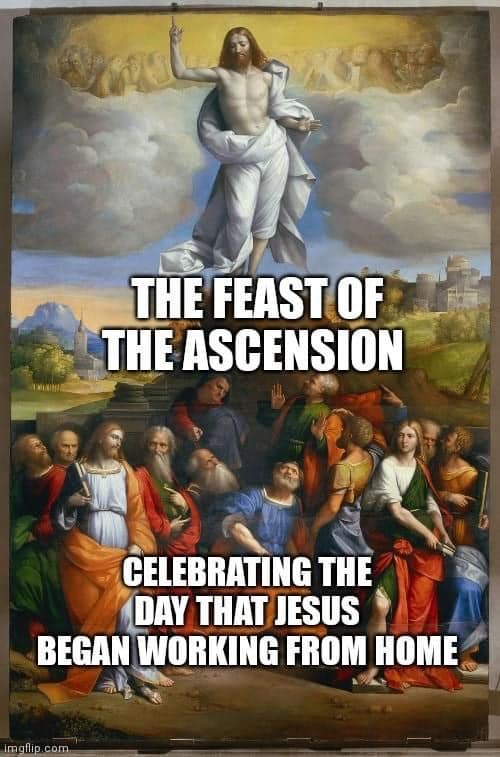
I saw this image on Facebook on Thursday, which was Ascension Day. A classic painting of Jesus ascending above the bewildered disciples has had a caption added:

The Feast of the Ascension: celebrating the day that Jesus began working from home.

I rather liked that. I wondered whether devout Catholic politician Jacob Rees-Mogg might ponder it the next time he leaves snarky notes on the office desks of civil servants who are working from home.

What do we make of the Ascension? When I try to explain the event to congregations, I usually suggest it is what John Calvin called one of God’s accommodations to us. He rose into the sky to get the message through to disciples who thought heaven was ‘up there’. Although Professor Tom Wright now says that the Jewish concept of heaven was that it was an invisible realm next door to this life and therefore the crucial part of the story is that Jesus disappears from sight.

But be that as it may, what does the Ascension mean for us? I’m going to divide that into two halves.

Firstly, it’s about the finished work of Jesus.

Hebrews 4:14 tells us that Jesus ‘has ascended into heaven.’ But what does he do there?

Two other parts of Hebrews tell us something that this section doesn’t, and they both use the same expression. In both chapter 10 and chapter 12 we read, ‘He sat down.’

It’s like he gets to heaven, he goes in the front door, finds the sofa in the living room, and takes the weight off his feet. Job done. Now he can rest.

In other words, the Ascension tells us that Jesus had completed all he was sent to Earth to do. Through his life, teaching, miracles, death, and resurrection he has achieved his goal. Salvation has been won. It is available to all. The task is being passed to the disciples and any day now the Holy Spirit will equip them for that.

Compare it if you will to the account of the crucifixion in the Gospel according to John. As he is about to die, Jesus cries out, ‘It is finished!’ (John 19:30) When he said ‘It is finished’ he didn’t mean, it’s all over, and my mission has failed, but the very opposite. For the Greek word that English Bibles translate as ‘finished’ means ‘finished’ in the sense of ‘accomplished’. Jesus is saying, ‘Mission accomplished!’ and the Ascension confirms that.

Jesus has done everything we need for salvation. The Cross is sufficient, the Resurrection proclaims it, and the Ascension ratifies it. To come into a relationship with the living God and to live as a disciple of Jesus requires only what he has done for us. At the Cross, the guilt we carry and the sentence we deserve for our sins are taken away and laid on Jesus. At the Cross, evil forces are conquered not by violence but by the suffering love of God in Christ. At the Cross we are set free.

It has all been done. Finished. Mission accomplished.

So one thing we must not do is attempt to add to what Jesus has done. Sometimes when we feel particularly guilty we think we have to do something as an act of penance to earn the favour of God. But as Martin Luther discovered when he studied the New Testament more fully than he had been taught as an Augustinian monk, the word is not ‘penance’ but ‘repentance’. And even then we do that in response to what Jesus is offering us.

Similarly, some people think they have to live a good life in order to win God’s favour. This is at heart an act of pride: ‘I did it myself’ – or even worse, in the words of the dreadful song, ‘I did it my way.’ But the fact that Jesus has done it all is meant to humble us. We cannot save ourselves. That’s the point. Everyone must come to that realisation, whether they are of high rank or low in human society, that we come in humility to Jesus and depend entirely on him for salvation.

On this day when we celebrate Jesus sitting down at the right hand of the Father, I want us all to realise afresh that our relationship with Christ is described in the words of the hymn:

Nothing in my hand I bring
Simply to thy Cross I cling.

What is faith then? It is not stretching out our hands to offer God something from our lives that we think or hope might make us acceptable to him. Instead, it is an opening out of our empty hands to be filled with all that Jesus has to give us from what he has done for us at the Cross.

John Wesley knew this. Last Tuesday was the anniversary of his conversion at Aldersgate Street, when he found that the assurance of God’s love simply came directly to him from God, not from all the labours to which he had devoted himself up until then.

Therefore, if you are ever the kind of person who says of yourself, ‘I’m trying to be a Christian,’ I want to ask you to put that language to bed from today. Either you are a Christian, or you are not. Being a Christian isn’t a boast, it isn’t a matter of personal superiority. It’s a matter of holding out those empty to hands to receive the finished work of Christ.

Secondly, the Ascension is about the unfinished work of Jesus.

Wait a minute Dave, you’ve just been at pains to say that Jesus finished his work. How can you now say his work is unfinished?

Glad you asked. And I hope this is provocative enough to keep you listening. One part of his work is finished, the work I’ve just been describing, to make salvation an offer to all.

But another part of his work is unfinished. And it’s described in our reading. Hebrews calls Jesus our ‘high priest.’ What does a priest do? A priest offers sacrifices for the people – but we’ve covered that in my first point about the finished work of Jesus in speaking about his death. Jesus our high priest offered himself as our sacrifice.

But a priest does something else for the people. A priest prays for them. This is something that Hebrews will refer to three chapters after our reading:

Therefore he is able to save completely those who come to God through him, because he always lives to intercede for them. (Hebrews 7:25)

Two circuits ago, and elderly Local Preacher prayed for me every day. But he died. My parents also prayed daily for me. But they have both died while I have been here.

However, I am not short on the most powerful prayer for me in my need, because Jesus intercedes for me. And he does the same for each of you. Be encouraged! This is his priestly work.

And furthermore, he understands, because as our reading says,

15 For we do not have a high priest who is unable to feel sympathy for our weaknesses, but we have one who has been tempted in every way, just as we are – yet he did not sin. 16 Let us then approach God’s throne of grace with confidence, so that we may receive mercy and find grace to help us in our time of need.

Don’t you find that encouraging, too? I often tell mourners at a funeral that when I am going through a bad time in my life I don’t necessarily find it helpful to have well-meaning Christians come up to me and tell me exactly what they believe about why God has allowed this. I want to lay my hands on such people – but not in the sense of healing!

The people I find most supportive when I am walking through troubles are those who have been there themselves. They understand.

One of my favourite examples of this is that about five years before I met Debbie I had a broken engagement – or, as my sister called it, a narrow escape. One day when I was grieving the break-up of my relationship, two friends called Sue and Kate turned up on the doorstep.

‘We’ve come to take you out for a pub lunch,’ they said.

I don’t remember the food from that meal. What I remember is how both Sue and Kate shared about broken engagements they had been through. They understood. They could support me.

Because Jesus has been through human weakness and faced temptation, he can do all that and more.

If you are facing sorrow or crisis right now, I encourage you to re-read the Gospels. Look for the stories where Jesus too goes through the ringer. Then recall that because he has been there too, he understands what you are facing, and can pray like no-one else to the Father for you.

This is how our ascended Lord spends much of his time. This is his unfinished work. It will continue until he appears again in glory, to judge the living and the dead, and to take us to our eternal home.

In conclusion, I’ve always been disappointed how Methodist churches treat the Ascension as a minor festival or even as a non-existent one. It is so important. It has much to teach us and encourage us.

I hope we will all leave today rejoicing in the finished work of Christ, who has sat down at the right hand of the Father, having completed everything necessary for our salvation.

And I hope we will also all leave today encouraged by the high priestly work of Christ who identifies with us and intercedes for us – his unfinished work.

May both of these great truths be strong foundations for our worship and our witness.

Sermon: Intercession

This Sunday, I get to preach in a sermon series on prayer.

1 Timothy 2:1-7

The Christian playwright Murray Watts tells a story of how in his early days in the profession he was waiting at a bus stop with his fellow playwright and actor Paul Burbridge. Fed up with waiting for a bus to come, they decided to pray for one. While they closed their eyes and prayed, a bus came … and went past. Watts says that has always been a reminder to him of Jesus’ words to ‘Watch and pray.’

So how do we pray when it comes to intercession – that is, praying for human need? Our passage gives us some answers, but some of what it says doesn’t always correspond with the way we typically pray, either on our own or in Sunday services. It may be that these verses provide a corrective to the ways we often pray.

There are three questions I think this text will help us with. They sound obvious questions with obvious answers, but I’d like us to pause and hear the answers that are actually given, rather than the ones we would give us a reflex response.

Firstly, how do we pray?

First of all, then, I urge that supplications, prayers, intercessions, and thanksgivings should be made for everyone (verse 1)

What do you make of these different words Paul uses for prayer here? ‘Supplications, prayers, intercessions and thanksgivings’ give us a range of prayer.

Supplications are usually prayers for ourselves. Some of us are reluctant to ask God for things for ourselves. Perhaps we think it’s selfish or greedy. Maybe you’re like me and when you were a child your parents didn’t have much money, so you got used to the idea that with your earthly parents you asked for little or nothing, and then you transferred that over to your relationship with your heavenly Father. In my case, it took some special experiences of answered prayer in my early to mid-twenties before I could begin to feel confident that I could ask God for big things for myself in prayer. I’m still careful and wary of my motives, especially when I want to ask for something I think I will like. Habitually I make major purchases a subject of prayer, and if it something that appeals to me – such as a new computer – part of my praying is to ask God to show me whether this is something I really need or whether I am just lusting after the latest technology. I certainly prayed before buying the iPad you have seen me using lately.

Prayers [and] intercessions probably go together. These are our requests for others. When we intercede, we are the go-between person, connecting those in need with God. It is a priestly role, representing human beings to God. However much some of our other Christian friends may call some of their ordained people ‘priests’, the New Testament sense is that all Christians are priests. We have the privilege of representing people to God, and representing God to people.

If that’s the case, then intercession is a privilege. We are invited into the throne room of God with our prayers for others. Yet if you’re anything like me on this one, sometimes the regularity and even the monotony of intercession make it dull. The sense of privilege gets worn away over time. So let’s pause for a moment and remember what a remarkable privilege it is. As the old hymn writer put it:

Large petitions with thee bring
Thou art coming to a king.

And linked with that sense of privilege, let’s note that the last word used in the ‘how’ of prayer is thanksgivings. Is this something we overlook, too? Intercession is linked with gratitude, because God answers prayer. Oh, I know we sometimes struggle to see the answer, and we often have to wait for him to do something, but answer he does and when he does it is only right to bring our thanksgivings as well as our requests.

This is something that Knaphill has tried to build into its practice of prayer. The church has a prayer chain. If someone has an urgent need of prayer, it is circulated around the people on the prayer chain and they will pray. But we also ask the person requesting prayer to let us know what God does in response to those prayers, so that we can report what happened and give thanks to God for all he has done.

Probably the only area of weekly public intercessions that includes thanksgiving is when we thank God for the departed in Christ. That’s good, but there is so much more to thank him for, when we consider all he has done for us in response to our prayers.

Secondly, who do we pray for?

for everyone, for kings and all who are in high positions (verses 1b-2a)

How many of these people are Christians? Few indeed. We are to pray ‘for everyone’ – and Christians are a minority. We are to pray ‘for kings and all who are in high positions’ – well, in the days of this letter very few Christians held high office. But we seek the same amount of blessing for those who do not know Christ, or who are yet to know Christ, as for any Christians in need. It is the job of the Christian as part of mission to bless the world. We are not simply to rail against the aspects of life that we do not like, even if there is a place for a prophetic word against sin. We are also to bless those we believe to be outside the kingdom of God. It is like the days of Jeremiah. When some of the population of Judah was carried off to pagan Babylon by Nebuchadnezzar’s army, Jeremiah wrote them a letter, in which he told them to bless the place to which they had been taken (Jeremiah 29).

So can we ask ourselves, how can we bless the world where we live? Much of that will of course be by practical action, but it needs to be done on a foundation of prayer. Are there neighbours or colleagues we are praying for? Do our friends know that if they are in trouble, we would be willing to pray for them? Think: what might happen if your friend suddenly realised that Jesus had shown up in her life?

But as well as the general everyone, let us also think about the specific kings and all who are in high positions. Now we often pray for such people in our public intercessions. We pray for the needs of the world, we pray that rulers and governments will act with justice and for the sake of peace. All of that is good and I would not wish to stop it. However, Paul has other things in mind.

Note how this is linked with the reference in the next verse to ‘God our Saviour’. Not only is it true that God is our Saviour, Paul is reminding Timothy that these kings and rulers are not saviours[1]. Some of them expected to be acknowledged as saviours: think of the claims to divinity by Roman emperors, for example. This, then, is prayer that puts things in perspective – God’s perspective. Today we have other people and forces in society who want to claim that they can ‘save’: think of the inflated promises made for consumer goods, to take one example. Intercessory prayer that remembers God is our true Saviour dethrones these idols from their pedestals.

We need to dethrone these pretenders to the throne of God in our own lives, of course, and it is also a vital task for Christians to pray that idols will come crashing down in society. In that respect, is it too irresponsible to wonder whether the financial woes of the last five years have at least in part been a bringing down of false economic gods that have wrongly laid claim to our worship? Does prayer not begin to clear the ground, spiritually speaking, for what God wants to do in truth and love in a society?

And that leads to the third and final question: why do we intercede?

Again, it probably seems like there is an obvious answer. We want things to get better. We want people to be healed. We want to see justice and peace.

Well, yes indeed to all those things! They can all be signs of God’s kingdom, and therefore such prayers are consistent with the Lord’s Prayer, where we pray for God’s kingdom to come, for his will to be done on earth as in heaven. But Paul goes further:

so that we may lead a quiet and peaceable life in all godliness and dignity. This is right and is acceptable in the sight of God our Saviour, who desires everyone to be saved and to come to the knowledge of the truth. (Verses 2b-4)

The part about leading ‘a quiet and peaceable life’ is probably there because the early Christians were a small and insignificant group of people, often not from influential strands of society. They could not hope to make a big political difference in their culture – and remember, it wasn’t a democracy as we know it, anyway. The best they could hope for was the chance to live undisturbed by persecution. Millions are the Christians today for whom that is also true. They need our prayers.

Beyond that, the ‘why; of prayer goes to another kingdom of God theme: the spread of the Gospel. ‘God our Saviour … desires everyone to be saved,’ says Paul, and he goes on in the remaining verses to talk about the key rôle of Jesus as mediator between God and humankind. Paul wants Christians to pray for those in authority so that the climate will be right in a society for the unfettered spread of the Gospel.

Now there are certainly Christian traditions that pray regularly for the Gospel to reach more people at home and abroad. The trouble is, it’s not one of our strengths. You rarely see anything like that alluded to in official liturgical intercessions, and it doesn’t always come naturally to our lips when our preachers construct extempore intercessions, either. It has slipped off our radar – which is all the more strange when you consider how concerned we become about the decline in church attendance and membership. Wouldn’t you think that one thing we would want to pray for was for more people to start following Jesus Christ and becoming part of his community, the Church? This is something we need to recover.

Certainly we need to lead by example by including this in our weekly public intercessions, and – I would suggest – in our Thursday morning prayers here. But then we also need to follow through in our own private devotions. I don’t know what you include in your private prayers at home – I hope you do pray regularly! One thing we could include is a list of people we know who do not yet know and follow Jesus. Should we not be consistently praying for such people, that the Holy Spirit will be at work in their lives to show Jesus to them?

It is said that the famous evangelist D L Moody had a long list of people he prayed for. By the time of his death, all but two of them had found Christ. I wonder whether he went to his death sorrowful about those two.

If so, he needn’t have despaired. After he died, both of them became disciples of Jesus.

Friends, the question of people becoming committed Christians is a spiritual issue. It will not be solved simply by adopting a programme or a set of techniques. It needs to be handled spiritually, and that at very minimum means prayer.

In fact, what of value does happen in the kingdom of God without prayer? Let us commit ourselves to it.

Leading Intercessions

I’m thinking of writing some guidelines for those who lead prayers of intercession in church. I have a few ideas of my own – range of themes to cover, overall length, how to signpost the prayers since most people will have their eyes closed, seeing them as representative of the congregation’s prayer life rather than exhaustive, etc. But before I get to this task I thought I would ask you, O noble blog reader, what you would include in any such document.

Suggestions are welcome below.

Depending on the appropriateness of the final content,  I may post the document here on the blog.

Remembering

Isaiah 64:1-9

Three times a year, I need to meet some people in London. I have a standing arrangement to travel with someone to that meeting. We catch a train together from Chelmsford station.

One of those meetings was due on Wednesday. I arrived at the station, and bought my ticket. My friend was not in the ticket hall ahead of me. That was unusual, but I was early. I climbed the stairs to Platform One. We nromally catch the 10:40, but I was so early that I got to the platform just before the 10:27 service. In the absence of my friend, I let it go.

But he wasn’t there for the 10:40, nor the 10:46. I kept looking down the stairwell from the platform. No sign of him.

With the 10:58 imminent, I rang Debbie to get my friend’s office number and called him there. While doing so, the 10:58 came and went. That was the last train that would get us to the regular appointment in London on time. Eventually, someone from reception found my friend, who told him that the meeting had been postponed for a fortnight. (I had not received an email telling me of this change.) Despite all my waiting, my friend was not coming. I returned to the ticket hall, explained the situation, received a refund and came home to reshape my day.

Waiting is one of the great Advent themes. We wait, wondering whether the Messiah will come. The Jewish people waited for centuries. They are still waiting.

We who believe the Messiah did come and that his name was Jesus are also still waiting. We await the appearing of the Messiah who promised to return. We have been waiting for two thousand years.

People mock us for it. In 1975, I loved the song ‘I’m not in love’ by 10cc.

I went to buy the album it was on: ‘The Original Soundtrack‘. Some of the content shocked me, not least a song called ‘The second sitting for the Last Supper’.

It contained words that deride the Christian hope: 

Two thousand years and he ain’t come yet
We kept his seat warm and the table set
The second sitting for the last supper 

Isaiah 64 speaks of waiting – waiting for the God who has not shown up. How do we live with the need to wait? Isaiah cries out to God in terms of the need to remember. What do waiting, Advent-hope people ask God to remember, as they struggle with the waiting?

Remember Your Works 
Here’s the problem: the prophet longs for God to come down in mountain-quaking, fire-making, enemy-quaking mode (verses 1-2). After all, he’s done it before (verses 3-4), so why not now? All is quiet on the God front, and that isn’t good. You’ve parted the Red Sea, sent fire from heaven when Elijah asked for it, helped your people in battle and many other things: why do you seem to be so inactive now?

And don’t Christians feel similar at times? We think back to the wonders performed by Jesus and the apostles. We remember an angel rolling away a stone for women to see that God by his Spirit had raised Jesus from the dead. We recount church history, with its highlights of revivals like the Wesleyan one, where preachers could thunder on Sunday and politicians would then resign on Monday. We see church growth in other parts of the world, but decline in the West. And like the prophet, we think, God you have done these things in the past. You are even doing them elsewhere on the planet today. So why not here and now?

This, then, is part of the tension that comes when we are in a ‘waiting’ phase. It is something that turns us to urgent prayer. We know that God has a track record. We know what he is like, because we know what he has done in the past. And we plead with him to renew his mighty works today.

The late Pope John XXIII knew this approach to prayer. He gave this famous prayer to Catholics:

“Renew your wonders in this our day, as by a new Pentecost. Grant to Your Church that, being of one mind and steadfast in prayer with Mary, the Mother of Jesus, and following the lead of blessed Peter, it may advance the reign of our Divine Saviour, the reign of truth and justice, the reign of love and peace. Amen”

Naturally, I wouldn’t go with the Mary language, nor to a lesser extent with the Peter language. But when he begins that prayer with the words, ‘Renew your wonders in this our day, as by a new Pentecost’, then I hear the kind of Advent waiting that turns into passionate intercession.

And I suggest that is one of the things to which God calls us this Advent: prayer from the heart. Prayer where we don’t just moan all the time about the state of the world – we’re too good at that as Christians – but deep, meaningful prayer, because what really matters is for God to work as he has done in the past. Not necessarily in the same way – it would be presumptuous of us to expect that – but with the same intensity.

A waiting time need not be idle time for Christians, especially not waiting-for-Jesus time. This Advent, let us remember God’s works and turn that remembrance to prayer as we wait.

Remember Your Ways 
Next, the prophet recognises that those who remember God’s ways do what is right, but when there is a sense of God’s absence, it is easier to do wrong (verses 5-7). It’s almost as if we bring the childish attitude of trying to get away something if we think no-one’s looking to the spiritual life. If we think we are waiting around for an absent God, who knows what we might do? It’s as old as Eden, where the serpent speaks when God is not walking in the garden.

Turning waiting time into idleness is a way of fertilising the ground for sin. Maybe the classic biblical example of this is King David’s adultery with Bathsheba. The text of that story tells us that it happened at the time of year when kings normally went to war. While I’m not trying to justify war in noting that detail, the thing to be aware of is that David was at home instead, idling away his time, when he saw Bathsheba bathing naked. From there came adultery, the murder of his lover’s husband and the death of the baby that was conceived.

But what about the positive side, that those who remember the ways of God ‘gladly do what is right’ (verse 5)? The way to cope with the waiting time is to remember God’s ways. What is God like? What do we know of God’s character? What are God’s traits? If we had to give a character description of God, what would we say?

I hope we might come up with a list that recalls how the ways of God are the ways of love, holiness and sovereignty, of grace, mercy and justice. And if we want a clearer picture of these ways in action, we need only reflect on the life of Jesus, who said that if we had seen him we had seen the Father.

So if just thinking about the qualities of God is too abstract, think about the life of Jesus. Then imagine how we would behave if he were physically present. I know many people didn’t behave well in his physical presence on earth, but some of that was to do with not believing his claims to be the Son of God. We might fail like the disciples did, but the gist of the issue is this: what will we do with the waiting time?

If we use it for idleness, the end result is most likely sin. If instead we meditate on the character of God, our motivation may well be different. I am not recommending we become frantic with church duties, but I am saying that remembering the ways of God will give us focus and direction for holy living as we wait for the coming of God.

And that makes Advent rather like Lent – which, historically, it has been for the Church. The Advent waiting time is a preparation time that includes penitence for our sins. It is about purification for the coming of the King. Advent preparation is less about tinsel, trees, presents and daily chocolates than about holiness. It’s what we do when we use the waiting to remember the ways of God.

Do Not Remember Our Wickedness 
So far, we’ve thought about two appeals for us to remember God, and their consequences. Remembering God’s works leads us to intercessions; remembering God’s ways motivates us to holiness.

But what if the boot were on the other foot? Do we want God to remember things about us? Isaiah 64 says, no! In fact, we want God to forget rather than remember. It would be so easy for God to remember our sin, and Isaiah is forthright about it. Yet he appeals to God on the grounds that we are his people and so God is the potter and we are the clay: God can mould us. Therefore, he pleads, may the God who can mould and remake us not remember our iniquity forever (verses 8-9).

So if Advent waiting calls forth prayer and holiness from us, it also leads us into God’s mercy. The Advent season leads us up to the extravagant sign of God’s mercy: the gift of his Son. In four weeks, we shall see mercy in a manger. Graham Kendrick imagines Mary looking down at her newborn son in his song ‘Thorns in the straw‘:

And did she see there 
In the straw by his head a thorn 
And did she smell myrrh
In the air on that starry night
And did she hear angels sing 
Not so far away 
Till at last the sun rose blood-red 
In the morning sky 

A thorn in the straw. Gold, frankincense and myrrh. Advent is leading up to these things. We are waiting for the mercy of God in Christ. For in Christ God will choose not to remember the iniquity of his people. 

And we extend that into the present and future. In a day when we wonder about the future of the church, we affirm that we shall wait prayerfully for the God of mercy. When we wonder about the future of our society and of the world, we wait prayerfully for the God of mercy.

Indeed, the two earlier responses come into play here as we long for God’s mercy in Christ for ourselves, the Church and the world. One is that – as I have just said – we wait prayerfully. We bring ourselves, the Church and the world to God in prayer as we seek mercy. We confess our sins. We even identify with the sins of others, as Christ did on the Cross and as biblical saints did to a lesser degree in prayer. Daniel, for example, identified even with the sins of earlier generations as he interceded for the people of God. Waiting for the mercy of God means praying.

But it also means holy living. We can’t wait passively for God to come with mercy. We can’t just pray and put all the responsibility onto God, as if to say, ‘It’s your fault, not ours, if the church or the world goes down the tubes.’ We anticipate the mercy of God for the world by holy living, which is not severe living but a merciful lifestyle itself. 

There are those Christians who pray and do not act. They become hyper-spiritual, substituting vivid imagination for the word of God. They become harsh towards the world.

And there are those Christians who act and do not pray. Cutting themselves off from the source of spiritual fuel, they dry up and become harsh towards the church. 

Neither of these groups reflects the merciful God for whom we wait at this Advent season. Intercession and holy living are the ways in which we wait for the God of mercy.

Create a website or blog at WordPress.com

Up ↑