Sermon: King’s Cross, Luke 23:33-43 (Last Sunday Before Advent, Feast of Christ the King, Year C)

Luke 23:33-43

Christmas Pudding Flames: Wikimedia Commons

Last Monday, our daughter went to visit my sister to continue a family tradition. Every year, they meet to make the Christmas puddings together. It’s a tradition that began when my Mum and my sister used to make them. Even when Mum was confined to a care home in the last six months of her life, my sister took the Christmas pudding mix into the care home for her to stir. After Mum died, my sister invited our daughter to continue the tradition with her. They follow an old family recipé.

Yes, today is what has historically been called ‘Stir-Up Sunday’, the stirring of the Christmas pudding mix linked to the traditional Collect prayer for today:

Stir up, O Lord,
the wills of your faithful people,
that they, bringing forth the fruit of good works,
may by you be richly rewarded;
through Jesus Christ our Lord. Amen.[1]

But in the last hundred years – in fact, this year is the centenary – the Last Sunday Before Advent has been given a new and better name: the Feast of Christ the King. An initiative of Pope Pius XI to emphasise the reign of Christ in the wake of increased atheism and secularism after World War One, I think it’s an excellent name.

Why? Because the last Sunday of the Christian Year (which begins again on Advent Sunday) should be the climax of the Christian story. Our God reigns – no contest – in the life of the age to come. It’s where we’re heading. It’s our controlling vision for life.

And so I want to reflect on Christ our King today.

Firstly, Jesus is King at the Cross:

Earlier this year, our nation was stunned when a six-figure crowd marched through London for the ‘Unite the Kingdom’ rally led by the far-right activist Stephen Yaxley-Lennon, better known as Tommy Robinson. Many people commented on the number of Christians and people with overtly Christian symbols, chanting Christian slogans, on the march. ‘Christ is King!’ they shouted. Some were dressed in mock-ups of Crusader uniforms. Alarmed at the spread of Islam, particularly in its militant form, they seemed to view a return to what they saw as the traditional religion of this nation as a way of subjugating Islam and Islamic terrorism. It was a view that seemed to want to impose Christianity by force. Is that the way Christ is King?

It’s very different from what Luke tells us. For sure, it’s what the religious authorities wanted from a Messiah. To them, Jesus couldn’t possibly the Chosen One, because here he was, nailed to a Cross, dying a shameful death as a convict:

‘He saved others; let him save himself if he is the Messiah of God, his chosen one!’ (verse 35b)

The Roman soldiers saw it similarly. They were used to enforcing the emperor’s will violently:

36 The soldiers also mocked him, coming up and offering him sour wine, 37 and saying, ‘If you are the King of the Jews, save yourself!’ 38 There was also an inscription over him, ‘This is the King of the Jews.’

And yet he was King of the Jews. And not just of the Jews. Here is the enthronement of King Jesus, not on a battlefield taking the blood of his enemies but shedding his own in the conquest of sin and of evil forces.

Had we read from Colossians 2 rather than Colossians 1 for our first reading, we might have come across these verses:

13 And when you were dead in trespasses and the uncircumcision of your flesh, God made you alive together with him, when he forgave us all our trespasses, 14 erasing the record that stood against us with its legal demands. He set this aside, nailing it to the cross. 15 He disarmed the rulers and authorities and made a public example of them, triumphing over them in it.

The Cross is an exercise in disarmament. Forgiveness takes away the power of shame that evil forces have over us. Jesus reigns, not through violence but through suffering love.

Is that something for us to remember in our Christian witness? Surely it is. When the world doesn’t like what we say, we don’t cower in silence but neither do we force it on people. Instead, we witness to Christ by a love that is willing to endure hardship and even suffer to be faithful to him.

Secondly, Jesus is King in Heaven:

Hear again some of the words of the penitent thief:

42 Then he said, ‘Jesus, remember me when you come into your kingdom.’ 43 He replied, ‘Truly I tell you, today you will be with me in Paradise.’

Jesus has the authority to welcome the penitent thief into Heaven. He reigns there, too. After his Ascension he will return there to reign at the Father’s right hand.

Right now, Jesus reigns from Heaven. He is King there. To be sure, as I have said before, not everyone acknowledges that, any more than criminals acknowledge the laws of our land passed by Parliament and enforced by the Police. That doesn’t change the sovereignty of Parliament in our nation.

The evangelistic call is to acknowledge Jesus as King. Again, as I’ve said before, ‘good news’ in the Roman Empire was the announcement of a new Emperor on the throne or of that Emperor’s armies conquering other nations. We call people to recognise who is on the throne of the universe, and to swear allegiance to him.

And it also means that if this is our message, it is one by which we are to live. Remember that earliest Christian creed: ‘Jesus is Lord.’ It is a challenge for you and for me to live under the teaching of Jesus, because he is Lord (or King).

If you’re anything like me, you will almost immediately know some areas of your life that do not currently conform to the commands of Jesus. Maybe you are battling in those things, wrestling between the will of Jesus and what you want.

But this is important for our witness. The world soon notices when we who proclaim God’s will in Jesus are not living like that. It’s why we are often called hypocrites.

Sometimes we believe the enemy’s lie that satisfaction in life is only found when we concentrate on gratifying our desires. It is as if God is some kind of cosmic spoilsport who just wants to make us miserable. Yet is it not actually the truth that real fulfilment comes from adopting the ways of Jesus, even when they are costly? Is it not a wider application of the principle that it is more blessed to give than to receive?

What are the parts of our lives where we sense Jesus is whispering to us by his Spirit and calling us to walk in his ways, acknowledging him as King? Will we finally believe the Good News that true contentment is found in the kingdom of God and not in self-centredness?

When the world sees Christians living like that, there is often a sneaking admiration for such people. Such Christians as these often earn the right to speak about Jesus, and their words carry weight.

CS Lewis wrote in his book ‘Mere Christianity’:

Human history is the long terrible story of man trying to find something other than God which will make him happy.

When we live under the reign of Jesus, we point to this better way.

Thirdly and finally, Jesus is King for eternity:

Verse 43 again:

He replied, ‘Truly I tell you, today you will be with me in Paradise.’

Paradise. What’s the significance of that word here? I’m going to quote the New Testament scholar Ian Paul:

The language of ‘paradise’ would have made sense to a non-Jewish audience, but it was also used by Jews to refer either to an intermediate state in the presence of God as well as to our final destiny in a renewed heaven and earth. It is worth noting that the Greek translation of the Old Testament (the Septuagint, LXX) constantly translated the Hebrew for ‘garden’ with ‘paradise’, so that God planted a ‘paradise’ in Eden for the first human in Gen 2.8. For anyone aware of this, Jesus’ promise to the thief is of the restoration of all things.

Jesus’ promise to the penitent thief holds not only for the immediate context when he reigns despite opposition, but right into eternity, when God has made all things new, when the redeemed live in the new creation and worship in the New Jerusalem.

For this is the climax of God’s reign in Jesus: that he will so rule over all things in goodness and love that they will be made new. Sin, suffering, and death will be no more. People will live in fully reconciled relationships with God and each other. There will be peace and justice.

This is where we’re heading as disciples of Jesus. This is our direction of travel. The destination sign on the bus says, ‘New Jerusalem.’ That’s why I said in the introduction that today is the climax of the Christian Year. For this is where the mission of Jesus is taking us.

And if that is the case, then we live accordingly now. We build our lives, relationships, and values based on what God will bring in under his benevolent rule. We don’t lord it over one another, because there is one Lord and Saviour who is over all of us. As the Colossians 1 reading today said, he is over all things and is head of the church.

Anyone who does try to lord it over others is not fit for the kingdom of God. That’s why many of our American friends have been protesting against Donald Trump at the ‘No Kings’ rallies – not merely to protect the American constitution but because Christians say Jesus is Lord, and when they see Trump not merely exercising authority but lording it over people and dismantling any accountability through Supreme Court decisions, that is contrary to the Gospel.

We may not face temptation on that level, but we can be enticed into acting as big fish in small ponds. The church is not the place to climb the greasy pole but to kneel and serve, because Jesus is Lord, and will be for all eternity.

Conclusion

Sometimes, I like to talk about the Local Preacher whom my church youth group adored. Alfred John Evill was born in 1902 and was therefore a toddler when the Welsh Revival of 1904 happened. He preached like the revival was still going on.

He didn’t pick the most modern of hymns, but he was the most challenging preacher – which we loved. But he said one important thing about the fact that his sermons were challenging.

“I never challenge you without first challenging myself.”

Today’s sermon has been challenging. It has brought me up short as I wrote it, thinking about my willingness to practise suffering love, the areas where I fall short of acknowledging Jesus as Lord, and my commitment to serve.

May God grant me – and may God grant you, too – the grace to affirm in both words and deeds that Jesus is King.


[1] Methodist Worship Book, p560

A Sermon for Remembrance Sunday: God’s Manifesto (Revelation 22:1-5)

Revelation 22:1-5

Remembrance Day Free Stock Photo – courtesy Public Domain Photos. Creative Commons Licence 1.0 Universal.

I don’t know whether congregations dread certain Sundays of the year, but I can tell you for sure that preachers do. Remembrance Sunday is one of them. Being planned on this day is the preaching equivalent of what football fans call a ‘hospital pass’: the ball is played to you, but you know an opponent will clatter into you.

For this is a day when whatever you say, there is a high likelihood someone will disagree passionately with you afterwards. You can upset the pacifists and the patriots. Once, as a young minister after I had tried to expound the Beatitudes on this day, a highly opinionated church steward dismissed my efforts by saying, “There’s only one thing to say on Remembrance Sunday, and that is that war is pointless.”

And fundamentally, today is a civic and political day rather than a Christian festival. So you can always upset people politically. You might take the opposite view to someone. Or just saying anything political will annoy those who think the church should stay out of politics.

Well, the Gospel does have political implications, because Jesus is Lord of all creation, and that includes the political sphere. So, we will have something to say about moral and ethical issues. We will have something to say about political leaders who flagrantly contradict God’s Law.

But what we will not do is come up with particular political policies. Those are rightly the realm of the politicians, political advisers, and civil servants with their different rôles to come up with.

What we preachers will do is paint the broad brush-strokes of God’s love, God’s will, and God’s good plans for creation, so that we may live accordingly.

And that, for me, is where our reading from Revelation 22 comes in. Jesus said, ‘The kingdom of God is at hand; repent and believe the Good News.’ Well, here is part of John’s vision about the fulness of God’s kingdom. These verses tell us where we are headed and the kind of society the kingdom of God will be. Therefore, they guide us in how we live today in anticipation of that time. They indicate how we are to live in the midst of a world that contains hatred and violence, pointing instead to God’s kingdom.

That’s why they form something of a manifesto for Christians on Remembrance Sunday.

Firstly, life:

1 Then the angel showed me the river of the water of life, as clear as crystal, flowing from the throne of God and of the Lamb 2a down the middle of the great street of the city.

This part of the vision is inspired by Ezekiel 47, where the prophet sees water coming out from the temple of God and coursing through the land, bringing life in its waters and on its banks wherever it flows. True life and the renewal of the world come from God.

It is not just physical life, but life in every sense, given by God who is Spirit, for in the New Testament the water of life is a way of speaking about the Holy Spirit.

If we want a world and a community where life in all its fulness comes, then we remember that is the promise of Jesus. It is one of his gifts. It can be received from him. He said, ‘I have come that they might have life, and have it more abundantly.’ The trouble with the church, as one preacher said, is that we think Jesus said, ‘I have come that they might have meetings, and have them more abundantly.’

Life in all its beauty and fulness is on offer from God. If you give your life over to Jesus and receive the Holy Spirit, then what you should expect is not to become some spiritual robot, but rather to become more fully human than you’ve ever been. You can expect all your gifts, talents, and passions to flourish like never before, because you are connected to the Source of all life, and all that is good.

It’s significant that in the Roman Empire, if a waterway flowed through the middle of a city like the river of the water of life does here in the New Jerusalem, it wouldn’t be a river. It would be an open sewer.[1] Do not look to the empires of this world for life, be those empires political systems, economic powers, or military might. Of themselves, they will only lead you to the open sewer.

Instead, the Christian God Manifesto is life: life in all its beauty and richness, available through Christ and empowered by the Spirit.

Let’s offer that. And let’s live like it’s true.

Secondly, healing:

2b On each side of the river stood the tree of life, bearing twelve crops of fruit, yielding its fruit every month. And the leaves of the tree are for the healing of the nations.

Now I know that taken literally this is a bizarre image, seemingly describing one tree that stands on both banks of a river. But remember this is a vision. Treat it a little bit like dream language.

And let me point you again to the river of the water of life in Ezekiel 47. Everywhere it goes, as I said, life flourishes in its waters and on the banks. That happens here with the tree of life that we first met in the Bible in the Garden of Eden.

Biblically, the tree of life was taken to represent God’s wisdom, in verses about wisdom such as Proverbs 3:18, which says,

She is a tree of life to those who take hold of her;
    those who hold her fast will be blessed.

But God’s wisdom, although always available, has been scorned. Now, however, as the water of life does its work in the New Jerusalem, it flourishes. In the kingdom of God, the wisdom of God prevails over the foolishness of the world.

Is it not the foolishness of the world that has so often led us to wars and conflict? But in the kingdom, God’s wisdom puts a stop to that.

For whereas in Ezekiel, the tree of life healed God’s people, now says John, the tree of life is for the healing of the nations. The Gospel offer of God’s wisdom is a universal offer. Come and find healing and peace in Jesus Christ, the Prince of Peace.

Oh, to be sure I’m not being simplistic and saying, be converted and everything will be fine. It’s not just a case of being forgiven. For in response to the healing of God’s forgiving love in Christ we need his wisdom to live differently. It needs to be lived out.

And there is our challenge. For too often the world looks at the church and does not see a community that has been healed by the wisdom of God. Rather, it sees one full of foolishness and in-fighting. They see us easily duped by politicians, from American evangelicals falling for Donald Trump to British mainstream churches, where every social pronouncement skews in a left-wing direction. They see us fighting too, tearing one another apart at times.

So to offer this second strand of the God Manifesto, we have some changing to do.

Thirdly, restoration:

3 No longer will there be any curse. The throne of God and of the Lamb will be in the city, and his servants will serve him.

No more curse? John’s vision is sending us back to the Garden of Eden again, only this time not to the beauty of the Tree of Life, but to the consequences of Adam and Eve’s sin.

For God tells them that sin leads to a curse over every part of life. The link between humans and the rest of creation is damaged. The joy of childbirth is infected with pain. The beauty of the male-female relationship is damaged by male domination. The realm of work becomes one of frustration rather than fulfilment. Life ends in the dust of death. Is this the beauty of creation? No.

But in the New Jerusalem, ‘No longer will be there be any curse.’ All that is broken is put right. Relationships are restored. The abuse of power is replaced by the spirit of serving one another. What once seemed futile is now worthwhile.

This, then, is another element of the God Manifesto: a thorough-going restoration that applies across the whole of creation from the physical world itself to human relationships. This is God’s vision. This is what we proclaim.

And therefore it is also what we as the Church are called to live out as a sign of that coming kingdom. We are here to nurture reconciled relationships. We are here to treat the earth with kindness. We are here to alleviate pain and to bring meaning to our everyday work.

Most of all, we are here to say that this all flows from a restored relationship with God, where not only are our sins forgiven, we then with gratitude shall live to serve Jesus Christ, who redeemed us. To repeat the second half of verse 3:

The throne of God and of the Lamb will be in the city, and his servants will serve him.

As with every element of this God Manifesto that proclaims a different and contrary reality to that of war and destruction, this is something the church needs both to preach and to live. If we truly believe what we say we believe, then our calling is to live it and thereby show the world by our actions that it is true.

Conclusion

There is so much more I would love to say about these verses. But here is how I want to draw this vision to a conclusion.

It’s common today when talking about what is right or wrong to say, ‘Make sure you are on the right side of history.’ It’s a dodgy saying that assumes everything in the world is becoming increasingly better from a moral point of view, even though it’s self-evident that things are getting both better and worse.

But there is a God way of being on the right side of history, and it is to embrace this vision. It is to say, here in Revelation we have the blueprint of God’s eternal destiny for all those who will say ‘yes’ to him in Christ.

If we want to be part of God’s eternal Manifesto of life, healing, and restoration, then we need to do two things. We need to ‘publish abroad’ these truths in the church and in the world. And we need to live out their truth in our lives as a witness.


[1] Ian Paul, Revelation (TNTC), p359.

Keeping The Wrong Company, Luke 15:1-10 (Ordinary 24 Year C)

Luke 15:1-10

Back in prehistoric times when I was training for the ministry, one of our tutors told us that we should be at our desks every morning at 9 am with our shoes on. I’m sure I wore out some carpet by wearing shoes rather than slippers in my first manse.

I used to follow that pattern at first. But in one appointment, I was rarely (if ever) at my desk at 9 am. For at this point, we had young children going first through pre-school and then on to primary school. These were at the top of our road, and Debbie and I made a point of building relationships with the other parents.

We didn’t always make it back by the sacred hour of 9 am, and sometimes there would be phone messages from church members who had an expectation of me being there for them at that time.

Christ and a Pharisee. Wikimedia Commons CC 1.0

I think of those church members when I read about the Pharisees and teachers of the law in today’s reading. They thought I was mixing with the wrong people, because to them I was their private chaplain, just as the religious leaders thought Jesus was mixing with the wrong sorts, and that this reflected badly on his character. Their attitude was rather like the saying that you know a person by the company they keep.

Yet it was Jesus’ vocation to be with ‘tax collectors and sinners’. He uses the two parables we heard (plus what follows – the Parable of the Prodigal Son) to lay out why this was so important.

And if it were important for Jesus, it is also important for us. If we are to renew our commitment to following him, then we need to understand why he did this, and then get on with doing it ourselves.

Now the parables have a lot in common. They both (all) speak about finding what is lost and rejoicing. Bringing, or bringing back those who are lost from the love of Jesus into that love and into his family is a high priority for Jesus.

It is not always a high priority for us. We like to run our Sunday services, have a few nice midweek activities, make sure there’s enough money in the kitty to keep the building in good order, and that’s quite enough.

But not for Jesus. Each of these parables has something important to tell us about why he spends so much time outside the synagogue with ordinary (and even disreputable) people for the sake of God’s kingdom. So let’s look at what we pick up from the Parable of the Lost Sheep and the Parable of the Lost Coin.

Firstly, the lost sheep

As you know, we were proud as anything a couple of months ago when our son graduated with a Maths degree from Cambridge. And when people asked us where he got his love of Maths from, I said that it had always been my subject at school. It was later that I developed my interest in Theology.

I have always loved numbers, even if I have not concentrated on Maths for decades now. And there is something about numbers in these parables. A hundred sheep, ten coins, and two sons. In relation to the lost sheep parable, I was reading the New Testament scholar Ian Paul this week, and he cited another scholar, Mikeal Parsons, from whom he learned this:

Counting on one’s fingers (flexio digitorum) was very commonplace in the Roman world, and was in fact seen as an indispensable skill for the educated (See Quintilian Inst 1.10.35). Up to 99, you would count on the left hand, but for three-digit numbers from 100, you would count on the right hand. In an age that preferred the right to the left, Luke’s Jesus is telling us that the whole flock is out of kilter as long as the one is missing—and the whole flock is ‘put right’ when the one returns. No wonder there is so much rejoicing!

The flock is not complete and whole while the lost sheep is missing. And we, the church, are also not whole and complete while there are lost people still to be brought into the orbit of God’s love in Christ, or former sheep to be coaxed back.

Lost Lamb by Roberto and Bianca on Flickr. CC 2.0

To put it another way, the Body of Christ is missing a limb while a lost person is still lost. We cannot stay as our own private association, just enjoying one another’s company or even saying dreadful things like, ‘As long as this church sees me out I’m happy.’ That is to take the opposite attitude to Jesus. The church was not founded by Jesus to be a religious club. It was founded to be his junior partner, working for the kingdom of God. It has an outward focus.

A few years ago, I saw a job advertised for a chaplain at an Army rehabilitation centre for soldiers who had lost limbs in military service. An admirable organisation, I am sure, helping soldiers to adapt and to get on with the fitting of prosthetic limbs.

I fear, however, that the church has spent too much time simply adjusting to living without certain limbs and to be content with the absence of many people. Certainly, much of the institutional leadership has set an agenda which is little more than the management of decline.

You may have come into the church because someone invited you to try it. I can think of someone I know who now attends church because she was invited by her elderly neighbour to try it when she was heartbroken over a relationship breakdown. The elderly neighbour said, I think Jesus might be able to help you in your sorrow.

All this requires us to have friends and relationships outside the church. And it means loving those people. It means being ready for the appropriate time to say something gentle and clear about our faith to them.

I am not asking anyone to go door-knocking. But I am asking that we look for those moments when we need to take a little bit of courage and speak about our faith to people outside the church. Jesus is missing them, and the church will be more complete when they find faith.

Secondly, the lost coin

Ever since the Covid pandemic accelerated the move in our society towards cashless ways of making payments in shops, our family has been divided in our attitudes. One of us occasionally pays by a contactless method but really regards cash as king. Another usually pays by contactless on their phone but keeps a small amount of cash. Another pays by contactless on their phone, and a fourth pays by contactless on their watch. I’ll leave you to guess who’s who!

You might think that in Jesus’ time cash was king when you hear the Parable of the Lost Coin, but actually coins were less common in their use. Kenneth Bailey, a New Testament scholar who spent most of his life in the Middle East, said this:

The peasant village is, to a large extent, self-supporting, making its own cloth and growing its own food. Cash is a rare commodity. Hence the lost coin is of far greater value in a peasant home than the day’s labour it represents monetarily.[i]

Ian Paul suggests that the woman’s ten coins in the parable are either family savings or possibly the dowry her husband gave her on marriage. Dowry coins were often worn by the wife either around the neck or on the forehead.

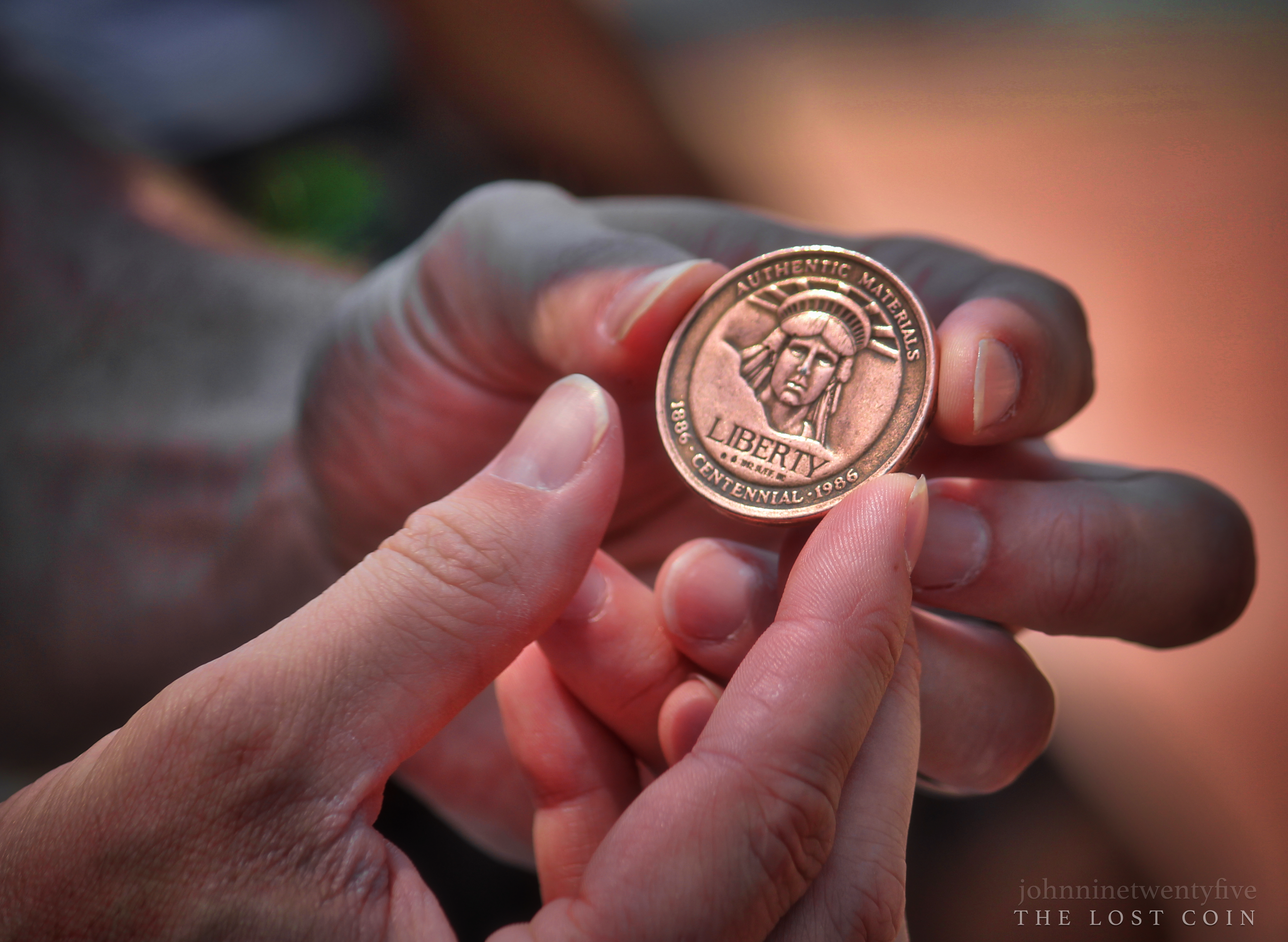
When you understand this, you realise that the loss of this coin is a catastrophe. She hasn’t mislaid a 5 pence piece. Something profoundly valuable has gone.

The Lost Coin by On Borrowed Time on Flickr. CC 2.0

What would it be like for me? It would be like me losing my wedding ring. It is not the most expensive item I own, but I do regard it as my most valuable possession, for what it represents. Earlier this week, when our elderly and grumpy cat bit my hand and I had to have a tetanus shot and strong antibiotics, I was told at the Urgent Treatment Centre that I had to remove my wedding ring in case my hand swelled up. I was careful to put the ring somewhere safe.

Those who are lost from the church and faith in Jesus are therefore to be seen as immensely valuable to Jesus. It doesn’t matter whether they are former Christians or never-been Christians, Jesus values them hugely. Sometimes we are very dismissive of judgmental of people outside the church, and of course some of them can be hostile to us, but the Jesus who tells us to love our enemies puts a high value on them. They are precious to him.

Like us, they are made in God’s image. Like us, they are loved so much by God that Jesus died for their sins. They are treasured by God.

Before he wrote worship songs, Graham Kendrick was a Christian folk singer. One of his most popular songs from that period of his life was called, ‘How Much Do You Think You Are Worth?

The first verse says this:

 Is a rich man worth more than a poor man?
A stranger worth less than a friend?
Is a baby worth more than an old man?
Your beginning worth more than your end?

It goes on to consider various ways in which we might or might not value human life highly. Then it comes to a climax with these words:

If you heard that your life had been valued
That a price had been paid on the nail
Would you ask what was traded,
How much and who paid it
Who was He and what was His name?

If you heard that His name was called Jesus
Would you say that the price was too dear?
Held to the cross not by nails but by love
It was you broke His heart, not the spear!
Would you say you are worth what it cost Him?
You say ‘no’, but the price stays the same.
If it don’t make you cry, laugh it off, pass Him by,
But just remember the day when you throw it away
That He paid what He thought you were worth.

Every single person outside the church is valuable to God. The neighbour who annoys you. The child who keeps kicking his football at your fence. The greedy businessman. The politician whose policies you hate. The sex worker. The drug dealer. All these, as well as the ones we find it easy to like! The Cross tells us how much God values them.

And – while they are missing from God’s family, not only are they incomplete, so is the church.

It’s time to expand our networks, increase our love, and let faith prompt our courage.


[i] Kenneth Bailey, Poet & Peasant and Through Peasant Eyes: A Literary Cultural Approach to the Parables in Luke, 1983, p 157

Begin With The End In Mind, Revelation 21:1-8 (Easter 5 Year C)

Revelation 21:1-8

Have you ever heard the saying, ‘Begin with the end in mind’? A novelist may have a beginning point and also know the end of the story but then has to work out how to get the characters from that beginning point to the end. We do something similar when planning a journey. Our sat-nav knows where we are, and we enter the place where we want to end up. It would be ludicrous just to set out on our travels with a vague hope that we will arrive at somewhere good. We begin with the end in mind.

But do we apply the same principle to the life of faith? I believe we should. A good, clear, healthy vision of the end of all things will guide us as we wonder how to live now.

And the book of Revelation does something like that for its readers. While I don’t believe it was written only to be decoded in our day with details that correspond to our world political situation, it does give a vision of the end that enables its readers to live faithfully now. I accept the common theory that Revelation was written for persecuted Christians, perhaps in the late first century. As they struggled to know how to live as Christians when under pressure and facing suffering, Revelation gave them a vision of the end, which enabled them to calibrate their lives right where they were.

We may not live our lives of faith in Jesus under the same level of stress that they did, but we too need to live with the end in mind. If we don’t, our lives will drift aimlessly, like heading out on that journey with no idea where we’re going.

Our passage today tells us about the end in verses 1 to 5 and then shows how we live with the end in mind in verses 6 to 8. So first of all we’re going to think about the end, and only then secondly are we going to think about how we begin.

Firstly, then, the end:

What is the end that we are to have in mind? As I said, it is described in verses 1 to 5, and to understand it I want us to think about a sandwich[1]. A sandwich has bread on the outside, top and bottom. Then just inside that, we have the butter on each slice of bread. Finally, in the middle, we have the filling.

Verses 1 to 5 are like that. The bread on the outside are the statements about things being made new. So on the top we have the new heaven and the new earth in verse 1 and on the bottom, we have God saying that he is making everything new in verse 5.

This bread of newness is buttered with the ‘No longer’ statements. The top slice is buttered with the statement at the end of verse 1 that ‘there was no longer any sea’ and the bottom slice is buttered with verse 4, where we hear

He will wipe every tear from their eyes. There will be no more death” or mourning or crying or pain, for the old order of things has passed away.

What, then, is the tasty filling? It is that God and his people will dwell together in the holy city, the New Jerusalem, as found in verses 2 to 3.

The making of all things new, eventually leading to the renewal of the entire heavens and the earth, began with the bodily resurrection of Jesus, and that’s why it’s appropriate to read this passage in the Easter season. When God raised Jesus from the dead, while he was recognisable, his resurrection body clearly had new powers, as we see from the times when he suddenly appears and disappears before the disciples. In 1 Corinthians 15 Paul tells us the resurrection body will be animated by the Holy Spirit.

We, then, are anticipating living in a new creation where everything is recognisable but has new powers and does not decay.

The butter on the bread is the ‘no longer’ statements, which show that in this new creation, suffering will be ended. Imagine you are a persecuted Christian in the first century and you hear that in the world to come ‘there will be no more death or mourning or crying or pain’ – all the things you have gone through as either you have been tortured or your friends and loved ones have suffered and even been killed at the hands of the authorities.

And add to that the mysterious – to us – vision that ‘there was no longer any sea’ in verse 1. I suspect this alludes to the fact that the sea was a place of terror for ancient people, and that also earlier in Revelation one of the evil beasts had arisen from the sea. So if there is no longer any sea it’s not that H2O has been abolished: it is that in the new creation, not only is suffering gone, but the cause of suffering is no more. Evil will no longer have its way.

So at the end we have all creation renewed. It is identifiable but now no longer subject to decay but exhibiting new power at animated by the Holy Spirit. Furthermore, suffering and all that causes it has been given its marching orders.

But it gets better. Because the filling in the sandwich, the very centre and heart is the fact that we will dwell together with God. This is what everything is leading up to: creation – including us – is remade, suffering and its causes are banished, all so that the redeemed can live with God with no handicap. Such will be the new creation that, as Augustine of Hippo, the great thinker who inspired the new Pope, put it, everything will mediate the presence of God.

That is the great vision Revelation 21 gives us. That is the end. It is the end we keep in mind when we begin to live the Christian life now.

So secondly, let’s turn to the way we begin:

For now, by the vision we can see that both creation and new creation are accomplished. As God looked on his initial creation and said it was good or it was very good, so he has looked on his new creation and said, ‘It is done.’ (verse 6)

Now, we have a choice in the way we begin our journey with the end of the new creation, drained of evil but filled with the presence of God in mind.

God offers us the free gift of the water of life if we are thirsty (verse 6). Biblically, the water of life is the gift of the Holy Spirit. Our thirst will only truly be quenched by the Spirit of God. It is the Holy Spirit who leads us on in the direction of the end. I mentioned Augustine of Hippo earlier, and one of his prayers puts it neatly:

Breathe in me, O Holy Spirit, that my thoughts may be holy.
Act in me, O Holy Spirit, that my work may be holy.
Draw my heart, O Holy Spirit, to love what is holy.[2]

The way to get on the route from wherever we are beginning to God’s great end is to open ourselves to the Holy Spirit, and to all the Spirit wants to do in our lives. Paul says in Galatians we are to ‘walk by the Spirit’, the Spirit leads us on the journey from where we are now to the destination God has for us in the new creation and in his presence. The Spirit prepares us for such an existence, purifying our motives and transforming our lives, making us more into people who will be in harmony with God’s new creation where suffering and evil are gone.

To set ourselves on this route from our starting place to the end is what will make us ‘victorious’ in the word of verse 7. In other words, we will not bow down to the evil forces of this world that seek to get us to deny our faith in Jesus and our allegiance to him. The Spirit of God is offered to us so that we may persevere in following Jesus. Or to put it another way, when my least favourite Christmas carol ‘Away in a manger’ ends with the words ‘And fit us for heaven to live with thee there,’ the way God fits us for our destiny is by the work of the Holy Spirit.

The other choice is to reject all this and say, actually, Lord, I don’t want to live in your beautiful new creation where evil has had its marching orders and we live close to you in your presence. For those who choose the lifestyles described in verse 8 – ‘the cowardly, the unbelieving, the vile, the murderers, the sexually immoral, those who practise magic arts, the idolaters and all liars’ – are by their very lifestyle saying no to God’s new creation. These are examples of practices that will be extinguished there. Hence, there is nothing harsh and vindictive about the fate of the depraved being ‘the fiery lake of burning sulphur’ (verse 8). It is ‘the second death’ and this is the natural consequence of choosing against the beautiful end God has planned, designed, and promised.

That probably isn’t most or even all of us. But the tricky challenge we face is that sometimes we want the beautiful destination God has for us but we’d like to compromise – everything in moderation as it were, even sin. We can do a bit of cowardice, not always confessing our faith. We can be unbelieving if there are parts of the faith that don’t suit us. We can make concessions to the sexual standards of society. Magic arts? Well, I certainly think of those Christians who read their horoscopes. I see idolatry in the devotion of some Christians to Donald Trump or to the acquisition of wealth.

Some of us want it both ways, but Jesus doesn’t allow us that option.

Don’t get me wrong, I know we are all far from perfect, not least me. But there is a difference between on the one hand setting our sights on the presence of God in his new creation but slipping up from time to time, and on the other hand wanting to hoover up the blessings of God while not wanting to change our lives out of gratitude for all he has done for us.

So as we approach Ascension and then Pentecost, when God pours out his Spirit through the ascended Jesus, let us examine ourselves. Are we imperfect followers of Jesus who desire the ways of God as well as the blessings of God? Or do we simply want to have our cake and eat it?

Pentecost will be an ideal time to avail ourselves of the living water, the Holy Spirit, so that we can indeed live with the end in mind.


[1] This is my version of Ian Paul’s description of the chiastic structure of verses 1 to 5 in his TNTC on Revelation, p338f.

[2] Lectio 365 morning prayer, 16h May 2025, adapted and modernised from https://www.loyolapress.com/catholic-resources/prayer/traditional-catholic-prayers/saints-prayers/holy-spirit-prayer-of-saint-augustine

The Sign of Water Into Wine, John 2:1-11 (Second Sunday in Ordinary Time)

I’m still not completely shot of the sinusitis, so this is another repeated sermon. In this case, it’s from six years ago, and hasn’t previously appeared on the blog.

John 2:1-11

I have long wanted to write a book, and perhaps the easiest to write would be the ministry equivalent of the old James Herriot ‘All Creatures Great And Small’ vet tales. Over a long course of time in the ministry, you can gather all sorts of tales, and few areas are more fruitful than what are formally called ‘rites of passage’, or more informally ‘hatch, match, and despatch’ – baptisms, weddings, and funerals.

Having had Sarah Steele’s wedding here yesterday, my mind would easily go to several stories:

  • My first ever wedding, where my nerves affected my preparation, and just as I was catching up the bride arrived early
  • The fourteen bridesmaids who arrived on a bus
  • The Catholic wedding I was asked to register, which was so calamitous in so many ways that I became convinced Father Ted was a real person
  • The wedding where my address was interrupted by a drunk guest, who was promptly told by the bridegroom, ‘Shut up, I’m listening!’
  • The Star Wars actress whose wedding I conducted last March at Weybridge. OK, she only had a minor part in the last Star Wars film, but don’t ruin a good story for me!

And more, of course, that were memorable for a host of reasons.

Maybe the wedding at Cana was the most memorable one in history, though. This is more than a miracle story. All the miracles in John’s Gospel are more than miracles. As this account concludes:

11 What Jesus did here in Cana of Galilee was the first of the signs through which he revealed his glory; and his disciples believed in him.

It’s not just a miracle, it’s a sign. A sign of Jesus and his glory. But in what ways?

Firstly, it’s a sign of resurrection:

On the third day a wedding took place at Cana in Galilee. Jesus’ mother was there, and Jesus and his disciples had also been invited to the wedding. When the wine was gone, Jesus’ mother said to him, ‘They have no more wine.’

Those opening words ‘On the third day’ should be a hint. For even though in this part of his Gospel John is apparently narrating a week in the life of Jesus, the words ‘on the third day’ have additional suggested meaning for Christians, especially since that came at the end of the narration of another week, Holy Week. If you think I’m stretching a point, then note this passage from Isaiah:

On this mountain the Lord Almighty will prepare
    a feast of rich food for all peoples,
a banquet of aged wine –
    the best of meats and the finest of wines.
On this mountain he will destroy
    the shroud that enfolds all peoples,
the sheet that covers all nations;
    he will swallow up death for ever.
(Isaiah 25:6-8a)

In the words of Professor Richard Bauckham (and yes, I’m biased, because he was my research supervisor),

Here the provision of the finest wine is linked with the abolition of death.[1]

Here in the second chapter of John is a sign of what we shall see in the second to last chapter: the resurrection of Jesus. John is hinting at what is to come. Jesus will reveal his glory in his resurrection, and his disciples will believe in him because of it. Peter and John will believe. Doubting Thomas will believe. Before any of the men believe, Mary and the women will believe.

If you want to see the glory of Jesus, see the One who in vacating his tomb conquered death. This is glory: he has defeated the last enemy for himself, and this points to the time when he will abolish death for all.

Dr Paul Beasley-Murray, a retired Baptist minister friend of mine, wrote an article the other day in which he reflected on four books he had recently read about death and dying. He included some quotes from some of the books, which happen to illustrate how the glory of resurrection hope transforms the way Christians look at death. All the people I am about to quote are themselves Christians (including the vicar!).  

From John Wyatt, Emeritus Professor of Neonatal Paediatrics at University College London:

If our hope is in the power of medical technology to overcome every obstacle, we are doomed to ultimate disappointment. What is worse, this kind of hope may stand in the way of godly acceptance of God’s will for the last phase of our life, impeding the possibility of strengthening or ‘completing’ our relationships in a healthy and faithful way.

From retired Anglican vicar Martin Down:

I know of no real remedy for fear of any sort other than faith… It is God alone who can both say to us ‘Fear not’ and give us good reason not to fear.

And finally from retired oncologist Elaine Sugden:

Rather than think about loss of hope, think instead of purpose and opportunity.

Because of the resurrection, we are people of hope. And that brings glory to Jesus.

Secondly, this story is a sign of intimacy between Jesus and his people:

When the wine was gone, Jesus’ mother said to him, ‘They have no more wine.’

‘Woman, why do you involve me?’ Jesus replied. ‘My hour has not yet come.’

His mother said to the servants, ‘Do whatever he tells you.’

Now at first this exchange might just sound like an almost amusing account of a mother – and a Jewish mother at that – who knows how to get her son to do what she wants him to do. (Although did Mary know Jesus would turn water into wine? I don’t think so. I’m sure she was surprised, too.)

But it’s much more than that. Who was responsible for supplying the wine at a Jewish wedding two thousand years ago? The answer is, the bridegroom. So by giving Jesus the problem that the wine has run out, Mary gives Jesus the rôle of the bridegroom. That is probably why he replies, ‘My hour has not yet come.’ His own great wedding feast – the wedding feast of the Lamb and his bride, the Church – has not yet taken place. It is to happen at the end of all things as we currently know them.

What we have here, then, is another part of the great image that runs through Scripture in which God’s love for his people is depicted in marital terms. In the Old Testament God woos his people with love, but she is unfaithful, and divorce language is used. But Jesus, the Bridegroom Messiah, washes his bride clean with his blood at the Cross, and will marry her to be with her for ever in the new heavens and new earth.

It’s not surprising, then, that in the rest of his Gospel John records Jesus using the intimate language of mutual abiding to describe the relationship between him and the believer. Jesus abides in the believer, and the believer abides in him. Jesus goes so far as to say this is what his own relationship with the Father is like[2].

The glory of Jesus here, then, is in the closeness of the relationship that he wants to have with his disciples. It’s a great deal more than celestial chumminess. Rather, having come and lived among people in the Incarnation, as John describes in his first chapter, Jesus wants not only to live among us but to share life with us: the joy and the mess, the simple and the profound.

The glory of Jesus is this: however majestic the Second Person of the Trinity is, he wants to share life in relationship with his church and with each of his disciples. Is it not remarkable – no, astonishing – and wonderful that this is what he wants for you and for me and for us?

Do not be afraid, but by all means be amazed. Be thrilled and be grateful!

Thirdly, this story shows the glory of Jesus in his abundance:

Nearby stood six stone water jars, the kind used by the Jews for ceremonial washing, each holding from eighty to a hundred and twenty litres.

Jesus said to the servants, ‘Fill the jars with water’; so they filled them to the brim.

Then he told them, ‘Now draw some out and take it to the master of the banquet.’

Stone jars were not subject to the Jewish purity laws. Unlike clay jars, they could not become impure and therefore have to be smashed. A priestly family, or at any rate a household concerned with ritual purity, would use them as working jars. They were also large, and expensive to make, because they had to be carved out of one large stone. But in the long run they were cheaper, because they could be reused, unlike clay jars. That meant that probably only the better-off families could afford them.

But the main thing here for our immediate purpose is that they were large. Connect this with these observations about wine (bearing in mind how much wine was made in the miracle) by a theologian called Andrew Wilson:

In the scriptural imagination, however, and particularly in the prophetic tradition, wine represents abundance, shalom, hope and new creation. It embodies blessing: “May God give you of the dew of heaven and of the fatness of the earth and plenty of grain and wine” (Genesis 27:28, ESV); and happiness: “wine to gladden the heart of man, oil to make his face shine, and bread to strengthen man’s heart” (Psalm 104:15). It speaks of love: “we will extol your love more than wine” (Song of Songs 1:4); and bounty: “then your barns will be filled with plenty, and your vats will be bursting with wine” (Proverbs 3:10).

Jesus makes so much wine in the six large stone jars. And he doesn’t make supermarket plonk, he makes fine wine:

‘Everyone brings out the choice wine first and then the cheaper wine after the guests have had too much to drink; but you have saved the best till now.’ (Verse 10)

Undoubtedly, we have a picture of the glory Jesus will reveal at the end of all time, in the new creation, when blessing and abundance will flow to his people and all will have plenty and be satisfied. This isn’t the so-called ‘prosperity gospel’, where if you truly have faith you will be healthy and wealthy now, but a promise of the End that Jesus will sometimes show glimpses of now when he blesses us in this life. And when he does bless us in this life, we respond with thanksgiving rather than hoarding, and with offering what he has blessed us with for the good of others.

We look forward, then, to the glory of Jesus when he puts all things right in creation, makes everything new, and blesses abundantly, not grudgingly.

But we also respond now, so when we witness those whose lives are not characterised by abundant living, we know as Christians we must pray, speak out, act, and give. It may be poverty. It may be famine. It may be injustice. It may be disease. Our call is to witness to the coming abundance of blessing, and to show that the present way of things is not the will of God.

All of which draws us to the conclusion where we note what the passage says about our response and how that may enable the glory of Jesus to be seen.

There are a couple of threads about response in the passage. One is about obedience to Jesus:

His mother said to the servants, ‘Do whatever he tells you.’

Nearby stood six stone water jars, the kind used by the Jews for ceremonial washing, each holding from eighty to a hundred and twenty litres.

Jesus said to the servants, ‘Fill the jars with water’; so they filled them to the brim.

The co-operation of the servants in obedience to his command enables Jesus to show his glory.

The other is about faith, and it’s back to where we began:

11 What Jesus did here in Cana of Galilee was the first of the signs through which he revealed his glory; and his disciples believed in him.

Put these two threads together and you have ‘Trust and obey’. If I’d known exactly where my studies of the passage were going to lead me this week when I picked the hymns, then ‘Trust and obey’ would almost certainly have been the next hymn. But it isn’t, because I didn’t realise that at the time.

However, ‘trust and obey’ are the ways we respond to the glory of Jesus and co-operate with his ways so that others may see his glory. When we encounter the glory of Jesus, as the disciples did at Cana, then the right response is to believe in him.

And when we do believe in him, the appropriate way of showing that is to obey him, so that others too may see his glory in the promise of resurrection, a relationship of intimacy, and and the gift of abundance.

Indeed – let us trust and obey.


[1] Richard Bauckham, Gospel Of Glory, p182.

[2] Ibid., pp9-13.

What Is The Ascended Jesus Doing Now? Acts 1:1-11, Hebrews 1:1-4 (Easter 7, Sunday After Ascension)

Acts 1:1-11 and Hebrews 1:1-4

When George Carey was Bishop of Bath and Wells, he was once asked to perform the reopening of the Post Office in Wells. However, they didn’t tell him all the arrangements.

He turned up, and it was Ascension Day. There he found a hot air balloon, and the plan was for him to ascend in it while the assembled throng sang the hymn, ‘Nearer, my God, to thee.’

Whether the ancient Jews believed that heaven was spatially directly above us is disputed. Some scholars believe their understanding was more akin to heaven being like a parallel dimension to our existence but usually invisible to us. Put like that, it sounds a bit like science fiction, doesn’t it?

But the key aspect in the description of the Ascension that we have in Acts chapter 1 is not simply the being taken up (which is quite a vague expression) but also that ‘a cloud hid him from their sight’ (verse 9). Yes, the ‘taking up’ is reminiscent of Enoch and Elijah going directly to heaven in the Old Testament, but the cloud also has Old Testament connotations, for clouds were sometimes a sign of God’s direct presence. Think of the Exodus, where the Israelites were led by a pillar of cloud by day and a pillar of fire by night.

So the Ascension tells us that Jesus has left this existence and is now in the direct presence of God in heaven.

But what is he doing now? I want to take you around a few New Testament references today to answer that question.

Firstly, he is resting:

After he had provided purification for sins, he sat down at the right hand of the Majesty in heaven. (Hebrews 1:3b)

He sat down. That sense of satisfaction when a job is finished. You’ve probably done that after completing something at home. Put the kettle on, make a brew, and put your feet up. He sat down. Even Jesus.

And so he should, because his mission on earth was complete. John’s Gospel records that just before he died on the Cross, he cried out, ‘It is finished!’ (John 19:30). And ‘finished’ here doesn’t mean, it’s over, I’ve failed, that’s it, it means quite the opposite. It means, ‘It is accomplished.’ Jesus has completed everything his Father sent him to do. His suffering and death opened the way to God’s presence. He was vindicated in the Resurrection. It’s done. Big tick!

When we celebrate the Ascension, we rejoice that Jesus has done everything necessary to bring us into fellowship with the God Who Is Trinity. There is nothing we can do or need to do to add to it, for we do not earn our salvation. Jesus has done it all, and now offers it as a gift, which we receive with the empty hands of faith.

I once had a couple start worshipping at a church I served, and they asked about becoming church members. I visited them, and they wanted to know if they were good enough to be accepted as members. I wish I’d picked up on that language at the time, because they turned out to be very judgmental people – especially the husband. If you’re forever trying to earn your salvation, you either become hugely self-critical, because you can never live up to your own standards, or you become hugely critical of others, always taking them to pieces.

And indeed, to try to earn salvation is effectively to say to Jesus, you didn’t need to die on the Cross. Which one of us dares to look Jesus in the eye and say that? But it’s what we do when we try to earn our own passage to heaven.

Instead, rejoice that Jesus has sat down. He has done it all. Receive his wonderful gift!

Secondly, he is sending:

‘For John baptised with water, but in a few days you will be baptised with the Holy Spirit.’ (Verse 5)

In a few days the Father would send the Holy Spirit through Jesus upon the disciples. Now of course we’ll think about that next week at Pentecost, so at this point I want to focus on the words ‘in a few days.’

Yes, it’s true that we no longer have to wait for the gift of the Holy Spirit. When we turn our lives over to Jesus Christ, the Spirit comes into our life. Indeed, even to get to that point the Spirit has already been prompting us. But again, that’s for next week.

What about those occasions when Jesus promises something good but it’s a long time coming? We’re not used to that in an instant society. We like fast broadband, Amazon Prime with next-day delivery, twenty-four hour news channels where political spokespeople are expected to react immediately to the latest gossip rather than take the time to be considered and reflective.

Is there something to be said for Jesus to temper his sending with waiting? Could it be that our demand to have everything now has made us immature, like overgrown children, saying, in the words of the Queen song, ‘I want it all, I want it all, and I want it now’?

Jesus does indeed send us good things, but he may well make us wait. For in the waiting for what he sends he has work to do in us, forming us and shaping us into more mature disciples.

Even the psychologists agree that the ability to delay gratification is a sign of maturity. But Jesus knew that long before the rise of psychology!

Is there something we have been praying about for a long time? To the best of our knowledge, does it sound like something the Jesus of the Gospels would approve of? If it is, then I encourage us to keep praying, even if we have been disheartened. Let him use the time before it is fulfilled to prepare us and shape us.

As someone who had to wait longer than most to find a wife, I speak from experience. But she was worth waiting for. And what Jesus sends to you will also be worth waiting for.

Thirdly, he is praying:

Later in the Epistle to the Hebrews we read these words:

Therefore he is able to save completely those who come to God through him, because he always lives to intercede for them. (Hebrews 7:25)

Over time, I have known a few people who promised to pray for me daily. Most of them are now dead. They included my parents, and a wonderful elderly Local Preacher. I only know of one person who prays for me daily now.

Actually, there’s a second. I know that the ascended Jesus is praying for me. He ‘ever lives to intercede for [us].’ You can’t do better than that! Jesus is praying for his people!

Someone I know once had a conversation with some Catholic friends and asked them why they prayed to Mary. They replied, ‘Because she’s human, so she understands.’

This seemed rather sad to my friend, who realised that her Catholic friends were so fixated on the divinity of Jesus that they had forgotten his humanity.

Her response to them was, ‘Why go to the mother when you can go straight to the boss?’

We can go straight to the boss. He is already praying for us.

Have we ever thought of asking Jesus to pray for us? Because his answer is ‘yes.’

What about those times when we really don’t know what to ask for in prayer? Could we pray, ‘Jesus, I have this issue, and I don’t know the right way to pray about it. I’d love you to guide me in the right way to pray and the right things to ask, but would you also pray to the Father about it for me, please?’ It seems to me that this would be a perfectly biblical approach to take and is far better than simply stating our request and just tacking on the end the words ‘If it be your will.’

Fourthly and finally, he is reigning:

‘He sat down’ not only hints at Jesus resting after completing his earthly work, it is also an act of authority. A Jewish rabbi sat down in the synagogue to teach – as Jesus himself did in the Nazareth synagogue in Luke 4. A king or an emperor would sit down on a throne. And Jesus here sits down ‘at the right hand of the Majesty in heaven’ (Hebrews 1:3).

But how do we understand him to be reigning when so much continues to be wrong with his creation? Allow me to answer that by talking about The Lord Of The Rings.

If you saw all three three-hour movies, you may remember that the final film comes to a climax with victory at the battle of Minas Tirith, and the ring that caused all the trouble being cast into the fires of Mount Doom. After that, most of the heroes board a boat to The Undying Lands, whereas Samwise goes back to the peace of The Shire. It’s just as we would want it.

But that’s not how the original trilogy of books end. There, after the battle is won at Minas Tirith and the ring is destroyed in the fires of Mount Doom, we come to a penultimate chapter, entitled ‘The Scouring of the Shire.’ In it,

the Hobbits come back to the Shire to find it under the thumb of Saruman and Wormtongue. It’s an Orwellian nightmare of jobsworths, ruffians and snitchers. Frodo, Sam, Merry and Pippin join forces with Tom Cotton and his family to throw off the Orwellian oppressors and collaborators and MtSGA (Make the Shire Great Again).[1]

The decisive victories have been won, but there are still skirmishes to be had with evil. Can you tell what I’m about to say?

For Christians, the decisive victories have been won at the Cross and the Resurrection. Christ is now reigning at the Father’s right hand. But we still have battles with evil, because not all will bow the knee to Christ in this life, even though the Father has elevated him above all earthly authorities. J R R Tolkien, a devout Catholic, knew this when he wrote The Lord Of The Rings.

Just as in the United Kingdom we have a constitutional monarch on the throne and an elected government in office yet not everyone obeys the laws of the land, so the ascended Christ is on the throne of the universe but not everyone obeys him.

The day will come when everyone will see him and all will bow the knee to him, whether willingly or otherwise. In the meantime, this truth gives us tasks to do. One is to proclaim the good news that Jesus is on the throne of the universe and call people to give their allegiance to him. The other is to demonstrate that truth as we build for God’s kingdom.

In conclusion, I hope you can see how rich and important the doctrine of the Ascension is. Although only Luke mentions the actual event, so much of the New Testament refers to it and builds on it. One scholar even called it ‘The most important event in the New Testament’[2].

But most of all, I hope we can appreciate together what Good News the Ascension is. Jesus who rests, sends, prays, and reigns is in all these things rooting for us.


[1] James Cary, The Forgotten Feast: The Ascension and The Scouring of the Shire

[2] Ian Paul, Why is the Ascension of Jesus the most important event in the New Testament?

Jesus The True Vine, John 15:1-8 (Easter 5 2024)

John 15:1-8

“Did you see that?”

“Well, no, darling, I’m driving.”

That’s a common conversation when my wife and I are in the car. I won’t tell you who typically says which in that exchange!

“Did you see that?” We had it again the other evening when walking the dog. One of us could see the full moon, but the other was standing a few yards away and couldn’t see it, thanks to some houses.

Did you see that? You know the experience, I’m sure.

I think there’s a ‘Did you see that?’ moment at the beginning of our reading when Jesus says, ‘I am the true vine’ (verse 1).

At the end of the previous chapter, Jesus says, ‘Come, now; let us leave’ (John 14:31b). The implication is that they leave the room where they have had what we call the Last Supper and are now on their way to Gethsemane.

On the way, it’s likely that they would have passed the Jerusalem Temple. And when Jesus says, ‘I am the true vine’, it’s a ‘Did you see that?’ moment, because there was a

massive golden vine that adorned the entrance to the temple.

There is a description of it in the writings of the Jewish historian Josephus:

The gate opening into the building was, as I said, completely overlaid with gold, as was the whole wall around it. It had, moreover, above it the golden vines, from which depended grape-clusters as tall as a man[1]

Did you see that golden vine? The disciples knew that in the Scriptures the vine or the vineyard symbolised Israel, and that’s why there was a golden vine at the entrance to the Temple. But now Jesus says that he is the true vine.

In other words, Jesus fulfils all that Israel was meant to be. And if you want to be part of the People of God, you need to be connected to him.

And further, if we don’t want the vine we are part of to be condemned like Israel the vineyard was in passages such as Isaiah chapter 5, then there are certain ways in which we need to let Jesus’ Father, the gardener, work in us. And there are certain ways in which we need to respond to his work.

Firstly, pruning:

He cuts off every branch in me that bears no fruit, while every branch that does bear fruit he prunes so that it will be even more fruitful.

When we read this metaphor about God pruning us, we naturally think of the ways in which God needs to remove sin from our lives. I wouldn’t dispute that, but we hear a lot about that quite regularly and so I’m not going to concentrate on that today. Instead, I want us to think about other ways God works to prune us.

One is when he takes us through adversity. For me, that has been when God has used experiences of ill-health for good. One occasion came when I had a collapsed lung at college and had to face major surgery. On the weekend when it happened, one of my friends was being visited by his father, who had a healing ministry. But when I got back from A and E, Mark’s Dad Reg had gone home.

Eleven days in hospital, a month convalescing, and three months to return to full fitness were not much fun in my twenties. But when I ended up in the ministry, my experience was invaluable when getting alongside others facing major hospital treatment. I guess God had to prune the ‘quick fix spirituality’ out of me.

Similarly, I have not been shy in saying that I come from a family where there is a history of depression. However, it is only in the last twelve months that I have gone public on the fact that I too am diagnosed as someone who lives with the condition. I was very wary about saying that publicly, because I know there are callous people in the church who would say that makes me unfit to be a minister.

But the way it has given hope to others who find the black cloud over their lives means I am glad I let people know. It may be my thorn in the flesh, I wish I didn’t have it, and I’m sure my family also thinks that, but God pruned from me the shallow thinking that unless you are perpetually joyful you are not a good Christian, and this has helped others.

I believe God often prunes good things from our lives for the greater good, just as a good vinedresser will prune good grapes so that others can grow even bigger. God even does that in churches. I know congregations that many years previously began a programme that worked as an outreach. However, these meetings were still going on, even though they now only connected with existing churchgoers. These meetings needed to be pruned. The only question was whether the church would go along with it.

Secondly, remaining:

Remain in me, as I also remain in you. No branch can bear fruit by itself; it must remain in the vine. Neither can you bear fruit unless you remain in me.

If pruning is something that God does, then remaining is something that we do in response. We remain in Christ. We remain vitally connected to Jesus.

One paraphrase of ‘Remain in me, as I also remain in you’ is to say that we make our home in Jesus, just as Jesus makes his home in us. We know that Jesus has come to make his home in our lives when we put our faith in him and our lives in his hands. But there is also a question of us making our home in him. What is that about?

It is going to involve us becoming more in harmony with him. God’s work of pruning us to make us cleaner and more useful in his service is part of it, but it also means that we need to pay particular attention to the teaching of Jesus and his apostles in the New Testament. The church recognised the books that comprise the New Testament as those which faithfully convey the teaching of Jesus, his apostles, and his apostolic circle.

Do you have a programme for reading your Bible regularly, preferably daily? Please don’t be like one woman I knew in a previous church who told me that her sole exposure to the Bible was when she heard it read in church and she didn’t bother with it at home in between Sundays. We need that regular engagement in order to connect with the teaching of Jesus.

And that teaching of Jesus needs putting into practice. That’s where it’s important to involve others. Meet regularly with one or more people and hold each other accountable – kindly, of course! If our small groups really did ape some of John Wesley’s small groups, then this would be part of the meeting every week. We would each talk about how our Christian life was going, what reasons we had for joy where it was going well, and where we were struggling and needed support.

Others do it by having a prayer partner or being part of a prayer triplet. Still others have what they call an ‘accountability partner.’ In one previous appointment I used to meet regularly with the local vicar. We would each talk about how our lives and ministries were going, we would offer reflections to each other, and we would finish by praying for one another.

Please don’t dismiss this as just intense stuff for the hyper-spiritual. We are called disciples of Jesus, which means that we are learners of him or apprentices to him. We need to take this seriously in order to remain in him, to make our home in him.

For this is what puts us in tune with God. If we want the blessing at the end of verse 7, where Jesus says,

ask whatever you wish, and it will be done for you

then we need to realise that this only happens after the first half of that verse, where he tells us we need to remain in him and his words remain in us.

So please, let’s take very seriously the importance of remaining in Jesus, making our home in him, by giving attention to his teaching and putting it into practice.

Thirdly and finally, fruit-bearing:

Jesus tells us in these verses that we bear fruit for him as a consequence of pruning and remaining. But what is that fruit-bearing? I want to suggest three examples.

Firstly, it’s about how we conduct ourselves socially in the world. Do we do so with righteousness and justice? In Isaiah 5, to which I referred at the beginning, where Israel is a vineyard gone wrong, the prophet says of God,

And he looked for justice, but saw bloodshed;
    for righteousness, but heard cries of distress. (Isaiah 5:7)

How do people outside the church perceive us? Are we known both individually and as a body to be people who not only stand up for what is right in what we say, but also in what we do? Are we the people in the town who are on the side of the poor, both in our pronouncements and in our actions? Do we treat people well? If we allow God to prune us and if we remain in Jesus and his teaching, then this should be a natural consequence.

Secondly, there is the fruit of our character. You may not be surprised that here I am going to link with what Paul says in Galatians 5 about the fruit of the Spirit. If we are in a vital relationship with God, allowing his indwelling Spirit to shape our lives, then we display love, joy, peace, patience, kindness, goodness, gentleness, faithfulness, and self-control.

And remember that it’s the fruit of the Spirit, not the fruits of the Spirit. It is not nine different fruits but one fruit with nine flavours. All of these things are meant to grow in our character as we are pruned and as we remain in Christ, with his Spirit at work in us.

Then finally, the most natural meaning of fruit-bearing is that of bearing seed to produce more fruit. We will have the desire for spiritual reproduction, for seeking to bring more people into that same close relationship with Jesus. It would be good if lives filled with both justice and holy character (the fruit of the Spirit) provoke questions among the people with whom we live and work. We also need to be ready to speak about our faith when the time is right.

Conclusion

Did you see that? Well, if you want to see physical vines and these principles in real life, Hampshire is a good place to be. A quick Internet search led me to a list of six in the county on the Visit Hampshire website.

But do we also see the spiritual application Jesus makes for us? He embodies the true People of God, and to be part of that people ourselves requires our submission to God’s pruning and our making our home in Jesus. What follows from such a relationship is fruitfulness in the form of just living, holy character, and the spreading of the Gospel.

Is that what we look like?


[1] Ian Paul, Jesus is the true vine in John 15

Why Does The Risen Jesus Appear To The Disciples? Luke 24:36-49 (Easter 3 Year B 2024)

Luke 24:36-49

It’s a thrill for parents when their child starts speaking. It’s less of a thrill when that child learns the word ‘Why.’ Every question becomes, ‘Why?’

As a child, I was certainly fond of asking ‘Why?’ Not only the dreaded ‘Why do I have to do this thing you are telling me to do?’ but also ‘Why’ in terms of wanting explanations for the way things worked in the world. I know I was persistent on that last kind of question, because my parents bought me a subscription to a children’s magazine called ‘Tell Me Why.’ You can still find old copies on eBay. It comes under eBay’s category of ‘Antiquarian Collectibles’, such is my age now.

As I read the familiar resurrection story from Luke, I realised that one of the questions I wanted to ask of this passage was ‘Why?’ Why did Jesus appear on this occasion to the disciples? What was this resurrection appearance about?

Going over the text, I came up with three answers to that question: why did the risen Jesus appear to the disciples on this occasion? I realised too that the reasons why Jesus appeared to the disciples here are also reasons that are relevant to us.

Firstly, the Risen Jesus brings peace:

36 While they were still talking about this, Jesus himself stood among them and said to them, ‘Peace be with you.’

These last couple of weeks I could have done with a dose of ‘Peace be with you’ from Jesus. Straight after Holy Week to Easter Day in which I preached or spoke eight times in eight days, I walked into a legal crisis over the text of my book, which I have had to remove from sale.

Then I had serious warning messages flash up on my car dashboard. An investigation by the dealer found that it needs repairs costing over £2000. The fault is something that the manufacturer should have put on the list for last year’s annual service but failed to do so. They are now trying to wriggle out of responsibility on a technicality.

Yes, I could have done with some peace from Jesus.

The one bright part was that I had to submit some blood pressure readings this week to the pharmacist at the doctors’ surgery, and he described my results as ‘gold standard’, so Debbie said that in fact I clearly haven’t had enough stress!

Now on the one hand ‘Peace be with you’ is a fairly standard Jewish greeting. When I flew to and from the Holy Land on El Al Airlines in 1989, every message over the plane’s PA from the pilot or cabin crew always began with ‘Shalom and good evening.’

But here, the disciples really need peace:

37 They were startled and frightened, thinking they saw a ghost.

A ghost: something not of God. So fear is natural. It’s equally possible to be fearful in the presence of God’s almighty power – which the Resurrection indicates.

The way in which Jesus leads the disciples to peace is basically to reassure them: ‘It’s me. You don’t need to be afraid. You know me.’

It was good news for the disciples then, and it is good news for Jesus’ disciples today. The Resurrection says, don’t stay at a distance from Jesus in your relationship with him.

Do you ever feel nervous about drawing near to Jesus? Here’s a secret: I do. My current devotional pattern comes in two parts. Earlier in the day, I have a reflection on a Bible passage, then at night I ponder how the day has gone in the light of Scripture. I find something to rejoice in, and something to confess. When I keep confessing the same sins and failures regularly, I can tell you I don’t want to draw near to Jesus. But what astonishes me is the way my devotional takes me every day to assurances of forgiveness in the Bible. It’s as if every evening Jesus is saying to me, don’t be afraid, don’t stay at a distance, the best thing you can do is draw near to me.

What about you? Where is the Risen Jesus saying ‘Peace be with you’ to you?

Secondly, the Risen Jesus brings proof:

When people invite others over for dinner, the hosts will usually ask in advance if there is anything they cannot eat or dislike. When people ask Debbie and me that question, they will find out that I am allergic to artichokes and dislike roast pork and gammon. Debbie will say that she cannot face fish or mushrooms. Whenever we go out to a pub or a restaurant for a meal, it is a standing joke that I will order fish to make up for not having it at home. If belly pork is on the menu, you can guarantee Debbie will be tempted.

I take great comfort in the Resurrection narratives, because there (including the one we read today) I learn that Jesus likes to eat fish. In John 21, he cooks a fish breakfast for the disciples after their overnight fishing trip. Here, he shows them his wounds and eats some fish to eat as proof that he is bodily to calm their fears and assuage their doubts (verses 38-43).

Now you may say that what was proof for the disciples two thousand years ago is not proof for us. But it is very strong historical evidence. We do not need to doubt the bodily Resurrection of Jesus.

I never tire of emphasising that the Resurrection is bodily. On Easter Day, I told Midhurst how that was a sign that God is renewing his material creation, and that’s why as Christians we care about things like healing, social justice, and the climate.

Today, I want to say that it also means we don’t need to doubt Jesus but trust in him. It’s why we sing lustily on Easter Day,

No more we doubt thee,
glorious Prince of Life[1]

We can trust Jesus because he has conquered sin and death in the Resurrection.

I know we will doubt him still from time to time. I do. But when I doubt, I always come back to the Resurrection. It’s real. It’s true. It’s bodily. It’s what makes life worthwhile. I hold onto that in my dark times. Or perhaps more accurately, that’s what holds onto me.

I don’t know what all your doubts and struggles are. Feel free to talk with me about them, if that would help. I simply invite you to remember that the bodily Resurrection is true, and so Jesus can be trusted.

I mean, the Risen Jesus must be trustworthy. He eats fish!

Thirdly and finally, the Risen Jesus brings purpose:

The Risen Jesus has brought good news for the disciples: fear replaced by peace and doubts replaced by proof. Now they can draw near to Jesus and trust him.

But if it’s good news for them it’s also good news for the world. And Jesus the Teacher gives his class of disciples a lesson. He recaps how he had told them he would die and rise again as the fulfilment of Israel’s hopes in her Scriptures (verse 44). Then he explains how this was rooted in those Scriptures (verses 45-46) – not so much proof texts, scholars suspect, as allusions to the whole story of Israel as Stephen would tell it before his martyrdom and passages like the Servant Songs, especially the Suffering Servant in Isaiah[2].

Israel’s vocation was to be a light to the nations. Jesus had fulfilled that. Now his disciples had to be the light of the world, taking this good news of peace and trust in Jesus from Jerusalem to the world (verses 47-49).

And in our day, that’s what we continue – being light in the world with the good news of Jesus.

But often we struggle with this vocation. If we have other events in our lives that are good news, we have no problem with sharing: the birth of a child or grandchild, a new job, exam success, a family wedding. We will tell our friends without any problems.

We are more reticent about the good news of Jesus. Has it become stale for us? Are we nervous about the response we shall receive? Are we worried about being a Bible-basher? There are many reasons why we may hold back.

Jesus knows that even though his disciples ‘are witnesses of these things’ (verse 48) they are not ready. They need to wait for the power of the Holy Spirit (verse 49).

We don’t have to wait for the Holy Spirit like they did, but this is a reminder to us that the key to fulfilling our purpose as witnesses is the power of the Spirit. We pray that the Holy Spirit will work through us so that we reflect the light of Jesus in the world. We also pray that the Holy Spirit will guide us to the right time to speak about Jesus, and the right way to talk about him. We further pray that the Spirit will give us courage when we find that difficult.

There’s a catchphrase from the movie and stage musical Mrs Doubtfire, where the title character repeats the words, ‘Help is on the way.’ That’s what Jesus promises his disciples at the end of this reading. Yes, his offer of peace enables us to draw near to him and not remain fearful of him. Yes, his proofs and evidence of his Resurrection enable us to trust him rather than doubt him. And yes, we are called to share this light with the world, which we may find daunting.

But help is on the way, because Easter will connect us to Pentecost.


[1] Edmond Budry (1854-1932), translated by Richard Birch Hoyle (1875-1939): Thine be the glory.

[2] Ian Paul, The risen Jesus meets the Eleven in Luke 24.

Doubting Thomas Overcomes Barriers To Faith, John 20:19-31 (Easter 2 Low Sunday 2024)

John 20:19-31

I gained my first experience of leading worship and preaching in a youth preaching team in my home circuit. We took services in the churches of the circuit under the supervision of a Local Preacher.

One year, we were appointed to take a service on the Sunday after Easter. The Local Preacher, a woman by the name of Win, explained to us that this Sunday was traditionally called ‘Low Sunday.’

Why was that, we asked?

Because, she said, after all the joy and celebration of Easter Day, people needed to come down a bit.

Oh, said we mischievous teenagers: Hangover Sunday!

Now I am not sure that the intoxication of Easter Day has negative side-effects at all. It’s the beginning of the whole Easter season that lasts fifty days until Pentecost. We have seven weeks of celebration!

And our Gospel reading today occurs in the Lectionary every year on Low Sunday. So what to say this year?

Well, there is so much in the reading, and given that I have been preaching on mission before Easter and will go back to that after the Easter season, I am going to leave the first half of the reading where Jesus commissions the remaining apostles to go into the world like he did in the power of the Spirit bringing the forgiveness of sins.

That leaves the second half of the reading and our good friend Thomas. Come with me as we walk with him on a journey to deeper faith in the risen Lord.

Firstly, angry Thomas:

Angry? Yes – angry. Before we ever get onto the question of ‘doubting Thomas’ we need to consider his anger.

How so? Well, part of my preparation for this week has been my regular reading of a blog by an Anglican New Testament scholar, Ian Paul. In his reflections this week on today’s passage he tells a story about how he once took a primary school assembly where he asked the pupils who their heroes were, and then told them that he had actually met each of those heroes on his way to the school that morning. The youngsters grew increasingly sceptical.

But then he asked them how they would have felt if he actually had met their heroes on the way to the school and they hadn’t. A boy shot up his hand and said, ‘I would be very angry!’ Ian Paul reflects on this incident and the Thomas story in these words:

It was an amazing insight into the things that hold us back from believing, and anger at what has happened to us and the way life has turned out seems to me to be far more common than an actual lack of evidence, even if it is evidential language that we naturally reach for.

Thomas is angry at having missed out. The other disciples are annoyingly happy, and he hasn’t had that experience. We talk today about FOMO – Fear Of Missing Out – and that’s Thomas. He has missed out, and he’s mad.

And like Ian Paul says, our anger at certain events and circumstances in life can do more to inhibit faith than our intellectual questions. I’m sure you’ve come across people who have described an unspeakable tragedy in their lives and who are angry at God about it. I’m sure you’ve met people who can’t cope with the fact that other people have received blessings that they have longed for, but they haven’t.

I’m sure many of us know how unresolved anger burns up our soul like acid. If we bury the anger, it comes out like a Jack-in-the-box in other forms. Some (but by no means all) forms of depression can happen this way. Yet if we let the anger fester, we become bitter and twisted people.

But here’s the good news. The risen Jesus appears to angry Thomas. He shows him his wounds. The Lord himself has been through unjust suffering. If anyone had the right to be angry about their treatment, it was Jesus. Yet he meets Thomas in love.

If we are struggling with anger, we have a God who can handle it. His Son has been through the most unjust suffering the world has ever seen. He understands. And he has given us the Old Testament Psalms, where so many express questioning and anger towards God about the circumstances of life. God holds us in his arms while we beat upon his chest. And in the Resurrection, he begins the work of reversing injustice.

Secondly, doubting Thomas:

It’s still true that Thomas doubts. He says,

‘Unless I see the nail marks in his hands and put my finger where the nails were, and put my hand into his side, I will not believe.’ (Verse 25b)

Although hear the anger in those words ‘I will not believe.’

And Jesus, after showing him his wounds, says,

‘Stop doubting and believe.’ (Verse 27b)

There are some mitigating factors here. Thomas was not alone in doubting. The male disciples generally also doubted the women’s testimony until they saw the empty tomb for themselves. I have often remarked that my late father thought Thomas has been unfairly singled out in history.

Now there are some who make a distinction between doubt and unbelief. The Christian writer Os Guinness says in his book on doubt that doubt is ‘faith in two minds’, whereas unbelief is a straight-out refusal to believe. Thomas seems to oscillate between the two.

But at least he is honest. He doesn’t play pretend. He doesn’t suppress his doubts and pretend to have more faith than he does.

However, ultimately, Jesus wants to bring him to a point of faith, a place of believing.

And what is faith? Contrary to what some of the ‘New Atheists’ say, it is emphatically not believing in something that you know to be untrue.

No. Faith is knowing enough in order to trust. When we have faith, we have enough evidence about Jesus and his Resurrection in order to trust him. We do not have complete knowledge, but we have enough to say, yes, we will entrust our lives to him.

We do this in other parts of life. The point at which I proposed to my then-girlfriend, now wife, was when I knew enough about her to trust her and believe that entering into life together would be a good enterprise. Of course, I will never know her fully: what man ever understands a woman like that?

As Jesus says to Thomas, most people will not get the benefit he does of a personal appearance to lead him to that place of faith. I did have a church member in my first appointment who had become a Christian when Jesus had appeared in a vision to her at the bottom of her bed one night, but for most of us, something like that doesn’t happen.

Instead, we have enough evidence about Jesus in order to trust him. We have the testimonies of the four Gospel writers. As John writes,

31 But these are written that you may believe that Jesus is the Messiah, the Son of God, and that by believing you may have life in his name.

We have good historical evidence for the Resurrection. I don’t have time to go into that now, ask me afterwards, but it’s good. We have the testimonies of our friends.

We may not know everything about Jesus. We may still have questions. We may wobble in our faith from time to time. But we have enough in order to stop our fundamental doubting and believe.

Thirdly and finally, humble Thomas:

28 Thomas said to him, ‘My Lord and my God!’

Now as an aside this is one of my favourite verses to quote to Jehovah’s Witnesses when they deny the deity of Jesus Christ. They try to say that Thomas is at this point addressing heaven, not Jesus, despite the fact that the context is a conversation between him and Jesus. That’s an amazing piece of grammatical gymnastics on their part.

But having said that, it struck me this week what a humble statement this is. After all his anger and doubt, Thomas responds to the evidence and the overtures of love from Jesus in the right way. Humility.

Not everybody does. I have heard of some atheists being asked, if you were given convincing evidence for God, would you then believe? Some still said, no, because they did not want to be answerable to anyone but themselves. Their problem was not intellectual but one of spiritual pride and rebellion.

Thomas has none of these. The right and proper response to Jesus is to bow in adoration and make an oath of allegiance to him. He doesn’t waste any time in doing the right thing.

For pride is another of the barriers to faith, but the gift of humility enables Thomas to respond to the mercy and love of Jesus. The only way we or anyone else find our way into the kingdom of God is by humbly receiving what God does for us in Christ.

I find that some of the people who have the worst problems with pride are intelligent, educated people. They point to surveys that show the higher you go up the scale of intellect, the less people believe in the existence of God. They draw the rather simple conclusion that more intelligent people think belief in God is not plausible, and therefore you should not.

But these people make a fatal mistake. They fail to see that our minds as much as any other part of our lives are affected by sin, and they have fallen victim to the temptation of pride, one of the key things that prevents belief in God. Beware that if you debate with an intellectual whose mind seems hardened against the idea of faith, pride may well be an issue.

Do not misunderstand me. I am not against intellectual endeavour. I have done post-graduate research at university and hold two Theology degrees. I believe Jesus when he said that we are to love the Lord our God with all our heart, with all our soul, with all our mind and with all our strength.

But at the bottom line, I believe the only way to avail ourselves of God’s blessings in Christ is humility. It is to say, I cannot get to God by my own beliefs, merits, or actions. I can only hold out the empty hands of faith to receive. And when I do, I honour Jesus as my Lord and my God. What he says, goes.

Conclusion

I think we can say, then, that Thomas has shown us some of the major barriers to faith and how they are overcome.

We can bring our anger into the arms of the loving God who has embraced suffering and begun the work of destroying injustice.

We can bring our doubts to the testimony of Jesus and learn that he is trustworthy.

We can reject the pride in our own abilities that prevents us receiving from God and in humility receive his grace and mercy.

Let us remember these things in our own lives and also in our witness to people beyond the church that the risen Jesus is this world’s true Lord.

Easter Day 2024: God Ships His Blessings On The Third Day (Mark 16:1-8)

Mark 16:1-8

Here’s a true story I heard on Thursday. Somebody was looking up on Google the famous blessing prayer from the Book of Numbers. I’m sure you’ll know the one:

The Lord bless you and keep you; the Lord make his face shine on you and be gracious to you; the Lord turn his face toward you and give you peace.

But the top result wasn’t from a Bible site like Bible Gateway, they only came in second to Amazon, who were selling a print of that text in a picture frame. As a result, the entry read:

 The Lord bless you and keep you; the Lord make his face shine on you and be gracious to you; the Lord turn his face toward you and give you peace. Usually ships within 2 to 3 days.

When the person shared this, somebody commented:

I do wish more of His promises came with delivery dates and tracking!

Welcome to Easter Sunday, where we celebrate the fact that God’s blessing has shipped within 2 to 3 days! For on the third day, the tomb was empty.

What blessings ship from God to us on Easter Day? There are many! I want to share four with you.

Firstly, a new body:

You may recall that during Holy Week, a woman at Bethany has anointed Jesus’ body with expensive perfume. Jesus says she has anointed his body for burial. You might say the woman did so prematurely, but perhaps prophetically.

Now, along comes this group of women to do what? Exactly the same.[1] The Greek implies they are bringing liquid spices. This is not the same as the solid spices that John tells us Nicodemus used. The women are coming to do what the woman at Bethany had prophetically foretold.

But if the woman at Bethany was early, the women at the tomb are too late! They knew Jesus was physically dead , otherwise they wouldn’t have come. But now, the body isn’t there, because he has risen.

They weren’t expecting that. Three times in Mark’s Gospel Jesus prophesies that he will suffer and die, but be raised from the dead, yet it hadn’t sunk in. It didn’t fit their prior beliefs. They were persuaded not by the divine words of Jesus but by God’s divine action.

Make no mistake, the Resurrection is bodily. This is not about an immortal soul, this is about God raising Jesus’ body from the dead and making it new – even with new powers, as we read in other Gospels such as John.

God is interested in redeeming the physical, the material, the bodily. Our faith is not simply an ethereal, spiritual matter. Resurrection tells us that the whole of creation is on God’s agenda for renewal.

And that’s why our mission is not only to call people to repentance and faith in Christ, it is also to things like healing, social justice, and the renewal of our planet. Everything that God created has been tainted, and everything that God created is up for redemption. The Resurrection assures us of that.

The second blessing to ship on Easter Day is a new family:

Who is ‘Mary the mother of James’ in verse 1?[2] In the previous chapter, among the women at the Cross, is ‘Mary the mother of Joses and James’ (15:40), which is then shortened to ‘Mary the mother of Joses’ (15:47). It’s likely that ‘Mary the mother of James’ at the empty tomb is ‘Mary the mother of Joses and James.’

But here’s the surprising thing. There is only one woman in Mark’s Gospel who is called ‘Mary the mother of Joses and James.’ She appears in chapter 6 verse 3 where she is the mother of Jesus’ brothers. In other words, this is Mary the mother of our Lord herself.

But just as Jesus had said that his true family were those who did his will, so here at the empty tomb Mary herself is discovering that the risen Jesus is indeed making a new family. His new family is the family of believers in him.

We sometimes talk about the church as a family, and that’s absolutely right. We are the family of God, the community of the King, the sign and foretaste of God’s coming kingdom. In our tradition, we may not go in for the hackneyed way that some Christians address one another as ‘brother’ or ‘sister’ and that’s fair enough, but that’s what we are. At both baptisms and funerals we refer to the subjects as ‘our sister’ or ‘our brother’, and that is because Jesus creates a new family in the Resurrection.

And his Resurrection will be ours one way. I guess that’s why he told the Sadducees during Holy Week that there would be no marrying and giving in marriage in the life of the age to come. There would be no more need for procreation, because no more would dead people need replacing in the population.

One of my colleagues recently told the circuit staff a story of how he was visiting a residential care home, and he met one resident who was dying for what would be the last time. Before my colleague left, the resident said to him, ‘I expect this will be the last time we see each other.’

He replied, ‘I’ve got news for you! I think you’ll find we’re going to be spending rather a long time together!’

So look around this morning in church. Here are members of your forever family. It’s worth us learning to get on with one another!

The third blessing to ship on Easter Day is a new commission:

Having seen the place where Jesus’ body had been laid, the ‘young man dressed in a white robe’ (verse 5) (which is just a long way of saying ‘angel’) tells the women to ‘Go’ (verse 7). They are to go with the message of the Resurrection.

Hang on – who is to go? The women. In our more egalitarian culture, that detail can pass us by. But this was a society in which women couldn’t even give evidence in a court of law. If you were going to choose witnesses to support your case, you wouldn’t select women. The fact that it’s women who are the first witnesses to the Resurrection is a sign that this is not a cobbled-together fiction.

And we might reflect on all those who still say only men can lead the church because Jesus chose twelve male apostles. He also only chose Jews. It’s apparent here that God doesn’t keep to our social conventions. Anyone and everyone who has encountered the Resurrection and wants to follow Jesus can be witnesses to Jesus.

How many of us feel disqualified from serving Jesus in any significant way? It may be through the disapproval of others. It may be through our own low self-esteem that we disqualify ourselves. We may feel unworthy or unfit. ‘I’ve let God down in the past.’ ‘I don’t have the necessary gifts.’ ‘I’m not strong enough.’

But could it be that in fact our risen Lord is giving us a poke on Easter Day and saying, the only thing that qualifies you is that you’ve encountered me and you want to follow me?

I want to invite you to consider whether there is some call you have been resisting, putting off, or filing away because you don’t think you fit the template. I certainly didn’t think I fitted the right mould to be a minister. I’ve had the odd congregation who have agreed! I still at times live with ‘imposter syndrome.’

But on Easter Day, we can put all that aside. Have we met with the risen Lord? Do we love him? If so, let’s take on a commission.

The fourth and final blessing is a new beginning:

But go, tell his disciples and Peter (verse 7)

says the angel to the women.

The disciples and Peter? Huh? Wasn’t Peter a disciple too, an apostle, even? Why mention him separately?

I’m sure we can guess. Peter is so mortified by his three denials of Jesus that he doesn’t even consider himself a true disciple anymore. He may even have returned to his old profession as a fisherman. It’s all over, especially with Jesus having been executed.

But in God’s economy, the end is not the end unless there is good news. And here we have that hint of what John’s Gospel will tell us in greater detail: that restoration is on the way for Peter. ‘No condemnation now I dread, Jesus and all in him is mine,’ as Charles Wesley wrote.

The new commission that I just spoke of is available to Peter as well. He has a new beginning.

This is after all the Gospel, isn’t it? That our sins and failures don’t have the final word, any more than the sins of those who conspired to have Jesus crucified had the last word. They didn’t. Jesus vacated his grave.

As the late Christian singer Larry Norman put it,

They nailed him to the cross,
They laid him in the ground,
But they should have known
You can’t keep a good man down.[3]

If anyone here thinks they have messed up so badly they can never be valuable to God, then the Resurrection says, think again. There is a new beginning for you.

If anyone here thinks they have committed the unforgivable sin, then the Resurrection says, think again. There is a new beginning for you, too.

The grace of God is bigger than our sins and failures. Even the worst of our betrayals of Christ do not have the final word in life: that place belongs to the love and mercy of God.

As a minister, I have heard respected church members privately tell me about the most awful sins they have committed. It has been my privilege to assure them of God’s forgiveness and the certainty that they, like Peter, have a new beginning with Christ. Easter Day is the reason I can do so. We all have a new beginning today.

I can’t conclude today without drawing attention to the theme of the women’s fear that is present in the reading.

‘Don’t be alarmed,’ says the angel, but despite his reassurances, the final verse says this:

Trembling and bewildered, the women went out and fled from the tomb. They said nothing to anyone, because they were afraid. (Verse 8)

I’m aware that I can give you all the arguments in the world for the joy, hope, and freedom of the Easter faith, but an encounter with almighty resurrection power can still leave us shaking.

And it seems such a strange way to end the Gospel – so much so that others have speculated that the original ending is lost, or have written alternative endings.

But maybe it all indicates that the necessary response is for us to write our own endings in each of our lives. For as Tom Wright has put it,

‘Jesus is risen, and we have a job of work to do.’


[1] This paragraph and the next are influenced by Ian Paul, The women at the empty tomb in Mark 16.

[2] Again, for what follows I am dependent on Ian Paul’s article.

[3] Larry Norman, ‘Why should the devil have all the good music?’, Only Visiting This Planet, MGM Records, 1972.

Create a website or blog at WordPress.com

Up ↑