Holy Week Meditations: Jesus Under Question. The Resurrection and Marriage (3/3)

Luke 20:27-40

The opponents

When our daughter was at secondary school, she acted in a school production of Joseph And The Amazing Technicolor Dreamcoat at the Rhoda McGaw Theatre in Woking. Debbie and I managed to see the production twice, having snagged tickets both for the preview night as well as the final show on the Saturday night. 

Seeing it twice alerted me to something I hadn’t noticed before. The theology in it is dreadful! Firstly, all reference to God is excised from the story. The key line in the Genesis account that what Joseph’s brothers meant for evil purposes, God meant for good, is not even hinted at. And secondly, the very title of the song One More Angel In Heaven gives away their failure to understand a book, Genesis, that has no direct reference to the afterlife.

Welcome to the world of the Sadducees, the latest group to interrogate Jesus in the temple and try to catch him out. They only accepted the Torah, or Pentateuch, the first five books of the Bible, as Holy Scripture, and since none of these books contained any direct reference to resurrection, they didn’t believe in it. Resurrection only gets a name-check in the Old Testament in the book of Daniel, and possibly Job. But to the Sadducees, these books weren’t scripture, whereas to the Pharisees and other groups they were – hence why the teachers of the law in this passage actually side with Jesus!

The other thing to appreciate about the Sadducees is that they were the aristocracy. They were wealthy and well-to-do, and exercised influence in Jerusalem. While they were not strictly part of the temple authorities, you can be sure that their money talked in the holy city. 

And like the religious leaders, they cosied up closely to the Romans. Doing so protected their wealth. For a rough parallel, think of Russian oligarchs keeping quiet to avoid the wrath of Vladimir Putin. Therefore, if Jesus’ good news of the kingdom of God was a threat to the Jewish powers that be in Jerusalem because it undermined the Roman Empire, it was also a threat to the Sadducees with their closeness to and dependence upon Rome. We are dealing with another unholy alliance of power. It is to their advantage to neutralise Jesus.

The issue

For Israel, Moses was the central and most important figure in their history. He led them from slavery in Egypt to the cusp of the Promised Land. He received the law from God on Mount Sinai. And the Sadducees, as I said, limited themselves in terms of biblical authority to those first five books of the Bible that were sometimes popularly known as ‘The Five Books of Moses’ (even though he didn’t appear in the first one, Genesis). So if Moses said something, it was very important. 

With their laser focus on Moses, they thought they could ridicule Jesus. And I say ‘ridicule’, because here is one of those times when it is important to see this story in its Holy Week context and the context of the two previous episodes we have considered in this chapter. If this story had existed somewhere else, the question the Sadducees pose could have been construed as an innocent enquiry. But the context in Luke’s Gospel demands that we see this too as an attempt to trap Jesus. 

What they try to do with their elaborate story is to say to Jesus, you believe in resurrection, but the teaching of Moses contradicts you. Their story about the woman who marries seven different brothers one by one is based on an Old Testament law of what came to be known as ‘levirate marriage.’ It was important to have offspring. Therefore, if a man died without having fathered children, it was his brother’s duty to marry the widow and have children that would be his heritage. It is like the popular modern belief that after death we live on through our descendants. The secular celebrant who conducted Miriam King’s funeral on Monday said something like that as she tried vainly to offer hope to her family and all at the funeral who were mourning. This view is called ‘immortality through posterity’, and what the Sadducees claim here is that the law of levirate marriage depends on it, and therefore the belief of Jesus (and others) in the resurrection is wrong and unscriptural. 

As far as the Sadducees are concerned, it’s game, set, and match to them. They reckon they have silenced Jesus in the way he has silenced others. How wrong they are. 

The response

Jesus’ response comes in two halves. The first is about how you understand Scripture. The second is specifically about the Sadducees’ hero, Moses. 

As to his understanding of Scripture, he talks about why marriage is not needed in the life to come. But before we get to that, I would just like you to see in passing a little detail that will take us off piste for a tangent, but which is a piece of incidental evidence for Jesus’ more positive view of women. It’s the way he refers to people who ‘marry and are given in marriage’, in English translations. We might read in there with the language of being ‘given in marriage’ the old custom of a bride being ‘given away’ by her father, as if her ownership is being transferred from him to the bridegroom. It’s something that is modified in the current Methodist marriage service so that the language speaks not of ‘Who gives this woman to be married to this man?’ but ‘Who presents this woman to be married to this man?’ (And it gives an opportunity for the man to be presented to the woman, not that I have ever had a couple avail themselves of that opportunity.)

However, the English translations let us down at this point. You might think that something translated ‘given in marriage’ was in the passive voice, but in the Greek it’s in a grammatical construction called the middle voice, and it should be rendered ‘those who allow themselves to be married.’ In other words, Jesus is allowing for women to have agency in the question of marriage, an utterly revolutionary thought in his day, and until relatively recently in our culture, too. 

That said, now let’s return to why Jesus says that marriage is not needed in the life of the age to come. He says that once death is abolished, there is no more need for people to have children. No more will dead people have to be replaced by the births of babies. Therefore, their extreme account of levirate marriage doesn’t stand up.

And why doesn’t it stand up? Because of what Christians call ‘eschatology’, that is the doctrine of the last things. The ‘eschaton’ is the age to come. In Christian terms, that is subjects like heaven, hell, the last judgment, the new creation, the kingdom of God, and so on. 

The point is that for Jesus you don’t just interpret Scripture in some flat way where you just read the meaning off the page (or the scroll!). You need to interpret it from a particular standpoint. And he says that the way to do so is from the perspective of God’s eternal, final, ultimate purposes. 

I wonder how we read our Bibles. Do we just lift verses off the page and out of context? Do we play what some people call ‘Bible bingo’? And it’s not just reading them in their immediate context which is important (and which we’ve been doing in this series), it’s about seeing the wider context of God’s great story and where it is heading. 

Now the Sadducees would object to this. ‘How can you do that,’ they would say, ‘when there is no evidence from the Torah that there is an age to come?’ So that is where the second part of Jesus’ response comes in. 

Here is where he says to these opponents, you say you go by what Moses teaches, but you don’t even understand him properly. The very thing you deny is there in the life, teaching, and experience of Moses himself! You want to talk about Moses, he says: well, here’s a question for you. How can Moses refer to ‘the God of Abraham, Isaac, and Jacob’ when all of those three men are dead? It makes no sense! If death is the end and that’s that, what on earth is the point of referring to God like this? 

The readers of Luke’s Gospel will not be surprised when Jesus says here that God ‘is not the God of the dead, but of the living, for to him all are alive’, because they have already heard Jesus give the Parable of Dives and Lazarus, where poverty-stricken Lazarus is carried off by the angels to Abraham, who is still alive. Jesus is consistent in his teaching, and Luke reflects that. 

The Sadducees thought they had game, set, and match, but not a bit of it. Jesus saved match point and turned the game on its head. It is their turn to join the company of those silenced by Jesus in Luke 20. 

The audience

Who is listening to this debate? We might expect it to be ‘the people’ again, but Luke has a surprise for us. Some teachers of the law are on the scene. It’s possible (but not certain) that these would have been aligned with the Pharisees, who originally were a more what we might call working class movement, and therefore not the most natural bedfellows of the Sadducees. 

Evidently, these teachers of the law take great delight in Jesus confounding the Sadducees. ‘Well said, teacher!’ they exclaim. And you would also expect them to have some sympathy with what Jesus teaches here. Remember they did not limit themselves to the first five books of the Bible. Although there is some debate as to when the canon of what we call the Old Testament was definitively agreed in Judaism, I think we can assume they accepted the books that mention or hint at resurrection. Hence, on this at least, Jesus is an ally. 

So is this good? Yes and no. On the one hand, this may be a sign of what was to come later in the early history of the church when some Pharisees sided with the first believers. In Acts 23, when Paul is on trial before the Sanhedrin, he cleverly says that he is on trial for believing in the resurrection of the dead, leading to a fierce example between the Pharisees and the Sadducees, where some of the Pharisees support Paul as an innocent man. 

But on the other hand, in the next few verses of Luke, Jesus will condemn the very same for not understanding the Scriptures as regards the Messiah, for not living their lives in the light of the age to come, and as hypocrites who love status, exploit the poor, and make a show of their spiritual practices (Luke 20:41-47). 

Overall, then, it seems that these are people who affirm some of the right doctrines, but it makes little difference in their lives. Being doctrinally accurate does not make them followers of the Messiah. It’s all very well cheering on Jesus for getting one over your rivals, but the bottom line is whether we are going to follow him as Saviour and Lord. 

And that following him will soon become quite tricky, as the story of Holy Week progresses. 

Holy Week Meditations: Jesus Under Question. Render Unto Caesar? (2/3)

Luke 20:20-26

It’s hard if you are of a certain age reading this story not to remember the time when Margaret Thatcher patronisingly said that Jesus ‘got it about right’ with his teaching to render unto Caesar. In one Christian magazine at the time, a writer compared her attitude to that of Field Marshal Montgomery, who one day was appointed to read the Old Testament lesson at Matins in a parish church. Montgomery began, ‘And the Lord said unto Moses – and in my opinion quite rightly …’

What a dangerous thing it is to put ourselves in judgment over Scripture. And it is not even more dangerous that the temple authorities in our story put themselves in authority over the One to whom the Scriptures witness, Jesus Christ himself?

What is at stake?

We left those leaders down on the canvas yesterday after Jesus outwitted them on the question of authority. But they have not been knocked out. They are going to get up and continue the fight. Indeed they must, if they are to preserve their position, their power, and the institution that gives all that to them. Like Arnie, they’ll be back.

And they are back here, albeit at arms’ length. They do not show their own faces immediately but instead send spies. That in itself is sinister enough. They are practising surveillance of their enemy. Think today of governments that plant spies in churches – China, for example. 

Naturally, Jesus is not fooled by this tactic of confronting him from the shadows. He knows who his questioners represent. He knows what Luke tells us in verse 20, that their motive was to have evidence that would enable them to hand him over to Pontius Pilate as a seditionary. 

In fact, the trap the spies lay is threefold. One element is indeed that if Jesus were to say, do not pay taxes to Caesar then that is an easy win for handing him over to Pilate. Look, they will say, here is someone who is undermining the Pax Romana. He is treacherous. Oh, and by the way, aren’t we good citizens for snitching on him? 

And that last element about their own reputation with Pilate was significant. Because Pilate was in a politically weak situation with them, even though he was the Roman governor. 

Why? Because earlier he had authorised some actions that were so offensive to the Jews when he allowed Roman symbols to be set up in the temple that a delegation of Jewish leaders had gone to Rome to complain about him. He had received a telling-off for not respecting the local religious customs and was now on thin ice. One more wrong step and he would be gone. The religious hierarchy here hope to further strengthen their position with him. As it is, they will certainly play on Pilate’s politically weak position later in Holy Week. 

This, then, is the first trap. Jesus may win popular acclaim if he tells people not to pay taxes to Rome – think how the tax collectors were hated. But if he does so, he effectively signs his own death warrant. And the temple authorities are in a strong and increasingly stronger position with Pilate, which suits them nicely. 

The second trap is if Jesus takes the opposite position and simply says, of course you should pay taxes to the ruling authorities. This is what the good believer does. There is a good case in both Old and New Testaments for Christians being loyal citizens – at least far as their consciences will allow – when living under the rule of nations that do not sympathise with their faith. The most striking example of this is the Jewish exile. Jeremiah tells the exiles in chapter 29 of his prophecy to seek the welfare of the city to which they have been sent. Daniel and his friends serve Babylon as far as they can and only stop at the point where to continue obeying would mean disobedience to God. Later, after Babylon has fallen, Nehemiah serves as cupbearer in the court of King Artaxerxes. 

But for all this, if Jesus does endorse paying taxes to Caesar, this will be seen by the ordinary people as caving in to the hated occupying Romans. These are the unclean people who must leave or be driven out of the Promised Land. The land must be cleansed of them. The Torah must be the law of the land and Israel must obey it. Then the Messiah will come. Groups like the Pharisees taught something like this. The Zealots took it to extremes with their violent and military opposition to Rome. 

Not only that, there was what you might call a social justice element to the opposition to rendering to Caesar. Although the Roman tribute only amounted to an annual payment of a denarius, a day’s wages, that would still have been significant for the many peasants who lived on the borderline of economic subsistence. They needed every penny, and even then survival was still precarious. They could do without another tax. 

These are the two traps that are most obvious in the text, and the two we hear about the most. But there is a third trap. I opened the first meditation by talking about the significance of the theme of the temple, and this is where it makes an appearance in this episode. Guess who was responsible for collecting that annual payment of one denarius to Rome? Why yes, it was the Jerusalem Sanhedrin. Some would say they compromised their loyalty to the Jewish faith by doing so, but in their eyes they were making a small concession in order to guarantee the continuation of the temple cult and the identity of the temple. To them, the temple mattered more than anything else. If Jesus opposed the payment of taxes to Rome, he would be undermining the Jerusalem temple itself, and that most certainly was not to be tolerated. 

How does Jesus respond?

Yesterday, we noticed how Jesus responded to a question with a question of his own. He does the same again today. He will not be boxed in by his opponents. He takes the initiative. He is after all Lord, even if they don’t acknowledge it, and he reserves his right to interrogate.

Not only that, but we shall also see that the outcome of his response is not a straight answer to the dilemma posed by the spies. If anyone is looking here for a simple answer about whether we should pay our taxes, Jesus’ answer will disappoint us, because he refuses to ask that. We are going to see that what Jesus does exposes the sin of the religious leadership. No wonder they are silenced afterwards. 

So here is how Jesus responds with a question:

23 He saw through their duplicity and said to them, 24 ‘Show me a denarius. Whose image and inscription are on it?’

‘Caesar’s,’ they replied.

25 He said to them, ‘Then give back to Caesar what is Caesar’s, and to God what is God’s.’

Well, lo and behold the spies do indeed have a denarius, just as Jesus asks. What a surprise! After all, as I mentioned, the Jerusalem Sanhedrin administered the Roman tribute tax for the occupying army. They are caught red-handed. 

And given that, there are two ways in which what Jesus says condemns the temple authorities. First is his language about ‘image.’ What are they going to think of in biblical terms when the word ‘image’ comes up? They are going to remember that all human beings were created in the image of God, and that the commandments forbade any graven images of the one true God. Yet here in the denarius is a coin that bears the inscription, ‘Tiberius Caesar, son of the divine Augustus.’ By colluding with the Roman authorities to collect a coin with that text, the temple leadership, the people who should have been defending and propagating the faith of Israel, are in fact colluding with false gods. They are promoting idolatry. They have no moral or religious authority, because it is undermined by their actions, which utterly contradict the basic tenets of the faith they are supposed to promote. 

The second is when he says, ‘Give back to Caesar what is Caesar, and to God what is God’s.’ Traditionally, we’re used to hearing, ‘Render unto Caesar’, but the emphasis is not simply on ‘Give,’ but on ‘Give back.’ In other words, Jesus is not saying, you have some civic duties and some religious duties. He is not answering a general question about taxation. Margaret Thatcher and others misunderstood him. No: he is telling the Sanhedrin to get out of administering the temple tax. They are more concerned with winning favour with the Roman powers-that-be than they are with winning favour with God. They have compromised their faith for the sake of political gain. 

Don’t get me wrong: Jesus is not saying that true disciples should not be involved in politics, but he is saying that followers of the One True God should not sell their souls to politics. They should not place it above their devotion to God. They should not use politics as a means to an end of personal gain. And if that sounds uncomfortably like what we have seen in the USA with Donald Trump’s MAGA Christian supporters, well, it is. 

Politics is a worthy if difficult place for a Christian to serve God in the world. Christians should take on such a call on the grounds of the old saying that if Jesus is not Lord of all then he is not Lord at all. He is Lord over politics. But going into that field must not be for personal gain. It must be to serve others, regardless of whether any benefit comes our way. 

Besides, when people play with politics for their own ends, what kind of people do well out of it? Is it the poor and the powerless? No. It’s the wealthy. It’s people who already have power. That should concern Christians. Again, look at America, and perhaps this time look at Elon Musk. 

No, Sanhedrin, says Jesus, give back to Caesar. Your job as leaders of God’s people – if that is what you truly are – is to speak truth to power, not to prefer power to truth. It’s a searing critique, and one the church needs to hear in every generation. 

Ultimately, this is not that different from when Jesus said, you cannot serve both God and Mammon. You have to make a choice, you ‘gotta serve somebody’, as Bob Dylan sang, but it can only be one and not both. The temple authorities have chosen to side with the Empire rather than the kingdom of God. 

The spies are silenced. They have been caught out. Moreover, they have been shamed by this public exposure of their utter disloyalty to Israel’s God. 

But while their shame may indicate that their sin has been laid bare, it is no more than remorse at best. It is not repentance. They do not change. They stay on their evil course, as the rest of Holy Week will demonstrate.

Holy Week Meditations: Jesus Under Question. By What Authority? (1/3)

Introduction

We are going to look at three stories that fall early in the Holy Week narrative in Luke’s Gospel, all of them in chapter 20, where Jesus is questioned by the authorities. Sometimes we read these stories in isolation, but it’s important to see that they occur in Holy Week, because they are all part of the authorities ramping up the pressure on Jesus. They are all part of the campaign that leads to the Cross. 

And within that context of the opposition during Holy Week, there is one theme we must bear in mind, and that is the Temple. All of the questioning finds its source in those who run the Temple. You will remember that when Jesus is put on trial, he is accused of saying, ‘Destroy this temple and I will rebuild it in three days.’ 

Well, later in Holy Week Jesus did indeed prophesy the destruction of the Jerusalem temple. It was not an act he was going to accomplish, though: his prophecies relate to the destruction that the Roman legions would execute in AD 70, when they put down the Jewish revolt. 

And we also remember that when Jesus said, ‘Destroy this temple and I will rebuild it in three days,’ he was referring to his own body. For in New Testament terms, Jesus himself is the true temple. The temple was reckoned by Jews to be the place where heaven and earth met. Jesus, being fully divine and fully human, encapsulated that in his own being. In Jesus, heaven and earth met. Hence, he was the true temple. Moreover, his death would replace the Jerusalem temple’s sacrificial system. Again, he was the true temple. He was coming to replace the existing one. 

Jesus, then, is a threat to all who constitute the Jerusalem temple authorities. They may not know all that I have just described, but they know enough to realise that this popular preacher is a hazard to all their vested interests. He must be stopped. 

But this isn’t just a private spat between Jesus and the authorities. It is set in the context of Jesus teaching the people. They are listening to him when the temple authorities turn up and interrupt. In between the three episodes we are going to look at, Jesus addresses the people with his counter-arguments, including a parable that shows up the authorities for just who they are before God. The people represent Israel. Will they follow the Messiah? Or will the temple leaders undermine their faith in Jesus?

So with all that background laid out, let’s look at the first of these three stories where the temple leaders put Jesus under question. 

Luke 20:1-8

The challenge

How ironic it is that the authorities turn up just as Jesus is teaching and ‘proclaiming the good news’. Is it that Jesus is good news and they are bad news? Why would they want to put a stop to someone who proclaims good news? What does this say about them? The contrast is set up at the outset. 

But even the ‘good news’ would have been threatening to them. Remember that ‘good news’ was something proclaimed in the Roman Empire by a ‘herald’ (the Greek word for which became a New Testament word for a preacher or evangelist) who travelled to different towns telling the population there of some wonderful event. ‘There is a new emperor on the throne in Rome!’ ‘Rome’s army has won a great victory!’

When Jesus proclaims the good news it’s all that and more. There is indeed a new king on the throne – not in Rome but in heaven, ruling the universe. After his death and resurrection, the early church will proclaim that as good news, too, because God will have won a great victory, not by killing but by suffering. 

If Jesus is proclaiming good news of a new king, then no wonder the New Testament tells us elsewhere that he was announcing the good news of the kingdom of God. This would have been a challenge for the temple leaders who, although they were not appointed by Rome, certainly had their security in office guaranteed by Rome, just so long as they played along. If there is a different king on the throne, then that Roman backing is undermined. Is it any wonder they don’t like the good news of Jesus?

And so they come along and they try to undermine Jesus on the basis of the location, namely the temple. It’s their territory. This is where they have authority. To ask Jesus, ‘By what authority’ he does these things and who gave him such authority, they are saying, look, this is our patch, we are the ones in charge here. You are the outsider. You haven’t been properly authorised and appointed. So what gives you any right to say or do any of that stuff, especially here? 

I guess it might work if you were dealing with a mere mortal. But Jesus knows where his authority comes from, and so do readers of Luke’s Gospel. Luke has told us that Jesus was conceived under the overshadowing of the Holy Spirit. The same Spirit has descended on him like a dove at his baptism, and the voice of his Father from heaven has affirmed him as his beloved Son. Jesus has laid out his manifesto under the anointing of the Spirit in the synagogue at Nazareth. And then a ministry has followed where all of this has been demonstrated. By what authority? Do the temple leaders really want to know the answer to that question? 

By what authority? It’s still a dangerous question today. We hope and pray that those in leadership in the church today are those who have the authority of the Holy Spirit at work in their lives and that also this is what the church has discerned in the selection and appointment process. Is it always true, though? Sometimes we come up with our own criteria that may sound good and faithful, but then in practice we may not sense the work of the Spirit. We who lead sometimes end up going through the motions rather than relying on divine authority. It’s not really enough for us to fall back on saying, well I was appointed or ordained by the church if we are not attentive to the Holy Spirit.

But Jesus has no such worries. His knowledge of where his authority comes from and who he is in relationship to the Father gives him a security that leads to the boldness of his ministry. He is the Beloved Son, always full of the Spirit. That’s potent. 

So is this how Jesus will respond, by setting out his credentials? Not a bit of it.

The response

It’s very rare that Jesus responds to a question, even a friendly one, with an answer. Often, he replies – as here – with another question. While there is truth in the old slogan ‘Jesus is the answer’ it’s every bit as true that ‘Jesus is the question.’ At least, here and in other places Jesus is the questioner. 

Even though later in Holy Week at his trials he will often be silent, here Jesus goes on the offensive with his question. He is still in the business of exposing unrepentant sin, and that is what he does by throwing a question about authority back at his opponents. 

And moreover – remember that the ordinary people are present in the scene – Jesus picks on an issue of authority that will chime with them, not with the temple leaders. 

That issue is John the Baptist. When Jesus asks, ‘John’s baptism – was it from heaven, or of human origin?’ it’s about more than just John’s baptism. Those two words are like an abbreviation for the whole of John’s ministry. This is a question about the entire authority behind John’s ministry: was it from God, or was it merely human? 

That makes it a huge question. John was a barometer for how people responded to the divine purposes of redemption. Not only that, but he was widely regarded as a prophet. And further, he was depicted as the one who would come before the Messiah, according to Malachi’s image of a returned Elijah heralding God’s anointed. Where you stood on the authority of John really mattered. 

And in particular, the link between John and Jesus meant that if you endorsed John’s divine authority, you endorsed that of Jesus, too. But if you denied John’s spiritual legitimacy, you not only denied Jesus, you also lost the people who was listening to Jesus, who certainly thought John was a prophet. 

Checkmate? Very possibly. That’s certainly how the religious leaders react. They don’t know what to say. They realise that any answer they give to Jesus’ conundrum puts them in a bad situation. At this stage, Jesus is too popular with the ordinary people and so they can’t alienate the crowds by denying the legitimacy of John’s ministry. But if they take the other option, then the logical conclusion is that they should end up following Jesus, and that is out of the question. He is the thorn in their side that they want rid of. 

Jesus wins this round. What was he trying to achieve? Is this an exercise in saving his own skin that succeeds here but will fail later in the week? Regular observers might suppose so. But the readers of the Gospel know, and the disciples should know, that he had prophesied his betrayal, suffering, and death. He is heading towards that destiny, even if the utter horror of it has not hit him yet in the way it will in the Garden of Gethsemane. 

Yet if he knows that the Cross is his destiny, why even bother to debate and outwit the temple hierarchy? Surely it is because wickedness must be exposed by the truth, whatever the cost. Think of how Jeremiah was called to a ministry where it was his calling repeatedly to remind Israel of God’s truth, even though in the short term they were not going to obey. It was still important for there to be a faithful witness to the truth in the face of evil. The people of Jeremiah’s day were without excuse. Those who exercised power during Jesus’ ministry would now also have no excuse before God for their words, attitudes, and actions. 

Does this make us think of situations today where Christians need to witness faithfully to God’s truth in opposition to great evil, and to do so at the risk of paying a great cost? Might that even happen in the USA under Donald Trump’s presidency? 

What about the leaders? They are embarrassed before the people. Their stature and authority before the ordinary Jews has been fundamentally undermined by Jesus. He had made a laughingstock of them. It is almost like the way a satirist uses ridicule to expose the wickedness of a politician and to imply that things should be better than they are. 

Are they going to take this defeat lying down? No. With their hearts hardened by their own choice to the searing moral critique given by Jesus, they are going to defend their position and their interests against all opposition, not least this upstart from up north in Nazareth. 

We haven’t heard the last of them. They will be back. 

Questions for reflection

In what ways today is the Good News of Jesus a threat to the powerful?

Is there any way in which the Good News has been a threat to you? How have you responded?

What makes you recognise the authority of Jesus?

How do you react when the teaching of Jesus shows you to be in the wrong?

What would be a Christian way of handling power today?

The Seven Last Words From The Cross

Here is an extended meditation/talk I gave a couple of days ago for Holy Week.

I want to take as a theme this year the sayings of Jesus on the Cross. I shall offer some brief thoughts on each of them, because between them they give us a picture of the Gospel message.

Father forgive them, for they do not know what they do
Who killed Jesus? I worked with a Jewish woman who told me how she grew up facing taunts of ‘Christ killer’. I said that was unfair, as the Romans as well as the Jewish authorities were implicated in the death of Jesus. Here, as Jesus pronounces these amazing words, he has Roman soldiers at his feet.

In showing that both Jews and Gentiles were co-conspirators in the execution of Jesus, the Gospel writers tell us that the whole world is guilty of causing this, the greatest injustice of history.

However, in Jesus offering forgiveness to his tormentors, it equally means that his Good News is open and available to all. All have sinned – no exception – but also, the Gospel is for all – no exception.

There is no-one here who is beyond the forgiving love of God. It doesn’t matter what you are ashamed of, it doesn’t matter what you can’t forgive yourself for, Jesus offers you forgiveness from the Cross.

For there is no-one in the world who is potentially beyond the reach of God’s love in Christ. People we like, and people we despise. People we think are deserving, and people we consider unworthy – because all of us are unworthy, not only those who have done what is socially unacceptable, as opposed to those of us who – in our eyes – are basically good, but have only committed minor foibles. All of us are sinners in the sight of God, all of us are in need of forgiveness, and that forgiveness is open to all of us. He died for our friends and our enemies. Housewife and paedophile, businessman and war criminal, Jesus offers forgiveness.

Is that scandalous? Yes, to some. But this is love. This is mercy. This is grace. And without it we’re all dead.

With this, we remember our humble status, yet our loved status. As the forgiveness of God on Christ lifts us from our knees to our feet, so we also recognise his love for others and treat friend and foe alike with dignity.

Today you will be with me in paradise
In this second saying, we see the grace and mercy of God in Christ exemplified. You remember the story. Jesus is crucified in the middle of two criminals. As in life, so in death, he is in the midst of the world of human sin. And just as in the world, the responses to Jesus are mixed. One is mocking, the other is longing.

Mockery gets you nowhere – a sobering thought for our culture today. But to the plaintive, desperate cry, “Jesus, remember me when you come into your kingdom,” the heart of Jesus responds in love: “Today, you will be with me in Paradise.” The thief knows no Scripture, he hasn’t taken confirmation classes, and he has no chance to avail himself of the sacraments, but the cry for mercy is enough.

But what and where is Paradise? I grew up opposite a park, and within the park was a walled-off rose garden, with a separate door for entry. In a similar way, the biblical scholar Paula Gooder points out that ‘paradise’ is not in the Jewish usage some luxury beach with white sand. Rather, it is a Greek word, derived from a Persian once, referring to an enclosed garden. It therefore does not strictly equate to ‘heaven’, but Gooder suggests an enclosed garden within Heaven. Many Jews believed that after Adam and Eve’s sin, the Garden of Eden had been sealed up from humankind until the end of time, when it would be opened to humanity again. So when Jesus promises paradise now to the penitent thief, he is promising a return to Eden within Heaven, and thus a sign that the kingdom of God is coming. The thief had asked to be remembered when Jesus came into his kingdom, and thus Jesus indicates that his kingdom is closer at hand than might have been expected.

So this mercy is more than forgiveness: it is the promise of being part of God’s kingdom, his new creation, his restoration of the universe to the way it was meant to be. It is more than wiping the moral slate clean, it is invitation into the intimate presence of God. 

Woman, behold your son. Behold your mother
I guess we all know those people who remarkably think of others in the middle of their own suffering. Jesus was all that and more. Even before the Cross, during Holy Week, he gave words of comfort and hope to his disciples, knowing they were going to face terrible grief. He promised that he was going to prepare a place for them, that he would come back for them and that he was the way to that place.

Now, here he is, hanging on the Cross, and there is Mary his mother. Joseph is certainly dead, otherwise there is no need for him to think, as the eldest child, about arrangements for his mother’s care. But this is especially awful. Surely no parent should have to watch their own child die.

Some of the most heart-rending funerals I have taken over the years have been precisely such deaths. I remember a dear friend who died at the age of 41 from breast cancer. Not only do I recall the grief of her husband and that of her two children who were primary age at the time, also fixed in my mind is the pain of her elderly parents. She died in November. She had already bought and wrapped Christmas presents for her children, gifts she would not see them open. But she planned for them.

Jesus plans for his mother in the midst of suffering for the sins of the world. He matches her up with ‘the disciple [he] loved’ – whom I take to be John.

And how much more moving that he does this, given that during his public ministry he had been ambivalent about biological family. He had said that his true family were those who did the will of God.

Perhaps this points up the theme of the Cross. It exemplifies the fact that what Jesus is doing here, he is doing not for himself but for others. It makes me ask myself how much I am willing to go through suffering for others, and to remain focussed n others while I do so.

Furthermore, perhaps we can take this as indicating how through his death Jesus would create a new family of God, one that gathers around the Cross. That is what makes us God’s family today: nothing less than Christ’s atoning death for us. Nothing else gives use Christian unity within a church or with other churches: only the Cross does that. It is what we need to emphasise time and time again.

My God, my God, why have you forsaken me?
Is the hardest of all the words from the Cross? It appears in Matthew and Mark. To draw out some meaning, I want to concentrate on its setting in Mark. I believe these words fit a wider pattern that you see in the second half of Mark’s Gospel, as the shadow of the Cross becomes ever darker.

Three times Jesus predicts the Easter events – in chapters 8, 9 and 10. On each occasion he goes into great length about how he is going to be betrayed, suffer at the hands of the religious leaders and be killed. Then he adds a brief statement that he will rise again. The events of Jesus’ betrayal, suffering and death are then told in some considerable detail by Mark, but he has only eight verses about the Resurrection.

In other words, we have a pattern that gives great attention to unjust suffering but then just has a small note of hope with the Resurrection.  Could the words, ‘My God, my God, why have you forsaken me?’ fit this scheme? I think so, and here is why.

The words are not original to Jesus. They are the opening words of Psalm 22, where David is struggling with unjust suffering. For twenty-one verses he emphasises this. But the final seven – the last quarter of the psalm – look forward with hope. When Jews quoted the first line of a Psalm, they usually had in mind the whole Psalm. It was rather like the way we quote a song title – we have the whole song in mind. So we should take seriously Jesus’ expression of desolation from God, it isn’t simply that he felt abandoned. However, he knows there is hope. There is much darkness, but there is a little light.

This would have made sense for Mark’s first readers, who were almost certainly Christians in Rome suffering under Nero’s persecution. Their pain needed to be taken seriously, and they needed a little glimmer of hope, without it going over the top into a cheap triumphalism.

Can this help us and those we love when we are struggling? I believe it can. When we face pain and agony, when perhaps this also has an effect upon our spiritual lives, we need people alongside us who can take the reality of that dark experience seriously, and not belittle it. Yet we also need a word of hope. Not someone who comes alongside with such a relentless cheerfulness that they are plain annoying, nor someone who is a Job’s comforter, explaining how it is all doubtless caused by our sin. We need the quiet, gentle promise that light is coming. All this is in a suffering Jesus who rose, and who spoke of his own God-forsakenness on the Cross.

I thirst
This is a poignant, if not ironic, saying, coming as it does in John’s Gospel. Back in chapter 4, John records Jesus’ encounter with the Samaritan woman at the well. He promises her that she will never thirst again – he means in a spiritual sense.

Here, though, the One who made that promise is himself thirsty. Crucifixion has dehydrated him. Someone offers him a sponge dipped in sour wine, on a hyssop branch.

The detail of the hyssop branch is unlikely to be accidental, especially for a writer like John, who loves imagery and symbolism. The hyssop was used in the Passover … and John records Jesus’ death as synchronising with the Passover. A branch of the hyssop herb was dipped in the blood of the lamb and daubed on Israelite door posts to indicate to the Angel of Death that he must not inflict his terrible plague of slaughter there. So, for the Christian, hyssop is used to strengthen Jesus as he offers his blood as the Lamb of God, saving his people from death.

Not only that, I wonder whether another meaning might have any significance here? Jews believed the bitter and sweet aroma of the hyssop plant could repel evil spirits. I’m not suggesting, obviously, that such a claim is true, but could it be that we have a symbol here of Jesus’ conquest of evil forces on the Cross? Some New Testament passages speak of the Cross as a victory over the forces of evil, for example: Colossians 2 arguably contains such an image. Forces and spirits that work by fear are conquered by love. Those that work by brute force are defeated by apparent powerlessness.

Certainly, Jesus thirsts. Not only does he thirst physically, he thirsts for righteousness and the victory of redeeming love.

Now if ‘I thirst’ indicates some kind of victory at the Cross, then we might ask whether there are any other signs of triumph at Calvary. I believe there are, and they become apparent in the final two sayings of Jesus as he hung, dying.

Father, into your hands I commit my spirit
Jesus may have been forsaken by God, but in these words from Psalm 31, he expresses a word of trust as he anticipates reunion with his Father. He will be vindicated – we shall see that in the Resurrection. He models for us the trust we may have when we draw near to death. Even Christians sometimes feel fear as death approaches, or even as ageing takes its course. It is said that William Williams, the author of ‘Guide me, O thou great Redeemer’, feared death and was unsure of God’s love for him. The theory goes that this explains the final verse of that hymn:

When I tread the verge of Jordan,
Bid my anxious fears subside;
Death of deaths, and Hell’s destruction,
Land me safe on Canaan’s side.

Perhaps we sing, with Paulus Gerhardt in ‘O sacred head, sore wounded’,

Be near me Lord when dying,
O show thy Cross to me.

For when we see the Cross and hear Jesus committing his spirit into the Father’s hands, we know we are in a safe place.

A further thought here: Jesus is in control of his own destiny here. He chooses this moment to give up his spirit into the Father’s safe keeping. Others may have thought they were in charge of events, but they weren’t.

More than that, this is not a request on Jesus’ part, it is an announcement. He has decided to do this. Strangely, somehow, he is still running the show. This is another reason to place our trust in him, even at the bleakest of times.

It is finished
Saying that something is finished may not sound like a word of triumph. It’s over. It’s the end. All gone. Nothing left. It might in those terms be what you expect from someone whose life is about to end in an unjust way. It’s all gone pear-shaped. Down the pan. Finito.

But what Jesus says here is far from despairing. It’s a word of victory. ‘Finished’ here more means ‘accomplished’. It’s about the fulfilment of purpose. I have achieved what I set out to do. Strange as it may sound, it is as if Jesus has a sense of satisfaction as he dies. Mission accomplished! He has drunk the cup of suffering. He has absorbed the sins of the world. He has conquered the powers of darkness, taking all they could throw at him and turning it back on them, much like in a judo contest, where you take what your opponent throws at you and you use it against him. The cry from the Cross is a shout of triumph; the cry from Hell is a howl of anguish.

Darkness may cover the land on Good Friday, and the disciples may disperse in despair. But what they do not see at the time is Jesus turning in his report to Heaven, and the Father saying, “Well done!”

There is a saying you may know that originated in black majority churches: ‘It’s Friday, but Sunday’s coming.’ We can leave Good Friday in doom and gloom, and there is a place for that. Yet even in the bleakness of Jesus’ death, the ear of faith hears words of victory that give hope: it is finished. All is accomplished. The work of the Messiah, the Suffering Servant is done, and in a couple of days God will confirm it. He will pit a great big tick by the work of Christ in the form of the Resurrection.

This Easter, do not be afraid to walk into the darkness. Because we are walking towards the light.

Samantha Brick And True Beauty


Samantha Brick’s article
in the Daily Mail two days ago in which she bemoans the disadvantages of beauty has caused a (social) media firestorm. The Telegraph reports that some of the criticism seems more nasty than the narcissism of the original piece. In The Guardian, a male journalist has parodied it. In The Independent, a female journalist has defended Ms Brick. All the reaction seems to be in the ‘quality press’ – is this such a deep and important article?

I’m not going to enter into whether I think Ms Brick is beautiful. It only matters that her husband thinks she is. There are worse things to suffer in this world than jealousy for good looks. And in my case, I have a lovely wife and the most beautiful daughter. All I will say is that I find this a particularly sad debate to have in Holy Week of all weeks. My mind has gone to the final Servant Song in the book of Isaiah, one which Christians have traditionally seen as a prophecy of Jesus and his passion. These verses seem apposite:

Just as there were many who were astonished at him
—so marred was his appearance, beyond human semblance,
and his form beyond that of mortals—
so he shall startle many nations;
kings shall shut their mouths because of him
(Isaiah 52:14-15a)

he had no form or majesty that we should look at him,
nothing in his appearance that we should desire him.
He was despised and rejected by others;
a man of suffering and acquainted with infirmity;
and as one from whom others hide their faces
he was despised, and we held him of no account.
(Isaiah 53:2b-3)

Does that put all this palaver about beauty into context?

Lent, Holy Week And (Heading For) Easter

Last week, I was asked to give an extended talk to a midweek group on this theme. This is the text I had before me when I gave the talk.

I have a series of questions for you this afternoon. Here are the first two. Can you eat chocolate in Lent? And if so, when?
To answer these vital questions, I bring you to another question: how many days are there in Lent? If you answered ‘forty’, then I invite you to count the number of days from Ash Wednesday to Easter Day (for Easter Day is when Lent ends). The answer you will come to is ‘forty-seven’.
So what happened to the so-called forty days of Lent? Well, they are still there if you exclude the Sundays. And that’s the clue to my initial question about eating chocolate in Lent. Sundays were never regarded as fast days. They were still feast days. Hence, if you have given up chocolate for Lent, you can still eat it on Sundays.
I think this illustrates the muddle we get into about Lent. We utterly confuse the beginning and the end of Jesus’ public ministry. The forty days of fasting make us think that it commemorates Jesus’ time of testing in the wilderness immediately after his baptism. But the way that time ticks down near the end, with Passion Sunday two weeks before Easter and Palm Sunday a week before, makes us think instead about the end of Jesus’ public ministry. Which is correct?
The answer is that Lent is connected to Easter. In the early Church, baptismal candidates would be baptised on Easter Day, and Lent was their season of preparation. It was similar for those who wanted to be readmitted to the life of the Church after excommunication. Both groups needed a period of reflection and repentance. Eventually, however, the Church came to see that a season of reflection and repentance would be good for everyone. No Christians are exempt from the need to examine themselves before God, and giving over a particular time of the year for everyone seemed to be a good idea. It doesn’t change the fact that this is something we need to do all year round, it’s just that sometimes dedicating a specific time to this underlines it. Similarly, every Sunday is a celebration of the Resurrection – that’s why we worship on a Sunday and not on Saturday, the Jewish Sabbath – but we still give particular stress to the Resurrection itself on Easter Day and in the Easter season that follows.
This, then, is why we give things up for Lent – not to mimic Jesus’ fasting in the wilderness but for another reason. Fasting is the giving up of something good for a season in order to dedicate that time especially to God. If we give up something in Lent, it is for this self-examination in the power of the Holy Spirit. Churches may try to reflect this in the tone of their Lenten worship. Liturgical churches will omit the Gloria in Excelsis during this time, they will have no flowers in the sanctuary and they will avoid hymns that include the word ‘Alleluia’. How this sits with the idea that Sunday is still a feast day, I have never been sure. It also requires a tricky navigation in order to reflect a sense of discipline but not of dreariness. At its best it provides a suitable contrast for what is to come on Easter Day, although when we get to thinking about Good Friday in a few minutes, I shall want to pose some questions about how we regard the darkness of that day.
But let us now move onto Holy Week, which we begin on Palm Sunday. I cannot think of Palm Sunday without remembering a neighbouring Anglican church which always brought a donkey into worship on that day. The reason I cannot forget – and was not allowed to forget while I was there – is that the donkey had a name. He was … Dave the Donkey. You can imagine the comments.
Traditionally, we see the Triumphal Entry as the beginning of the week which led to Jesus’ death, and this has been held in the Church since the fourth century AD. However, there is no certainty in Mark’s Gospel, the first Gospel to be written, that Mark understood Palm Sunday to begin that week. It comes in chapter 11 of his account, but he doesn’t mention the Passover until chapter 14. Nevertheless, it is fitting in that the way Jesus enters Jerusalem on a donkey ramps up the tension between him, the religious leaders and the power of Rome. In his recent book ‘Simply Jesus’, Tom Wright calls the clashing of these three powers ‘The Perfect Storm’, and that is what we are about to face in Holy Week. We can have all the fun we like, waving palm branches and singing ‘Hosanna’, but the reality is that the conflict is being ramped up, and the subtext of Palm Sunday is that this is going to end badly for someone. Blood will be spilt. It happens that because we know the rest of the story, we know whose blood it will be. But if you were in that crowd when Jesus rode in on the donkey, you probably wouldn’t have seen that, just as his disciples couldn’t understand his repeated prophecies that he would be betrayed, suffer, die – and be raised from the dead.
But let us move on from Palm Sunday, without immediately doing what many Christians do, which is jump over several days. If we’re lucky, we’ll only jump to Maundy Thursday with the Last Supper and the washing of feet. Some will at least jump to Good Friday. Many, though, take leave of absence until Easter Day itself, missing out the unpleasant, gory parts of the story. It’s why in the Lent Course this year we’ve tried to reflect on some of the incidents while Jesus was in Jerusalem during that final week, as the tension increased.
It’s common in more Catholic circles to take a particular journey with Jesus leading up to the Cross, a journey you will have heard of – and perhaps experienced – called The Stations of the Cross. Some churches have icons depicting the story, as did an ecumenical church I served in Chelmsford. Some dramatise it – my first experience of the Stations was to walk around the streets of the City of London, seeing actors perform the story. As a crowd, we walked with the action. In one previous appointment, I joined with the local Anglican and Catholic clergy in each taking a meeting once a week in Holy Week to explore the Way of the Cross.
This, though, comes after Maundy Thursday, with its encircling darkness. You feel the discrepancy between Jesus and his disciples. They aren’t picking up all he has warned them about, so much so they are still arguing about status and greatness and looking forward to a good Passover meal. All the time, Jesus knows what is coming. The betrayal happens, you get those evocative words in John’s Gospel, ‘And it was night’, and the lights go out. We’ll be reflecting that here in our Maundy Thursday service when this year we follow the Tenebrae tradition. Candles will be extinguished, one by one, until finally all is dark.
At least, I keep calling it ‘Maundy Thursday’, but there is an argument for it being Tuesday. There are a couple of days missing from the sequence of the Gospels in Holy Week, and one possibility is this: could all the trials Jesus faced really have taken place in one night? It might also explain the problem with night-time trials, which were illegal.
But whether the trials drag over forty-eight hours or are compressed into one night, Jesus is arrested in Gethsemane after one of the most powerful scenes in the Gospels for showing how much he identifies with us. Not only does he identify with our sin at his baptism and on the Cross, we recognise his full humanity in the Garden as he wrestles in prayer with the suffering that is to come.
All that goes, though, and off he is taken to trials that are a mixture of stitch-up and political expediency. Pontius Pilate is in a weak position, politically. Although he has all the power of being the imperial power’s official representative, he had previously offended Jewish sensibilities about the Temple. The Jewish leaders had sent a delegation to Rome to complain about him, and now he knew that one further false step could lose him his job. So although at first he resists their requests, ultimately he cannot deny their pressure. The loser, in human terms, is Jesus.
And now off he goes, on the Way of the Cross, the Via Dolorosa. Mel Gibson’s film, The Passion of the Christ, may have horrified many, but it did not spare any detail as to the true nature of first-century Roman floggings, torture and execution. Many prisoners died just from the flogging. But Jesus carries his cross beam, the visual sign to all who watch that he is a condemned man.
He is on his way. It is his great journey. It reminds us, amongst other things, that we have not ‘arrived’ spiritually. So often we talk about faith as if now we have found Jesus Christ we have arrived. But we haven’t. It’s like that wonderful U2 song ‘I still haven’t found what I’m looking for’, where Bono affirms his belief that Jesus died for his sins but still insists he hasn’t found what he’s looking for. Why? Because he’s still on the journey. He hasn’t come to the fullness of God’s kingdom yet.
And neither has Jesus. The climax will be the Cross. In the eyes of the world, he will be humiliated there. In his own estimation – and his Father’s – he will be enthroned there. When he is ‘lifted up’ he will draw all people to himself.
This is the wonder of the Christian faith. What the world considers shameful we say is glorious. Our Muslim friends have a big issue with the Cross. The Qur’an can be read as denying that Jesus died on the Cross, but that he was snatched away and someone else died there instead. They have a terrible problem with the idea that Jesus would have to endure this. Indeed, if he did die on the Cross it is for them one further strike against the idea of his divinity, because surely God would not be humbled and humiliated like that.
Yet the Christian says yes, that is precisely what happened, and that is the wonder of the Christian faith. Our Lord was even willing to taste the worst humiliation in identification with humanity at its basest in order to bring salvation. Our account of God is not about One who is remote from suffering and evil, it is about One who is deeply involved with blood-stained hands in fight against it.
All of which brings me to two contrasting stories. See what you think of these.
Story number one: I am in a vestry before a Good Friday service. The steward prays for me before the service. The whole tone of his prayer is about how Good Friday is the worst day of the year. He seems to miss the word ‘Good’.
Story number two: I am an enthusiastic young twenty-something Christian, and I am at the annual joint Free Churches Good Friday service in my home town. It is being held at the Baptist church, but my Methodist minister is speaking. He introduces a worship song that was popular at the time. It begins with the lines, ‘I get so excited, Lord, every time I realise I’m forgiven.’ The congregation sings it – like a dirge. Michael, my minister, berates the assembled throng for this. “Can’t you understand on Good Friday the joy of being forgiven through the Cross?” he asks.
How do you respond to those two stories? Had the church steward missed the heart of the Gospel? Was my minister belittling the sufferings of Jesus? Somehow we have a difficult tension to hold together on Good Friday – both the sorrow for our sins which took Jesus to the Cross, and yet joy that he was willing to do that for us. Like so much of life, we have to live with tension. It’s like the question of the tone you set for a funeral. Is it to grieve, or is it – as is more and more requested these days – a celebration of the deceased’s life? Grief or celebration? Actually, I think you need both at a funeral.
And the greatest tension – or paradox – is on the way at this point, the tension between Good Friday and Easter Sunday. Some major on one, but not on the other, yet we have to hold to both. One of the greatest theologians of the last fifty years, a German called Jürgen Moltmann, says we need to speak both of ‘The Resurrection of the Crucified One’ and ‘The Cross of the Risen One’.
But in terms of our own lives, we are awaiting our own empty tombs. We shall die and await the great resurrection of the dead. We live in that time between Good Friday and Easter Day. We live on that one day we so rarely mark in the Christian calendar, because we are too busy getting ready for Easter morning. We live in Holy Saturday. (Not Easter Saturday, by the way, because Easter only starts when the Resurrection has happened.) Holy Saturday is that time when Jesus is still in the tomb. That is where we spend a lot of our lives. Suffering is real. It takes its toll. Prayer seems unanswered, and God’s great deliverance has still not come. It’s quite appropriate that Holy Saturday this year is when one of our church member’s ashes will be buried in Bisley churchyard. She awaits her great deliverance, her resurrection after her suffering.
And so I won’t move on in this exposition of the season to talk too much about Easter itself. We’ll have plenty of opportunity here on Easter Day and in the succeeding weeks, when we are going to delve deeply into the meaning of the Resurrection. We’re going to close these reflections at Holy Saturday, because it is where many of us exist. Often we are in that cold tomb, with grave clothes wrapped tightly around us.
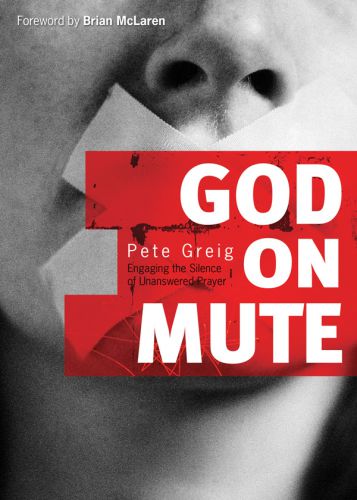
Pete Greig, the founder of the 24-7 Prayer movement, wrote a wonderful book about his experience of … unanswered prayer. While all the wonderful stories of answered prayer were happening as 24-7 prayer burgeoned around the world, his wife Sammie suffered a brain tumour. Greig puts his reflections on that experience in a book called ‘God On Mute’, and he shapes a spirituality around Maundy Thursday, Good Friday, Holy Saturday and Easter Day. He has this to say about Holy Saturday:
No one really talks about Holy Saturday, yet if we stop and think about it, it’s where most of us live our lives. Holy Saturday is the no-man’s land between questions and answers, prayers uttered and miracles to come. It’s where we wait – with a peculiar mixture of faith and despair – whenever God is silent or life doesn’t make sense.
As we turn to explore the silence of God, we are compelled to address the problem of unanswered prayer more literally than we have done so far, examining the times when God simply doesn’t reply to us when we pray. It’s not that He’s saying ‘yes’, ‘no’ or ‘not yet’ to our prayers; it’s that He’s not saying anything at all. We pray and pray but God remains silent.
But … Sunday is coming. And we can eat chocolate.

When Did The Last Supper Happen?

Like many churches, we’ll be marking the Last Supper and the institution of the Lord’s Supper this Holy Week on Maundy Thursday evening. However, it has long been known that the chronology of ‘Holy Week’ is problematic in the Gospels. The ‘Synoptic Gospels’ (Matthew, Mark and Luke) tie the Last Supper to the Passover, but John places Jesus’ execution on the day of Passover.

Theories to resolve this have abounded for years. One involves the idea that Jesus and his disciples used an unofficial calendar. A particular version of this theory has them using an Essene calendar, that varied from the mainstream. However, for many it is a further problem to see Jesus having any crossover with the Essene community at the Dead Sea, since his teaching was so radically different, especially his rejection of an ascetic approach to faith.

Others argue that the Synoptic Gospels got it right, but John put the Passover detail into his account of the crucifixion for symbolic reasons. While John is hugely different from the other three Gospels in many ways, I’m not sure that the way John incorporates this detail into his account easily reads as symbolism rather than history.

A further argument is that Jesus brought the Passover meal forward to an earlier date, knowing what was going to happen to him. This, too, is appealing to some, but if the last theory sits loose to John and history, this one risks not taking the historical detail of the Synoptic Gospels seriously.
Today’s Guardian reports another attempt to resolve the different narratives. In an article entitled Last Supper … or penultimate supper? Scientist challenges Maundy Thursday, the sub-editor makes it sound like a scientific solution to the dilemma. Which it isn’t. Although Professor Sir Colin Humphreys is a metallurgist, he seems to be using similar methods to resolve this conundrum to those used by biblical scholars. He is not the first to assert that the number of trials Jesus is subjected to in between his arrest in Gethsemane after the meal cannot be fitted into one night. Combined with the evidence that there are some missing days in the Gospels’ accounts of Holy Week, others have brought the Last Supper forward, as I have already indicated above.
I first heard a version of this theory in 1989 when I visited the Holy Land for three weeks, and Dr Jim Fleming, formerly of the Ecumenical Institute for Theological Research and the Biblical Resources Centre (now the Explorations In Antiquity Center in the USA) proposed to us that the Last Supper probably took place on the Tuesday. However, Dr Fleming seemed to lean on the Essene calendar theory.

Professor Humphreys tends towards the Wednesday. His work depends upon the crucifixion being in AD 33 and Jesus using another unofficial calendar, one that would have identified him with Moses. It will be interesting to see whether these two factors command assent from scholars. Watch this space.

Sabbatical, Day 71, Easter Sunday: Jesus Returns To Life

Vodpod videos no longer available.

more about “Damaris Trust Holy Week 2009, Easter …“, posted with vodpod

Christ is risen! He is risen indeed! In this final Damaris Trust video for Holy Week, Krish Kandiah and Peter May talk about how Jesus’ resurrection from the dead gives us hope when considering what happens when we die.

…………

A great service for Easter Day at St Andrew’s this morning. ‘In a packed programme tonight’, as the Two Ronnies used to say, we had the Easter liturgy, renewal of baptismal vows, Holy Communion (of course) and people invited from the community to remember deceased loved ones.

In the middle of all that, there were two highlights for me. Firstly, the worship band shrank at one point to the younger members only. So Emily on vocals , Dan on guitar, Bradley on keys  and the drummer whose name I don’t know – they’re all round about thirteen years old – led us in Tim Hughes‘ ‘Happy Day‘. Here’s a version by the original artist:

Emily is a great singer, Dan a quiet and efficient bandleader, Bradley filled in subtly and the drummer guy is top drawer.

The other highlight was Lee’s sermon. Taking Mark 16:1-8, he made a virtue of the strange and sudden ending to Mark’s Gospel. He said we have to write our own ending to the Easter story in our lives. I thought that was great. 

For all that, it’s been quite a mixed day emotionally. On the one hand, I have entered Easter with a renewed confidence in the truth and importance of the Resurrection. Not that I ever lost my belief in the bodily Resurrection of Christ for one moment, but sometimes when life or circumstances aren’t the most encouraging, it can feel far away. Reading Tim Keller (sorry to mention him again!) and Tom Wright (see this excellent article from The Times yesterday) has done much to fortify my faith.

But other things have been weighing me down. My friend Will says today, in talking about his service this morning, 

Before the prayers of intercession, I reminded our congregation that for many the joys of Easter are still crowded out by their own personal Good Fridays. I know I have friends who will this week spend more time agonising in the Garden of Gethsemane (Jen and Mike, we are praying for you and Luke). For some, Easter is more like the women in Mark who hid when afraid.

And as he mentions his friends Jen, Mike and Luke, so I have been thinking about the three couples I mentioned last Sunday who have separated. Some events today have reminded me of them. Debbie and I feel such pain for them. And if that is how we feel, how do they?

More trivially, our eighteen-year-old cat is suddenly looking old, frail and weak. We are beginning to think the end might be near. The children realise, and on top of the fact that they have been asking questions about death as we’ve come through Holy Week, Good Friday and today. Mark in particular keeps asking whether he will die on a cross like Jesus.

I’m also starting to get more regular questions about how much longer the sabbatical has to go. The answer is that – with having tacked a week’s leave onto the end – I shall be back on duty four weeks today. The official Methodist literature on sabbaticals talks about planning your ‘re-entry’, which rather makes ministers feel like Apollo astronauts. The idea is that there should be a managed, phased re-introduction to active ministry.

Which makes me think of two words: ‘fat’ and ‘chance’. At least I hope it won’t be like my last sabbatical, when the superintendent asked me to come back early due to a crisis with the circuit treasurer. However, a sabbatical grants you new vision in all sorts of ways. It is then a huge challenge to share that vision with churches that are used to things being a long way different from such visions. I’ve always been a restless traveller on the outer fringes of Methodism: right now I feel somewhere out beyond Pluto.

Of course, it may just be a version of what anyone feels when a good holiday is coming to an end and they have to return to work. (Not that I’m suggesting the sabbatical is a holiday!) Time will tell.

Sabbatical, Day 70, Holy Saturday: Jesus’ Body Lies In A Tomb

Vodpod videos no longer available.

more about “Damaris Trust Holy Week 2009, Holy Sa…“, posted with vodpod

This is the Damaris Trust video for Holy Saturday (not Easter Saturday, please: we’re not into Easter until tomorrow). Pete Greig talks about where God was on the day that Jesus lay dead in a tomb. He discusses our experiences of feeling in this inbetween state, and the hope that we can cling to.

…………

One of the themes of John’s Gospel after Jesus dies is that of secret disciples. Joseph of Arimathea and Nicodemus arrange for the burial of Jesus’ body. Joseph follows Jesus secretly for fear of ‘the Jews’ (i.e., the religious leadership); Nicodemus had come to see Jesus in chapter three ‘by night’. I mention that, because this morning I have had forwarded on to me the Premier Radio campaign to get Christians to sign up online to declare they are Christians. I first read about this a week ago on Jason Clark’s blog, where he expressed reservations about the initiative.

Now I have seen it for myself, I share Clark’s concerns. The declaration amounts to an assent to certain doctrines. Yet as the Epistle of James says, ‘Even the devils believe.’ Clark proposes an alternative that includes a strong element of discipleship action, and I don’t see how you can exclude that from any understanding of what a Christian is. I would add that the declaration also woefully omits any sense of faith being about the grace of God. It’s all couched in ‘me, me, me’ language. 

I don’t like saying this about Premier Radio, and especially about their Chief Executive Peter Kerridge. I met him a few times in his previous appointment, when he worked as an avowedly Christian radio professional on a community commercial radio station in Harlow, Essex, called Ten 17 radio. He was training Christian leaders (including me) to create snappy ninety-second ‘thoughts for the day’ that would be broadcast on their breakfast programme, in the midst of Top 40 hit singles. We could be as religious as we liked, so long as we were lively and entertaining. It was a great vision.

Equally, I don’t want any of this construed as sympathy for the National Secular Society’s campaign for ‘debaptism’. Their requests that churches delete records of baptism at the request of those who renounce Christian faith amounts to an altering of history that would make Soviets and Maoists proud. People are free to accept or reject faith anyway. It all amounts to a silly campaign from a tiny group of self-important self-appointed self-publicists.

…………

Tonight I’ve been to Chelmsford Cathedral. There was a Service of Light and Confirmations. I went for the confirmations. Five of the twenty candidates came from the parish church where we are worshipping. Another used to be part of that parish. It was great to support them.

I found the Easter Eve liturgy curious in one respect: already we were proclaiming ‘Alleluia, Christ is risen! He is risen indeed, alleluia!’ I had never uttered those words before Easter morning. I am sure there is a good reason, but I can’t see it. I thought we would still be marking the waiting period.

The Bishop of Chelmsford made a thought-provoking point at the beginning of his brief address. He spoke about how the tomb of Jesus was in a garden. Gardens are places of rest and new life. He then compared it with Eden, the symbolic place for the beginning of human life, and said that the Garden containing Jesus’ tomb was the place where new life and new creation began. (Sounded very Tom Wright!) You may have thought of that many times before, but it was a new and fresh thought for Easter this year for me.

See you tomorrow, when I shall be celebrating that Christ is risen!

Create a website or blog at WordPress.com

Up ↑