
Sometimes, Christians tell stories of miraculous answers to prayer where they are saved from a disaster. Around the time of 9/11, I heard one about a Christian who should have been on one of the planes that crashed into the Twin Towers, but whose circumstances changed unexpectedly and they missed the flight.
Here is one I read recently, from a respected pastor:
I remember once almost booking a trip to Prague. I’d planned it perfectly—a romantic getaway for Vicky and me. My finger hovered over the “Book Now” button, but something in my spirit said no. It didn’t feel right. I hesitated and didn’t book it. Weeks later, there was a massive explosion in the very square where we would have been staying.
Admittedly, that pastor is making a different point, about how God sometimes says ‘no’ because he is preparing something better for us. But I still read the account and wondered about who might have been present at the site of the explosion.
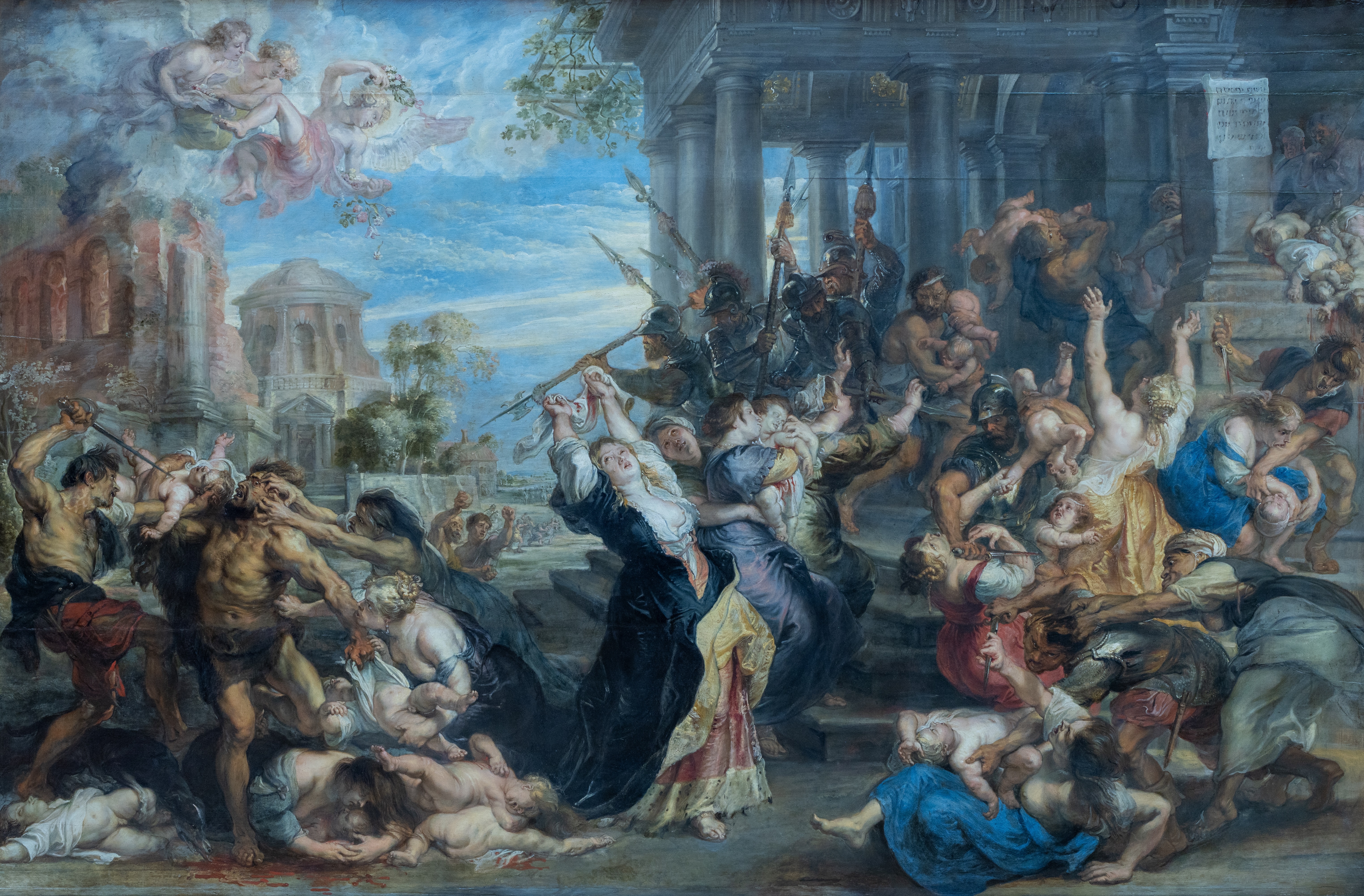
And something like this is one of the concerns we bring to the disturbing account of Herod the Great’s order to kill babies and toddlers in Bethlehem, whereas Jesus, Mary, and Joseph miraculously escape.
How are we going to tackle this troubling story? It naturally falls into three acts: the escape, the slaughter, and the return. These will be our guide to the flow of the story and what Matthew is saying.
Firstly, the escape:
Just as he did when Mary fell pregnant by the Holy Spirit, Joseph hears an angel of the Lord in a dream, and they escape to Egypt. That would have been financially easy for well-off Jews of their day, but it was certainly not a preferred option[1]. And while it is debatable whether Jesus’ family was poor, they were certainly not wealthy, so this was not an easy decision.
And yes, that makes Jesus, Mary, and Joseph refugees, something we might remember in today’s fevered politics of immigration. The fact they returned later does not negate that, as some have tried to claim.
Right from the beginning, then, pain and suffering cast their shadow over the life of Jesus. It will also be so for his followers.
In doing so, Jesus is like Moses, who was also rescued from certain death as a baby at the hands of Pharaoh. It is one sign that Jesus will be the One greater than Moses, who was prophesied.
That gets further underlined when Matthew, as he does so often and especially in the birth stories, quotes Scripture as being fulfilled. In verse 15 he cites Hosea 11:1,
Out of Egypt I have called my son.
In other words, he makes a parallel to the Exodus, which again was led by Moses. And just as in Old Testament texts such as this one Israel was called God’s son, so now Jesus is supremely God’s Son – not only because of the virginal conception by the Holy Spirit, but also because Jesus will fulfil all that Israel was meant to be, but failed to be, due to sin.
Even – and perhaps especially because – suffering and injustice are at work, what we see here is that Jesus’ ministry of salvation is being foreshadowed, maybe even beginning, in his infancy. The One greater than Moses, the True Israel, will lead his people through and from suffering to salvation. In the midst of the darkness, the light of Christ is shining.
Is that not reason to praise God? Even in this darkest of stories, God is working his purpose out.
And if God has preserved us through trials, are we listening to know what our place in those purposes is?
Secondly, the massacre:
There is a lot to say here. There are those who think the story didn’t happen, and that Matthew made up this story to fit with the fulfilment of a Scripture. However, if that’s what he did, then that makes Matthew a pretty awful person, and I don’t think that’s sustainable on the tone of the rest of his Gospel.
The big objection is that there is no historical record of the ‘slaughter of the innocents.’ All sides agree that it is consistent with Herod’s vile character. We know he had family members whom he regarded as political rivals killed. We know he even arranged for a number of nobles to be executed on the day of his own death, so that there would be grieving in the land. He obviously knew that few would grieve his own death.
But the reality is, horrible as it sounds, that the killing of male babies and toddlers in Bethlehem was probably political small fry in comparison to all his other atrocities. The violent acts that get reported by ancient sources like Josephus tend to be ones of national importance. This would not have been so, especially given that working from our best estimates of Bethlehem’s population at the time, probably around twenty youngsters in an insignificant town were slain[2].
That is still twenty too many, and it is still unbearably wicked. And I am working from the assumption that Matthew has given us an entirely plausible account.
Building on that, this is not the only place in Scripture where we see a juxtaposition of deliverance for some but suffering for others. To give one other example, when persecution breaks out against the early church in the Acts of the Apostles, many are imprisoned, Simon Peter is freed from his cell by an angel, but others are executed.
Many years ago, I heard a story about a massacre of some missionaries, who lived together in a compound. Many were killed, but others escaped. The survivors returned to their homeland, where a memorial service was held. As you can imagine, people struggled there with the fact that some were murdered but others were not. A speaker at the memorial service said, “God delivered all the missionaries. He delivered some of them from suffering, but he delivered others through suffering.”
The slaughter of the innocents is the most graphic telling of why Jesus needed to come. This is the level of wickedness in our world. Human sin and depravity is such that we will even not spare the most vulnerable and the most innocent for the sake of our own comfort, status, or financial gain. It is just as true today. While some abortions do happen because of serious medical complications and other distressing reasons, there are others that happen because of couples who are unwilling to make the financial sacrifices necessary to raise a child. If the Assisted Dying Bill gets successfully through Parliament, there will be elderly people in this country put under emotional pressure to end their lives so that greedy relatives can get their hands on their inheritance sooner.
Make no mistake, the slaughter of the innocents is not just something terrifying that happened two thousand years ago. Parallels are still happening today. And they will continue until people bow the knee to Jesus.
For Jesus is God’s remedy for all the violence and hatred in the world. Jesus, who escaped suffering here, would one day go to the Cross where he would absorb the sin of the world for all of us.
God had planned this from the beginning. God had created this world out of love, but love is something that takes risks, including the risk of rejection. God knew from the outset that it could and would go wrong, and that a rescue plan was needed. That is why Revelation speaks of Jesus as ‘the Lamb who was slain from the creation of the world.’
Even here, there is hope. For when Matthew looks for an appropriate Old Testament text, he finds one in Jeremiah 31 that imagines the matriarch Rachel weeping in her grave as the exiles are marched off to Babylon. That sounds relentlessly bad, doesn’t it? But in that chapter, the disaster of the Exile leads to God’s rescue plan. For it climaxes in the promise of the New Covenant. And for Christians, that means Jesus.
Even in the darkness, God’s light in Christ is still shining. May we remember that.
Thirdly, the return:
Once again, Joseph has an angelic visitation during a dream. What a man Joseph was, for being open to God speaking to him. We laud Mary for her example of discipleship in agreeing to carry the Messiah in her womb, but Joseph deserves praise, too. He is an example of true faith to us as well.
When the family returns, Joseph also shows he is astute. Not Bethlehem, because although Herod is now dead, his son Archelaus is in charge of that area. He was every bit as bad, if not worse, than his father[3].
Joseph opts for Nazareth, where according to Luke he and Mary came from. It was politically insignificant, a small settlement of about five hundred people[4]. There is no way the sophisticated urban elites from Jerusalem would have ever had Nazareth on their shortlist for the upbringing of the Messiah.
But if the town was inconsequential to them, it certainly wasn’t to God. In his eyes, Nazareth was spiritually significant – something Matthew makes clear with a quotation that is a wordplay[5]. That quotation, ‘He will be called a Nazarene’, in verse 23, does not appear anywhere in the Old Testament. However, it was a common practice to make Hebrew puns by what was called ‘revocalising’ a word, which basically meant putting in a different selection of vowels. The best theory is that Matthew has revocalised the Hebrew word ‘nezer’ to make ‘Nazarene.’
If he has done that – and I think he has – then ‘nezer’ is the word for ‘branch’ in the prophecies that the Messiah will come from the ‘nezer’ or ‘branch’ of David’s line. The Messiah growing up in obscure Nazareth? Oh yes. What is insignificant in the world’s eyes is significant to God.
Now if that is true, what about those of us who do not live in our great metropolis or indeed in another major city today? Who cares about these places? God does. Let others write off the places we live in. God doesn’t. He cares about them and has plans for them.
For our part, let us be open to God’s leading in the places where he has called us to serve him. Let us be modern-day Josephs, attentive to the voice of God in our lives, especially in the Scriptures.
People who know their Methodist history should get this. We make a lot of the fact that John and Charles Wesley grew up in Epworth in Lincolnshire. For many years, we even had a publishing house named after Epworth. But who would have heard of Epworth were it not for the Wesleys? God had other ideas, just as he did for Nazareth.
What does God want to do here, and who does he want to raise up as his servants in this place, who might even go on to have a wider influence for Christ?
Let us be on the lookout.
[1] Craig S Keener, The Gospel of Matthew: A Socio-Rhetorical Commentary, p109.
[2] Keener, p111.
[3] Keener, p113.
[4] Ibid.
[5] Keener, pp113f for this and what follows.
 Big Circumstance