Before we read from the Bible, I need to explain the background to what we’re going to hear. The Apostle Paul and his companion Silas have been preaching in a city called Philippi, but they kept getting interrupted by a very disturbed young woman. She was a fortune-teller, but she was also a slave, and so her owners made a lot of money out of her. They exploited her.
Image courtesy Picryl. Public Domain.
So Paul cast the spirit out of the young woman that enabled her to tell fortunes, and that angered her owners, who lost a lot of money, because they could no longer exploit her. In revenge, they got Paul and Silas locked up in the local prison, and that’s where we pick up the story.
Now I’ve read that story largely because we read near the end that the jailer found faith, but on the basis of his faith not only he was baptised, but so was his entire household – although it must also be admitted that Paul and Silas spoke the word to the whole household.
Image courtesy StockCake. Public Domain.
And today, we shall baptise [name] on the basis of [the child’s parent]’s faith. One day, [name] will have to decide for himself whether to follow Jesus.
So what does this faith look like? Well, it’s a lifetime commitment, but let me pick out two important elements from the story.
The first is belief:
Believe in the Lord Jesus, and you will be saved (verse 31)
What does it mean to ‘believe in the Lord Jesus’? It’s not simply that we believe he exists, although the historical evidence for that is extremely strong. No: we believe certain things about Jesus, and we then trust him with our lives.
We believe that Jesus is the Son of God, that he died for our sins, and that he rose again from the dead to give us new life.
Some people say that they think they are good people and that will get them into eternal life with God when they die. But none of us is good enough to meet God’s perfect standards. We all fall short. Those failures need to be forgiven.
And the thing about forgiveness is this: it hurts and it is costly. I think of a time when I was still living with my parents. A friend of mine had a broken engagement. He needed somewhere to stay while getting over it, and we invited him in. He stayed for two weeks. But he never helped with anything around the house. He seemed to expect my Mum to cook for him and do his washing. When he left, he didn’t offer any money towards all that my parents had shelled out while he was with us.
Image courtesy Picryl. Public Domain.
We had a family conference about this. I’ll never forget my Dad’s words. “We’ll put this down to God’s account.” To forgive my friend involved my parents absorbing that debt. It cost them.
Similarly, Jesus dying on the Cross shows us that it cost God to forgive our sins.
So I invite you this morning to realise that is the cost God has paid for you to be forgiven. Will you believe it? And will you then trust Jesus with your life?
The second thing that faith involves is action:
At that hour of the night the jailer took them and washed their wounds; then immediately he and all his household were baptized.
The jailer brought them into his house and set a meal before them; he was filled with joy because he had come to believe in God—he and his whole household. (Verses 33-34)
The jailer does engage in good deeds, but they are not what earn him salvation. Instead, his action is a matter of gratitude.
We are so grateful that God has loved us so much it has cost him the death of his Son, that we respond. And we do so by putting our faith into action.
Yes, that gratitude is certainly shown in worship, but it is also shown in the world. The jailer tends to the wounds of Paul and Silas, who had been beaten and flogged before they were thrown into prison (verses 22-24).
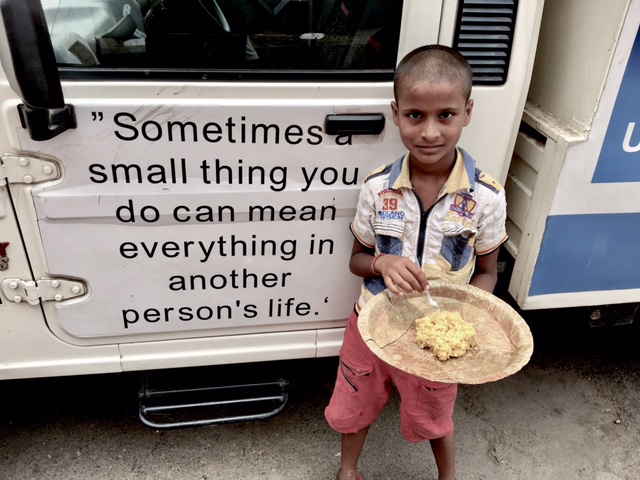
Food drive for homeless. Wikimedia Commons. CC 4.0
So if we are grateful for all that God has done for us in Jesus, who are the wounded people we can serve and show his love? Perhaps we can think of this a little bit like the idea today of ‘paying it forward.’ Where and how can I pay it forward, because God has shown so much love to me?
The jailer didn’t have to look too far and neither do we. You will have a neighbour who needs some practical help. You will find organisations where you live that that work and campaign on behalf of those in the most desperate need, either in this country or abroad.
Conclusion
This is the faith into which we baptise [name] this morning. One that urges him to believe that Jesus died for his sins, and to trust his life to him. One that shows gratitude for God’s love in our actions, especially in the service of those in most need.
But do you know what will make the most sense of this faith to [name]? It will be when those of us in the church and in his family live out that faith ourselves before his eyes.
Over the years, I have learned as a preacher that there are a few topics you can preach on that can easily make your hearers feel guilty. One is prayer: who can honestly say that they pray enough? Another is evangelism: many of us feel nervous about that and so it’s easy to ladle on the guilt.
And one other is giving: it’s easy to tug on the emotions on that subject. Just look at the highly emotive advertisements many charities produce, if you doubt me. Preachers can do something similar.
Well, today’s passage is about giving. But it’s in reverse. Paul speaks as the recipient, not the giver. And although elsewhere he quotes Jesus as saying, ‘It is more blessèd to give than to receive,’ here he tells his friends in Philippi about the grace of receiving.
It struck me that this would be a helpful approach to adopt. Some of us find it hard to receive. Others of us are rather too keen to receive!
So you’ve heard all those sermons down the years about being a cheerful giver; this is about being a gracious receiver.
I’ve identified three traits of a gracious receiver in these verses.
Firstly, thankfulness:
10 I rejoiced greatly in the Lord that at last you renewed your concern for me. Indeed, you were concerned, but you had no opportunity to show it.
Paul was so grateful that he ‘rejoiced greatly.’
I expect that when you were young you were taught to write thank-you notes to people who had given you birthday or Christmas presents. The age of the handwritten note may be fading away, but our kids still ask us for the mobile phone numbers of the people who have given them presents, so that they can send them text messages. In fact, every Christmas Day at present-opening time I sit there with sheets of paper, recording who gave what to whom, so these lists can be used for the thank-you messages.
How different this is from Trick Or Treat at Halloween, which is like a small-scale demanding of gifts with menaces. At least some things happen now to moderate that and to reduce the fear some elderly people have, by kids only going to houses with pumpkins outside. Whatever would happen to the economy of Rogate otherwise?
Thankfulness is an important discipline that reminds us all of life is a gift. We don’t need to wait for our annual harvest festival to affirm that ‘All good gifts around us are sent from heaven above.’
We may have saved for certain things. We may have earned them with hard work. But they are still gifts, because all that is good comes from the hand of God. We are dependent on the giving nature of our God for life itself and all its accoutrements.
God is a giver. The sun shines and the rain falls on the righteous and the unrighteous alike. In the Parable of the Sower, the farmer distributes the seed everywhere with an almost reckless extravagance.
Therefore thankfulness, especially when practised towards God, is a reminder of God’s grace. Whether he gives directly to us or through someone else, it is pure gift. It is not based on what we deserve, only on what we need and what he delights to give us.
We are thankful to a generous God. But this is something it took me many years to grasp. I came up in a family where the default financial atmosphere was one of struggle. That my parents couldn’t give my sister and me as much as our friends received from their Mums and Dads is something I carried over into my image of God. Yes, God the Father was a giver, but he only just about gave what we needed to scrape by.
I have learned differently since. I still affirm that God is Father, and not an indulgent grandfather. He doesn’t want spoilt brats for his children. But he is good, and he is generous, and these are all reasons for thankfulness.
In the ancient form of Christian prayer called the Examen, each evening we review the day that is about to pass, and we look back for where we can rejoice with thankfulness at what God has done. It’s an encouraging practice. I commend it to you.
Secondly, contentment:
Paul goes on to say,
11 I am not saying this because I am in need, for I have learned to be content whatever the circumstances. 12 I know what it is to be in need, and I know what it is to have plenty. I have learned the secret of being content in any and every situation, whether well fed or hungry, whether living in plenty or in want. 13 I can do all this through him who gives me strength.
Remember, Paul is sending this letter from prison in Rome. In those days, prisoners did not have their basic needs met by the state. If one of your family was imprisoned, you needed to supply them with the basics of life, even including food and drink. This is why Paul depends on gifts like these ones from his friends the Philippians.
What a contrast this is from when he was Saul, the up-and-coming scholar who also ran his tentmaking business. He was probably quite comfortably off then. He has experienced such oscillations in his standard of living.
But in the middle of such tumultuous changes in his lifestyle over the years, he can affirm that ‘I have learned to be content whatever the circumstances.’
I don’t know whether you have been through similar ups and downs. I am sure some of you have. I certainly have. As I said a moment ago, my upbringing was financially challenging. But then when I was working as a single person, things were a lot easier. They were fine when we first got married.
Until we had children and Debbie ceased from paid work. Well do I remember the year when we would not have been able to afford new school uniform for one of our two unless I had received a funeral fee. For at that time, our friends at HMRC had managed to double-count my income and deny us the Child Tax Credits we were entitled to. On more than one occasion we only got the tax credits we were due thanks to the intervention of our MP.
Yet – did God change during that time? I would say ‘No.’ We still had whatever we needed, even if sometimes it was by the skin of our teeth.
God doesn’t change in his faithfulness. He doesn’t guarantee us wealth, but he does commit to looking after us in what he gives us. Perhaps Proverbs 30:8 puts it in a balanced way:
keep falsehood and lies far from me; give me neither poverty nor riches, but give me only my daily bread.
When we live in such an acquisitive society with its desire for more, more, more, what could be a more countercultural sign of living under God’s kingdom than doing so with contentment, because God is faithful?
Thirdly, reverence:
I’d like you to notice how Paul describes the Philippians’ generous gifts to him in verse 18:
I have received full payment and have more than enough. I am amply supplied, now that I have received from Epaphroditus the gifts you sent. They are a fragrant offering, an acceptable sacrifice, pleasing to God.
This is the language of temple worship: ‘a fragrant offering, an acceptable sacrifice, pleasing to God.’ Paul sees the package Epaphroditus has brought from Philippi as way more than a food parcel. He treats the giving of the Philippians as being an act of worship to God. Therefore, he handles it with reverence. Their gifts are holy.
Now I am sure that in one sense that is exactly how the Philippians regarded their giving. To supply Paul’s needs was something they did as an expression of their faith. Their love for God is a response to God’s love for them in the gift of Jesus Christ.
Therefore, a fitting response of worship is for them to give. And just as the giving of sacrifices in the Old Testament often constituted support for the temple workers such as the priests and Levites who had no land of their own where they could farm animals for their food, so here the Philippians give as an act of worship to support a worker in the new temple, namely their apostle. Paul recognises what they are doing. It’s worship. Their gifts should be handled with holiness.
Some of you have heard me say that when I first wanted to go to theological college, I was denied a student grant. (Remember them?) God provided for me financially in a remarkable way. I cannot tell you the whole story now, but I want to pull out one example of the generous giving. An elderly and very prayerful single lady in the church gave me a cheque for a large sum of money. With it she wrote a letter. In it she said, ‘It seems that God is calling you to trust him to supply your needs. We will trust him to meet our needs, too.’ Those words told me that her giving was a sacrifice. It was an act of worship.
All this is why I’m not so keen to refer to the monetary gifts we bring forward in the service as ‘The collection.’ Collections are OK, if not good, such as when we hold a collection for a good cause. But what we give to the Lord is not a collection because he’s in need: he owns the cattle on a thousand hills, as the Psalmist says.
No: it’s an offering. We dedicate it. We treat it with reverence. We pray for those who will handle it. It’s part of our worship.
Conclusion
You may have seen the news story in the week about the death of the famous actor Timothy West at the age of 90. He had been married to the actress Prunella Scales for 61 years. And you may well know that in their final years together West was caring for his wife through dementia. One of the news reports showed a clip of them a year or so ago when they had reached their diamond wedding. The reporter asked what it was like being married for that long. Prunella struggled for words, but then planted a kiss on her husband’s cheek, and said, ‘Thank you.’ It was a beautiful moment.
There is a beauty in being thankful, being content, and treating gifts with reverence. It offers beauty back to the giver and gives glory to the Great Giver himself.
Sure, it is more blessèd to give than to receive. But this is one way in which that giver is blessed.
So let us never tire of being thankful. We have an eternity of thankfulness ahead of us.
I’m sure you recognise that as the frustrated cry of a young child on a car journey. I’m pretty certain those words came out of my mouth when I was small.
A frustrated child would have been driven mad by the antics of ancient Israel:
2 (It takes eleven days to go from Horeb to Kadesh Barnea by the Mount Seir road.)
3 In the fortieth year, on the first day of the eleventh month, Moses proclaimed to the Israelites all that the Lord had commanded him concerning them.
Forty years to travel a distance that should have taken them eleven days. And now Moses preaches this recent history back to the Israelites by recognising this trait in them:
6 The Lord our God said to us at Horeb, ‘You have stayed long enough at this mountain. 7 Break camp and advance …
God is calling them into a new future, a future of blessing, in the Promised Land. But they are resistant.
And that makes this a good passage to look at in the second of my sermons on New Beginnings at the start of my ministry here. Last week, I talked about how we must leave the past behind, learning from it yes, but living there no, and seek the new thing God wants to do in our day and age. (You can watch the video or read the blog). This week, I want to talk about moving on, and the spiritual qualities we need.
Here are four important things we need to practise.
Firstly, every member ministry.
In verses 9 to 18 we read of how Moses was overloaded and how he shared the leadership and pastoral care of the people. He knew the whole enterprise would grind to a halt unless he stopped everything funnelling through him.
I once heard about a vicar who would go to the bottom of his garden every morning at 10:30 to watch the Inter-City express train whizz past. Someone asked him why he did so.
He replied, “I want to see the only thing in this parish that moves without me pushing it.”
I think Moses felt like that, and so he drew on the gifts and talents of others. He wasn’t worried about keeping all the glory for himself.
At Monday’s welcome service I said how such occasions made me uncomfortable. The very fact that ministers get public welcome services but others don’t tends to raise people’s expectations of people like me.
But, I said, we are not your saviours, because the job of Saviour of the world is not vacant. It was taken long ago by Jesus. Ministers come alongside to help lead the work of the kingdom, we don’t come to save your church.
So – I won’t be the first preacher to say this to you, but it bears regular repeating – have you considered what your talents and spiritual gifts are? And have you offered them in the service of God’s kingdom? We are all what the Bible calls ‘vessels of honour’ who have the privilege of serving Christ in response to his great salvation.
How does that work out for you?
Secondly, obedience.
After the spies come back with some beautiful fruit from the Promised Land and their message that ‘It is a good land that the Lord our God is giving us’ (verse 25), how does Israel respond? Moses says,
26 But you were unwilling to go up; you rebelled against the command of the Lord your God.
Let us not think that once we have received salvation we can behave as we like. Obedience is not what earns us the love of God, but it is the way we show our gratitude for the salvation we have received. It’s no accident that Israel receives the Ten Commandments after being set free from Egypt, and not before.
And there’s a very specific command here that Israel disobeys: to take the presence of God into the world where he is not yet known, and where people at the time worshipped other gods, false gods. Oh no, they said, we’ll stay among ourselves here where we’re comfortable.
And God gets mad.
I was once asked to conduct the funeral of an elderly church member, and so I arranged a meeting with her family to discuss the service and talk about her life. When her grown-up children, who were no longer churchgoers, were telling me about her, they said one very striking thing.
They told me that the old lady’s whole life had been based on the church and its activities, even her social life.
I think they were trying to impress me, but inside my heart sank. Just as Israel had a command from God to get into the Promised Land, so we have a command from Jesus to get into the whole world with his redeeming love.
It’s so easy just to have a nice quiet life with our Christian friends, but all of us are called to show and tell the Gospel in our words and deeds. There are people around us who need some demonstration of God’s love, and we are the people to do it.
I was so sad when I heard one of the lecturers where I trained for the ministry say, “I don’t have any non-Christian friends.” What a tragedy for the Gospel that was.
There are many ways we could explore this question of obedience, but let’s just concentrate on this for now: how are our lives shining with the Gospel in the world?
Thirdly, gratitude.
It’s more than disobedience to take the presence of God into the world, says Moses. He goes on to say,
27 You grumbled in your tents and said, ‘The Lord hates us; so he brought us out of Egypt to deliver us into the hands of the Amorites to destroy us.
Grumbling, rather than gratitude, characterises Israel here.
Please don’t misunderstand me. There are times to complain. We should not always let lazy or malicious people mistreat us or others. There are issues of justice to take into account.
But there is a grumbling negativity that pervades some Christians and some churches. Nothing is ever good enough for some people.
In one church I had people refuse to take on a role with teenagers. Two of those I approached declined, giving the same reason.
“I’m not taking that on just to be ripped to shreds at Church Council by [Name].”
And when we did get someone else to do the job, guess what happened to them?
When we consider all that God has done for us in Jesus Christ from creation to redemption to the gift of the Spirit and the promise of a New Creation, surely our default attitude in the community of faith needs to be one of gratitude. It will show in our worship. It will come through in our relationships and our sense of community. It will be a shining witness to the world.
When I was a child, I recall my maternal grandmother, who lived with us, singing the old chorus ‘Count your blessings’ around the house. The thought of counting our blessings and being surprised how much the Lord has done is a good principle. Put into practice, it changes the atmosphere in a place. It brings a kingdom atmosphere, I might say.
In saying all this I don’t want to minimise the hardships and struggles that some of you are doubtless facing. But I do want to say that the sort of church which can survive and thrive in the future is a grateful one. There is more than enough of the grumbling spirit in the world. Let’s live – as one Christian leader once put it – ‘in the opposite spirit.’
Fourthly and finally, faith.
Here is the last issue that Moses and God have with Israel:
28 Where can we go? Our brothers have made our hearts melt in fear. They say, “The people are stronger and taller than we are; the cities are large, with walls up to the sky. We even saw the Anakites there.”’
29 Then I said to you, ‘Do not be terrified; do not be afraid of them. 30 The Lord your God, who is going before you, will fight for you, as he did for you in Egypt, before your very eyes, 31 and in the wilderness. There you saw how the Lord your God carried you, as a father carries his son, all the way you went until you reached this place.’
32 In spite of this, you did not trust in the Lord your God, 33 who went ahead of you on your journey, in fire by night and in a cloud by day, to search out places for you to camp and to show you the way you should go.
Fear replaces faith. Israel sees the task ahead purely in terms of what they can or cannot do on their own. They do not see that when God commands something that seems to be humanly impossible, that same God will provide the means to achieve what he has commanded. Israel does not trust its God. Paralysing fear takes over.
This is certainly something we see in churches, and it inhibits their mission. It may even be the beginning of the death of those churches.
Perhaps you have come across churches where they have been offered a great refurbishment and rebuilding project that will reinvigorate their premises for mission. Their existing building is getting old and expensive to run. Although a lively and loving community worships there, the local community looks at the building and thinks it’s closed. What do they do?
They can choose between fear and faith. Fear says, ‘We can’t do this. It’s too much money and too much work for the people we have.’ Faith says, ‘What is God saying to us here? If he is calling us to do this, then we will.’
Fear says we can’t. Faith says God can – provided it’s what he has said.
Hudson Taylor, the famous nineteenth century missionary to China, once said this:
God’s work done in God’s way will never lack God’s supply.
Conclusion
Perhaps, like Israel at the beginning of Deuteronomy, we are on the verge of something new. Will we embrace these qualities and go forward with God?
Every member ministry, where all our gifts contribute
Obedience, to take the love of God into the world
Gratitude for all God has done for us in Christ
Faith, to run with whatever God calls us to do, even if it stretches us.
So this week we get to Mount Sinai and God gives the Ten Commandments. Find the reading at Exodus 20:1-20.
But how do we regard these laws in a post-Christian society? And how should Christians approach ancient Jewish laws from the perspective of the Gospel? How should we live in the light of them today?
These are the questions behind this week’s talk. I hope you find it helpful.




 Big Circumstance